Exclusive: How Trump Has Redefined America’s Standing on World Stage Ahead of China Trip
Thomas Peter-Pool/Getty Images

18 Apr 20262,539
9:07
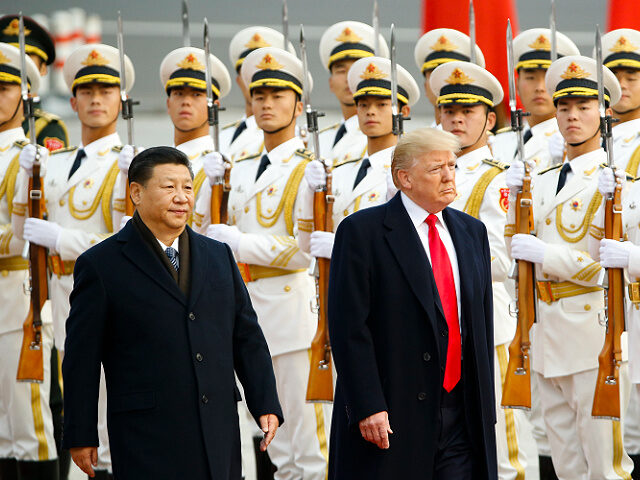
President Donald Trump embarks on a much-anticipated trip to China next month to meet with President Xi Jinping, as the first year-plus of the Trump presidency has redefined global economic affairs and foreign policy.
Trump and Xi are set to meet in Beijing on May 14-15. Over the past 15 months, Trump has reasserted the United States’ role on the global stage, whether it be through economic policy, diplomacy, or military operations. In turn, the developments have certainly redefined the U.S.-China relationship.
“President Trump has undoubtedly restored American strength on the world stage – showing the entire world that the days of Biden-era weakness are over. The President has secured key trade deals, solved eight global conflicts through his peace through strength policies, and built the greatest military in the world – whose results speak for themselves,” White House spokeswoman Olivia Wales told Breitbart News in an exclusive statement.
“The United States is respected again thanks to President Trump’s leadership, and the President looks forward to visiting China, which he is expecting to be a very positive visit that will lay the groundwork for many positive results achieved in the coming years between our countries,” Wales added.
On the economic front, Trump has assembled numerous trade deals that not only strengthen ties between the United States and the respective countries but also counter China’s Belt and Road Initiative. Following his Liberation Day tariffs announced on April 2, 2025, the president struck major deals with the European Union, the United Kingdom, and numerous countries in China’s backyard, like Japan, the Philippines, South Korea, Indonesia, Vietnam, Malaysia, and Cambodia, while also securing major investments from key Middle East countries. The deals account for more than 85 percent of the global gross domestic product.
Through the use of the International Emergenc
The United Kingdom is on a trajectory toward slow-motion collapse.
British Prime Minister Kier Starmer’s initial reaction to the outbreak of the war against Iran was schizophrenic.
He seemed wholly unprepared for a scenario in which Donald Trump would actually use the forces he had spent the previous two months flooding into the region, confounding the former Royal Navy officers and opposition lawmakers who somehow understood that Trump’s ultimatums weren’t just talk.
At first, Starmer was appalled, and he blocked the Pentagon from using U.K. bases to launch sorties against Iranian targets.
But the impracticality of that protest sapped his resolve, and his government swiftly changed course. After all, British interests were under attack by Iran as well.
So, under pressure, Starmer committed his nation to a show of force — one more visible than his deployment of defensive airpower to the Middle East. The Royal Navy’s HMS Dragon would lead the way, but it would do so alone. Britain’s five other Type 45 Destroyers were not fit for deployment. The Dragon set sail on March 10 and finally arrived at its destination, a Royal Air Force base in Cyprus that had been targeted by Iran, 17 days later. But within days, the Dragon succumbed to a “technical” issue and had to retreat to port for repairs.
The Economic Powers Act tariffs, which the Supreme Court later struck down in February, Trump gained significant leverage over countries worldwide, enabling deals that shift economic dependency away from China and toward the United States.
 THE ARTFUL DILETTANTE