
More than any other moment since the launch of Sputnik in 1957, the future of the human race’s effort to explore and settle the solar system is right now shining bright and hopeful, with everything converging enthusiastically in a manner that — if nothing is done to forcibly stop it — will make that colonization inevitable.
To understand that convergence, it necessary to understand how radically different this situation is. Unlike every space effort since Sputnik, space exploration is no longer controlled by governments. No longer do innovators and space geeks need to go to lawmakers, their hands out begging for money. Space exploration is now in the hands of private capital, which is quite generously committing a lot of money to fund a lot of space projects — not because these investors want to explore the stars — but because they see a lot of profits to be made.
This fact — that governments no longer control the situation — is what is driving this renaissance. It is also the one fact that might kill it, but I am getting ahead of myself. I must first describe this renaissance, in all its glory.
Rockets
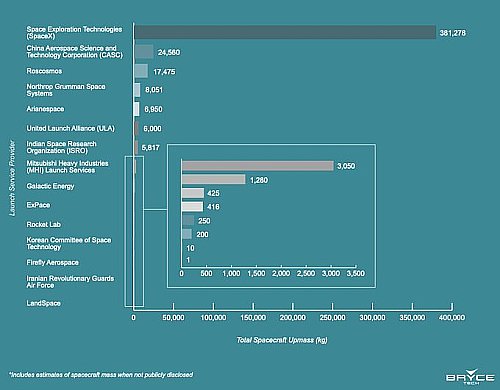
The mass sent to orbit in 2023. Click for original image.
The numbers for 2024, 2025, and 2026 have been comparable.
Above all, we must begin with rockets, because without them nothing in space can happen.
First on the list is of course SpaceX’s Falcon family of rockets, which revolutionized the rocket industry by being the first ever capable of reuse. That capability forced a major lowering in launch costs while making frequent and reliable launches of new payloads possible. For the past three years this rocket has dominated the global launch industry, launching more than the world combined and placing in orbit something like 90% of the total mass. Its development was funded from Elon Musk’s own pocket as well as from NASA.
The company is now building its much larger Starship/Superheavy rocket, intended to be the most powerful rocket ever built but also designed to be reusable with the ability to launch again and again, within hours. Unlike Falcon, its development has almost entirely been funded by private and public investment capital as well as the ample revenue SpaceX is getting from Starlink and its computer divisions. In fact, at this moment the contribution from NASA is relatively minor, only a very small percentage of the total cost.
SpaceX’s reliance on private capital however is not unique. Jeff Bezos’s Blue Origin has built its New Glenn rocket entirely from private capital (most coming from Bezos’s own pocket). Peter Beck’s Rocket Lab has developed both its Electron rocket (flying now for almost a decade) and its Neutron rocket (about to make its first flight) also from private capital. New Glenn and Neutron are both reusable, and will thus help accelerate the drop in launch costs.
Nor are these the only new rockets funded mostly on private investment. There are at this moment at least seventeen different privately funded rockets that are either operational or about to complete their first flights, aimed at garnering whatever commercial and government business they can get. For a more complete outline of this coming wave of rockets, see this September 10, 2026 essay.
But why is so much capital going into developing these rockets? What are they launching? Who are their customers?
Satellite constellations of all kinds

Visualization of just SpaceX’s 2nd generation Starlink constellation.
Click for source.
When it comes to the future in space,, the hot topic recently has been coming launch of several gigantic constellations of data center satellites to serve the computer world of AI and smartphones. SpaceX plans a constellation, dubbed Starmind, of one million satellites. Blue Origin has its own, called TeraWave, comprising more than five thousand satellites. The startup Starcloud wants to build its own 88,000 data center satellite constellation. And Google is developing its own, dubbed Suncatcher, though the numbers and schedule remain unstated at this point.
That’s only a few examples of proposed data center constellations. All have investment capital, and all are on the verge of their first launches. The rocket industry will be hard pressed to meet this demand.
But data center constellations are only the newest entrant in the satellite business. Voice communications remains the first big player, with the industry shifting from geosynchronous satellites providing linkage between ground stations to large smallsat constellations in low orbit providing direct phone-to-cell connectivity. Both SpaceX and AST SpaceMobile already have satellites in orbit providing this service, with SpaceX planning a bigger constellation of 15,000 satellites in the future.
Starlink meanwhile established the viability of satellites for internet access, with Amazon’s Leo and several Chinese constellations now coming on line to compete.
Nor is this all. Commercial imaging satellite constellations, in both radar and optical, have become ubiquitous in recent years, replacing the expensive less capable government constellations. GPS-type constellations, launched by the U.S. the European Union, India, and China, are still needed and are being expanded, with private satellite companies beginning to offer their systems as alternatives. Weather satellite constellations, previously launched only by governments, are now being developed by private companies because they can build them faster and cheaper.
And of course, there are demands for new communications, surveillance, and reconnaissance satellites by the War Department. Most are simply variations of the above constellations, though designed to be more secure for military purposes. Some, such as Trump’s proposed Golden Dome, have unique goals, such as acting as a shield against missile attacks. All however presently have large budgets and are moving at this moment aggressively to get built.
In the next decade this demand should require thousands of launches per year, a demand that should further increase the number of reusable rockets available which in turn will further lower the cost to get into orbit.
Space Stations
Menu
To read this post please scroll down.
Thank you!
The July fund-raising campaign is now over. Though the donations and subscriptions were poor for most of the month, the response in the last helped make up the difference. Thank you all for coming through in the end. It was beyond gratifying to find out that there are supporters to my work out there.
I will keep this thank you notice up for the next week, just so that everyone who donated or subscribed can see it. And if you haven’t donated this year as yet, please consider supporting me in some small manner. My website has no advertising and no sponsors (other than my readers), and it is free for all to read and comment without charge or registration. Your support is the only thing that keeps me going. You can either give a one-time contribution or a regular subscription. There are five ways of doing so:
1. Zelle: This is the only internet method that charges no fees. All you have to do is use the Zelle link at your internet bank and give my name and email address (zimmerman at nasw dot org). What you donate is what I get.
2. Patreon: Go to my website there and pick one of five monthly subscription amounts, or by making a one-time donation. Takes about a 10% cut.
3. A Paypal Donation or subscription, which takes about a 15% cut:
4. Donate by check. I get whatever you donate. Make the check payable to Robert Zimmerman and mail it to
Behind The Black
c/o Robert Zimmerman
P.O.Box 1262
Cortaro, AZ 85652
You can also support me by buying one of my books, as noted in the boxes interspersed throughout the webpage or shown in the menu above.
The human colonization of the solar system is now unstoppable, except by force
The new century will see a renaissance of space exploration as exciting and as challenging as the space race of the 1960’s. And this rebirth will happen under the banner of freedom and private property, the very principles for which the United States fought the Cold War. [predicted in 1998 in Genesis: the Story of Apollo 8, p. 263].
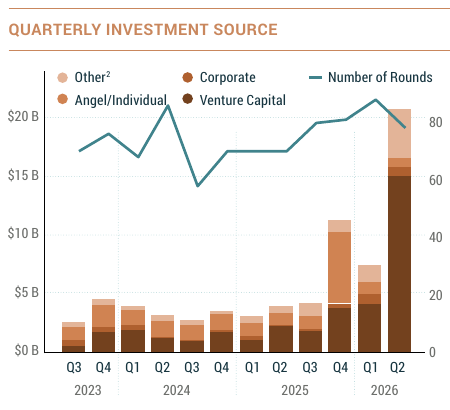
Investment in space since 2023, from the
Space Capital report in July 2026.
More than any other moment since the launch of Sputnik in 1957, the future of the human race’s effort to explore and settle the solar system is right now shining bright and hopeful, with everything converging enthusiastically in a manner that — if nothing is done to forcibly stop it — will make that colonization inevitable.
To understand that convergence, it necessary to understand how radically different this situation is. Unlike every space effort since Sputnik, space exploration is no longer controlled by governments. No longer do innovators and space geeks need to go to lawmakers, their hands out begging for money. Space exploration is now in the hands of private capital, which is quite generously committing a lot of money to fund a lot of space projects — not because these investors want to explore the stars — but because they see a lot of profits to be made.
This fact — that governments no longer control the situation — is what is driving this renaissance. It is also the one fact that might kill it, but I am getting ahead of myself. I must first describe this renaissance, in all its glory.
Rockets
The mass sent to orbit in 2023. Click for original image.
The numbers for 2024, 2025, and 2026 have been comparable.
Above all, we must begin with rockets, because without them nothing in space can happen.
First on the list is of course SpaceX’s Falcon family of rockets, which revolutionized the rocket industry by being the first ever capable of reuse. That capability forced a major lowering in launch costs while making frequent and reliable launches of new payloads possible. For the past three years this rocket has dominated the global launch industry, launching more than the world combined and placing in orbit something like 90% of the total mass. Its development was funded from Elon Musk’s own pocket as well as from NASA.
The company is now building its much larger Starship/Superheavy rocket, intended to be the most powerful rocket ever built but also designed to be reusable with the ability to launch again and again, within hours. Unlike Falcon, its development has almost entirely been funded by private and public investment capital as well as the ample revenue SpaceX is getting from Starlink and its computer divisions. In fact, at this moment the contribution from NASA is relatively minor, only a very small percentage of the total cost.
SpaceX’s reliance on private capital however is not unique. Jeff Bezos’s Blue Origin has built its New Glenn rocket entirely from private capital (most coming from Bezos’s own pocket). Peter Beck’s Rocket Lab has developed both its Electron rocket (flying now for almost a decade) and its Neutron rocket (about to make its first flight) also from private capital. New Glenn and Neutron are both reusable, and will thus help accelerate the drop in launch costs.
Nor are these the only new rockets funded mostly on private investment. There are at this moment at least seventeen different privately funded rockets that are either operational or about to complete their first flights, aimed at garnering whatever commercial and government business they can get. For a more complete outline of this coming wave of rockets, see this September 10, 2026 essay.
But why is so much capital going into developing these rockets? What are they launching? Who are their customers?
Satellite constellations of all kinds
Visualization of just SpaceX’s 2nd generation Starlink constellation.
Click for source.
When it comes to the future in space,, the hot topic recently has been coming launch of several gigantic constellations of data center satellites to serve the computer world of AI and smartphones. SpaceX plans a constellation, dubbed Starmind, of one million satellites. Blue Origin has its own, called TeraWave, comprising more than five thousand satellites. The startup Starcloud wants to build its own 88,000 data center satellite constellation. And Google is developing its own, dubbed Suncatcher, though the numbers and schedule remain unstated at this point.
That’s only a few examples of proposed data center constellations. All have investment capital, and all are on the verge of their first launches. The rocket industry will be hard pressed to meet this demand.
But data center constellations are only the newest entrant in the satellite business. Voice communications remains the first big player, with the industry shifting from geosynchronous satellites providing linkage between ground stations to large smallsat constellations in low orbit providing direct phone-to-cell connectivity. Both SpaceX and AST SpaceMobile already have satellites in orbit providing this service, with SpaceX planning a bigger constellation of 15,000 satellites in the future.
Starlink meanwhile established the viability of satellites for internet access, with Amazon’s Leo and several Chinese constellations now coming on line to compete.
Nor is this all. Commercial imaging satellite constellations, in both radar and optical, have become ubiquitous in recent years, replacing the expensive less capable government constellations. GPS-type constellations, launched by the U.S. the European Union, India, and China, are still needed and are being expanded, with private satellite companies beginning to offer their systems as alternatives. Weather satellite constellations, previously launched only by governments, are now being developed by private companies because they can build them faster and cheaper.
And of course, there are demands for new communications, surveillance, and reconnaissance satellites by the War Department. Most are simply variations of the above constellations, though designed to be more secure for military purposes. Some, such as Trump’s proposed Golden Dome, have unique goals, such as acting as a shield against missile attacks. All however presently have large budgets and are moving at this moment aggressively to get built.
In the next decade this demand should require thousands of launches per year, a demand that should further increase the number of reusable rockets available which in turn will further lower the cost to get into orbit.
Space Stations
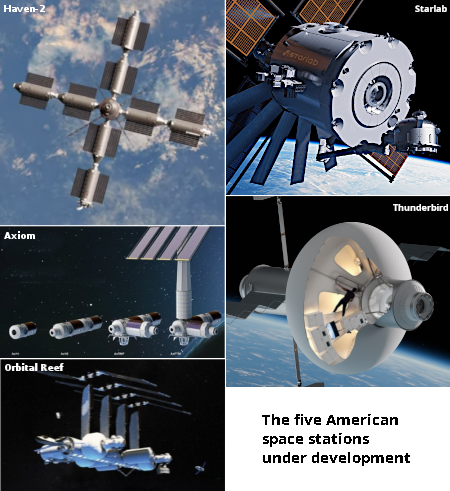
In the United States at this moment there are five commercial space stations under development, as shown to the right. All have all got extensive funding. Two, Vast’s Haven-2 and Max Space’s Thunderbird, are at this point funded entirely by their wealthy owners. Two, Starlab and Axiom, have raised about $1.5 billion in private capital, while also obtaining development contacts from NASA worth a little less than $300 million. The last, Orbital Reef, has also won a development contract from NASA, worth $130 million, but has done very little with it.
All five exist because their owners recognize that there is a lot of potential for making money in space, inside a space station. First, the U.S. and its international partners on ISS are not the only governments that want the prestige of flying astronauts in space. Numerous other countries want to do it also, and in fact in the past three years France, Czechia, Lithuania, Colombia, Uzbekistan, Japan, India, Poland, Hungary, and the Maldives have all signed passenger contracts with Axiom, Vast, and Starlab, with Axiom having already completed four such flights for profit to ISS.
Second, NASA is committed to buying space and passenger service for its own astronauts to one or more of these stations. It issued its request for space station proposals last week, with major contract awards to be issued in April 2027. The agency’s goal is to sustain its own manned program in low Earth orbit by encouraging competition between privately owned and operated space stations.
Third, the pure research done on ISS has demonstrated that valuable products can be produced in weightlessness that cannot be made on Earth, and many companies in a variety of fields, from pharmaceuticals to medical implants to material sciences, want access to an orbital facility to make these products for later sale. The new stations are not only eager to sign them up, Vast, Starlab, and Axiom have already begun to do so (see here, here, and here).
Serving the space stations

All these stations are going to need a range of ferrying services. For manned transportation only SpaceX at present provides this service with its fleet of five manned Dragon capsules. For cargo, both SpaceX’s unmanned Dragons and Northrop Grumman’s unmanned Cygnus capsules are available. The problem for manned transportation is that SpaceX is considering retiring both Dragon and the Falcon 9 rocket that launches it. While I personally doubt this will happen until other alternatives exist, its possibility remains a threat to the operation of these private stations.
Many of those alternatives are either on the verge of becoming operational or will do so in the near future. All have issues, but all are real. Boeing’s Starliner has flown with problems several times. If it can prove out its systems finally and become reliable, it becomes an immediate alternative.
The French startup The Exploration Company is building its Nyx cargo capsule. It has raised $680 million in private capital and has won a contract worth almost a billion dollars from the European Space Agency (ESA) to fly three Nyx missions. The company fully intends to eventually upgrade Nyx to a manned version, in the same manner as SpaceX did with Dragon, but that development is likely several years away.
Northrop Grumman has several times proposed upgrading its Cygnus capsule as a manned alternative. Little development on this option however has occurred because — as an old established space company — Northrop refuses to commit any of its own funds to such work. It wants a contract first. This however could change once one or more space stations begin operations.
Sierra Space’s Dream Chaser reusable cargo mini-shuttle is also an option. It was originally conceived as a manned ferry, but NASA wasn’t confident in its design to go with that concept. In retrospect this decision was a wise one, as an undisclosed technical issue has delayed the first launch of the first Dream Chaser, Tenacity, for more than two years. This undisclosed issue finally had NASA cancel its ISS cargo deal with Sierra Space. Nonetheless, this design concept is a viable one, and if Sierra can fix things it remains a future option for supplying the commercial stations.
And then there are the unknown manned and cargo spacecraft that don’t yet exist. Based on the investment capital going into the private stations, their need for ferrying service is going to become critical in the next decade. It therefore seems certain to me that one or more companies are going to step forward with new ideas, and make it happen. In fact, one of those companies might very well be found in the next area of space development.
Recoverable capsules
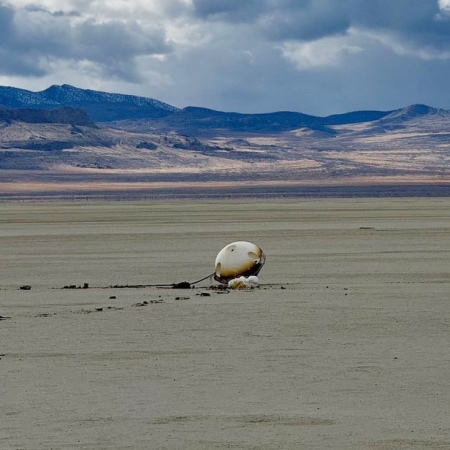
Varda’s first capsule on the ground in Utah in 2024, after completing
an eight-month mission producing the drug ritonavir, which is used
to treat HIV/AIDS.
While the space stations aim to provide large and extended capacity for product manufacture in orbit, the new recoverable capsule industry offers this same capability now, on a smaller scale and for much lower cost. The company Varda was the first, having already flown and recovered six capsules, with SpaceX following with its own test flight of its Starfall capsule.
A half dozen more startups in the U.S. and Europe have now raised capital to compete. In the U.S. Varda and SpaceX have been joined by Reditus, Inversion Space, and Sierra Space, all of whom have raised money or won contracts for putting short-term small recoverable capsules in orbit. In Europe, The Exploration Company in France, Atmos in Germany, PLD in Spain, Genesis in Croatia, and Space Cargo in Luxembourg have also raised capital for the same.
All of capsules these companies are building are relatively small, too small for humans to fly on. All however are developing the precise technology required for ferrying cargo and humans up and down from the commercial stations. We should fully expect that as the profits from their products begin to roll in, one or more of these capsule companies will commit the funds for developing larger capsule designs capable of carrying humans.
Miscellaneous other orbital industries
These miscellaneous industries include a half dozen orbital tug companies, a handful of robotic servicing companies, and a number of companies developing technologies of removing space junk. There are also proposals to provide refueling depots and fueling tankers for refueling satellites periodically.
All have raised capital, and all are either in development, have demonstrated their technology in orbit, or have actually started flying operational missions.
NASA’s Artemis program
While most would think I should list this government program first, because it is the most public part of America’s space
NASA’s Artemis program
While most would think I should list this government program first, because it is the most public part of America’s space effort, I place it last because in truth it is the least likely to succeed, and it acts mostly as an emotional linchpin for fueling all the other investment, innovation, and other industries now being developed above.
However, the way NASA is presently structuring its program is especially beneficial. The agency is no longer attempting to build anything. Instead it is asking the private sector — many of which are the many companies I list above — to do it. It is also not demanding ownership, as it has in the past. Instead, it is buying what it needs from these companies, and letting them develop the product in a manner that will allow them to sell it to others for further profits. As I wrote in the 2017 policy paper, Capitalism in Space,
Ownership … allows the companies to sell their products widely and make profits from it, regardless of whether NASA buys it.
In other words, NASA’s Moon program is now designed more than anything to fuel the growth of this private space sector. This is something it has failed to do very effectively since Apollo.
The threat that can kill it all

“Proclaim liberty throughout all the land unto all
the inhabitants thereof.” Photo credit: William Zhang
Though it is certain that some of these projects and companies will fail, the number and wide variety of their customers and products provides depth and redundancy. Profits are going to be made by building things in space, in one case or another, thus guaranteeing a continuous and never-ending driving force upward. If some fail, others will not. The demand is now simply too high and varied.
Left to its own purposes, freedom and capitalism is now poised to conquer the stars.
What threatens all this new space development however is also its very fundamental nature: it is privately owned, independent, fueled by profit, and not controlled by the government. Governments — and the power-hungry people who are naturally attracted to these political positions — don’t like it when they don’t control things. In fact, the reason this renaissance in space has only occurred now is because, since the 1960s, the governments in both the U.S. and Europe have worked hard to keep control over the space industry. Only in the late 2000s did this finally begin to change, but it has taken almost two decades to wrest power from the government and give it back to the private sector.
All of that could change in a moment, if the wrong people gain power. All of the grand private projects listed above hinge entirely on the choices we make in a few short weeks on election day. For you see, elections always matter, and in this election we are really being presented a choice between this bright future of private enterprise in space and a dark future comparable to that of the failed Soviet Union.
Sadly, the concepts of communism and top-down rule by government have become strongly entrenched within the American Democratic Party. Too many politicians in that party now advocate socialism as their guiding principle of governance. They wax poetic about the socialist utopia they wish to create, where everything is controlled from above by wise government officials who only have our real needs in mind. At the same time, these same Democrats, like Bernie Sanders and Abdul El-Sayed (the Democrat candidate running for the Senate in Michigan), like to use the word “billionaires” as a curse word, advocating the use of government to squelch such people, on the misguided or downright evil idea that because someone has become rich building a business they have somehow robbed others of wealth.

The Democrats to private enterprise: “Great business you got there!
Really be a shame if something happened to it!”
To achieve these goals however they must shut down freedom and private enterprise, because you can’t run things from on top if you allow free competition and innovation to exist outside your central control.
Nor is this just my opinion, it is based on recent history. During the Biden administration this is exactly what the Democrats did to Elon Musk and SpaceX after he announced his support for Republicans in 2022, slow-walking and even blocking the launch licenses SpaceX needed to test Starship/Superheavy, while conducting an aggressive lawfare campaign of investigations against him and his companies by numerous government agencies.
We should therefore have no doubt what the Democrats will do if they regain control of Congress, and eventually the presidency. They have made it clear they resent the success of others outside their control, and they have every intention of clamping down on that freedom, hard.
And while one might not like Donald Trump or the Republican Party, he and that party at this moment are the only political party that is working to encourage private enterprise, freedom, and using the government as a servant of the people. In fact, this renaissance in space is occurring right now precisely because of the policies the Trump administration has initiated since his second term began. As is stated expressly in a Trump executive order issued in December 2025, the goal is to grow ” a vibrant commercial space economy through the power of American free enterprise.” This was reinforced by Trump’s revised national space policy announced in August 2026, and confirmed by repeated orders to reduce red tape impacting both the launch and satellite industries.
This is the choice we face on election day, between the Democrats who want to squelch private enterprise and the Republicans who want to encourage it. I might sound partisan in saying this, but I am only summarizing the positions and actions of the two political parties. Nor will this choice impact only space exploration and this new space sector. It will impact American life across all sectors. Think once again of the Soviet Union and Venezuela, both of which chose the communist model and both of which went bankrupt.
Let me close on a cautious but hopeful note, quoting again from Genesis: the Story of Apollo 8 [p. 265-266]:
As surely as the sun has risen this morning, and as surely as it will set this evening, the human race is going to the stars. Though we might do it for the adventure or profit or the search for knowledge, we will eventually settle down on those barren hills that Frank Borman called “not a very inviting place to live and work.” And when we do, we had better consider the social order that we establish. The Cold War might be over, but it was only a small episode in the never-ending struggle between freedom and tyranny, a battle that began when the first bully found he could use a club to make others do what he wanted.
We now face another episode in that never-ending struggle. I pray Americans will choose wisely.

Robert Zimmerman

