Inside the “confidential” midterm playbook from a group founded by Obama lawyers—and the plans being promoted to progressive lawmakers for grand juries, ballot battles and election confrontations.
A fourteen-page election guide marked “CONFIDENTIAL” offers a detailed look at progressive preparations for the 2026 midterms, mapping confrontations over federal intervention, criminal investigations of election officials, ballot counting and certification.
Protect Democracy’s guide for state legislators lays out seven scenarios extending beyond Election Day. Among its proposals:
– Educating community members to “reject improper prosecutions when serving on grand juries”.
– Immediately framing investigations used to enforce unlawful demands as intimidation intended to overturn an election.
– Using public outrage to make seizures of election materials politically costly.
The organizations behind the memo
Protect Democracy was co-founded by Ian Bassin and Justin Florence, former associate White House counsels to President Barack Obama.
The network promoting the guide, State Innovation Exchange, or SiX, describes its mission as advancing progressive change through state legislators. Its work includes policy support, strategic advice and collaboration between elected officials and civic organizations.
Despite the confidentiality marking, SiX publicly linked the guide in an October 22 briefing by Anthony Gad, director of its Shared Tactics & Training program.
Seven scenarios, one underlying accusation
The guide’s opening alleges a three-part administration strategy: “Deceive,” “Disrupt” and “Deny.” It presents manufactured fraud narratives, federal intervention and rejection of unfavorable results as connected stages.
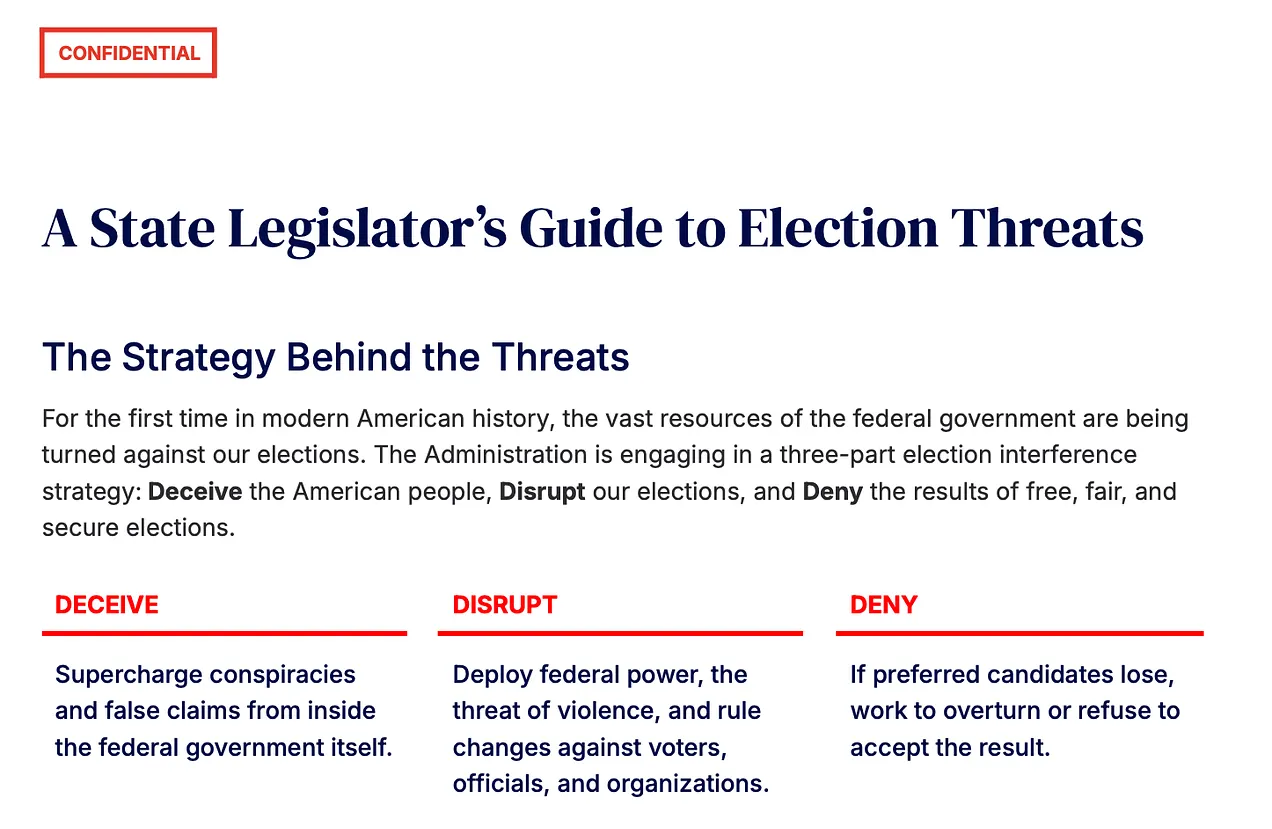
The guide’s opening framework and confidentiality marking.
Its seven scenarios cover voter intimidation; attempts to nationalize election administration; seizures of ballots, machines or records; criminal investigations; interference with counting; mass ballot challenges; and refusal to certify. The guide treats those as distinct risks requiring different preparations.
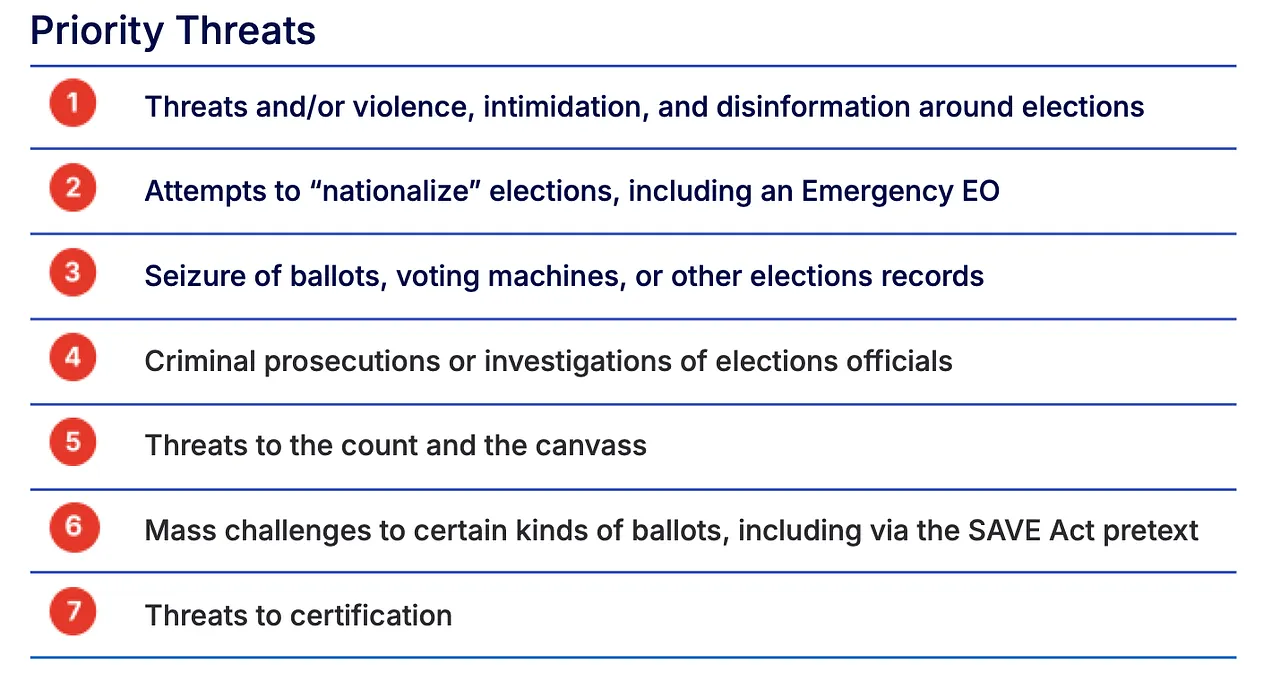
All seven scenarios covered by the guide.
Investigations—and the grand jury
The fourth scenario pairs challenges to overbroad subpoenas with the grand-jury education proposal. It anticipates investigations used to pressure officials into unlawful compliance.
Protect Democracy’s separate grand-jury explainer, published January 28, gives a fuller picture of its educational approach.
Its five-part account tells jurors to test probable cause, examine the credibility of evidence, request original documents and direct witnesses, question witnesses and seek clarification, and report prosecutorial misconduct to a supervising judge.
The group celebrates refusals to indict in prominent and protest-related cases as examples of ordinary citizens checking government power. Its argument is that a prosecutor’s decision to bring a case should not guarantee an indictment.
A plan for public officials and public messaging
The SiX briefing tells lawmakers to call clerks, sheriffs and prosecutors, join nonprofit election-protection coalitions’ communications lists, and seek public commitments to enforce voter-intimidation laws.
For intimidation during voting, the guide describes volunteer documentation, police coordination and litigation to extend disrupted polling hours, alongside reassurance for voters.
A highlighted reminder asserts that online election disinformation peaks during the ten days before Election Day and tells lawmakers to have messaging ready. Communications preparation is built into the document’s timetable.
Natalie Winters

