Tom Hoopes 9November 4, 2026
Pro-lifers are complaining that they “got slaughtered” on election day, with a pro-abortion amendment to the Virginia constitution passing, and with pro-life picks in race after race failing.
It should remind us of the other times Christians learned that politics wouldn’t be their salvation — including the first Christians after seeing their leader on the cross.
Fleeing Jerusalem back home to Emmaus, two disciples told a stranger how disappointed they were with Jesus: “We had hoped that he would be the one who would redeem Israel!” They figured they had just witnessed the end of their hope. They lived in a Roman culture of death and they had put their hopes on one way out: The new leader, Jesus. But he lost. He got slaughtered.
The stranger rebuked them: “Oh, how foolish you are! How slow of heart to believe all that the prophets spoke!” Then Jesus — because that’s who the stranger turned out to be — reminded them that his mission was never about politics in the first place.
Jesus came for the Beatitudes we heard on November 1, not the ballots we filled out on November 3.
In election years, if you’re like me, you can forget that.
Looking at the political facts on the ground looks hopeless and exhausting. If you are feeling despondent at witnessing blow after blow to pro-life candidates and causes, it might be good to remember that politics isn’t everything.
Don’t get me wrong — politics is extremely important. Catholics need to be deeply involved in politics, fighting for the justice. But Catholics can’t make the fundamental error those Emmaus disciples made. They hoped Jesus would come and solve this world’s problems here and now.
Instead, they got the cross.
Christ didn’t become the political ruler of Israel. Instead, he invited his disciples to go back to Jerusalem on the eve of its political destruction, and build the Church. Christ didn’t crush the Roman Empire like a warrior messiah. Instead, he invited his disciples to transform it from within — through loving service and martyrdom.
In the same way, anyone who thinks God will work in large part through the victories of one political party or the other for the ultimate good is destined to be disappointed.
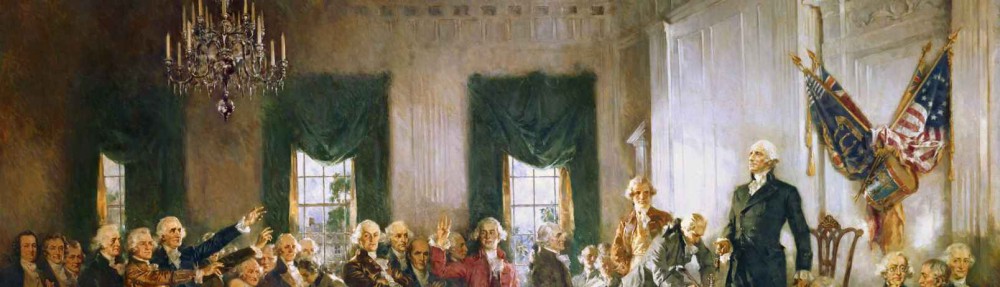
At the dedication of Benedictine College’s Independence Hall Library (pictured above), President Stephen Minnis said “A few decades after our founding, the American bishops met in Baltimore—including our very own Bishop Fink of St. Benedict’s Abbey — and the bishops exhorted Catholic families to send into public life ‘not partisans, but patriots.’”
“‘Not partisans, but patriots,’” he repeated.
“That remains part of our task at Benedictine College. But our patriotism does not come at the expense of our faith,” he said.
After the crucifixion, all seemed lost. Jesus had been killed, the world’s mightiest empire and the members of God’s chosen religious establishment were working together to oppose us, and no one seemed to care what we had to say. After Pentecost, all those facts remained the same, but now Peter knew that Christ had risen from the dead and the Holy Spirit — God himself — was with the new Church.
From that day forward, Christianity has never stopped growing. It grew from the ruins of the Temple after it was destroyed in the first century and it grew from the ruins of the Western Roman empire after it collapsed in the fifth century.
In the aftermath of the empire’s fall, Benedictine abbeys became centers of community, faith, and scholarship. St. Benedict and St. Scholastica’s monasteries lit small lights in the darkness. But that was enough. From them came spiritual giants such as St. Gregory the Great, St. Boniface, St. Augustine of Canterbury, and St. Hildegard of Bingen, who spread Benedict’s light to the pagan kingdoms of Europe and
fanned it into a fire.
The same thing can happen in America.
The same three tools — community, faith, and scholarship — can transform culture in America, with a little help.
On the eve of the twenty-first century, St. John Paul II put Our Lady of Guadalupe in charge of America’s evangelization, and said, “Through her powerful intercession, the Gospel will penetrate the hearts of the men and women of America and permeate their cultures, transforming them from within.”
This is already happening. We are seeing record numbers of U.S. converts, vocations to the priesthood are booming in many places and new priests are more faithful and more committed than in memory. Religious vocations of certain kinds are growing too — but there is still a lot to do.
When New York Cardinal Timothy Dolan visited Kansas, he said, “The dream and dare of the Benedictines to renew culture through Catholic higher education is as game-changing today as it was in the sixth century.”
The Church’s future was never brighter than when Jesus looked down from the cross, and when Benedict looked out from his cave. And today, it is brighter than we can imagine.
By Tom Hoopes

