Even in the best of times, government is not your friend.
Government is not your friend. It cares about its own preservation, not yours. That’s why citizens who resist the government’s authority are tried for treason, while governments that resist the people’s authority award themselves immunity. Ostensibly, governments are formed to protect the lives and liberties of citizens. In practice, governments sacrifice their citizens’ lives and liberties whenever expedient (see, e.g., open borders and mass migration, COVID lockdowns and experimental “vaccines” that are neither safe nor effective, the “global warming” hoax and “green energy”-induced inflation, and the reckless European push for WWIII against the Russian Federation).
Over the course of human history, there have been “good” governments — which is to say, there have been governments remembered more for their accomplishments than for their crimes or failures. Even those governments included venal, mendacious, immoral, and outright murderous officials among their ranks. But when the right historical conditions arise — when the ingredients of culture, virtue, legal tradition, and circumstance come together — governments are remembered for leading their countries through calamity, war, depression, and heartbreak.
Every once in a while, governments accomplish something that inspires not only citizens but also people around the world. When kings, presidents, or prime ministers unite their countrymen in common cause — whether that be resisting Nazi conquest or voyaging to the moon — their governments are often remembered as “good.” Governments that conjure dreams for their people to pursue are sometimes even remembered as “great.” But for every Camelot, there are a hundred Iron Curtains. Both dreams and nightmares spring from the same place: a government’s “best intentions.”
As Americans, we used to know this. Our schools taught young students about the political virtues of our Founding Fathers. Our towns celebrated personal freedom and condemned government tyranny. Local self-government allowed every citizen’s voice to be heard, while regulation and bureaucracy were widely despised. Americans understood that the best government is the one that governs least. Why? Because liberty exists in the space between personal sovereignty and government jurisdiction. The more that governments control, the less that we do. Governments do not build rights; they build prisons. Governments do not brighten freedom’s light; they dim that light with every law and regulation.
One of the things that long separated America from the rest of the West (those nations founded on the civilizational pillars of Athens and Jerusalem) was an inherent distrust of government. Whereas Europe celebrated its various monarchies, America celebrated the defeat of kings. There was nothing scary about this proposition. Members of Congress and local officials of all political stripes walked in Fourth of July parades commemorating revolution against government tyranny.
Citizen militias were as common as high school gun clubs because self-defense was correctly understood to include defense against government overreach. In fact, the Second Amendment’s protections for an American’s God-given right to self-preservation has always been an instrumental check on government’s natural impulse toward tyranny. A well-armed citizenry makes it more difficult for a government to ignore its constitutional restraints by infringing upon the rights and liberties of its citizens. (If citizens of the U.K. were well-armed, the British government would never have been able to arrest sixty-five thousand people for “speech-related offenses” over the last five years.)
For most of the last century, successive generations of American politicians have quietly deconstructed what it means to be an American and replaced it with something foreign. Instead of recognizing that American families inherited their freedoms from ancestors who fought and died for them, politicians have reinvented America as just some nebulous “idea” available to anyone in the world. But America is much more than an idea; it is home to a people whose ancestors risked everything — again and again — to build the greatest country in the world.
What Americans did on this continent has never been done before, and it will likely never be done again. Our ancestors built the foundations of self-government that enabled them to reject the bonds of empire. Their self-rule, self-reliance, self-resilience, and personal ingenuity put America on the path toward unprecedented prosperity. Our American ancestors crossed mountains, rivers, and uncharted territories to settle a dangerous frontier. They fought against nature, hostile enemies, and each other as they connected the continent from coast to coast — one stream, trail, and railroad at a time.
For two centuries, people left their home countries for the United States of America because it was the one place in the world where a person’s grit and determination could forge a new destiny. This is real history involving real people who matter. Of course America is a land of ideas and ideals, but it is also the product of blood, sweat, and tears.
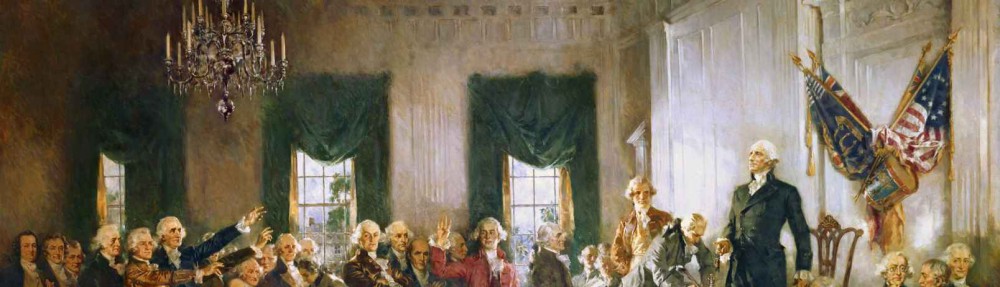
But we don’t hear that anymore, do we? Outside of President Trump’s energetic efforts to celebrate America’s two-hundred-fiftieth birthday this year, politicians never recognize the Herculean achievements of past Americans. The Founding Fathers were probably the most intelligent, virtuous, and wise collection of men to come together at any critical point in human history. Without them, there is no declaration to the world that all men are created equal and endowed with God-given rights that include life, liberty, and the pursuit of spiritual happiness. Without them, there is no American system of economics that values innovation and production over government-created monopolies, slavery, conquest, and central bank money-printing. Without them, America is just Canada, a part of the British Empire with subjects who still bow down to a king.
For such an extraordinary group of men, isn’t it strange how infrequently our politicians discuss their lives, their accomplishments, and their religious and political beliefs? For something as historically significant as the American Revolution, isn’t it equally strange how few television shows and movies have been produced about America’s most consequential war? It is almost as if the political Establishment and the media Establishment would prefer for Americans to forget that their country was birthed in the spirit of liberty and the rejection of Big Government tyranny. It is as if the political and media Establishments would prefer for us to forget all the American heroes who built this country, fought and died to secure it, and bequeathed it to those of us charged with protecting it today. If you take out the people and their sacrifices, it’s much easier to repeat the mindless refrain that America is “just an idea” open to everybody.
These increasingly less subtle attacks on our heritage make sense if the goal is to make America weak enough for globalists to destroy. For years, Independence Day celebrations have become more about fireworks than defeating empires and tyranny. Now the political and media Establishments have pushed the celebration of Juneteenth into direct conflict with the Fourth of July. Just as the “1619 Project” was advanced to rewrite America’s origin story from one of liberty to slavery, Juneteenth was promoted to divide Americans against each other and erase Independence Day altogether. If the Fourth of July is just a “white” holiday, then the celebration of freedom’s triumph over tyranny is recast as a racist celebration of “white supremacy.”
Lutheran pastor Martin Niemöller’s “First They Came” confessional admonished his fellow intellectuals for their complicity with the Nazi Party. The Nazis came for one group after the next, and those who stayed silent realized only too late that there was nobody left to speak out for them. But it’s not just disappearing people that should worry us. We should be equally concerned when governments come for our weapons, founding principles, common history, secure borders, and free speech.
If we are not careful, America will follow much of the West in recognizing — only too late — that we allowed government tyrants to take our freedoms. The only answer to globalist tyranny is to treat every day as Independence Day.
J. B. Shurk, American Thinker

