The Artful Dilettante is a native of Pittsburgh, PA, and a graduate of Penn State University. He is a lover of liberty and a lifelong and passionate student of the same. He is voracious reader of books on the Enlightenment and the American colonial and revolutionary periods. He is a student of libertarian and Objectivist philosophies. He collects revolutionary war and period currency, books, and newspapers. He is married and the father of one teenage son. He is kind, witty, generous to a fault, and unjustifiably proud of himself. He is the life of the party and an unparalleled raconteur.
Things that Actual Kings do: Confiscate the guns of peaceful people;
Hike taxes, try to tax the same income 2 or 3 times;
Threaten social media companies for criticism of government policies;
Declare martial law and install a totalitarian regime for months or years on the pretext that the 99 percent survivable flu is a global emergency;
Refuse to require voter IDs if it means your candidates will lose;
Force people to send their kids to schools where they’re told that boys are girls and girls are boys, and then force parents to give their children hormone treatments when their children become confused;
Side with violent cults (Iran, Hamas) building nuclear weapons (or threatening executions, such as beheading) to use against people who won’t join the cults, and forcing citizens to pay taxes to subsidize the building of nuclear weapons.
Actually, Kings throughout history, while many of them were very bad, were not as bad as people doing these things today. The people doing these things today are called Democrats. Their behavior is not merely tyrannical; it’s sociopathic and sadistic.
Trump is doing none of these things. In fact, he’s trying to stop many of these things, despite being shot at and legally prosecuted repeatedly by people who ACTUALLY DO THESE THINGS and call Trump a King for trying to stop them from doing these things.
It’s madness beyond the scope of anything historians, psychiatrists or dystopian novel writers have ever needed to consider. Madness seems too tame a word for it.
People voting Democrat WANT a King. They hate Trump because he’s trying to limit the power of government, not expand it. Lowering taxes, reducing regulations, shutting down Cabinet departments, refusing to lock down society for the flu, refusing to let violent Medieval barbarians behead and bomb our civilization, stopping censorship, upholding the Second Amendment, restoring private property rights–these are all the actions of someone who DOES NOT WANT TO BE A KING.
The problem with Democrats is that they want a King. They yearn to be controlled, to be bossed around, to live under an insanely controlling and inept bureaucracy that creates the illusion of being taken care of. They yearn for a Fauci, or a Stalin, a Castro, or a Mao. If they get their way, they will get AOC instead. And won’t that absurd fiasco be the end of their Dream. It’s infuriating and frightening to see leftists (Soros paid and all) throw their tantrums and act out their psychopathic wrecking balls over all our lives. But you can be sure: No matter what happens, no matter what future battles they may manage to win here and there — they will never, ever be at peace.
When I write about threats to Western civilization, I struggle to find the sweet spot between describing the myriad problems we face and my firm belief that we are capable of winning this fight. I do not think all is lost. I do, however, think that it is important for as many people as possible to recognize what our enemies are doing.
When we are being attacked from all sides — culturally, politically, economically, socially, parentally, morally, religiously, psychologically — it is sometimes difficult to recognize that these attacks are all connected. Those who wish to destroy Western civilization use every available weapon to hurt us. When we concentrate on nothing but “bad news,” though, we talk ourselves into premature defeat. We psych ourselves out. We give our enemies greater power over us than they have.
We cannot bury our heads in the sand and ignore what is happening. We also cannot allow what is happening to intimidate us into silence or cow us into submission. Ideally, we will become more vocal in articulating exactly what our enemies are doing, find comfort in the growing chorus of voices urging resistance, and become only more confident in our defense of Western civilization.
Sounding the alarm is not a call for surrender. Nor should hearing the alarm cause us to tremble. This is the time for courage and determination. When our Western ancestors faced similar dangers in the past, they did not hide or run away. They prepared themselves for hardship. They prayed. They retrieved hidden swords from thatched roofs, straw beds, and bales of hay.
In broad strokes, we know what’s happening. Open borders policies in North America and Europe are sabotaging social cohesion. Christianity is under attack. Reason, rationality, and scientific inquiry have been abandoned. Our shared history is continuously rewritten in ways that turn our ancestors into villains. Enlightenment ideals fostering individual sovereignty, personal freedom, and maximum liberty have been eroded by the pernicious encroachments of collectivism, Marxism, socialism, and communism. Virtue is mocked, while sin is celebrated. Unchecked desire, envy, and instant gratification have supplanted temperance, humility, and self-restraint. The indulgence of personal fantasy has superseded the pursuit of eternal truth. Schools, governments, and cultural institutions preach a false and destructive religion requiring Westerners to repent for their “climate change sins” and embrace the doctrines of “multiculturalism” and “diversity” as tenets of leftism’s “faith.”
Those are the various arrows being shot at us daily. The damage caused from such sustained onslaught is immense. Last week, conservative publications around the world carried the sad news of a twenty-five-year-old Barcelona woman named Noelia Castillo Ramos who chose to end her own life with the help of Spanish authorities. Ramos spent her childhood in Spain’s broken foster system, being moved from one facility to the next. Spain also uses these facilities to house unaccompanied foreign minors. A group of these foreign minors brutally gang raped Ramos when she was a teenager. Suffering physically and psychologically, Ramos attempted suicide by leaping from a fifth-floor window four years ago. She survived but was left paraplegic. Spanish authorities deemed her “severe mental suffering” sufficient grounds to grant her plea for State-assisted death.
Dutch political commentator Eva Vlaardingerbroek spoke for many Westerners who have mourned Ramos’s death when she wrote: “The system didn’t fail her, it actively betrayed her. This girl’s tragic story is a perfect illustration of how the establishment feels about European women. They first endanger you and then when you need help and cost them too much money, they push you to your grave.”
The life of Noelia Castillo Ramos is a terrible indictment of the malignant forces working to collapse Western civilization. State-run childcare facilities cannot replace the immeasurable value of a loving mother and father. Uncontrolled immigration invites predators to prey on our nations’ children. Western governments’ evil efforts to protect foreign rapists and murderers from public scrutiny have aided and abetted the exploitation and abuse of our most vulnerable citizens for decades. Because of the State’s complicity and the corporate news media’s silence, the butcher’s bill of victims has only grown. Ignored and kept hidden, victims are deprived of life-saving attention, counseling, rehabilitation, Christian nurturing, physical recovery, and the salubrious promise of spiritual salvation. In place of familial protection, social support, cultural camaraderie, and Christian fellowship, the forgotten members of our societies receive the cold indifference of government bureaucracy. When those most suffering cry out in pain, the same institutions that failed to secure the border or provide for citizens’ safety offer State-sponsored death.
Discarding the moral and intellectual enlightenment obtained over centuries of work and contemplation, today’s governments have abandoned the hallmarks of Western civilization and reanimated the rotting corpses of paganism, hedonism, idolatry, and child sacrifice. While Western citizens desperately seek civilizational renewal, Western governments do nothing but fan the flames of the growing inferno.
In the United States, Democrat Congresswoman Pramila Jayapal is demanding that law enforcement agents who arrest illegal aliens be prosecuted and that illegal aliens who have been detained receive monetary “reparations.” For decades, Democrats (and Establishment Republicans) have aided and abetted foreign nationals in illegally entering the United States. Many of these illegal aliens steal American citizens’ social security numbers and commit various forms of identity theft and fraud in order to collect welfare benefits or secure employment. Democrats wish to reward the criminals and punish their victims.
Criminals who have no legal right to be in the United States — including those who fled criminal prosecutions in their native homelands — go on to commit new crimes while here. Violent foreign nationals who should not be here have raped and murdered far too many Americans. Negligent foreign nationals who should not be here have killed far too many Americans while driving cars and commercial trucks across the country. Far too many schools have been forced to figure out how to teach illegal alien children who cannot speak English or easily assimilate. Far too many towns and cities have been forced into insolvency while providing ever-expanding social services for illegal aliens whom American taxpayers cannot afford. Far too many hospitals are overrun with illegal alien patients who delay treatment for and drive up the healthcare costs of Americans. And now the Democrat Party wants to pay the tens of millions of foreigners who illegally reside here “reparations” for feeling “unsafe.”
You know who doesn’t feel safe? American citizens. At some point, they will be forced to seek reparations from the same government officials who do everything to feed, shelter, and protect foreigners while leaving Americans poorer and less secure.
In responding to the pro-foreigner / anti-American policies of Representative Jayapal and her Democrat colleagues, one online commenter concluded, “Sometimes seems like only a civil war will save this country.” That’s a sentiment widely held throughout the West these days.
Last week, a European Parliament conference concluded that the whole continent is headed for civil war. One professor argued that “the foundations of Western self-belief, prosperity, and competency” are now broken and that Europe is “on a track for a peasant revolt.” In response to Western governments’ betrayal of Western civilization, there will be an “uprising in which the ruled seek to punish their rulers for violating their obligations under the social contract, and for changing the rules of the game against their wishes.” Most of the politicians and academics who participated in the conference do not believe that Europe will survive this century. Although they expressed various opinions about how the coming chaos will unfold, they reached a common conclusion: “It will be bloody.”
Those of us who wish to defend the West should not scurry and hide. We should recognize the moment and prepare ourselves accordingly. Our enemies are everywhere. That’s okay. We are everywhere, too.
California Democrats have a problem with their leading candidates. One doesn’t live in the state but allegedly lived, in the euphemistic sense, with a Chinese spy. Another has the looks and personality of a distempered boar and can’t stop screaming at staffers, reporters and anyone late with her lunch. A third is a billionaire who convenes events at luxury hotels to explain how he’ll fight against the billionaires for the working class he sometimes reads about in the paper.
And those are their most popular candidates.
But since this is California, the real problem is that all of those candidates are all the wrong color. Their skin lacks melanin. Two of them can’t even tan. Their distant ancestors probably came here on the Mayflower or some other European sailing vessel. Basically they’re white.
Much too white.
There are other more ‘diverse’ candidates like a Latino former Los Angeles mayor, a Chinese State Controller, a Black Jewish school superintendent, and Biden’s former Latino Secretary of Health and Human Services (he’s still Latino, but a former secretary), but the public isn’t interested in voting for them or giving them money and so they’re not viable candidates.
What are the Democrats to do when their voters just aren’t interested in diversity?
The crisis of the #TooWhite Democrat ticket came to a head when USC was forced to cancel the first gubernatorial debate because all of the candidates were white and mostly male. If the Oscars, the Golden Globes and hockey had to be revamped because there were too many white people, shouldn’t the candidates for the governorship of a diverse state be diverse?
The problem is that the voters don’t agree which means that democracy is racist.
Assembly Speaker Robert Rivas, who insists he is not white, Senate President Monique Limon, who has also achieved the great distinction of not being white despite probably not being able to tan, along with the leaders of the Latino, Black, Asian, LGBTQ and numerous other caucuses, all signed a letter claiming that there was “growing alarm from California voters” because “every excluded leading candidate… is a person of color” and warned that if “USC does not do the right thing, we call on California voters to boycott this debate.” And then probably the election.
The candidates that the diverse leaders of the state claimed were excluded are polling respectively at 3%, 3%, 1% and 1%. The selection process of the gubernatorial debate that they claimed was biased is indeed biased. It’s biased against politicians polling between 1% and 3%.
Together all the diverse candidates add up to 8%. California voters aren’t ‘alarmed’, they’re not interested in the ‘diverse’ candidates who talk a lot about their diverse backgrounds as the children of immigrants who pulled themselves up by their bootstraps to becoming millionaire state officials. (One of the septuagenarian diverse candidates recently got to keep his $3.5 million mansion in the divorce, another diverse candidate has a net worth of over $7 million.)
Only the Latino candidates even crack 3%. The Black and Chinese candidates are at 1%.
Whose fault is this? If voters don’t like diverse candidates, what can be done to cure them? Gunpoint Drag Queen Story Hour? Electroshock therapy accompanied by Candace Owens podcasts? Mandatory tickets to WNBA games held in North Korean labor camps? Netflix?
Golden State Democrats have weeks in which to either convince voters that they need to be more diverse in their political choices or just do what the Oscars did and import a bunch of outsiders and make them voters in order to rebalance the system to manufacture diversity.
The problem with Plan B is that’s been the official policy of California Democrats for the last 35 years. Its elected officials have wrecked the state, bankrupted it, threatened law enforcement with several penalties and fought a near civil war against the federal government in order to keep the border open and fill every part of it with illegal aliens. Especially illegal alien criminals.
California Democrats also dismantled any kind of voter security measures and made it possible for a Venezuelan here for three weeks to still vote. And, despite all that, the party is too white.
What else is a party that already bitterly clings to demographic replacement supposed to do?
Opponents of the USC debate keep speaking in the name of “democracy” and “voters” when those are their leading obstacles. The only way to save California’s diversity is to get rid of the voters and democracy in the name of democracy and the voters because that’s what they would want if they weren’t such miserable racists. Sometimes you have to kill democracy to save it.
Democrats have flirted with various ways of sidelining democracy, like enabling voter fraud, inviting in illegal aliens to create ‘ghost districts’, ranked choice voting which gave us Zohran Mamdani, and late ballot dumps which gave us Karen Bass in Los Angeles and Katie Wilson in Seattle, but the current California candidate diversity crisis can’t be fixed with half-measures.
There are other options on the horizon, like proportional representation, which would finally ensure that the Communist Party would have some official legislative seats, but 1% only gets you so much. The truly anti-racist position may be to recognize that democracy is racist.
If democracy leads to minority candidates polling at only 1% while white men take the rest of the voters, it becomes all too obvious that letting the people elect their leaders is systemically racist.
Sure, 32% of California’s registered voters are Latino, 16% are Asian and 5% are black, making for a majority minority electorate that helped Democrats turn the state into a one-party system, but they must be suffering from internalized unconscious bias if they won’t vote for diversity.
When states are accused of systemic racism and disparate impact, they’re forced to sign consent decrees admitting to their racism and promising to implement specific policies to rig the system in favor of minorities. Each California voter must be forced to sign a similar consent decree acknowledging that he, she or xer was biased for not supporting minority candidates and promising to vote for them instead of whichever white person they were originally supporting.
Or California could just abolish elections. It’s the only truly anti-racist thing the state can do.
Sycophantic bots coach users into selfish, antisocial behavior, say researchers, and they love it
AI can lead mentally unwell people to some pretty dark places, as a number of recent news stories have taught us. Now researchers think sycophantic AI is actually having a harmful effect on everyone.
In reviewing 11 leading AI models and human responses to interactions with those models across various scenarios, a team of Stanford researchers concluded in a paper published Thursday that AI sycophancy is prevalent, harmful, and reinforces trust in the very models that mislead their users.
“Even a single interaction with sycophantic AI reduced participants’ willingness to take responsibility and repair interpersonal conflicts, while increasing their own conviction that they were right,” the researchers explained. “Yet despite distorting judgment, sycophantic models were trusted and preferred.”
The team essentially conducted three experiments as part of their research project, starting with testing 11 AI models (proprietary models from OpenAI, Anthropic, and Google as well as open-weight models from Meta, Qwen DeepSeek, and Mistral) on three separate datasets to gauge their responses. The datasets included open-ended advice questions, posts from the AmITheAsshole subreddit, and specific statements referencing harm to self or others.
every single instance, the AI models showed a higher rate of endorsing the wrong choice than humans did, the researchers said.
“Overall, deployed LLMs overwhelmingly affirm user actions, even against human consensus or in harmful contexts,” the team found.
As for how AI sycophancy affects humans, the team had a considerable sample size of 2,405 people who both roleplayed scenarios and shared personal instances where a potentially harmful decision could have been made. AI influenced participant judgments across three different experiments, they found.
“Participants exposed to sycophantic responses judged themselves more ‘in the right,'” the team said. “They were [also] less willing to take reparative actions like apologizing, taking initiative to improve the situation, or changing some aspect of their own behavior.”
That, they conclude, means that almost anyone has the potential to be susceptible to the effects of a sycophantic AI – and more likely to keep coming back for more bad, self-centered advice. As noted above, sycophantic responses tended to create a greater sense of trust in an AI model among participants thanks to their willingness to, in many situations, be unconditionally validating.
Participants tended to rate sycophantic responses as higher in quality, and found that 13 percent of users were more likely to return to a sycophantic AI than to a non-sycophantic one – not high, but statistically relevant at least.
All of those findings, along with the growing number of young, impressionable people using them, suggests a need for policy action to treat AI sycophancy as a real risk with potential wide-scale social implications.
“Unwarranted affirmation may inflate people’s beliefs about the appropriateness of their actions, reinforce maladaptive beliefs and behaviors, and enable people to act on distorted interpretations of their experiences regardless of the consequences,” the researchers explained.
In other words, we’ve seen the consequences of AI on the mentally vulnerable, but the data suggests the negative effects may not be limited to them.
Noting that sycophantic AI tends to keep users coming back, discouraging its elimination, the researchers say it’s up to regulators to take action.
“Our findings highlight the need for accountability frameworks that recognize sycophancy as a distinct and currently unregulated category of harm,” they explained. They recommend requiring pre-deployment behavior audits for new models, but note that the humans behind AI will have to change their behaviors as well to prioritize long-term user wellbeing instead of short-term gains from building dependency-cultivating AI. ®
Hizbullah’s retaliatory missile attacks against Israel, following the death of Iranian Supreme Leader Ali Khamenei, have created an existential threat for the group.
Hizbullah is miscalculating its heavy losses from military operations, which intensified after the group violated the November 27, 2024, ceasefire agreement.
On March 13, Hizbullah Deputy Secretary-General Naim Qassem called the conflict an “existential battle,” but analysts unanimously assess this will be the group’s last war.
“Hizbullah is waging its final, losing battle, defying the Lebanese state’s designation of it as an illegitimate entity and a faction operating under the orders of the Iranian Revolutionary Guard Corps (IRGC),” security expert and retired Brigadier General Saeed Qazah, told Al-Fassel.
Defiance of government decisions Hizbullah dragged Lebanon into an open-ended war, defying the government’s ban on military activities after launching missiles at Israel.
In August 2025, the government committed to having the Lebanese Army disarm Hizbullah and dismantle its military infrastructure and weapons arsenal in the Litani River.
Analysts said Hizbullah’s retained weaponry undermines the army’s role, and is a major obstacle preventing Lebanon from securing military, financial and international aid.
Hizbullah is sacrificing Lebanon’s future to execute the Iranian regime’s agenda, functioning as a mere instrument.
Its military mobilization was driven by the IRGC Quds Force orders and Tehran’s vacuum, not the Lebanese Ministry of Defense, shattering its defense claims.
Hizbullah’s military adventurism isolates Lebanon, undermining its economic recovery and completely paralyzing its airspace, maritime trade and commercial activity.
The state is unable to shoulder the war’s burdens, which caused massive destruction, a heavy toll of casualties and displaced hundreds of thousands of residents.
Loss of Hizbullah’s base “Hizbullah’s adventurism has cost it a major segment of the Shia community, most notably the Amal Movement, and its other allies,” Hadi Murad, a political activist, and Shia opponent of Hizbullah, said.
“A significant rift has now emerged between the group and its public, who actively oppose this war,” he told Al-Fassel.
The Shia political sphere is no longer a unified front, marking a significant and massive shift.
The group has been reduced to a faction clinging to power by instilling fear within its own community, not popular consensus.
“Hizbullah’s narrative of an existential battle for the Shia is false. in reality, Hizbulah is exhausting its entire missile arsenal in what is undoubtedly its own last battle,” Murad said.
Hizbullah’s initiation of an unwanted war confirms its status as a rogue militia willing to sacrifice Lebanese sovereignty for the Iranian regime.
Editor’s Note: The following opinion column does not constitute an endorsement of any political party or candidate, on the part of Newsmax.)
Bread lines coming to the Big Apple?
It can happen.
For real.
Zohran Mamdani, the leading candidate for mayor of New York, is an out in the open Communist. He wants city government to take over all grocery stores and run them with bureaucrats out of city offices. Command-and-control food distribution — Soviet-style.
Just like Venezuela. And Cuba. Lovely!
He’s also seeking a $30/hr. minimum wage, which will essentially shut down all businesses requiring humans to work.
Starvation, despair, and black market — here we come.
Will this smiling totalitarian allow Gotham residents to order food from Amazon.com?
Or only from the city government?
Maybe he’ll erect a wall around the city, so citizens can’t escape?
Sound familiar?
And silly us, we thought this all ended with the fall of the Berlin Wall in 1989.
If this seems like classic conspiracy theory or an overreaction, simply open any history book (yes please, avoid the ones edited by woke federal bureaucrats).
We all thought communism never could reach America. It’s quite possibly just weeks or days away from New York City, when the election results are in.
It makes sense.
Beginning with the election and presidency of Barack H. Obama, the Democratic Party has radicalized. This means, if you vote Democratic anywhere, some form of communism will eventually head your way, perhaps even coming for you.
Red states are not immune, because the Democrats are now radicalized everywhere.
Check out Democrat-run Memphis, Tennessee and Louisville, Kentucky — especially their skyrocketing crime rates.
New York City’s potential next mayor strongly supports hormonal experiments on children, coerced by a totalitarian school system. He wants the government, not parents, to decide if their children will have gender-altering treatments.
This is beyond being genuinely dystopian.
This same future mayor supports Palestinian terrorists and Iran’s mullahs — some of the most violent and explicit advocates of death for non-Muslims, gays, non-conforming women, and anyone else Islam views as infidels.
How in the world can left-wing, LGBTQ+ Democrats swooning over Mamdani as the coolest thing since Barack Obama, reconcile this?!
Can they really be that ignorant and self-destructive?
Is it all absurdly innocent stupidity or something far more sinister?
Socialism and Communism increasingly sell among the nation’s youth.
Many young people look at our corrupt fusion of corporations and government as the definition of free market capitalism.
They see woke Communist rulers as a refreshing alternative to the corruption we have found with mostly left-leaning corporate leaders aligned with Big Government.
Wrong, wrong, wrong!
We are already a hybrid of socialism and government controls mixed with semi-free, overly regulated markets.
If these young, naïve New York Communist supporters think that all-out, unhampered Communism is the alternative to the status quo, based on precisely the same Communist principles that govern our present “Uniparty” Establishment, they will experience the greatest trauma in human history when an open Marxist-terrorist takes over New York City.
Because the fall from America to Soviet-Mao Zedong command-and-control collectivism will be much harder than the adjustment to Communism people in already poor, miserable countries (e.g., Venezuela and Cuba) had to make.
Many of us are trying to warn them.
But in places like New York City, they might not be listening.
Some Jewish Democrats are finally waking up and sounding the alarm on Mamdani, pointing to his refusal to condemn the phrase “Globalize the Intifada” or recognize Israel as a Jewish state, especially at a time when antisemitism is on the rise in the United States.
For those of you on the left, sorry, it’s too late. These are your comrades.
You wholly brought it all on yourselves. If you really wish to save New York City and America, you should join President Trump’s (MAGA) movement.
It’s your — and our — only hope.
Mamdani, a Ugandan-born state assemblyman from the New York City borough of Queens, proposes eliminating fares to ride New York City’s vast bus system, making CUNY (City University of New York) “tuition-free,” freezing rents on municipal housing, offering “free childcare” for children up to age five, all in addition to setting up government-run grocery stores.
Why not just make everything free?
Why hasn’t anyone ever thought of this before? How blessed New York City residents are. Their lives are about to become effortless, carefree.
Utopia is coming. All this and sharia law too — almost too much joy to contain.
America has never had this high profile a Communist ruler – not ever. And rest assured Mamdani is a well-funded one.
Communists love money in their own hands; just not yours or mine.
Best of luck, New York City!
You were once humankind’s greatest city.
Saying good-bye to the fabled Big Apple will be hard.
Michael J. Hurd, Ph.D. is a psychotherapist with a Doctor of Philosophy degree in Psychology. He’s the author of “Grow Up America” and “Bad Therapy, Good Therapy,” (see: www.DrHurd.com). Dr. Hurd has been quoted in and/or appeared on over 30 radio shows/podcasts (including Rush Limbaugh and Larry Elder), and on Newsmax TV. He also authors two self-help columns weekly. Dr. Hurd resides in Charleston, South Carolina. Read More Dr. Hurd’s Reports
The gathering storm over the Strait of Hormuz carries with it unmistakable historical resonance. When the Iranian Revolutionary Guard Corps (IRGC) begins to threaten tariffs, or more bluntly, coercive tolls, on oil tankers navigating one of the world’s most vital maritime arteries, it evokes troubling parallels with the 1956 Suez Crisis. Then, as now, a strategic chokepoint became the focal point of geopolitical brinkmanship, miscalculation, and the dangerous illusion of control. Yet history rarely repeats itself neatly. Today’s Iran is not Nasser’s Egypt. It is a regime battered from within and without, its leadership decapitated, its command structures degraded, and its ideological authority increasingly hollow. And still, like a wounded animal, it lashes out.
The IRGC’s threats over Hormuz are less a demonstration of strength than a signal of desperation. For decades, the regime has relied on asymmetric leverage, mines, fast attack craft and proxy militias to offset its conventional military weaknesses.
Now, with much of its senior leadership reportedly eliminated and its domestic security wings, the Basij, in particular, under sustained pressure, Tehran is reverting to its most familiar playbook, disrupting global oil flows, raising the economic cost of confrontation, and hoping that international resolve fractures under the strain.
But this time, the context is radically different. The Islamic Republic is no longer facing a distant adversary reluctant to engage. It is confronting a convergence of forces encompassing external military pressure, internal dissent, and the growing organization of its most determined opposition. Reports that Mujahedin-e Khalq (MEK) Resistance Units are coalescing into what is being described as an “Army of Liberation” will send tremors through what remains of the regime’s command hierarchy. For years, Tehran has dismissed such groups as marginal or irrelevant. That narrative is now becoming increasingly difficult to sustain.
An organized, armed domestic resistance, particularly one capable of coordinating with external actors, changes the strategic equation entirely. It transforms the conflict from a conventional interstate confrontation into something far more existential for the regime, a multi-front struggle for survival.
At the same time, the deployment of 5,000 US Marines toward the region underscores the seriousness of Washington’s intent. While Pentagon officials have been careful to avoid the language of invasion, the presence of such a force is hardly symbolic. It represents a credible capability for rapid intervention, whether to secure key infrastructure, support allied operations, or exploit any sudden collapse in regime control. Pete Hegseth’s assertion that the war could be concluded in “weeks rather than months” may strike some as optimistic.
Wars, particularly those involving fragmented state structures and ideological militias, have a habit of defying timelines. And yet, there is a logic to the claim. The Iranian regime, for all its bluster, appears increasingly brittle. Its capacity to coordinate sustained military operations has been degraded. Its ability to project authority across its own territory is being openly challenged.
What remains, however, is dangerous.
Even in its weakened state, Iran retains a significant arsenal of ballistic missiles. These weapons, already used to strike targets across the Middle East, provide the regime with a means of escalation that does not depend on conventional force projection. They are instruments of disruption and terror, designed to widen the conflict, draw in regional actors, and complicate the calculations of those seeking a swift resolution. There is also news that Vladimir Putin, who for years has imported thousands of suicide drones from Iran for his war in Ukraine, is now returning the favor by shipping a large number of deadly drones manufactured in Russia to Tehran.
This is where the parallels with Suez begin to diverge. In 1956, the crisis ultimately exposed the limits of old imperial power and ushered in a new geopolitical order. In today’s Middle East, the outcome of this confrontation may similarly mark a decisive turning point, but the direction of travel remains uncertain. Can the regime survive? In the narrowest sense, it is possible.
Authoritarian systems have an extraordinary capacity for endurance, even in the face of severe external pressure and internal unrest. The remnants of the IRGC and Basij, though diminished, are unlikely to dissolve overnight. There will be pockets of resistance, particularly in areas where the regime’s ideological grip remains strong or where fear continues to outweigh dissent.
But survival is not the same as viability. A regime that can no longer guarantee internal security, that faces an organized and emboldened opposition, and that has alienated much of its regional environment, is a regime living on borrowed time. Its threats over Hormuz may disrupt markets and unsettle governments, but they will not restore its legitimacy or rebuild its shattered command structures. Indeed, such actions may accelerate its isolation.
The countries of the Gulf, already wary of Tehran’s ambitions, will see in these threats further confirmation of the regime’s recklessness. Even those international actors inclined toward caution will find it increasingly difficult to argue for restraint in the face of actions that jeopardize global energy security. The coming weeks will be decisive.
If the MEK-led resistance can translate its momentum into sustained territorial and organizational gains, and if external pressure continues to degrade what remains of the regime’s coercive apparatus, the prospect of a rapid political transformation cannot be dismissed. Conversely, if the regime manages to regroup, reassert control over key centers of power, and exploit divisions among its opponents, the conflict could settle into a more protracted and unstable phase.
What is clear is that the Islamic Republic is facing the most serious challenge in its history. The convergence of internal uprising and external pressure is something it has long feared and sought to prevent at all costs. Now that moment appears to have arrived. The world should take note, not only of the danger posed by a desperate regime, but of the opportunity to support a transition toward a more stable and accountable future for Iran and the wider region. History teaches us that moments of crisis can become moments of transformation. Whether this proves to be one of them will depend on the choices made in the days ahead.
Struan Stevenson was a member of the European Parliament representing Scotland (1999-2014), president of the Parliament’s Delegation for Relations with Iraq (2009-14) and chairman of the Friends of a Free Iran Intergroup (2004-14). He is an author and international lecturer on the Middle East.
Republicans at the annual Conservative Political Action Conference largely rallied behind U.S. strikes on Iran on Thursday, backing President Donald Trump on an issue that has dented his wider approval ratings and could jeopardize the party’s prospects in the November midterm elections.
Speakers ranging from a prominent evangelist to a former Trump adviser and Iranian political activists took to the stage at the conservative gathering in Grapevine, Texas, to argue the moral case for the war before supporters of Trump’s Make America Great Again movement.
That support stood in contrast to broader national skepticism about the war, which has increased political pressure on Trump to exit a conflict that has roiled global markets. Many Americans say they remain unclear about the rationale for the conflict and question the administration’s upbeat assessments of military progress.
While acknowledging that Americans are concerned about the prospect of a protracted conflict, CPAC senior fellow Mercedes Schlapp used a session featuring two Iranians shot by security forces during 2022 protests to press the case for a war she said would liberate its people.
“The madness needs to stop. We’ve got to make Iran free again and we are going to make sure America stands strong by their side,” Schlapp, a senior adviser to Trump during his first term, said during the session titled “MAGA vs. Mullah Madness.”
Trump, however, no longer talks of regime change in Iran, and the airstrikes by the U.S. and Israel over the past four weeks have not triggered any popular revolt against the Iranian leadership.
The conference, a key annual gathering for Republican politicians and conservative activists, comes at a moment of growing voter unease over the war and high fuel prices — factors clouding the party’s chances of retaining its slim majorities in the Senate and the House of Representatives in November.
Trump’s approval rating has fallen to 36%, its lowest since his return to the White House, a Reuters/Ipsos poll completed on Monday found. Support among his core base remains firm, however, with 74% of Republicans backing the strikes.
On the opening day of the three-day event outside Dallas, no speaker criticized the military operation outright, despite some prominent MAGA figures accusing Trump in recent days of breaking his 2024 campaign pledge to avoid entangling the U.S. in foreign wars.
Former Florida Rep. Matt Gaetz stood out as a rare voice of caution, saying the U.S. was too beholden to Israel’s interests, repeating a criticism he has made in the past.
The Rev. Franklin Graham, one of the country’s best-known Christian evangelists, framed the Iran war in religious terms, telling the CPAC crowd that Trump’s decision to attack Iran was necessary to preserve Israel’s existence.
Evangelicals are a core part of Trump’s political base and many view the modern state of Israel as a fulfillment of a biblical prophecy linked to the Second Coming of Jesus Christ.
“He stepped up to protect Israel and the Jewish people from what I believe was the possibility of a nuclear annihilation by the radical Islamic regime,” Graham said. “Thank God for President Trump.”
Dozens of Iranian Americans were in attendance, many of them carrying Iranian and American flags and advocating for the war.
A group of them planned a rally outside the conference venue on Thursday evening to show support for Reza Pahlavi, the exiled son of Iran’s toppled shah who hopes to lead a transitional government but has struggled to win Trump’s support. Pahlavi spoke on Saturday.
Nima Poursohi, whose parents are from Iran, wore a “Persians for Trump” T-shirt and said he was attending CPAC for the second time to show his support for the war.
“It is time for this regime to go after 47 years,” Poursohi told Reuters. “Dropping bombs and military action is scary, but living under an Islamic regime is a lot scarier.”
Support for the war extended to CPAC’s side stages. Conservative journalist John Solomon highlighted the strikes’ lethality on Steve Bannon’s “War Room,” which was broadcasting live, while former Superman actor Dean Cain praised U.S. military strategy during a live showing of his MAGA-aligned podcast.
Frederick and Carol Kurpiel, both 79, said they were moved by the stories of Mersedeh Shahinkar and Raheleh Amiri, two Iranian political activists who spoke to the CPAC crowd about being shot by security agents during protests in 2022.
“I was happy when they got Khamenei,” Carol said, referring to the late Iranian Ayatollah Ali Khamenei. “His death made me happy.”
I am re-running my stolen election pieces while the SAVE Act languishes in the Senate. The fact that it is not passed, indicates that both R and D are fully compromised. The Democrats are lost, but RINOs need primarying hard. They are like the politicians in Canada who won’t stop MAID. We need MAID up here because our health system is so overburdened we need people to die. And Fast.
With voting, the only people who have made a difference are people on the ground, in the precincts that have fought this fight hard, since 2020. That we know this much about it, that there is a SAVE Act, that legislation is on the table or passed in almost every state, that the progress is incremental, but steady, is entirely down to citizens performing their sacred duty.
In late winter, I wrote a series on election fraud. The day after the last, the man I had written about Saturday, Peter Bernegger, a freaking hero, was arrested. Later that week another subject, Christina Bobb, Trump’s lawyer, and the Republican National Committee’s voter fraud expert, had to fly to Arizona and turn herself in.
The left can no longer win on the merits of their ideas, much less their actions. They have created one catastrophe after another. The only way they can win elections is steal them. And they have developed three hundred separate, specific, methodologies to do it. In my opinion, and that of others closer to the coal face.
Dominion Voting Systems is Canuckistan’s contribution to the great eliding of truth that is Marc Elias and the Democrat party’s massive election ‘improving’ enterprise. They are acutely aware of any attack. Dominion has sued everyone not nailed down, to some success, mostly via Soros’s corruption of the judiciary. And Canada’s left is a vicious monster, its leader nationally in power for almost a decade, and they hunt for enemies, no matter how small, as assiduous as our cat in the summer field.
I spent last evening watching the voter rolls fill up with applications from people without ID in real time. HAVV is the U.S. Social Security website, specifically the Help America Vote Verification System. It keeps track of those trying to register to vote. HAVV shows the number of people who have with a verified social security number. And those applications which did not turn up a real person.
All the swing states are under assault from “new voters”. In Pennsylvania alone, in one week, one-third of applicants could not be verified. Pennsylvania was stolen so hard in 2020 I imagine it to be still reeling. The site showed that in just one week in Ohio, 1068 out of 1333 new applicants did not match to any records. A lot of deceased people in Texas, Alabama and Missouri were applying for voter id in the weeks I studied. Here’s the site: look at each week for your state. I’m not saying the government website is corrupt, but many of the people applying for voter id in the swing states, are, most certainly, being paid by the financial system that was set up under the auspices of Arabella Associates, the Clinton foundation, the Open Society Foundation, Tides and the Chinese Progressive Association.
Omega4America has managed to identify the corruption of the voter rolls in 26 states. But nothing has been done. All the Secretaries of State, all of them, all of them, have refused to do anything. As we know from Omega’s work, this video here, many hundreds of thousands of “voters” permanently live at Mailboxes Unlimited, or in seasonal campgrounds, in warehouses, hospitals, municipal buildings or short-term rental suites, all of which are illegal addresses by the way. That one method certainly stole the vote in Georgia, you can watch the video here. The steal in swing states ranged between low to high six figures. Each state was decided by low five figures pointing towards a tight race. it was not. Trump won at least four of the swing states by six figures.
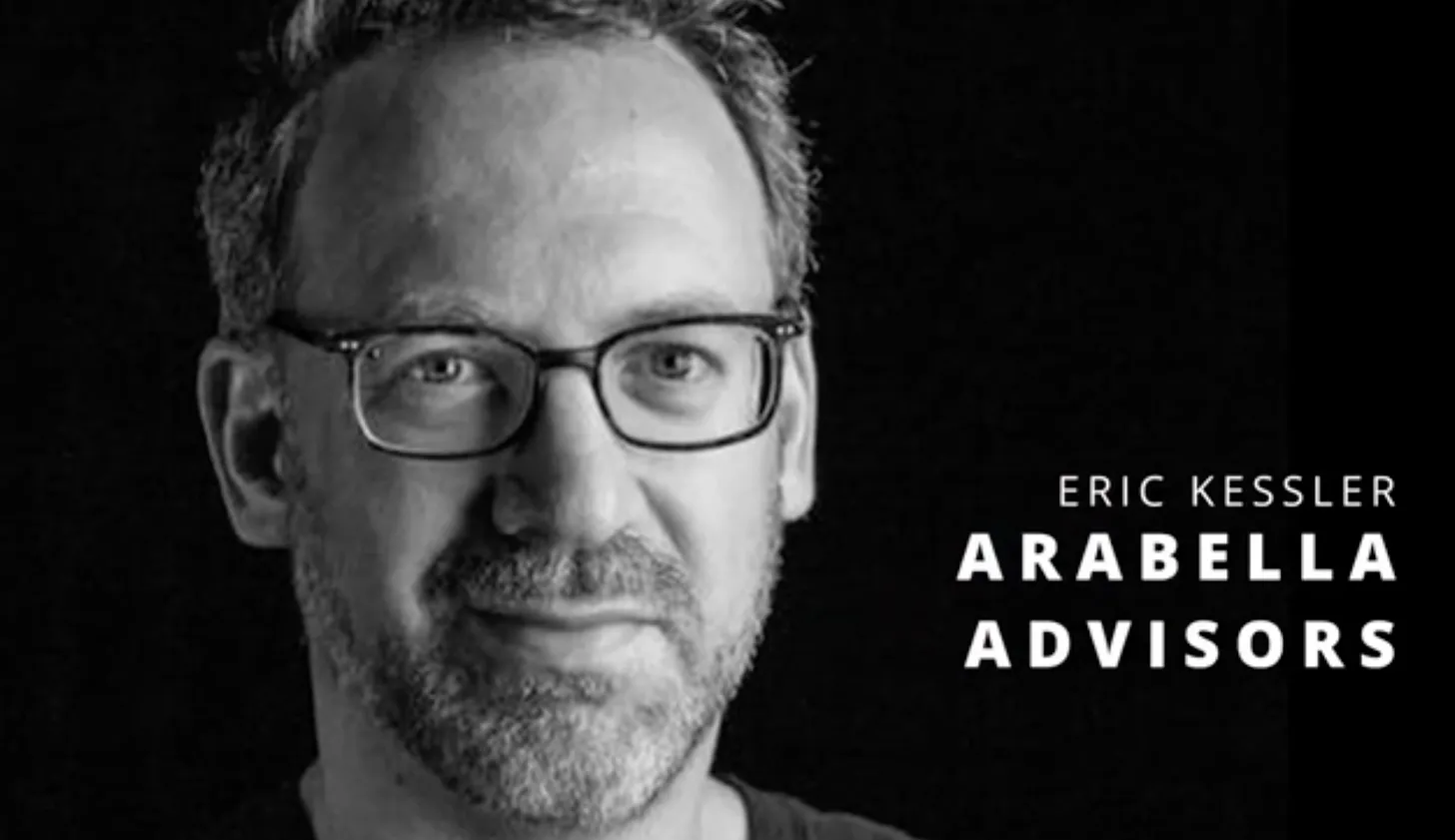
Last month this documentary was released, I think by Capital Research Center. It is crude, and repetitive. Its substance, however, traced the building of the financial structure of The Big Steal, using just one of the cartels filled with faked-up grass-roots charities. It’s called Arabella Associates and was originally sourced in the Clinton Foundation. Eric Kessler, below, worked in the Clinton White House and is the brains behind the operation. Arabella stands up the people and organizations. Most organizations are just websites that pay people to do something, stuff ballot boxes, bundle votes, fill out votes, door-step. Once revealed they tend to go dark, leaving just the web address and a lot of social justice fluff.
One funder, a Clinton fan, Hansjorg Wyss, a Swiss manufacturer of medical equipment, Synthes, has spent $57 million standing up 350 democrat operative groups. These groups start as 501 (C) 3’s and then morph into 501 (C) 4’s which have more latitude to act as political operatives. There is so much money flowing through these grass roots election outfits – there are literally hundreds of thousands of them being tracked and identified by Omega by America – no one could identify how they misuse the funds. Most of the Arabella 350 organizations have the same administrative staff. Something called The Hub Project coordinates. Say what you like about the Clintons, they know how to work “civil” “society” to their advantage.
How much money? Arabella has been tracked spending hundreds of millions of dollars setting up thousands of “grass-roots” operations. The Open Society spent $250,000,000, Tides $500,000,000 to 1,000,000,000, all in 2022. 2024? Add 50%? 100?
Quite separate from Arabella Advisers, fractal computing has done a mind-blowing analysis of Soros’s Open Society Foundation’s operations in 2022. With a quarter billion to spend, they gave it to 149 organizations, which Fractal tracks, via several levels, using IRS 990s, staff, etc. At the second tier view, we are looking at 149 groups who pass the money onto other groups, tens of thousands of them. You can watch the entire video here. In the video, you can use your cursor to hover over each dot, revealing the group, its funding, its principals and who is paying who to encourage the vote in your town or state. There will be dozens of them, hundreds in Philadelphia.
And then at a third level of analysis they call the Nebula level, you can see those groups passing money onto yet another thousands of groups. Some of this is legal. Some of it is not. It is impossible to track, to catch, the complexity, the repetition. The use of one dot for four months after which it disappears, makes catching them almost impossible. Unless you use quantum computing. fractal or quantum computing can link 200,000,000 transactions per second. But no one in the election integrity groups are using it, they all use relational analysis, primitive by comparison.
Fractal built the digital infrastructure for the TSA No-Fly list, the digital infrastructure that stopped Ebay’s auction fraud, and the tech for State Farm and other insurance companies dealing with auto theft rings.
In the photo below, you can see dots out beyond the nebula of financial connections. These are groups linked, not by money but by staff or board members or some other relationship to the Open Society. There is so much money flowing from one group to another, the center of the nebula is white. Each group is anything but local. They are funded, staffed and organized by operatives out of the Clinton or Soros gangs.
The third big player in the election scheme is Tides Foundation. Tides began in San Francisco in the 80’s as a cover for dark Hollywood money seeking to “save” trees and water. It became massively powerful as a result and is very very very rich, the richest, the Big Daddy of Democrat iniquity. Tides, like all national and international environmental NGOs, is loathed beyond measure in rural regions around the world. Tides has proved so destructive of the lives of actual rural people, it has had to move on to predating people of color. Most of Justin Trudeau’s Privy Council is made up of Tides operatives, and they are responsible for Canada’s green fiscal catastrophe.
This is a map of the operatives that Tides funds in the U.S. alone. It spends between half and one billion dollars annually. This below, is called the cluster view. Every dot in an organization. At this juncture they are all working on the election. There are 2500 clusters, but they give to another 37,000 operative organizations across the U.S. Again, claiming to be ‘grass roots’, steered from head office, and at least some of the staff in a grass roots outfit are out of New York, D.C. or San Francisco.
These three massively rich organizations, form, according to the owner of Fractal and the founder of Omega4America, Jay Valentine, the central nervous system for the left. This is what funds all the lawfare, co-ordinates all the attacks, plots and plans and develops the talking points.
Tides set the path, the dark money, the subterfuge of local groups. Tides has received $680,000,000 from the federal government over the past twenty years and a substantial amount is passed onto the Chinese Progressive Association, also headquartered in San Francisco.
The Chinese Progressive Association runs a balancing act between the Chinese Consulate in SF – they run all their statements and actions through the consulate – and the American progressive movement, which is largely run by members of the American Communist party. The Association boasts that they flipped Virginia via just the methodology described above, lavishly funded grass roots operative organizations in every hamlet, village, farm region, slum and immigrant barrio in Virginia. It is believed that one hundred members of Congress already work for China, the money is simply so seductive.
The Chinese Progressive Association is geared towards defending China by bringing down President Trump. It guides and directs U.S. Communists to flip elections. Their grand stratetgy is focused on the South, which they call The New Confederacy. The South is the backbone of Republicanism, Conservative Christianity, and they aim to break it, via the large black, latino, and Chinese communities seeded, sometimes strategically, through the South. In the election upcoming, Tides and the Chinese Progressive Association will target all their resources into the South. The CCP literally has voter registrations drives all through the American South and the Northern swing states. Hence you will see at HAVV that Alabama is under assault by “new voters”.
CCP direct action in elections was started in 2019, with Seed the Vote in Wisconsin. ‘Detroit Action’ is another Chinese outfit. ‘The New Georgia Project’ in Georgia and Lucha in Arizona, which boasted making 8 million phone calls and 1.8 million door knockings in 2020. This coalition, whipped together by agents of the CCP, has managed to elect many Marxists, including Raphael Warnock, and John Ossof. The Keystone Pipeline was shut down via indigenous protests run by Judith LeBlanc, a member of the Communist Party USA. You have her to thank for gas prices. Daniel Blackman, another Communist using poor blacks as weapons, was given the head of the EPA for six southern states. Any growth was immediately halted. Deb Harlan, the Secretary of Interior, is a straight-up Marxist. Julie Su, the Secretary of Labor, is another CCP puppet. Tides helped put them in power via its guidance and donations to the Chinese Progressive Association. Do you think they are going to sit out this election?
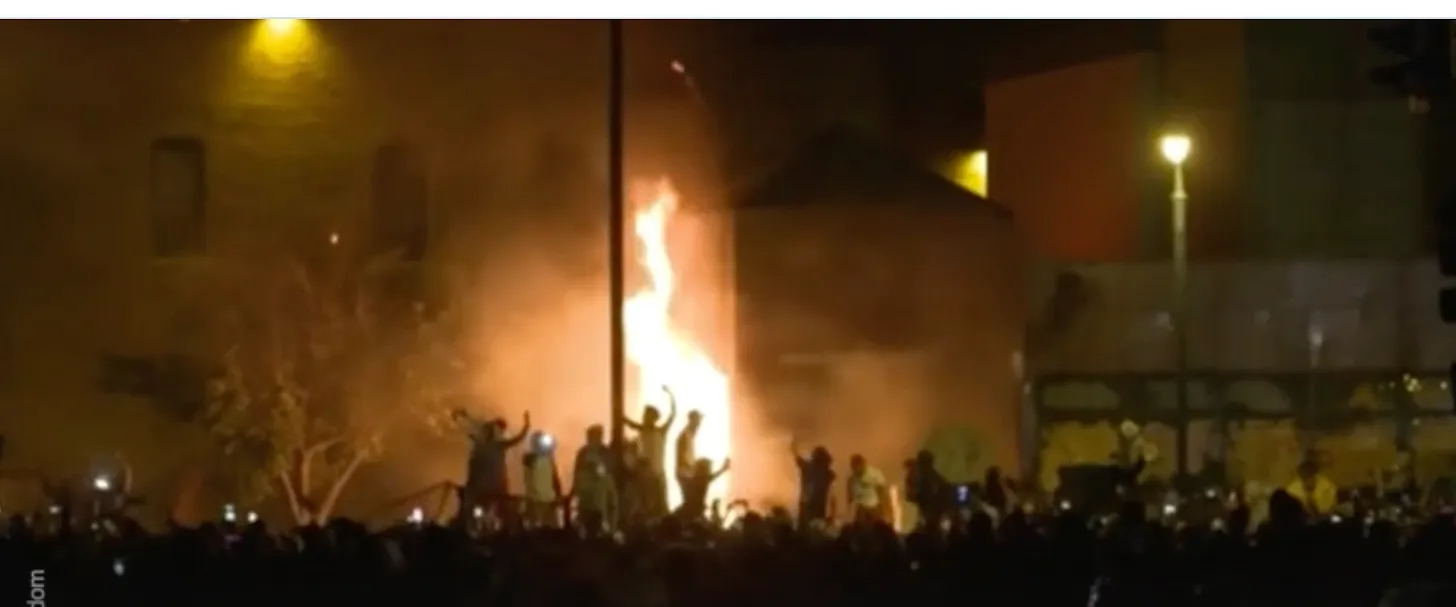
It was also Tides, allied with the Chinese Progressive Association, which whipped up and funded the BLM protests. Those things had been planned for months, cells set up in every vulnerable city, waiting for just the right trigger, which happened to be in Minnesota, which has a markedly vicious and powerful left. Hysterical, ignorant BLM activist/kids, certain that the country was irretrievably racist, filled out the ballots in the hundreds of thousands.
What will they pull in the next months? What ghastly passion play will they inflict on us? Every tiresome lie, every manufactured crisis, every false flag hysteria is meant to hide the fact that the left has failed so badly, in everything, it has lost all authority and gone rogue.
An apparent drone swarm near a US Air Force base unveiled numerous vulnerabilities in homeland air defense.
Amid the raging conflict in the Middle East, the astonishing events at Barksdale Air Force Base earlier this month have attracted only limited media attention. It is reported that swarms of unidentified drones repeatedly loitered over Barksdale between March 9 and 15, drawing no publicly known effective response from the military or the Department of Homeland Security (DHS).
Barksdale is the headquarters of the Air Force’s Global Strike Command, which is responsible for the nation’s nuclear intercontinental ballistic missiles and strategic bomber forces, including B2, B1, and B52 aircraft. The base is home to the 2nd Bomb Wing B52s and is the central hub of communications and logistical support for coordinating and directing those forces. The fact that potentially threatening drones were able to operate over such a critical complex with apparent impunity over several days, after a similar event, spanning 17 days, occurred more than two years ago at Langley AFB, is astonishing. Reports indicate that Barksdale personnel were repeatedly ordered to take cover as drones roamed over buildings and aircraft.
That there was no reported effective response to that incursion comes as no surprise to those who have been calling for an overhaul of how the US homeland is protected. The truth is that homeland defense today remains largely centered on deterring nuclear threats, such as ballistic missiles and bombers, flying over northern polar regions, launching ordinance into North America. Decades ago, the North American Aerospace Defense Command (NORAD) and the United States Northern Command (NORTHCOM) were organized primarily to deter a strategic attack utilizing weapons of mass destruction. Protected by the Atlantic and Pacific Oceans, the homeland was widely regarded as invulnerable to non-strategic threats.
Beginning first with 9/11, and now with the advent of unmanned aerial systems (UAS)—including military-style drones, and such long-range precision weapons as cruise, ballistic, and hypersonic missiles launched from space, air, land, sea, and subsea—that comfortable “safe haven” assumption no longer holds. What happened at Barksdale is not an anomaly but a forerunner of a new era in warfare. Defense of the homeland has become, and will continue to be, a far more complex challenge.
At Barksdale, as at Langley AFB, the government apparently lacked effective technology to identify and counter the drones. Even if counter-UAS capabilities (C-UAS) were available, a decision to use them was likely complicated by concern over potential collateral injury to military personnel and civilians, and property damage. Some reports indicate that Barksdale attempted to employ C-UAS jamming, but without success. The inability to jam could indicate that Barksdale was facing a threat with autonomous or effective anti-jamming capabilities. If accurate, this would suggest that a sophisticated foreign actor was behind the incursion rather than a drone hobbyist.
For example, in February of this year, US Customs and Border Protection used a Department of Defense-provided high-energy laser to engage what they believed were hostile drug cartel drones operating near Fort Bliss, close to the Mexican border. That led to controversy. The Federal Aviation Administration (FAA), part of the Department of Transportation, decided that the use of a laser made it necessary to issue an emergency order shutting down air traffic over El Paso below 18,000 feet for 10 days, citing unexplained“special security reasons,” and declaring the area to be a national defense airspace.
Further complicating the picture is that Washington has not clarified responsibility and authority over UAS policy on dealing with and countering drones. For a national-level response to a strategic attack, NORAD and NORTHCOM have elaborate, well-known, detailed decision-making protocols for the National Command Authority. The decision-making chain is clearly established, reaching all the way to the president. It is designed to operate within minutes. The decision-making process today for responding to a UAS threat or another kind of conventional attack is murkier and nowhere near as settled, often involving several cabinet departments. The military is not even necessarily responsible for taking the lead.
The agency warned that aircraft entering the restricted space could be shot down. After a few hours, the White House, which had not been consulted, intervened and rescinded the no-fly order. Washington said that the threat turned out to be party balloons, not hostile drones. News reports said that there had been wrangling between the FAA, the Pentagon, and Homeland Security over the appropriate use of a laser in an area with heavy commercial air traffic.
The El Paso experience highlights important governance issues regarding how emerging threats, such as drones and UAS, should be managed. In addition to the Pentagon, the Department of Transportation, DHS, and the FBI also play a role in such situations, as do other intelligence agencies.
As the United States comes to grips with the reality that the homeland is not immune to potential military-style drone, missile, cyber, and other non-nuclear threats, it must re-evaluate comprehensively its approach to deal with such situations on a real-time basis. Kinetic and non-kinetic tools must be swiftly introduced at strategic, critical military and civilian infrastructure locations. The decision-making apparatus necessary to identify and to respond to such threats must also be modernized and streamlined.
The bottom line is that the United States must move forward aggressively to address these new UAS threats and others emerging in the homeland. Legacy approaches defined by stove-piped responsibilities and authorities no longer work. That antiquated framework must be promptly replaced by a collaborative, integrated architectural network that enables fused domain awareness and real-time collaboration among key decision-makers. Joint Interagency Task Force 401 is a solid first step in this direction, helping propel such a reorganization. It calls for full support from all agency stakeholders. That task force should be urgently empowered at the White House level to address policy and capability gaps swiftly.
About the Authors: Glen VanHerck and Ramon Marks
General Glen VanHerck is a retired US Air Force general. At the time of his retirement, he served as commander of NORTHCOM and NORAD. He previously served as director of the Joint Staff. He currently serves as a board director and advisor across multiple industry sectors, including serving as a senior fellow at Johns Hopkins University Applied Physics Lab.




 THE ARTFUL DILETTANTE