Unknown's avatar

About theartfuldilettante

The Artful Dilettante is a native of Pittsburgh, PA, and a graduate of Penn State University. He is a lover of liberty and a lifelong and passionate student of the same. He is voracious reader of books on the Enlightenment and the American colonial and revolutionary periods. He is a student of libertarian and Objectivist philosophies. He collects revolutionary war and period currency, books, and newspapers. He is married and the father of one teenage son. He is kind, witty, generous to a fault, and unjustifiably proud of himself. He is the life of the party and an unparalleled raconteur.

MAGA Split over Iran Splinters Trump Allies

The prospect of U.S. involvement in an increasingly volatile conflict between Israel and Iran has cleaved clear divisions within the MAGA movement – a rarity over the course of President Trump’s decade-long political career.

Top Trump allies have pleaded their case in recent weeks directly to the president and on social media for why the U.S. should fully avoid engaging in any dispute between Iran and Israel. On another side, other Trump allies are arguing it is in the president’s interest to take a more aggressive posture toward Iran.

Some have suggested the schism could fracture the president’s coalition. Sources who spoke with The Hill downplayed that notion, arguing Trump is the ultimate arbiter of what constitutes “America first.”

Here is who falls into each camp.

Advocating for non-intervention

A vocal group of influential MAGA voices have been banging the drum in recent days to argue against any kind of U.S involvement in a conflict with Iran.

Those figures have made the case that targeting Iran would contradict Trump’s “America First” foreign policy rhetoric and would echo the mistakes of the George W. Bush administration, which Trump has sharply criticized.

“This is exactly the same pitch as the Iraq war,” former Trump chief strategist Steve Bannon said on Tucker Carlson’s show on X.

Carlson has also been an outspoken opponent of U.S. involvement in the Middle East, going as far as to call out by name individuals he claimed were “warmongers” in the president’s ear.

The former Fox News host voiced frustrations after Israel late last week launched missile strikes against Iran’s nuclear facilities and killed multiple top Iranian military officials. Carlson wrote that Trump was “complicit in the act of war” and said what occurs next in the region “will define Donald Trump’s presidency.”

Those comments did not sit well with Trump, who derided Carlson as “kooky” in a social media post.

Coming to Carlson’s defense was a typically staunch Trump ally: Rep. Marjorie Taylor Greene (R-Ga.). She posted on X that Carlson’s opposition to foreign wars did not make him “kooky.”

“Americans want cheap gas, groceries, bills, and housing. They want affordable insurance, safe communities, and good education for their children. They want a government that works on these issues,” Greene posted on Tuesday.

“Considering Americans pay for the entire government and government salaries with their hard earned tax dollars, this is where our focus should be,” Greene added. “Not going into another foreign war.”

Brett Samuels, The Hill

Why President Trump Stepped Out

There are moments in history when the world needs more than a diplomat. It needs a man of action. A commander. A decider. A leader. This week, when Iran escalated the war with Israel, the rest of the globe issued statements and expressed “grave concern.” President Donald J. Trump left the G7 Summit early, stepped on Air Force One, and went home to get to work.

That’s the difference.

While the international elites clinked wine glasses and crafted nonbinding resolutions, President Trump did what he always does: led.

This was not a war he asked for. It wasn’t one he provoked. But it was one that carried consequences far beyond the Middle East—and President Trump understood that. Iran’s sustained campaign of terror, its deep-pocketed funding of Hamas, Hezbollah, and the Houthis, and its nuclear ambitions have long threatened not only Israel’s existence, but the global order itself. There is no stability in Europe or Asia if Tehran becomes a nuclear power. Period.

And unlike the paper-pushers in Brussels and the Ivy League think tanks back home, Trump never waited around for the “perfect time” to act. There never was one. Whether it was taking out Soleimani in 2020, brokering the Abraham Accords, or cutting off Iran’s financial lifeline, Trump always understood that bold leadership shapes outcomes. Hesitation merely concedes the battlefield.

Iran crossed a line this week. Not just by striking Israel again, but by openly daring the West to respond. And while every other world leader scrambled for cover or PR statements, Trump made the call: the game had changed. The time to act had come.

The critics were instantly breathless. “But the G7!” they shrieked. “Trump is abandoning America’s allies!” Nonsense. The G7 isn’t a wartime alliance. It’s a photo-op for bureaucrats who never put on a uniform. Our real allies—those who share our values, face our enemies, and actually carry the burden of freedom—are in Jerusalem, not Geneva.

Let’s be clear: Trump didn’t leave the summit in disgrace. He left it to do something the rest of the world’s leaders couldn’t—or wouldn’t—do: defend peace through strength.

That phrase may sound Reaganesque—and it is. But it’s also Trump’s foreign policy in action. Iran only understands force. During his first term, Trump had their economy on the verge of collapse. There were no uranium enrichment parties in Natanz. No missiles flying toward Tel Aviv. The ayatollahs feared the White House. But under the weakness of the previous administration, they had become emboldened—and alarmingly close to nuclear capability.

Which is why this moment matters so much.

No American president in recent memory had been willing to take the decisive steps necessary to prevent a nuclear Iran. Obama paid them off. Biden turned a blind eye. Even Bush let it simmer. Trump? He was never interested in kicking the can. He was interested in removing the threat—permanently.

And if that required stepping away from a summit of speechmakers to engage in actual statecraft, so be it. History will remember it as one of the most consequential—and courageous—moves of his second term.

What comes next won’t be easy. There will be resistance. The media will foam. Europe will protest. The usual suspects at the UN will wring their hands and pass toothless resolutions. But this isn’t about appeasing international bodies—it’s about securing international peace. And Trump understood something they didn’t: peace through weakness is an illusion. Peace through dominance is reality.

Let’s be clear: Trump didn’t leave the summit in disgrace. He left it to do something the rest of the world’s leaders couldn’t—or wouldn’t—do: defend peace through strength.

That phrase may sound Reaganesque—and it is. But it’s also Trump’s foreign policy in action. Iran only understands force. During his first term, Trump had their economy on the verge of collapse. There were no uranium enrichment parties in Natanz. No missiles flying toward Tel Aviv. The ayatollahs feared the White House. But under the weakness of the previous administration, they had become emboldened—and alarmingly close to nuclear capability.

Which is why this moment matters so much.

No American president in recent memory had been willing to take the decisive steps necessary to prevent a nuclear Iran. Obama paid them off. Biden turned a blind eye. Even Bush let it simmer. Trump? He was never interested in kicking the can. He was interested in removing the threat—permanently.

And if that required stepping away from a summit of speechmakers to engage in actual statecraft, so be it. History will remember it as one of the most consequential—and courageous—moves of his second term.

What comes next won’t be easy. There will be resistance. The media will foam. Europe will protest. The usual suspects at the UN will wring their hands and pass toothless resolutions. But this isn’t about appeasing international bodies—it’s about securing international peace. And Trump understood something they didn’t: peace through weakness is an illusion. Peace through dominance is reality.

And here’s the kicker: a decisive strike on Iran’s nuclear capabilities doesn’t just protect Israel. It buys the rest of the world breathing room. Specifically, it delays—possibly by years—China’s appetite for aggression.

Make no mistake: the Chinese Communist Party is watching this conflict like a hawk. If the U.S. folds, they move on Taiwan. If we show resolve, they blink. And right now, President Trump is giving Xi Jinping a masterclass in deterrence.

The big tamale is always China. The entire geopolitical chessboard—from oil prices to Pacific shipping lanes—comes down to whether or not Beijing believes the United States is serious about protecting freedom. Taking Iran’s nukes off the table sends exactly the right message: poke the eagle and you get the talon.

So let the think-piece crowd moan. Let the diplomats drone on about “process” and “international consensus.” Trump is doing what the job requires. What the moment demands. What the future depends on.

He’s leading.

And the world is already safer for it.

Kevin McCullough, Townhall

WSJ: Trump Mulls Options, Including Strike on Iran

President Donald Trump said he is considering a range of options on Iran, including a strike on the Islamic Republic, The Wall Street Journal reported Tuesday.

Trump was discussing those options with top security advisers in the Situation Room, according to the report. The Journal reported that the meeting concluded Tuesday afternoon after nearly 90 minutes.

It’s unclear if any decision was reached during the meeting. The Journal reported that Trump’s goal is that Iran not be able to develop nuclear capabilities.

reported another option for Trump is enlisting the U.S. Air Force to help refuel Israeli fighter jets as they execute strikes in Iran. More than 30 refueling tankers have assembled in the region over the last several days, according to the report.

Earlier Tuesday, Trump called for Iran’s “unconditional surrender” and said the U.S. knew “exactly where” Iran’s Ayatollah Ali Khamenei was hiding.

“He is an easy target, but is safe there — We are not going to take him out (kill!), at least not for now,” Trump said in a post to Truth Social.

Trump prematurely left the G7 summit in Canada on Monday night, saying he had to get back for something “much bigger” than a ceasefire between Iran and Israel. He said he wanted “an end, a real end, not a ceasefire.” He also urged Iranian citizens to evacuate the capital city of Tehran, spurring speculation that action against Iran was imminent.

Early Tuesday morning, Trump said in a post to Truth Social that he had not reached out to Iran for peace talks “in any way, shape, or form.”

“If they want to talk, they know how to reach me. They should have taken the deal that was on the table — Would have saved a lot of lives!!!” he said in the post.

Mark Swanson 

Mark Swanson, a Newsmax writer and editor, has nearly three decades of experience covering news, culture and politics.

Trump threatens Iran’s leader, demands ‘unconditional surrender’

Trump threatens Iran’s leader, demands ‘unconditional surrender’

President Donald Trump on Tuesday warned Iranian leader Ayatollah Ali Khamenei that he is an “easy target” and “our patience is wearing thin,” before demanding Tehran surrender in its conflict against Israel.

“We know exactly where the so-called ‘Supreme Leader’ is hiding,” Trump wrote on Truth Social.

“He is an easy target, but is safe there – We are not going to take him out (kill!), at least not for now,” he wrote after declaring “total control” over Iran’s airspace.

“But we don’t want missiles shot at civilians, or American soldiers. Our patience is wearing thin.”

Trump in a subsequent post made clear what he does want from Iran: “UNCONDITIONAL SURRENDER!”

The threat from the U.S. president came two days after news outlets reported that Trump vetoed a plan by Israel to assassinate the ayatollah.

Israeli Prime Minister Benjamin Netanyahu on Monday downplayed his reported disagreement with Trump over

Khamenei, saying, “I wouldn’t rush to conclusions.”

The Trump administration has previously insisted that the U.S. was not directly involved in what Israel called a preemptive strike against Iran on Friday, which kicked off five days of missile fire between the two regional powers.

But Trump’s latest comments suggest the U.S. is now at least willing to threaten direct military intervention as it backs Israel’s effort to bring Tehran to heel.

U.S. stocks slid Tuesday afternoon as the geopolitical tensions mounted. The Dow Jones Industrial Average fell more than 300 points, or 0.7%, while the S&P 500 declined 0.8% and the Nasdaq dropped 0.9%.

Crude oil futures jumped more than 3% to above $74 per barrel around 2 p.m. ET.

The Pentagon, meanwhile, is moving more warships and another aircraft carrier to the Middle East, NBC News reported Tuesday. The U.S. previously deployed military assets to the region to help Israel shoot down Iranian missiles and projectiles, according to NBC.

Trump is expected to hold a meeting in the Situation Room on Tuesday afternoon to discuss the Israel-Iran conflict with his top national security advisors.

On Monday, Trump abruptly returned to Washington, D.C., from Canada, where he had traveled for a meeting of the Group of Seven nations.

Before he left, Trump criticized the G7 for kicking Russia out of the group in 2014 after its annexation of Crimea.

Trump teed up Tuesday’s threat against Khamenei with an earlier social media post declaring, “We now have complete and total control of the skies over Iran.”

Tehran “had good sky trackers and other defensive equipment, and plenty of it, but it doesn’t compare to American made, conceived, and manufactured ‘stuff,’” Trump wrote.

“Nobody does it better than the good ol’ USA.”

The New York Times reported Monday that Trump is weighing whether to help Israel destroy Iran’s underground uranium enrichment facility at Fordo, which could only be accomplished with the U.S.′ biggest “bunker buster” bomb.

The White House did not immediately respond to CNBC’s request for comment on that report, or on other questions about the latest developments in the Israel-Iran conflict.

Kevin Breuninger, CNBC

Israel Saves Civilization

Within the span of a week, what was begun by Israel on June 13 could easily be a replay of Sept. 12, 1683 when Poland’s Winged Hussars, as led by King Jan Sobieski III, broke the siege of Vienna and saved Central Europe from Ottoman subjugation.

Israel is about to put an end to more than forty-five years of regional and worldwide state-sponsored terrorism by Iran’s theocrats, although the very people whom Israel saves are unlikely to thank them for it. Israel’s role is in fact similar to margraves, voyevodes, and similar border lords who, often at high costs to themselves, defended the ungrateful civilizations behind them from the barbarians and savages in front of them. We are, quite frankly, watching history in the making.

A Margrave’s Lot is Not a Happy One

Science fiction writer Poul Anderson’s “Among Thieves” is highly instructive. It is set in the distant future, with an on-and-off “forever war” between the planets Norstad and Osterik (the first is reminiscent of Germany, and Osterreich is Austria) and Kolresh, a space-faring nation of what are essentially pirates and terrorists. Neither can really get at the other because the first side cannot match the other in space, while the second cannot match the first’s army.

Iran has similarly been a state sponsor of terrorism for more than forty years, while Israel has fought terrorists even before it became a country; hence the relevance of this discussion.

We can easily imagine ayatollah-ruled Iran as Mother Jihad, similar to Mother Ginger in the Nutcracker except she has terrorists instead of ballet dancers under her voluminous skirt.

In Anderson’s story, the Margrave of Drakenstane — draken is Swedish for dragon, and stane is Old English for stone — pretends to collude with Kolresh to invade Earth and its associates, who have done very little to protect the frontier or “march” regions. Margrave means, in fact, Mark-Graf or border lord. His own people berate him for siding with the enemies they have fought for generations, and throw stones at their own soldiers when they board the enemy troop transports and accompanying warships to attack Earth.

However, at an appointed time, the Drakenstane officers order their men to attack the crews of the “allied” warships and transports. They know they will die if they fail to capture the ships, and many do, but now the Kolresh fleet is in the hands of Norstad and Osterik, and the forever war is over. The pirates and terrorists are disarmed and will never menace civilization again, but the Margrave says in essence “Don’t bother to thank us” because he doubts the decadent inhabitants of Earth, who have been hiding behind his own people for decades — much as a good part of the civilized world has hidden behind Israel — will do so.

Israel will similarly put an end to the puppet master behind the Houthi pirates, Hezbollah terrorists who murdered U.S. Marines in Beirut, Hamas, Instagram moderators who work side jobs for the ayatollahs, and many domestic enablers of the terrorists in question.

I doubt Israel will get much in the way of thanks either, except from the Persian people themselves.

Anderson appears to have modeled his Margrave on very real people who held similar roles throughout history. These warlords all had the duty of defending the civilizations behind them against barbarians, robbers, and enemy countries like the Ottoman Empire.

Austria’s Grenzers (border guards) performed this function against the Ottomans, and the United States’ own history includes many people whose job was to protect settlements from hostile natives, hostile foreign countries, bandits, and outlaws.

Wikipedia explains

Margrave was originally the medieval title for the military commander assigned to maintain the defence of one of the border provinces of the Holy Roman Empire or a kingdom.

In England, a “marcher lord” guarded the frontier between Wales and Britain. Scotland and England both had a “Lord Warden of the Marches” who were responsible for dealing with criminal activity in the border region. The voyevodes of the Polish-Lithuanian Commonwealth had similar responsibilities on the Crimean and Turkish frontiers, and it is telling that voyna is the Slavic word for war.

Margraves, march-wardens, and voyevodes were all what Rudyard Kipling depicted as the “uniforms that guard you while you sleep,” and he pointed out that the soldiers who protected England were not well treated either.

Make no mistake; Israel is now the Margrave of civilized humanity, and the IDF’s personnel are now the uniforms that guard us all while we sleep.

We sit, quartered comfortably and safe out here, with two oceans between us and the terrorists, while some Israelis have about thirty seconds to reach bomb shelters when Hamas launches rockets. Students and faculty at our colleges, most of whom would be raped and/or killed if they fell into Hamas’ or Iran’s hands, bleat when Israel defends its own people. A Margrave’s lot is indeed not a happy one, but now the forever war and cycle of violence between Israel and the terrorists needs to come to an end.

Persians Must Topple the Ayatollahs

Everybody knows that, if one lets even a handful of cancer cells survive, the cancer will eventually return. It is not enough for Israel to disable Iran’s nuclear program. As Israel has already disrupted Iran’s military forces, this is the best time for the Persian people to take their country back from the medieval savages who hijacked it in 1979.

Israel’s name for its operation, Rising Lion, might in fact relate not to Israel’s Lion of Judah, but rather the Lion and Sun on the pre-1979 Iranian Flag. Reza Pahlavi has urged his people to rise up and depose the ayatollahs.

The jailers and torturers at Evin Prison, about which Amnesty International actually has something worthwhile to say, should take note of the following:

During the Second World War, Americans liberated the Dachau concentration camp. The Americans and some of the inmates put the guards up against the nearest convenient wall and shot them. The fate of Benito Mussolini, at the hands of his own people, meanwhile speaks for itself. Evin’s jailers and torturers should therefore unlock all the cells, leave the prisoners with the best available food and clothing, and decamp quickly to somewhere like Russia, Communist China, or North Korea before they get similar treatment from their victims and the victims’ families.

The same goes for the ayatollahs, religious judges, and police who have tortured, raped, and/or executed women for not wearing hijabs and hanged LGBT people and Baha’is. They need look no further than the Nuremberg defendants who were fitted with Pierrepoint neckties for similar crimes against humanity. That’s Pierrepoint, not Pierrepont; the extra ‘i’ makes all the difference between a fashionable garment and a broken neck, as in the Danny Deever treatment. Some have already seen the handwriting on the wall, and are fleeing the country.

When the ayatollahs go down, expect to see major changes throughout the world. The Houthi pirates, who produce nothing themselves, should dry up and blow away in the absence of their Iranian sugar daddies. The same might happen to Hezbollah and Hamas, which are totally dependent on foreign aid.

The same goes for many organizations that are causing trouble in our universities and on our streets — no Iranian oil money, no rioting or vandalism. Meanwhile, although the stock market fell on June 13 when Israel attacked Iran, I expect it to go up quickly once investors realize the Houthi pirates will be out of the picture and Iran will no longer be sponsoring violence around the world.

Civis Americanus is the pen name of a contributor who remembers the lessons of history, and wants to ensure that our country never needs to learn those lessons again the hard way. He or she is remaining anonymous due to being subjected to “cancel culture” for denouncing Black Lives Matter’s incitement of civil disorder.


Real reason Israel had to launch pre-emptive strike against Iran

Israel and Iran are not “trading blows” as some have phrased it. Israel is dealing strategic devastation on Iran, eliminating much of the terrorist regime’s military top brass and key nuclear scientists , and attacking nuclear weapons sites, air defence systems, and offensive drone and missile capabilities.

Meanwhile Iran is lashing out with drones and ballistic missiles, fired into Israel’s population centres, deliberately killing and wounding civilians in places like Tel Aviv, the most densely populated city in the country. Here, for the last two nights I have heard ballistic missiles roar overhead and seen Israel’s impressive air defences knock some of them out of the sky.

Those missiles that did get through told a terrifying story. What if just one of them had been armed with a nuclear warhead? Vast numbers would have been killed. That’s why Israel had to launch this pre-emptive assault on the Islamic Republic. Israeli intelligence and the International Atomic Energy Agency both saw that Iran was on the cusp of obtaining nuclear weapons capability.

Had they been allowed to get to that point we must assume they would use them in pursuit of their frequently declared intent of destroying Israel. That Jerusalem has nuclear weapons would not have deterred them.

fanatical ayatollahs in Tehran wouldn’t care how many of their own people were sacrificed in pursuit of their religious duty of annihilating the Jewish state. As for the rest of the world, it should be grateful to Israel because a nuclear armed Iran would have threatened us all.

The ayatollahs have repeatedly shown their unbridled thirst for violence before, including killing British soldiers in Iraq and Afghanistan and attempting terrorist attacks in our country.

All wars are terrible but sometimes they have to be fought to prevent an even worse evil.

Colonel Richard Kemp

King-less ?

Realize where we are.” — Oilfield Rando on “X”.

Saturday morning, we toodled over to the next town, Salem, New York, (pop. 2,612, per capita income $19,499) fifty miles northeast of Albany, to catch one of the hundreds of “No Kings” demos across the nation sponsored by Shanghai-based software billionaire Neville Roy Singham, Walmart heiress Christy Walton, Paypal partner (and Linked-in founder) Reid Hoffman, and father-and son team, George and Alex Soros.

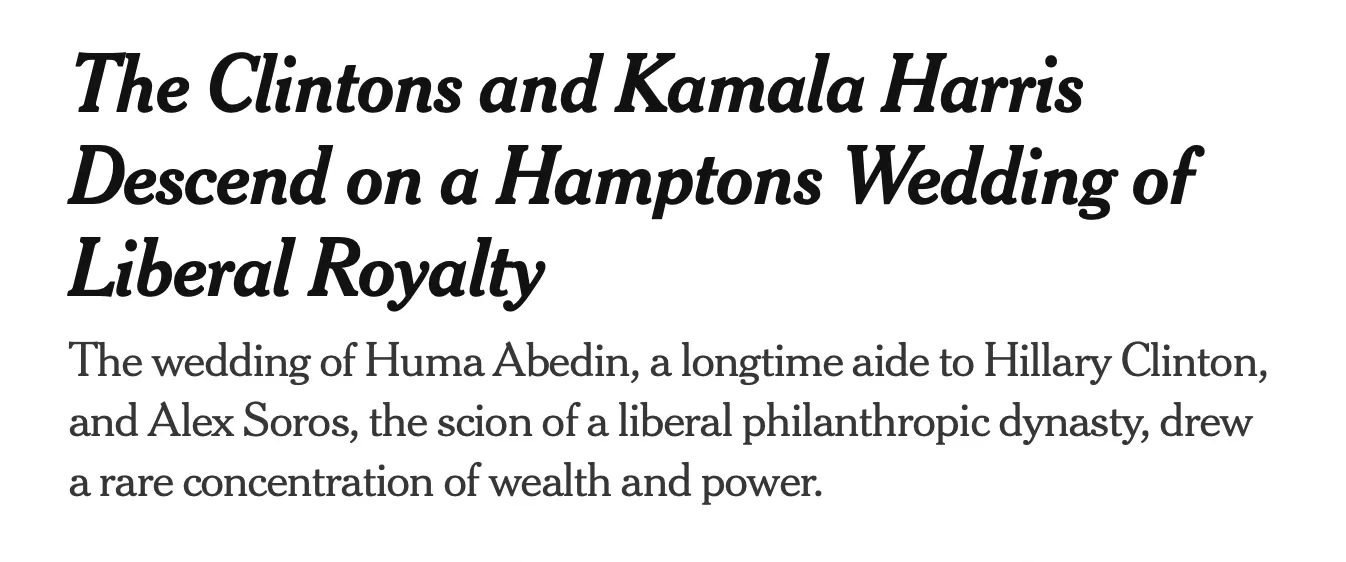
Speaking of Alex Soros, Saturday also happened to be his wedding day, to Huma Abedin, former Hillary Clinton sidekick and BFF (and ex-wife of disgraced congressman and convicted sex offender Anthony Weiner.) The nuptials happened at the Soros’s Hamptons estate. Cable news covered the fabulous cavalcade of black Escalade limousines conveying the super-elite of Progressive-Wokery to the glorious event. The New York Times, with its habitual lack of self-awareness, styled the event thusly:

“Liberal royalty?” Say, what. . . ? There is such a thing? In the party of No Kings? What’s the deal, then? Just princes and princesses, dukes and duchesses, earls, viscounts, baronets, lairds, marquis, knights and dames, and so on. Yet, no king? Well, if you asked the fortunate wedding guests, they might aver to Hillary Clinton as a sort-of Queen of the party, or maybe just Queen Bee. As for former president Bill, he appears to be undergoing slow-motion mummification, so he currently occupies an ambiguous zone between this world and the next, with no mojo left for kingly duties. Anyway, it rained that day down on the South Fork.

Meanwhile, back upstate, cloudy and cool but no rain, some two-hundred wrathful plebeian souls gathered at the one-stoplight-intersection in little Salem, these days mainly a farm community, the old railroad engine repair shop defunct, and many good non-farm jobs with it, the usual story in this corner of the country. The hopped-up crowd was well-supplied with signs and placards, many avouching Down with Oligarchs! — which, oddly, seemed a sort of backhanded reference to billionaires of the very type underwriting the day’s festivities, not to mention the super-rich “liberal royalty” gang gathered for the Soros-Abedin royal wedding.

But that was only one of the many incongruities haunting the mass protest against the abhorred president, Mr. Trump. For instance, one poor fellow on the southeast corner of South Main and East Broadway inveighed mournfully against the suppression of free speech, apparently unaware of the epic efforts 2021 to 2025 by “Joe Biden’s” underlings to censor the Internet and de-platform the regime’s critics (including yours truly, whose website was mysteriously destroyed in October 2024).

The moiling mob was overwhelmingly geriatric, perhaps reflecting the backwater demographics of a region with few job opportunities for young folk. A spirit of revival bubbled among them as they reenacted old rituals of the hippie halcyon, the grand old days of the Vietnam War protests, when thousands gathered to levitate the Pentagon. Only now, their sentiments and beliefs exhibit a striking and peculiar inversion of the ancient 1960s credos that drove the beloved Movement.

I know because I was there, on campus, between 1966 and 1971. Back then, the Left opposed the wicked “establishment” and all its nefarious operations, from the war in Vietnam to the FBI’s underhanded suppression of political dissent. These days, strange to relate, the Left stands in staunch defense of the Deep State, big government (and its prodigious corruption), and the politicization of the FBI and CIA.

Their placards lament the withering of “our democracy,” yet they were just fine with “Joe Biden” selecting a 2024 presidential candidate for them — with no customary vote by party delegates, or anything approaching an open democratic process. They shout for the “rule-of-law,” except when it concerns special persons such as the former president’s crackhead, bag-man son. They’re all for the colossal grift around the war in Ukraine. And don’t forget they supported vaccine mandates, the closing and ruination of small businesses (while Walmart and Taco Bell were allowed to thrive), and all the other hypocritical, fraudulent, lethal actions of Covid-19 policy.

The object of the “No Kings” shuck and jive, you might suspect, was to prepare so many friction-points around the country that violence was apt to erupt in order to create a George Floyd-type martyr figure, so as to re-energize the Left for another sustained summer of riots. There was plenty of mayhem around the country but, alas, no martyr emerged, no apotheosis of “progressive” victim-hood. . . only the peculiar murder of two Minnesota legislators by an apparently deranged Democratic party fringe character, the sometime evangelist and Tim Walz appointee, Vance Boelter.

$65-million is a plausible number for the money spent by billionaires and political NGOs on the nation-wide “No Kings” project. A lot of that was paid directly to protesters for just showing up. (They ran ads on Craig’s List to enlist players.) None of them showed up in the Hamptons, though, where “liberal royalty” assembled for their special event. You’ve got to think that they missed something rather bigly there.

James Howard Kunstler

Trump: ‘We want a real end to Iran threat, not a ceasefire’

President Donald Trump reaffirmed his commitment to addressing Iran’s nuclear program during remarks made to the press aboard Air Force One as he headed back to Washington, DC, following an early departure from the G7 Summit in Canada.

Trump emphasized his desire for a decisive resolution to the nuclear standoff, stating, “I want a real end,” and clarified that he was not seeking a temporary ceasefire. “I didn’t say I was looking for a ceasefire,” he told reporters. “I want a real end, with Iran giving up entirely on nuclear weapons.”

The president also expressed confidence in Israel’s ongoing actions against Iran. “The Israelis aren’t slowing up their barrage on Iran,” he said. “You’re going to find out over the next two days. Nobody’s slowed up so far.”

On the topic of civilian safety, Trump noted that while he understood the gravity of the situation, his primary concern remained ensuring “people are safe.” He added that he needed to be in Washington, where he could be better informed, rather than relying on phone updates while in Canada. “I need to be present at the White House, not Canada, to be well-versed on the situation,” he explained.

While Trump did not confirm whether he would send US officials like Witkoff or Vice President Vance to engage with Iran, he left the door open. “I may,” he said, “but it depends what happens when I get back.”

Regarding any potential threats to US interests, the president stressed a clear warning to Iran. “Iran knows not to touch our troops,” he declared, adding that if they did, the US would respond decisively. “We’d come down so hard if they do anything to our people.”

Trump remained tight-lipped about US military planning in the event of an Iranian attack on American bases in the region, refusing to divulge details on whether military leaders have provided him with options. “I can’t tell you that,” he said.

When asked whether members of the US Senate’s Gang of Eight had been briefed, Trump responded that it wasn’t strictly necessary. “We’ll be talking to them,” he stated, “but it’s not necessary.”

As for the long-term goal, Trump expressed hope that Iran’s nuclear program would be dismantled before it ever became a target for US military intervention. “We hope their program is wiped out long before that,” he concluded.

President Trump later rejected claims that he is pushing for peace talks with Iran, writing on social media: “I have not reached out to Iran for ‘Peace Talks’ in any way, shape, or form. This is just more HIGHLY FABRICATED, FAKE NEWS! If they want to talk, they know how to reach me. They should have taken the deal that was on the table – Would have saved a lot of lives!!!”

Israeli National News

Brian Wilson’s California Died Decades Ago

Mass immigration from Mexico, legal and illegal, transformed California and created a fractured, riotous, and unstable polity.

The sad news that Brian Wilson, the musical genius behind the Beach Boys, died last week at 82 carried with it a strange and foreboding symbolism. His death came as Los Angeles was reeling from a series of riots — and poised to plunge into a period of sustained civic unrest.

The immediate cause of the unrest is violent opposition to the legitimate enforcement of federal immigration law, especially among Mexican nationals and Mexican-American residents of Los Angeles. In recent days we’ve all heard impassioned declarations from anti-ICE protesters, rioters, and many in the corporate press along the lines that “Los Angeles belongs to Mexico,” or that California was “stolen” from Mexico.

At the heart of these protests and riots we have seen, in short, the assertion of a specifically ethnic and Mexican national identity over and against an American national identity — immortalized in the striking images of masked rioters waving the Mexican flag amid burning vehicles, rubble, and beleaguered police.

That all this was happening in California, and that Wilson passed away in the middle of it all, underscores just how much California has been demographically and culturally transformed by mass immigration from Mexico since the 1960s. Put bluntly, the California that Wilson sang about died long before he did. Through the mass immigration regime established by the 1965 Hart-Celler Act, what was once a stable bastion of American life and culture — that for many people epitomized the American dream — was replaced by an inherently volatile and fractured polity built on the unstable foundation of multiculturalism and competing ethnic identities.

When the Beach Boys released their first album Surfin’ Safari in 1962, and in quick succession released follow-ups Surfin’ USA, Surfer Girl, and Little Deuce Coupe in 1963, California was about 90 percent white and its Hispanic population was rather small, about 7 percent (today those shares are 34 and 40 percent, respectively). The culture, industry, and infrastructure of California were the creation of non-Hispanic whites who settled there from the late-19thto early-20th century. Neither Los Angeles nor California at large in any sense “belonged to Mexico” or was even Mexican in a cultural sense.

California in the 1960s was more racially and ethnically diverse than many other states, owing partly to its geographical size and unique history, but it was nevertheless overwhelmingly white and Christian — like the rest of America at the time. In contrast to the fractured identities and split loyalties of our time, mid-century Americans had a shared identity and culture — and shared loyalties and loves.

No wonder, then, that the country was adept at assimilating a relatively small number of immigrants through the maintenance of norms around citizenship, social cohesion, and national interests. We had not yet severed a tradition of patriotic assimilation stretching back 200 years that allowed us to incorporate newcomers into a robust and confident American polity. George Washington’s hopes had been vindicated, that immigrants, “by an intermixture with our people, they, or their descendants, get assimilated to our customs, measures, and laws: in a word, soon become one people.”

That we were in fact one people with a common culture could be heard in the popular music we produced. The iconic sound cultivated by Wilson and the Beach Boys during their most popular and influential period, from their debut album in 1962 to Pet Sounds in 1966, was sometimes called the California Sunshine Sound, and it evoked an innocence, optimism, and playfulness appropriate to a society with every reason to be confident and hopeful about its place and the world. California, as Michael Anton writes in his book The Stakes, “was the greatest middle-class paradise in the history of mankind. Yet, in barely one generation, that California was swept away and transformed into a left-liberal one-party state.”

How did that happen? It began with the passage of Hart-Celler in 1965, which transformed the basis of immigration and ushered in a period of rapid demographic change in America. The new immigration regime created by Hart-Celler abandoned the quota-based immigration system that had prioritized immigration from European countries that shared closer cultural, religious, and ethnic ties to the United States. Instead, immigration under Hart-Celler would be based on family reunification, the need for workers, and the protection of refugees.

At the time, Democrats like President Lyndon B. Johnson and Sen. Ted Kennedy assured voters that Hart-Celler would not, in Kennedy’s infamous declaration, “disrupt the ethnic composition of our society.” They were wrong. 

Indeed, the long-term effects of Har-Celler cannot be overstated. In short, it worked a radical demographic transformation of America in a matter of decades. Prior to 1965, about 84 percent of all immigrants to the U.S. came from Europe, with only about 10 percent from Mexico and Latin America. Today, nearly half of all immigrants hail from Mexico and Latin America, with around 30 percent coming from South and East Asia, while immigrants from Europe and Canada make up only about 12 percent.

Hart-Celler was of course not the only factor in the massive cultural upheavals of the 1960s, which included urban race riots, the sexual revolution, and the anti-war protests connected to the Vietnam War. But Hart-Celler worked its changes over decades, such that by the 1990s, California in particular had gone through a massive demographic shift, with huge numbers of Hispanic immigrants — many of whom attained legal status thanks to President Ronald Regan’s 1986 amnesty to nearly three million illegal immigrants.

These sweeping demographic changes heralded profound political changes. Reagan, a popular former governor of California, swept the state in consecutive presidential elections in the 1980s. But by the early 1990s Democrats had come to dominate California politics, and they have since cemented their control over the state.

When Democrats were taking control of California, however, they were not the champions of open borders and mass immigration they are today. Voters in both parties recognized the deluge of immigration unleashed by Hart-Celler was a destabilizing force in civic life, and they wanted to do something about it. In 1994, California residents overwhelmingly passed Proposition 187, which denied state benefits to illegal immigrants.

Opponents of the measure, including the president of Mexico and the Democratic gubernatorial candidate, Gray Davis, who succeeded Republican Pete Wilson, claimed it was xenophobic and racist. Mass protests ensued that explicitly appealed to ethnic identities and divided national loyalties, with student demonstrations and walk-outs featuring marchers waving the Mexican flag — a controversial move at the time that many establishment Democrats and opponents of prop 187 denounced, arguing that protesters should be waving American flags. The measure was eventually struck down by a federal judge, sealing California’s demographic fate. 

The subsequent success of California Democrats has come in part from pandering to the state’s large Hispanic immigrant minority, promoting a concept of citizenship that rejects assimilation and patriotism in favor of what Mike Gonzales has called the “transnational multicultural movement,” which champions “the novel idea that immigrants should reject assimilation, retain loyalty to their country of birth, and become active participants in the American political process.”

The result of this reckless and indeed revolutionary idea is what we now see playing out on the streets of Los Angeles: Mexican flags flown in defiance of U.S. law enforcement amid rioting and looting, fractured political identities among an immigrant population that maintains loyalties to foreign nations, and a social order without cohesion or stability.

A nation cannot survive under these conditions. It will eventually come apart. Sixty years after setting the policy conditions in place, California — and by extension, all of America — is doing just that.

John Daniel Davidson is a senior editor at The Federalist. His writing has appeared in the Wall Street Journal, the Claremont Review of Books, The New York Post, and elsewhere. He is the author of Pagan America: the Decline of Christianity and the Dark Age to Come. Follow him on Twitter, @johnddavidson.
Perhaps Rube Goldberg Can Fix the New York City Housing Authority

Over the years I have returned repeatedly to the subject of the New York City Housing Authority, or NYCHA. Begun with great optimism prior to World War II, NYCHA expanded rapidly in the 1960s and 70s, until it housed around 500,000 people. The economic model was always pure unmodified socialism — the government owns everything, rents are tied to income (“to each according to his needs”), and any shortfalls in paying costs fall on the taxpayers. But after all, we will save oodles of money because there will be no profits for the evil developers. For a few of my prior posts, see here, here and here

The socialist economic model always lacked any mechanism to renew the capital investment in the buildings as they aged. After 2000, buildings were turning 30, 40 and even 50 years old. Beginning in the 2010s, NYCHA started regularly announcing large sums of money that it claimed it needed urgently for major repairs to these buildings. These numbers started at $17 billion in 2015, but escalated rapidly, first to $25 billion, and then to $32 billion in 2021. In 2023 there was a new “audit,” and suddenly the number became $78 billion. In the New York Post article at that last link, Mayor Adams is quotes as saying “[O]nly the federal government can provide the level of funding needed to overcome decades of disinvestmnt in the hundreds of thousands of New Yorkers who call public housing home.”

I don’t think that will happen in the Trump administration.

So at this point there is only one remotely feasible way forward for NYCHA, which is privatization in some form or another. I have repeatedly proposed the most obvious and workable route: give the buildings to the residents. No charge. I’d even be OK with a relatively slow real estate tax phase-in. Once they own the buildings, the residents can, if they wish, use their equity to borrow to make the needed improvements. But honestly, in most cases, the buildings are in such bad shape that the residents/new owners will be smarter to sell, take the money, and move somewhere else. In the case of many buildings which now find themselves in desirable neighborhoods, the residents will become millionaires. Meanwhile, the buyers in all likelihood would knock the buildings down and build something much better.

Adopting this proposal would be a huge win for both the residents and the taxpayers. Essentially, it manufactures and unlocks large amounts of wealth currently suppressed in the socialist ownership model. As long as the buildings are owned by the City, the apartments cannot be bought or sold, and have zero value. As soon as they can be traded, the apartments — or the buildings as a whole — will have values comparable to other buildings in their neighborhoods. In most Manhattan neighborhoods, that will mean values in the range of $1 – 2 million per apartment, and even substantially more in some cases.

Needless to say, this proposal is complete anathema to everyone involved, at least to the politicians, the bureaucrats, and the residents. To all of those, the starting point for any possible reform is that the existing tenants get to keep their existing economic arrangements for life without any change. That means that they don’t get to be owners. Somehow, it seems, the tenants are ready to go along with that. Maybe once you have been lulled into government dependency, any small level of economic risk in life becomes unbearable, even if you stand to become a millionaire.

And thus we get a proposal for restructuring some housing authority properties that could only have come from the mind of Rube Goldberg.

The first two NYCHA projects up for the proposed restructuring model are known as the Fulton Houses and the Chelsea-Elliott Houses. Here is an aerial view of Chelsea-Elliott:

Fulton and Chelsea-Elliott are located in the Chelsea neighborhood of Manhattan. When they were built (mostly in the 1960s), the Chelsea neighborhood, and particularly the western part of it where these projects are found, was a backwater of mostly underused warehouses that had been built to serve the port that since had moved away. But in the intervening years, Chelsea has become chic and valuable. There is lots of value here to be unlocked.

The restructuring program for Fulton and Chelsea-Elliott has been in the works for several years, and is only now getting ready to start implementation. As of this time, there has been no actual construction on any of the buildings that I am aware of. The proposal for how to proceed is laid out in this NYCHA Board Presentation document from last October. To greatly simplify, they will start by gradually moving all the residents of one building into apartments in other buildings in the complexes as they become vacant. Eventually, this first building will be completely vacant, at which point it will be demolished and replaced with a much larger building. Then residents of a couple of other buildings will get moved into this new building, and those other buildings will then be demolished and replaced with much larger buildings. The process will continue until there are new apartments for all the existing residents, plus lots of new apartments for new residents, mostly paying market rates. That last piece is where a developer gets to make some money. The whole thing is projected to take about 15 years, which sounds optimistic to me.

Oh, and according to this New York Post article from June 1, the NIMBYs in the Chelsea neighborhood are now organizing to keep the scheme from moving forward. They don’t want 15 years of construction across the street from their multi-million dollar homes. I can’t say I blame them.

Because there is no such thing here as a simple sale to the highest bidder, the “privatization” consists of bringing in a couple of well-connected developers to run the process for years on end. Those have been named via a non-competitive process called an RFP (request for proposals). The named entities are Related Companies and Essence Development. Lord knows what levels of graft were involved in their selection.

There is talk of doing something comparable at several other NYCHA locations. But because the economic model here is so complicated, and leaves a lot of locked-up value still locked-up, the potential for replicating this approach at all NYCHA projects is limited. Without real privatization or a massive bailout (that is completely unrealistic from any source), NYCHA will likely continue gradually deteriorating for the rest of my lifetime.

Francis Menton, Manhattan Contrarian