The Artful Dilettante is a native of Pittsburgh, PA, and a graduate of Penn State University. He is a lover of liberty and a lifelong and passionate student of the same. He is voracious reader of books on the Enlightenment and the American colonial and revolutionary periods. He is a student of libertarian and Objectivist philosophies. He collects revolutionary war and period currency, books, and newspapers. He is married and the father of one teenage son. He is kind, witty, generous to a fault, and unjustifiably proud of himself. He is the life of the party and an unparalleled raconteur.
“No one is coming to save you; no one is coming to make life right for you; no one is coming to solve your problems. If you don’t do something, nothing is going to get better. The dream of a rescuer who will deliver us may offer a kind of comfort, but it leaves us passive and powerless. We may feel if only I suffer long enough, if only I yearn desperately enough, somehow a miracle will happen, but this is the kind of self-deception one pays for with one’s life as it drains away into the abyss of unredeemable possibilities and irretrievable days, months, decades.”
There is no difference between communism and socialism, except in the means of achieving the same ultimate end: communism proposes to enslave men by force, socialism – by vote. It is merely the difference between murder and suicide.
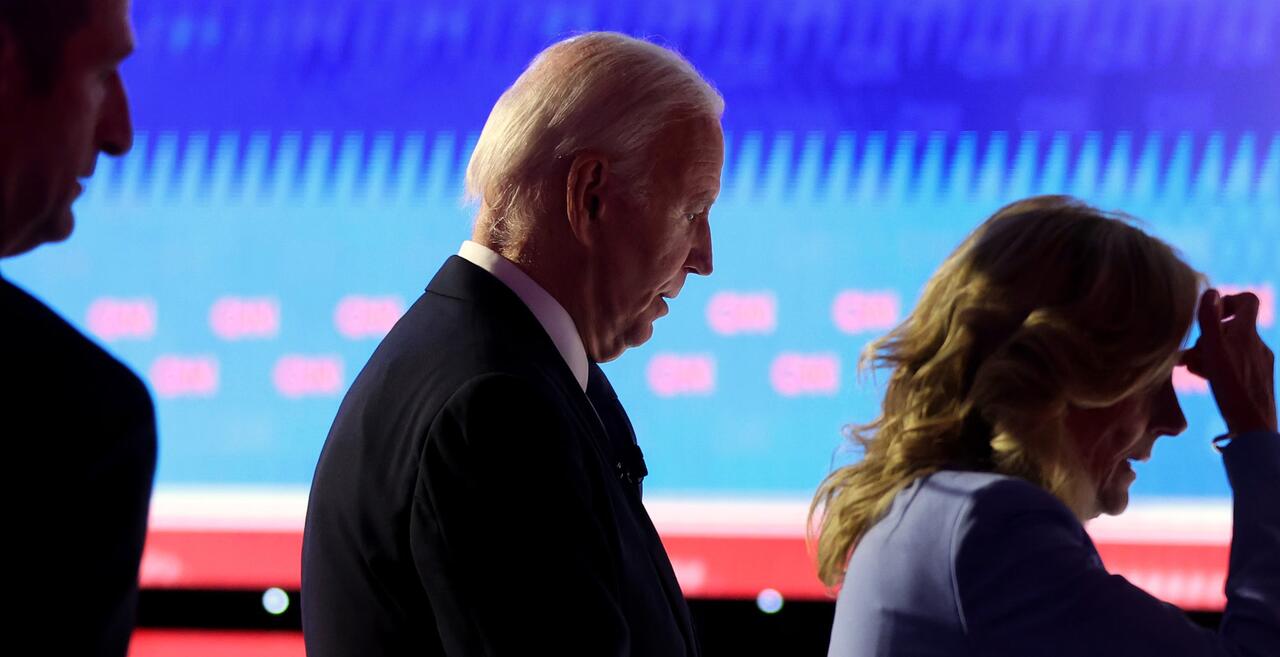
Alex Thompson, co-author of the provocative new book Original Sin: President Biden’s Decline, Its Cover-Up, and His Disastrous Choice to Run Again, has ignited a firestorm across Democrat Party circles, asserting that a secretive cadre of aides ran the White House like a shadowy “politburo” to conceal President Joe Biden’s failing mental health.
Thompson told The Atlantic’s Jeffrey Goldberg that he began questioning the White House’s narrative about Biden’s mental fitness in April 2023, after hearing concerns from administration insiders about Biden’s capacity to endure a reelection campaign or another term. Despite repeated denials from the White House, which labeled such claims false, Thompson’s reporting uncovered a different reality, eroding his trust in their statements. He described a tight-knit group of aides – referred to by some within the administration as the “Politburo” – effectively steering the White House. This inner circle, Thompson noted, included longtime Biden aides like Mike Donilon, Steve Ricchetti, Bruce Reed, and Ron Klain, alongside key figures close to the Biden family, such as First Lady Jill Biden, Hunter Biden, Jill’s chief of staff Anthony Bernal, and deputy Annie Tomasini, who often serves as Biden’s traveling chief of staff.
The term “politburo” refers to the elite inner circle of a communist regime, wielding unchecked power at the top.
We note that Former Secretary of State Antony Blinken and DHS Secretary Alejandro Mayorkas are conspicuously absent from this list.
He’d only have to show proof of life every once in a while,” the author said the aide relayed to him. “His aides could pick up the slack.”
“When you’re voting for president, you’re voting for the aides around him,” the aide reportedly said.
Thompson told CNN on Saturday that multiple Biden cabinet members expressed doubts about the president’s ability to handle a critical “2:00 a.m. crisis call.”
“We talked to two cabinet members that believed that he wasn’t up to that. If the 2:00 a.m. crisis phone call, they said like maybe he could have done it, but they did not have confidence that he was at every single day capable of responding to a national security crisis at 2:00 a.m.,” the author told the network. “And just because that 2:00 a.m. crisis did not happen doesn’t mean that it was not irresponsible in the views of these senior members of his own administration.”
“We have Senator Mark Warner in the book Democrat of Virginia saying that he, during a foreign policy national security conversation, they believe that Biden was not really up to snuff on all the issues,” he added. “We also have Senator Michael Bennet of Colorado, a Democrat, also probably running for governor, believing that Biden’s age made him unable to handle the immigration portfolio and all the factions of the Democratic Party which led to such incoherence with the border and immigration policies of this country.”
Last week, Biden’s office announced that the former president was diagnosed with an aggressive form of prostate cancer.
“On Friday he was diagnosed with prostate cancer, characterized by a Gleason score of 9 (Grade Group 5) with metastasis to the bone,” the statement said. “While this represents a more aggressive form of the disease, the cancer appears to be hormone-sensitive which allows for effective management. The President and his family are reviewing treatment options with his physicians.”
He’d only have to show proof of life every once in a while,” the author said the aide relayed to him. “His aides could pick up the slack.”
“When you’re voting for president, you’re voting for the aides around him,” the aide reportedly said.
Thompson told CNN on Saturday that multiple Biden cabinet members expressed doubts about the president’s ability to handle a critical “2:00 a.m. crisis call.”
“We talked to two cabinet members that believed that he wasn’t up to that. If the 2:00 a.m. crisis phone call, they said like maybe he could have done it, but they did not have confidence that he was at every single day capable of responding to a national security crisis at 2:00 a.m.,” the author told the network. “And just because that 2:00 a.m. crisis did not happen doesn’t mean that it was not irresponsible in the views of these senior members of his own administration.”
We note that Former Secretary of State Antony Blinken and DHS Secretary Alejandro Mayorkas are conspicuously absent from this list.
“We have Senator Mark Warner in the book Democrat of Virginia saying that he, during a foreign policy national security conversation, they believe that Biden was not really up to snuff on all the issues,” he added. “We also have Senator Michael Bennet of Colorado, a Democrat, also probably running for governor, believing that Biden’s age made him unable to handle the immigration portfolio and all the factions of the Democratic Party which led to such incoherence with the border and immigration policies of this country.”
Last week, Biden’s office announced that the former president was diagnosed with an aggressive form of prostate cancer.
“On Friday he was diagnosed with prostate cancer, characterized by a Gleason score of 9 (Grade Group 5) with metastasis to the bone,” the statement said. “While this represents a more aggressive form of the disease, the cancer appears to be hormone-sensitive which allows for effective management. The President and his family are reviewing treatment options with his physicians.”
A warning from the US at the United Nations in New York on Thursday:
‘Deal on offer now is Russia’s best possible outcome’ – US at UN Security Council
Some of the lines from Acting US Alternate Representative to the UN John Kelley:
“If Russia makes the wrong decision to continue this catastrophic war, the United States will have to consider stepping back from our negotiation efforts to end this conflict. To be clear, in doing so, we would not be “abandoning” our principles or our friends. Rather, we would be recognizing Russia’s refusal to work with us toward a desirable outcome.”
“As President Trump has made clear, we want to work with Russia, including on this peace initiative and an economic package. There is no military solution to this conflict. The deal on offer now is Russia’s best possible outcome. President Putin should take the deal.”
He also made clear that more sanctions are on the table as an option. “Additional sanctions on Russia are still on the table. President Trump has emphasized from the beginning that this war was a strategic mistake and should never have happened; time is not on the side of any who would prolong it,” Kelly said.
He also made clear that more sanctions are on the table as an option. “Additional sanctions on Russia are still on the table. President Trump has emphasized from the beginning that this war was a strategic mistake and should never have happened; time is not on the side of any who would prolong it,” Kelly said.
Russia has been precisely ramping up its military response of late: “Russian forces have carried out precision strikes on a facility used by Ukrainian special operations forces, the Defense Ministry in Moscow announced Thursday.
‘Command HQs’ are now clearly being targeted in Ukraine, at a moment Germany has said it has lifted all restrictions on long-range weapons for Kiev.
“Of course, it is within the realms of possibility,” the new German chancellor, Friedrich Merz, told TV channel ZDF when asked if Germany would supply long-range weapons for Ukrainian troops. This is after he claimed that leading allies such as the US, UK, German, and France have lifted “absolutely” all restrictions on arms limits – something which Washington has yet to confirm or deny.
Merz hinted that Berlin might transfer its long-range Taurus missiles to Ukraine this year, but which would take a many months-long training program for Ukrainian military operators. This is also as he promised new military aid worth €5 billion (£4.2 billion), upon hosting President Zelensky in Germany on Wednesday.
Ukraine will be able to fully defend itself, including against military targets outside its own territory,” said Merz. While leaving the question of Taurus transfer open, the German leader did promise to bankroll Ukrainian domestic development of long-range missile capability.
“We want to talk about production and we will not publicly discuss details,” Merz affirmed. And BBC added in the wake of the Zelensky-Merz meeting:
Germany’s defense ministry said in a statement that Berlin would finance the production of long-range weapons systems in Ukraine and that the “first of these systems could be deployed in the Ukrainian armed forces in just a few weeks”.
As expected the reaction from the Kremlin was immediate, given Merz is certainly testing Moscow’s red lines: “The Russian Federation will respond ‘harshly, asymmetrically, and decisively’ if Germany proceeds with supplying Taurus missiles to the Kiev regime,” a statement from the State Duma Defense Committee said.
Already over the last several days running Russia’s military has struck Kiev, and has long threatened to ramp up attacks on ‘command centers’ – including places where foreign troops and Western advisers might be located.
Russian state media has been more blunt in reaction to Merz’s comments, warning that Moscow could simply directly strike Berlin if German-made missiles begin raining down on Russian cities.
These threats were not made officially, but this is often how the Kremlin indirectly communicates its most dire warnings – either through a mid-level official or something like the outspoken editor-in-chief of RT.
President Trump has said this week that Putin is “playing with fire” with the continual aerial attacks on Kiev and other locations in Ukraine. But Russia has pointed to the literally thousands of drones launched on its territory from Ukraine this month, which have even reached Moscow, disrupting flights at several international airports.
On Wednesday FM Lavrov announced that the next round of peace talks are set for June 2 in Istanbul – but will the warring sides even make it to the negotiating table? The jingoist war of words and threats are ramping up hotter than ever, with the Kremlin warning that further delays (on key conditions like territorial concessions) mean “peace tomorrow will be even more painful”.
(Daily Signal)—It was not very long ago that liberal writers would rhapsodize about how America’s changing demographics would spell Republicans’ doom. A 2012 headline from The New York Times read, “Demographic Shift Brings New Worry for Republicans.” By 2014, the corporate media was already writing the GOP’s obituary: “Republicans have a major demographic problem. And it’s only going to get worse,” one Washington Post headline claimed.
Then conservatives committed the crime of noticing—noticing that mass migration followed by mass amnesty was Democrats’ play for political power. The Left labeled them peddlers of the “Great Replacement Theory.”
Sen. Eric Schmitt, R-Mo, joined “The Signal Sitdown” to discuss how President Donald Trump upended Democrat plans for permanent control in Washington.
For Schmitt, it all starts with one crucial realization: The American nation is “not just an idea.”
This is a real nation with real people,” the Missouri senator said, and the GOP should be “fighting for them.”
“When Joe Biden is letting 15 million people here illegally, people don’t understand. How could the president of our country allow this? And the answer is that he bought into and was captured by this worldview that there wasn’t anything particularly unique [about America], that America was just some economic zone with an airport attached to it,” Schmitt continued. “We can have our jobs shipped overseas, all those good-paying jobs, and we get cheap Chinese T-shirts in return and everything is going to be great.
In fairness, Schmitt says some of these policies were justifiable prior to the end of the Cold War. In the aftermath of World War II, America’s trade and foreign policy focused on “rebuild[ing] our European allies and Japan, to bring them into the fold, and defeat Soviet communism. That defined our foreign policy in the sense that we had this security umbrella for our friends and allies. We had trade deals that weren’t really good for us, but that allowed them to get back on their feet.”
Once the Cold War ended, Schmitt told The Daily Signal, “this is when the mistakes were made because the people in charge, the elites, they never really adjusted. They never adjusted trade policy. They never really adjusted foreign policy.”
“You sort of had this globalist view,” Schmitt said, “the end of history. And that fueled this mass migration. It fueled a wandering, aimless, Wilsonian kind of foreign policy that was based on these abstract ideas of global democracy.”
It was far from a Democrat-only problem. “Republicans were a part of this problem, too,” Schmitt added. Republicans of the post-Cold War era pursued trade policies “that shipped our jobs overseas,” but promised ‘creative destruction’ would leave Americans better off. The destruction came, but the creativity did not.
“We’ve seen devastation in our communities, factories that are desolate now, and they’ve been replaced with, in many ways, despair and death,” Schmitt said.
Long before Trump was president, he was one of the first to recognize the need for change. Since taking American politics by storm, he has vigorously reasserted the sovereignty of the American nation. Republicans of yesteryear hesitated to embrace this view, afraid of pejoratives like racist or xenophobic. But the Republicans of today have caught up to the party’s frontman.
America is “much more” than idea, Schmitt told The Daily Signal. “It’s our home.”
“We’re a people and we believe in things and that we ought to be fighting for the dignity of the guy that doesn’t have a PhD, but who wants to work and he wants to be able to raise a family and he wants his kids to have a better life,” Schmitt said. “He shouldn’t have to compete with foreign labor for that.”
“Work is important for people. It gives them meaning,” Schmitt continued. “And I think if we’re honoring the dignity of every individual, which we should, that’s a big part of what we should be fighting for. And President Trump tapped into that in a way that no political figure in my lifetime has ever really tapped into because he met the American people really where they were.”
In doing so, Trump reversed what The Washington Post and The New York Times seemed to think was inevitable.
“The Left understands they were playing a game of getting a permanent majority and total control,” Schmitt said. “It’s important, I think, to remember how close we were to maybe losing all of this.”
“If they had the House and they had the Senate and [Joe] Biden or [Kamala] Harris or somebody else was in the White House,” Schmitt continued, “they would eliminate the filibuster in the Senate. They’d add states to the union. They would pack the United States Supreme Court. They would get mass amnesty. They’d add a bunch of new voters and they very well could have been in the majority for a very, very long time.
“Trump is a unique political figure in that way,” Schmitt claimed. “He was able to break through, and that’s why they came at him so hard.” But the task for the next generation of Republican leaders like Schmitt will be not to squander the inheritance they will receive from Trump.
The rise of artificial intelligence should have marked a new frontier in innovation, productivity, and security. Instead, it’s beginning to look more like the opening act of a high-tech cautionary tale. As AI advances in sophistication, it’s not ushering in utopia. It’s opening the floodgates to a new kind of threat — one that uses data, mimicry, and digital misdirection to exploit our oldest and most reliable vulnerability: ourselves.
A recent report reveals how AI is now at the center of a technological arms race in cyberspace. Deepfake technology has reached the point where criminals can manufacture photorealistic video messages of business leaders directing financial transactions. In one case, an AI-generated video impersonating a company executive was convincing enough to authorize a transfer worth 20 million British pounds. That’s not science fiction — that’s now.
Even more concerning is the rise of voice-cloning attacks, where a simple phone call — one that sounds precisely like your boss, your spouse, or your colleague — can be enough to bypass even the most diligent human gatekeepers. When the attacker sounds like someone you trust, the battle is half won before it begins.
But it doesn’t stop there. AI-powered phishing has revolutionized social engineering. Gone are the typo-laden emails from dubious overseas princes. In their place are personalized, well-structured messages tailored to your professional life, even echoing the tone and writing style of those you communicate with most often. These are not amateur-hour scams — they are precision-crafted traps engineered by intelligent machines.
Yet for all the sophistication of modern AI threats, the most common factor behind successful cyberattacks remains devastatingly low-tech. Human error continues to be the Achilles’ heel of cybersecurity. NinjaOne’s findings underscore the point with brutal clarity: over 95% of breaches are the result of user mistakes.
These mistakes run the gamut — clicking on suspicious links claiming you’ve received money, sharing social media accounts and credentials over insecure platforms, ignoring critical system updates, or misconfiguring cloud settings. The common thread is carelessness, complacency, or sheer ignorance. And while AI is making attacks harder to detect, it’s our refusal to take cybersecurity seriously that turns vulnerabilities into disasters.
At the institutional level, the situation isn’t much better. The cybersecurity staffing crisis that began during the Biden administration has only worsened in what insiders now call the “DOGE Era.” Resources meant to fight cyberthreats are stretched thin, talent is in short supply, and public-sector teams are often outmatched by the rapidly evolving threat
This isn’t about blaming a particular party or administration. It’s about recognizing that the digital world moves far faster than the government’s ability to adapt. Bureaucracy was never built for speed, and cybersecurity demands agility, foresight, and constant vigilance. That leaves the burden of defense squarely on the shoulders of private industry and individuals.
Cybersecurity is no longer the sole domain of IT departments. Every employee is now a potential attack vector. Every device connected to the internet is a potential gateway. Every careless click or sketchy app download could be the domino that topples an entire organization’s
So what’s the solution? First, we must change the culture. Organizations must treat cybersecurity as a central pillar of their operations, not an afterthought. Cyber literacy should be part of employee onboarding, reviewed regularly, and reinforced through training simulations that mimic real-world attacks.
Second, we need to invest in tools that keep pace with the threats. That includes AI-powered defense platforms that can detect behavioral anomalies, flag suspicious traffic, and automatically respond to early signs of compromise. These tools are not cheap, but the cost of inaction is exponentially higher.
Third, it’s time for leadership — public and private — to take full responsibility. This is not a challenge to be delegated. CEOs, school superintendents, hospital administrators — all must understand the threat landscape and prioritize cyber resilience. The health of our digital infrastructure depends on informed leadership making serious investments in protection.
And finally, we need personal accountability. Every one of us must adopt better digital hygiene. That means using strong, unique passwords. Enabling multi-factor authentication. Staying updated on software patches. Learning how to spot phishing attempts. And yes, thinking twice before clicking.
AI isn’t inherently evil. It is a tool — one that can be used for defense just as it can be used for deception. But right now, the bad actors are using it more effectively than we are. They’re not inventing new exploits; they’re just capitalizing on human laziness and lack of regulatory oversight.
The machines aren’t coming for us with laser beams and killer drones. They’re coming through emails, phone calls, and login portals. And the only way they succeed is if we let them. If we don’t wake up, educate ourselves, and strengthen our defenses, we may find that the age of AI didn’t end civilization with a bang — but with a single click.
The apocalypse won’t be automated. It’ll be human-assisted.
Julio Rivera is a business and political strategist, cybersecurity researcher, founder of ItFunk.Org, and a political commentator and columnist. His writing, which is focused on cybersecurity and politics, is regularly published by many of the largest news organizations in the world.
Earlier this year, as President Donald Trump was beginning to reshape the American government, Michael, an emergency room doctor who was born, raised, and trained in the United States, packed up his family and left the country.
Michael now works in a small-town hospital in Canada. KFF Health News and NPR granted him anonymity because of fears he might face reprisal from the Trump administration if he returns to the U.S. He said he feels some guilt that he did not stay to resist the Trump agenda but is assured in his decision to leave. Too much of America has simply grown too comfortable with violence and cruelty, he said.
“Part of being a physician is being kind to people who are in their weakest place,” Michael said. “And I feel like our country is devolving to really step on people who are weak and vulnerable.”
Michael is among a new wave of doctors who are leaving the United States to escape the Trump administration. In the months since Trump was reelected and returned to the White House, American doctors have shown skyrocketing interest in becoming licensed in Canada, where dozens more than normal have already been cleared to practice, according to Canadian licensing officials and recruiting businesses.
The Medical Council of Canada said in an email statement that the number of American doctors creating accounts onphysiciansapply.ca, which is “typically the first step” to being licensed in Canada, has increased more than 750% over the past seven months compared with the same time period last year — from 71 applicants to 615. Separately, medical licensing organizations in Canada’s most populous provinces reported a rise in Americans either applying for or receiving Canadian licenses, with at least some doctors disclosing they were moving specifically because of Trump.
“The doctors that we are talking to are embarrassed to say they’re Americans,” said John Philpott, CEO ofCanAm Physician Recruiting, which recruits doctors into Canada. “They state that right out of the gate: ‘I have to leave this country. It is not what it used to be.'”
Canada, which has universal publicly funded health care, has long been an option for U.S.-trained doctors seeking an alternative to the American healthcare system. While it was once more difficult for American doctors to practice in Canada due to discrepancies in medical education standards, Canadian provinces have relaxed some licensing regulations in recent years, and some are expediting licensing for U.S.-trained physicians.
The Trump administration did not provide any comment for this article. When asked to respond to doctors’ leaving the U.S. for Canada, White House spokesperson Kush Desai asked whether KFF Health News knew the precise number of doctors and their “citizenship status,” then provided no further comment. KFF Health News did not have or provide this information.
Philpott, who founded CanAm Physician Recruiting in the 1990s, said the cross-border movement of American and Canadian doctors has for decades ebbed and flowed in reaction to political and economic fluctuations, but that the pull toward Canada has never been as strong as now.
Philpott said CanAm has seen a 65% increase in American doctors looking for Canadian jobs between January and April, and that the company has been contacted by as many as 15 American doctors a day.
Rohini Patel, a CanAm recruiter and doctor, said some consider pay cuts to move quickly.
“They’re ready to move to Canada tomorrow,” she said. “They are not concerned about what their income is.”
The College of Physicians and Surgeons of Ontario, which handles licensing in Canada’s most populous province, said in a statement that it registered 116 U.S.-trained doctors in the first quarter of 2025 — an increase of at least 50% over the prior two quarters. Ontario also received license applications from about 260 U.S.-trained doctors in the first quarter of this year, the organization said.
British Columbia, another populous province, saw a surge of licensure applications from U.S.-trained doctors after Election Day, according to an email statement from the College of Physicians and Surgeons of British Columbia. The statement also said the organization licensed 28 such doctors in the fiscal year that ended in February — triple the total of the prior year.
Quebec’s College of Physicians said applications from U.S.-trained doctors have increased, along with the number of Canadian doctors returning from America to practice within the province, but it did not provide specifics. In a statement, the organization said some applicants were trying to get permitted to practice in Canada “specifically because of the actual presidential administration.
Michael, the physician who moved to Canada this year, said he had long been wary of what he describes as escalating right-wing political rhetoric and unchecked gun violence in the United States, the latter of which he witnessed firsthand during a decade working in American emergency rooms.
Michael said he began considering the move as Trump was running for reelection in 2020. His breaking point came on Jan. 6, 2021, when a violent mob of Trump supporters besieged the U.S. Capitol in an attempt to stop the certification of the election of Joe Biden as president.
“Civil discourse was falling apart,” he said. “I had a conversation with my family about how Biden was going to be a one-term president and we were still headed in a direction of being increasingly radicalized toward the right and an acceptance of vigilantism.”
It then took about a year for Michael to become licensed in Canada, then longer for him to finalize his job and move, he said. While the licensing process was “not difficult,” he said, it did require him to obtain certified documents from his medical school and residency program.
“The process wasn’t any harder than getting your first license in the United States, which is also very bureaucratic,” Michael said. “The difference is, I think most people practicing in the U.S. have got so much administrative fatigue that they don’t want to go through that process again.”
Michael said he now receives near-daily emails or texts from American doctors who are seeking advice about moving to Canada.
This desire to leave has also been striking toHippocratic Adventures, a small business that helps American doctors practice medicine in other countries.
The company was co-founded by Ashwini Bapat, a Yale-educated doctor who moved to Portugal in 2020 in part because she was “terrified that Trump would win again.” For years, Hippocratic Adventures catered to physicians with wanderlust, guiding them through the bureaucracy of getting licensed in foreign nations or conducting telemedicine from afar, Bapat said.
But after Trump was reelected, customers were no longer seeking grand travels across the globe, Bapat said. Now they were searching for the nearest emergency exit, she said.
“Previously it had been about adventure,” Bapat said. “But the biggest spike that we saw, for sure, hands down, was when Trump won reelection in November. And then Inauguration Day. And basically every single day since then.”
At least one Canadian province is actively marketing itself to American doctors.
Doctors Manitoba, which represents physicians in the rural province that struggles with one of Canada’s worst doctor shortages, launched a recruiting campaign after the election to capitalize on Trump and the rise of far-right politics in the U.S.
The campaign focuses on Florida and North and South Dakota and advertises “zero political interference in physician patient relationship” as a selling point.
Alison Carleton, a family medicine doctor who moved from Iowa to Manitoba in 2017, said she left to escape the daily grind of America’s for-profit health care system and because she was appalled that Trump was elected the first time.
Carleton said she now runs a small-town clinic with low stress, less paperwork, and no fear of burying her patients in medical debt.
She dropped her American citizenship last year.
“People I know have said, ‘You left just in time,'” Carleton said. “I tell people, ‘I know. When are you going to move?'”
Editor’s Note: The views expressed in the article clearly do NOT reflect those of the Artful Dilettante. I posted it to show the ignorance of these doctors and their supporters. The Artful Dilettante is a conservo-libertarian to the marrow of his bones, a Mega-MAGA guy. A/D
all accounts, LGBT Pride Month 2025 will be conspicuously low-key. Appalled by Trump’s electoral victory and alarmed by the signal voters (a.k.a. consumers) sent, major corporations that once supported Pride events have scrambled for the exits as quickly as if someone had pulled the fire alarm. These developments bring relief to normal Americans, who feel as if the playground bully astride their chests finally dismounted and fled. But, for a cadre of die-hard activists, such public retreat from progressivism’s excesses represents an existential threat that must be thwarted.
Substance
Some of those activists identify with various religious communities. Sadly, some of them even wear the label, “Christian.” On Tuesday, a coalition of left-wing activists published an open letter, declaring that, in response to waning support from government, business, and society, “this year, we, who are from diverse faith traditions and beliefs, are showing up and refusing to back down. … Inspired by our beliefs and faith traditions, we Recommit to Pride.”
This final, capitalized phrase (“Recommit to Pride”) served as a chorus for the letter, reoccurring no less than five times in three paragraphs. In substance, this recommitment looks like “public prayers, bold statements, and visible acts of support for the LGBTQ+ community,” such as “show[ing] up with love for our LGBTQ+ neighbors with signs of solidarity at Pride celebrations.”
Most Americans would hardly notice when left-wing activists “recommit” themselves to left-wing activism. But the absence of newsworthy events has never prevented the mainstream media from spinning a tactical narrative before, and this letter provided a framing too delectable to ignore.
In the end, Axios plucked this propaganda plum, gleefully announcing the “exclusive” scoop that “a coalition of faith leaders is urging religious organizations to openly show their support for LGBTQ+ people ahead of this year’s Pride Month.”
Such framing ascribes undue significance to the letter by making it seem like “faith leaders” now support people who identify as “LGBTQ+.” The conventional wisdom is that “religious” people — especially evangelical Christians — are more conservative, more likely to support Trump, and less open to gender and sexual confusion. The Axios report subverts this expectation — notwithstanding its solid grounding in reality — to bolster a counter-narrative about the political inclinations of “religious” Americans.
Alas, the transparent trick would be silly if it weren’t so sinister. Humor subverts expectations for laughs; the mainstream media subverts expectations to advance a political agenda. The agenda is to sow doubt and division among the substantial majority of orthodox Christians who support conservative policies and — to the extent he will implement policies that accord with nature and promote human flourishing — President Donald Trump. The point is to trip up those who don’t know their Bibles well by regurgitating the serpent’s famous question, “Did God actually say?” (Genesis 3:1).
Signatories
But the façade begins to crumble as soon as one examines the structure holding it up. Out of 17 signatory organizations, two (GLSEN and Christopher Street Project) are simply trans activist groups, with no religious orientation. Five are non-Christian organizations (three Jewish, one Muslim, one Hindu), while two are “interfaith” cooperatives.
This leaves only a minority of organizations that are, in any sense of the word, Christian. Two mainline denominations made the list: the Evangelical Lutheran Church in America (ELCA) and the United Church of Christ (UCC). So did two networks within mainline denominations: the Reconciling Ministries Network (within United Methodism) and the Association of Welcoming and Affirming Baptists (with the American Baptist Churches USA).
The list also included the Kairos Center for Religions, Rights, and Social Justice at Union Theological Seminary, which in 2019 had students confess their sins to plants; Sojourners, a progressive evangelical organization that published a defense of the plant confession chapel; and Pride in the Pews, which organizes LGBT-identifying people in predominantly black churches.
Last but not least, the letter was signed by Faithful America, an allegedly Christian group funded by Jewish billionaire George Soros. Most of its public activities involve attacking conservative evangelicals and Catholics like Hobby Lobby, Family Research Council, and Supreme Court Justice Amy Coney Barrett. Faithful America’s latest stunt involved staging a gigantic golden calf, made to look like Trump, outside FRC Action’s Pray Vote Stand Summit — another item sympathetically covered by Axios. (Ironically, the Trump golden calf jab failed to land, coming only months after FRC Action Chairman Tony Perkins publicly broke with Trump’s team over the watered-down language rammed through in the 2024 GOP platform.)
Struggle
In summary, Axios’s celebrated “faith leaders” consist of transgender activists, non-Christians, a few mainline denominations, and some unrepresentative, progressive fringe groups. It is neither surprising nor newsworthy that this amalgamation of interests continues to support the LGBT agenda.
In fact, the letter itself tried to have it both ways. On one hand, it claimed that “the majority of religious people in America support full LGBTQ equality.” This claims too much. Some surveys might show majority religious support for acceptance of same-sex couples. But “full LGBTQ equality” — as expressed in the “Equality Act” and elsewhere — has expanded to overriding conscience rights, indoctrinating children, and endangering women — overreaches that the majority of Americans detest.
On the other hand, the letter acknowledged the LGBT agenda’s weakening cultural position. “Corporations are backing out of Pride. And polls show that all of these attacks are working. For the first time in years, public support for LGBTQ equality is declining,” it complained. This would suggest that the LGBT movement — and the signatories of this letter — hold far less cultural clout than they let on. If their agenda really enjoyed the support of a majority of “religious people in America,” then it would not be in such a state of decline.
Scrutiny
It should come as no surprise that a pledge to “recommit to Pride” will find little support among Christians. The first obvious problem with this notion is the word “pride.” Scripture clearly warns that “pride goes before destruction, and a haughty spirit before a fall” (Proverbs 16:18). This is because “God opposes the proud but gives grace to the humble” (James 4:6, 1 Peter 5:5). This is more than a superficial coincidence. Advocates of “LGBT Pride” really do endorse pride in the biblical sense, exalting their own will and desires above all criticism, in pursuit of a society where “everyone [could do] what was right in his own eyes” (Judges 21:25).
This raises a second obvious problem, that the recommitment to LGBT Pride contradicts the clear teaching of Scripture. God created mankind in his image as male and female (Genesis 1:26), ordaining marriage as a union of one man and one woman (Genesis 2:24). Jesus himself applied these texts as an ongoing foundation for sexual norms (Matthew 19:4-6). The Interfaith letter complained, “We lament every form of backsliding on public support for the full dignity and equality of LGBTQ+ people.” Bible-believing Christians, by contrast, should lament every form of backsliding of public support for God’s created order and the teachings of Jesus.
A third obvious problem is related to the second: in setting themselves against the Creator, LGBT activists also set themselves against the biological reality he created. The letter lamented that “many in the LGBTQ+ community view religion as hostile to their well-being.” But the LGBT activist’s problem is not so much with “religion” as it is the pesky reality that “religion” — and specifically Christianity — affirms. Therefore “God gave them up to dishonorable passions,” and they “receiv[ed] in themselves the due penalty for their error” (Romans 1:26-27).
In other words, it is their own rejection of reality that is most hostile to the well-being of people who identify as LGBT. Christians understand that obedience to God’s commands is the only true path to human flourishing. And love requires that Christians faithfully point this out to those who have strayed.
Ruddy: Trump, Zelenskyy Want Peace, Putin Does Not
President Donald Trump has had a simple and bold plan to win the peace in the brutal war between Russia and Ukraine.
In my opinion, Trump knew getting President Volodymyr Zelenskyy and the Ukrainians to negotiate was never going to be the problem.
But Russian President Vladimir Putin would be.
So Trump seemingly castigated the Ukrainians at the very same time he extended a very welcoming hand to Putin, a nonthreatening and nonjudgmental one at that.
Trump’s maneuver was a brilliant one, including a peace deal that would start with both sides agreeing to an immediate ceasefire.
As expected, Zelenskyy quickly signed on.
At Trump’s demand, the Ukrainians even gave away a big chunk of their national wealth in a minerals deal with the U.S.
Putin has talked a good game and still does.
While Trump and Zelenskyy have taken concrete steps toward peace, Russia has actually stepped up its attacks against Ukraine.
This past weekend, Russian forces have undertaken one of their largest combined drone and missile strikes since the invasion began in February of 2022.
The recent attacks, largely targeting civilian centers, have included nine Kh-101 cruise missiles and a record 355 Shahed-type attack drones.
Putin’s ongoing attacks have contributed to the wider toll of the war on Ukraine, which has seen hundreds of thousands of casualties, millions displaced and significant damage to the nation’s civilian infrastructure.
Russia’s own toll has been enormous, with estimates of total Russians killed and wounded around 1 million men.
With his proposals, Trump had offered Putin a relatively easy off-ramp from his apparent suicidal mission.
But the Russian leader doesn’t want a deal.
A Russian-American businessman told me recently Putin cannot end the war because his whole economy is now based on war.
Russia has mobilized an army of 1.5 million men, has a military budget equal to all European countries combined, and has a massive armament program underway making everything from drones to tanks to artillery shells — you name it.
“For a while, it will be next to impossible for Russia to reduce military spending.”
Does Russia eventually reduce its military-industrial complex or retarget its forces against NATO?
Earlier this year, Dutch Admiral Rob Bauer, NATO’s military committee chief, warned that the alliance should “expect the unexpected” and urged members to begin preparations for a Russian attack.
The risks of such a war are real.
I believe that President Trump saw ending the war between Ukraine and Russia as the single biggest priority in his second term.
He also knew that neither side would be happy about the result of a deal.
But the “bloodbath” would end.
Trump believed he could end the war because of his working relationship with Putin during his first term.
The two disagreed on many things but were able to live with each other.
But Putin himself has changed since Trump’s first term.
Former British Prime Minister Tony Blair has said the Putin today is almost unrecognizable from the man he knew in the 2000s.
As Trump is discovering, Putin also is very different from the man he dealt with previously.
Trump said in a social media post Sunday, “I’ve always had a very good relationship with Vladimir Putin of Russia, but something has happened to him.”
It is widely believed that Putin was encouraged to invade Ukraine after he saw then-President Joe Biden order America’s hasty and humiliating exit from Afghanistan in 2021.
Sensing weakness, he believed that Ukraine would fall in a matter of days — a week at most — if he invaded.
Putin then launched an unprovoked attack on a sovereign democratic state.
But Zelenskyy’s resolve, coupled with immediate backup from Britain (and still armed with those Javelin anti-tank missiles Trump had previously provided), the Ukrainians not only stopped the Russian invasion but repulsed them from much of their territory.
Over three years later, Putin has now wasted over a million Russian lives and untold national treasure on a folly of a war that will only give him a small portion of Ukraine if he agrees to a ceasefire.
My Russian friend suggests such a “peace” does not secure Putin’s position. Putin needs war to survive.
Putin has stated repeatedly he wants to rebuild the old Soviet empire, not just Ukraine.
He wants to end America’s “unipolar” hegemony around the world.
He wants NATO to effectively disappear.
Putin can only achieve these things by widening the war, not agreeing to a peace deal now.
The U.S. really has only one feasible response to Putin: to continue arming Ukraine.
If Ukraine were to fall because the U.S. withdraws, it would be catastrophic (think Afghanistan by a factor of 10).
If Putin gets Ukraine, he would only be emboldened to take the Baltic states, Finland, Poland and more.
President Trump should be applauded for his efforts to get both parties to the peace table.
But if those efforts ultimately fail, only one person is responsible, Vladimir Putin.
The U.S. need not escalate or de-escalate the war — but just give the Ukrainians enough weapons to continue the fight.
It is a war Putin started, and he alone must come to his senses to end it. This may take longer than imagined.
Christopher Ruddy is CEO of Newsmax Media, Inc., a leading news company that operates Newsmax TV and Newsmax.com. Read more Christopher Ruddy Insider articles — Click Here Now.
What’s so awesome about the capitalist ideal? It’s a system based on individual freedom and voluntary consent. You’re allowed to do what you want with your own body and your own stuff. If other people want to cooperate with you, they have to persuade you; if you want other people to cooperate with you, you have to persuade them. Can consent really be “voluntary” if some people have a lot more to offer than others? Absolutely. Some people are vastly more attractive than others, but that does nothing to undermine the voluntariness of dating. Under capitalism, how people use their freedom is up to them; they can try to get rich, they can relax, they can help the poor, all three, or none of the above.





 THE ARTFUL DILETTANTE
