The Artful Dilettante is a native of Pittsburgh, PA, and a graduate of Penn State University. He is a lover of liberty and a lifelong and passionate student of the same. He is voracious reader of books on the Enlightenment and the American colonial and revolutionary periods. He is a student of libertarian and Objectivist philosophies. He collects revolutionary war and period currency, books, and newspapers. He is married and the father of one teenage son. He is kind, witty, generous to a fault, and unjustifiably proud of himself. He is the life of the party and an unparalleled raconteur.
Like cats chasing red laser beams the media quickly switched from Charlie Kirk’s assassination to magnifying the preposterous claims that removing Jimmy Kimmel from the air was the worst violation of the Constitution ever.
On the internet the big story seems to be the indefinite suspension of Jimmy Kimmel by ABC. I confess to being somewhat at a disadvantage. The last time I looked at network television my set had four dials: on/off, vertical, and horizontal, volume, and channel. In this I’m not alone. Kimmel’s show had fewer viewers than a number of online podcasters, sponsors were fleeing, and local stations represented by affiliates Nexstar and Sinclair wanted out. The great Iowahawk nailed the flight from network television:
“Anyway, I see people debating who should replace Kimmel in the coveted late night talk chair, and it’s like debating who should move into the empty Spencer Gifts at the abandoned Twin Pines Mall.”
A Little History of Democrats and Free Speech
Before discussing the specifics of Kimmel’s suspension, let’s review a little recent history about the Democrats and free speech. Do you remember when Roseanne Barr had her show cancelled by ABC on the false charge that a tweet she made linking Valerie Jarrett to Iran was “racist”? Did you know who was behind axing what was one of the most popular shows on ABC?
“In an interview with the Sunday Times Magazine in 2019, Barr revealed that Michelle Obama personally pressured ABC executives to axe her.
Former ABC president Channing Dungey, who carried out her firing, worked directly with the Obamas at Netflix.”
Roseanne was but one example of the Democrat cancel culture ruining the careers of anyone who disagreed with them.
This is a pattern of cancel culture. Conservatives have been targeted and canceled by the same leftist mob:
Gina Carano — fired from The Mandalorian for “wrongthink.”
Megyn Kelly — fired by NBC for Halloween costume commentary.
Dave Chappelle — targeted by Netflix employees for “transphobia.”
Joe Rogan — smeared and nearly canceled over COVID discussions.
Tucker Carlson — taken off Fox News after advertiser pressure campaigns.
Parler — wiped off the internet by Apple, Google, and Amazon.
J.K. Rowling — blacklisted for defending women’s rights.
Mike Lindell — banned from Twitter and retailers for supporting Trump.
The Gateway Pundit was banned on Google AdSense, Amazon Ads, and PayPal for reporting on election fraud and COVID.
And the list goes on.
Former congressional candidate Jack Lombardi also slammed Obama, reminding him that it was under his own presidency that the government waged direct war on the free press:
October 2009: The White House tried to exclude Fox News from a pooled interview — other networks refused to participate until Fox was included.
May 2013: DOJ secretly seized two months of AP reporters’ phone records, an intrusion AP called “massive and unprecedented.”
May 2013: DOJ labeled Fox’s James Rosen a “co-conspirator” in a leak probe to obtain his emails and phone records.
Feb–Mar 2014: The FCC floated a “Critical Information Needs” newsroom study, later scrapped after a First Amendment backlash.
Even President Donald Trump’s voice was muzzled by Democratic action when Twitter threw him off the site.
Meta CEO Mark Zuckerberg has now admitted publicly that moderators at Facebook and Instagram faced vast pressure from the federal government to take down contrarian COVID-19 content, election-related content — including jokes and satire — as well as the New York Post‘s Hunter Biden laptop story. This led the platforms to make moderation decisions that Zuckerberg now regrets. “I believe the government pressure was wrong, and I regret that we were not more outspoken about it,” wrote Zuckerberg in a letter to the House Judiciary Committee, which is investigating the suppression of speech on social media. “We’re ready to pushback if something like this happens again.”
Every Twitter and Facebook poster who was silenced as a result of government action had his constitutionally protected right to free speech infringed. The Constitution prevents government restriction and pretending the Twitter and Facebook actions were private conduct has long been proven false.
“The Democrats and progressives used the FBI to coerce social media companies to block online content that that the Biden Admin didn’t want getting a foothold. The online companies refused to allow links to the NY Post articles on Hunter’s laptop. The federal government has ZERO authority to impose any kind of regulation on the internet. The FCC has legal authority to regulate the airwaves. Whether FCC Chairman car stepped over the line or not is an interesting academic debate involving the limits of FCC authority over ABC and the stations. The is NO DEBATE that what the Biden Admin and the progressives did was a blatant violation of the First Amendment.”
For five years, some of us have been sounding the alarm about the government-directed attack on free speech that censored how topics and communities in every possible venue. It was totalitarian. We litigated, we exposed, we FOIA’d, we did what we could. The censorship has been far-reaching, top down, pervasive, well funded, and directed toward one end: political conformity. No one in the mainstream media cared and you know why? Because they were the censors and thrilled to play that role. Not even the Supreme Court could be bothered. It’s still going on now: YouTube and LinkedIn reliably remove posts about vaccine injury. Now some lying loser late-night bubble dweller gets his show canceled and I’ve heard more about are speech than at any point in years. These same people had nothing to but cheers when Alex Jones, every Covid skeptic, and even the sitting US president was silenced. Now these same people are suddenly channeling John Stuart Mill. The hypocrisy is astounding. This is next-level Orwell stuff.–Jeffrey Tucker
Kimmel’s Indefinite Suspension by ABC
As much of the nation was shocked and in mourning over the assassination of Charlie Kirk — murdering someone for what he says is, after all, the clearest example there could be of censorship — Jimmy Kimmel flounced about asserting that the assassin was a Trump supporter, something he pulled out of his backside and a bald faced lie his huge staff nevertheless seemed to think was appropriate. Saner heads considered this charge reprehensible and ABC affiliate Sinclair sought an apology for this blatant lie. Kimmel refused to apologize and said he’d double down. Not surprisingly, ABC, which pays this jerk $16 million a year for making demonstrably false, partisan, and incendiary charges, indefinitely suspended him. Reportedly, ABC’s senior executives thought his plan to address the controversy would “make the situation worse”
Like cats chasing red laser beams the media quickly switched from Kirk’s assassination to magnifying the preposterous claims that removing Kimmel from the air was the worst violation of the Constitution ever.
Democrats like Barack Obama, Hillary Clinton and Chuck Schumer, already on record for praising for years the cancellation of those with whom they disagreed, promoted this nonsense.
Obama did his usual shitty shtick where he starts a sentence claiming high virtue and ends it by calling for more death, mayhem, and self righteous Democrat violence. Obama has perfected in every sentence what all Dems now do in their hearts, which is assert some Grand Abstract then tell each other to beat little old ladies to death with the Grand Abstract.
“We believe this truth to be self-evident, that all are created equal and that… you need to go out now and kill a random Republican for disagreeing with you on anything… those are the noble values that truly make our nation!”
Victor Davis Hanson details the shifting left narratives about Kirk’s assassination which is worth reading in its entirety for I can only summarize here:
From One Leftist False Kirk Narrative To the Next
Somewhere in the leftwing command bunker, false narratives about Kirk’s murder, replete with talking points, are issued and disseminated through the network news, social media, Hollywood, and academia — at least until their party-line absurdity demands a new concoction.
Here are the daily, changing leftist narratives over the past few days:
#1 “No Motive” [snip]
#2 “The Gun Did It”. [snip]
#3 “The Assassin Was MAGA” [snip] Narrative three then was floated that MAGA right wingers did it, or white supremacist gangs, or a veritable civil war on the right were responsible.
Jimmy Kimmel finally lost his job over spreading that preposterous lie. Robinson’s engraved messaged bullets, his texts, his friends, his family, the nature of his boy-girlfriend relationship, and his chat group all proved beyond a doubt he hated Kirk for his influence and politics, and thus committed a leftwing political shooting of a conservative in the fashion of a Luigi Mangione or James Hodkinson.
#4 “Both Sides” [snip] Unfortunately, many on the Left could not keep still and smother their glee. So an unhinged array of students, bureaucrats, teachers, professors, the media, and actors — the usual suspects — started posting their accustomed delight over the killing of Kirk. Thus, narrative four evaporated, given the nutty Left’s glee over Kirk’s death was near synonymous with one of their own killing him.
#5 “Trump Did it” As narratives imploded thick and fast, the Left next claimed that Trump’s ‘hate speech’ and divisiveness caused Robinson to kill. In other words, this new ‘Trump did it’ narrative dispensed with the prior leftist failed ones, by claiming there was now a new motive indeed, and it was the solitary Trump.
But that attempt sputtered almost immediately, given the reactive Trump was first targeted by four lawfare partisan prosecutors, 2 failed assassination attempts, ballot removal, and smeared as a fascist by high-ranking generals, Kamala Harris, and most of the Democratic Party. So he might have had some reason to talk back, given the Left sought to rerail his 2016 candidacy, sabotage his first term, and destroy him (literally) after 2020.
As part of the narrative, Trump supporters were derided as “chumps”, “dregs”, “semi-fascists”, and “garbage” by Joe Biden, who boasted twice he wanted to beat up Trump behind the gym, put a bullseye on him (“time to put Trump in a bullseye”), and jail him (“we gotta lock him up!”). Did Joe then incite the violence?
Barack Obama emerged from one of his many mansions to squeak up the ‘Trump did it’ narrative. But the community organizer who said, “get in their faces”, “bring a gun to a knife fight”, and sicced his intelligence agencies on Trump to destroy his campaign, transition, and early presidency faded fast.
So, sermon finished, Pastor Obama quietly private jetted back to either his Martha’s Vineyard acreage or his Hawaiian beach estate. At that point, it seemed there could be no more crazy narratives. But in fact there were more.
He Kinda, Sorta Deserved It” An exasperated Left, after seeing all of their narratives implode, finally shrugged and defiantly has sent out the last version that best reflected its own.
The new narrative? Why should the Left be apologetic or deferential at all? It will damn Kirk and see what conservatives are going to do about it.
So after the de rigueur acknowledgment about the abhorrence of murdering anyone — the Left now cuts to the quick and pontificate, euphemistically, about Kirk bringing it on himself.
The new narrative has the Left openly admitting they despised Kirk’s (mostly undefined) views. And while they did not approve of his murder, per se, they sorta, sorta understood that his type of “divisive” rhetoric was, well, bound at some point to inflame and excite those who were ‘morally’ bothered by his ‘hate’.
In the aftermath of his gruesome assassination, the new narrative says it maybe kinda, sorta of wrong for the Left to imply Kirk earned his death. But nevertheless, it was sorta, kinda true — and by implication the leftwing world is better off for his passing.
That final sick narrative, distilled from all the other failed ones, will more or less now be institutionalized as the authentic Left party-line as the months wear on.
By week’s end a resolution was forwarded in the House which called upon Americans “to reject political violence, recommit to respectful debate, uphold American values and respect one another as fellow Americans.”
A bipartisan group in the Senate and House has signaled an intention to forward a bill tagged No Political Enemies Act (NOPE) which would permit parties deprived of free speech for political reasons to sue and receive legal fees. (The provision permitting recovery of legal fees is critical, allowing anyone even of modest means to pursue such cases.)
Defying all prediction, somehow, Jimmy Kimmel’s suspension (he isn’t even fired!) has now prompted Democrats into proposing a real solution for one of conservatives’ biggest complaints: the egregious excesses of Twitter files censorship. Since we haven’t yet seen it, who knows whether the NOPE bill’s text will actually have teeth. But things are obviously moving in the right direction.
The turnaround was so astonishing that you could even call it miraculous. Democrats have not exactly championed free speech. After all, they are the party of microaggression, deplatforming, virtue-signaling, social media censorship, hate speech, and cancel culture. We could recite a long list of Democrat cancellation victims.
A promising development, but we haven’t seen NOPE yet and since it comes at the same time 96 House Democrats refused to vote to support free speech, we may never see it.
The Taliban government on Sunday rejected U.S. President Donald Trump’s bid to retake Bagram Air Base, four years after America’s chaotic withdrawal from Afghanistan left the sprawling military facility in the Taliban hands.
The chief Taliban spokesman, Zabihullah Mujahid, rejected Trump’s assertions and urged the U.S. to adopt a policy of “realism and rationality.” Afghanistan had an economy-oriented foreign policy and sought constructive relations with all states on the basis of mutual and shared interests, Mujahid posted on X.
It had been consistently communicated to the U.S. in all bilateral negotiations that Afghanistan’s independence and territorial integrity were of the utmost importance, he said.
“It should be recalled that, under the Doha Agreement, the United States pledged that ‘it will not use or threaten force against the territorial integrity or political independence of Afghanistan, nor interfere in its internal affairs,’” he said. The U.S. needed to remain faithful to its commitments, he added.
Mujahid did not reply to questions from The Associated Press about conversations with the Trump administration regarding Bagram and why Trump believed the U.S. could retake it.
At 18, you can’t legally rent a car. You can’t buy a drink. In some states, you can’t even rent an apartment without a co-signer. But you can sign your name to $100,000 or more in student loans—debt that you may spend the rest of your life trying to repay, and that can never be erased through bankruptcy. That is not just a legal loophole. It is a moral failure.
Each year, thousands of young people graduate high school with dreams of changing the world, fueled by ambition, idealism, and the promise that a college degree is the key to a better life. They are encouraged—by parents, schools, society—to pursue their passions, follow their dreams, and enroll in the “best” college they can get into, with little to no understanding of what that decision will mean financially. What they don’t hear until it’s too late is that their dream may come with a price tag that haunts them for decades.
It’s easy to blame these young borrowers for making “bad choices.” But that excuse falls apart under scrutiny. These are teenagers, many with no financial literacy, being asked to make a six-figure financial decision with fewer consumer protections than someone applying for a car loan. Unlike almost any other form of debt, student loans are nearly impossible to discharge in bankruptcy. The terms are long, the interest compounds relentlessly, and the lenders—often the federal government—face virtually no consequences when students fail to thrive.
Worse still, the system is designed to give the illusion of opportunity without accountability. Colleges can charge whatever they like, regardless of whether their graduates are able to earn enough to pay off the loans. Students majoring in low-paying but essential fields—like teaching, social work, or the arts—often face the harshest outcomes. They were told their passions mattered. What they weren’t told was that passion doesn’t pay down principal.
We have safeguards in other areas of life to protect young people from predatory decisions. We regulate the tobacco industry. We require financial disclosures in credit card applications. But when it comes to college loans, we turn a blind eye. We celebrate the student who gets into a prestigious private university without asking whether the $60,000-a-year tuition is an act of financial sabotage.
The ethical question is simple: Should we allow teenagers to take on life-altering debt for a product that might not deliver on its promise? And if we do, do we not bear some responsibility for the consequences?
This is not a call to abolish higher education or even student loans. It’s a call for informed consent, transparency, and a system that does not exploit youthful optimism. At the very least, we must mandate real financial counseling before loans are approved. We should tie loan limits to realistic earning potential by major. And we must re-examine bankruptcy laws that treat student borrowers as morally defective while letting corporate bankruptcies slide through the courts with ease.
When dreams become debt, we all lose. We lose talented individuals who never get the chance to thrive under the weight of what they owe. We lose the promise of education as a tool for social mobility. And we lose our moral compass, allowing a system that punishes people not for failing—but for daring to hope.
It’s time we ask not just what is legal, but who benefits—and at what cost.
The death of an outspoken conservative American was only a matter of time. The coming conflict remains unavoidable.
This is incomprehensible to conservative Americans. We think America is indomitable; no American in his right mind would ever deny freedom to embrace Marxism in any form. But we’re fatally naïve, because we don’t understand how ideas build nations and tear them apart. America is caught in a war of competing ideologies, and we don’t know how these wars work. We were too busy enjoying endless prosperity to learn that America, like any other nation, rises and falls based on the ideas that define its vision for equality and justice.
Every nation is built on a set of generally accepted ideas, beliefs, and assumptions that define concepts of justice, peace, freedom, property, equality, and acceptable sexuality and conduct that become the foundation for society. That nation remains relatively stable until the ideological foundation changes, as radical ideas and theories cast a new vision of equality and justice that criminalizes the past and demands liberation for the future. This ideological crisis results in bloodshed as irreconcilable visions of equality and justice compete for supremacy until one ultimately defeats the other. This is the story of the battle between the Jewish and Christian West and Marxism throughout the 20th century. The battle has come to America. It’s as vulnerable to Marxism as any nation.
Aleksander Solzhenitsyn warned us: “Alas, all the evil of the twentieth century is possible everywhere on earth.”
If you’re incredulous, ask those who suffered under Stalin, Mao, and Pol Pot what happens when equity captures the hearts and minds of young radicals who were willing to liquidate over 100 million to achieve the utopian promise. Kirk’s death reveals that equity has no intention of leaving America unscathed.
The right is incapable of accepting the reality that equity is entrenched in America and refuses to accept that they can’t vote their way out of this ideological war. The left has no idea that equity opens a Pandora’s box that pours out an incomprehensible bowl of wrath upon America. As long as these two facts remain unchanged, the nation’s future is as predictable as Charlie Kirk’s tragic death.
Chuck Mason (M.Div., Fuller Seminary) is a conservative Christian author and social commentator. You can read his perspectives at www.chuckmason.net.
Massive event is expected to attract nearly 100,000 to NFL stadium for tribute to Turning Point USA founder.
The conservative world will gather in Arizona on Sunday, September 21, to remember American legend Charlie Kirk.
The service for the Turning Point USA founder will be held at the NFL home of the Arizona Cardinals, which holds more than 60,000 people and has been the site of multiple Super Bowls. It will feature speeches by the top administration figures including President Donald Trump, Vice President J.D. Vance, Secretary of State Marco Rubio, and Secretary of War Pete Hegseth.
It will also feature a speech by Erika Kirk, who was unanimously elected to take over her husband’s role as CEO and Board Chair of Turning Point USA.
The Daily Wire will stream the Turning Point USA event across all platforms at 2:00 p.m. ET.
Erika Kirk has pledged that the assassination of her husband will only make Turning Point USA stronger.
“The evildoers responsible for my husband’s assassination, they have no idea what they have done,” a fiery Erika said. “They should all know this, if you thought that my husband’s mission was powerful before, you have no idea, you have no idea what you just unleashed across this country.”
“You have no idea the fire you have ignited in his wife,” she said. “The cries of this widow will echo around the world like a battle cry.”
“The movement my husband built will not die. It won’t. I refuse to let that happen,” Erika pledged. “No one will ever forget my husband’s name, and I will make sure of it.”
The conservative world is expected to turn out in force to honor Kirk, who has been credited as one of the key architects of Trump’s political movement.
“Charlie inspired millions, and tonight, all who knew him and loved him are united in shock and horror. Charlie was a patriot who devoted his life to the cause of open debate and the country that he loves so much, the United States of America,” Trump said in an Oval Office address. “He fought for liberty, democracy, justice, and the American people. He’s a martyr for truth and freedom, and there’s never been anyone who was so respected by youth.”
Trump has also said that Kirk will be awarded the Presidential Medal of Freedom.
“The useful idiots, the leftists who are idealistically believing in the beauty of the Soviet socialist or Communist or whatever system, when they get disillusioned, they become the worst enemies. That’s why my KGB instructors specifically made the point: never bother with leftists. Forget about these political prostitutes. Aim higher. […] They serve a purpose only at the stage of destabilization of a nation. For example, your leftists in the United States: all these professors and all these beautiful civil rights defenders. They are instrumental in the process of the subversion only to destabilize a nation. When their job is completed, they are not needed any more. They know too much. Some of them, when they get disillusioned, when they see that Marxist-Leninists come to power—obviously they get offended—they think that they will come to power. That will never happen, of course. They will be lined up against the wall and shot.”
Through clever innuendo and seemingly noncommittal suggestion, Barack Obama has spent two decades subtly dividing America socially, racially, and politically.
Obama is known for making his points with surgical precision. No one can deny that, armed with a sharpened teleprompter, an emotionally detached Barack Obama appears as a methodical, unemotional speaker skilled at disguising deep-seated hostility as civility.
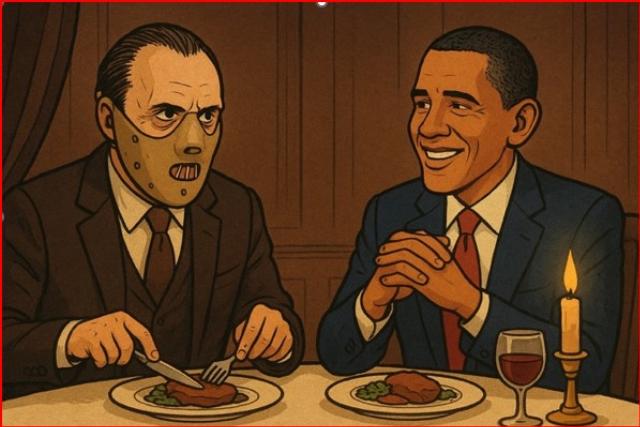
The former president’s detached eloquence bears resemblance to that of the fictional character, serial killer and cannibal Hannibal Lecter.
Hannibal had a complex psyche that could be hidden behind a refined manner of expressing rage, with his wrath concealed behind a façade of feigned grace and collegiality; that is precisely what Barack Obama does.
From the beginning, Obama worked hard to craft the narrative that the real threat to this nation was patriotic Americans who adhered to the Constitution. It started in April 2009, when the newly elected president directed Janet Napolitano’s DHS to focus on nonexistent right-wing threats in America. The administration’s assessment titled, “Rightwing Extremism: Current Economic and Political Climate Fueling Radicalization and Recruitment,” became the basis for a tone that would define an aggressive presidency — where everyone from pro-lifers to the military, pro-Second Amendment activists, and Americans advocating for immigration law were viewed as threats.
The racial element that sparked division in America was fueled by the statement in the document that mentioned recruitment for right-wing extremism was vigorous among those most upset about “the election of the first African-American president.”
Fast forward sixteen years, and like Hannibal Lecter sending condolences to his victim’s family, at the Jefferson Educational Society’s 17th annual global summit in Erie, Pennsylvania, a blasé former president decided he needed to extend sympathy for the death of Charlie Kirk, who was murdered on September 10th by a trans activist’s assassin’s bullet during his American Comeback Tour at Utah Valley University
After calling Kirk’s death “horrific and a tragedy,” void of even a modicum of self-awareness, Obama proceeded to blame none other than Donald Trump for sowing political division and inciting a “political crisis,” which resulted in the slaying of Trump’s most ardent defender.
About Charlie Kirk, Obama had this to say:
Obviously, I didn’t think his ideas were wrong, but that doesn’t negate the fact that what happened was a tragedy and that I mourn for him and his family.
Coolly, Obama informed global summit attendees that for him, ideas like devout Christianity, patriotism, intellectual brilliance, the sanctity of life, and all things good, holy, and sane were “wrong.”
Calling shooting someone through the jugular on live stream TV a “tragedy,” Obama forgot to mention his participation in fueling years of transgender activism.
The former president also forgot to inform his audience that, unlike the LGBTQ community, he did not “see” nor “stand” with the likes of Charlie Kirk, nor did he ever state that “dignity, equality, and justice are fundamental to ensuring that [people like Charlie Kirk] feel safe and protected.”
Besides trying to shame a dead man by taking everything he ever said out of context, Obama haltingly went on to tell his captivated audience that the country is facing a “political crisis of the sort that we haven’t seen before.”
Then, while distancing himself from decades of promoting far-left ideas, with the precision of a surgeon dividing a skull from a brain without causing harm, Obama offered the opinion that extremism is common at both ends of the political spectrum.
The entire encounter can be compared to Lecter picking his teeth with a human thigh bone, all the while claiming he’s a vegetarian.
Then, the author of the April 2009 treatise on right-wing extremism, the person who coined the term “tea baggers,” agrees with abandoning babies born alive in botched abortions without medical intervention, sending transgenders into restrooms with women, and is the agitator who weaponized the federal government to pursue and prosecute his political enemies, continued by saying:
Those extreme views were not in my White House. I wasn’t empowering them. I wasn’t putting the weight of the United States government behind them. When we have the weight of the United States government behind extremist views, we’ve got a problem.
When an extremist is authorized to use the “weight of the United States government” to indoctrinate and oppress a nation for eight years, and then calls those exposing that corruption “extremists,” that’s when it’s time to point out that he’s the one who’s “got a problem.”
Fictional character Hannibal Lecter is depicted as a master manipulator who uses gaslighting tactics against his enemies, which is not surprising. A former forensic psychiatrist, Lecter is skilled at blurring the line between rapport and rivalry, causing his victims to lose their ability to think clearly or know who to trust. This is similar to how Barack Obama’s twisted interpretation of facts has affected the American public’s ability to discern that they have been victims of his psychological manipulation.
In the wake of Kirk’s death, the man known for insisting that the First Amendment should be limited to control his definition of “disinformation” took the opportunity to accuse the current White House of seeking to “silence discussion.”
Obama shared that the Trump administration promised to take action against social media users who celebrated Charlie’s death. Like Hannibal Lecter using his position to frame his colleague, the man who publicly and privately silenced every critic — from the Supreme Court to conservative businesses seeking tax-exempt status to critics of Benghazi — dared to accuse the Trump administration of exactly what his far-left critics have been guilty of doing for years.
Obama, whose party labeled patriotic Americans racists, extremists, terrorists, and fascists, exploited projection like Hannibal Lecter, yielding a karambit knife when he said:
When I hear not just our current president, but his aides, who have a history of calling political opponents ‘vermin,’ enemies who need to be ‘targeted,’ that speaks to a broader problem that we have right now, and something that we’re going to have to grapple with — all of us.
Attempting to place a proper-fitting “bite restraint muzzle” on Obama, the Trump White House spokeswoman, Abigail Jackson, responded to the former president’s comments in the following way:
Barack Hussein Obama is the architect of modern political division in America — famously demeaning millions of patriotic Americans who opposed his liberal agenda as ‘bitter’ for ‘cling(ing) to guns or religion,’ Obama used every opportunity to sow division and pit Americans against each other, and following his presidency more Americans felt Obama divided the country than felt he united it.
His division has inspired generations of Democrats to slander their opponents as ‘deplorables,’ or ‘fascists,’ or ‘Nazis. If he cares about unity in America, he would tell his own party to stop their destructive behavior.
Barack Obama set the table and, during his eight years in office, he carefully sliced up his political enemies while displaying both the charm and brutality embodied by the fictional character Hannibal Lecter.
Lest we forget, it was Obama who once said this about Republicans, “If they bring a knife to the fight, we bring a gun.”
Therefore, if it’s true that “words cut deeper than a knife,” thanks to the animosity Obama has been skillfully fueling since he entered politics, Charlie Kirk, a man whose honest words strike at the core of the agenda Barack Obama has been nurturing throughout his career, lost his life to a bolt-action rifle brought to the fight by one of Obama’s star pupils.
Now more than ever, the ability to speak our minds is crucial to the republic we cherish. If what you see on American Thinker resonates with you, please consider supporting our work with a donation of as much or as little as you can give. Every dollar contributed helps us pay our staff and keep our ideas heard and our voices strong.
The Senate rejected competing measures on Friday to fund federal agencies for a few weeks when the new budget year begins on Oct. 1, increasing prospects for a partial government shutdown on that date.
Leaders of the two parties sought to blame the other side for the standoff. Democrats accused Republicans of not negotiating with them to address some of their priorities on health care as part of the funding measure, even though they knew some Democrat votes would be needed to get a bill to the president’s desk.
Republicans said Democrats were making demands that would dramatically increase spending and were not germane to the core issue of keeping agencies fully running for a short period of time while negotiations continued on a full-year spending measure.
The Republican bill is a clean, nonpartisan, short-term continuing resolution to fund the government to give us time to do the full appropriations process. And the Democrat bill is the exact opposite,” Senate Majority Leader John Thune, R-S.D., said shortly before the votes. “It’s what you might call, not a clean CR, a dirty CR – laden down with partisan policies and appeals to Democrats’ leftist base.”
The Democrat proposal would extend enhanced health insurance subsidies set to expire at the end of the year, plus reverse Medicaid cuts that were included in Republicans’ big tax breaks and spending cuts bill enacted earlier this year.
“The American people will look at what Republicans are doing, look at what Democrats are doing, and it will be clear that public sentiment will be on our side,” said Senate Democratic Leader Chuck Schumer of New York, who has repeatedly threatened a shutdown if health care isn’t addressed.
The Senate action came after the House earlier in the day passed the Republican-led funding bill. The measure would extend government funding generally at current levels for seven weeks. The bill would also add about $88 million in security funding for lawmakers and members of the Supreme Court and executive branch in the wake of the assassination of conservative activist Charlie Kirk.
The vote was 217-212. Rep. Jared Golden of Maine was the lone Democrat member to support the bill.
House Speaker Mike Johnson of Louisiana said he knew he had few votes to spare as he sought to persuade fellow Republicans to vote for the funding patch, something many in his conference have routinely opposed in past budget fights. But this time, GOP members see a chance to portray the Democrats as responsible for a shutdown.
“The ball is in Chuck Schumer’s court. I hope he does the right thing. I hope he does not choose to shut the government down and inflict pain on the American people,” Johnson said.
President Donald Trump had urged House Republicans to pass the bill and put the burden on Democrats to oppose it. GOP leaders often need Trump’s help to win over holdouts on legislation.
“Every House Republican should UNIFY, and VOTE YES!” Trump said on his social media site.
Democratic leader Hakeem Jeffries, D-N.Y., said that in opposing the continuing resolution, Democrats were working to protect the health care of the American people. He said that with Republicans controlling the White House and both branches of Congress, “Republicans will own a government shutdown. Period. Full stop.”
The Senate moved quickly after the House vote to take up the measure plus the Democratic counter. Both fell short of the 60 votes needed for passage. Now, it’s unclear how things will shake out.
Senators could then potentially leave town until Sept. 29 — one day before the shutdown deadline. The Senate has a scheduled recess next week because of Rosh Hashana, the Jewish new year. Meanwhile, Johnson said Republicans were discussing whether to stay back in their home districts through the rest of September, essentially forcing the Senate to approve the House-passed measure or risk a shutdown. He said lawmakers have a lot of work to do in their districts.
Democrats on both sides of the Capitol are watching Schumer closely after his last-minute decision in March to vote with Republicans to keep the government open. Schumer argued then that a shutdown would be damaging and would give Trump and his White House freedom to make more government cuts. Many on the left revolted, with some advocates calling for his resignation.
The vote in the spring also caused a temporary schism with Jeffries, who opposed that particular GOP spending bill and said he would not be “complicit” with Schumer’s vote.
The two Democrat leaders now say they are united, and Schumer says things have changed since March. The public is more wary of Trump and Republicans, Schumer says, after the passage of Medicaid cuts.
Most Democrats appear to be backing Schumer’s demand that there be negotiations on the bill — and support his threats of a shutdown, even as it is unclear how they would get out of it.
“Look, the president said really boldly, don’t even talk to Democrats. Unless he’s forgotten that you need a supermajority to pass a budget in the Senate, that’s obviously his signal he wants a shutdown,” said Sen. Tammy Baldwin, D-Wis.
While the Democrat measure to fund the government had no chance of passage, it does give Democrats a way to show voters their focus on cutting health care costs. Unless Congress act, tax credits going to low- and middle-income people who purchase health insurance through the Affordable Care Act will expire. That will mean a big increase in premiums for millions of Americans.
“There are some thing we have to address. The health insurance, ACA, is going to hammer millions of people in the country, including in red states,” said Sen. Angus King, I-Maine. “To me, that can’t be put off.”
Republicans have said the tax credit issue can be dealt with later this year. They’re also using Schumer’s previous arguments against shutdowns to make the case he’s playing politics.
“Democrats voted in favor of clean CRs no fewer than 13 times during the Biden administration,” Thune said. “Yet now that Republicans are offering a clean CR, it’s somehow a no-go. It’s funny how that happens.”
President Donald Trump had urged House Republicans to pass the bill and put the burden on Democrats to oppose it. GOP leaders often need Trump’s help to win over holdouts on legislation.
“Every House Republican should UNIFY, and VOTE YES!” Trump said on his social media site.
Democratic leader Hakeem Jeffries, D-N.Y., said that in opposing the continuing resolution, Democrats were working to protect the health care of the American people. He said that with Republicans controlling the White House and both branches of Congress, “Republicans will own a government shutdown. Period. Full stop.”
The Senate moved quickly after the House vote to take up the measure plus the Democratic counter. Both fell short of the 60 votes needed for passage. Now, it’s unclear how things will shake out.
Senators could then potentially leave town until Sept. 29 — one day before the shutdown deadline. The Senate has a scheduled recess next week because of Rosh Hashana, the Jewish new year. Meanwhile, Johnson said Republicans were discussing whether to stay back in their home districts through the rest of September, essentially forcing the Senate to approve the House-passed measure or risk a shutdown. He said lawmakers have a lot of work to do in their districts.
Democrats on both sides of the Capitol are watching Schumer closely after his last-minute decision in March to vote with Republicans to keep the government open. Schumer argued then that a shutdown would be damaging and would give Trump and his White House freedom to make more government cuts. Many on the left revolted, with some advocates calling for his resignation.
The vote in the spring also caused a temporary schism with Jeffries, who opposed that particular GOP spending bill and said he would not be “complicit” with Schumer’s vote.
The two Democrat leaders now say they are united, and Schumer says things have changed since March. The public is more wary of Trump and Republicans, Schumer says, after the passage of Medicaid cuts.
Most Democrats appear to be backing Schumer’s demand that there be negotiations on the bill — and support his threats of a shutdown, even as it is unclear how they would get out of it.
“Look, the president said really boldly, don’t even talk to Democrats. Unless he’s forgotten that you need a supermajority to pass a budget in the Senate, that’s obviously his signal he wants a shutdown,” said Sen. Tammy Baldwin, D-Wis.
While the Democrat measure to fund the government had no chance of passage, it does give Democrats a way to show voters their focus on cutting health care costs. Unless Congress act, tax credits going to low- and middle-income people who purchase health insurance through the Affordable Care Act will expire. That will mean a big increase in premiums for millions of Americans.
“There are some thing we have to address. The health insurance, ACA, is going to hammer millions of people in the country, including in red states,” said Sen. Angus King, I-Maine. “To me, that can’t be put off.”
Republicans have said the tax credit issue can be dealt with later this year. They’re also using Schumer’s previous arguments against shutdowns to make the case he’s playing politics.
“Democrats voted in favor of clean CRs no fewer than 13 times during the Biden administration,” Thune said. “Yet now that Republicans are offering a clean CR, it’s somehow a no-go. It’s funny how that happens.”
Dear leftists: If you don’t like having the FCC, I’m all in. Let’s abolish the FCC. Right now. Forever. NO REGULATION of media whatsoever. But no regulation means no regulation. It doesn’t mean you get to censor and intimidate like you openly did during the Biden and Obama regimes. It doesn’t mean conservatives get regulated and censored while “progressives” get to say (and do) whatever the hell they wish. It means across the board — no regulation. Are you ready for that? Or are you only angry and a principled libertarian when the existence of an FCC appears to harm your Communist-fascist-terrorist-totalitarian buddies?
In red states like South Carolina, Texas and Florida, “educators” have been fired for celebrating Charlie Kirk’s brutal murder and, in the process, further reinforcing their views that anyone who doesn’t agree with their militant Communism, fascism and woke (i.e., psychotic) ideas about the need for state-sanctioned hormonal alteration of children is a racist, Nazi and savage. In other words, they get to be paid money by the government to brainwash and intimidate young people into adopting the stupidest and most toxic ideas and attitudes ever to present themselves in a classroom going back to ancient Greece. Adding insult to injury, these toxic “teachers” get to call reasonable people all the things that they, the teachers and professors themselves, actually ARE: bigots and tyrants.
In red states, a few of them are being held accountable–for now. In blue states they’re having a field day. We need to 100 percent federally DEFUND all schools and universities immediately. Let Soros, Oprah and the Obamas pay them to spew poison. This has got to stop.
As for President Trump going after political enemies like Obama? We should be so lucky. Obama should literally hang for treason, but we know he never will. We’ll be hearing his Marxist-fascist lecturing 30 years from now, maybe beyond.
Obama complains about “cancel culture” in the firing of Jimmy Kimmel by far-left Disney/ABC.
It’s like Stalin complaining about starvation. Or Hitler complaining about the poisonous gas showers. The audacity of projection.
Obama also brags that when he was President, he didn’t respond to a tragedy by going after political enemies.
Good grief. There are no words for this stunning evasion of truth, this openly orchestrated inversion of sensory-level facts. People applauding this? Even one? THIS is how you get Nazi Germany.
I am sometimes shocked almost speechless by the inconceivable hubris, the profound dishonesty and utterly brazen lack of awareness exhibited by these freaks. How can even minimally decent and intelligent people fall for any of it?
Jimmy Kimmel, in one respect, has nothing to worry about. He will simply run for President. All Democrats want to be President. They think–correction: they FEEL–it will give them the elusive visibility and metaphysical significance that, on some level, they know they do not possess. He can fantasize he will get his revenge by being President, by becoming the Stalinesque dictator he imagines Donald Trump to be. However, one problem for Jimmy : All the other grotesque leftist celebrities like himself will also be running for President in 2028. And it will not matter; Party officials, not voters, will be picking their nominee anyway.
BREAKING: Timothy Cardinal Dolan on fallen hero Charlie Kirk: “The more I learned about him, I thought this guy is a modern-day Saint Paul. He was a missionary, an evangelist, a hero.” Charlie should be made a SAINT!