Unknown's avatar

About theartfuldilettante

The Artful Dilettante is a native of Pittsburgh, PA, and a graduate of Penn State University. He is a lover of liberty and a lifelong and passionate student of the same. He is voracious reader of books on the Enlightenment and the American colonial and revolutionary periods. He is a student of libertarian and Objectivist philosophies. He collects revolutionary war and period currency, books, and newspapers. He is married and the father of one teenage son. He is kind, witty, generous to a fault, and unjustifiably proud of himself. He is the life of the party and an unparalleled raconteur.

Americans’ No. 1 financial regret—and how to avoid it

Published Wed, Aug 20 202512:31 PM EDT

By Mike Winters

When asked their biggest financial regret in 2025, most Americans said it was not saving enough, according to a new Bankrate poll.

Altogether, 3 out of 4 respondents said they had a financial regret in the past year, with around 40% pointing to regrets tied to savings — whether for retirement, emergency expenses or children’s education — making it the most common theme in this year’s 2,078-person survey.

By comparison, 20% say their biggest regret was taking on too much debt from credit cards or student loans.

“One consistent takeaway from this study every year is the durability of ‘not saving enough for retirement’ as a regret. The percentage of people with this regret grows with age as retirement draws closer,” says Stephen Kates, financial analyst at Bankrate.

Among those with regrets, 43% say they haven’t made any progress toward addressing the issue over the past year. And when asked what would most improve their finances in the near term, Americans pointed to cheaper essentials such as gas and groceries, followed by better job opportunities, lower rent and a rising stock market.

How to get back on track with your savings

Whether it’s saving up a cash emergency fund or boosting retirement investments, experts say the hardest part can be simply starting, especially if it feels late.

But, “starting late is better than never starting at all,” says Jake Martin, a certified financial planner in Ohio. Here are three steps to help you get on track.

1. Put out ‘financial fires’

Before focusing on long-term savings, prioritize putting out “financial fires,” Martin says. High-interest debt such as credit cards or payday loans should be paid down first. “These typically carry rates above 15%, making them a drag on your finances and your retirement goals,” he says.

Help us help you: Take our survey on work, money and life goals

“Credit card debt should always be prioritized and paid down, but debt such as student loans and mortgages need to be thought out more strategically,” says Paul Gaudio, a CFP in Boston.

These loans often carry relatively low interest rates, which may make it smarter to stick with minimum payments and put extra cash into investments instead, he says.

2. Build an emergency fund

Once your debt is under control, work on building up emergency cash reserves worth three to six months of living expenses, so an unexpected job loss or medical bill doesn’t push you back into debt, Martin says.

An emergency fund is crucial because it helps you avoid relying on high-interest credit cards when the unexpected happens, he says.

3. Save for retirement

Next, focus on retirement. For late starters, that usually means saving more aggressively. “While most people shoot to save 5% to 10% of their income, someone who is trying to catch up should look for ways to boost this savings rate to 20% to 30%,” particularly if you’re starting in your 40s, says Martin.

You may also want to consider extending your retirement age if you need more runway for savings, he says.

The exact amount that will make sense for you to save will vary based on a number of factors, including your age and your ideal lifestyle in retirement. CNBC Make It’s savings calculator can help you determine how much you may want to aim for.

Another way to free up money is by cutting fixed expenses, a strategy South Carolina-based CFP Ashton Lawrence calls “controlling the controllables.”

“Identify where discretionary dollars are leaking, whether dining out, streaming sprawl, app subscriptions you forgot about, convenience delivery, impulse buys, and lifestyle creep,” he says. “Every dollar you don’t spend is a dollar you can assign for better use.”

Want to stand out, grow your network, and get more job opportunities? Sign up for Smarter by CNBC Make It’s new online course, How to Build a Standout Personal Brand: Online, In Person, and At Work. Learn from three expert instructors how to showcase your skills, build a stellar reputation, and create a digital presence that AI can’t replicate. Sign up today with coupon code EARLYBIRD for an introductory discount of 30% off the regular course price of $67 (plus tax). Offer valid July 22, 2025, through September 2, 2025

Mike Winters, CNBC

Patel’s FBI raids John Bolton’s home in high-profile national security probe

FBI agents raided former Trump National Security Advisor John Bolton’s DC-area home Friday morning in a high-profile national security probe, The Post can exclusively reveal.

Federal agents busted into Bolton’s house in Bethesda, Md., at 7 a.m. in an investigation ordered by FBI Director Kash Patel, a Trump administration official told The Post.

“NO ONE is above the law… @FBI agents on mission,” he said in a cryptic post to X shortly after the raid began.

The probe — which is said to involve classified documents — was first launched years ago, but the Biden administration shut it down “for political reasons,” according to a senior US official.

Bolton has previously been accused of including classified information in his 2020 book, “The Room Where it Happened.”

President Trump fought to quash its publication over its inclusion of national secrets — saying Bolton broke an NDA signed as a condition of his employment — but was ultimately unsuccessful.

His first-term Justice Department opened an inquiry into the book in September 2020.

The ex-Trump adviser has been at odds with his old boss since, regularly appearing on cable news criticizing the president’s national security and foreign policy.

John Bolton, National Security Advisor, in the White House.
National security adviser John Bolton worked during President Trump’s first administration.The Washington Post via Getty Images

It comes a day after Patel revealed former FBI Director James Comey had authorized leaks of classified documents “while misleading Congress” just before the 2016 elections.

Patel has pledged to rid the federal government of corruption and expose cover-ups.

Caitlin Doornbos, New York Post

Social Security marks its 90th anniversary — here’s what could happen to future benefits

Ninety years ago, President Franklin Delano Roosevelt signed the Social Security Act, which created the program that now sends monthly benefit checks to millions of Americans, including retirees, disabled individuals and families.

But by the time the program celebrates its centennial, benefits may not look the same as today’s Social Security payments.

The reason: Social Security’s trust funds, which the program relies on to help pay benefits, are facing a looming shortfall.

Starting in 2033 — two years before its 100th anniversary — the program may only be able to pay 77% of scheduled benefits for retirees, their families and survivors, Social Security’s trustees projected in an annual report released in June.

However, should those funds be combined with Social Security’s trust fund for disability benefits, as has happened in prior emergencies, payments may be cut one year later, in 2034. At that point, 81% of scheduled benefits would be payable, Social Security’s trustees project.

Importantly, Social Security benefits would not disappear entirely. The program would still have ongoing income from payroll taxes to help fund benefit payments.

That scenario is not inevitable. Changes to the program may be enacted sooner to shore up its funding and prevent sudden benefit cuts.

Most, 83%, of surveyed Americans think Social Security reform should be a top priority for Congress, even if it means benefit cuts or tax increases for future beneficiaries, according to a new poll from the Bipartisan Policy Center’s American Savings Education Council. The group polled more than 4,000 adults.

“This is the time for action,” said Sen. Bill Cassidy, R-Louisiana, who is among the lawmakers pitching a plan to help restore the program’s solvency, told CNBC.com.

Cassidy has teamed up with Sen. Tim Kaine, D-Virginia., to co-lead a bipartisan pitch — the centerpiece of which is a new $1.5 trillion investment fund for Social Security, separate from Social Security’s current trust funds.

The initial $1.5 trillion outlay would be borrowed. Because the money would be held in escrow and could be liquified, it would not increase the national debt, Cassidy said.

The funds would be invested more aggressively than Social Security’s current trust funds, which are invested in U.S. Treasury securities. Because those investments are backed by the full faith and credit of the U.S. government, they are secure. However, the average rate of return over a one-year period was around 2.5% in 2024.

In contrast, the S&P 500 has returned an annual average of around 10%, though those results vary from year to year.

Investing the proposed separate investment fund in stocks, bonds and other investments could cover an estimated 70% of Social Security’s trust fund shortfall, Cassidy said. That would make it much more doable for lawmakers to address the remaining 30%, he said.

Most Americans — 64% of Democratic voters and 61% of Republicans — want Congress to work together across party lines to reform Social Security, the Bipartisan Policy Center found in its recent poll.

That’s as 41% of surveyed Americans expect Social Security will be their primary source of income in retirement, according to the BPC. Moreover, 74% of Americans worry Social Security will run out before they retire, while 80% worry Congress will cut benefits.

Nevertheless, the poll results show Americans would welcome a “comprehensive, balanced reform package that entails both benefit adjustments and tax increases,” said Emerson Sprick, director of retirement and labor policy at the Bipartisan Policy Center.

Increasing taxes on the wealthiest 1% to help repair the program’s finances had the most support among BPC’s poll respondents, with 85% of Democrats and 72% of Republicans. That’s in contrast to the 65% of Democrats and 62% of Republicans who support a higher cap on payroll taxes.

A majority of voters also support adjusting benefits for those most in need, with 63% of Democrats and 62% of Republicansreducing benefits for higher income individuals, with 64% of Democrats and 61% of Republicans; and increasing the amount that both employees and employers pay into the program, with 61% of both Democrats and Republicans. Most voters also support encouraging legal immigration that would result in more workers paying into the program, with 64% of Democrats and 54% of Republicans.

The urgency of addressing Social Security’s funding woes will increase over time.

Two new laws have provided generous enhancements for certain Social Security beneficiaries. The Social Security Fairness Act increased benefits for some public pensioners, while President Donald Trump’s “big beautiful” budget and tax package provides a tax deduction for seniors.

The changes in both laws will accelerate the trust fund depletion dates. The Fairness Act was included the Social Security trustees’ latest projections. The more recent “big beautiful” legislation will move the insolvency date for the retirement trust fund to late 2032 up from the early 2033 trustees’ projection, according to the Committee for a Responsible Federal Budget.

Senators who are elected in 2026 will be in office during those projected depletion deadlines, Sprick said.

As the trust fund depletion dates come closer, there will be more discussion about Social Security’s future on Capitol Hill, Sprick said. The current proposals on Capitol Hill are a start, he said.

“We’ve put this off for way too long; the political process moves very slowly,” Sprick said. “But that does not negate the fact that these conversations are moving in the right direction.

Lori Konish, CNBC

The Political Disaster Hiding in Plain Sight for the Democrats

headphone stoped
share
more

Opinion by Chris Cillizza

Opinion: The Political Disaster Hiding in Plain Sight for Democrats

 • 15h • 

2 min read

Photo Illustration by Thomas Levinson/The Daily Beast/Getty

Photo Illustration by Thomas Levinson/The Daily Beast/Getty

I am generally bullish about Democrats’ chances of retaking the House majority in 2026. That’s because the history of midterm elections is pretty overwhelming when it comes to seat losses for the president’s party.

When a president is unpopular in polls—as Donald Trump is today—those losses are even steeper. And yet, I don’t think a Democratic-controlled House is in the bag just yet.

Why?

Well, for much of the past year, I have been hearing from smart Democratic strategists who insist that their party has fallen badly behind Republicans in one of the critical nuts and bolts needed for winning elections: Registering voters.

President Donald Trump answers questions from reporters in the Oval Office on August 14, 2025 in Washington, D.C. / Andrew Harnik / Getty Images

President Donald Trump answers questions from reporters in the Oval Office on August 14, 2025 in Washington, D.C. / Andrew Harnik / Getty Images

And now the New York Times has exposed that problem — in a massive (and massively important) piece published this week. Here’s the key bit:

Of the 30 states that track voter registration by political party, Democrats lost ground to Republicans in every single one between the 2020 and 2024 elections — and often by a lot.

LG 24-In Front Control Built-In Dishwasher With Third Rack ( Printproof Stainless Steel ) ENERGY ...

call to action icon

That four-year swing toward the Republicans adds up to 4.5 million voters, a deep political hole that could take years for Democrats to climb out from.

It gets worse. In all four swing states that register voters by party—Arizona, Nevada, North Carolina and Pennsylvania—Democratic registration eroded between 2020 and 2024. That year, for the first time since 2018, more voters registered as Republicans than Democrats; in 2018, two-thirds of new voters under the age of 45 were registering as Democrats, while in 2024, more than half of new voters under 45 registered as Republicans.

This is both an operations problem and a brand issue.

Democrats have largely farmed out their voter registration operation to outside groups who, clearly, have not done a good job.

And now, even if the Democratic National Committee wanted to take back over the registration efforts, it might not have the financial wherewithal to do so. At the end of July, the Republican National Committee had more than $84 million in the bank to spend. The DNC? Less than $14 million.

(Sidebar: How does DNC Chair Ken Martin still have his job?)

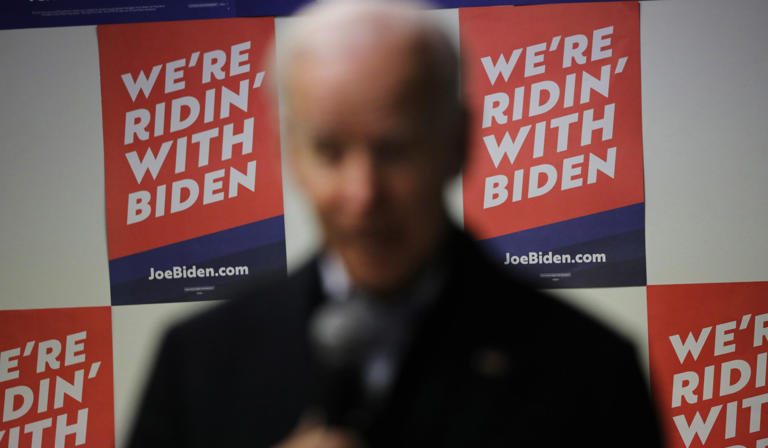
Democratic presidential candidate Joe Biden speaks to volunteers at state campaign headquarters on January 13, 2020 in Des Moines, Iowa. / Spencer Platt / Getty Images

Democratic presidential candidate Joe Biden speaks to volunteers at state campaign headquarters on January 13, 2020 in Des Moines, Iowa. / Spencer Platt / Getty Images

The Democrats’ current issues with their ‘brand’ are well known. In poll after poll, Democratic favorability is near or at all-time lows. How does that affect voter registration? Voters—and new voters especially—clearly don’t want to be associated with the Democratic brand. And that is a major problem.

A Fun Way To Learn About Art - Vast Range Of Products

call to action icon

still tend to think 2026 will be a good election for Democrats. The historical trends are just too damn strong. But, man does the party have problems. And, at least on the voter registration front, there’s no quick fix.

Want more ball and strike calling—no matter what uniform the batter at the plate is wearing? Check out Chris Cillizza’s Substack and YouTube channel.

The Cure for Trump Derangement Syndrome? Success!

At this point in his second term, President Donald Trump has higher approval ratings than Presidents George W. Bush and Barack Obama in their second terms. According to the RealClear Politics average of presidential approval polls, Trump, on Aug. 13, 2025, had a rating of 45.8 percent. G.W. Bush on Aug. 13, 2005, registered a 43.2 percent rating. Obama, on Aug. 13, 2013, stood at 43.8 percent.

For Trump, this approval rating follows: two impeachments; a verdict of liable defamation; a criminal verdict of guilty by a Manhattan jury for a supposed violation of federal election law; a prosecution by the Fulton County district attorney for alleged presidential election interference; an investigation by a special counsel into Trump’s role in the Jan. 6, 2021, Capitol building riot; the special counsel investigation of Trump’s alleged violation of federal law over his possession and handling of government documents, including classified documents; a verdict of liability and a judgment, now approaching $500 million, for supposedly inflating the value of his properties to obtain bank loans; a two-and-a-half-year investigation by a special counsel into whether Trump colluded with Russia to win the 2016 election and whether Trump committed obstruction of justice during the investigation; and two assassination attempts, one of which nearly killed him.

Trump’s approval rating follows the signing of the controversial Big Beautiful Bill. Critics claim the bill “kicks off” deserving recipients of Medicaid while providing “tax cuts for the rich.”

The approval rating follows fierce pushback from so-called sanctuary cities and states over Trump’s campaign promise of mass deportations. The approval rating follows Trump’s unrealized promise to end the Russia-Ukraine War “on Day 1,” as well as Hamas’s refusal to release an estimated 50 of the remaining hostages under a deal Trump thought he reached for their release.

Trump’s approval rating follows bombshell accusations by the Trump Department of Justice that Obama and members of his administration in charge of intelligence knowingly falsely accused Russia of not just 2016 election interference but of committing this interference to aid Trump. Attorney General Pam Bondi announced convening a grand jury to investigate whether criminal charges should be brought against members of the Obama administration, possibly including Obama himself.

Trump’s rating is all the more stunning given the nearly wall-to-wall bad coverage by much of the media. In April 2025, the Media Research Center wrote,

Media Research Center analysis of the ABC, CBS and NBC evening newscasts shows the new Trump administration has faced a withering 92% negative coverage, even worse than the relentlessly hostile coverage Trump faced in early 2017 … (these) news programs averaged more than 19.3 million viewers during the first quarter of 2025, making them the most widely-watched news programs in the country.

But wait, there’s more.

Trump’s Aug. 13 rating took place before Trump’s White House meeting with Russian President Vladimir Putin and before Trump’s White House meeting with Ukraine President Volodymyr Zelensky. After Trump’s nearly three-hour meeting with Putin, Trump and the Russian leader jointly addressed the media. They took no questions, but Putin agreed with one of Trump’s frequent anti-President Joe Biden talking points. Putin said: “Today when President Trump says that if he was the president in 2022, there would be no war, and I’m quite sure it would indeed be so. I can confirm it. Overall, me and President Trump have built a very good and businesslike contact.”

That’s an extraordinary statement about Trump and about his predecessor. And then there’s the praise of Trump by NATO Secretary General Mark Rutte and his acknowledgement that Trump was right to a) criticize the failure of many NATO countries to meet their financial obligations to the alliance and b) make NATO pay America for its weapons and material assistance the U.S. is giving Ukraine.

Based on recent events, Trump’s Aug. 13 rating has become ancient history. After his meeting with Putin, Trump’s Insider Advantage approval rating among voters now stands at 54 percent! Pollster Mike Towery said: “Only the nation’s oldest voters disapprove of his job performance, which is consistent with our prior surveys. Overall, his approval numbers are surging upwards post-summit.”

I have long predicted Trump’s many successes would eventually propel him to a 60 percent approval rating. Should Trump’s meetings with Putin, Zelensky, and European leaders lead to an end to the Russia-Ukraine war, a 60 percent rating is easily in sight.

Larry Elder

10 Ways Babies Are Smarter Than Liberals

While babies are undeniably cute, they aren’t too bright. Yet, despite being unable to talk or poo on a potty, babies are still significantly smarter than today’s liberals. Here are ten ways babies are outpacing the libs:

  1. They instinctively know only mommy has breasts: First point goes to the babies.
  2. They firmly refused to wear government-mandated face masks: Babies follow the science.
  3. Babies know that a grown man falling up the stairs of Air Force One is really funny and want to see it again and again: Adorable and smart.
  4. They do not eat kale: Only dumb libs eat kale. Babies win again.
  5. A baby has never said, “True communism has never been tried.”: Their brilliance towers over the poor liberals.
  6. Babies do not enact segregation based on skin color: Another loss for the libs.
  7. They have never once voted to limit Second Amendment rights: Yet again, babies come out on top.
  8. Babies poop themselves, but don’t try to pretend like they didn’t: You weren’t fooling anyone, Joe.
  9. Babies have never raised your taxes: They understand that taxation is theft.
  10. Babies somehow know abortion is wrong: Wow. Babies are just running the table here.

And the final tally is: Babies 10, Liberals 0. Congratulations, babies.

The Babylon Bee

Russia to Join NATO ?

Congressman Matt Gaetz proposed a radical peacetime solution – allow Russia to join NATO. “Before you suggest I’m crazy for thinking about NATO and Russia as partners, the idea has been floated by foreign policy thinkers on the right and left for some time,” Gaetz added.

“In 1997, the Senate Foreign Relations Committee held a hearing on NATO expansion. President Clinton’s secretary of state, Madeleine Albright, reflected on groundbreaking cooperation between NATO and Russia.” The concept never came to fruition as NATO decided that encircling Russia was of paramount concern, and partnering with its greatest enemy was of no interest to the neocons who WANT war. “Michael McFaul was President Obama’s ambassador to Russia. In 2006, he wrote an article entitled, ‘Why a Democratic Russia Should Join NATO,’” Gaetz went on. “Again, this reinforces that NATO membership is an earned reward, not an entitlement, but why not give Russia a chance to earn it?”

McFaul’s piece on Russian NATO membership was published in July 2006. But you must read between the lines, as the ambassador was suggesting more than mere integration. “In Russia, they are represented by the corrupt bureaucracy and advocates of authoritarianism who believe that greater contact with the West restricts their power and diminishes their wealth. In the West, and especially in the United States, they are represented by policymakers and analysts who believe that Russians do not value democracy, Russian leaders are imperialists, and Russia therefore can never be considered part of the West,” McFaul wrote.

He continued to say that the West was not threatening to Russia, nor are “Russians genetically disposed towards autocracy nor historically destined to remain imperial.” Yet, under the leadership of Vladimir Putin, the West refuses to consider Russia a true democracy because it upholds nationalist views. Russia refuses to bend the knee to the globalist world order and, therefore, is considered an “unqualified member of the West.”

A regime change would alter the West’s perspective, as the West has long sought control over Russia. McFaul suggested that European leaders should outline a framework for Russia to join the European Union to become fully integrated into the West “even if it takes chunks of centuries.” Again, Russian NATO membership is contingent on Russia becoming a Western globalist world order member.

Obama’s Russian ambassador then went on to state that Russia must establish closer relations with other globalist organizations such as the United Nations, the OSCE, and the Council of Europe. Furthermore, Russia was to support the United States in its war in the Middle East and establish a “regional security organization, not unlike the CSCE that the United States and the Soviet Union anchored when first formed in 1974.”

Russia would never agree to join NATO. The North Atlantic Treaty Organization (NATO) was founded in the aftermath of the last World War to counter Russian influence, despite Russia being an ally during wartime. NATO incorporated Eastern bloc countries of the former Soviet Union to weaken Russia’s global influence in a move that humiliated the Russian people. Even after the Cold War, NATO continued to encircle Russia and expand eastward to assert dominance.

Former Russian President Boris Yeltsin was cautious about NATO expansion but agreed to join the Partnership for Peace in 1994 to maintain diplomatic relations with the West. Yeltsin then signed on to the 1997 NATO-Russia Founding Act that stated Russia and NATO would not consider each other adversaries.

NATO promised not to place nuclear weapons in new member states. Both sides agreed to increased transparency and cooperation. Every promise imploded in 2014 after the annexation of Crimea, the installation of a faux Ukrainian government, and the lie that was the Minsk agreement.

“Take care of Russia,” were Yeltsin’s final words to Putin before relinquishing power. Not only is Putin protecting Russia against foreign influence, but he is keeping the true hardliner oligarchs who wish to recreate the glory days of the USSR at bay.

However, both the hardliners and NATO have been impatiently waiting for a misstep from Putin since he took office. Russia does not want to become a vassal state of the West. NATO was formed to combat Russia and now acts as a retirement home for neocons who want to see Russia destroyed before they take their final breaths.

Martin Armstrong, Armstrong Economics

Behind the Curtain: Rising Democratic MAGA Movement

Behind the Curtain: Rising Democratic MAGA movement

Democrats are tortured by what they should stand for now and heading into the 2028 elections. But a number of current trends suggest a likely answer: their own version of a populist, anti-establishment, MAGA-like makeover.

Why it matters: The debate is usually framed as liberal vs. centrist, Rahm versus AOC. But big, fast changes in AI, media habits and general public angst point to a more sweeping shift in ideas and attitude.

Four megatrends that are already shaping Democrats’ efforts to remake their image and rewrite their agenda:

  1. Media: MSM is fading in its mesmerizing hold over liberals. At the same time, the emerging media of podcasts, YouTube and TikTok favor the new and edgy.
  2. Mood: You see it every day, from California Gov. Gavin Newsom’s foul-mouthed declarations of redistricting wars to Rep. Jasmine Crockett (D-Texas) mocking her state’s Republican governor, Greg Abbott, for using a wheelchair. Dems are tired of looking and feeling like chumps. They want to brawl, politically and verbally.
  3. AI: Some level of job devastation is coming. Championing the worker will be too appealing for Dems to resist — a chance to win back the base, at a time when Rs are all-in with Big Tech, like Dems were during the rise of the internet.
  4. Attention: The attention economy favors the bold — see New York mayoral candidate Zohran Mamdani, or the democratic socialist candidate for Minneapolis mayor, State Sen. Omar Fateh.

Between the lines: Democrats say the grassroots energy is with Rep. Alexandria Ocasio-Cortez (D-N.Y.) — not necessarily because they agree with her on everything, but because she’s so adept at communicating in this era.

  • AOC, drawing huge crowds along with Sen. Bernie Sanders (I-Vt.) on the Fighting Oligarchy Tour, raked in more grassroots donations in the first half of the year than the DCCC (Democrats’ House fundraising committee) or any other Democrat in Congress, progressive strategist Tim Tagaris noted on X.
  • Mamdani, Axios’ Marc Caputo noticed, is in many ways a leftist version of Trump when he started running a decade ago: a product of New York … a social media sensation … the media can’t stop talking about him … opponents loathe him as an extremist.
    • How it works: Democrats look at the GOP’s 2024 gains and realize they’ll be left behind if they don’t abruptly change how they communicate. Suddenly, everyone’s a brawler:
      In the New York mayoral race, Andrew Cuomo was outhustled by Mamdani in the Democratic primary. Cuomo has revamped his strategy for November’s general election to try to be more relatable and ubiquitous — and is picking fights on social media.
      Illinois Gov. JB Pritzker gave refuge this month to Texas Democratic legislators who were fleeing the statehouse to avoid voting on redistricting. The two-week walkout ended Monday.
      Sen. Elissa Slotkin (D-Mich.) told The New York Times that her party needs “alpha energy … speaking about your gut and your emotion. I think Democrats have lost that. We respond to people’s pain with a long list of wonky policies.”
      Potential Democratic candidates are more likely to sit down with explicitly partisan spaces like Pod Save America or Ezra Klein’s podcast than they are with the longtime national political reporters who long dominated presidential-campaign coverage during the hot-stove season.
    • Alex Bruesewitz — a top Trump digital adviser, and architect of the 2024 campaign’s bro-heavy podcast strategy — told us he’s not worried about Democrats trying to replicate his recipe. He says it only works with a charismatic candidate, not ones who are “boring, stiff and scripted.”
    • at the GOP’s 2024 gains and realize they’ll be left behind if they don’t abruptly change how they communicate. Suddenly, everyone’s a brawler:
      In the New York mayoral race, Andrew Cuomo was outhustled by Mamdani in the Democratic primary. Cuomo has revamped his strategy for November’s general election to try to be more relatable and ubiquitous — and is picking fights on social media.
      Illinois Gov. JB Pritzker gave refuge this month to Texas Democratic legislators who were fleeing the statehouse to avoid voting on redistricting. The two-week walkout ended Monday.
      Sen. Elissa Slotkin (D-Mich.) told The New York Times that her party needs “alpha energy … speaking about your gut and your emotion. I think Democrats have lost that. We respond to people’s pain with a long list of wonky policies.”
      Potential Democratic candidates are more likely to sit down with explicitly partisan spaces like Pod Save America or Ezra Klein’s podcast than they are with the longtime national political reporters who long dominated presidential-campaign coverage during the hot-stove season.
    • .
      How it works: Democrats look at the GOP’s 2024 gains and realize they’ll be left behind if they don’t abruptly change how they communicate. Suddenly, everyone’s a brawler:
      In the New York mayoral race, Andrew Cuomo was outhustled by Mamdani in the Democratic primary. Cuomo has revamped his strategy for November’s general election to try to be more relatable and ubiquitous — and is picking fights on social media.
      Illinois Gov. JB Pritzker gave refuge this month to Texas Democratic legislators who were fleeing the statehouse to avoid voting on redistricting. The two-week walkout ended Monday.
      Sen. Elissa Slotkin (D-Mich.) told The New York Times that her party needs “alpha energy … speaking about your gut and your emotion. I think Democrats have lost that. We respond to people’s pain with a long list of wonky policies.”
      Potential Democratic candidates are more likely to sit down with explicitly partisan spaces like Pod Save America or Ezra Klein’s podcast than they are with the longtime national political reporters who long dominated presidential-campaign coverage during the hot-stove season.
      Alex Bruesewitz — a top Trump digital adviser, and architect of the 2024 campaign’s bro-heavy podcast strategy — told us he’s not worried about Democrats trying to replicate his recipe. He says it only works with a charismatic candidate, not ones who are “boring, stiff and scripted.”
    • Case in point: Democrats’ rising MAGA energy is being showcased in their ferocious response to Trump’s effort to make the Texas congressional map even redder. Democrats are trying to replicate his audacious move coast to coast — even though Republicans have a clear advantage over Democrats in states that could redraw their lines before next year’s midterms.
      James Carville told us: “I’m afraid map-drawing is [a] most valuable political skill. There is no way off this hamster wheel.”
      Reality check: Matt Bennett, co-founder of the center-left think tank Third Way, told us Democrats need “combative centrists,” and said it would be a huge mistake for the party to overread the attention the left is currently getting.
      “The very online left are the only ones who actually believe that kind of politics can flip seats and win the White House,” Bennett said. “We’ve got to appeal to the gigantic group of voters who’ve left Democrats in the last 10 years. Those people are not looking for socialism. They’re looking for fighters — but only ones who share their values.”
      The bottom line: Trump’s suit fits Trump uniquely. Others who try to don it can wind up looking like clowns.

Axios’ Alex Thompson and Marc Caputo contributed.

President Trump is a Humble Man

In the book of James, Chapter 4, verse 6, it says, “God opposes the proud but shows favor to the humble.” Donald Trump’s public image has always been portrayed as one that lacks humility and exhibits pride. The way the President discusses his accomplishments and highlights his successes is widely recognized, even among his supporters, as evidence that his is a massive ego. Couple that with a media that has been successful at force-feeding a false narrative concerning Trump that is widely accepted as accurate. However, for those with keen discernment, Trump is a man who, upon careful observation, reveals a humble side that forms the foundation of who he truly is.

Trump is unlike his predecessor, Barack Obama, who was the quintessential narcissist, exuding an air of self-perceived greatness. Everything Obama has done and continues to do screams of unbridled conceit. Obama enters a room as if God Himself were making an appearance and about to impart eternal wisdom. It’s not even what Obama says; it’s how he conducts himself. And what makes it worse are his devotees who genuflect accordingly. Trump, on the other hand, carries himself in a way that projects none of that and never has.

For Trump, gatherings are celebrations of America, her history, her people, and a camaraderie that demonstrates a oneness of heart, mind, and patriotic spirit. Obama gatherings, on the other hand, were more of a worship service where the nation and half its people were preached at and denigrated, and racial division was instigated. Idolatry was encouraged by the idol himself, who favored telling us what God wants, rather than asking God what He requires us to do.

One of the principal characteristics of humility is truth.

Trump, on the other hand, values America and its Constitution. Based on the team around him, it’s clear that the President is also well aware of his limitations. That was evident in his first term, too, when, to his detriment, he trusted those he should never have trusted. Even still, Trump relies on the experts he surrounds himself with, taking counsel and guidance from them on all his decisions, which is a sign of humble leadership. If unpretentiousness is truth, then Trump’s verbalization of his successes is a sign of his diffidence.

Trump often acknowledges the nation’s need for Godcalls for prayer, and allows himself to be prayed over, all examples of a person’s submissive attitude and reliance on God. Misconstrued by those who lack a smidgen of discernment, instead of Trump thinking he is God, after he was shot, the President verbalized his dependence on God when he said,

I’m supposed to be dead. I’m not supposed to be here. But something very special happened. Let’s face it. Something happened. It’s… an act of God. God spared my life for a reason. I was saved by God to make America great again. It changed something in me. I feel even stronger.

More recently, in his address to the nation, Trump said this:

want to thank everybody. And, in particular, God. I want to just say, we love you, God, and we love our great military. Protect them. God bless the Middle East. God bless Israel and God bless America.

If that doesn’t smack of reverence, nothing does. Trump’s statement was a public proclamation that, as a nation, we depend on God. Humility is not self-deprecation; it’s honest acknowledgement of our need for a power higher than ourselves. Trump’s attitude is not off-putting; it’s refreshing. This is especially true after years of undeserved self-exaltation and liberal religiosity, where Democrat politicians profess faith, publicly walk with their families to church for a photo op, prayerfully take communion, and then support legislation that contradicts everything clearly outlined in God’s Word as forbidden. That sharp combination of extremist beliefs and fake Christianity effectively led many people astray.

Yet, those who accept the hypocrisy of the Left’s idea of pseudo-Christian faith are often the first to criticize Trump’s relationship with faith-based advisors and mock his open acknowledgment of America’s need for the guidance and protection from the Creator. For those who recognize a spiritual awakening and journey, it’s clear that this is precisely what Donald Trump has set out on. Willingly surrounded by people of faith, welcoming prayer even when the press is absent from the Oval Office, and always modestly acknowledging the nation’s need for God are all signs of a character trait that Trump is often not given credit for.

Meanwhile, messianic Barack Obama walked around for eight years, receiving worship while disingenuously acknowledging his personal need for God, and never once was he accused of the smugness he exuded in place of perspiration; instead, Trump is.

Now, amid the peace discussions with Putin, Zelensky, and world leaders, Donald Trump makes the most surprising statement of all his remarks thus far. Calling into “Fox & Friends,” he revealed that he hopes to negotiate a deal to end the war in Ukraine, saying,

I want to get to heaven. I’m hearing I’m not doing well. I am really at the bottom of the totem pole. But if I can get to heaven, this will be one of the reasons.

Unlike secularists Biden, Pelosi, and, of course, Barack Obama, who behaved as if his awesomeness was the key to heaven, Trump publicly acknowledged his inability to gain access to heaven. He also admitted his minuscule worth and demonstrated an unpretentious understanding that it is God alone who offers access to eternal life. All of which is “truth,” and therein is what sets Donald J. Trump apart as a genuinely humble man.

Jeannie DeAngelis

Jeannie hosts a blog at www.jeannieology.us