Manipulation Through Racial Hoaxes


Manipulation Through Racial Hoaxes

We black people are so convenient and useful to America’s leftists. Whenever there’s a bit of silencing to be done, just accuse a detractor or critic of racism. A recent, particularly stupid, example is CNN’s Brandon Tensley’s complaint that the “Coronavirus task force is another example of Trump administration’s lack of diversity.” Tensley said the virus experts are “largely the same sorts of white men (and a couple women on the sidelines) who’ve dominated the Trump administration from the very beginning.” I’d like for Tensley to tell us just what racial or sex diversity contribute to finding a cure or treatment for the coronavirus.

Jesse Watters was criticized as a racist for claiming that the coronavirus outbreak was caused by Chinese people “eating raw bats and snakes.” He added that “They are a very hungry people. The Chinese communist government cannot feed the people, and they are desperate. This food is uncooked, it is unsafe and that is why scientists believe that’s where it originated from.” Watter’s statement can be settled by a bit of empiricism. Just find out whether Chinese people eat bats and snakes and whether that has anything to do with the spread of the coronavirus.

It may be perplexing to some, but I believe that our nation has made great progress in matters of race, so much so that imaginary racism and racial hoaxes must be found. Left-wingers on college campuses and elsewhere have a difficult time finding the racism that they say permeates everything. So they’re brazenly inventing it.

Jussie Smollett charged that two masked Trump supporters, wearing MAGA hats, using racial and homophobic insults attacked him. The anti-Trump media gobbled up Smollett’s story hook, line and sinker, but it turned out to be a hoax.

A large percentage of hate-crime hoaxes occur on college campuses. Andy Ngo writes about this in his City Journal article “Inventing Victimhood: Universities too often serve as ‘hate-crime hoax’ mills.” St. Olaf College in Minnesota was roiled in mass “anti-racism” protests that caused classes to be canceled. It turned out that a black student activist was found to be responsible for a racist threat she left on her own car. Five black students at the U.S. Air Force Academy Preparatory School found racial slurs written on their doors. An investigation later found that one of the students targeted was responsible for the vandalism.

Andy Ngo writes that there are dozens of other examples. They all point to a sickness in American society, with our institutions of higher education too often doubling as “hate-hoax mills,” encouraged by a bloated grievance industry in the form of diversity administrators. These are diversity-crazed administrators, along with professors of race and gender studies, who nationwide spend billions of dollars on diversity and a multiculturalist agenda. Racial discord and other kinds of strife are their meal tickets to greater influence and bigger budgets.

There’s another set of beneficiaries to racial hoaxes and racial strife. These alleged incidents are invariably seized upon by politicians and activists looking to feed a sacrosanct belief among liberals that discrimination and oppression are the main drivers of inequality. Jason Riley, writing in The Wall Street Journal says “In the mainstream media we hear almost constant talk about scary new forms of racism: ‘white privilege,’ ‘cultural appropriation,’ and ‘subtle bigotry.’” Riley mentions the work of Dr. Wilfred Reilly who is a professor of political science at Kentucky State University and author of a new book, “Hate Crime Hoax,” that states “a huge percentage of the horrific hate crimes cited as evidence of contemporary bigotry are fakes.” Reilly put together a data set of more than 400 confirmed cases of fake allegations that were reported to authorities between 2010 and 2017. He says that the exact number of false reports is probably unknowable, but what can be said “with absolute confidence is that the actual number of hate crime hoaxes is indisputably large. We are not speaking here of just a few bad apples.” But Reilly has a larger point to make, writing, “The Smollett case isn’t an outlier. Increasingly, it’s the norm. And the media’s relative lack of interest in exposing hoaxes that don’t involve famous figures is a big part of the problem.”

Walter E. Williams is a professor of economics at George Mason University. To find out more about Walter E. Williams and read features by other Creators Syndicate writers and cartoonists, visit the Creators Syndicate webpage at 

Defending the Miser

The miser has never recovered from Charles Dickens’s attack on him in A Christmas Carol. Although the miser had been sternly criticized before Dickens, the depiction of Ebenezer Scrooge has become definitive and has passed into the folklore of our time. Indeed, the attitude pervades even in freshman economics textbooks. There the miser is roundly condemned and blamed for unemployment, changes in the business cycle, and economic depressions and recessions.

In the famous — or rather infamous — “paradox of savings,” young students of economics are taught that, although saving may be sensible for an individual or a family, it may be folly for the economy as a whole. The prevalent Keynesian doctrine holds that the more saving in an economy, the less spending for consumption, and the less spending, the fewer jobs.

It is time that an end be put to all these misconceptions. Many and various benefits are derived from saving. Ever since the first caveman saved seed corn for future planting, the human race has owed a debt of gratitude to the hoarders, misers, and savers. It is to those people who refused to use up at once their entire store of wealth and chose rather to save it for a needy time that we owe the capital equipment that enables us to aspire to a civilized standard of living.

It is true, of course, that such people became richer than their fellows, and perhaps thereby earned their enmity. Perhaps the whole process of saving and accumulating was cast into disrepute along with the saver. But the enmity is not deserved. For the wages earned by the masses are intimately dependent upon the rate at which the saver can accumulate money.

There are, for example, many reasons contributing to the fact that the American worker earns more than, say, his Bolivian counterpart. The American worker’s education, health, and motivation play important roles. But a major contribution to the wage differential is the greater amount of capital stored up by American employers than by Bolivians. And this is not an exceptional case. The saver has been instrumental throughout history in lifting the pack above the level of the savage.

Perhaps it will be objected that there is a difference between saving (acknowledged to be productive in the process of capital accumulation) and hoarding (withholding money from consumption spending), and that while the saver channels his money into capital goods industries where it can do some good, hoarded money is completely barren. The hoarder, it will be claimed, reduces the money received by retailers, forcing them to fire employees and reduce orders from jobbers. Jobbers in turn are forced to reduce their staff and to cut back on orders from wholesalers. The whole process, under the influence of hoarders, will be repeated throughout the entire structure of production. As employees are fired, they will have less to spend on consumption goods, thus compounding the process. Hoarding is thus seen as completely sterile and destructive.

The argument is plausible except for a crucial point that this Keynesian-inspired argument fails to take into account — the possibility of changes in prices. Before a retailer begins to lay off employees and cut back on orders because of unsold goods, he will usually try lowering his prices. He will hold a sale or use some other technique that will be equivalent to a decrease in price. Unless his troubles are due to the unsalability of his wares, this will suffice to end the vicious circle of unemployment and depression.

How so? In withholding money from the consumer’s market, and not making it available for the purchase of capital equipment, the hoarder causes a decrease in the amount of money in circulation. The amount of available goods and services remains the same. Since one of the most important determinants of price in any economy is the relationship between the amount of money and the amount of goods and services, the hoarder succeeds in lowering the level of prices.

Consider a simplistic but not wholly inaccurate model in which all the dollars in the economy are bid against all its goods and services. Thus the fewer the dollars, the greater the purchasing power of each. Since hoarding can be defined as reducing the amount of money in circulation, and other things equal, less money means lower prices, it can readily be seen that hoarding leads to lower prices.

There is no harm in lowering the level of prices. Quite the contrary: one of the great benefits is that all other people, the nonmisers, benefit from cheaper goods and services.

Nor will lower prices cause depressions. Indeed, the course of the prices of some of our most successful machinery has followed a strong downward curve. When cars, televisions, and computers were first produced, they were priced far beyond the reach of the average consumer. But technical efficiency succeeded in lowering prices until they were within the reach of the mass of consumers. Needless to say, neither a depression nor recession was caused by these falling prices. In fact, the only businessmen who suffer in the face of such a trend are those who follow the Keynesian analysis and do not lower their prices in the face of falling demand.

But far from causing an ever-widening depression, as the Keynesians contend, such businessmen only succeed in driving themselves into bankruptcy. For the rest, business continues as satisfactorily as before, but with a lower price level. The cause of depressions, therefore, exists elsewhere.1

There is likewise no substance in the objection to hoarding on the ground that it is disruptive, and continually forces the economy to adjust. Even if true, it would not constitute an indictment of hoarding, for the free market is preeminently an institution of adjustment and reconciliation of divergent and ever-changing tastes. To criticize hoarding on this ground, one would also have to criticize changing clothing styles, for they continually call on the market for “fine tuning” adjustment.

Hoarding is not even a very disruptive process, because for every miser stuffing money into his mattress, there are numerous misers’ heirs ferreting it out. This has always been the case, and it is not likely to change drastically.

Claims that the miser’s hoard of cash is sterile because it does not draw interest as it would if it were banked are also without merit. Could the money held by individuals in their wallets be characterized as sterile since it does not draw interest either? If people voluntarily forbear to earn interest on their money and instead hold it in cash balances, the money may appear useless from our point of view, but it undoubtedly is not useless from theirs.

The miser may want his money not for later spending, not to bridge the gap between expenditures and payments, but rather for the pure joy of holding cash balances. How can the economist, educated in the utility maximization tradition, characterize joy as sterile? Art lovers who hoard rare paintings and sculpture are not characterized as engaging in a sterile enterprise. People who own dogs and cats, solely for the purpose of enjoyment and not investment, are not described as engaging in sterile activity. Tastes differ among people, and what is sterile for one person may be far from sterile for another.

The miser’s hoarding of large cash balances can only be considered heroic. We benefit from lowered price levels, which result from it. The money that we have and are willing to spend becomes more valuable, enabling the purchaser to buy more with the same amount of money. Far from being harmful to society, the miser is a benefactor, increasing our buying power each time he engages in hoarding.1.

Walter Block, senior fellow, Mises Institute

Marxism Unmasked: Part VIII: Money, Interest, and the Business Cycle

There are two purely theoretical problems which have had serious influences and serious consequences that cannot be exaggerated.

The first of these two problems relates to the taking of interest. This leads us back to Aristotle and his famous dictum, “Money cannot beget money.” Aristotle found interest a very difficult problem. He was responsible for the error that interest was paid for the use of money. For many centuries, for two thousand years, this was the theoretical basis of the legal prohibition of interest-taking on loans. People saw only the interest on loans; they didn’t see that interest stemmed from a general category of human action, that it arose out of the fact that all people by necessity, without any exception, valued present goods higher than future goods. Therefore, this meant that the discounted values and discounted prices of future goods as against present goods could not be eliminated simply by a government fiat, rule, or command. When the Roman Empire’s “capitalism” broke down and the highly developed Roman economic system was supplanted by the economy of the invading tribes—an economy that was purely agricultural and based on the self-sufficiency of every householder’s farm—the general prohibition against the taking of interest was increasingly enforced.

In many parts of Europe there was a struggle against the taking of interest. At the head of this struggle was the Church. For a thousand years, the councils of the Church repeated the unconditional prohibition of interest. But in order to find a theoretical basis for this prohibition they could not use the Gospels and the New Testament—they had to go back to the law of Moses. There they found a passage referring to the taking of interest on loans lent to Jews and not to Gentiles. Later at the beginning of the twelfth century the theologians found a passage in the Gospels[1] which could also be interpreted as being against interest taking. This, however, did not refer specifically to interest taking; it said, “lend, hoping for nothing again.” I think that translation is correct. This raised a problem which we needn’t go into, but which was contested by theologians and historians of law.

There was on the one hand the prohibition of the Church—the Canon Law—which the Church was very eager to enforce—but there was on the other hand reality, the practice of the people. Loans were needed. In the countries under the power of the Church, both religious and secular, modern banking was slowly developing. Theologians began to study the question of interest to determine whether or not there were reasons to justify the taking of interest. These studies were the beginning of economic law versus canonistic doctrine. They discussed many issues, and at least eliminated the erroneous belief that the lender extracts something unjust from the borrower by earning interest on money that is lent. Nevertheless that idea is still found in many American textbooks.

There was, however, another question and that question was this: If you increase the supply of money that is available for lending, then you bring about on the money market (the market for short-term loans) a tendency toward a drop in the rate of interest. If interest is not the reward for giving a man the use of a certain sum of money but in fact depends on the discount of present goods against future goods (and is independent of whether the supply of money is greater or smaller), how, then, and why does the initial drop in the rate of interest, caused by an increase in the supply of money, get reversed? In other words, notwithstanding this increased supply of money, what is the process that re-establishes a rate of interest that reflects people’s evaluations concerning the discount of future against present goods? Some people denied the existence of this phenomenon. Some people simply declared that if you increase the amount of money or money substitutes you can bring about a progressive tendency toward a further and further drop in the rate of interest until interest finally disappears completely. There are actually socialist authors who believe this is the right way to bring about abundance, to create plenty for all, and make everybody rich.

We must draw a sharp distinction between two types of bank transactions. The classical old definition of a banker, the businessman’s and economist’s definition, was that a banker was a man who loaned other people’s money. (A man who lends only his own money is a money-lender.) The banker is a person who gets deposits from people, who takes other people’s money, and lends this money to still other people. His business gains are derived from a difference in the rate of interest he pays to his depositors and the rate of interest he gets from those to whom he lends money. This is the genuine business of banking, of a banker.

The situation that came about in the nineteenth century with the development of modern methods of banking, with the issue of banknotes and of deposits subject to check, led to two serious problems: fiduciary media and credit expansion.

It was a historical evolution that took place first in Great Britain, and then also in other countries. People deposited money for safekeeping with persons whom they later called bankers—earlier these persons were the goldsmiths of London. From these goldsmiths the depositors got receipts for their money which they used in making payments. Today, we would call these receipts “banknotes.” When the goldsmith concerned enjoyed favorable good will, there was no reason for another person not to accept such a receipt in payment of money due him. The goldsmiths and the early bankers very soon discovered that it was not necessary to keep as reserves in their vaults funds amounting to the total amount of the receipts they issued—they could issue more receipts, more banknotes, than they really had ready in their cash holdings. They discovered that they could lend a part of their reserves, that it was possible to give more credit by means of banking operations than the amount of money actually deposited with them would have permitted. Thus they discovered what we would call “fiduciary media.”

The second very questionable business consists of the institution of credit expansion, which may be called the most important economic problem of our age. This means that the banker lends more money to people than he receives from his depositors. This surplus of banknotes issued by the banker, or of deposits subject to check which he opens for his customers, is credit expansion. The question is, “What are the consequences of such operations?” At the beginning, credit expansion of this type was not very critical, not very dangerous, because it was done by individual bankers who had a good standing in the city and their notes could be taken by people, or they could be refused. You could go to the banker and receive from him a loan made up completely of additional banknotes, fiduciary media, made up completely of credit expansion. But then the question was, would your customers and your creditors really be ready to accept as payment the banknotes issued by this banker? We may assume that a creditor who has a questionable deal would answer, “It is better to take these notes than to wait any longer for payment.” But then, he would have gone immediately to the banker who issued the notes and would have redeemed them, thus reducing the number of surplus banknotes outstanding. Therefore, the dangers of credit expansion were not very great as long as the credit expansion was the business of private banks and private businesses subject to commercial laws. As long as the surplus banknotes could be returned to the bank of issue for redemption, there was a check on credit expansion, and there couldn’t be credit expansion of any considerable extent.

But very soon governments invaded this field of action. They invaded it under the erroneous idea that by issuing circulation credit, additional credit, fiduciary media, by issuing more money than they had received from the public, the banks were in a position, precisely on account of this credit expansion, to reduce the height of the rate of interest.

I pointed out before that a great mistake concerning interest was inherited from earlier ages. It was a correct description of the conditions in ancient times to say that the wealthy were the creditors and the poor were the debtors. And as a result of this, the idea prevailed that a high interest rate was bad. People were not prepared to accept the rate of interest as a market phenomenon that could not be influenced by the government. They considered the interest rate merely as an obstacle to economic development and progress. Many even believed that the rate of interest was something produced by the greed of selfish money-lenders and that it was the duty of the government to fight against it. The development of modern capitalism was due to the fact that governments, after centuries and centuries of making mistakes, finally abandoned the idea that they should interfere with market prices, wage rates, and so on. Capitalism wouldn’t have developed if government interference with prices and wages had not been abandoned in the eighteenth century. This development laid the way for the economic improvements of our age. However, it did not succeed completely with regard to the rate of interest.

It is true that the older government decrees fixing maximum rates of interest were abolished in the age of liberalism and capitalism. But they were abolished only because governments thought they had discovered a new means of making credit cheaper, i.e., through credit expansion by the banks. In the process, private bankers disappeared completely from this business. Governments gave privileges to governmental banks that had the monopoly of the issuance of fiduciary media. It was not easy for them to do this, because there was some resistance. Twice in the United States, the efforts to establish a United States bank of issue were thwarted by the majority of the population.

What the governments did was to introduce a very weak “middle of the road” procedure for dealing with the problem. A consistent supporter of this system of credit expansion would have said, “If you can reduce the interest rate by credit expansion, why should you not finally abolish it altogether and make the rate of interest disappear and give everybody loans without charging them any rate of interest at all? This would be a solution to the social problem of poverty—you could give to everybody. Why not?” But the governments did not believe they could abolish the rates of interest altogether.

There was a famous exchange of letters between the French socialist Pierre-Joseph Proudhon [1809–1865] and Frédéric Bastiat. Proudhon was an opponent of Bastiat. Proudhon maintained that if we established such credit-issuing banks, then we could make the rate of interest disappear completely. Bastiat disagreed, but he didn’t find precisely the correct position; he endorsed a “middle of the road” solution, namely that interest rates should be allowed to go up to certain points but that they should not be “too high.” This middle-of-the-road position became later the generally accepted doctrine of the world. Those who still maintained that it was possible to create riches for all by credit measures aimed at lowering or eliminating interest rates altogether were called “monetary cranks.” There was no reason to call them monetary cranks; they were only more consistent than those who advocated the official middle-of-the-road policy. Some of the advocates of lowering interest rates drastically were very eminent men, eminent in other fields. There was Ernest Solvay [1838–1922], a Belgian who was successful as a businessman and as a chemist, but who believed that it was possible to make all people happy by establishing comptabilisme social [compatibilism]. In Canada, there was the Alberta Experiment, the program of an Englishman, Major Clifford H. Douglas [1879–1952]. Douglas called it “social credit.”

How could people be so mistaken as to assume that there were no consequences from this credit expansion? A special doctrine was developed for this purpose. It was said that within the economic system there is a natural limit to credit expansion. The amount of money required for business transactions, they said, was determined by the “needs of business,” and if the banks did not expand credit more than called for by these “needs of business,” then no harm can be done. Their idea was this: The producer of raw materials sells raw materials to a manufacturer and issues a bill of exchange to him; the businessman who buys the raw materials takes the bill of exchange to the bank; the bank discounts it and gives him credit to pay for these raw materials; after three months the manufacturer has produced a finished product out of these raw materials; he sells the product and pays back the loan granted to him. Therefore, the proponents of this system say, there is no danger if the bank merely provides credit enabling the businessman to buy these raw materials. If the bank limits itself to granting credit to such business already transacted, they say, then the amount of credit asked from the bank for such purposes is limited by the “needs of business”—by the exact and real amount of business transacted in the country. Therefore, it doesn’t mean an increase in the supply of credit, because the increase in the supply of credit corresponds exactly to the increase in the demand for credit transactions based on real transactions on the part of business.

But what this doctrine did not see was that these “needs of business” depend on the amount of credit given by the bank. And the amount of credit it gives out depends on the interest rate it asks from borrowers. The higher the interest rate, the fewer borrowers will want loans; the lower the interest rate, the more borrowers will ask for credit.

Every businessman calculates the expected outgo and income of his projects. If his calculations show that the transaction, given the costs, including, of course, the cost of interest, will not pay, then the project is not undertaken. But if the bank of issue appears on the scene and creates additional circulation credit to give out for such purposes, thereby lowering the rate of interest below what it would have been in the absence of this new credit, even if only by a quarter or a fifth of one percent, a number of projects which would not have been undertaken at the higher rate of interest would now be done. The credit expansion of the bank creates its own demand; it gives the impression that more savings, more capital goods, are available than actually is the case. In fact what has been increased is only the amount of credit.

If the bank does not expand credit, if it does not give out new circulation credit for this purpose, that is, if it lends only money from someone’s savings, the consequence would be that the bank would have to charge a higher rate of interest than if it did create new credit. Then many transactions would not be conducted, precisely on account of the fact that the rate of interest was a little bit higher. However, if the bank gives out new credit, additional money, it must reduce the interest rate to attract new borrowers, as all available funds were already loaned out at the prevailing market rate of interest.

The banks very often expand credit for political reasons. There is an old saying that if prices are rising, if business is booming, the party in power has a better chance to succeed in an election campaign than it would otherwise. Thus the decision to expand credit is very often influenced by the government that wants to have “prosperity.” Therefore, governments all over the world are in favor of such a credit-expansion policy.

On the market, credit expansion creates the impression that more capital and savings are available than actually are, and that projects which yesterday were not practical because of the higher interest rate are feasible today because conditions have changed. Businessmen assume that the lower interest rate signals the availability of sufficient capital goods. This means that credit expansion falsifies the businessman’s economic calculations; it gives the impression to him, to the nation, and to the world, that there are more capital goods than there really are. By credit expansion, you can increase the accounting concept of “capital”; what you cannot do is create more real capital goods. As production is necessarily always limited by the amount of capital goods available, the result of credit expansion is to make businessmen believe that projects are feasible which actually cannot be executed on account of the existing scarcity of capital goods. Thus credit expansion misleads businessmen, results in distorting production and causes economic “malinvestment.” When the credit expansion causes businessmen to undertake such projects, the result is called a “boom.”

We must not overlook the fact that all during the nineteenth and twentieth centuries there was always an obsession, unfortunately not against credit expansion, but at least against giving the government too much power in matters of credit expansion. The main object was to limit the government’s influence with regard to the central banks.

In the course of history, governments have used the central banks again and again for borrowing money. The government can borrow money from the public. For instance, a person who has saved one hundred dollars could hold them as dollars or invest them. But instead of doing either of these things he can buy a new government bond; this purchase doesn’t change the amount of money in existence; the money he pays for the bond passes from his hands to those of the government. But if the government goes to the central bank to borrow the money, the bank can buy government bonds and lend money to the government simply by expanding credit, in effect creating new money. Governments have a lot of good ideas as to how to carry out this borrowing.

There has always been a struggle between parliaments and the executive concerning the government’s influence on the central banks. Most of the European legislatures said very clearly that their central banks must be separate from the government, that they must be independent. And in this country, you know there is a continual conflict between the Federal Reserve Board and the U.S. Treasury. This is a natural situation caused by economic laws and government legislation. Some governments have found it very easy to violate the legislation without violating the letter of the law. The German government, for instance, borrowed from the public during World War I because the Reichsbank had promised to give it loans. Private individuals who bought German government bonds needed to pay out only 17 percent of the amount of the bond, and this 17 percent gave them a yield of 6 or 7 percent. Hence, 83 percent of the price of the bond was supplied by the Bank. This meant that when the government borrowed from the public, it was actually borrowing indirectly from the German Reichsbank. The result was that in Germany the U.S. dollar went from 4.20 Marks pre-World War I, to 4.2 billion Marks by the end of 1923.[2]

There has always been resistance to giving power to the central banks, but in the last decades this resistance has been by and large completely defeated in all countries of the world. The U.S. government has used the power of the central bank, the Federal Reserve, to borrow from it to obtain a considerable part of the money it needs to fund its expenditures. The consequences have been inflation and a tendency for prices and wage rates to rise.

There is no doubt that the credit expansion brings about a drop in the rate of interest. Why then does this not mean that the rate of interest can always remain low and that interest could really disappear completely? If it is true that the rate of interest is not a monetary phenomenon but a general phenomenon of the market, which reflects the fact that future goods are traded at a discount as compared with present goods, we must ask ourselves, “What is the nature of the process which, after the initial drop of the interest rate due to credit expansion, finally brings about step by step a return of the rate of interest to that level which reflects market conditions and the general state of affairs?” That is, if the rate of interest is a general category of human action, and yet if an increased supply of money and bank credit can bring about a temporary drop in the rate of interest, how does the interest rate return once more to the rate that reflects the discount of future goods over present goods?

In answering this question, we are also answering a question that has occupied people for decades, even centuries in some countries that have had central banks and a system of credit expansion. This is the problem of the trade cycle—the regular return of periods of economic depression. In Great Britain from the end of the eighteenth century on, and later in those countries of the world that entered step by step into the system of modern capitalism and modern banking methods, we could observe from time to time an almost regular occurrence of events, i.e., the emergence of periods of economic depression, economic crises. We do not mean economic crises brought about by some obvious event that makes it possible to explain the emergence of this crisis. For instance, in the early 1860s the American Civil War made it impossible to ship cotton from the United States to Europe; and the U.S. Southern states were at that time the only suppliers of cotton to Europe. There was a very bad economic crisis, starting in the cotton-goods industries in Europe and as a consequence other industries suffered also. But everyone realized what was causing this crisis—it was the American Civil War and the stoppage of shipments of cotton to Europe. We do not deal with such crises due to a definite identifiable situation. We deal with a genuine crisis in all branches of business—although it is sometimes worse in some branches than in others—a crisis for which people couldn’t see any special reason.

From the beginning of the nineteenth century on, people began to consider these periodic crises as one of the most important problems of economic research. In the 1830s and 1840s British economists answered this question by saying, “What we have to study is not the economic depression. This depression is always the consequence of a preceding boom. We must ask ourselves not ‘What is the cause of the crisis?’—we must ask ‘What is the cause of the preceding boom?’ And we must ask ourselves what is the reason why the unquestionable and certain development of economic conditions that takes place in all countries with capitalism does not proceed steadily upward, but follows a wave-like movement, a movement in which there are repeated boom periods that always are followed by periods of depression.” In this way the crisis problem was transformed into the problem of the trade cycle. And for the problem of the trade cycle many more or less wrong explanations were offered.

I want to mention only one. This was the doctrine of an otherwise famous economist, William Stanley Jevons [1835–1882]. His doctrine acquired some fame. He attributed economic crises to sunspots. He said that sunspots bring about bad harvests, and this means bad business. If this was so, why then didn’t business adjust to this natural phenomenon as it learned to adjust to other natural phenomena?

If there is credit expansion, it must necessarily lower the rate of interest. If the banks are to find borrowers for additional credit, they must lower the rate of interest or lower the credit qualifications of would-be borrowers. Because all those who wanted loans at the previous rate of interest had gotten them, the banks must either offer loans at a lower interest rate or include in the class of businesses to whom loans are granted at the previous rate less-promising businesses, people of lower credit quality.

When individuals consume less than they produce, the surplus production is set aside as savings. Thus when the money given out in loans comes from savers, it represents actual goods which are available for further production. But when the loans are granted out of credit expansion, businessmen are misled; there are no goods standing behind them, only newly created credit. This leads to a falsification of economic calculation. Credit expansion brings about a systematic falsification—it gives to the individual businessman the impression that a project that couldn’t be executed yesterday because there were not enough capital goods, can now be executed on account of the credit expansion. As a result, there is an intensification of business activity, which means that higher prices are offered for the factors of production. But there has been no increase in the quantity of capital goods. Therefore the intensification of business activity means an artificial boom. Producers of factors of production are happy when they see that the prices they are getting are higher than they were yesterday. But this cannot go on forever, because no more material factors of production have been produced. The prices of these factors of production are going up more and more as borrowers of the new credit compete and bid up their prices. Then finally two alternatives are possible.

Business is asking for more and more credit. Either (1) the banks grant this demand by creating more and more credit (this happened in Germany in 1923, when it led to a complete breakdown of the currency). Or (2) one day, because they realize for some reason or other that they must stop credit expansion, the banks do stop creating new credit to lend. Then the firms that have expanded cannot get credit to pay for the factors of production necessary for the completion of the investment projects which they have already committed themselves. Because they cannot pay their bills, they sell off their inventories cheap. Then comes the panic, the breakdown. And the depression starts.

On account of the credit expansion the whole economic system of the country or of the world is in the situation of a man who has a limited supply of building materials available and wants to construct a home. But being poor in technological calculations, he makes some mistakes. He thinks he can build a bigger house out of his limited supply of building materials than he really can. Therefore, he starts by constructing too large a foundation. Only later does he discover that he has made a mistake and that he cannot finish the house in the way he had intended. Then he must either abandon the whole project, or use the materials still available to build a smaller house, leaving part of the foundation unused. This is the situation in which a country or in which the world finds itself at the end of a crisis caused by credit expansion. Because of the easy credit businessmen make mistakes in their economic calculations and find themselves with over-ambitious plans which cannot be completed because of insufficient factors of production.

In every boom period that precedes a crisis, in Great Britain and then later in other parts of the world, indeed, in every country in the world which has experienced credit expansion, you always find people who have said, “This is not a boom that will be followed by a crisis; only people who do not know what is going on can say such a thing. This is the final prosperity—an everlasting prosperity. We will never again have such a crisis.” The more people believe in this slogan of everlasting prosperity, the more desperate they become when they discover that the “everlasting” prosperity doesn’t last forever.

One thing that made matters worse following 1929, than in preceding periods of depression, was that the American unions were really very powerful and they would not tolerate that the crisis should bring about those results which were the consequence of earlier crises in this country and in other countries—i.e., they would not tolerate a considerable drop in money wage rates. In some branches of business, money wages went a little bit down. But by and large the unions were successful in maintaining the wage rates which had been developed artificially during the boom. Therefore, the number of unemployed remained considerable, and unemployment continued for a very long time. On the other hand, those workers who did not lose their jobs enjoyed a situation in which their wages did not drop to the same extent as commodity prices. The living conditions of some groups of labor even improved.[3]

This was the same situation that led to the conditions in England in the latter part of the 1920s, which were important in bringing about the doctrines of Lord Keynes and the ideas of credit expansion that have been practiced in recent years. The British government made a very serious mistake in the 1920s. It was necessary for Great Britain to stabilize the currency. But they did not simply stabilize. In 1925, they returned to the pre-war gold value of the pound. That meant that the pound was a heavier pound afterwards and had a greater purchasing power than the pound, of let us say, 1920. A country like Great Britain that imports raw materials and foodstuffs and exports manufactures should not have made the pound more expensive. As Hitler expressed it, “They must either export or starve.” In such a country, in which the unions did not tolerate a drop in wage rates, it meant that the costs in pounds of manufacturing British products were increased in relation to production costs in countries which had not made a similar return to the gold standard. With higher costs, you must ask higher prices to stay in business. So you can sell fewer units and must cut production. Therefore, unemployment increased, and there was permanent mass unemployment.

Because it was impossible to deal with the unions concerning this problem, the government proceeded in 1931 to devalue the pound much more than it had been revalued in 1925, in order, they said, to encourage export trade. Other countries did the same. Czechoslovakia did it twice. The United States followed in 1933. The countries of the French standard (France, Switzerland) followed in 1936. I mention this because it is necessary to realize why the crisis of 1929—it was merely a crisis of credit expansion—had much longer and more serious consequences than those crises in preceding times. Of course, the Marxians say, every crisis must be worse and worse; the Russians, they say, have no trade cycle. Of course the Russians don’t; they have a depression all the time.

We must realize the tremendous “psychological” importance, the enormous importance of the fact that in the history of the nineteenth and twentieth centuries, credit expansion was limited. Nevertheless, it was the general opinion of businessmen, economists, statesmen, and the people, that bank credit expansion was necessary, that the rate of interest was an obstacle to prosperity, and that an “easy money” policy was a good policy to have. Everyone, businessmen as well as economists, considered credit expansion necessary and they became very angry if somebody tried to say that it might have some drawbacks. At the end of the nineteenth century, it was considered practically indecent to support the British Currency School, which was opposed to credit expansion.

When I started to study the theory of money and credit I found in the whole world of literature only one living author, a Swedish economist, Knut Wicksell [1851–1926], who really saw the problems in credit expansion.[4] The idea prevails even today that we cannot do without credit expansion. It will be impossible, without a very serious struggle which really has to be fought, to defeat all those ideological forces that are operating in favor of credit expansion. Most people, of course, don’t give any thought to credit expansion. But the governments have a very clear idea about it—they say, “We can’t do without it.”

Credit expansion is fundamentally really a problem of civil rights. Representative government is based on the principle that the citizens need to pay to the government only those taxes that have been legally promulgated in a constitutional way: “No taxation without representation.” However, governments believe they cannot ask their citizens to pay as much in taxes as is needed to cover the whole of government expenditures. When governments cannot cover their expenses out of legally enacted taxes, they borrow from the commercial banks and so expand credit. Therefore, representative government can actually be the instigator of credit expansion and inflation.

If the institution of credit expansion and other types of government inflation had been invented in the seventeenth century the history of the struggle of the Stuarts with the British Parliament would have been very different. Charles I [1600–1649] wouldn’t have had any problems in getting the money he needed if he could simply have ordered the Bank of England, which didn’t exist in his time, to grant him credit. He would then have been in a position to organize an army of the King and to defeat Parliament. This is only one aspect.

The second aspect—I don’t believe that this country could stand psychologically a recurrence of a crisis like that of 1929. And the only way to avoid such a crisis is by preventing the boom. We are already very far along in this boom, but we could still stop it in time. However, there is a great danger. While capital goods are limited in amount and are scarce and would, therefore, limit those projects which can be executed and make many projects appear impossible for the time being, credit expansion can hide by the illusion of an increase in the capital reported in dollars on the books. Credit expansion creates the illusion of available capital, while in fact there is not.

The fundamental problem of the nineteenth century was that people didn’t realize these things. As a result, capitalism was very much discredited, for people believed that the almost periodic occurrence of depressions was a phenomenon of capitalism. Marx and his followers expected the depressions to get progressively worse, and Stalin still says openly every day: “We have only to wait. There will be a very bad crisis in the capitalist countries.” If we want to thwart these plans we must realize that sound credit policies acknowledge the fact that there is a scarcity of capital goods, that capital cannot simply be increased by credit expansion. This must come to be recognized by our businessmen and politicians.
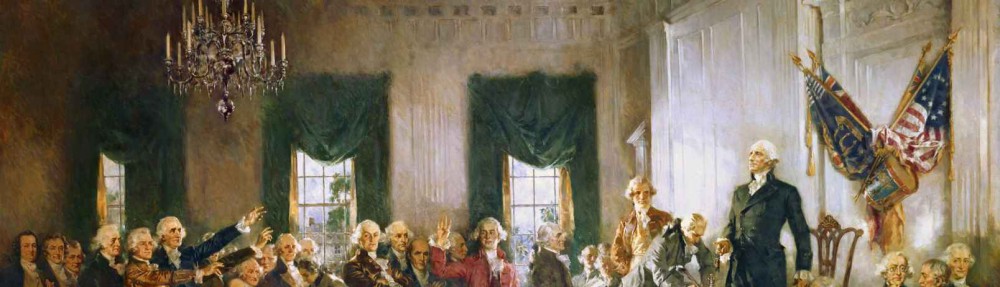
The Assassin who Created the “Deep State”

By now it is abundantly clear that President Trump faces furious opposition not just from the Democrats, the establishment Republicans, and the mainstream media, but from a shadowy, determined cabal of unelected, unaccountable bureaucrats who are deeply embedded in the government: the “deep state.” Paradoxically, the ability of such a cabal to grow and operate freely can be traced back in American history to well-meaning efforts to end government corruption — as well as to the evil act of one deranged assassin.

As Rating America’s Presidents: An America-First Look at Who Is Best, Who Is Overrated, and Who Was An Absolute Disaster explains, today’s deep state is a result of efforts to reform what was known as the “spoils system.” In 1828, Andrew Jackson was elected president on promises to end the hegemony of a privileged aristocracy, and to drain that swamp, he would need his own men in key positions. He removed a large number of civil service employees and replaced them with men of his own faction, which came to be known as the Democracy, or Democratic Party. This came to be known as the spoils system, after the old adage “To the victor belong the spoils.” This practice led to numerous incompetent people being placed in positions of responsibility; after the Civil War, a movement grew to remedy that problem by making civil service jobs based on merit rather than party affiliation.

In 1880, a champion of civil service reform, James A. Garfield, was nominated for president by the Republicans; to mollify the Stalwarts, or Republicans who favored the spoils system, the vice-presidential nod went to Chester Alan Arthur, a man who had been fired from his job as Collector of the Port of New York by President Rutherford B. Hayes for ignoring Hayes’s civil service reform executive order forbidding forcing federal officers to make campaign contributions.

The Garfield/Arthur ticket won, and immediately as president, Garfield pushed for measures that would end it. When a scheme to steal the public revenues was discovered in the Post Office Department, he moved swiftly, firing those implicated and calling for the prosecution of anyone involved, no matter how high a position he occupied. Accompanying this was his insistence on adopting a merit-based system that would, he hoped, reduce corruption by removing federal offices from the realm of partisan politics. He did not live to see this come to fruition.

Garfield had only been president for four months when, on July 2, 1881, he and Secretary of State James G. Blaine were walking through the Baltimore and Potomac Railroad Station in Washington, on their way to board a train to spend part of the summer in New Jersey, away from the heat of the capital. Just then, a man stepped up behind Garfield and fired his gun twice at the president, hitting him in the back and arm, and crying, “I am a Stalwart and now Arthur is President!”https://lockerdome.com/lad/9371484590420070?pubid=ld-8832-1542&pubo=https%3A%2F%2Fwww.americanthinker.com&rid=&width=748

That man was Charles Guiteau, who has been described in so many history books as a “disappointed office seeker” that the label has practically become a Homeric epithet. A disappointed office seeker Guiteau undeniably was, but he was much more than that. After repeatedly pressing Chester Arthur for a chance to campaign for the Garfield/Arthur ticket during the 1880 campaign, Arthur relented, likely just to end his harassment, and Guiteau delivered his speech, “Garfield against Hancock,” a single time. Guiteau thought he was owed a federal office as a result and had pestered White House officials repeatedly for a chance to see Garfield, who did meet with him at least once, and then Blaine in order to make his case for an appointment as consul to France.

Guiteau was, however, not an ordinary office seeker. He wanted a position in France but did not speak French. His sister recounted that in 1875, six years before the assassination, he had raised an axe to her with a look on his face “like a wild animal.” She explained: “I had no doubt then of his insanity. He was losing his mind.” In 1881, before the assassination, he also pressured Senator John Logan of Illinois for a federal job; Logan recounted: “I must say I thought there was some derangement of his mental organization.”

There was. As he bought a pistol and hatched his plan to murder Garfield, Guiteau wrote: “The Lord inspired me to attempt to remove the President in preference to someone else, because I had the brains and the nerve to do the work. The Lord always employs the best material to do His work.”

On September 19, 1881, Garfield died. At his murder trial, Guiteau stated that he was pleading “insanity, in that it was God’s act and not mine. The Divine pressure on me to remove the president was so enormous that it destroyed my free agency, and therefore I am not responsible for my act.”

Guiteau was not a “disappointed office seeker” first and foremost; he was a madman. That he has gone down in history as the former rather than the latter can be attributed to attempts to discredit the spoils system and advance the merits of civil service reform. Although Guiteau thought that by elevating Arthur to the presidency he was protecting the spoils system, his crime had the opposite effect: national revulsion over the killing of Garfield made civil service reform the most pressing issue of the day. The time for that reform had come at last, even as the Stalwart Arthur took the oath of office.

Rating America’s Presidents details how, when he became president, Arthur proceeded to shock the entire nation, and especially his Stalwart friends, by supporting civil service reform. His determination that he had a responsibility to do what Garfield would have done outweighed his commitment to the Stalwarts. He declared his support for civil service legislation, explaining that not he, but Garfield, had been elected president, and that he consequently had a responsibility to carry out his policies. On January 16, 1883, Arthur signed the Pendleton Civil Service Reform Act, which mandated that some employees of the government would be hired on the basis of written tests, not political affiliation, and forbade the firing of government employees for political purposes.

Arthur demonstrated immense personal courage and honor in choosing to carry out the wishes of his slain predecessor rather than implement his own contrary agenda. His decision to do this effectively ended his political career, as he almost certainly knew it would, and yet he stood firm.

Whether his stance was entirely wise in the long run is a separate question. Historians take for granted that civil service reform was good for the country, and there has been no significant indication that it wasn’t until quite recently, when a president has been thwarted in numerous endeavors by an army of unelected bureaucrats within the various departments and agencies of the government, who are determined to impede his agenda in every way possible.

The proponents of civil service reform never envisioned a situation in which deeply entrenched opponents of a sitting president in the FBI, the Justice Department, and elsewhere would be determined to destroy the president — or at very least make it impossible for him to carry out his policies — and could not be removed from their jobs because of civil service regulations.

Would not government work more smoothly, and the executive branch be able to operate more effectively in the way the Founding Fathers envisioned it would, if the president were able to clear out the employees of these agencies who opposed him and replace them with people more in line with his vision?

Charles Guiteau’s madness helped pave the way for the deep state. The spoils system has no defenders today and has had none for over a century. It should have more.

Robert Spencer is the director of Jihad Watch and a Shillman Fellow at the David Horowitz Freedom Center. He is author of 21 books, including the New York Times bestsellers The Politically Incorrect Guide to Islam (and the Crusades) and The Truth About Muhammad. His latest book is Rating America’s Presidents: An America-First Look at Who Is Best, Who Is Overrated, and Who Was An Absolute Disaster. Follow him on Twitter here. Like him on Facebook here.

Image: {{PD-US-expired}}

Help Support American Thinker

In today’s climate of political correctness and economic uncertainty, ad revenue only goes so far to keep an independent voice like AmericanThinker.com going. If you enjoy our articles, please consider supporting us with a direct contribution of as much or as little as you can give. Your donation will ensure that we continue to bring great pieces from our outstanding columnists.

Thank you.https://js.stripe.com/v3/elements-inner-card-a53606f7ea67fbeebc8d648e23283e52.html#style%5Bbase%5D%5BfontFamily%5D=Roboto%2C+Open+Sans%2C+Segoe+UI%2C+sans-serif&style%5Bbase%5D%5BfontSize%5D=16px&style%5Bbase%5D%5Bcolor%5D=%23000000&style%5Bbase%5D%5Bfont-weight%5D=400&style%5Binvalid%5D%5Bcolor%5D=%23ff2f00&componentName=card&wait=false&rtl=false&keyMode=live&apiKey=pk_live_ylKFAuZgL0gwhmJlAURCf48f&origin=https%3A%2F%2Fwww.americanthinker.com&referrer=https%3A%2F%2Fwww.americanthinker.com%2Farticles%2F2020%2F09%2Fthe_assassin_who_helped_create_the_deep_state.html&controllerId=__privateStripeController1

$5$10$50Otherhttps://lockerdome.com/lad/8965120688797543?pubid=ld-7146-6908&pubo=https%3A%2F%2Fwww.americanthinker.com&rid=&width=748https://www.facebook.com/v2.6/plugins/like.php?action=like&app_id=172525162793917&channel=https%3A%2F%2Fstaticxx.facebook.com%2Fx%2Fconnect%2Fxd_arbiter%2F%3Fversion%3D46%23cb%3Df3af4410b1608b%26domain%3Dwww.americanthinker.com%26origin%3Dhttps%253A%252F%252Fwww.americanthinker.com%252Ff36e24bdbf0083c%26relation%3Dparent.parent&container_width=0&font=arial&height=25&href=https%3A%2F%2Fwww.americanthinker.com%2Farticles%2F2020%2F09%2Fthe_assassin_who_helped_create_the_deep_state.html&layout=button_count&locale=en_US&sdk=joey&send=false&share=false&show_faces=false&width=90https://platform.twitter.com/widgets/tweet_button.2d7d9a6d04538bf11c7b23641e75738c.en.html#dnt=false&id=twitter-widget-1&lang=en&original_referer=https%3A%2F%2Fwww.americanthinker.com%2Farticles%2F2020%2F09%2Fthe_assassin_who_helped_create_the_deep_state.html&size=m&text=The%20Assassin%20Who%20Helped%20Create%20the%20Deep%20State&time=1599258176219&type=share&url=https%3A%2F%2Fwww.americanthinker.com%2Farticles%2F2020%2F09%2Fthe_assassin_who_helped_create_the_deep_state.html%23.X1K-NG4O02M.twitterShare62|66 Comments| Print|Emailsponsored contentFrom the WebPowered by ZergNetReporter Gives Haunting Confession Before Taking Her Own LifeTragic Details About Leah ReminiMatt Lauer Had an Affair with a ‘Well-Respected’ NBC StarMuhammad Ali’s Son Makes Head Turning Statement About BLMHow to Eat Less Meat and Save More MoneyA Landslide Win For Trump Is More Likely Than You Might Thinksponsored content

Carson’s Over-The-Counter Memory Drug Hits MarketTrump Moves to Defund 4 Riot-Roiled, Democrat-Run CitiesBloomberg Group Says Trump Could Win Big Election Night, But Biden Still Becomes PresidentProphecy About Trump Coming TrueUnmasked Pelosi Gets Hairdo in Salon Ordered ClosedZuckerberg, Wife Give $300M for Safe, Reliable VotingGov. Cuomo’s Near Threat to Trump ‘Out of Bounds,” Says MSNBC’s ScarboroughAG Barr Says Antifa ‘Flying Around’ US to Incite ViolenceDonald Trump Jr. to Newsmax TV: Pelosi the New ‘Marie Antoinette’The Rock, His Family Recovered From COVID-19Powered by 

FOLLOW US ON

American Thinker on Facebook
American Thinker on Twitter
American Thinker Newsletter Signup

Recent Articles

Blog Posts

Monthly Archives

sponsored contentFROM THE WEBby ZergNetWhat Trump Said To Kimberly Guilfoyle After Her RNC SpeechNancy Pelosi Is Just Too Important to Obey the RulesTwitter’s Reacting Strongly to the RNC Speaker We Didn’t SeeRadcliffe Makes The Admission We Basically Suspected All AlongParis Jackson Says Dad Michael Jackson Knew Her SexualityMajor Update on Eileen Davidson & Husband Vincent Van Pattensponsored content RECOMMENDEDMetformin Manufacturers in Panic After Truth Is ExposedProphecy About Trump Coming TrueThis Meeting Really Happened. Trump Was Targeted.The Rock, His Family Recovered From COVID-19AG Barr Says Antifa ‘Flying Around’ US to Incite ViolenceTrump Support Among ‘Non-Whites’ Up​Trump Moves to Defund 4 Riot-Roiled, Democrat-Run CitiesFacebook: No New Political Ads Week Before ElectionPowered by About Us | Contact | Privacy Policy | RSS Syndication © American Thinker 2020https://s7.addthis.com/static/sh.f48a1a04fe8dbf021b4cda1d.html#rand=0.5311992985516203&iit=1599258165206&tmr=load%3D1599258164947%26core%3D1599258165070%26main%3D1599258165173%26ifr%3D1599258165229&cb=0&cdn=0&md=0&kw=&ab=-&dh=www.americanthinker.com&dr=&du=https%3A%2F%2Fwww.americanthinker.com%2Farticles%2F2020%2F09%2Fthe_assassin_who_helped_create_the_deep_state.html&href=https%3A%2F%2Fwww.americanthinker.com%2Farticles%2F2020%2F09%2Fthe_assassin_who_helped_create_the_deep_state.html&dt=The%20Assassin%20Who%20Helped%20Create%20the%20Deep%20State&dbg=0&cap=tc%3D0%26ab%3D0&inst=1&jsl=4129&prod=undefined&lng=en&ogt=type%3Darticle%2Cdescription%2Curl%2Cimage%2Ctitle&pc=men&pub=aramanujan&ssl=1&sid=5f52be340e315172&srf=0.01&ver=300&xck=0&xtr=0&og=title%3DThe%2520Assassin%2520Who%2520Helped%2520Create%2520the%2520Deep%2520State%26image%3Dhttps%253A%252F%252Fwww.americanthinker.com%252Fimages%252Fbucket%252F2020-09%252F223430.png%26url%3Dhttps%253A%252F%252Fwww.americanthinker.com%252Farticles%252F2020%252F09%252Fthe_assassin_who_helped_create_the_deep_state.html%26description%3DBy%2520now%2520it%2520is%2520abundantly%2520clear%2520that%2520President%2520Trump%2520faces%2520furious%2520opposition%2520not%2520just%2520from%2520the%2520Democrats%252C%2520the%2520establishment%2520Republicans%252C%2520and%2520the%2520mainstream%2520media%252C%2520but%2520from%2520a%2520shadowy%252C%2520determined%2520cabal%2520of%2520unelected%252C%2520unaccountable%2520bureaucrats%2520who%2520are%2520dee…%26type%3Darticle&csi=undefined&rev=v8.28.7-wp&ct=1&xld=1&xd=1https://js.stripe.com/v3/controller-7214ce75b9fcb70166e1f4c474a0cd6e.html#apiKey=pk_live_ylKFAuZgL0gwhmJlAURCf48f&stripeJsId=28aebcfb-bbd5-41cb-819e-8b682f40c71b&startTime=1599258165461&origin=https%3A%2F%2Fwww.americanthinker.com&referrer=https%3A%2F%2Fwww.americanthinker.com%2Farticles%2F2020%2F09%2Fthe_assassin_who_helped_create_the_deep_state.html&controllerId=__privateStripeController1https://dp2.33across.com/ps/?tt=iframe&pid=1198&us_privacy=&random=1599258167939.5https://js.stripe.com/v3/m-outer-93be17fde268c6ff50c5aed9122214d2.html#url=https%3A%2F%2Fwww.americanthinker.com%2Farticles%2F2020%2F09%2Fthe_assassin_who_helped_create_the_deep_state.html&title=The%20Assassin%20Who%20Helped%20Create%20the%20Deep%20State%20-%20American%20Thinker&referrer=&muid=1dc5721a-2e12-443f-ad9b-31f32d5d9e86a064e2&sid=NA&version=6&preview=falsehttps://ssc-cms.33across.com/ps/?us_privacy=&ts=1599258168461.5&ri=25&ru=https%3A%2F%2Fads.pubmatic.com%2FAdServer%2Fjs%2Fuser_sync.html%3F%26p%3D156423%26us_privacy%3D%24%7BUS_PRIVACY%7D%26predirect%3Dhttps%253A%252F%252Fcms-xch-chicago.33across.com%252Fmatch%253Fus_privacy%253D%24%7BUS_PRIVACY%7D%2526bidder_id%253D25%2526external_user_id%253D

Read more: https://www.americanthinker.com/articles/2020/09/the_assassin_who_helped_create_the_deep_state.html#ixzz6X7Aj3McL
Follow us: @AmericanThinker on Twitter | AmericanThinker on Facebook

Marxism Unmasked: Part VII: The Making of Modern Civilization: Savings, Investment, and Economic Calculation

Institutionalism[1] used to ridicule the classical economists because they started with “Crusoe economics.” In the beginning a fisherman got the idea that he could catch more fish one day than he needed and then he could have some leisure time to manufacture fishing nets. These nets and saved fish are “capital goods”; I don’t call them “capital.”

Capital goods are the intermediate factors between the given natural factors of production and consumer goods. Nature—given resources and human labor are the given natural factors. But if they are to produce, they must be guided. The produced, intermediary factors of production—capital goods—are not only tools; they are also all other intermediary goods, half-finished products, and supplies of consumer goods which are used for the support of those who are producing with the aid of capital goods. The production process which we are organizing and operating today started in the early ages of history, in the remotest ages of history. If the children used up the nets and fish produced by their parents, capital accumulation would have had to start all over again. There is a continuous progress from simpler conditions to more refined conditions. It is important to realize this because we must know that, from the early beginnings on, the first step toward this system of producing with the aid of capital goods was saving, and has always been saving.

The concept of “capital” must be distinguished from the concept of “capital goods.” It is impossible to think and to deal with the problems of capital goods without using and referring to the concepts which we have developed in the complicated modern system of capital calculation. Capital goods are something material—something that could be described in terms of physics and chemistry. The concept of “capital” refers to the valuation of a supply of these capital goods in terms of money. This valuation of capital goods in terms of money is what marks the beginning of what may be called a new and higher period in human endeavors to improve the external conditions of mankind. The problem is how to maintain or to preserve the amount of capital available and how to avoid consuming the available capital goods without replacing them. The problem is how not to consume more, or if possible, how to consume less, than the amount of newly produced products. It is the problem of capital preservation, maintenance, and of course of increasing the capital available.

Under some circumstances, it is possible to deal with this problem without any special calculation or computation. If a farmer continues to produce in the same way and if the methods of construction and method of living haven’t changed, he can estimate his condition because he can establish comparisons in physical and biological terms—two barns are more than one barn, a dozen head of cattle is more than two cows, and so on. But such simple methods of computation are insufficient in an economic system in which there is change and progress. Replacement may not be in the same form as the factors which are used up. Diesel engines may be substituted for steam engines, and so on. Replacement and maintenance of capital under such conditions require a method of computation and calculation which can only be figured in terms of money. The various physical and external factors of production cannot be compared in any other way than from the point of view of the services they render to men, calculated in terms of money.

It was one of the fundamental errors of Aristotle that he believed that in exchanges the things which were exchanged must have the same value. Since the days of Aristotle, for two or three thousand years, the same error has prevailed again and again, leading great thinkers, as well as simple men, astray. The same error appears in the first pages of Marx’s Das Kapital, making everything Marx said about these problems useless. This error was repeated even much later in the writings of Henri Bergson [1859–1941], the eminent French philosopher.

There is no equivalence in exchange. On the contrary, it is differences that bring about exchange. You cannot reduce the terms of exchange and of trade to equivalence; you can only reduce them to differences in evaluation. The buyer values what he gets more highly than what he gives away; the seller values what he gives less highly than what he gets. Therefore, the equivalence that we use in determining the importance the various capital goods have in our lives can only be expressed in terms of prices. In calculating in terms of prices you can establish a system of prices, and determine whether or not a price has increased or decreased—that is, in terms of money. Without a price system there cannot be any calculation. In the socialist system, which cannot have a price system as we have it in the market system, there cannot be established calculation and computation.

In the system of economic calculation, we have the terms “capital” and “income”—terms and notions that cannot be thought of outside this system. “Capital” is the sum of the prices that can be obtained on the market for a definite given supply of capital goods. The businessman employs economic calculation in a specific way; he could not operate without this system of economic calculation. At the beginning of his enterprise he establishes a total value of all the capital goods at his disposal and calls it his “capital,” or the “capital” of his firm or corporation. Periodically, he compares the value of the prices of all the capital goods available in the firm with the prices of these capital goods at the beginning. If there is an increase he calls it “profit.” If there is a decrease, he calls it “loss.” No other system would make it possible to establish whether what has been done has increased the capital available, improved it, or decreased it. From another point of view, the total surplus that he calls “profit” can also be called “income,” insofar as it makes it possible for the owner—corporation or individual—to consume this amount without reducing the amount of capital available and without, therefore, living at the expense of the future. Thus the concepts of “capital” and “income” developed only within this system of economic calculation.

If the total amount of “income” is consumed, then there is no change in the amount of capital available for the enterprise. If a part is saved, i.e., not consumed but reinvested—that is, if it is used to expand the stock of capital goods working in the enterprise—then we can say additional capital has been accumulated; the enterprise has earned some “income.” If the contrary is the case, if the amount consumed by the owner exceeds the income, then we have capital consumption, or capital decumulation, and there will be less available in the future for the production of consumer goods.

I don’t want to enter into how much knowledge the ancient Greeks and Romans had of these ideas. They had some knowledge at least, but by the Middle Ages it had entirely disappeared. Under the conditions of the Middle Ages, there was no need for such calculation. It developed slowly, step by step in the latter part of the Middle Ages in the countries in which at that time economic progress was much better than other countries, in Italy, for instance. As a result, some of the fundamental terms of accountancy preserve their Italian origin, for instance the word “capital” itself.

In the beginning, the terms of accountancy were not very clear. People were not very good at arithmetic, and we discover very bad errors simply in arithmetical problems even in the books of big fifteenth-century firms. Gradually these ideas developed more and more until the system of double-entry bookkeeping was developed. Our whole thinking is now influenced by these ideas, even the ideas of those who know nothing of the problems of accountancy and who are not in a position to read and interpret the balance sheet of a corporation. Accountants and bookkeepers are only the handymen in this fundamental way of dealing with all material and external problems. However, these problems concern others than accountants and bookkeepers. Goethe, who was a great poet, scientist, and a precursor of the science of evolution, described a merchant’s double-entry accounting system as “one of the most marvelous inventions of the human spirit.” Goethe realized these ideas were fundamental to the modern system of producing and acting and that these concepts were a kind of practical mathematics and logic in the way people deal with all these problems.

In our age, public opinion and legislation have completely lost all understanding of these problems. This is due to modern income-tax legislation. First of all, in the legislation concerning income taxes, the law-giver calls salaries and wages “income” or “earned income.” However, the main characteristic of “income” in the economic sense is that it is that surplus over a businessman’s costs that may be consumed without reducing capital, i.e., without living at the expense of the future. You cannot consume “income” without deteriorating your opportunities for future production. The concepts of “capital” and “income” developed only within the system of economic calculation.

These income-tax laws also deal with “profits” as if they were salaries. The income-tax authors are very astonished if a firm doesn’t have a profit every year. They don’t realize that there are good years and bad years for an enterprise. One consequence was that during the depression in the early 1930s people used to say, “How unjust that a man who owns a big factory doesn’t have to pay any income tax this year, while a man who makes only $300 a month has to pay.” It was not unjust from the point of view of the law; that year the big factory owner had no “income.”

The authors in promulgating these income-tax laws had not the slightest idea of what “capital” and “income” in the economic system really meant. What they didn’t see was that the greater part of the great profits and great incomes wasn’t spent by the businessmen, but reinvested in capital goods and plowed back into the enterprise to increase production. This was precisely the way in which economic progress, improvement in material conditions, took place. Fortunately I do not have to deal with the income-tax laws, nor with the mentality that led to these laws. It is enough to say that, from the point of view of the individual worker, it would be much more reasonable to tax only income spent, not income saved and reinvested.

In many cases, it is difficult for a man in the late years of his life to make a living, or at least to earn as much as he had earned in his prime. To make it simple, take the situation of singers whose years of big earning are definitely limited.

What I want to deal with is the idea that saving in general, or that saving under special circumstances, is supposedly bad from the point of view of the welfare of the commonwealth and, therefore, that something should be done to restrict saving or to direct it into special channels. In fact, we may say, and nobody can deny it, that all material progress, everything that distinguishes our conditions from those of earlier ages, is that more has been saved and accumulated as capital goods. This also distinguishes the United States from, let us say, India or China. The most important difference is only a difference in time. It is not too late for them. We just started earlier to save some of the excess of production over consumption.

The most important institutional factor in the development of nations was the establishment of a system of government and of legislation that made large-scale saving possible. Large-scale saving was impossible and still is impossible today in all those countries in which the governments believe that when one man has more it must necessarily be the cause of other people’s distress. This was once the idea of all people. And it is today the idea of the people in many countries outside the countries of Western civilization. It is the idea that is now jeopardizing Western civilization by introducing different methods of government into the constitutions which made possible the development of Western civilization. It was also the idea prevailing in most European countries until the rise of modern capitalism, that is, until the age very inappropriately called the “Industrial Revolution.”

To show how strong this idea was, I quote from Immanuel Kant [1724–1804], one of the most important philosophers—but he lived in the east, in Kaliningrad, then called Königsberg: “If one man has more than necessary, another man has less.” This is mathematically perfectly true, of course, but mathematics and economics are two different things. The fact is that in all those countries in which people believed in this dictum and in which governments believed that the best way to improve conditions was to confiscate the wealth of successful businessmen—it was not necessary to confiscate the wealth of those who were unsuccessful—in all those countries, it was not possible to save and invest.

If someone asked me why the ancient Greeks did not have railroads, I would answer, “Because there was a tendency in those days to confiscate wealth. Why should people then invest?” The Greek philosopher Isocrates [436–438 BC] made some speeches which are still available to us. He said if a wealthy citizen stood trial in Athens he had no chance to win because the judges wanted to confiscate his wealth, expecting this would improve their situation. Under such conditions there couldn’t be any question of large-scale savings.

Large-scale savings developed only from the eighteenth century on. And from that time on there developed also those institutions which made saving and investment possible, not only by the well-to-do, but also of small sums by the poor man. In the early days the poor man could save only by hoarding coins. But coins don’t bear any interest, and the advantage he got from his savings was not very great. Moreover, it was dangerous to have such small hoards in his regular home; they could be stolen easily and they didn’t earn anything. From the beginning of the nineteenth century on, we had a large-scale development that made saving possible for the broad masses.

One of the characteristic differences between a capitalistic and a pre-capitalistic system is that in the capitalistic system even those who are not very well off are owners of savings and have small investments. Many people do not recognize this difference. Still today, in dealing with the problem of interest, statesmen, or politicians, as well as public opinion, believe that creditors are the rich and the debtors are the poor. Therefore, they think that a policy of easy money, a policy of lowering interest rates artificially by government interference, is in favor of the poor and against the rich. In fact, the poor and the less well-to-do own deposits with savings banks, have bonds, insurance policies, and are entitled to pensions. According to a newspaper account today, there are 61/2 million owners of bonds (promises to pay) in this country. I don’t know whether or not this figure is accurate. But nevertheless these bonds are widely distributed, and so this means that the majority are not debtors but creditors. All these people are creditors. On the other hand, the owners of the common stock of a corporation that has issued bonds, or is indebted to banks, are not creditors, but debtors. Similarly the big real estate operator who has a big mortgage is also a debtor. Therefore, it is no longer true to say that the rich are creditors and the poor are debtors. Conditions in this regard have changed considerably.

One of Hitler’s great rallying cries was: “Do away with interest slavery. Long live the debtor; perish the creditor.” But one German newspaper recognized the error in this and wrote an article with the headline, “Do You Know That You Yourself Are a Creditor?” I cannot say that this article was appreciated by Hitler.

There developed some years ago a hostility to saving and capital accumulation. This opposition to saving can’t be attributed to Marx, because Marx didn’t understand how capital was accumulated. Karl Marx didn’t foresee the development of large corporations and ownership by many small savers. A Russian economist who was influenced by Marx declared years ago that the whole economic system of capitalism was self-contradictory. Instead of consuming everything that was produced, a great part of the things produced is saved and accumulated as additional capital. There will be more and more for coming generations. What is the sense of this? For whom do they accumulate all this? Like a miser they accumulate, but who will enjoy what the saver earns? It is ridiculous; it is bad; something should be done about it.

John Maynard Keynes [1883–1946] succeeded with his anti-saving program. According to him, there is danger in over-saving. He believed, and many people accepted his view, that opportunities for investment were limited. There may not be sufficient investment opportunities to absorb all the income that is set aside as savings. Business will become bad because there is too much savings. Therefore, it was possible to save too much.

The same doctrine from another point of view had been prevalent for a very long time. People believed that a new invention—a labor-saving device—would produce what was called “technological unemployment.” This was the idea that led the early unions to destroy machines. Present-day unions still have the same idea, but they are not so unsophisticated as to destroy the machines—they have more refined methods.

As far as we can see, human wants are practically unlimited. What we need to fulfill satisfactions is more accumulation of capital goods. The only reason we don’t have a higher standard of living in this country is that we don’t have enough capital goods to produce all the things that people would like to have. I don’t want to say that people always make the best use of economic improvements. But whatever it is that you want, it requires more investment and more manpower to satisfy it. We could improve conditions, we could think of more ways to employ capital, even in the wealthiest parts of the United States, even in California. There will always be plenty of room for investment as long as there is scarcity of the material factors of production. We cannot imagine a state of affairs without this scarcity. We cannot imagine life in a “Land of Cockaigne,” where people have only to open their mouths and let food enter and where everything else people wanted was available.

Scarcity of the factors of production means a scarcity of capital goods. Therefore, the whole idea that we must stop saving and start spending is fantastic. In 1931 or 1932, Lord Keynes and a number of his friends published a declaration in which they stated there was only one means to avoid catastrophe and to improve economic conditions immediately—that was to spend, spend more, and still more. Economically we must realize that spending in this sense does not create jobs that investment wouldn’t have created just as much. It doesn’t matter whether you use your money for the purchase of a new machine or you spend it in a night club. According to Keynes’s theory the man who spends the money on a better life creates jobs, while the man who buys a machine and improves production is withholding something from the public.

It is not true that when Keynes wrote his book conditions in Great Britain justified his theory of government spending to create full employment. What created the unfavorable situation in Great Britain was that British industries after World War I did not have the means required to improve the material equipment in their factories. Therefore, the British machines were inefficient when compared with the machines in some other countries, especially in the United States. As a result, the marginal productivity of labor was lower in Britain. But as the unions would not tolerate any significant reduction of wage rates to make British industry more competitive, the result was unemployment. What Great Britain needed was more investment to improve the productivity of the factors of production, just as they need to do the same today.

Lord Keynes was very peculiar about this idea. An American friend published an article dealing with his personal friendship with Lord Keynes. He tells a story about visiting Keynes in a Washington hotel. In washing his hands, the friend was very careful not to soil more than a single towel. Keynes then crumpled all of the towels and said in that way he was making more jobs for American chambermaids. From this point of view, the best way to increase employment would be to destroy as much as possible. I would have thought that idea had been demolished once and for all by Frédéric Bastiat [1801–1850] in his broken window story.[2] But evidently Keynes didn’t understand this tale of Bastiat’s.

The fallacy that labor-saving machines create technological unemployment has not only been disproved by theoretical examination but also by the fact that the whole history of mankind consists precisely of the introduction of more and more labor-saving machines. Today we produce a greater amount of various amenities with a smaller amount of human labor. Yet there are more people and more employment. Therefore, it is not true that people are deprived of their jobs because some new machines are invented.

It is no less a fable, and it is also a very bad fable, that the accumulation of capital hurts the workers. The more capital goods available, the higher the marginal productivity of labor—other things being equal. If an employer considers the hiring of an additional worker or the firing of an additional worker, he asks himself what the employment of this man adds to the value of his products. If the employment of one worker more adds something to the quantities produced, the employer’s problem is, does his employment cost more than it brings from the sale of his production? The same problem arises when the employment of an additional amount of capital goods is considered. The greater amount of capital available per head of the worker, the greater the marginal productivity of the worker and consequently the higher the wages the employer can pay. The more capital accumulated—other things being equal—the more workers can be employed at the same rates, or at higher rates.

Two businessmen—J. Howard Pew [1882–1971] of Sunoco, and Irving Olds [1887–1963] of U.S. Steel—have tried, without too much success, to explain to other businessmen the effect of inflation on their capital accumulation, inventories, depreciation, and so forth. Inflation raises the businessmen’s selling prices, creating the illusion that they are making profits. The government then taxes and uses for current expenses these apparent “profits” which would otherwise have been used for investment or set aside for depreciation and replacement.

If an individual takes out a policy with a private insurance company, the insurance company invests this money. Later, of course, when the insurance has to be paid out, it has to disinvest. Individuals come to the point where they must disinvest, but insurance companies expand from year to year, and as there is capital accumulation taking place in the whole country, the insurance companies as a whole do not have to disinvest.

It is different with the Social Security system. The government talks about actuarial statistics but this does not mean what it means to an insurance company. What the individual pays, the government spends for current expenses. The government then gives to the “Social Security Fund” an IOU which it calls a “bond.” Thus the government “invests” in government bonds. When the government collects “Social Security” taxes, it says, “give me your money to spend and in return I promise that in 30 or 40 years the taxpayers will be willing to pay back the debt which we have incurred today.” Therefore the Social Security system is something very different from private insurance. It doesn’t mean something has been saved. On the contrary, the savings of individuals are collected by government for “social security” but they are used for current expenses. I am fully convinced the government will pay, but the question is, in what kind of dollars? The whole thing depends on the readiness of future Congresses and the future public to pay in good money. If people don’t like the paper money, they won’t use it. For instance, California stayed on hard currency during the Civil War era of the greenbacks.

Bismarck’s idea of social security was that he wanted everybody to receive something from the government. He compared the situation with that of the French, many of whom owned government bonds and received interest. He thought that was why the French were so patriotic; they were receiving something from the government. Bismarck wanted the individual German, too, to depend on the government. So he started an additional government bonus of 50 Marks to every old-age pensioner. This was called the Reichszuschuss [governmental supplementary allowance].

The problems of capital are problems of economic calculation. You cannot increase “capital goods” by inflation, although you can seemingly increase “capital.” The result is a discrepancy between capital goods and capital, as is pointed out by economic calculation.

Socialism: The Failed Idea that Never Dies

Institute for Economic Affairs, London 2019, 374 pages.

What would you say to an amateur chef who baked a cake following a certain recipe only for everyone who ate a slice to fall ill quickly afterward? Being such an enthusiastic baker, they bake the same cake a second time just a few weeks later, again following the same recipe, but this time with one or two slight adjustments. Unfortunately, the result is the same—everyone who eats the cake soon ends up feeling sick.

The cake baker repeats this more than two dozen times, always modifying the recipe a little, but the basic ingredients remain more or less the same despite the fact that their guests throw up every time. Of course, there’s no way such a thing would happen. The cake baker would soon realize that there is a major problem with the recipe and throw it away.

Yet this is exactly what socialists have done:

Over the past hundred years, there have been more than two dozen attempts to build a socialist society. It has been tried in the Soviet Union, Yugoslavia, Albania, Poland, Vietnam, Bulgaria, Romania, Czechoslovakia, North Korea, Hungary, China, East Germany, Cuba, Tanzania, Benin, Laos, Algeria, South Yemen, Somalia, the Congo, Ethiopia, Cambodia, Mozambique, Angola, Nicaragua and Venezuela, among others. All of these attempts have ended in varying degrees of failure. How can an idea, which has failed so many times, in so many different variants and so many radically different settings, still be so popular? (p. 21)

This is the central question asked by this extremely important book from economist Kristian Niemietz, who works at the London Institute for Economic Affairs. He manages to provide the answer to his question in one sentence:

It is because socialists have successfully managed to distance themselves from those examples. (p. 55)

As soon as you confront socialists with examples of failed experiments, they always offer the following response: “These examples don’t prove anything at all! In fact, none of these are true socialist models.” During the “heyday” of most of these socialist experiments, however, intellectuals held quite a different view, as Niemietz illustrates with many examples.

The latest example of socialism’s failings is Venezuela, which just a few years ago was being hailed by leading intellectuals and left-wing politicians as a model for “Socialism of the 21st Century.” At a demonstration in commemoration of Hugo Chávez in London in March 2013, for example, current British Labour Party leader Jeremy Corbyn said:

Chávez… showed us that there is a different, and a better way of doing things. It’s called socialism… In his death, we will march on, to that better, just, peaceful and hopeful world. (p. 239)

And even as late as June 2015, when the failure of the socialist experiment in Venezuela was already evident, Corbyn repeated:

When we celebrate – and it is a cause for celebration – the achievements of Venezuela, in jobs, in housing, in health, in education, but above all, its role in the whole world as a completely different place, then we do that because we recognize what they have achieved, and how they’re trying to achieve it. (p. 246)

Just a few weeks later, he enthusiastically declared that “the Bolivarian revolution is in full swing and is providing inspiration across a whole continent.” Venezuela was praised as a successful counter-model to “neo-liberal policies.” (p. 247)

Niemietz shows that even mass murderers such as Josef Stalin and Mao Zedong were enthusiastically celebrated by leading intellectuals of their time. These intellectuals were not outsiders but renowned writers and scholars, as Niemietz demonstrates with numerous examples. Even the concentration camps in the Soviet Union, the Gulags, were admired:

They were presented as places of rehabilitation, not punishment, where inmates were given a chance to engage in useful activities, while reflecting upon their mistakes.

A then-well-known American writer explained:

The labor camps have won high reputation throughout the Soviet Union as places where tens of thousands of men have been reclaimed. (p. 72)

Even journalists and intellectuals who didn’t completely turn a blind eye to the regime’s crimes found arguments to justify what was happening:

But – to put it brutally – you can’t make an omelet without breaking eggs and the Bolshevist leaders are just as indifferent to the casualties that may be involved in their drive toward socialization as any General during the World War who ordered a costly attack. (p. 80)

These sentences were written by The New York Times’ Moscow correspondent, who was head of the newspaper’s office in the Russian capital from 1922 to 1936.

Niemietz concedes that some socialist intellectuals did criticize the Soviet Union. But for many, their antipathy was the result of using utopian standards as a yardstick for judging real-world systems—utopian fantasies that no system in the world would have been able to live up to.

If one’s idea of socialism demands the immediate abolition of the police, the army, the court system, the prison system, etc., if it requires people to voluntarily give up money, private property, exchange, etc., and if one does not accept any compromises, halfway measures or phase-in periods, then yes, such a person would not have been seduced by Leninism. But this is simply because they would have set the bar impossibly high. A lot of early socialist critics of the Soviet Union fall into this category. (p. 98)

Many Western intellectuals were enthusiastic in their support for Mao Zedong and his cultural revolution despite the 45 million lives lost during socialism’s greatest experiment—the Great Leap Forward—at the end of the 1950s alone. After Mao’s death, when Deng Xiaoping’s reform policies liberated hundreds of millions of Chinese from bitter poverty, these same intellectuals were nowhere near as enthusiastic about China as they had been in Mao’s day.

Just as ironically, the enthusiasm of Western intellectuals for China began to fade when the most murderous period was over… Western intellectuals had lavishly heaped praise on China when millions of Chinese people were starving or worked to death in forced labour camps. But when a programme of relative liberalisation lifted millions of people out of poverty, those intellectuals were conspicuous by their silence. Market-based reform programmes, no matter how successful, will never inspire pilgrimages. (p. 110-111)

Even the North Korean dictator Kim Il Sung and the murderous Khmer Rouge regime in Cambodia found admirers among Western intellectuals, as Niemietz demonstrates in two chapters of his book. And that’s not to mention Cuba and Che Guevara, who became a pop icon in the West.

In his thorough historical analysis, Niemietz shows every socialist experiment to date has gone through three phases.

During the first phase, the honeymoon period (p. 56), intellectuals around the world are enthusiastic about the system and praise it to the heavens. This enthusiasm is always followed by a second phase, disillusionment, or as Niemietz calls it, “the excuses-and-whataboutery period.” (p. 57) During this phase, intellectuals still defend the system and its “achievements” but withdraw their uncritical support and begin to admit deficiencies, although these are often presented as the result of capitalist saboteurs, foreign forces, or boycotts by US imperialists.

d12e9117613a1599144490-donate-thankyou-landscape.png

Join us in preserving the principles of economic freedom and individual liberty for the rising generationSupport FEE’s Mission

Finally, the third phase sees intellectuals deny that it was ever truly a form of socialism, the not-real-socialism stage. (p. 57) This is the stage at which intellectuals line up to state that the country in question—for example, the Soviet Union, China, or Venezuela—was never really a socialist country. According to Niemietz, however, this line of argumentation is rarely presented during the first phase of a new socialist experiment and becomes the dominant view only after the socialist experiment has failed.

This is an incredible book and should be compulsory reading at schools and universities, where today the song sung by anti-capitalists reigns supreme.

Nowadays, Western socialists do not even attempt to oppose real-world capitalism with historical examples of socialism. Instead, they put forward arguments based on the vague utopia of a “just” society. Sometimes, they cite “Nordic socialism”—i.e. the variant of socialism that emerged in countries like Sweden—as an example, although they completely forget that the Nordic countries, having learned from their failed socialist experiments of the 1970s, have long since abandoned the socialist path. Today—despite having higher taxes—they are no less capitalist than, for example, the United States.

In the author’s place, I would have dealt explicitly with “democratic socialism,” which has also always failed miserably. After all, the policies pursued by socialists in Great Britain and some high-profile members of the Democratic Party in the United States, namely very high taxation on the rich and a high level of state regulation of the economy, has certainly also been seen before in democratic countries, including Sweden and Great Britain in the 1970s. But even these experiments, despite not ending in totalitarian rule or even mass murder, were catastrophic for the economy and led to stubborn declines in prosperity.

Socialists who criticize Stalinism and other forms of real-world, historical socialism always fail to analyze the economic reasons for the failures of these systems. (p. 28) Their analyses attack the paucity of democratic rights and freedoms in these systems, but the alternatives they formulate are based on a vague vision of all-encompassing “democratization of the economy” or “worker control.” Niemietz shows that these are the exact same principles that initially underpinned the failed socialist systems in the Soviet Union and other countries.

When contemporary socialists talk about a non-autocratic, non-authoritarian, participatory and humanitarian version of socialism, they are not as original as they think they are. That was always the idea. This is what socialists have always said. It is not for a lack of trying that it has never turned out that way. (p. 42)

This is an incredible book and should be compulsory reading at schools and universities, where today the song sung by anti-capitalists reigns supreme. Niemietz argues with intellectual authority as he weighs, differentiates, and marshals a wealth of historical evidence in support of his thesis. No other author has so far managed to so convincingly explain why socialism has nevertheless continued to remain so attractive to this day despite the sharp lessons of bitter historical experience.

In his Lectures on the Philosophy of History, the German philosopher Hegel observed,

But what experience and history teach is this, – that peoples and governments never have learned anything from history, or acted on principles deduced from it.

It could well be that Hegel’s verdict is too harsh. Nevertheless, it does seem that the majority of people are unable to abstract and draw general conclusions from historical experience. Despite the numerous examples of capitalist economic policies leading to greater prosperity—and the failure of every single variant of socialism that has ever been tested under real-world conditions—many people still seem incapable of learning the most obvious lessons.

Leftist Efforts to Revise American History

There is very little new under the sun. The monument and statue destruction that we are witnessing has been witnessed in other times and other places. A tyrant’s first battlefield is to rewrite history. Most notable were the political purges of Joseph Stalin. The Soviet government erased figures from Soviet history by renaming cities — such as the Imperial capital of St. Petersburg to Petrograd and Leningrad and Stalingrad — and eradicating memories of czarist rule. Stalin’s historical revisions also included changing photographs and history books, thereby distorting children’s learning within educational establishments.

Most of the effort to rewrite American history has its roots among the intellectual elite on our college campuses whose message has been sold to predominantly white college students who have little understanding of how they are being used. Much of their current focus is on tearing down statues and changing names that they deem offensive. They have denounced George Washington, Thomas Jefferson and Abraham Lincoln. Without much understanding of history, they have demanded that Princeton University remove the name of Woodrow Wilson, who was a progressive, from its public policy school and residential college. Some are urging Yale University to change its name because its benefactor Elihu Yale was a slave trader.

To purge our society of names associated with evil is going to be quite a task. I suggest that we set up a formal commission to deal with this formidable challenge. Maybe we can name it the Commission to Eliminate Bad Memories. There are some challenging issues. What should be done about our nation’s capital, Washington and District of Columbia? After all, George Washington owned slaves, and Columbia is the feminine form of Columbus. Speaking of Washington, its football team, the Washington Redskins, has finally agreed to temporarily call themselves Washington Football Team until they can find a snazzier name.

Renaming things is a big job. Our military has several fighting aircraft named with what today’s tyrants might consider racial slights, such as the Apache, Iroquois, Kiowa, Lakota and Mescalero. Perhaps offensive to PETA, we also have military hardwarenamed after animals, such as the Eagle, Falcon, Raptor, Cobra and Dolphin.

Clarence Page of the Chicago Tribune wrote, “Now that Washington’s NFL team has announced its ‘retirement’ of the racial slur that has been its brand name since 1933, I am tempted to gloat a little.” In response to Page’s article, there is an email making the internet rounds that raises naming issues. What about the Kansas City Chiefs, the Atlanta Braves and the Cleveland Indians?

The New York Yankees might offend Southerners because there is no team named for the Confederacy, Some people, particularly Catholics, might be offended by or deem it sacrilegious to have sports teams named the New Orleans Saints, the Los Angeles Angels or the San Diego Padres. Then what about team names that glorify savage barbarians and criminals who raped and pillaged such as Oakland Raiders, Minnesota Vikings, Tampa Bay Buccaneers and Pittsburgh Pirates? The New York Giants and the San Francisco Giants might be promoting obesity and the Milwaukee Brewers promoting alcoholism.

There is another naming issue that needs resolution. I have been working 40 years at George Mason University. Despite his monumental contributions, such as our Bill of Rights, George Mason was a slave owner. Therefore, in keeping with the times, George Mason University is due for a name change. How about Al Sharpton University, Jesse Jackson University or Black Lives Matter University? Does objection to these names make one a racist?

Walter E. Williams is a professor of economics at George Mason University. To find out more about Walter E. Williams and read features by other Creators Syndicate writers and cartoonists, visit the Creators Syndicate webpage at http://www.creators.com.

Ten Reason Our Kids are so Anxious all the Time

Writing at Psychology Today, psychotherapist Amy Morin offers some reasons why teenagers seem more anxious nowadays.  But do we actually know teens are more anxious than ever? And more anxious compared to when? Like so many things in print, we can’t take that statement for granted. But my clinical experience suggests that at least some teenagers are indeed anxious, so let’s take a close look at her thoughts on the subject.

  1. Electronics offer an unhealthy escape. The issue is not electronics. The issue is WHY so many teenagers seek an unhealthy escape. Before smartphones and the Internet, teens could just as easily escape into music, television or shopping malls. Again begging the question: Why?

Escapism, in its unhealthy form, means a desire to escape one’s own thinking. That’s the worst kind of anxiety. If you fear spiders, heights or clowns, you can take steps to avoid those things. But you cannot escape your mind unless you choose the dead-end street of drugs, alcohol or some other form of altering your consciousness. Today’s electronics offer that escape for everyone. And if so, it’s the misuse of the electronics that creates the problems.

  1. Happiness is all the rage. Don’t blame happiness. Blame the inability or unwillingness to define one’s happiness. Happiness is always the proper goal!
  2. Parents are giving unrealistic praise. “You can be anything you want to be.” What well-meaning parent has not said this to their kids? The problem is that kids take things literally. Cognitively and emotionally, most are not able to do otherwise. They can easily take it out of context where they believe that the achievement of difficult things ought to be easier than it is.
  3. Parents are getting caught up in the rat race. Does this mean that parents are too busy? Are kids whose parents have dead-end jobs happier than kids whose parents are well-off and highly productive? I don’t buy it. Kids do indeed need to feel psychologically and emotionally visible to their parents. Their minds and selves need to matter. That can happen no matter what the parents do.
  4. Kids aren’t learning emotional skills. These skills include the ability to know what you’re feeling and to rationally express one’s feelings. But here’s the most important skill that’s almost always overlooked in today’s feelings-oriented culture: The ability to separate feelings from facts. One of the cornerstones of psychological health.
  5. Parents view themselves as protectors, rather than guides. In fact, parents should be both. They start out as protectors and gradually become guides. But the point is well-taken: A majority of parents think they’re permanent protectors of their children. When they sense their young adults’ anxiety, they respond by doubling up on the protection role rather than saying, “So what do you think you should do about that problem?”
  6. Adults don’t know to help kids face their fears. And worse yet, they see it as their job to eradicate the fears, rather than putting their kids on notice that it’s up to them to manage their fears – like the adults they will eventually be.
  7. Parents are parenting out of guilt and fear. Our politically correct age is carefully designed to cause unearned guilt in just about anyone. That’s how politicians get what they want. People of all ages are made to feel guilty for things they didn’t choose, like their race, their economic status, and/or their genetics. It’s an absurd waste of time and a very sick thing to blame yourself or others. Adults and teens alike have to overcome this dangerous trend.
  8. Kids aren’t being given enough free time to play. Many families schedule every hour of every day. Sometimes kids are genuinely passionate about activities that require scheduling, and of course there’s nothing wrong with that. But there’s a compulsive component implicit in the need to fill every last hour of otherwise free time. There’s nothing wrong with a little quiet time.
  9. Family hierarchies are out of whack. It took me a minute to figure this one out, and I think it means that there are few family rules or guidelines. Anything goes. And the lack of objective principles is just as irrational as a fixation on arbitrary or irrationally rigid ones. If anything goes, then we’re left with only our feelings. And with feelings alone, the world can become a pretty unsettling and anxiety-producing place. Just ask our teens.

Amy Morin

Marxism Unmasked: Part VI: Nationalism, Socialism, and Violent Revolution

Marxian doctrine doesn’t deny the possibility of absolute truth, but it maintains that absolute truth can be attained only in the classless society. Or in the proletarian class society.

Lenin’s main book,[1] or at least his most voluminous book (now available in the Collected Works of Lenin), led some people to call him a philosopher. Most of Lenin’s critique of the ideas of his adversaries consists of calling them “bourgeois.” Lenin’s philosophy is merely a restatement of the philosophical ideas of Marx; to some extent it is not even up to the level of other Russian writers on Marxism.

Marxist theory or philosophy had no development in countries where there were Communist parties. Persons whom we call Marxians consider themselves merely interpreters of Marx; they never tried to change anything in Marx. However, there are contradictions in Marx. So it is possible to quote passages from his writings from all points of view. The influence of Marx on all authors and writers who have lived since Marx died has been considerable, even though it is not usually admitted that these authors were influenced by Marx.

Although Marxians considered themselves solely interpreters of Marx, one Marxian, one writer, added something and had a strong influence, not only on the small group of his followers, but also on other authors. Georges Sorel [1847–1922]—not to be confused with Albert Sorel [1842–1906]—an important historian, developed a philosophy in many respects different from the Marxian philosophy. And it influenced political action and philosophic thinking. Sorel was a timid bourgeois intellectual, an engineer. He retired to discuss these things with his friends at a bookshop owned by Charles Péguy [1873–1914], a revolutionary socialist. In the course of the years, Péguy changed his opinions and at the end of his life he was a very ardent Catholic author. Péguy had serious conflicts with his family. Péguy was remarkable for his intercourse with Sorel. Péguy was a man of action; he died in action in 1914 in the first weeks of the war.

Sorel belonged psychologically to the group of people who dream of action but never act; he didn’t fight. As a writer, however, Sorel was very aggressive. He praised cruelty and deplored the fact that cruelty is more and more disappearing from our life. In one of his books, Reflections on Violence, he considered it a manifestation of decay that Marxian parties, calling themselves revolutionary, had degenerated into parliamentary parties. Where is the revolution if you are in Parliament? He also didn’t like labor unions. He thought the labor unions should abandon the hopeless venture of seeking higher wage rates and should adopt, instead of this conservative pattern, the revolutionary process.

Sorel saw clearly the contradiction in the system of Marx who spoke of revolution on the one hand and then said, “The coming of socialism is inevitable, and you cannot accelerate its coming because socialism cannot come before the material productive forces have achieved all that is possible within the frame of the old society.” Sorel saw that this idea of inevitability was contradictory to the idea of revolution. This is the contradiction all socialists ask themselves about—Kautsky, for one. Sorel completely adopted the idea of revolution.

Sorel asked of the labor unions a new tactic, action directe—attack, destroy, sabotage. He considered these aggressive policies only preliminary to the great day when the unions would declare a “general strike.” That is the day when the unions will declare “Now we don’t work at all. We want to destroy the life of the nation completely.” General strike is only a synonym for the live revolution. The idea of action directe is called “syndicalism.”

Syndicalism can mean ownership of the industry by the workers. Socialists mean by this term ownership by the state and operation for the account of the people. Sorel wanted to attain this by revolution. He didn’t question the idea that history leads toward socialism. There is a kind of instinct that pushes men toward socialism, but Sorel accepted this as superstition, an inner urge that cannot be analyzed. For this reason his philosophy has been compared with that of Henri Bergson’s élan vital (myths, fairy stories, fables, legends). However, in the doctrine of Sorel, “myth” means something else—a statement which cannot be criticized by reason.

1. Socialism is an end.

2. The general strike is the great means.

Most of Sorel’s writings date from 1890 to 1910. They had an enormous influence on the world, not only on the revolutionary socialists, but also on the royalists, supporters of the restoration of the House of Orange, the “Action française,” and in other countries the “Action nationale.” But all these parties gradually became a little bit more “civilized” than Sorel thought they should be.

It was the idea of French Syndicalism that influenced the most important movement of the twentieth century. Lenin, Mussolini, and Hitler were all influenced by Sorel, by the idea of action, by the idea not to talk but to kill. Sorel’s influence on Mussolini and Lenin has not been questioned. For his influence on Nazism, see the book by Alfred Rosenberg[2] titled The Myth of the 20th Century. The fundamental idea of racism was borrowed from Frenchmen. The only man who really contributed something to the Marxian idea was Sorel, along with a group of syndicalists—a comparatively small group composed exclusively of intellectuals and even of idle rich and intellectuals, like the “penthouse Bolshevists” of New York. They repeated again and again that only the workers have enough vigor and enough class consciousness in order to search out and to destroy the bourgeois system.

The center of Marxian activity shifted from Germany to France. The greatest portion of Marxian writings are in French. Sorel’s work was done in France. Outside of Russia, there are more Marxians in France than in any other country; there is, however, more discussion of communism in France than in Russia. The École Normale Supérieure in Paris was an important center of Marxian teachings. Lucien Herr [1864–1926], the librarian, had a great deal of influence. He was the father of French Marxism. As former students of École Normale Supérieure became more and more important, the school spread Marxism all over France.

By and large, the same condition prevailed in most European countries. When the universities seemed slow to accept Marxism, special schools were endowed to educate the rising generations in orthodox socialism. This was the goal of the London School of Economics, a Fabian institution founded by the Webbs. But it couldn’t avoid being invaded by persons of other ideas. For instance, [Friedrich A.] Hayek [1899–1992] taught for some years at the London School of Economics. This was the case in all countries—European countries had state universities. People generally ignored the fact that Marxians, not free traders, were appointed by the Tsar at the imperial universities in Russia. These professors were called legal, or better “loyal,” Marxians. When the Bolshevists came to power in Russia, it was not necessary to fire the professors.

Marx didn’t see any differences between the various parts of the world. One of his doctrines was that capitalism is one stage in the development of socialism. In this regard, there are some nations that are more backward than others. But capitalism was destroying the trade barriers and migration barriers that once prevented the unification of the world. Therefore, the differences in the evolution of the various countries with regard to their maturity toward socialism will disappear.

In the Communist Manifesto in 1848, Marx declared that capitalism was destroying all national peculiarities and unifying into one economic system all the countries of the world. The cheap prices of products were the means capitalism used to destroy nationalism. But in 1848, the average person didn’t know anything about Asia or Africa. Marx was even less informed than the average English businessman who knew something about business relations with China and India. The only attention Marx gave to this problem was his remark, later published by Vera Zasulich, to the effect that it might be possible for a country to skip the capitalist stage and proceed directly to socialism. Marx saw no distinction between various nations. Capitalism, feudalism, brings about progressive impoverishment everywhere. Everywhere there will be mature economies. And when the age of mature capitalism comes, the whole world will have reached socialism.

Marx lacked the ability to learn by observing political events and the political literature being published around him. For him practically nothing existed but the books of the classical economists, which he found in the library of the British Museum, and the hearings of the British Parliamentary Commissions. He didn’t even see what was going on in his own neighborhood. He didn’t see that many people were fighting, not for the interests of the proletariat, but for the principles of nationality.

Marx completely ignored this principle of nationality. The principle of nationality asked that every linguistic group form an independent state and that all the members of such a group should be recognized and unified. This was the principle which brought about the European conflicts, led to the complete destruction of the European system, and created the present-day chaos in Europe. The principle of nationality doesn’t take into account that there are large territories in which linguistic populations are mixed. Consequently there were struggles between the various linguistic groups which finally resulted in the situation we have today in Europe. I mention this because it is a principle of government which was unknown up to now.

According to this principle there is no such nation as India. It is possible that this principle of nationality will break India up into many independent states fighting one another. The Indian Parliament uses the English language. The members of the various states cannot communicate with one another, other than by employing the language of the government, a language which they have practically expelled from their country. But this situation will not last forever.

In 1848, when the Slavs of Europe met for a Panslavist Congress in Moscow, they had to speak with one another in German. But this didn’t prevent later developments in a different way.

Karl Marx and Engels didn’t like the nationalistic movement and never took notice of it. It didn’t fit into their plans or schemes. If, on account of the unfriendly remarks Marx and Engels made about various linguistic groups of Austria-Hungary and the Balkans, some authors, especially French authors, think Marx was a forerunner of National Socialism—Nazism—they are wrong. Marx said that what he wanted was to create a one-world state. And that was Lenin’s idea too.

By 1848 Marx had already assumed that socialism was just around the corner. Given such a theory, there was no reason to form a separate linguistic state. Such a state could only be very temporary. Marx simply assumed that the age of nationalities would come to an end, and that we were on the eve of an age in which there would no longer be differences between various types, classes, nations, linguistic groups, etc. Marx absolutely denied any differences among men. Men would all be of the same type. There was never any answer in Marx as to what language the people in his one-world state would use, or what the nationality of the dictator would be.

Marx was furious when someone said there were differences between men in the same nation, the same city, the same branch of business, just as all Marxists became furious when someone told them there were differences between Englishmen and Eskimos. According to Marx, the only difference was due to education. If an idiot and Dante had been educated in the same way, there would have been no difference between them. This idea influenced Marx’s followers, and it is still one of the guiding principles of American education. Why is not everybody equally intelligent? Many Marxians assume that in the future socialist commonwealth the average person will be equal in talents, gifts, intelligence, artistic attainments, to the greatest men of the past, such as Trotsky, Aristotle, Marx, and Goethe, although there will still be some more gifted people.

It never occurred to Marx that, in the best case, education can only transfer to the pupil what the teacher already knows. In the case of Marx, it wouldn’t have been enough for him to have been educated in a school by perfect Hegelian teachers because then everything he would have produced would have only been Hegelianism again. By educating people in the knowledge of the generation preceding motor cars, it wouldn’t have been possible to produce motor cars. Education can never bring about progress as such. That some people, thanks to their positions, inheritance, education, and so on, have the gift to go one step farther than preceding generations cannot be explained simply by education.

Similarly, it is impossible to explain great things and the great acts of some men simply by referring to their national affiliation. The problem is, why were these people different from their brothers and sisters? Marx simply assumed, without any reason, that we are now living in the age of internationalism and that all national traits will disappear. In the same way that he assumed that specialization would disappear, because machines can be operated by unskilled workers, he assumed there would no longer be any differences between various parts of the world and various nations. Every kind of conflict between nations was interpreted as the consequence of the machinations of the bourgeoisie. Why do Frenchmen and Germans fight? Why did they fight in 1870? Because the ruling classes of Prussia and the ruling classes of France wanted to fight. But this had nothing to do with the interests of nations.

In regard to his attitude toward war, Marx was, of course, influenced by the idea of the Manchester laissez-faire liberals. In using the term “Manchester liberalism” always as an insult, we tend to forget the essential statement in that famous declaration of the Manchester Congress where the term originated. It was said there that in the world of free trade there is no longer any reason for nations to fight one another. If there is free trade and every nation can enjoy the products of every other nation, the most important cause of war disappears. The princes are interested in increasing the territorial size of their princely province to get greater income and power, but nations as such are not interested, because it doesn’t make any difference under free trade. And in the absence of immigration barriers it doesn’t matter to the individual citizen whether his country is large or small. Therefore, according to the Manchester Liberals, war will disappear under popular democratic rule. The people will not then be in favor of war because they have nothing to win—they have only to pay and to die in the war.

It was this idea that was in the mind of President [Woodrow] Wilson [1856–1924] when he went to war against Germany. What President Wilson didn’t see was that all this about the uselessness of war is true only in a world when there is free trade between the nations. It is not true in a world of interventionism.

Sir Norman Angell [1872–1967] still argues in the same way. What did the individual Germans gain in 1870? This was almost true then, because there was comparatively free trade. But today the situation is different. Italy’s own policies made it impossible for Italians, in the world of interventionism, to get the raw materials they needed. It is not true in today’s interventionist world that the individual person does not gain something from war.

The League of Nations is one of the great failures in world history—and there have been many failures in world history. During the League’s 20 years the trade barriers had been more and more intensified. Tariffs became unimportant as trade barriers because embargoes were established.

Because the liberals said war was no longer economically advantageous because the people will not gain anything from it, therefore, a democratic nation will no longer be eager to fight wars. Marx assumed that this was true even in the interventionist world which was developing under his very eyes. This was one of the fundamental errors of Marxism. Marx was not a pacifist. He didn’t say war was bad. He only said—because the liberals said so—that war between nations had no importance or meaning at all. He said war—i.e., revolution, by which he meant civil war—was necessary. Nor was Friedrich Engels a pacifist; he studied military science day in and day out in order to prepare himself for the position he had assigned himself as commander-in-chief of all nations, as commander-in-chief for the proletarians of all countries united. Remember that he participated in fox hunting in a red coat, which he told Marx this was the best exercise for a future general.

Because of this idea of revolution—civil war, not international war—the Marxian International began to discuss peace. In 1864 Marx founded in London the First International. A group of persons who had very little to do with the people and the masses met together. There was a secretary for every country. The secretary for Italy was Friedrich Engels and many of the other countries were represented by persons who only knew the countries they represented as tourists. Arguments between the members disrupted the whole International. Finally it was moved to the United States and then fell apart in 1876.

The Second International was formed in Paris in 1869. But this Second International didn’t know what to deal with. The unions had arisen and the unions were opposed to free trade and free migration. Under such conditions, how could you find subjects to be discussed at an international congress? Then they decided to discuss peace and war, but only on a national level. They said they were all proletarians and they agreed they would never fight the wars of the bourgeoisie. The Germans included Engels and Karl Kautsky. There were some “bad” Frenchmen in the group who asked, “What do you mean when you say we can’t defend our own country? We don’t like the Hohenzollerns.” The French at this time made an agreement with the Russians and the Germans didn’t like that. Every few years there was such an international congress and each time the newspapers said it heralded the end of war. But these “nice fellows” didn’t discuss the real causes of friction, migration barriers, etc. The outbreak of World War I disrupted the International Congresses.

What Marx planned was a revolution. But what really happened was that he created a bureaucratic organization in the European countries which was, by and large, innocent because it lacked the power to execute its theories. Then there developed in the East a Communist organization that unfortunately has the power to execute people and to threaten the whole world. And all this was started in the Reading Room of the British Museum in London by a man, who was not in this regard a man of action, but who was able to bring about violent action. It was the timid bourgeois characters, Karl Marx and Georges Sorel, who created all this mischief. Most of the violent ideas of our times have come from men who themselves wouldn’t have been able to resist any aggression.

Wilson accepted the doctrine of the Manchester Liberals, namely that so far as war was concerned, democracies don’t like to fight wars; democracies fight only wars of defense because the individual citizen cannot expect any improvement of his conditions from war, not even if his country is victorious. But Wilson didn’t see that this was true only in a world of free trade. He didn’t see that this was quite different already in the age in which he lived, which was an age of interventionism. He didn’t realize that an enormous change in economic policies had deprived this theory of the Manchester Liberals of its practicability. Trade barriers were comparatively innocent in 1914. But they were very much worsened during the years of the League of Nations. While free traders were meeting with the League in Geneva and talking about reducing trade barriers, people at home were increasing them. In 1933, there was a meeting in London to bring about cooperation among the nations. And precisely at this time the richest country, the United States, nullified the whole thing with monetary and financial regulations. After this the whole apparatus was absolutely useless.

Ricardo’s theory of comparative advantage is that it is to the advantage to a nation to have free trade even if all other nations cling to their trade barriers. If the United States alone today adopted free trade there would be certain changes. But if all other countries clung to protectionism with import barriers, it would not be possible for the United States to buy more goods from other countries.

There are isolationists not only in this country; there are also isolationists in other countries. Imports must be paid for by exports and exports have no other purpose than to pay for imports. Thus the establishment of free trade by the richest and most powerful nation only would not change the situation for the Italians, for instance, if they retained their trade barriers. It would not make any difference for other countries either. It is advantageous for any country to have free trade even if all other countries do not, but the problem is to remove the barriers of the other countries.

The term “socialism,” when it was new in the second part of the 1830s, meant exactly the same as “communism”—i.e., the nationalization of the means of production. “Communism” was the more popular term in the beginning. Slowly the term “communism” fell into oblivion and the term “socialism” came into use almost exclusively.

Socialist parties, social democratic parties, were formed and their fundamental dogma was the Communist Manifesto. In 1918, Lenin needed a new term to distinguish his group of socialists from those groups which he called “social traitors.” So he gave to the term “communism” a new meaning; he used it to refer, not to the final goal of socialism and communism, but only to the tactical means for attaining them. Until Stalin, communist meant simply a better method—the revolutionary method—as against the peaceful, socialist, method of the “socialist traitors.” At the end of the 1920s, without great success, Stalin in the Third International tried to give a different meaning to the term “communism.” However, Russia is still called the Union of the Soviet Socialist Republics (USSR).

In a letter, Karl Marx distinguished between two stages of socialism—the lower preliminary stage and the higher stage. But Marx didn’t give different names to these two stages. At the higher stage, he said, there will be such an abundance of everything that it will be possible to establish the principle “to everybody according to his needs.” Because foreign critics noticed differences in the standards of living of various members of the Russian Soviets, Stalin made a distinction. At the end of the 1920s he declared that the lower stage was “socialism” and the higher stage was “communism.” The difference was that at the lower socialist stage there was inequality in the rations of the various members of the Russian Soviets; equality will be attained only in the later, communist, stage.