Many people are wringing their hands over the election of self-identified democratic socialist Zohran Mamdani as New York City mayor. Unfortunately, they have reason to be worried, because his election reflects a trend that can be called conservatively, concerning, and liberally, alarming. To understand this assessment better, it helps to understand the nature of democratic socialism.
What is the history of the movement in this country?
Although he wasn’t an admitted socialist, Franklin D. Roosevelt introduced sweeping socialism to America:
While Roosevelt was not a socialist, his administration enacted a series of sweeping government programs that had long been championed by the Socialist Party.
Policies such as Social Security, unemployment insurance, federal jobs programs like the Works Progress Administration (WPA), and laws protecting workers’ rights to organize were all core tenets of the socialist platform that had been dismissed as radical just years earlier.
The Great Depression thus serves as the clearest example of how a systemic crisis can rapidly move socialist-inspired ideas from the political fringe to the center of American public policy.
Many of these programs have now become integral to the operations of the federal government, in spite of the early criticism of them. There is a good reason for calling them “entitlement programs.” Most of the country has come to depend on them.
Shortly before he co-founded Democratic Socialists of America (DSA) in 1982, academic and leftist activist Michael Harrington attended a conference of the Socialist International in Paris. There he befriended many of the world’s leading socialists, including Israeli Knesset opposition leader Shimon Peres. Peres was among the coterie of leftist leaders with whom Harrington could sit down ‘over a beer and exchange stories,’ as Harrington’s biographer Maurice Isserman put it.
Interestingly enough, Jews and Israel were originally supported by the DSA:
Harrington would build support for Israel into the amalgamation of American socialist groups that formed DSA. Embracing Israel as the fulfillment of the Jewish right of self-determination, he wrote that Zionism is ‘the national liberation movement of a Jewish people.’
In spite of its founding principles, DSA made an about-face when it came to the Jews and Israel. It’s hard to know precisely when this shift occurred, but October 7 solidified this change:
On October 7, 2023, in response to Hamas’s horrific attack, DSA issued a statement ‘unequivocally’ condemning the killing of all civilians but also calling Hamas’s actions ‘not unprovoked’ and ‘a direct result of Israel’s apartheid regime.’ The following spring, members of its youth branch, Young Democratic Socialists of America (YDSA), played a leading role in pro-Palestinian/anti-Israel campus demonstrations. In at least one instance, Jewish protesters were told to ‘go back to Poland.’ Other demonstrators used imagery and slogans equating Zionism with Nazism. The slogan “
‘From the River to the Sea,’ often interpreted as a call for eliminating Israel, has sounded at DSA meetings. And at its 2025 national convention, DSA approved a resolution citing support of Israel’s right to defend itself or equating anti-Zionism with antisemitism as ‘expellable offenses.’
As it turned out, the DSA was behind many of the campus protests and riots that consumed American campuses after October 7. In April of 2024, the DSA posted a statement to the website, which included this passage:
We support the righteous message of protesters at the encampments. We call on our comrades to support efforts nationwide to force universities to divest from the Zionist occupation and call on the United States government to cease all aid to Israel. Where protests appear, we’ll appear in numbers. Where repression looms, we’ll show up and protect the whole. Where support is needed, we’ll be a support.
Now, if you’re thinking that the participation of the DSA in political affairs is fringe or harmless, look at the inroads that the DSA has made:
A new report by the Heartland Institute, a national free-market think tank, reveals that nearly every candidate endorsed by prominent socialist organizations in the United States emerged victorious during the 2024 election.
Overall, these organizations endorsed a total of 51 socialist candidates, of which 48 (94 percent) won their races for federal, statewide, or local office with an average margin of victory of approximately 49 percent. Nine of these candidates ran in uncontested races. Taking out those nine candidates, the 39 remaining socialist candidates won their races by an average margin of approximately 37 percent. Only three socialist candidates lost their races, with a 13 percent average margin of defeat.
Among the candidates endorsed by these three socialist groups, 27 ran for the U.S. House of Representatives, two ran for U.S. Senate, 12 ran for statewide offices, and 10 ran for local offices. These races occurred in 22 states and the District of Columbia. California was the leading state for socialist candidates in the 2024 election, with 10 in total.
The DSA also publicly condemned one of their own, Alexandria Ocasio-Cortez, after she led a panel discussion in July 2024 against antisemitism:
The Democratic Socialists of America (DSA) dropped its endorsement of New York Rep. Alexandria Ocasio-Cortez after she hosted a panel discussion on antisemitism.
The DSA said in a Tuesday statement that it was rescinding its conditional endorsement of Ocasio-Cortez’s reelection campaign after she ‘conflated anti-Zionism with antisemitism and condemned boycotting Zionist institutions’ during the discussion she sponsored last month.
‘This sponsorship is a deep betrayal to all those who’ve risked their welfare to fight Israeli apartheid and genocide through political and direct action,’ the statement said.
Ocasio-Cortez, a Democrat, condemned antisemitism in the public discussion with two Jewish activists — Amy Spitalnick, the CEO of the Jewish Council for Public Affairs (JCPA), and Stacy Burdett, a former senior official at the Anti-Defamation League and US Holocaust Memorial Museum.
Democrats in the party continue to radicalize. The position of the socialists in supporting Marxist ideology increases its hold. People who feel they can draw on government programs are becoming more dependent on the “free” services that are offered. The movement to extend entitlement grows.
Are we truly prepared to accept people running for office who are democratic socialists? What if they are antisemitic? Are the freebies too tempting to too many people? Even if they fail to be elected—increasingly unlikely—how much damage will be done?
Zohran Mamdani’s triumph has given socialists huge power in New York City. Now they must use it well—or see the ruling class crush them.
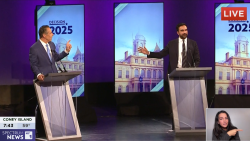
Zohran Mamdani’s election as mayor of New York City has thrust the US democratic socialist movement into the national spotlight. If Mamdani’s triumphant affordability platform—which includes plans to provide universal childcare by increasing taxes on high-income earners—is implemented, it could lead to a significant transfer of wealth from the wealthy elite to the working class and provide a blueprint for socialist leaders across the country. Equally, if Mamdani’s mission is stymied, the forces banking on his failure will use it as a weapon to try and banish the left everywhere. In other words, the stakes of a Mamdani mayoralty could not be higher. That’s why it’s so crucial for the left and progressive movements to adopt a mass politics orientation during Mamdani’s tenure, the 2026 midterms, and beyond.
Mamdani’s rise is partly due to the corporate elite’s failure to defend working-class New Yorkers against the city’s cost-of-living crisis. It’s also because corporate Democrats lacked a strategy to counter Mamdani’s left-wing populist economic message, which resonated with many New Yorkers who came to see themselves as renters and working people struggling with affordability because of the billionaire class.
Now, the movement behind Mamdani’s election is poised to stand up against the chaos fueled by Donald Trump’s policies, particularly those that have exacerbated economic inequality. The same strategy and message that worked so well for Mamdani can be used to challenge corporate Democrats in the midterms, holding them accountable for their inaction on the cost-of-living crisis and their failure to build a diverse coalition against authoritarianism.
Win the Affordability Agenda
The Mamdani campaign transformed the New York City electorate, tapping into long-ignored Muslim and Southeast Asian communities while shoring up support among younger Black and Latino working-class voters—many of whom were being lured rightward by Trump. If it lasts beyond Mamdani’s win, this realignment presents an opportunity for progressive forces to become rooted in New York City’s multiracial working class and build an organized and combative political base. By doing so, they can leverage the electorate’s power to implement Mamdani’s affordability agenda.
The incoming Mamdani administration is well-positioned to build institutional working-class power by empowering unions with stronger contracts, raising the minimum wage to $30 per hour, standardizing and improving working conditions for informal workers, exploring sectoral bargaining legislation, increasing access to affordable housing, promoting public power in utilities, and encouraging community participation and civic engagement among working-class New Yorkers.
The more than 100,000 volunteers the Mamdani campaign was able to mobilize can turn their attention to the work of sustaining the movement they helped build—for instance, by training volunteers to become community organizers in support of Mamdani’s political program. A key task will involve exposing the purposefully opaque and baroque channels through which the governor and state legislature in Albany might try to stifle Mamdani’s agenda. Having organizers on the ground who can demystify the state budget process and connect working-class New Yorkers to campaigns that pressure their state representatives—for example, to tax the rich in order to fund Mamdani’s plan for free universal childcare— will be key.
This organization can help create the mass working-class movement this city desperately needs and serve as a national model for other successful grassroots electoral campaigns. By institutionalizing the Mamdani coalition, we can popularize the narrative that his campaign rode to victory.
There is not a second to lose in building up this infrastructure. That’s because the ruling class—the real estate industry, the finance sector, the charter school industry, pro-Israel forces, corporate Democrats, the right wing of the City Council and the state legislature, and, of course, the fascist Trump administration in DC—is already gearing up to try to derail Mamdani’s administration, turn public opinion against him, and attempt to fracture his political base. This coalition, which has spent decades hollowing out state capacity through ruthless austerity, will try to make an example of Mamdani’s New York City and use an “NYC in crisis” narrative for their own electoral gains in the midterms. (Republicans have wasted no time, instantly framing Mamdani’s ascent as a “national story of a party bending to socialism and the far left.”)
By staying laser-focused on winning the affordability agenda, orienting its work to organize the unorganized, and continuing to center the active participation of working New Yorkers in its campaigns, the left can take advantage of this populist moment and blunt the opposition’s narrative.
Replicating Mamdani’s ruthless message discipline can also help blunt the bigoted culture wars that both Republicans and many right-leaning Democrats seem so eager to fight. A key breakthrough that the left achieved through the Mamdani campaign was championing left-wing economic populism while demonstrating solidarity with oppressed communities. We prioritize a universalist affordability agenda not because we practice narrow economism, but because we know the cost-of-living crisis affects communities of color and other oppressed groups the hardest, and we aspire to center them as key pillars of our coalition. Applying that strategy nationwide can suck the air out of the far-right’s faux-populism and help the left in the midterms.
Last night was the (well, not mid-term elections — those are next year — “quarter-term” elections?) and the areas that thought that Kamala Harris was a damned fine pick for POTUS last cycle stayed Blue. That should not have been a big surprise to anyone with a licence to adult.
In Newt Yack City, a CAIR1–fundedcommunist Democratic Socialist is now mayor.
Whee. As long-time readers of my little scribblings have probably already figured out, I doubt that Mamdani will be as bad as his detractors say; but I damned sure don’t think he’s going to be all that his supporters want him to be.
Newt Yack City has been going head-first into the khazi for years. Mamdani, with his standard-issue Democrat Socialist ideas2 of blended communism and unicorn-fart-fueled idealism3, isn’t going to slow that trend down any — odds are that it’ll speed up.
And I find that I really don’t care — other than I don’t want the cancer that is socialism/communism to metastasize to red states. If you voted for Mamdani, and you decide to flee to Texas or Tennessee after it bites you on the arse, you should be stopped at the State line, horse-whipped, and forcibly kicked back to Newt Yack City.
Y’all voted to turn your city into a cess-pit — own it, and wallow in it. Be proud of your vote!
I don’t want to hear a Democrat snivel at me about “political violence” ever again. It’s quite obvious from the Virginia Attorney-General election that Democrats think that calling for “political violence” is an Evil Bad Thing when it’s directed at them, but Business As Usual and Completely Legitimate when they do it against anyone else.
We’ll see, but the cynical side of me is snorting.
Blue Areas stayed Blue. Voters who thought that Kamala Harris was the best thing since sliced bread … voted that way again.
Conservatives are spinning this as a strategic victory, that voters will see the destruction wrought by these idiots and wreck the Democrat party in the mid-term elections next year.
To quote H.L. Mencken: “Democracy is the theory that the common people know what they want, and deserve to get it good and hard.”
Given the proven track record of the Republican party at snatching defeat from the jaws of victory, I’m less sanguine about that, but maybe I’ll be surprised for once.
I’m betting that once the voters have figured out how badly they voted to bugger themselves, they’ll either flee to another State6, or bleat piteously for a God-Emperor to wave regally and unilaterally un-bugger them.
Pfagh.
Personally, what the damage that voters in Newt Yack City and Virginia do to themselves means very little to me — other than when the people who self-inflict socialism upon themselves, flee to free States, but bring their stupid political ideas with them — so I’m going to sit on my front porch in Small Town Texas, mutter sulphurously into my coffee, buy another gun, more ammunition, and get some more training in Applied Social Violence.
We have frequent elections, and every time we hold an election one side is badly surprised — the Pendulum of Politics is always swinging. After all, don’t forget that the Democrats took it in the neck during the last election for POTUS. The conservatives took the brass ring last time; the leftists took it this time. That is the way of things.
In the long run it’s going to be ok,7 Gentle Readers.
CNN analyst Van Jones sounded off after New York City Mayor-elect Zohran Mamdani’s fiery victory speech, suggesting the far-left Democrat may have alienated the same voters who helped him win.
At just 34, Mamdani became the first Muslim, first South Asian, and first democratic socialist elected mayor of New York City. His campaign centered on grassroots organizing, affordable housing, and public transit — all themes that drew strong support from young and working-class New Yorkers.
“I think he missed an opportunity,” Jones said during CNN’s post-election coverage. “The Mamdani that we saw on the campaign trail — who was a lot more calm, who was a lot warmer, who was a lot more embracing — was not present in that speech.”
Jones, typically seen as sympathetic to progressive causes, described Mamdani’s tone as “sharp” and even “almost yelling.” “That’s not the Mamdani that we’ve seen on TikTok and in great interviews,” he said. “It felt like a character switch… the warm, open, embracing guy that’s close to working people was not on stage tonight.”
But the tone of his victory remarks surprised even allies. “There was some other voice on stage,” Jones said. “He’s very young, and he just pulled off something very, very difficult. I wouldn’t write him off, but I think he missed an opportunity to open himself up tonight — and that will probably cost him going forward.”
Mamdani’s speech itself drew immediate attention. “Since I know you’re watching… turn the volume up,” he said to President Trump — a line that went viral across social media. He declared his win a victory for “working people, immigrants, and dreamers,” while promising rent freezes, free bus service, and universal childcare.
Jones’ reaction mirrored that unease. “There are a lot of people trying to figure out, ‘Can I get on this train with him or not?’” he said. “Is he going to include me, or is he going to be more of a class warrior, even in office?”
Mamdani’s win capped a stunning rise that began with his June primary upset over former Governor Andrew Cuomo, followed by a general-election victory over both Cuomo — who continued as an independent — and Republican Curtis Sliwa. With just over 50 percent of the vote, Mamdani’s campaign rewrote the city’s political map, energizing younger voters across Queens, Brooklyn, and the Bronx.
Yet as Van Jones noted, the challenges of leading a city of nine million will demand a broader coalition than the one that carried him to office. His populist message about “taking back New York from the powerful” resonated deeply on the campaign trail, but governing will require partnerships with unions, law enforcement, and business leaders who may not share his worldview.
“He’s got the passion,” Jones said. “But you also need presence — that ability to pull people in rather than push them away. That’s the Mamdani people fell in love with on the campaign trail. That’s the one he needs to bring back.”
The coming months will show whether Mamdani can translate his activist energy into leadership that unites a diverse and skeptical city — or whether, as Jones hinted, his first impression as mayor will be remembered more for rage than reach.
The radical left’s takeover of America’s largest city is complete, and it comes with open attacks on President Donald Trump, capitalism, and even the very foundations of Western civilization.
Zohran Mamdani, a self-described “democratic socialist” and the first Muslim mayor-elect of New York City, delivered a fiery, Marxist-tinged victory speech that sounded less like an American mayor and more like a disciple of Bernie Sanders, Ilhan Omar, and Eugene Debs rolled into one.
Mamdani not only quoted socialist Eugene Debs but also invoked Jawaharlal Nehru, the Marxist “founding father” of socialist India, who “crushed Hindus and empowered Jihadis.”
Mamdani also declared his intention to “freeze rents,” make “buses fast and free,” and bring “universal childcare” to New York — an agenda right out of a socialist manifesto.
Calling himself a “Muslim democratic socialist,” Mamdani celebrated toppling what he called “a political dynasty” and said his victory marked the “dawn of a better day for humanity.”
He vowed to make New York a city where “the Donald Trumps of our city have grown far too comfortable taking advantage of their tenants.”
Translation: higher taxes, more regulation, and open hostility toward landlords, small businesses, and anyone daring to succeed under the free market.
Mamdani couldn’t finish his remarks without unleashing a tirade against President Trump, the city’s most famous native son. “If anyone can show a nation betrayed by Donald Trump how to defeat him,” he boasted, “It is the city that gave rise to him.”
He went on to mock Trump and his supporters as “billionaires and bosses who seek to extort workers,” calling his administration “a despot” and promising that “to get to any of us, you’ll have to get through all of us.”
Mamdani: After all, if anyone can show a nation betrayed by Donald Trump how to defeat him, it is the city that gave rise to him. If there is any way to terrify a despot, it is by dismantling the very conditions that allowed him to accumulate power. This is not only how we stop Trump; it’s how we stop the next one.
So, Donald Trump—since I know you’re watching—I have four words for you: turn the volume up.
We will hold bad landlords to account, because the Donald Trumps of our city have grown far too comfortable taking advantage of their tenants.
We will put an end to the culture of corruption that has allowed billionaires like Trump to evade taxation and exploit tax breaks. We will stand alongside unions and expand labor protections, because we know—just as Donald Trump does—that when working people have ironclad rights, the bosses who seek to extort them become very small indeed.
New York will remain a city of immigrants, a city built by immigrants, powered by immigrants, and, as of tonight, led by an immigrant. Hear me, President Trump: when I say this, to get to any of us, you will have to get through all of us.
Mamdani’s speech wasn’t a victory address, it was a manifesto.
He proudly declared himself a Muslim and a “democratic socialist” who refuses to apologize for it.
In his words, New York will “respond to oligarchy and authoritarianism with strength,” but in reality, his plan replaces individual liberty with state control.
This is the new Left, obsessed with tearing down not only Trump but also the millions of Americans who believe in faith, freedom, and the rule of law.
I am an enthusiastic supporter of homeschooling. When parents are in a position to prioritize their children’s education, young minds learn more information more quickly. A young person who excels in mathematics, for instance, is not forced to follow the regimented schedule of the state’s curricula, in which geometry belongs to a certain grade level, an introduction to calculus must be kept secret until the final years of high school, and summer vacations interrupt the accumulation and application of new knowledge. Those who show promise in mathematics — especially those who enjoy working with numbers — should not have their educations slowed down merely because a state education board has decided that everyone should learn the same things at the same age.
This is particularly true today because public schools are “dumbing down” lesson plans, eliminating advanced classes for bright students, and replacing academic competition with generic passing grades. A half-century ago, students who failed classes were forced to attend summer school or repeat the same grade level in September. Now everybody passes, and in certain Democrat-controlled cities, it has become entirely too common for entire “graduating” classes to be incapable of demonstrating proficiency in concepts that should have been mastered years earlier. In some Democrat-controlled school districts, sizable percentages of “graduating” high school seniors read at an elementary school level.
Such failures should shock people. What is the point of putting a young person in a classroom for twelve or more years if nothing is learned? If teachers’ unions and school superintendents believed that their primary responsibility is to educate young minds, then they would hang their heads in shame and desperately seek solutions. But it seems clear that modern-day school administrators have no interest in helping the youngest members of society learn how to think critically. They are interested in the number of tax dollars they receive for each name on an enrollment sheet.
Whether those names belong to bodies that will actually sit in chairs in functioning classrooms is irrelevant to those who treat “education” as a business. If “students” show up long enough to be counted, and if those counts are sufficiently large enough to justify increased school budgets, then it doesn’t matter whether anything is taught or learned. If those numbers need a little padding, then Democrat officials can flood the local schools with illegal aliens. There’s a reason teachers’ unions love open borders and mass migration: Like other human-traffickers, they make big money by aiding and abetting criminal activity.
Today, many public school teachers are babysitters at best and prison guards at worst. They are expected to do the “parenting” that parents won’t do. This was not the case in the past. An education was not treated as a “right” that teachers (or anyone else) owed to students. It was considered a privilege, and, accordingly, students showed a measure of respect to those who did the teaching. Teachers did not “owe” a student a passing grade, and teachers were not expected to endure bullying from their “students.” Parents understood that there were serious repercussions for their children should they fail classes or be expelled for bad behavior.
These days, the inmates are officially running the asylum. When students behave inexcusably, parents blame the teachers. When students fail exams, parents blame the teachers. Should a teacher attempt to discipline a student, parents become irate. Teachers are simultaneously expected to fill the many gaps that deficient parents leave in the upbringing of their children while doing so without a modicum of deference from those wayward parents or their incorrigible offspring.
A primary reason for the collapse in academic and behavioral standards in public schools is the absence of moral teachings. When U.S. courts effectively banned the expression of Christian principles in public school settings, they torpedoed teachers’ ability to cultivate virtue in their classrooms. Educators since the time of the ancient Greeks have understood that young minds require a proper mixture of intellectual, spiritual, moral, and physical rigor to reach their full potential. When courts demanded that Christians hide their beliefs and teach students as if God were not real inside a school’s walls, the recipe for meaningful education was corrupted.
Devoid of spiritual authority, moral lessons became antiseptic. Without the sowing of firm moral foundations in the classroom, true virtue could no longer be reaped in the outside world. Without the supervised struggle of rejecting sin and seeking salvation, character-building disappeared from public schools. Students deprived of a moral education left school without the protections of fully formed shells constructed from discipline and nurtured character. This deformity metastasized and crippled society. Why? Because those who lack moral character find themselves both intellectually and physically ill prepared to face and fight the struggles of this world. No person can become a great thinker if the soil in which his thinking has grown lacks the spiritual and moral nutrients found only in a relationship with God.
Without these necessary nutrients, teachers’ unions and public school administrators added synthetic versions of their own. Left-wing politics became the public school’s “moral code.” Sexual propriety was jettisoned for abortion on demand. Historical facts were supplanted with politically correct “narratives.” Math became “racist.” Literary masterpieces were bowdlerized to conform to “woke” standards or discarded entirely for being “white supremacist.” Love for knowledge disappeared. In its place, leftists taught students to love the “cause” and “revolution.” By taking control of public schools, leftists grew young minds in Marxist manure, and the stench of that manure oppresses America today like the smells of a junkyard trapped under a dome of summer heat.
We may not be able to save public schools from themselves. Until the whole monstrosity is demolished and rebuilt from the ground up, I will continue to support all opportunities for young students to discover their true potential. If schools exist to indoctrinate, rather than to educate, then they betray their purpose. If they insist on teaching students what to think instead of how to think, then they are just brainwashing camps. If they prioritize narratives over knowledge, then they are simply surgical wards for amputating critical thinking. American students need to be rescued from the intellectual barbarism and moral vacuums now posing as public school education.
For me, it’s back to basics. I don’t think there is any one way to learn. Daily schooling for children between the ages of five and eighteen, after all, is a modern invention whose implementation more or less coincided with the emergence of the nineteenth-century factory. As business owners enticed workers to leave their farms for industrial jobs, the creation of public school institutions provided three immediate benefits: (1) Schools kept an eye on children who might otherwise get into a bit of mischief while their fathers toiled. (2) Schools taught children the skills needed to become an entrepreneur’s future employees. (3) Schools put children on a daily work schedule that mimicked the schedule of a worker in an industrialized society.
Before the growth of public school systems, people learned wherever they could. Christian priests and ministers taught children reading, math, and logic as part of their moral education. Civic leaders such as Benjamin Franklin established public libraries. Parents taught their children personally. Those who could afford private tutors hired teachers to supervise their children’s education. Today, almost every thought that has ever been committed to writing is available online. It has never been easier for a human being to acquire a free — yet priceless — education.
Teachers’ unions criticize parents for daring to help their children escape the public school prison. They think they know what’s best for American students. They think they are every student’s true parents. They are not. Too many are liars and grifters. Learning does not require so much dogmatic control.
The list of Islamist attacks in Germany and Europe is long and growing month by month. And it proves how intimidation of secular western society has become successful — when even traditional festivals like Christmas markets are only possible behind heavy police presence and concrete barriers to stop jihadist vehicle attacks.
The feeling of carefree celebration is gone.
Another Christmas Market Falls
The cancellation of this year’s Christmas market in Overath near Cologne fits perfectly into this picture. High security costs to protect visitors from terrorism make it impossible to open. The city refused to cover the organizer’s expenses.
The same now in Dresden — several smaller private Christmas markets cancelled because security costs exploded.
Wouldn’t this be precisely the moment for the city to step up? Aren’t politicians always preaching about civic engagement and vibrant local life?
But there is no sign of courage, no standing up for a free, tolerant society. Just hollow political phrases for their own feel-good bubble.
In Overath, Islamists have managed — without any real resistance — to crush a piece of tradition and communal life.
Outside knife-free zones and heavily policed city centers, a chilling silence spreads.
Winter Markets as Fig Leaf
The pitiful renaming of Christmas markets into “Winter Markets” was already a bow to Islam. A needless kowtow to an increasingly irritable, alienated homegrown left-wing milieu.
Germany is trapped in an identity and cultural crisis.
It’s impossible to ignore: large parts of politics and society have thrown in the towel, surrendering to Islamist pressure and the obvious threat.
A real solution would begin at the border — with a completely new regime controlling who enters the country. But the political Left and its media complex successfully taboo such measures as nationalist extremism.
The policy of open borders — a one-way membrane into the welfare state — has inflicted deep wounds on German society over the last decade. This is not just a vague feeling of insecurity; it is statistically documented in black and white.
With endless migration waves and the lack of cultural immune defense, German traditions and public life are fading into a deafening silence.
Michel Houellebecq’s grim vision of Europe bowing before militant Islam is, year after year, turning into a bleak certainty.
In the German town of Overath (North Rhine-Westphalia), this year’s Christmas market has been cancelled. The cost of protecting visitors from potential terrorist attacks exceeds the organizer’s budget. The city refuses to cover the expenses. A capitulation to Islamism.
It wasn’t long ago that Christmas markets were among the social highlights of the year. Whether in small towns or major cities — they were meeting points for friends and family, for mulled wine, sausages, and quiet conversations wrapped in winter’s cold and early darkness.
Places of Togetherness
There was this special peaceful coziness. A place where community was celebrated — joyful, calm, and without fear. A tradition that brought people closer together.
What would urban life be without safe and regular gatherings in public spaces? A wasteland. A dystopia.
These moments — when people could pause, breathe, and let the soul drift for a moment — have become scarce in Germany’s public life. Since 2015, since Angela Merkel’s open-border decision, Europe has entered its own Michel Houellebecq moment.
The mass influx of young men from predominantly Islamic countries has deeply shattered the population’s sense of security.
The Loss of Carefreeness
And in this increasingly tense atmosphere, just when Chancellor Friedrich Merz touched a sore point by speaking about the changing face of cities, a manufactured storm of outrage erupted against him.
Even after deadly Islamist attacks — Berlin’s Breitscheidplatz in 2016 with 12 victims, the Solingen festival stabbing in 2023 with three dead, or the car ramming attack at the Magdeburg Christmas market last year — Germany still refuses to confront militant Islam pressing into Europe.
The aggressive rejection of any criticism within Islamic circles points to the core problem: Islam never passed through the crucible of Enlightenment like Christianity did. Christianity’s claws were cut
what remained was woven into the psychological fabric of modernity.
The list of Islamist attacks in Germany and Europe is long and growing month by month. And it proves how intimidation of secular western society has become successful — when even traditional festivals like Christmas markets are only possible behind heavy police presence and concrete barriers to stop jihadist vehicle attacks.
The feeling of carefree celebration is gone.
Another Christmas Market Falls
The cancellation of this year’s Christmas market in Overath near Cologne fits perfectly into this picture. High security costs to protect visitors from terrorism make it impossible to open. The city refused to cover the organizer’s expenses.
The same now in Dresden — several smaller private Christmas markets cancelled because security costs exploded.
Wouldn’t this be precisely the moment for the city to step up? Aren’t politicians always preaching about civic engagement and vibrant local life?
But there is no sign of courage, no standing up for a free, tolerant society. Just hollow political phrases for their own feel-good bubble.
In Overath, Islamists have managed — without any real resistance — to crush a piece of tradition and communal life.
Outside knife-free zones and heavily policed city centers, a chilling silence spreads.
Winter Markets as Fig Leaf
The pitiful renaming of Christmas markets into “Winter Markets” was already a bow to Islam. A needless kowtow to an increasingly irritable, alienated homegrown left-wing milieu.
Germany is trapped in an identity and cultural crisis.
It’s impossible to ignore: large parts of politics and society have thrown in the towel, surrendering to Islamist pressure and the obvious threat.
A real solution would begin at the border — with a completely new regime controlling who enters the country. But the political Left and its media complex successfully taboo such measures as nationalist extremism.
The policy of open borders — a one-way membrane into the welfare state — has inflicted deep wounds on German society over the last decade. This is not just a vague feeling of insecurity; it is statistically documented in black and white.
With endless migration waves and the lack of cultural immune defense, German traditions and public life are fading into a deafening silence.
Michel Houellebecq’s grim vision of Europe bowing before militant Islam is, year after year, turning into a bleak certainty.
A former special agent says the agency has become top-heavy and self-absorbed.
“Uh, Pat, the FBI is at the door,” my wife called out to me on an otherwise quiet Tuesday morning last month.
Those words would strike fear in most, but this wasn’t the first time I’d heard such a thing. In my almost two decades with the FBI, colleagues helped with childcare, invited one another over for holidays, and drove each other to doctor appointments. A pop-in wasn’t out of the ordinary.
But this time seemed different, and I could hear it in my wife’s voice. Two agents stood on my front stoop. They didn’t appear to be there to catch up with an old pal. Their unmarked car was wedged in my driveway, and their tone sounded adversarial. They presented a nondisclosure agreement that I had signed last year when I resigned out of frustration with both the bureau and my deteriorating mental health.
Their concern, it seemed, was my cooperation with an international media investigation that could expose embarrassing failures within the FBI, the Department of Justice, and our German police partners.
As the Washington Post, Der Spiegel, and others have reported, investigators uncovered a sprawling, sadistic child-abuse network called “764.” Its members shared images of torture and abuse and pressured children to harm themselves.
In 2022, we identified and warned German police about a key suspect in Hamburg who used the alias “White Tiger.” Despite detailed, specific intelligence, German authorities failed to act. Only after additional crimes—including the death of a 13-year-old Gig Harbor boy, which I investigated—was the suspect arrested, years later.
The case raised disturbing questions about missed opportunities and international law enforcement. But the failures were not limited to German police. They also illustrate how the FBI, once fearless in its mission, has become paralyzed by bureaucracy and risk aversion—and how desperately it needs reform.
I saw the FBI’s transformation firsthand. In my time at the bureau, investigators who knew cases best were second-guessed by managers with little operational experience. Every agent misstep spawned a mandatory training module, which distracted from pursuing urgent leads. Bureaucrats stalled big cases, micromanaged small ones, and stifled resources for critical national security work. The American people paid the price.
Meantime, street agents—those who execute the bureau’s mission—were underpaid and overburdened. Many senior ones counted the days until retirement. New agents, many recruited from lucrative careers elsewhere, were sent with their families to expensive cities and paid salaries near the poverty line.
When I joined the FBI after 9/11, I knew my work was meaningful. I deployed to war zones, ran informants into terrorist groups, and sought to recover hostages. Many rank-and-file agents retain that sense of mission.
But excessive administration, obsolete technology, and careerist executives have degraded morale and distracted the bureau. What should be the world’s premier law enforcement agency has become top-heavy and self-absorbed. The Hamburg case is a devastating reminder of what happens when the FBI loses sight of its purpose.
The FBI can correct course, but it should embrace three reforms. First, leadership needs to reconnect with and advocate for the rank-and-file. That means honest feedback, candid conversations, and respect for agents’ financial and personal sacrifices.
Second, agents, not managers or political appointees, should become the FBI’s backbone again. To do that, the FBI must streamline intelligence functions, send resources into the field, and remove unnecessary oversight.
Finally, the bureau must return to its core mission: protecting the vulnerable and upholding the law, not shielding itself from embarrassment or bending to partisanship. The FBI serves our nation, not any one administration.
To be sure, the bureau today still accomplishes righteous work. Agents stop complex cyber and financial crimes, combat foreign influence, and disrupt terrorist plots every day. But these successes happen despite the FBI’s leadership and general dysfunction.
The bureau I joined was not perfect, but it was fearless. Today’s FBI too often is scared of its own shadow—hiding behind legal threats while demoralizing its workforce and ignoring real priorities.
I want only protection for future victims—and to sound a warning. I, too, want to see justice rendered in the White Tiger trial. But some leaders will always be company men first, public servants second. Maybe that’s precisely the problem.
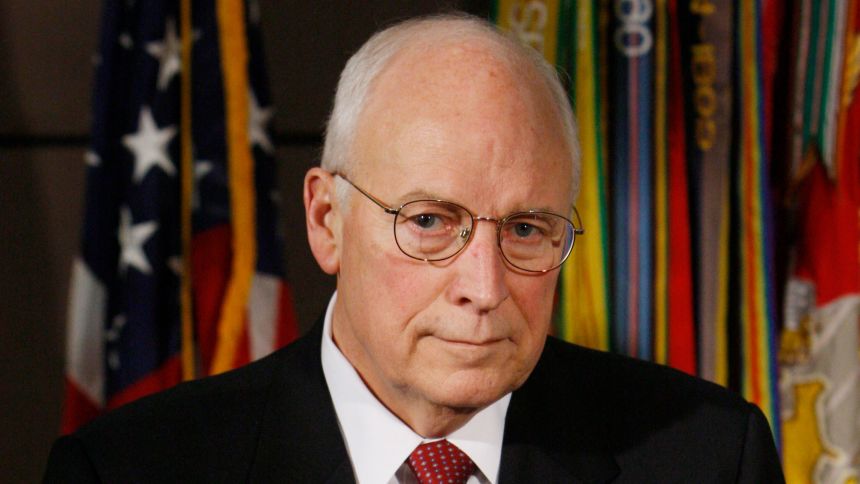
U.S. — The nation is mourning the death of former Vice President Dick Cheney, who has tragically passed away without getting to see World War III.
The renowned politician, avid hunter of both animals and men, and 43rd most popular Vice President, passed away peacefully at 84, surrounded by family.
“He dedicated his life to achieving his dream of devastating global conflict, and it’s a shame he passed before any of his work came to fruition,” said close friend John Bolton while adding his signature to the latest batch of bombs coming off the assembly line. “We can only do our best to carry on his legacy until this wretched sphere is baptized in the holy fires of thermonuclear war.”
“It’s what Dick would want.”
Cheney was known for vastly increasing the surveillance state, his aggressive foreign policy of invading Iraq and Afghanistan, and also for shooting a dude in the face. “We have lost a titan,” said Bolton.
At publishing time, reports from the celestial realm reported Cheney had opted to go to Hell after hearing it had oil.
“His beloved wife of 61 years, Lynne, his daughters, Liz and Mary, and other family members were with him as he passed,” the family said, adding that he died due to complications of pneumonia and cardiac and vascular disease.
“Dick Cheney was a great and good man who taught his children and grandchildren to love our country, and to live lives of courage, honor, love, kindness, and fly fishing,” the family added.
“We are grateful beyond measure for all Dick Cheney did for our country. And we are blessed beyond measure to have loved and been loved by this noble giant of a man.”
The 46th vice president, who served alongside Republican President George W. Bush for two terms between 2001 and 2009, was for decades a towering and polarizing Washington power player. In his final years, however, Cheney, still a hardline conservative, nevertheless became largely ostracized from his party over his intense criticism of President Donald Trump whom he branded a “coward”and the greatest-ever threat to the republic.
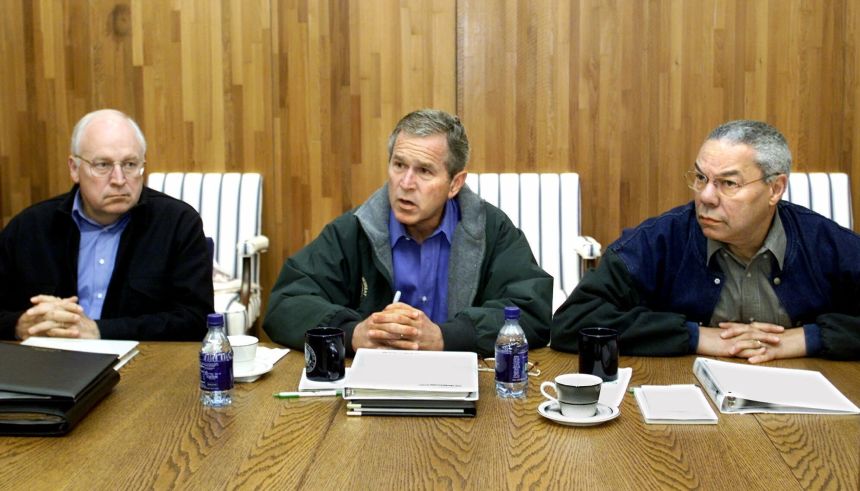
Cheney sits next to President George W. Bush as he meets with his cabinet and advisers, including Secretary of State Colin Powell, on September 15, 2001, at Camp David in Maryland. J. Scott Applewhite/AP
In an ironic coda to a storied political career, he cast his final vote in a presidential election in 2024 for a liberal Democrat, and fellow member of the vice president’s club, Kamala Harris, in a reflection of how the populist GOP had turned against his traditional conservatism.
Cheney was plagued by cardiovascular disease for most of his adult life, surviving a series of heart attacks, to lead a full, vigorous life and lived many years in retirement after a heart transplant in 2012 that he hailed in a 2014 interview as “the gift of life itself.”
Cheney, a sardonic former Wyoming representative, White House chief of staff and defense secretary, was enjoying a lucrative career in the corporate world when he was charged by George W. Bush with vetting potential vice-presidential nominees. The quest ended with Cheney himself taking the oath of office as a worldly number two to a callow new president who arrived in the Oval Office after a disputed election.
While caricatures of Cheney as the real president do not accurately capture the true dynamics of Bush’s inner circle, he relished the enormous influence that he wielded from behind the scenes.
Cheney was in the White House, with the president out of town on the crisp, clear morning of September 11, 2001. In the split second of horror when a second hijacked plane hit the World Trade Center in New York, he said he became a changed man, determined to avenge the al Qaeda-orchestrated attacks and to enforce US power throughout the Middle East with a neo-conservative doctrine of regime change and pre-emptive war.
“At that moment, you knew this was a deliberate act. This was a terrorist act,” he recalled of that day in an interview with CNN’s John King in 2002.
Cheney reflected in later years on how the attacks left him with overwhelming sense of responsibility to ensure such an assault on the homeland never happened again. Perceptions however that he was the sole driving force behind the war on terror and US ventures into Iraq and Afghanistan are misleading.
Contemporary and historic accounts of the administration show that Bush was his own self-styled “The Decider.”
A changed man
From a bunker deep below the White House, Cheney went into crisis mode, directing the response of a grief-stricken nation suddenly at war. He gave the extraordinary order to authorize the shooting down of any more hijacked airliners in the event they were headed to the White House or the US Capitol building. For many, his frequent departures to “undisclosed” locations outside Washington to preserve the presidential chain of succession reinforced his image as an omnipotent figure waging covert war from the shadows. His hawkishness and alarmist view of a nation facing grave threats was not an outlier at the time – especially during a traumatic period that included anthrax mailings and sniper shootings around Washington, DC, that exacerbated a sense of public fear even though they were unrelated to 9/11.
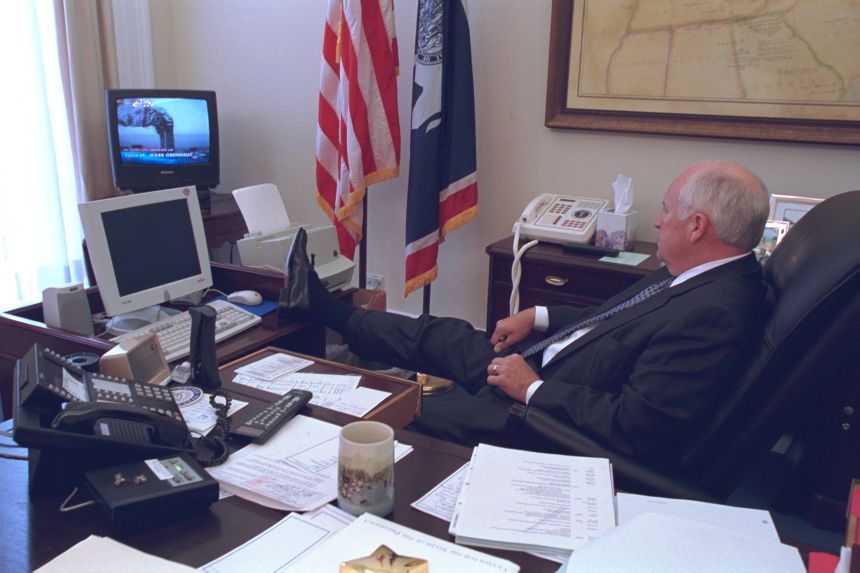
Cheney watches news coverage of the terror attacks on September 11, 2001. US National Archives
The September 11 attacks unleashed the US war in Afghanistan to overthrow the Taliban, which was harboring al Qaeda, though the terror group’s leader Osama bin Laden escaped. Soon, Cheney was agitating for widening the US assault to Iraq and its leader, Saddam Hussein, whose forces he had helped to eject from Kuwait in the first Gulf War as President George H.W. Bush’s Pentagon chief.
The vice president’s aggressive warnings about Iraq’s supposed weapons of mass destruction programs, alleged links to al Qaeda and intent to furnish terrorists with deadly weapons to attack the United States played a huge role in laying the groundwork for the US invasion of Iraq in 2003. Congressional reports and other post-war inquiries later showed that Cheney and other administration officials exaggerated, misrepresented or did not properly portray faulty intelligence about weapons of mass destruction programs that Iraq turned out not to possess. One of Cheney’s most infamous claims, that the chief 9/11 hijacker Mohamed Atta, met Iraqi intelligence officials in Prague, was never substantiated, including by the independent commission into the September 11 attacks.
But Cheney insisted in 2005 that he and other top officials were acting on “the best available intelligence,” at the time. While admitting that the flaws in the intelligence were plain in hindsight, he insisted that any claim that the data was “distorted, hyped, or fabricated” was “utterly false.”
Cheney watches F-18 attack planes headed for Afghanistan catapult from the USS John C. Stennis in the Arabian Sea on March 15, 2002. J. Scott Applewhite/AP
The conflicts in Iraq and Afghanistan also led the US down a dark legal and moral path including “enhanced interrogations” of terror suspects that critics blasted as torture. But Cheney – who was at the center of every facet of the global war on terrorism – insisted methods like waterboarding were perfectly acceptable.Cheney was also an outspoken advocate for holding terror suspects without trial at Guantanamo Bay, Cuba – a practice that critics at home and abroad branded an affront to core American values.
No regrets
Cheney became a symbol of the excesses of the anti-terror campaigns and the fatally false premises and poor planning that turned the initially successful invasion of Iraq into a bloody quagmire. He left office reviled by Democrats and with an approval rating of 31%, according to the Pew Research Center.
To the end of his life, Cheney expressed no regrets, certain he had merely done what was necessary to respond to an unprecedented attack on the US mainland that killed nearly 2,800 people and led to nearly two decades of foreign wars that divided the nation and transformed its politics.
“I would do it again in a minute,” Cheney said, when confronted by a Senate Intelligence Committee report in 2014 that concluded enhanced interrogation methods as brutal and ineffective and responsible for damaging US standing in the eyes of the world.
Of the Iraq war, he told CNN in 2015: “It was the right thing to do then. I believed it then and I believe it now.”
‘He’s a coward’
Cheney’s aggressive anti-terror policies fit into a personal doctrine that justified extraordinary presidential powers with limited congressional oversight. That was in line with his belief that the authority of the executive branch had been mistakenly eroded in the aftermath of the Vietnam War and the Watergate scandal that led to the resignation of his first presidential boss, President Richard Nixon.
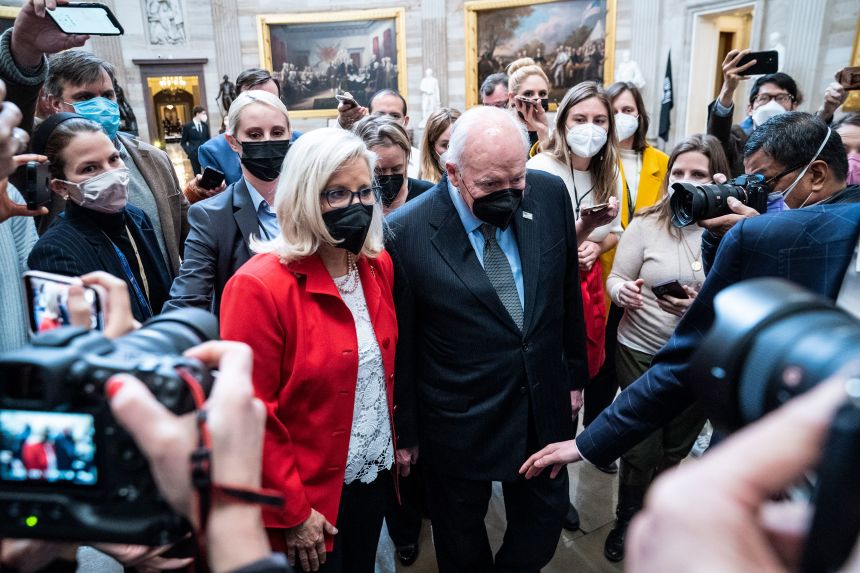
Cheney walks with his daughter Rep. Liz Cheney through the Capitol on January 6, 2022, the one year anniversary of the Capitol insurrection. Jabin Botsford/The Washington Post via Getty Images
Yet in his final years, Cheney emerged as a fierce critic of a man who had an even more expansive view of the powers of the presidency than he did – Trump. Cheney had supported Trump in 2016 despite his criticism of Bush-Cheney foreign policies and his transformation of the party of Reagan into a populist, nationalist GOP. But the ending of the president’s first term, when his refusal to accept his 2020 election defeat led to the January 6 insurrection, caused Cheney to speak out, in a rare, public manner.
The former vice president’s daughter, then-Wyoming Rep. Liz Cheney, meanwhile, sacrificed a promising career in the GOP to oppose Trump after his attempt to overturn the 2020 presidential election and the US Capitol insurrection on January 6, 2021. In an ad for his daughter’s unsuccessful campaign to fight off a pro-Trump candidate’s primary challenge in 2022, Dick Cheney – who was, by then, rarely seen in public – looked directly into the camera from under a wide brimmed cowboy hat and delivered an extraordinary direct message.
null
“In our nation’s 246-year history, there has never been an individual who is a greater threat to our republic than Donald Trump,” Cheney said.
“He is a coward. A real man wouldn’t lie to his supporters. He lost his election, and he lost big. I know it. He knows it, and deep down, I think most Republicans know.”
Early days out West
Richard Bruce Cheney was born January 30, 1941, in Lincoln, Nebraska. While living in the small mountain town of Casper, Wyoming, he met his high school sweetheart and future wife Lynne Vincent. Cheney was accepted to Yale University on a scholarship, but he struggled to fit in and maintain his grades. By his own admission, he was kicked out.
He returned West to work on power lines and was twice arrested for driving under the influence. In a turning point for Cheney, he was given an ultimatum from Lynne, who had “made it clear she wasn’t interested in marrying a lineman for the county,” he told The New Yorker. “I buckled down and applied myself. Decided it was time to make something of myself,” he told the magazine.
Cheney went back to school and earned a bachelor’s and master’s in political science from University of Wyoming. The couple was married in 1964.
Cheney is survived by Lynne, his daughters Liz and Mary Cheney and seven grandchildren.
A veteran Washington power broker
Cheney began honing his inside power game – at which he became a master – as an aide to Nixon.
He was later picked by Donald Rumsfeld as his deputy White House chief of staff under President Gerald Ford and then succeeded his mentor and close friend in the job in 1975 when Rumsfeld departed to become defense secretary. Cheney was instrumental in reviving their partnership in 2001 when he recalled Rumsfeld from the political wilderness to return to the Pentagon. The pair formed an extraordinary backroom alliance in the Bush administration throughout the war on terror and the Iraq war – much to the frustration of more moderate members of the administration including then-Secretary of State Colin Powell and National Security Adviser Condoleezza Rice – who took over from Powell in the second term.
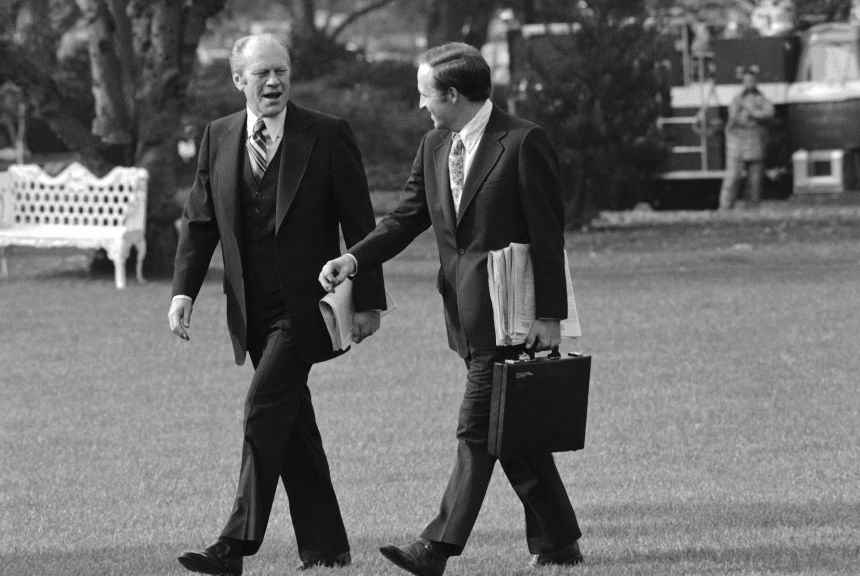
White House Chief of Staff Cheney chats with President Gerald Ford outside the White House as they walk to a helicopter in Washington, DC, on November 7, 1975. Bob Daugherty/AP
While Democratic President Jimmy Carter was in the White House, Cheney decided to run for Congress and was elected to Wyoming’s sole US House seat in 1978. Cheney served six terms, rising to become House minority whip, and racked up a very conservative voting record.
In 1989, President George H. W. Bush, who had served with Cheney in the Ford administration, tapped him to serve as his defense secretary, calling him a “trusted friend, adviser.” He was confirmed by the Senate in a 92-0 vote.
As Pentagon chief, Cheney showed considerable skill in directing the US invasion of Panama in 1989 and Operation Desert Storm in 1991 to push Iraq’s troops out of Kuwait. Following his stint as defense secretary, Cheney briefly explored a run for president in the 1996 election cycle but decided against it.
During Democrat Bill Clinton’s presidency, Cheney joined Dallas-based Halliburton Co. serving as its chief executive officer.
It wouldn’t be until the younger Bush decided to run for office that Cheney was chosen to lead the Republican candidate’s search for a running mate and, after initially turning down the job, ended up being added to the GOP ticket.
“During the process, I came to the conclusion that the selector was the best person to be selected,” Bush said in the 2020 CNN film “President in Waiting.”
Cheney brought a wealth of knowledge and experience to areas where critics complained Bush was weak. As a former Texas governor, Bush had no elected experience in Washington and little military and foreign policy background compared with Cheney.
Early in Bush’s presidency, Cheney led a task force to develop the administration’s energy policy and sought to keep its records secret in a fight that lasted Bush’s first term and went all the way to the US Supreme Court.
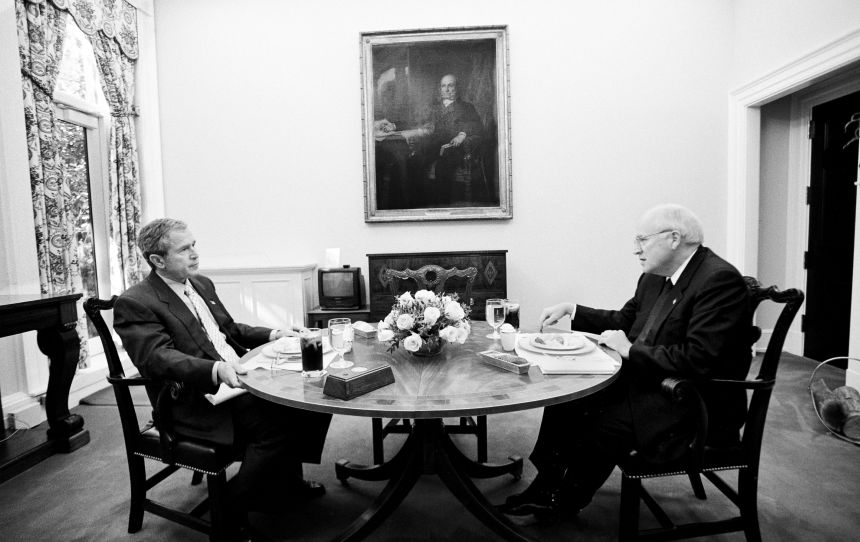
Bush and Cheney have their weekly lunch in a small dining room at the White House in October 2001. Brooks Kraft/Sygma via Getty Images
He was, however, at odds with Bush over the issue of same-sex marriage, saying that it should be left to the states to decide. In a 2004 town hall, he noted his daughter Mary’s sexual orientation reportedly for the first time publicly, according to The Washington Post. “With respect to the question of relationships, my general view is that freedom means freedom for everyone. People … ought to be free to enter into any kind of relationship they want to,” he said, the Post reported.
His relationship with Bush was complicated in later years, including by Bush’s refusal to pardon Cheney’s chief of staff Scooter Libby, who had been convicted of perjury and obstruction of justice in 2007 after a probe into who leaked the identity of a CIA operative. Libby was eventually pardoned by Trump in 2018.
In one of the most notorious moments in his personal life, which added to his grizzled legend in 2006, Cheney accidentally shot a hunting partner in the face with birdshot, causing relatively minor wounds.
Health issues
Cheney’s health issues began in 1978, when he had his first heart attack at age 37 while running for Congress. Three more followed in 1984, 1988 and November 2000, just a few days into the Florida presidential ballot recount that resulted in a Bush-Cheney win.
Cheney at the time said that he’d be the “the first to step down” if he learned he’d be unable to do the job and had a resignation letter in case he was deemed incapacitated. Cheney completed both terms under Bush, attending Barack Obama’s inauguration in January 2009 in a wheelchair.
A year after a fifth heart attack in 2010, Cheney received a heart pump that kept the organ running until his transplant in 2012.
Life after the White House
After leaving office, Cheney returned to private life, penning two memoirs — one about his personal and political career and the other about his struggles with heart disease as well as a book with his daughter, Liz. He became one of the most strident GOP critics of President Barack Obama, who had based his election campaign on promises to end the wars and other changes from what he called failed policies of the Bush-Cheney administration.
Years later, Cheney was decrying his own party — especially its leadership’s response to the attack on the Capitol — when he returned to the US Capitol with then-Rep. Liz Cheneyon the one-year anniversary of January 6, 2021.
“I am deeply disappointed at the failure of many members of my party to recognize the grave nature of the January 6 attacks and the ongoing threat to our nation,” he said in a statement.
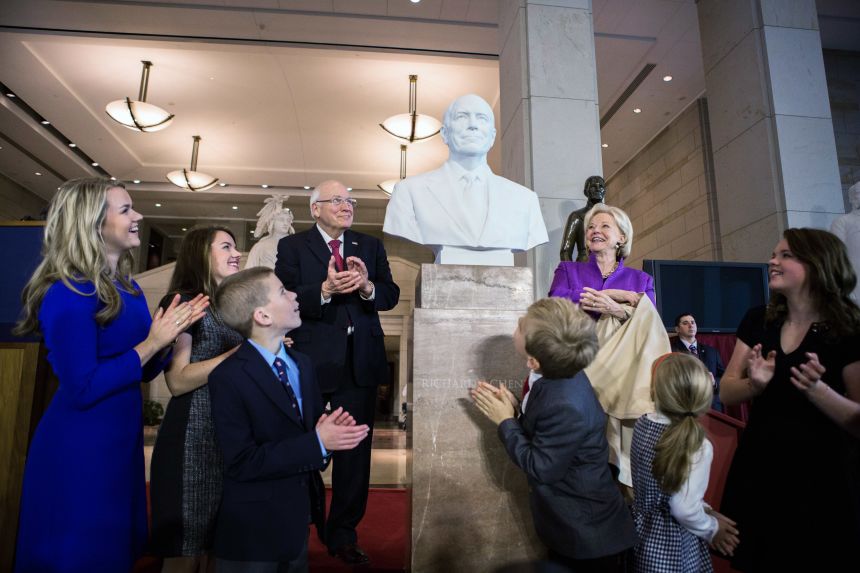
Cheney, alongside his wife and family, look at the bust of the former vice president after it was unveiled at Emancipation Hall inside the Capitol on December 3, 2015. Keith Lane/Getty Images
In a remarkable moment, Democrats lined up to greet the former Republican vice president and shake his hand. Former Democratic House Speaker Nancy Pelosi hugged Cheney. The former vice president slammed Republican leaders in Congress, saying they do not resemble the leaders he remembered from his time in the body.
It was a scene that would have been unthinkable two decades earlier and an illustration of how the extraordinary changes in American politics wrought by Trump had made former bitter political foes find common cause in the fight for democracy.
“It’s not leadership that resembles any of the folks I knew when I was here for 10 years,” Cheney said at the Capitol in 2022.
Cheney continued his criticism of Trump in the following years and went as far as to endorse then-Vice President Kamala Harris, a Democrat and Trump’s opponent in the 2024 presidential campaign. He said he would vote for Harris because of the “duty to put country above partisanship to defend our Constitution.” Cheney emphasized his disdain for Trump at the time and warned that he “can never be trusted with power again,” though Trump would go on to win the presidency a couple of months later.
CNN’s Jamie Gangel and Shania Shelton contributed to this report.