Homeland Security @DHSgov AND STAY OUT!
In less than 250 days, 2 MILLION illegal aliens have left the United States.
Homeland Security @DHSgov AND STAY OUT!
In less than 250 days, 2 MILLION illegal aliens have left the United States.
Jimmy Kimmel has always been a fraud. He poses as a comedian, but he’s not funny. He never was funny. He didn’t miss his calling as a CNN or MSNBC propaganda specialist.
He’s a barbarian. His true calling is running the 21st Century, woke version of concentration camps. He will get his wish if the people who put President Trump back in the White House ever let down their guard.
In the meantime, he will continue to spew unhinged hatred once Disney puts him back on the air, as they eventually will.
Or: Maybe he’ll run for President. He’ll be a folk hero to Democrats everywhere. Sadly, they’re all barbarians now.
Michael J. Hurd, Daily Dose of Reason
By Eric Utter
Incredibly, if you choose to believe a new YouGov poll, a plurality of Americans believe the alleged assassin of Turning Point USA founder Charlie Kirk is a Republican.
Several outlets and notable figures have made the preposterous claim that the suspect, 22-year-old Tyler Robinson, was a conservative Christian, when the truth is that he was a radical transgender man living with another transgender man whose own relatives admit he “hates conservatives and Christians.”
Federal authorities confirm that Robinson has been “deeply indoctrinated with leftist ideology.”
Yet, according to the poll, 24% of adults believe Robinson to be a Republican, while only 21% believe him to be a Democrat. Fifteen percent polled said he was neither, and 40% admitted to having no clue.
Tragically, fake news is still consumed by many. Speaking of which, most all mainstream media outlets — and many online sites — seem to be trying to pass off the most preposterous lies imaginable.
“The transgender man who shot up a Catholic church in Minneapolis recently was actually a devout Christian nationalist and Trump supporter.” Never mind what he wrote on his bullets. Or what his family, neighbors the authorities, or his diary says!
The media has leaned left for a very long time now, but in recent years has morphed into a rabid pack of mudslinging liars possessed by Trump Derangement Syndrome and a vitriolic hatred of America and all things traditional.
If today’s mainstream media were around on Dec. 7, 1941, it would have reported that “Right-wing extremists have attacked Pearl Harbor!”
If the president at the time would have been Republican Wendell Willkie, instead of FDR, the media would have stated something like, “Willkie’s chickens come home to roost; regret your vote now, Americans?”
Fake news is very dangerous, if only because the perhaps 20%-30% of undecided voters in the mushy middle may well determine the outcome of many elections, especially in battleground states.
Free speech, whatever it is, must be defended. (Sorry, Pam Bondi.) But fake speech, deliberately used to indoctrinate, disarm, confuse … or foment violence, must be aggressively and routinely challenged, mocked, and corrected.
Charlie Kirk’s murder sparked peaceful resolve, not riots—sharply contrasting the violence, destruction, and radical agendas unleashed after George Floyd’s death.
Just days after the assassination of Charlie Kirk, the left is working overtime to hide the truth and create fantasies about his death.
Specifically, leftists alleged that conservatives were going to “pounce” on the death to wage protests and boost radical agendas in the manner of what followed George Floyd’s death.
Here are some of the lies that such a ridiculous narrative entails.
One, Charlie Kirk is not conservatives’ George Floyd. There were no mass riots after his death of the sort that followed Floyd’s demise.
Floyd’s death was used by the left to justify five months of rioting, arson, murder, looting, and attacking police officers.
The postmortem respect for Kirk’s singular life was not characterized by $2 billion in property damage, the torching of a police precinct, a federal courthouse, and an iconic church, 35 deaths, and 1,500 injured law-enforcement officers.
Instead, thousands of people peacefully joined his Turning Point USA organization and promised to redirect their lives toward peaceful political engagement.
Two, after Kirk’s death, no prominent Republican or conservative is encouraging ongoing mass (and often violent) protests in the manner of high-profile leftists like Kamala Harris.
She blurted out on national television in June 2020, “But they’re not gonna stop. They’re not gonna stop, and this is a movement, I’m telling you. They’re not gonna stop, and everyone beware, because they’re not gonna stop. They’re not gonna stop before Election Day in November, and they’re not gonna stop after Election Day. Everyone should take note of that, on both levels, that they’re not going to let up—and they should not. And we should not.”
Victor Davis Hanson
We are disgusted to learn that Disney has pulled Jimmy Kimmel’s show off the air simply for him being a MAGA Republican.
No one has stood for MAGA more than Jimmy Kimmel. Raised by a Republican family in a conservative area, Kimmel embodies everything MAGA stands for.
“We are horrified and saddened by the loss of a great MAGA voice like Jimmy Kimmel,” said Bee CEO Seth Dillon. “He loved Trump more than life itself. You simply cannot pretend he was anything other than a Trump lover.”
We at The Babylon Bee call on Disney to do the right thing and bring back the conservative, right-wing, MAGA hero known as Jimmy Kimmel.
Babylon Bee
Debates about public school funding sometimes include an underlying assumption that more funding results in better student outcomes. Available data tells a more complex story. Our review of 12,531 school districts across the country shows a negative correlation between overhead and student performance. In other words, districts that spent more on teacher and administrative pay saw their students’ standardized test scores drop.
Using the Open the Books proprietary database of government salaries across America, we calculated how much each U.S. state increased its total public school payrolls from 2019 to 2023. We compared that number to the change in each state’s ranking on the National Assessment of Educational Progress (NAEP), which measures reading and math skills for 4th and 8th graders.
By plotting the percentage change in payroll, state by state, versus the percentage change in the national rankings of its districts, a surprising picture emerges. Growing payrolls are not closely correlated with improved performance among districts in a given state. In fact, the opposite correlation appears. There is a mild inverse relationship between these two data sets. Higher overhead costs are associated with lower test scores.
In layman’s terms, that means while schools may hope that increasing their payroll will help their students outperform other states, there is little evidence in the data to support that claim. Again, the opposite seems to be true.
There were six states that increased their school payrolls by at least 23% from 2019 to 2023. Four of them saw student performance decrease, and one saw no change. Only Utah moved up in the NAEP rankings. *** Scafidi wrote that this “irresponsible use of taxpayer dollars is indefensible,” and that was before the surge in salaries over the last few years. From 2010 to 2022, the number of administrative staff rose by another 41%, while overall school employment rose by only 10%.
In 2023, 8,884 public school employees across the country earned salaries of at least $200,000, costing $2.08 billion,*** Christian Barnard, assistant director of education reform at the Reason Foundation, previously reported that per-pupil spending in the U.S. increased by almost 21% from 2002 to 2019, but 64% of the increased spending was used to pay benefits for instructional and support staff. Barnard found that if benefit pay had instead only kept pace with inflation, U.S. schools would have saved nearly $70 billion in 2019 — enough to give every teacher in America a $20,913 raise.***
Open the Books, Staff
“I don’t get no respect,” said Rodney Dangerfield, thousands of times. It was one of the great taglines in show-business history. It was the basis of his act—the denial of respect. Whatever his protestations, Rodney was one of the most beloved entertainers of the 1970s, ’80s, and ’90s.
There is now a biography, Nothin’ Comes Easy, by Michael Seth Starr. Mr. Starr has written many biographies of entertainers, and several of comedians such as Dangerfield. His other subjects include Joey Bishop, Redd Foxx, and Don Rickles.
You may prefer to read a long magazine piece about Dangerfield. You may prefer to watch a few video clips of his act on YouTube. But if you’re up for a deep dive—this book is for you.
Often, comedy arises from personal pain, as everyone knows. Rodney Dangerfield had a terrible, terrible upbringing. Therefore, he had a lot of material. Would he have traded the material for a better upbringing, and a different career? I would like to ask him.
Rodney once said, “I’m not a happy guy. Comedy is a camouflage for depression. Comics turn to jokes because they don’t want to face themselves. Actually, I’m not a happy guy.”
I grew up with Rodney’s jokes, so to speak. They were very funny—but tinged with pain. He was always talking about how ugly he was. (He was not.) “My kids are good-looking. Good thing my wife cheats on me.”
There were two jokes he reliably told about his birth. (1) “When I was born, the doctor said to my mother, ‘We did everything we could, but he pulled through anyway.’” (2) “When I was born, I was so ugly, the doctor slapped my mother.” Funny, yes, but…
He was born Jacob Cohen in 1921 and he grew up in Queens, N.Y. His father was a vaudeville performer—”Phil Roy,” he called himself. His mother was Dorothy, or “Dotty.”
There have been worse parents. But not many.
The father was simply absent. Rodney (or Jacob, as he was then) saw him once or twice a year, for an hour or two. Later, Rodney would quip, “Dad had no time for kids. He was always out trying to make new kids.” His mother was very, very cold—also needy, which makes for a brutal combination. According to Rodney, she never gave him a compliment, a kiss, or a birthday present. Not even a card.
When he was a boy, Rodney was molested, repeatedly, by a neighborhood man. In school, he was the target of anti-Semitism, not just from students but also from teachers. But Rodney had a goal in life, which was life-saving, as I see it. He had a purpose. He wanted to become a comedian.
“I went into show business to get love,” he later said. “I think nine-tenths of the people in this racket have an identical need … “
He strove and struggled to break into the business, appearing under the name “Jack Roy.” He earned a living, sort of, and gained some attention. But not enough to keep going, as he saw it. So he quit.
“I was the only one who knew I had quit,” he would say, with his trademark self-deprecation.
In an interim period—wilderness years—he sold aluminum siding and paint. He was fairly good at it. But in his heart, and in his head, he was a comedian. He never stopped writing jokes—for himself and for other comedians.
“I had to tell jokes,” Rodney would say. “I had to write them and tell them. It was like a fix, like I had the habit, you know?” In his biography, Starr quotes Joseph Merhi, a producer, who said about Rodney, “Every waking moment, he was thinking about stand-up. He always had a pad and a pen and was writing down jokes.”
Having had his fill of aluminum siding and paint, Jacob Cohen, or Jack Roy, decided to give comedy one more go. And, as Rodney Dangerfield, he made it big. His breakthrough moment came on The Ed Sullivan Show in 1967. He was an overnight success—at 45 years old, having worked his tail off for years.
There was more to come—more than nightclubs and TV shows. There were movies, beginning with Caddyshack in 1980, through Back to School in 1986, to something not exactly funny: Oliver Stone’s Natural Born Killers in 1994. The guy who got no respect became a living legend and national treasure.
I think I can make the claim “national treasure” because Rodney’s signature white shirt and red tie were installed in the Smithsonian.
Throughout his life, Dangerfield suffered from depression—black, awful depression. He would joke, of course. “I told my psychiatrist, ‘I have suicidal thoughts.’ He said, ‘From now on, you pay in advance.’”
There was solace, though—marijuana. He smoked it from young adulthood to the day he died. “It allows me to cope with life,” he explained. Would he have been even sharper, in his comedy onstage, without the daily influence of pot? Many people—I have known some—think they are knockin’ ’em dead when under the influence. Rodney was aware of this.
In his autobiography—It’s Not Easy Bein’ Me (2004)—he wrote, “I did coke for a while. What a mistake that was. When you’re on coke, things can be going bad and you think you’re doing great.” Marijuana, he never abandoned, nor, from his perspective, did it abandon him.
Louis Armstrong was another performer, and living legend, and national treasure, who swore by marijuana. Reading a line in Starr’s biography, I thought of him.
An actress, Candice Azzara, said of Rodney, “Even though he made a lot of jokes, he seemed like the saddest man I knew.” Once, the actor Ossie Davis glimpsed Armstrong in an unguarded moment. Armstrong did not know anyone was observing. He wore, said Davis, “the saddest, most heartbreaking expression” he had ever seen.
As time went on, Rodney developed a relationship of sorts with his father. “Even though he had walked out on me,” he said, “there was a part of me that liked him.” And, “knowing my mother, what were his alternatives?” Rodney attended his father’s funeral. He was the only person there (seriously).
I caught Rodney’s act in 2001, when he was marking his 80th birthday. (For the piece I wrote about that evening, go here.) The performance was in Avery Fisher Hall at Lincoln Center in New York. The last words Rodney spoke were, “My old man was in vaudeville, and he said, ‘You can always count on a New York audience.’”
Rodney died in 2004. By that time, he had his own website, which featured a joke of the day. The joke the day he died—by sheer coincidence—was this: “I tell ya, I get no respect from anyone. I bought a cemetery plot. The guy said, ‘There goes the neighborhood.’” This line was, in fact, inscribed on Rodney’s gravestone (at a cemetery in Los Angeles). The epitaph reads, “There goes the neighborhood.”
Rodney Dangerfield was “an adornment to society,” to borrow a phrase from Paul Johnson, the late British historian. I will borrow another from him: Rodney “added to the gaiety of life.” Yes, but at what cost to him.
Nothin’ Comes Easy: The Life of Rodney Dangerfield by Michael Seth Starr Citadel, 240 pp., $29
Jay Nordlinger writes at Onward and Upward on Substack and is the music critic of the New Criterion.
Like almost everyone in my circle, I have spent the better part of the last week in a stupor. The news of conservative activist Charlie Kirk’s assassination has left all of us who counted him as a friend or colleague in a state of shock and sadness.
I did not know Charlie Kirk well. But I had met him in various green rooms, appeared on his radio program, and worked with him to find capable staffers for the Department of Education. He was always genuine, idealistic, and dedicated to the cause. I’m still astonished by all that he accomplished in such a short period of time. He built an enormous organization, turned himself into a media star, advised the president of the United States, and built a beautiful family—all by age 31.
When we are in the fray of day-to-day politics, it is easy to get consumed by each new headline and triviality. But Kirk’s death marks a pivotal moment, requiring deeper reflection. His life, and tragically his death, reveal some profound truths about the man and about America.
First and foremost, Charlie Kirk did it all the right way. He was a conservative willing to wade into controversial territory. But he was always guided by the idea that debate is the great clarifier and that, in a democratic society, persuasion is the primary means of political change. He set up tables on campus. He debated his opponents. And he believed he could win through the ballot box.
Kirk’s death, and the subsequent reaction to it by the radical Left, underscored the arguments he had made during his time on the stage. For nearly ten years, Kirk had argued that transgender ideology, especially when paired with experimental medical procedures, would result in disaster. From the reports now emerging, it appears likely that the alleged assassin, Tyler Robinson, was radicalized online into anti-fascist and transgender politics. In their most extreme forms, both lines of thinking advocate a nihilistic embrace of violence—the antithesis of Kirk’s approach.
In fact, when he was murdered, Kirk was answering a question about the relationship between transgenderism and mass shootings, a phenomenon that seems to have accelerated in recent years. Kirk sought to engage his opponents in debate; his killer, quite possibly inspired by the trans-radical movement, sought to end that debate with a bullet.
The reaction to Kirk’s death by the mainstream Left has been equally troubling. Thousands of Americans, including students, professors, and even active-duty military members, have publicly cheered his assassination. Some have called for further violence against conservatives. Though I have covered left-wing radical movements for years, I was surprised by the number of people in the “helping professions,” including teachers and doctors, who embraced violent rhetoric.
How should conservatives respond? First, by drawing a line that Kirk himself exemplified: debate is healthy; violence is unacceptable. I’m glad to see that some institutions have terminated the employment of those who cheered on Kirk’s murder.
Contrary to the criticism that this represents a form of right-wing “cancel culture,” these firings were warranted. During the “woke” era, left-wing social media mobs sought the social annihilation of teenagers who sang rap lyrics and a Latino utility worker who cracked his knuckles the wrong way—examples of extreme and unjustified social policing. By contrast, a public school dismissing a teacher for applauding political assassination is a fair consequence.
All societies require boundaries. If there is no social sanction for celebrating violence, America will become a more dangerous place. Social trust, already fragile, will collapse.
On the question of transgender ideology, more information will emerge about Kirk’s alleged killer. But more than enough evidence already exists for federal law enforcement to consider radical transgender ideologues a threat to the civil order of the United States—much like white nationalists, neo-Nazis, militant “anti-fascists,” and other hateful groups. Some figures in the Trump administration, such as policy adviser Stephen Miller and Vice President J. D. Vance, have already indicated that they are ready to take action to enforce the law against violent movements.
Charlie Kirk sacrificed his life for truth. We should honor his legacy by standing firmly on principle, engaging in political debate, and, when necessary, enforcing the law against those who would organize violence in the name of politics.
Christopher F. Rufo, City Journal
During the process of developing the U.S. Constitution Alexander Hamilton submitted a suggested draft for a Constitution on June 18, 1787. At some point, he also suggested to the framers a proposal for the qualification requirements in Article II as to the necessary Citizenship status for the office of President and Commander in Chief of the Military. Another version of Hamilton’s proposed Constitution and which principles were stated during the convention’s deliberations per Madison notes and journal (see work of Farrand – pg 619), was given to Madison near the close of the convention for inclusion in Madison record of events for the convention. Hamilton’s proposed Constitution was not accepted.
Alexander Hamilton’s suggested presidential eligibility clause:
“No person shall be eligible to the office of President of the United States unless he be now a Citizen of one of the States, or hereafter be born a Citizen of the United States.”
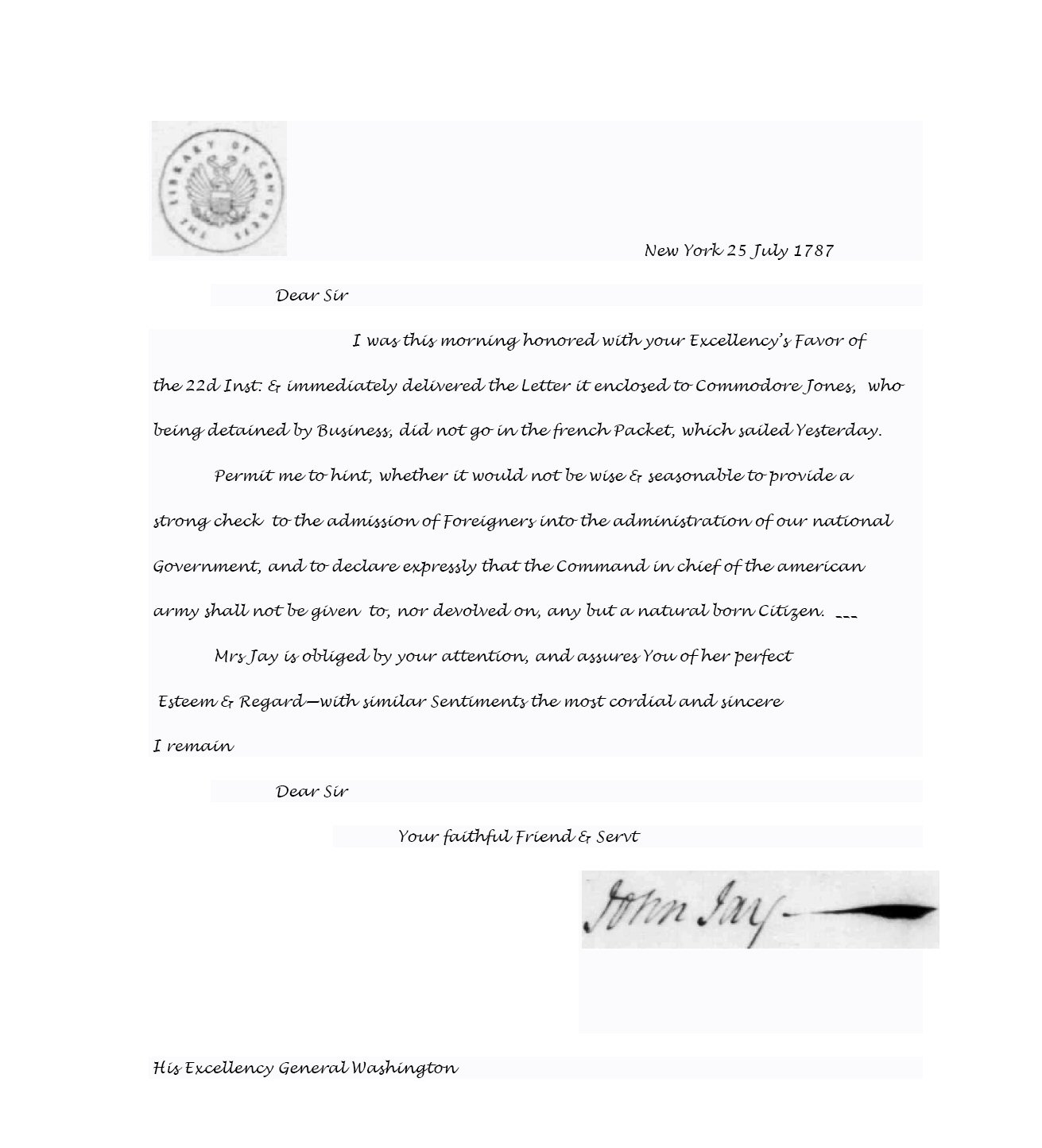
Many of the founders and framers rightly had a fear of foreign influence on the person who would in the future be President of the United States since this particular office was singularly and uniquely powerful under the proposed new Constitution. The President was also to be the Commander in Chief of the military. This fear of foreign influence on a future President and Commander in Chief was particularly strongly felt by John Jay, who later became the first Chief Justice of the U.S. Supreme Court. He felt so strongly about the issue of potential foreign influence that he took it upon himself to draft a letter to General George Washington, the presiding officer of the Constitutional Convention, recommending/hinting that the framers should strengthen the Citizenship requirements. John Jay was an avid reader and proponent of natural law and particularly Vattel’s treatise on Natural Law and the Law of Nations. In his letter to Washington he said that the Citizenship requirement for the office of the commander of our armies should contain a “strong check” against foreign influence and he recommended to Washington that the command of the military be open only to a “natural born Citizen”. Thus Jay did not agree that simply being a “born Citizen” or “born a Citizen” was sufficient enough protection from foreign influence in the singular most powerful office in the new form of government. He wanted another adjective added to the eligibility clause, i.e., ‘natural’. And that word natural goes to the Citizenship status of one’s parents, both of them, when their child is born, as per natural law.
The below is the relevant proposed change language from Jay’s letter which he proposed to strengthen the citizenship requirements in Article II and to require more than just being a “born Citizen” of the United States to serve as a future Commander in Chief and President.
John Jay wrote in a letter to George Washington dated 25 Jul 1787:
“Permit me to hint, whether it would be wise and seasonable to provide a strong check to the admission of Foreigners into the administration of our national Government; and to declare expressly that the Commander in Chief of the American army shall not be given to nor devolve on, any but a natural born Citizen. “
See a transcription of Jay’s letter to Washington at this link. This letter from Jay was written on July 25, 1787. General Washington passed on the recommendation from Jay to the convention and it was adopted in the final draft and was accepted adding the adjective “natural” making it “natural born Citizen of the United States” for future Presidents and Commanders in Chief of the military, rather than Hamilton’s proposed “born a Citizen”. Thus Article II, Section 1, Clause 5 of the U.S. Constitution, the fundamental law of our nation reads:
Article II, Section 1, Clause 5 of U.S. Constitution as adopted 17 Sep 1787:
“No Person except a natural born Citizen, or a Citizen of the United States, at the time of the Adoption of this Constitution, shall be eligible to the Office of President; neither shall any person be eligible to that Office who shall not have attained to the Age of thirty five Years, and been fourteen Years a Resident within the United States.”
There you have the crux of the issue now before the nation and the answer.
CDR Charles Kerchner (Ret)
ABC News correspondent Matt Gutman described text messages between alleged Charlie Kirk assassin Tyler Robinson and his transgender roommate, about the alleged murder weapon, as “very touching.”
If you do not see a problem with this reporter, then YOU are part of the problem and YOU are one of the reasons we are headed in America for another Nazi Germany, only worse.
Why did the left — and it was the left, not just one sociopath — kill Charlie Kirk? He was reasonable. He gave people a chance to debate him. He was kind, and fair. Reason, not polemics, was his methodology. He belonged more to ancient Greece, the domain of Aristotle, than to our cruel, adversarial, cynical, hard culture of today. Don’t you understand? It was precisely BECAUSE of his most virtuous qualities that Charlie Kirk had to go — from the leftist, utterly psychotic totalitarian perspective that still rules our time.
If Charlie Kirk didn’t have so much to offer, especially to young people who might have been considering an alternative to the brazen insanity, intellectual dishonesty and open evil surrounding them, then it would not have been necessary to kill Charlie Kirk in cold blood, with all the world watching. You must understand just how evil the established viewpoint and attitudes of our era really are. Leftism is more ruthlessly and morally hollow than anything yet served up to humankind, including Nazism, Stalinism and all the rest. Consider yourself warned by the leftists themselves–one more time.
Sen. Eric Schmitt, R-Mo., told Newsmax on Tuesday, “When you see numbers like 25% of self-described very liberal citizens think political violence is justified to achieve political ends, that’s very troubling.”
“There’s a real sickness on the left here that has to be addressed. … We have to tell the truth about what’s going on,” he added.
If you have known any leftists, it’s not surprising. Most are riddled with hatred. 25 percent of leftists will support concentration camps, or some equivalent, in our time. Much of the other 75 percent will turn the other way. We are one rigged election (or armed insurrection) away from it happening. My point here isn’t to be alarmist. It’s acceptance of the hard reality of just how evil many of our fellow countrymen are. Be vigilant.
Michael J. Hurd, Daily Dose of Reason