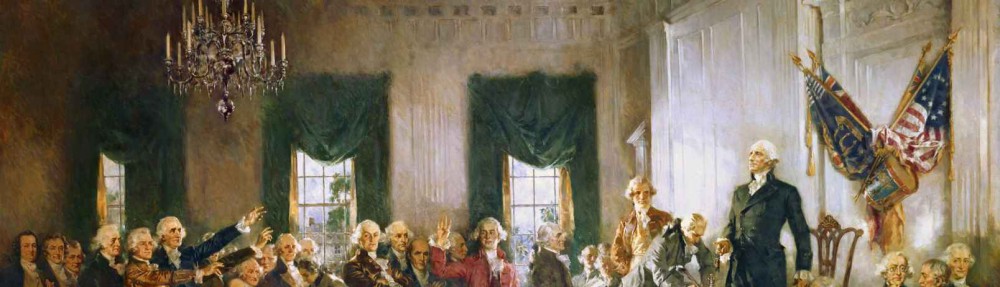
Not What You Want to Hear, but Read it Anyway

Stop fixating on the 2024 election. You will be disappointed, frustrated and angry — again. I stand by my prediction that they will imprison Trump. And when his supporters protest, they will be imprisoned too. It will be a gigantic January 6. Watch.

Bigger picture: Freedom loving Americans must figure out ways to break with the nasty, psychotic and authoritarian federal regime. DeSantis is a hugely talented Governor of a robust, growing state. He should concentrate on establishing a republic of Florida. Perhaps South Carolina, Alabama, Mississippi and Georgia (minus Atlanta) could join. Offer peace with the federal government. Peace and trade treaties, and the like. Let New York, DC, San Francisco, Chicago and all the deep blue territories have their socialism. Let’s stop fighting, and simply leave them. Have real police, and a real military. Let the drag queen, woke military defend Manhattan.

I cannot design all the specifics for you. I can only tell you that the left-right differences are no longer sustainable. The left understands this. That’s why they impose an increasingly totalitarian net around our lives. The right just keeps promising a modern day Reagan Revolution. It’s too late for that. Way too late. Stop assuming there’s a majority who want freedom under the original American model. Do you actually know any leftists? They do not want ANYTHING you want. And they will stand by and let the government do anything it wishes to you, so long as the government is “progressive.” There are 70 and 80 percent majorities of leftists in some areas. They are not friendly and they are no more peaceful than Hamas and the Palestinians. They are mean, brutal, irrational and intolerant.

Move on, conservatives. It’s too late for reconciliation. A better world is possible, but NOT on our present course.

Michael J. Hurd, Daily Dose of Reason

Remembering the Assassination of John F. Kennedy 60 Years Ago

Sixty years ago today, I was in Mrs. Isles’ fifth-grade class on Friday afternoon at Boothwyn Elementary School in Pennsylvania when we got the news: President John F. Kennedy had been assassinated in Dallas, Texas. They sent us home immediately and the next several days were consumed with the killing and its aftermath.

First, there was the arrest of Lee Harvey Oswald, who was accused of shooting the president from a sniper’s perch on the sixth floor of the Texas School Book Depository, which was located by the presidential motorcade route. Two days later, Oswald himself was shot to death by Jack Ruby, a Dallas nightclub owner who managed to slip into police headquarters with a gun when authorities were transferring him from the Dallas city jail to the county jail.

Finally, on Monday, there was the funeral, which I watched with one of my friends on his black and white TV at his house on Meetinghouse Road. I was only 10 years old but knew that something momentous had happened. I didn’t realize that it would be a watershed event.

Much has been written about the events of November 22, 1963, and six decades later, there is much disagreement with the government’s official story that Oswald was the lone shooter. Most people, to be honest, don’t buy the government’s account, which is summed up by the Warren Commission Report.

There is a veritable industry of writing and speculation about the assassination, and perhaps no one has been more dogged than Jacob Hornberger of the Future of Freedom Foundation. With each major anniversary of the assassination, new information seems to come out about the case, and the FFF site has linked two accounts, one involving medical professionals who saw the president’s fatal wounds, and one from the Kennedy Beacon blog. They make for compelling reading.

According to Hornberger, the Kennedy assassination was an inside job with the CIA taking out the president because he wanted to end American involvement in Vietnam and pursue a more vigorous course of détente with the Soviet Union, as well as dismantling at least part of the developing national security state. Certainly, others who closely follow the various conspiracy theories associated with the assassination have different variations, but most agree that it is unlikely that the angry loner Oswald did all of the killing himself – or was even directly involved.

I see myself as unqualified to make a judgment on these theories, although there is nothing implausible with the account that Hornberger has created these past several years. Too many things happened after the shooting with too many witnesses to debunk them. If Hornberger’s viewpoints are correct – and I, for one, believe they are plausible – then America as we have known it died that day at Dealy Plaza.

The government’s actions after Kennedy’s assassination from the US escalation of the Vietnam War to the development of the vast national security state has eroded liberty and empowered the American state. Whatever hopes there were to preserve the constitutional republic known as the United States of America ended with the death of John F. Kennedy.

The Greek Way

As for the state, it never entered an Athenian’s head that it could interfere with his private life: that it could see, for instance, that his children were taught to be patriotic, or limit the amount of liquor he could buy, or compel him to save for his old age. Everything like that a citizen of Athens had to decide himself and take full responsibility for.
 

Edith Hamilton, The Greek Way (1930)

Politics–The Demagogues are Running

On what political propositions are Americans apparently agreed? There are two. The first is that the President currently in the White House should be replaced. Not by being tossed out on last February’s impeachment rap, but replaced when his term finally ends.

The second proposition is that no presidential candidate currently striving to succeed the incumbent is an exhilarating alternative. What’s the problem? If the incumbent is so bad, shouldn’t we be enthusiastic about at least one of the contenders? After all, there are two Democrats out there to choose from, and six Republicans. So whom are the American people waiting for? Abraham Lincoln? Pericles?

Many people are inflamed by the rampant demagoguery in the present scene. Demagoguery–demagogy–comes in two modes. Most conspicuous is that of the candidate who promises the voters what are best described as Nice Things. Why not health care for the uninsured? Or for children? Why not cheaper drugs? Free child delivery? (Free funerals?) Sharpshooters tracking down demagogy were out there waiting last summer, eyes trained, when Bill Bradley arrived in Iowa. Would he do it? Would he advocate an end to the subsidy of ethanol? Ethanol is the program, excogitated during the Carter Administration, which sought to augment the staying power of a gallon of gasoline by an infusion of ethanol. What happened is that the price of oil went down, and the potential economic value of an ethanol additive turned out to be less than the cost of producing ethanol, and that was many moons ago.

Answer? No. Bradley (like his Republican opponent Steve Forbes, a sound economic fundamentalist on most points) devised airy reasons why ethanol was an okay federal program, which he would not disturb, if elected President.

Was that demagogy? You would tend to dismiss it as that on the simple grounds that that is what Iowa voters wanted to hear. But wait! Only a small percentage of the agricultural community of Iowa is engaged in producing the corn that goes into making ethanol. So how do we account for the politician who ignores the interests of 96 percent of the taxpaying public in order to endear himself to so small a minority?

The answer to that is that voters at large don’t naturally intuit economic realities. Iowans assume that ethanol subsidies materialize from the good offices of fairy political godparents out there somewhere. They do not focus on the itinerary of the ethanol subsidy. It is of course a dollar collected in Iowa from citizens at large and then remitted to those Iowans who are engaged in producing ethanol.

So there we have the one problem–the encouragement given to demagogues by undiscriminating voters. The procedure here is to attract support to finance a campaign. But does the term demagogue fit in other circumstances? What about the aspirant who has a private vision to offer to the public and has the means, personal or contrived, to finance a campaign? In some cases, the vision isn’t merely a program to be adopted. It is a program that includes the visionary’s serving as President. Look for the narcissist. The most obvious target in today’s lineup is, of course, Donald Trump. When he looks at a glass, he is mesmerized by its reflection. If Donald Trump were shaped a little differently, he would compete for Miss America.

But whatever the depths of self-enchantment, the demagogue has to say something. So what does Trump say? That he is a successful businessman and that that is what America needs in the Oval Office. There is some plausibility in this, though not much. The greatest deeds of American Presidents–midwifing the new republic; freeing the slaves; harnessing the energies and vision needed to win the Cold War–had little to do with a bottom line. So what else can Trump offer us? Well to begin with, a self-financed campaign. Does it follow that all who finance their own campaigns are narcissists?

At this writing Steve Forbes has spent $63 million in pursuit of the Republican nomination. Forbes is an evangelist, not an exhibitionist. In his long and sober private career, Steve Forbes never bought a casino, and if he had done so, he would not have called it Forbes’s Funhouse. His motivations are discernibly selfless. Yes, you can make the point that under a flat tax he would pay less in federal income tax, leaving the critic with the problem of figuring out how many decades it would take Forbes to earn back, in reduced taxes, the $63 million he has spent on his campaign.

The other way to enter a political contest in which there is something less than a draft movement working for you and you don’t have the means to finance it on your own, like Trump and Ross Perot and Steve Forbes, is to opportunize on a political anomaly. If there is something approaching a dead heat between the two candidates of the major parties, go for the independent ticket.

Now this is (in my judgment, colored no doubt by personal experience) not exclusively the behavior of the demagogue. In New York State 35 years ago, the Republican Party had become a zygotic twin of the Democratic Party. In 1965 I ran for mayor of New York City having no prospect whatever of prevailing. It could therefore be said of my political venture that I was an exhibitionist and a demagogue: except that what I said, and the measures I advocated, were in large measure what many voters did not wish to hear (accounting, perhaps, for the paltry 13 percent of the vote I won). But then five years later my brother James Buckley, running on a third-party ticket, caused a great upset. He was a more persuasive contender, and he had a gift for giving life to common sense. It had been 50 years, back in Wisconsin in the Twenties, since a third-party candidate had been elected to the Senate. What accounts for such anomalies is a latent ear in the voting public that suddenly awakens to the tedium of establishmentarian contenders and says, on voting day: Cut it out!

Was that what brought Jesse Ventura to the State House in St. Paul in 1998? That, in part–plus the devil-may-care gratification of voting for governor a professional wrestler. The Minnesota voters may have suffered something of a hangover the next day. (What did we do!!!) On the other hand, what deep trouble could Jesse Ventura get Minnesota into? He wasn’t going to lead a movement to secede from the United States. Or to forbid smoking. The only strategic mischief he might get into (the voters were saying to themselves in midwinter) was to join the fray against Pat Buchanan and Donald Trump and maybe Ross Perot for Reform Party candidate for President in 2000. He couldn’t have so much as considered the possibility except for his victory in the race for governor. And since no one, possibly including Mrs. Ventura, can tell you what Jesse would proceed to do, assuming he were elected President and had omnipotent powers, any race in which he seriously competed can be dismissed as a venture in opportunism; a practice of the art of the demagogue.

So much for the passing scene. We need, in searching for consolation, to remind ourselves that the missionary is not automatically to be dismissed as a demagogue, practicing or inchoate. The apparent demagogue is, of course, a candidate for the respect owing to a prophet. John Brown was hanged. If he had lived and fought a hundred years later, there’d have been a national holiday named after him.

On the other hand, a sovereign democratic responsibility is to measure the claims of a candidate by empirical standards: Is he right for the United States? Now? And if he is right, is he the person to incarnate that mission? John Brown was wrong even as Martin Luther King Jr. was right, and a study of the two, and of their two movements in history, illustrates what we need to know about demagoguery and prophecy.

There are moments of deep gloom during the primary season. The candidates are immediately approached after a public event to be told whether what they just finished saying added or subtracted from their probable standing in the polls. And the American voter who wants to see a sign of life and of pride in the participants in our expensive and exhausting democratic obstacle course wonder, sometimes with a sense of desperation, whether what we’re seeing is new. Or, are we looking at merely this season’s reenactment of a ritual that began when Aaron Burr and Alexander Hamilton were quarreling before their conclusive encounter at Weehawken?

There is always rivalry, and there is always a search for means of exploiting the means of advancing one’s own position. In other ages, one paid court to the king. Now we pay court to the people. In the final analysis, just as the king might look down with terminal disdain upon a courtier whose hypocrisy repelled him, so we have no substitute for relying on the voter to exercise a quiet veto when it becomes more necessary to discourage cynical demagogy, than to advance free health for the kids. That can come later, in another venue; the resistance to a corrupting demagogy should take first priority.

William F. Buckley

DeSantis Needs to Win the Newsom Debate–and Here’s How

Thursday, Florida Gov. Ron DeSantis and California Gov. Gavin Newsom will face off on Fox News in the great “Red State vs. Blue State” debate, AKA the GovShove or the Acrimonica in Alpharetta or Sir Galahad’s Lament .

Whatever it is dubbed, the debate is important for both men, with DeSantis – why didn’t he wait until ’28? – having to prove that his terrible campaign has been a mere eight-month “oopsy” and with Newsom having to prove that he is a human being and not just an autobot bred for office by the San Francisco elite.

Over the past few months – with DeSantis’ campaign having been a central Asian multiple incursion that Meg Whitman’s and Jeb Bush’s consultants would be proud of – it had seemed that Ron needed this way more than Gavin.

But with the largely negative fallout from Newsom’s global galivant and the growing national public realization that California is an utter mess – Gavin now needs it to go very well, too. That means Gavin will most likely go full jargonaut as he usually does when asked to, um, “explain” why the state is in such a roiling mess (remember, this is billed as the “Red State Vs. Blue State” debate.)

DeSantis cannot let that happen. He cannot let Newsom confuse-a-buster his way through the 90 minutes. He needs to throw him off his game from nearly the get-go – let the nation see Gavin in all his nonsensical glory for a few minutes and then drop the hammer.

And, amazingly enough considering who, what, and where he is now, DeSantis should take a cue from Stephen Colbert – yeah that guy.

Because before his utter woker-than-woke conversion was complete, Colbert could make a good point here and there. With one guest – I cannot find the clip and am pretty sure it’s waaaaay buried or literally gone – near the beginning of the Hillary-Barack Democratic nomination contest he agreed that Obama shifted personas based upon his audience and tended to be “as black as it was convenient to be.”

Interviewing Gavin in 2013 about his book “Citizenville” – imagine reading Gavin instead of merely having to listen to him – Colbert actually called him out on his nonsense:

Newsom: “The whole idea is this: Right now we have a broadcast model of governing. You vote and I decide. You understand this intimately. You’ve seen the contours of this change with the media, you’ve seen it, certainly, in the music industry. Big is getting small, small is getting big. Technology has the ability to level the playing field —

Colbert: “What the f*** does any of that mean? … The big is getting small and the small is getting big? What are you talking about? Is there a glossary [in the book]? Is there a bullshit translator?”

It is this type of thing DeSantis must do, in part because it is absolutely 100% true and in part because Newsom really really doesn’t like it when he is challenged and he will be on his back foot for the rest of the debate.

Recall this gem from the Newsom recall campaign, his chat with the editorial folks from the Bee newspapers:

That’s the Newsom DeSantis wants to debate and the Newsom the nation needs to see with its own eyes.

A note: While Twitter can often be a morass of irritation, occasionally a comment appears that is hilariously on-point. So credit where credit is due, Pete Campbell @googlewell, for coming up with this gem after watching the video:

“Good thing California doesn’t have nuclear weapons.”

This sort of unhinged tetchiness is not a DeSantis problem. If you recall DeSantis dealing with a hostile national press corps when the national press corps saw him as a threat, you will know that is true: he calmly wiped the floor with reporter after reporter and that’s how he needs to approach Newsom.

Newsom’s thin skin – a product of California’s cosseted, cradle-to-grave, challenge-free environment that is the political equivalent of a climate-controlled, custom-built, full-time gardener-attended, glassed-in arboretum, a hothouse designed to grow only one type of flower and a flower that does not transplant well beyond state lines – has on occasion been on display before.

While – save for the recall question – the local press has not dared to confront him about anything ever in the past decade or so, at one point it did, showing that Newsom’s tendency to lash out and whine is not a recent issue.

Here is then-San Francisco Mayor Newsom responding to a reporter’s question about underage drinking and then referencing reports that Gavin’s 20-year-old girlfriend at the time has appeared drinking in public:

Newsom went to rehab – sorry, re-centered his life – shortly thereafter.

If DeSantis can unleash the real Gavin – the petulant, coddled, selfish, actually not terribly bright – Newsom he will not only prove he is really ready for the big leagues but also unmask Newsom for the manque he is, hopefully sparing the nation from having to listen to him for the next five years.

Oh, and he would make Kamala very very very happy, too.

Insights and Issues, Thomas Buckley

The Next Phase of Communist Revolution in America

Conservatives regard Thanksgiving as a Pilgrim achievement but the Marxists in our midst see it differently. To them, Thanksgiving is a stain, a stigma, an opportunity for Marxist exploitation of racial differences to advance a communist revolution.

The “progressive” strategist Steve Phillips, author of Barack Hussein Obama’s “Permanent Revolution” strategy of political power, refers to the practice of “land acknowledgment,” or recognizing the indigenous land owners, but he quickly adds the following important note: this “simply doesn’t go far enough in addressing and bringing about justice and reparations for the murder, genocide, and brutality that Native peoples faced at the hands of settler colonists; the theft of their land; and the conditions and challenges their descendants continue to face today as a result.”

In line with this, consider the message from the group “Progressive Maryland,” declaring that “Operating on stolen land, we voluntarily pay a monthly land tax to the Cedarville Band of Piscataway Indians, aiding efforts to revitalize Native land and communities while empowering Indigenous people to regain control of their ancestral territory.”

Progressive Maryland says it “acknowledges that both our organization and the spaces we work within stand upon the unceded ancestral homelands of the Indigenous people of Maryland, including the Accohannock Indian Tribe, Assateague Peoples Tribe, Nause-Waiwash Band of Indians, Piscataway Conoy Tribe, Piscataway Indian Nation, Pocomoke Indian Nation and Youghiogheny River Band of Shawnee Indians. We acknowledge them as the original stewards of Maryland’s lands.”

In other words, we must give the land back to the Indians and pay them for it.

In Maryland, that amounts to 7 million acres of “ancestral land.”

But don’t get the idea that these “progressives” are going to give up their homes and salaries to the Indians. Don’t think progressive Governor Wes Moore will vacate his office and turn it over to an Indian chief.  

In truth, this is all about whitewashing the brutality of the Indians and demonizing the white man. Hence, the name “Redskins” for the local Washington NFL team was eliminated and they have now become the “Commanders,” still losing to the Dallas Cowboys.

The narrative is that these Indians simply co-exist with nature and are no threat to anybody else. But let us remember that the sacred document, the Declaration of Independence, declares that “He [King George III] has excited domestic insurrections amongst us, and has endeavored to bring on the inhabitants of our frontiers, the merciless Indian Savages, whose known rule of warfare, is an undistinguished destruction, of all ages, sexes and conditions.”

As I have noted in a previous column, the British-backed Indian attacks on the Americans were a factor in the cause of independence. Our founders understood that some of these “savages” were ruthless killers fighting for the British against the American revolutionaries.

An honest rendition of American history shows that Indians hostile to the revolution raided white settlements, murdering men, women, and children. The barbaric practice of scalping was so common by the Indians that some forts had people who specialized in treating scalped heads. One of the scalping treatments was called “pegging.”

Another part of relevant history, frequently overlooked, is that Indian tribes owned slaves. One tribe, the Chickasaws, owned over a thousand black slaves, as noted by David S. Reynolds, the author of Waking Giant: America in the Age of Jackson.

In Maryland, the Piscataway Conoy Tribe received Maryland State recognition on January 9, 2012.

The state says the traditional territory of the tribe primarily included present-day Charles, Prince George’s and St. Mary’s counties, extending north into Baltimore County and west to the foothills of the Appalachians.

So when the group “Progressive Maryland” says that we are “operating on stolen land” and voluntarily paying “a monthly land tax to the Cedarville Band of Piscataway Indians,” they are laying the groundwork for what is to come – reparations from the citizens of the state of Maryland, to be copied on a national basis.

As part of the “Landback” movement, we learn that their objective is the “reclamation of everything stolen from the original peoples” and that, in the name of Mother Earth, we anticipate “a future where Black reparations and Indigenous LANDBACK co-exist” and “BIPOC collective liberation is at the core.”

BIPOC stands for Black, Indigenous and People of Color.

The BIPOC Project “aims to build authentic and lasting solidarity among Black, Indigenous and People of Color in order to undo Native invisibility, anti-Blackness, dismantle white supremacy and advance racial justice.”

So eliminating the name “Redskins” isn’t the end of this movement. What it means is that our ancestors and their descendants must pay the ultimate price — in money and our own place and situation in America today.  

We are the targets.

Exposing this Marxist movement, which is the next phase of Obama’s Permanent Revolution, is our challenge.

We must remember President Andrew Jackson’s Farewell Address, highlighting the plight of the Indians and referring to their “unhappy race” and them being “the original dwellers in our land.” But now, he said, “we may well hope that they will share in the blessings of civilization.” 

So-called “nation-building” worked in America. We owe the Indians nothing.  

Cliff Kincaid

Self-Described Libertarian Wins in Argentina

In an election held on Sunday, Argentina chose as its new President self-described libertarian Javier Milei. Milei won by a not-close margin of about 56/44 over Sergio Massa, who has been the economics minister under the incumbent President Alberto Fernandez. Milei is known for a bombastic style of speaking, and for using a chainsaw in his campaign appearances as a symbol of how he plans to hack away at the government. He is also known for having even worse hair than Donald Trump.

Current President Fernandez is what they call in Argentina a “Perónist.” That’s after Juan Perón, who became President of the country in 1946, promising to deliver a more just and fair society through government action and spending. Perón served for about a decade before getting thrown out in a military coup in 1955. (He later came back to power for a brief period in the 70s.). Although the 77 years since 1946 have seen some substantial periods of non-Perónist rule, including both military dictatorships and elected governments, Perónism has been the dominant ideology of Argentina’s government over that period. Recent Perónist Presidents have included Nestor Kirchner (2003-2007), Christina Fernandez de Kirchner (2007-2015), and current incumbent Alberto Fernandez (2019-2023).

The Perónist model of economic policy basically tracks the Democratic Party/Paul Krugman/blue state model here in the U.S. Key elements include: high taxes, high government spending, heavy government regulation of the economy, large state-owned or -supported crony capitalist business sector, tight controls over labor markets, and special protected status for labor unions.

The last 100 years — and particularly the Perónist period from 1946 on — have seen Argentina decline from one of the richest countries in the world to a kind of perennial basket case. From Manuel Llamas at The Economic Standard:

In the first third of the 20th century, it was one of the ten wealthiest countries in the world, today it is 63 (IMF, 2017).

Here is the latest Wikipedia chart of GDP per capita by country, according to calculations by the IMF, World Bank, and United Nations. The chart indeed has Argentina in 66th place, with GDP per capita of $13,297 according to the IMF (and even lower according to the UN). That puts Argentina behind such places as Mexico and Chile (although slightly ahead of Russia, China and Brazil). But any way you look at it, it’s a huge fall from one of the ten richest in the world.

Some of the economic statistics out of Argentina are relatively well-known, and others less so. In the well-known category, there is the inflation rate. In the period of Perónist rule, Argentina’s government has consistently overspent and run large deficits, and then relied on the central bank to monetize the debt to avoid having to raise taxes. Inevitably, inflation takes off. Current it is running over 100% per year. Such inflation makes everyday life enormously complicated. For starters, bank credit becomes almost impossible to obtain. Here’s a recent (April 2023) piece on that subject from the Australian ABC. Excerpt:

Few people know what $US220,000 ($334,200) in cash looks like. Ana does. She showed up with a backpack of her life savings to buy the land for her house in Patagonia in Argentina. No deposit. No mortgage. Just one lump sum payment. . . . Ana bought the land for her home in Argentina with cash. . . . “There’s almost no bank credit here. I saved for 20 years to buy that land. It would have been impossible otherwise.” Bank financing is rare in Argentina. Most people buy their properties outright with cash.

Note that the “cash” in question is U.S. dollars, not Argentine pesos. If you tried to save those, they would have lost all value well before you could ever buy a house.

The fifteen years since the 2008-09 “Great Recession” have been relatively good ones for the U.S. economy, and for the world. But not for Argentina, with most of that period under Perónist rule. Here is a chart from Trading Economics of Argentine economic growth (and shrinkage) over the past 10 years since 2014:

Take out the sharp decline and recovery in the pandemic years of 2020-2021, and what remains is a decade when the economy shrank as often as it grew, and when it grew the growth was rarely above 1%.

Of various less-well-known economic statistics about Argentina, here is one of my favorites: the percentage of employment in the “informal” sector of the economy is nearly 50%. (Statista here puts the percentage at 48.9% for 2021.). In other words, intensive government regulation of the labor market and attempts to support unionization have only led nearly half the population to flee into the informal sector.

I wish Mr. Milei the best of luck in hacking away at the parasitic bureaucracy in Argentina. However, he will clearly need legislative support to accomplish his goals.

UPDATE, November 22: I should mention that Milei is also a self-described “proud climate skeptic,” who has promised to privatized the Argentine government state-owned oil and gas monopoly and to unleash the fossil fuel energy sector. Here is a report on that subject from Forbes, November 20. Excerpt:

[T]he President-Elect, who takes pride in declaring himself to be a climate skeptic, has promised to unshackle Argentina’s energy industry from red tape. This broad all encompassing pledge seemingly ranges from closing the country’s ministry for the environment and sustainable development to encouraging private sector investment in renewables should there be takers.

Don’t worry about that last pledge to “encourage private sector investment in renewables should there be any takers.” Without massive subsidies, there won’t be any takers.

Francis Menton

Five Things to be Happy for on Thanksgiving

Happy Thanksgiving. I hope you’re going to eat yourself silly today and slowly digest while enjoying time with family or friends and maybe even a Detroit Lions victory (which only a year ago was a punchline since the 1950s). But before you slip off into your tryptophan coma, take a moment and be thankful. Be thankful for whatever – you know your life, I don’t. If, however, you’re having difficulty finding something to be thankful for, or just want a slightly longer list, this column is for you.

No. 5: Be thankful you aren’t Joe Biden. Yes, he’s rich, but he’s barely aware of that fact anymore. He also had to sell out his country to get rich. He’s also gross. Imagine repeatedly assaulting young girls in public, smelling them like they’re a freshly baked loaf of bread and handling them like they’re a Barbie. Were it not for the combination of “Is this really happening?” freezing people in the moment and various levels of security around him his entire adult life, how many times would that pervert have been knocked unconscious?

Granted, he does show all the classic signs of CTE, but this stems from dementia occurring in nature, not a father hitting his face like Hunter hit a bag of booger sugar.

Speaking of Hunter – No. 4: Be thankful your child is not like Hunter Biden. Sure, he brings a lot of money into the family business…without there actually being a business and, honestly, there isn’t much of a “family” as normal people know the word either, but if he did not have the last name “Biden,” you’d have to visit him in prison.

No parent wants to see their kid having sex with prostitutes or smoking crack cocaine, but that’s almost the least embarrassing thing Hunter has done. Imagine, after a lifetime of making jokes about “Hillbillies getting dates at their family reunions,” your son cheating on his wife with the widow of your other son. Not quite a sister, but only not by an “in-law,” which is still gross. Hunter spent his life in his brother’s shadow, as it is clear Beau is the only child Joe really loved, then he follows him into the bedroom? Freud is spinning like a turbine in his grave to the point that if you hooked up some wires to it you could power the east coast.

At least you’re not Nancy Pelosi, which brings us to our next entry – No. 3: Be thankful you’re not Nancy Pelosi. There are a whole bunch of botched facelift jokes here that I’m just not going to make. It would be rude and not in keeping with the holiday spirit to talk about Nancy’s ears being tied together behind her head.

I will also avoid talking about the attack on her husband by a mentally ill illegal alien leftist, mostly because “chickens coming home to roost” jokes are overdone. I will give her props for practicing what she preaches. She didn’t really give a damn when Kate Steinle was murdered by an illegal alien, and she didn’t really care when her husband almost was either. Consistency is a rare thing in politicians, but for Nancy it’s consistently awful.

No, be thankful you aren’t Nancy Pelosi because it seems like no one in her family wants anything to do with her, or she wants nothing to do with them. Born just after the Earth cooled, Nancy refuses to retire. Imagine being as old as she is, with a family and more money than you’ll ever need, and yet you choose to spend most of your time on the other side of the country. There are families with members in prison who spend more time together than Nancy does with hers. They’re probably happier, too, but they likely don’t have a $20,000 freezer stuffed with ten grand worth of ice cream, so…

That brings us to No. 2: Be thankful you aren’t Kamala Harris. No explanation is really necessary here. Imagine being the only politician in the country that makes Joe Biden look smart, engaged and popular by comparison. How awful do you have to be to embody everything your party insists people celebrate – the “first” woman, woman of color, person of color, black woman, Indian woman, whatever else – and no one likes you. Donors pay extra for her to not speak at fundraisers.

Kamala has as many children as she does accomplishments. How embarrassed would you be to know the entire world knows how you got your stare in politics – as the side piece of the former Mayor of San Francisco who rewarded you with a what you were giving him – a job. Now her unibrowed step-daughter (sorry if she now identifies as a man, which pictures suggest) is sympathizing with terrorists while her party is openly pretending she doesn’t exist when speculating about how might replace her boss. The only way to become less popular in the Democratic Party is to be pro-life or opposed genital mutilation of children.

Lastly – No. 1: Be thankful you aren’t a Democrat. “Liberal,” “Progressive,” “Traditional,” whatever label they attach to it on any given day, being a Democrat means you’re a hate-filled, racist, anti-Semite pile of garbage chained to policies that have never worked anywhere, but you’re so damn stupid and arrogant that you’re convinced the only reason they’ve always failed is you haven’t implemented them. You aren’t part of any group where conspiracy theorists like Rachel Maddow and brain damaged AOC are considered intellectuals, why Joy Reid or Chris Hayes are thought of as among the best.

“Cream rises to the top,” they say, but sometimes expelled, post-digested food chunks float too. That is the modern left. No matter what is happening in your life, and I know it can get pretty bad sometimes, at least you aren’t them. As long as you have common decency and two brain cells to rub together, you never will be.

Happy Thanksgiving.

Bad, Worse, Worst: The Misguided Perfectionism of Gavin Newsom

Skip to main content

Toggle navigation

SUPPORT MISESJOIN OR RENEW TODAY

MISES WIRE

Print

A

A

Bad, Worse, Worst: The Misguided Perfectionism of Gavin Newsom

  • coins on pile of cash

TAGS Bureaucracy and RegulationEconomic PolicyLabor and WagesUnemployment

11/11/2023Scott Drylie

My grandfather used to sing to me, “Good, better, best / never let them rest / till the good is better / and the better is best.” I appreciated that lesson and have been applying it to try to make sense of a recent bill signed by California governor Gavin Newsom. While the bill may be the result of Newsom’s grandfather singing to him about “bad, worse, and worst,” I have determined it is more likely a case of bad/worse/worst economic thinking. It exposes a level of bad that most economics teachers likely never bother to discuss.

AB 1228 is an unusually precise and dramatic bill related to the minimum wage. Currently, the minimum wage in California is $15.50 per hour. This bill raises the minimum wage to twenty dollars per hour for employees who specifically work in fast-food restaurants that have over sixty stores nationwide. This will be a nearly 30 percent increase in labor prices for the “big chains.”

The sponsor of the bill, Assembly member Chris Holden, boasts that it is “the most impactful fast food wage law that this country has ever seen.” I suspect he will be proven right. However, he and the governor get the impact all wrong. They point to a half million fast-food workers who will positively feel this impact. In truth, all 39.3 million Californians will feel it. Life as they know it is about to change.

The First Two Levels of Bad

In case Governor Newsom’s smile tricked you into a state of warm fuzziness, this bill is bad, worse, and worst. The bad occurs on the demand side of the labor market. The bad is the textbook story. Employers (i.e., demanders of labor) now face a higher price for humans in their production process. To try to keep a check on burger and taco prices, they will seek out alternative production approaches. The predictable solutions include the intensification and replacement of human roles. The only question—an empirical one—is how harassed and how obsolescent humans will be. Still, it is safe to say that the minimum wage has long been machine’s best friend.

The worse occurs on the supply side. The worse requires some guts (and a supportive human resources department) to discuss. Higher wages always attract more and better-skilled applicants. The skills needed for work in the fast-food industry foremost include discipline, respect, confidence, punctuality, efficiency, humility, and cooperation. One can gain these important life skills in such entry-level jobs, or one can arrive with them. The newly attracted applicants tend to arrive with them, having developed them—or at least the intuition for them—in thoughtful and engaging versions of school, sports, clubs, philanthropy, family, and church.

Economist Walter Williams made the case that the privileges of the middle class come to the fore in this scenario. The middle class has more opportunity to develop these skills outside of employment, and they end up winning out over those poorer folk who have now been forbidden by law to underbid them. And to put a point on it, Williams explains that this often means whites win out over blacks.

The minimum wage—as viewed either through its initial intentions or its contemporary effects—should always be treated as a racist policy. It reduces the number of entry-level jobs and transfers some of the remaining ones away from those who can most benefit from the excellent opportunity (which McJobs are) to develop the foundational skills needed to ascend out of poverty.

The Third Level of Bad

There is a worst to this story. The worst pertains to effects outside the labor market. Here, it will be helpful to imagine future California, or for simplicity, “Futurfornia.”

Prices will inevitably rise for burgers and tacos in Futurfornia, and customers will inevitably buy fewer. Again, it is only a question of how much fewer, but it is safe to say that not all fast-food locations will survive. The key for survival will be volume, and volume helps us imagine what Futurfornia will look like.

First, consolidation will happen. Locations in the busiest traffic corridors will do fine, but many locations scattered conveniently throughout cities will go away. Futurfornians with a hankering for a Jack in the Box will be funneled into ever-denser traffic patterns to reach locations ever-further away. Convenience and environment will be out. Blighted zones, lower property values, and increased crime will be in.

Second, peculiar volume-based models will replace traditional ones. Expect gas stations to become more common places for finding fast-food. Expect exclusively drive-through solutions—with perhaps mandatory online preordering. In walking areas, like downtown Los Angeles and San Francisco, expect the Dutch FEBO “automats,” where one deposits money to access premade food from little drawers installed into the side of buildings. In short, freshly made bowls and salads are out; heat lamps, hot-dog rollers, and preservatives are in.

Third, expect restaurants outside the scope of the bill to be impacted as well. Workers at the $15.50 per hour minimum wage restaurants will gravitate toward these higher-paying chains, leaving the local traditional restaurant with the option of either inferior workers or having to raise their wages as well. The first option will diminish the dining experience for Futurfornians, and the latter will create the cycle already discussed, leaving the surviving restaurants to be more densely packed and less accessible.

Futurfornia is a world antithetical to the advertised spirit of California. Futurfornia will be less healthy, less green, less diverse, less convenient, less safe, less beautiful, less spontaneous, and less free.

Conclusion

To imagine a happy Futurfornia requires some assumptions that most economists cannot accept. These assumptions are perhaps best exemplified in the subterfuge of a minimum-wage advocate and former chief economist in the Department of Labor under President Barack Obama (and a regularly featured “expert” on National Public Radio).

Heidi Shierholz writes, “If you are a low-income person working at the current minimum wage, a higher minimum makes you better-off, assuming no reduction in hours or employment. Most objective observers would agree that barring negative job impacts, a worker . . . is better off for it.”

In both cases, she is entirely correct. But, ah, the rhetorical beauty of dependent clauses that a reader might not notice! She has assumed away the issue at hand. Workers do lose employment and negative impacts do happen. By her logic, I would also agree that asbestos and lead paint are wonderful things for those who do not ingest their particulates.

Any teacher who has addressed the minimum wage in class knows that many students don’t like to think through these realities. Our society has emphasized good intentions so much that it pains students to scrutinize them. Modern society is so rich that it is hard for students to accept that economic pressures of scarcity could possibly still govern us and lead to these unintended consequences.

It is to be expected, then, that students force themselves to discount the science of economics as if it comes from an inhumane ideology, as if it applies austere models designed to deceive. But nothing is further from the truth—at least for the cautionary tale told here. This is a tale coming from humanism, from passionate public-mindedness, from a sense of social justice.

A great many economists who work from this humanist tradition realize economics can put them at odds with popular sentiment. As a result, the role of economics is often to “put parameters on people’s utopias.” While this statement perhaps offers no practical advice for how to overcome such deep-seated faith in good intentions, it at least reminds us to keep trying . . . or, as my grandfather encouraged, to do our good/better/best in a world so deluded by their opposites.

Author:

Contact Scott Drylie

Scott Drylie is an Assistant Professor of Economics, Cost Analysis, and Acquisition Management at the Air Force Institute of Technology in Dayton, Ohio. 

Do you want to write on this topic?

Check out our submission Guidelines

Creative Commons Licence
Note: The views expressed on Mises.org are not necessarily those of the Mises Institute.

Image source: 

Adobe Stock

WHAT IS THE MISES WIRE?

Mises Wire offers contemporary news and opinion through the lens of Austrian economics and libertarian political economy.

Submitting articles to Mises Wire

Reprints, Permissions & Copyrights

The views expressed on Mises Wire and mises.org are not necessarily those of the Mises Institute.

MOST POPULAR WIRE ARTICLES

The Taxman Cometh

David Gordon

Philip Goff wants to solve the why of the universe, but his answers are not always logically coherent, as David Gordon explains.

You’re Paying for the Israel War. You’ll Also Pay for the Refugees. 

Ryan McMaken

Resettling Gazans in America—at taxpayer expense—will be sold as a “humanitarian” effort, but anyone who sees through the propaganda will see that it’s really all a cynical effort to please Israeli politicians.

The Problem with Joe Manchin’s Centrism

Connor O’Keeffe

Sen. Joe Manchin says he is retiring because of legislative divisions that keep Congress from finding political “solutions” to the nation’s problems. In truth, Congress is more united than the people they supposedly represent.

The TSA Is Still Crazy after All These Years

James Bovard

In the past two decades, the TSA has proven it is ineffective in providing real security for airline passengers. However, its growing incompetence is matched only by its increasing intrusion into travelers’ lives.

The Fed Has No Plan, and Is Just Hoping for the Best

Ryan McMaken

Contrary to the longstanding myth of Fed independence and political neutrality,  the Fed is a deeply political organization committed to kicking the can down the road to get the regime through just one more election without a fiscal or monetary disaster. 

MEET THE WRITER

Scott Drylie

Scott Drylie is an Assistant Professor of Economics, Cost Analysis, and Acquisition Management at the…

How to Teach Austrian Economics to the Neighbor Kids

Austrian economics is not dry theory. It helps us make sense of our world and shows that exchange and production…

MEET OUR WIRE CONTRIBUTORS

Jeffrey M. Herbener

Jeffrey M. Herbener

Jeffrey Herbener teaches economics at Grove City College and is chairman of the economics department. He is…

MORE

TOPICS

AUSTRIAN SCHOOL

BROWSE LIBRARY

ABOUT THE MISES INSTITUTE

CONTACT US

Mises Institute
518 West Magnolia Avenue
Auburn, Alabama 36832-4501

PHONE 334.321.2100 | FAX 334.321.2119

Email Us

Tu ne cede malis,
sed contra audentior ito

STAY CONNECTED

Website powered by Mises Institute donors

Mises Institute is a tax-exempt 501(c)(3) nonprofit organization. Contributions are tax-deductible to the full extent the law allows. Tax ID# 52-1263436