Ayn Rand wrote, “Socialism is the doctrine that man has no right to exist for his own sake, that his life and his work do not belong to him, but belong to society, that the only justification of his existence is his service to society, and that society may dispose of him in any way it pleases for the sake of whatever it deems to be its own tribal, collective good.”
She nailed it.
Because I am a therapist, people always ask me: “What is self-esteem?”
In part, self-esteem refers to the attitude that you have a right to your OWN life, and to live for your OWN sake.
In line with Rand’s quote, socialism (which is tyranny) is incompatible with self-esteem.
¹In short: Freedom (economic and otherwise) is the mental oxygen you breathe. Your self-esteem will choke under socialism. And if you possess any self-esteem at all, you could never support socialism.
The only difference between a socialist and a Democrat is that the Democrat says, “Your earnings don’t belong to you. Your earnings belong to the government. Now hand over half of your earnings.”
A socialist (aka communist) says, “Your earnings don’t belong to you. Your earnings belong to the government. Now hand over ALL of your earnings.”
Morally, there’s no distinction.
null
Today’s Democrat has turned into a socialist. Why? Because the thief who feels entitled to half your income feels entitled to all of it. It’s only a matter of time.
A conventional Republican, by the way, claims: “Your earnings are yours. But please hand over half of them anyway. And if the communists take over — well, we’ll meet them halfway.”
You cannot meet a thief, a brute, a predator, or a totalitarian halfway. Once you concede anything to a totalitarian, you have lost it all.
Most of the world, outside of America, now understands this. Americans will be the last to learn it — the hard way.
Uninformed people say they support socialists because they’re struggling with expenses. “I care about affordability.”
So, imagine this solution: Hire someone to rob other people and give you a portion of the loot. Now you’ll be able to afford more, right? “Well, no, that would be theft. I can’t do that. It’s not right.”
So instead, they vote for a candidate who says he will make robbery LEGAL when he does it — that he’ll give you a portion of the loot, and then all will be well.
null
“Now you’re talking. That’s not only morally acceptable. It’s morally virtuous.” Being uninformed will come with consequences.
And then there’s the economics of it. Let’s pretend for a moment that there are no moral issues with voting for someone who promises to legalize robbery.
You can pretend there are no unintended practical consequences of this action — but there are.
For one thing, there’s the law of supply and demand. Now that you’ll have all this free loot, the prices for those goods and services will go up.
Why? Because as demand goes up with supply staying the same, prices go up.
And supply, in fact, will go down. Why? Because with a communist now in charge of everything, the most productive and profitable companies and businesses will flee — to places with no socialism, or less socialism. Or they’ll just stop producing.
Put simply: When you outlaw profit as socialism does, you outlaw production.
So economically, socialism’s legalized theft can be expected to lead to smaller supply and greater demand: a recipe for high prices.
This will create an even greater “affordability” crisis. Case in point: the empty grocery shelves in Soviet Russia, Cuba, or Venezuela.
At that point, communists will do what communists always do: Take everything over.
“Prices are out of control, thanks to greedy capitalists; no job is too big for the government, so let the government handle everything.”
In New York City, victorious socialists have already promised to take over grocery stores and control the distribution of food. This sets the stage for taking over everything, which will seem rational when socialist policies make prices go through the roof.
Remember: This is what the Democrat Party has in store for all of America. We are no longer dealing with JFK’s Democrat Party. Nor even Lyndon Johnson’s, Jimmy Carter’s, or Bill Clinton’s Democrat Party.
The Democrats have gone all the way, both in theory and practice.
The previously unthinkable result of all this? AOC is their front-runner for the 2028 nomination for president.
A growing number of younger voters, as they age, say they want socialism. What will America look like in 10 years under socialism? What will NYC look like in 10 months?
The only hope for “affordability” is capitalism. Capitalism meets demand by producing the goods.
The quest for profit ultimately leads to more goods and that, in turn, reduces prices.
Conversely, socialism creates NOTHING. It disrupts innovation, prevents production, and leads to stagnation and shortages.
Note that socialist supporters always live in capitalist countries. They take for granted that goods will continue to be present and plentiful.
The U.S. economy expanded at a surprisingly strong 4.3% annual rate in the third quarter as consumer spending, exports, and government spending all grew. Interesting.
All I hear people saying is how bad the economy is. “AI is destroying the economy!”
How? It’s never explained.
“Trump is destroying the economy.” By doing what? “Why, it’s Trump!”
No other explanation needed. “Well, OK; he’s racist.”
Inflation is killing us. Yes, it is. But governments create inflation. The Democrats’ unlimited government equals even more inflation.
Affordability? We cannot afford socialism. And we cannot afford to abandon capitalism.
America, at least the part governed by socialists, stands on the precipice of economic ruin.
Tragically, had we been paying attention, none of it ever had to happen.
Michael J. Hurd, Ph.D. is a psychotherapist with a Doctor of Philosophy degree in Psychology. He’s the author of “Grow Up America” and “Bad Therapy, Good Therapy,” (see: www.DrHurd.com). Dr. Hurd has been quoted in and/or appeared on over 30 radio shows/podcasts (including Rush Limbaugh and Larry Elder) and on Newsmax TV. He also authors two self-help columns weekly. Dr. Hurd resides in Charleston, South Carolina. Read More Dr. Hurd’s Reports — More Here.
Next month the most important political book of the year, or perhaps the decade, will be published. It is called The Information State: Politics in the Age of Total Control. The author is Jacob Siegel, a journalist for the Tablet.
To summarize: shocked by the arrival of Donald Trump in 2016, American government officials, the media, and the technology giants created a system of censoring the public, spying on other opponents, and planting false stories. The media was complicit and will never fully recover.
Trump’s rise, Siegel writes, “meant that politics had become war, as it is in many parts of the world, and tens of millions of Americans were the enemy.” He goes on: “One of the most disorienting aspects of the conspiratorial mania that overtook America’s elites in response to the rise of Donald Trump was the sheer scale of expert consensus behind views that were, on their merits, utterly deranged. What an ordinary person saw in 2016 was the country’s most venerated institutions all promoting the same claims about a Russian takeover of the American political system. Any given charge about Trump’s ties to the Kremlin might fall apart under scrutiny, but there were so many, coming from seemingly authoritative sources, that their totality seemed to outweigh their individual merits. The alternative—that it might all be so much propaganda—was difficult to face.”
To face the truth means to face the fact that “legions of Harvard professors, senators, senior national security officials, and respected journalists touting Trump’s sinister connections to Vladimir Putin had allowed themselves to become credulous bullhorns for a cynical and destructive information operation. If that was true it suggested that institutions and individuals with hundreds of years of built-up trust behind them were not only capable of getting big questions wrong but could, at any moment, decide to join hands and break out in song while they led the entire country off a cliff.”
One of the things that is going to make The Information State so powerful is that it will challenge the media’s greatest power – the power to ignore. Siegel, a veteran of both Iraq and Afghanistan wars, is not MAGA, even if he is not liberal. He will be interviewed at the CUNY Graduate Center on March 16. His book will get reviewed – unlike others that the media chooses to ignore.
Siegel explores how reporters became more pliant and stupid, even as the digital revolution exploded with access and new voices. A key moment came in 2015 when White House aide Ben Rhodes tried to sell Obama’s deal with Iran. Rhodes observed, “Most of the outlets are reporting on world events from Washington.” Siegel: “Without reporters on the ground, journalists simply retailed the narratives fed to them by their political contacts….Rhodes seemed to enjoy boasting about his power over people he considered beneath him. That did not make his assessment of the media landscape wrong. ‘The average reporter we talk to is twenty-seven years old,’ he noted. ‘Their only reporting experience consists of being around political campaigns. That’s a sea change. They literally know nothing.’ The depth of reporting and institutional experience built into the twentieth-century print model was dead. Something else that was easier to manipulate had taken its place.”
When asked about the “onslaught of freshly minted experts cheerleading for the deal,” Rhodes explained how the White House had manufactured a consensus: “We created an echo chamber.” The legions of experts were apparatchiks. “They were saying things that validated what we had given them to say,” Rhodes acknowledged. The echo chamber effect relied on the twin revolutions in social media and the smartphone. It worked because great masses of people had already been herded into the vast, unbroken wholeness of the digital networks, where a message could reverberate from one end to the other without hitting any structural walls. Twitter, the social media platform favored by journalists and DC insiders, played a crucial role by synchronizing the various narrative purveyors in the echo chamber.”
On December 23, 2016, Obama signed the Countering Foreign Propaganda and Disinformation Act. The Act directed the State Department to expand the mission of the recently formed Global Engagement Center, run out of the Department of Homeland Security, and whose job was to counter the effects of foreign propaganda and disinformation. Siegel notes that “by creating a mechanism to enforce a party line on matters related to fighting disinformation and defending ‘US interests,’ the agency effectively created an official government office for coordinating the resistance to Trump.”
Then came Russiagate. Terrible people like John Brennan of the CIA, James Comey of the FBI, and President Barack Obama created a false story and sold it to the American people. Government officials were practicing the new art of “hybrid warfare,” which involved manipulating information itself. “Hybrid warfare,” Siegel writes, “provided the framework for reclassifying populist parties as security threats and shoving them outside the protection of the law.”
Obama also forced people like Mark Zuckerberg and platforms like Twitter to go along. Zuckerberg at first resisted, but quickly caved when Obama demanded that they combat “disinformation.” The new Leviathan, observes Siegel, was huge. The “whole-of-society apparatus” intent on “fighting disinformation” was in reality a group that “fused the political goals of the Obama-led ruling party with the institutional agenda of the intelligence agencies, funding from the financial elite, the narrative power and activist fervor of the media and NGOs, and the tech companies’ technological control of the public arena. The fact that the populist challenge was both legal and highly democratic did not affect their view that it was illegitimate. If democracy allowed such a threat to arise, then the rules of democracy would have to be changed.
So the Democratic Party plans to turn Texas blue by placing a creepy-looking faux minister in the U.S. Senate. “He’s a moderate.”
But once in the Senate, how will he vote?
Will he support the genital mutilation, grooming and exploitation of children by trans activists? Will he support 90 percent tax rates and unlimited spending? Will he support abortion at 8.5 months? Will he support multiple impeachments of President Trump and his eventual arrest, if Democrats take over again? Will he support gun confiscation, including in Texas? Will he support censorship of conservatives, and bankrolling Muslim terrorists? Will he oppose Trump’s strengthening of the military? Will he support open borders? OF COURSE HE WILL. The Democratic Party is now a unified totalitarian force. They all vote in lockstep. There are no moderate elements in a totalitarian movement.
The men in Zhongnanhai do not rattle easily. Decades of patient statecraft, a foreign policy built on studied ambiguity, and an economy engineered to absorb external shocks have granted Beijing’s leadership a remarkable tolerance for turbulence. Operation Epic Fury, the American-Israeli air campaign now dismantling Iran’s military architecture, has produced something unusual in the corridors of Chinese power: visible confusion.
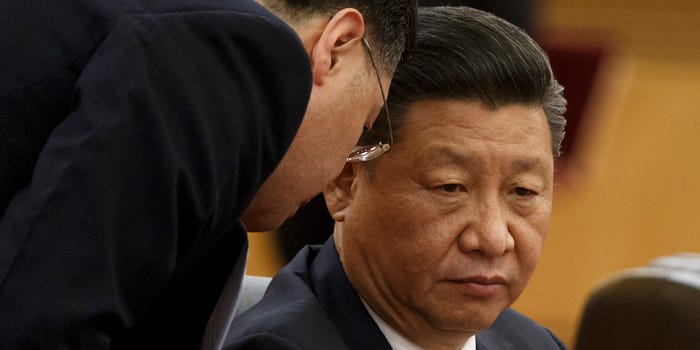
Xi Jinping is scrambling. The word is not used lightly. For a leader who has built his image on strategic composure and long-horizon thinking, the current moment is acutely dangerous. Not because China faces a direct military threat, but because every available response to the crisis in the Persian Gulf leads Beijing into a trap of its own contradictions.
Three Reasons Operation Epic Fury Is Catastrophic for Xi
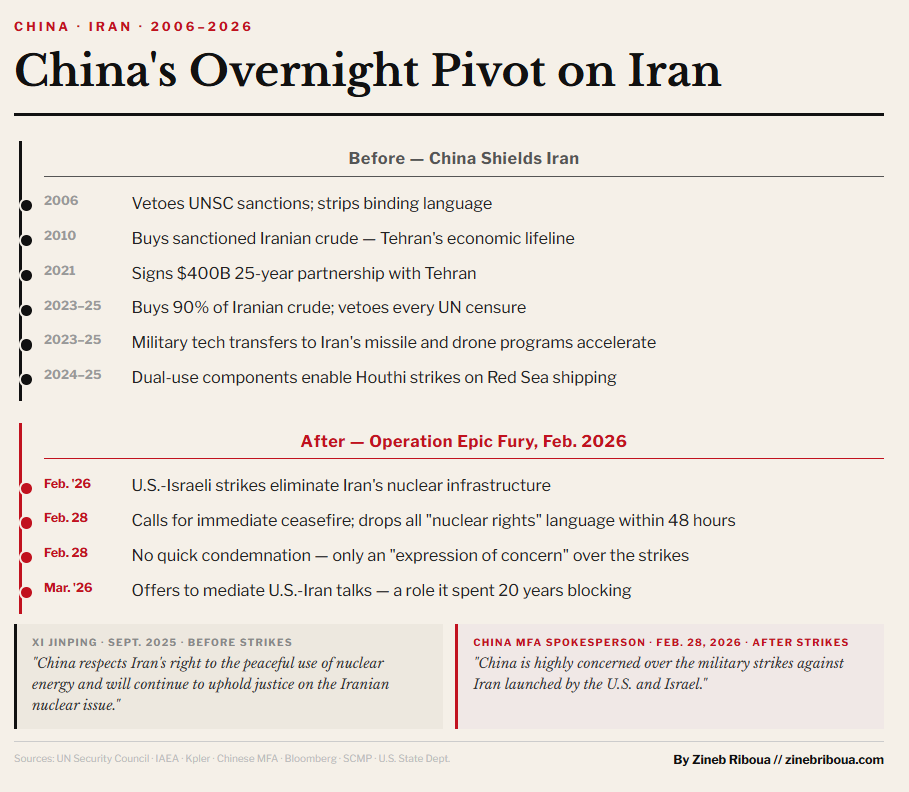
First, the Iranian counterweight is gone. In 2021, Xi told senior Party officials that “the East is rising and the West is declining,” that America was “the biggest source of chaos in the present-day world,” and that China was entering a period of strategic opportunity. Iran was central to that thesis. Beijing needed a defiant Tehran to keep Washington pinned down in the Gulf, to sustain a sanctions-proof energy corridor, and above all, to stand as living evidence that American power had hard limits. The entire architecture of CCP’s dogma of inevitability, which rested on Iran’s ability to endure, and Epic Fury removed the foundation in a single afternoon.
Khamenei was the man who made the thesis feel real. Beijing’s relationship with the Islamic Republic was never really ideological, but Khamenei’s survival was the single most useful fact in Chinese foreign policy. Here was a man Washington had threatened, sanctioned, plotted against, and encircled for over four decades, and he was still giving Friday sermons. Xi personally signed the comprehensive strategic partnership with Khamenei’s government. He personally authorized the weapons transfers. And he personally wielded the Security Council veto. None of it kept Khamenei alive for one additional hour once Washington decided he was finished.
Second, Xi’s own story is collapsing from the inside. The story he told 1.4 billion people, that America is a declining power incapable of decisive force projection, does not match what happened in seventy-two hours over Tehran. State media can suppress the footage and the censors can scrub Weibo, but the ones who matter most, the military planners, the foreign policy professionals, the provincial officials who read between the lines for a living, know what they saw. And if the story is wrong about Iran, the unavoidable next question is whether it was ever right about anything else.
Third, the energy math turns against Beijing. China bought 1.38 million barrels per day of Iranian oil last year and takes over 80% of everything Iran ships. Half of China’s total oil imports pass through the Strait of Hormuz. With Ayatollah Khamenei now dead and Iran’s military leadership weakened, the Gulf’s strategic balance shifts decisively toward Saudi Arabia and the United Arab Emirates, whose energy ties with the United States are strengthening. China’s old selling point was very simple and transactional: we buy your oil and never mention human rights. That pitch loses its utility when Gulf producers already feel protected by an American security guarantee that just proved, on live television, that it works.
The Messaging Trap
Xi’s communications problem may be worse than his strategic one, because there is no good answer. If Beijing endorses the strikes, it loses the “Global South.” If Beijing condemns the strikes, it attaches Chinese prestige to a dead man’s regime, and risks provoking a Trump administration that has just demonstrated, through the act itself, that it does not bluff.
So Beijing chose the remaining option: hide behind the United Nations. Mao Ning called the killing “a grave violation of sovereignty.” The language sounds forceful, but the Belt and Road countries are watching, and what they see so far is a confused superpower reading from a script while American carriers do the actual deciding.
Every Iranian Move Is a Chinese Loss
The truly vicious part of Beijing’s situation is that Iran’s entire playbook for retaliation was designed to punish Washington, but the geography and economics of each weapon mean the damage lands on China instead. Iranian missiles aimed at Gulf states threaten the very oil infrastructure and port facilities that Chinese companies have spent billions investing in across the region.
The Strait of Hormuz is worse. Iran’s Revolutionary Guard announced within hours that no ship would pass through the channel, a threat designed as leverage against the West, except that the United States has a shale industry and a crisis-proof strategic petroleum reserve. In fact, according to Kayrros, as of March 31, 2025, China had only filled 56% percent of its above-ground strategic and commercial storage facilities.
Which means that nearly 45% of China’s own oil imports now sit/would sit hostage to a blockade that was never meant to hurt Beijing. The Houthis have resumed attacks on Red Sea shipping, every flare-up in Iraq threatens oil concessions that Chinese companies spent billions building, and the sum of Iran’s resistance amounts to a systematic disruption of Chinese commercial interests across every waterway and energy corridor Beijing depends on, executed in Khamenei’s name, with no regard for who actually pays the price.
Counting Moves
The clearest sign of Beijing’s disorientation is the absence of action: no emergency summits, no diplomatic maneuvers, no military repositioning, even as a Chinese citizen was killed in crossfire in Tehran and over 300 nationals were evacuated. The sum total of Beijing’s response to the largest American military operation in a generation remains a press conference.
Xi bet a decade of foreign policy on Khamenei’s ability to withstand American pressure, and the bet did not pay off. Operation Epic Fury was designed to break the Islamic Republic, but it may also have exposed the uncomfortable truth that Chinese influence in the Middle East was only as durable as the assumption that no one would ever call it into question, and in Zhongnanhai, they know it.
Khamenei now dead and Iran’s military leadership weakened, the Gulf’s strategic balance shifts decisively toward Saudi Arabia and the United Arab Emirates, whose energy ties with the United States are strengthening. China’s old selling point was very simple and transactional: we buy your oil and never mention human rights. That pitch loses its utility when Gulf producers already feel protected by an American security guarantee that just proved, on live television, that it works.
The Messaging Trap
Xi’s communications problem may be worse than his strategic one, because there is no good answer. If Beijing endorses the strikes, it loses the “Global South.” If Beijing condemns the strikes, it attaches Chinese prestige to a dead man’s regime, and risks provoking a Trump administration that has just demonstrated, through the act itself, that it does not bluff.
So Beijing chose the remaining option: hide behind the United Nations. Mao Ning called the killing “a grave violation of sovereignty.” The language sounds forceful, but the Belt and Road countries are watching, and what they see so far is a confused superpower reading from a script while American carriers do the actual deciding.
Every Iranian Move Is a Chinese Loss
The truly vicious part of Beijing’s situation is that Iran’s entire playbook for retaliation was designed to punish Washington, but the geography and economics of each weapon mean the damage lands on China instead. Iranian missiles aimed at Gulf states threaten the very oil infrastructure and port facilities that Chinese companies have spent billions investing in across the region.
The Strait of Hormuz is worse. Iran’s Revolutionary Guard announced within hours that no ship would pass through the channel, a threat designed as leverage against the West, except that the United States has a shale industry and a crisis-proof strategic petroleum reserve. In fact, according to Kayrros, as of March 31, 2025, China had only filled 56% percent of its above-ground strategic and commercial storage facilities.
Which means that nearly 45% of China’s own oil imports now sit/would sit hostage to a blockade that was never meant to hurt Beijing. The Houthis have resumed attacks on Red Sea shipping, every flare-up in Iraq threatens oil concessions that Chinese companies spent billions building, and the sum of Iran’s resistance amounts to a systematic disruption of Chinese commercial interests across every waterway and energy corridor Beijing depends on, executed in Khamenei’s name, with no regard for who actually pays the price.
Counting Moves
The clearest sign of Beijing’s disorientation is the absence of action: no emergency summits, no diplomatic maneuvers, no military repositioning, even as a Chinese citizen was killed in crossfire in Tehran and over 300 nationals were evacuated. The sum total of Beijing’s response to the largest American military operation in a generation remains a press conference.
Xi bet a decade of foreign policy on Khamenei’s ability to withstand American pressure, and the bet did not pay off. Operation Epic Fury was designed to break the Islamic Republic, but it may also have exposed the uncomfortable truth that Chinese influence in the Middle East was only as durable as the assumption that no one would ever call it into question, and in Zhongnanhai, they know it.
Democrats and RINOs suddenly shriek that Iranian terrorist cells in the U.S. are going to rise up against us.
So let me get this straight: Muslim terrorists will START to become violent only now, due to Trump. Seriously, leftist media?
“This constant lying is not aimed at making the people believe a lie, but at ensuring that no one believes anything anymore. A people that can no longer distinguish between truth and lies cannot distinguish between right and wrong,” according to a quote usually attributed to Hannah Arendt.
As for Donald Trump, he’s a lone wolf in politics. For decades, nearly all Republicans and even many Democrats said we had to do something about Iran. The few given a chance never did a thing. Now Donald Trump as President has done it.
Ayn Rand’s quote comes to mind about Donald Trump:
“Notice how they’ll accept anything except a man who stands alone. They recognize him at once. . . . There’s a special, insidious kind of hatred for him.”
Rand was mostly referring to the creator, the innovator, or the risk-taker required by capitalism. Donald Trump is that in the business world, but he also achieved that in the world of politics. It hasn’t been done before; and probably won’t be done again, at least not for a very, very long time.
Our job wasn’t to replace the Iranian regime. Our job wasn’t to give the Iranians “democracy” or a Constitutional republic. Our job was just to destroy the Iranian regime, because it was the # 1 sponsor of world terrorism for 50 years (primarily against America) and it was in our interest to do so. The rest is up to the Iranians. If they create a new terrorist regime, then we will have to destroy that one too, most likely.
People critical of Trump’s actions are caught in a false alternative. Either we fix Iran, or do nothing to defend ourselves. No to BOTH! We cannot fix Iran. Only the Iranians can pull that off. Look how well trying to fix Iraq and Afghanistan worked out. But we must defend ourselves. It’s plausible to assert that 9/11 and so many other things would not have happened without Iran’s direct or indirect help. Sooner or later, thanks to billions in aid to Iran provided by Obama and Biden, Iran would have acquired nuclear weapons and used them offensively, first against Israel and eventually against American troops and cities. Why Obama, Biden and other treasonous Democrats still walk free after giving a mortal enemy the means to incinerate us all is beyond comprehension.
YES (a thousand times YES!) to Trump’s intervention against Iran. Trump is an American hero. NO to any hint that we owe anyone else anything. The world owes US for getting rid of the Iranian regime. Well, the world owes those of us who voted for President Trump, at least.
Capitalism is the social system of the Enlightenment, founded on a philosophy based on reason, egoism, and freedom. Central to a proper concept of capitalism is reverence for the power of reason and the human mind. It is this power that allows us to harness the power of the atom for energy, build planes and rocketships to travel the skies and stars, and innovate technology to increase the quantity and improve the quality of our lives.
Luxembourg just wrote abortion into its constitution.
On March 3, Luxembourg’s Chamber of Deputies voted to add the “freedom” to have an abortion to the country’s highest law. The initiative began when MP Marc Baum of déi Lénk introduced the proposal in 2024, then pushed it through the legislative pipeline in 2025, including review by the State Council.
Along the way, lawmakers contorted themselves into knots and deliberately shifted the text from a claimed “right” to a “freedom,” a rhetorical dodge that changes the label while keeping the same moral claim: the state should publicly bless the deliberate destruction of unborn children.
Tragic.
And here’s the thing, even supporters of this constitutional alteration admit the truth that exposes the whole project: this constitutional change does not alter Luxembourg’s abortion statute. Abortion is already available “upon request” in Luxembourg up to the end of the first trimester. The government’s own health portal states plainly that a pregnant woman can request an abortion before the end of the 12th week of pregnancy.
So why do it? Because symbolism and faux hysteria now drive abortion politics in Europe.
France constitutionalized abortion in 2024, with leaders openly framing the move as a “safeguard” against a potential rollback like the one that followed the U.S. Supreme Court’s reversal of Roe v. Wade in 2022. Luxembourg’s advocates explicitly cast this vote in the same mold, presenting it as a long-term shield against future democratic change.
That is exactly why this change is so dangerous and so unnecessary.
Luxembourg does not, and has not, faced an imminent pro-life “ban.” Even Luxembourg’s Catholic Church, while opposing the amendment with moral clarity, noted a basic political fact: “In Luxembourg, no political party has made it their mission to weaken or even abolish the current abortion legislation.” The same statement points out that the proposed constitutional move did not even appear in the coalition agreement or the governing parties’ election programs.
That matters because constitutions exist to protect core rights rooted in justice, not to freeze contested moral wrongs into place out of political anxiety.
This amendment did not arise from a legal emergency in Luxembourg. It arose from ideological imitation. France did it, so Luxembourg followed. And France did it largely to send a message after Dobbs.
Luxembourg’s leaders have now imported a French political gesture and called it “progress.”
Cardinal Jean-Claude Hollerich, Archbishop of Luxembourg, warned last year that constitutionalizing abortion would mark “a sad day in Luxembourg’s history.” He argued that since abortion is already legal, locking it into the Constitution amounts to “imposing” one view on the whole population. He warned that such a move could give liberal democracy “features of a totalitarian system” by forcing a view on citizens who dissent.
He also cautioned that this kind of political coercion can “drive people to extremism,” not because truth drives extremism, but because elites sometimes create backlash when they treat moral dissent as illegitimate.
You do not need to agree with every phrase to grasp his central point: once a nation constitutionalizes abortion, it declares the unborn child unworthy of the law’s protection.
The Church also reminded lawmakers that Luxembourg’s constitution already declares human dignity inviolable and argues that this protection “also refers to unborn life.” In other words, Luxembourg now risks embedding an internal contradiction at the constitutional level: inviolable dignity on one page, constitutionalized permission to kill the smallest human beings on the next.
This was overkill, and it will harm future efforts to protect life
Supporters sold this amendment as “security,” not as policy. But “security” here means something chilling: they want abortion insulated from ordinary democratic debate. They want future governments blocked from offering greater protection to unborn children, even if voters demand it, because constitutional text sits above ordinary legislation and usually requires supermajorities to revise.
In plain terms, Luxembourg just tried to make abortion harder to limit, harder to regulate, and harder to reconsider.
No woman becomes more supported by this change. No family gains better maternity care, better housing, better childcare, or better protection from abandonment. This amendment does not build a single resource that helps a mother carry her child with confidence.
It does something else. It tells women, at the highest legal level, that when life creates a conflict, the child loses.
That is not liberation. That is legal despair.
A humane society does not respond to Dobbs, or to France, by racing to constitutionalize the killing of unborn children. A humane society responds by making it easier to welcome children and harder for any mother to feel trapped. Luxembourg’s Church named those real answers: family-work compatibility, support for single parents, preventing child poverty, and building genuinely child-friendly conditions.
Luxembourg chose the opposite path. It chose constitutional theater over concrete love.
Sanjay Nirupam, a leader from the Shiv Sena (Shinde faction), raised concerns about the madrasa education system on Thursday. In a recent conversation, he stated, “India has a single law, a single constitution, and a unified governance system, and our education system should reflect this uniformity.”
Nirupam emphasized that schools and colleges, particularly at the primary and secondary levels, are structured to integrate all students into the national mainstream. However, he noted that the education provided in madrasas is heavily focused on religious teachings, which can alienate students from the broader Indian context.
He argued that to ensure children remain part of the national mainstream, develop a love for their country, and engage in the governance system, the number of madrasas should be gradually reduced. According to him, this step is crucial for students’ futures and for fostering national unity. He highlighted that children deprived of modern education risk becoming isolated in society and unable to contribute to national development.
Additionally, Nirupam referenced student leader Umar Khalid, suggesting that such youth often engage in activities under the guise of promoting freedom of expression and specific ideologies, which can foster anti-national sentiments.
He also criticized Congress leader Rahul Gandhi, accusing him of compromising national interests while emphasizing his viewpoints. Nirupam pointed out that when any leader appears to compromise national interests, they may inadvertently become associated with anti-national activities, as seen in the cases involving Khalid.
Furthermore, he remarked on a recent incident where individuals were found praying in the Malegaon Municipal Office, asserting that prayers should not be conducted in government offices. If such activities are to occur, he insisted that special permission should be obtained. He concluded that the notion that the law does not apply in such spaces is entirely misguided.

 THE ARTFUL DILETTANTE