The Democrat Party: The Enemy Within

New Image
sharethis sharing button
American Thinker on MeWe

The Democrat Party: The Enemy Within?

By Amil Imani

The Democrat party is not simply irrelevant.  Rather, it is America’s greatest adversary, driven by globalist priorities and divisive policies — a decaying shell scheming to undermine the nation that Donald Trump revived.  From the Rio Grande to the Rust Belt, patriots see the truth: This is a radical mob set on tearing apart our borders, our jobs, and our freedoms.  Republicans — especially in Texas, where the battle feels personal — must defeat this threat before it drags the whole country down.  This is war — for America, not just Austin.

Once a cornerstone of American political life, the Democrat party has morphed into something unrecognizable — a force that now threatens the fabric of the nation.  Historically a party of working-class advocacy and progressive reform, it has abandoned its roots in recent years to embrace a radical, anti-American agenda.  This transformation demands scrutiny.

The Democrats once waved the blue-collar flag — FDR, JFK, all that jazz.  Now?  They’ve betrayed the working man.  Newsweek nailed it post-2024: They lost the heartland — Pennsylvania, Michigan, and even Texas saw ranchers and oilmen switch to red.  Why?  Rep. Pramila Jayapal (D-Wash.) pushed her “Jobs for All” bill in January 2025, promising jobs but delivering billions to green-energy fat cats while rig workers in Odessa barely get by.  Trump’s tariffs rebuilt steel towns; Democrats promote solar panels that nobody asked for.  America First means jobs, not handouts.

The Democrats’ border policy hits hard, especially in Texas, where illegal crossings overwhelm towns like Del Rio.  Since 2021, Biden’s administration has allowed in over 10 million, according to Politico, flooding the streets with drugs and crime.  Kamala Harris, the laughable “border czar,” smirked on CNN in 2024, cooing, “We’re a nation of immigrants.”  Tell that to the ranchers dodging cartel bullets.  Now, in 2025, Sen. Chuck Schumer (D-N.Y.) is pushing through his “Pathway to Citizenship Act,” a February amnesty bill aimed at securing blue votes nationwide.  Trump’s wall helps stop the bleeding; Democrats tear it wide open.

Foreign policy is in disarray under the Democrats.  They’ve aligned themselves with the Islamic Republic of Iran since the 2015 nuclear deal; Trump terminated it because it funded terrorism.  Rep. Ilhan Omar (D-Minn.) tweeted in 2023, “Sanctions are economic warfare,” advocating for leniency toward Tehran while it attacks Israel.  In contrast, Trump’s Abraham Accords advanced peace through strength.  In 2025, Sen. Bernie Sanders (I-Vt., essentially a Democrat) criticized Trump’s China tariffs in a March speech, calling them “regressive” while Beijing continues dismantling American factories.  From Houston to Harrisburg, Democrats betray us to tyrants.

The Democrats cater to globalists, not to Americans.  Biden’s Inflation Reduction Act funneled $369 billion into climate initiatives, according to The Guardian, while Texas drillers and Ohio miners received nothing.  In February 2025, House speaker Hakeem Jeffries (D-N.Y.) promoted the “Global Climate Partnership,” tying U.S. energy to U.N. authorities.  Forget that — we’ve got oil in Midland.  Sen. Elizabeth Warren (D-Mass.) criticized Trump’s China tariffs in a March op-ed, lamenting that they “hurt consumers,” oblivious to the fact that they preserved jobs from Laredo to Lansing.  It’s always elites over workers, every single time.

Democrats oppose law and order — end of story.  San Francisco’s Chesa Boudin, regarded as a puppet of George Soros, released felons until voters pushed back in 2022.  That’s their playbook: defund the police and embrace criminals.  ABC News revealed GOP ads in 2024 criticizing blue cities for it — think Chicago, not just Dallas.  Now Rep. Alexandria Ocasio-Cortez (D-N.Y.) promotes her 2025 “Community Safety Act,” which cuts police budgets for “restorative justice” rhetoric — because feelings can prevent carjackings.  Trump’s firm approach succeeds; Democrats encourage chaos.

Democracy?  They rig it!

Don’t fall for their “save democracy” tears.  The Journal of Democracy reported that 20% of Democrats supported violence in 2021 — less than the GOP’s 30%, but still despicable.  They cheered the riots of 2020.  Harris tweeted support for bail funds — then cried when Trump defeated them in 2024.  Now Rep. Jamie Raskin (D-Md.) proposes his Electoral College “reform” bill in 2025, a blatant power-grab aimed at eliminating red states like Texas.  Trump won big; they can’t stand it.
Trump’s Tariffs Did Not Cause the Market Downturn

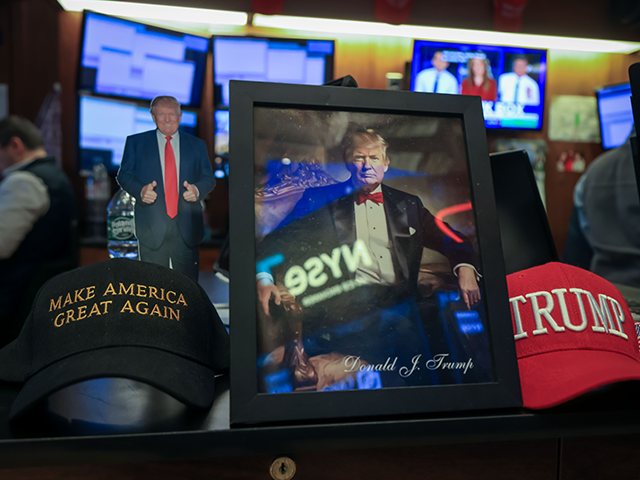
President Donald Trump memorabilia is seen on the floor of the New York Stock Exchange (NY

Breitbart Business Digest: Trump’s Tariffs Didn’t Tank the Market

Michael Nagle/Bloomberg via Getty ImagesJohn Carney

The Tariff Selloff Narrative Doesn’t Make Sense

If you’re looking for an explanation of why the stock market has been stumbling, the financial press has a ready-made answer: blame Trump’s tariffs.

The claim is familiar, convenient, and utterly predictable. It also happens to be wrong. Markets don’t move in neat response to political narratives, and the idea that investors suddenly woke up to the perils of trade policy months after Trump was elected is as laughable as it is lazy.

If the press had a better explanation, they’d use it—so long as it made President Trump look bad. Instead, they’re dusting off the same script they used in 2018. But the numbers—and history—tell a very different story.

The Real Culprit: The End of the Government Spending Boom

Over the last few weeks, technology stocks and other speculative assets cratered, while safe assets such as Berkshire Hathaway, Treasury bonds, and dividend-paying stocks have held steady or even risen. If tariffs were driving the selloff, we would see broad market declines, not a selective retreat from high-risk, high-valuation stocks. This isn’t about tariffs—it’s about investors finally reckoning with the excesses of the past few years.

John Rekenthaler, Vice President for Research at Morningstar, put it plainly: speculators have ruled the market for years, chasing anything that looked exciting. But when confidence shakes, they stampede out the exits—just like we’re seeing now.SUBSCRIBE

The same thing happened in early 2022 when the Fed started pulling back the easy money. This time, the trigger is different, but the dynamic is the same.

Rekenthaler also made another key point: the market’s timing doesn’t support the tariff panic theory. Tariffs weren’t some surprise revelation. Trump had been talking about them for months, yet the market surged from August through December. If tariffs were such a clear-cut market killer, investors wouldn’t have waited until late February to react. That’s simply not how markets behave. The selloff happened when speculation hit a breaking point—not because of tariffs.

The Sell-Off Is a Rotation, Not a Sign of Economic Doom

Jared Woodard argues in the latest Bank of America RIC Report that this selloff is a rotation, not an economic crisis. The report highlights a major shift in market fundamentals. Tech stocks are plummeting, while sectors such as defense, value stocks, and emerging market debt are gaining. Government-driven growth is fading as public sector hiring slows and spending levels shift. The market is adjusting to a world where speculation and following the government-spending goodie trail is no longer being rewarded.

Fiscal and monetary policy are in transition, forcing investors to reassess risk. High-budget deficits and heavy government spending have propped up speculative assets in recent years, but that cycle is ending. The RIC report underscores a fundamental truth: this selloff is the result of markets recalibrating after an era of over-investment in high-risk, high-momentum stocks. Investors are pulling back not because they fear tariffs, but because they are repositioning in anticipation of a new market environment.

Despite what the financial media wants you to believe, there is no academic support for the idea that tariffs drive broad market selloffs. History tells us the opposite. The Trump tariffs of 2018 and 2019 didn’t tank the market—it kept rising. Even Biden keeping those tariffs in place didn’t stop the rally. Markets only fell when speculative excess and Fed tightening caught up with a factual explanation.

President Donald Trump memorabilia is seen on the floor of the New York Stock Exchange (NY

Breitbart Business Digest: Trump’s Tariffs Didn’t Tank the Market

166Michael Nagle/Bloomberg via Getty ImagesJohn Carney

13 Mar 2025178

5:11

The Tariff Selloff Narrative Doesn’t Make Sense

If you’re looking for an explanation of why the stock market  tanked, the media would have us believe it is the Trump tariffs.

The claim is familiar, convenient, and utterly predictable. It also happens to be wrong. Markets don’t move in neat response to political narratives, and the idea that investors suddenly woke up to the perils of trade policy months after Trump was elected is as laughable as it is lazy.

If the press had a better explanation, they’d use it—so long as it made President Trump look bad. Instead, they’re dusting off the same script they used in 2018. But the numbers—and history—tell a very different story.

The Real Culprit: The End of the Government Spending Boom

Over the last few weeks, technology stocks and other speculative assets cratered, while safe assets such as Berkshire Hathaway, Treasury bonds, and dividend-paying stocks have held steady or even risen. If tariffs were driving the selloff, we would see broad market declines, not a selective retreat from high-risk, high-valuation stocks. This isn’t about tariffs—it’s about investors finally reckoning with the excesses of the past few years.

John Rekenthaler, Vice President for Research at Morningstar, put it plainly: speculators have ruled the market for years, chasing anything that looked exciting. But when confidence shakes, they stampede out the exits—just like we’re seeing now.

The same thing happened in early 2022 when the Fed started pulling back the easy money. This time, the trigger is different, but the dynamic is the same.

Rekenthaler also made another key point: the market’s timing doesn’t support the tariff panic theory. Tariffs weren’t some surprise revelation. Trump had been talking about them for months, yet the market surged from August through December. If tariffs were such a clear-cut market killer, investors wouldn’t have waited until late February to react. That’s simply not how markets behave. The selloff happened when speculation hit a breaking point—not because of tariffs.

The Sell-Off Is a Rotation, Not a Sign of Economic Doom

Jared Woodard argues in the latest Bank of America RIC Report that this selloff is a rotation, not an economic crisis. The report highlights a major shift in market fundamentals. Tech stocks are plummeting, while sectors such as defense, value stocks, and emerging market debt are gaining. Government-driven growth is fading as public sector hiring slows and spending levels shift. The market is adjusting to a world where speculation and following the government-spending goodie trail is no longer being rewarded.

Fiscal and monetary policy are in transition, forcing investors to reassess risk. High-budget deficits and heavy government spending have propped up speculative assets in recent years, but that cycle is ending. The RIC report underscores a fundamental truth: this selloff is the result of markets recalibrating after an era of over-investment in high-risk, high-momentum stocks. Investors are pulling back not because they fear tariffs, but because they are repositioning in anticipation of a new market environment.

https://d2.ads.rmbl.ws/loader?a=270&if=false&url=https%3A%2F%2Fwww.breitbart.com%2Feconomy%2F2025%2F03%2F13%2Fbreitbart-business-digest-trumps-tariffs-didnt-tank-the-market%2F&title=Breitbart%20Business%20Digest%3A%20Trump%27s%20Tariffs%20Didn%E2%80%99t%20Tank%20the%20Market

Despite what the financial media wants you to believe, there is no academic support for the idea that tariffs drive broad market selloffs. History tells us the opposite. The Trump tariffs of 2018 and 2019 didn’t tank the market—it kept rising. Even Biden keeping those tariffs in place didn’t stop the rally. Markets only fell when speculative excess and Fed tightening caught up with

The reality is that tariffs are a long-term adjustment tool, not a short-term market killer. The argument that tariffs are responsible for this downturn is nothing more than a convenient excuse for investors who don’t want to admit that they bet too much on speculative assets.

The Financial Media’s ‘Liar’s Poker’ Routine

In Michael Lewis’ famous Wall Street tome Liar’s Poker, traders are depicted as inventing plausible-sounding but entirely imagined explanations for market moves to satisfy media demand for a simple narrative. When no one knew why the dollar was falling, they’d just blame “Arab selling” because it was a story that couldn’t be refuted. No one had a clue what the Arabs were doing or why, so it was a full-proof answer.

That’s exactly what’s happening now. The financial press needs a tidy explanation for why markets are falling, so they scream “Trump’s tariffs!” It doesn’t have to be true. It just has to sound good enough to keep the anti-Trump narrative

Senators Grassley and Johnson Expose Deep State

Senators Chuck Grassley (R-IA) and Ron Johnson (R-WI) have blown the lid off yet another sham investigation orchestrated by Biden’s corrupt Department of Justice (DOJ) and the politically compromised FBI.

According to newly uncovered documents, the agencies weaponized their power to target President Donald Trump, former Vice President Mike Pence, and their allies through an illegitimate probe dubbed “Arctic Frost.”

Armed with whistleblower disclosures and damning internal documents, the senators are sounding the alarm over “Operation Arctic Frost,” a taxpayer-funded witch hunt that seized government-issued cell phones belonging to former President Donald Trump and former Vice President Mike Pence while conducting a sweeping barrage of interviews across the country.

The FBI did not require a warrant to take possession of government phones from the Biden White House. However, after securing the devices, agents began preparing a search warrant to access their data, sources familiar with the investigation told Fox News.

“The Biden White House played right along with the FBI’s ‘gotcha’ scheme against Trump,” the source told Fox News.

“Biden’s Office of White House Counsel, under the leadership of Dana Remus and Jonathan Su, gave its blessing and accommodation for the FBI to physically obtain Trump and Pence’s phones in early May 2022. Weeks later, the FBI began drafting a search warrant to extract the phones’ data.”

In a fiery letter dated March 13, 2025, addressed to Attorney General Pam Bondi and FBI Director Kash Patel, Grassley and Johnson pulled no punches.

Jim Hoft, Gateway Pundit

Betsy DeVos: The End of Federal Control of Education is Near

Kimberley Strassel hits the nail on the head in “Trump’s School Choice” (Potomac Watch, March 7). It is time to end the experiment in federal control over education, returning the matter to states and, more important, to families.

As Ms. Strassel explains, the Education Department is a misnomer. It educates no one. Instead, it functions as a bureaucratic middleman that adds cost and complexity—as well as radical political agendas—at every turn, without adding value anywhere. The proof is in the outcomes. The department’s stated purpose is to close the gap between high- and low-performing students. It has spent $1 trillion since 1979, ostensibly in pursuit of that goal, but the results show the gap is wider today than it was three decades ago. Seven out of 10 fourth-graders today aren’t proficient readers. This is what happens with a system that rewards compliance over competence.

Why has anyone abided such failure? As Ms. Strassel rightly notes, the federal department was never functionally intended to serve students. It was created as a political payoff to the school union bosses and thus built to serve the interests of adults.

This underscores why, finally, President Trump and Congress must put parents squarely in the driver’s seat of their children’s education. When they have the power to take kids out of failing schools, real accountability will follow. Mr. Trump has clearly called for expanding education freedom across this country, and Congress must finally heed his call by including the Educational Choice for Children Act in the upcoming budget reconciliation.

The president’s efforts, including eliminating unneeded and duplicative staff, are far from extreme. They are what is necessary to address and correct the significant challenges facing America’s students and teachers. By shuttering the Education Department for good, we can begin to fix education and help children unlock their full potential.

Betsy DeVos

Grand Rapids, Mich.

Mrs. DeVos was U.S. education secretary, 2017-21.

What MAGA Really Means

Robert Kennedy, Jr. understands:

What “MAGA” really means

The phrase has troubled liberals who think it is a call for a return to an America before civil rights, gay rights, and women’s rights. But I have a more generous interpretation, one that is truer to my experience of Donald Trump as he is today. “Make America Great Again” recalls a nation brimming with vitality, with a can-do spirit, with hope and a belief in itself. It was an America that was beginning to confront its darker shadows, could acknowledge the injustice in its past and present, yet at the same time could celebrate its successes. It was a nation of broad prosperity, the world’s most vibrant middle class, and a idealistic belief (though not consistently applied) in freedom, justice, and democracy. It was a nation that led the world in innovation, productivity, and technology. And it was the healthiest country in the world. I have talked to many Trump supporters. I have talked with his inner circle. I have talked to the man himself. This is the America they want to restore.

@RobertKennedyJr on X (formerly Twitter)

*****************

Lawless Jack Smith’s latest made-up charges against Trump?

It’s not “lawfare.” It’s warfare. Literally, a cold civil war getting hotter by the hour.

******************

“Now I get it. When they say ‘democracy’ they really mean ‘dictatorship of the proletariat.’”

— Matt Kibbe

******************

Kamala is lying that she now opposes electric car mandates and wants Trump’s border wall completed. Last week she wanted Soviet-style pricing and bread lines. Why can’t she make up her mind? Is she a Communist, or a Constitutionalist? How can leftists justify voting for her, if she’s supposedly adopting Trump positions? Do these toxic totalitarians think we are all brain dead? Or are they brain dead, and just assume we’re the same?

******************

“Opinions don’t affect facts. But facts should affect opinions, and do, if you’re rational.” (Ricky Gervais)

By this definition, today’s American culture is wildly, utterly irrational. Everything is upside down and inside out. It’s the cultural equivalent of psychosis. Not most of the people; but virtually everyone the people rely on for any kind of intellectual, social or psychological guidance.

Michael J. Hurd and RFK, Jr.

Tulsa Gabbard Announces Major Move Against Deep State

U.S. Director of National Intelligence Tulsi Gabbard has announced her first major move since being confirmed last month, eliciting joyful reactions by MAGA supporters and certainly some appreciation from some of her affected colleagues.

Some of the biggest elements of President Donald Trump’s agenda have been stymied by actors within the federal bureaucracy who have “agendas” of their own, according to U.S. Department of Homeland Security Kristi Noem. Their obstruction was on display during last month’s botched immigration raid in Los Angeles after leakers tipped off the city’s largest newspaper, putting the lives of U.S. Customs and Immigration Enforcement officers in jeopardy.

Now, Gabbard is using the power of the “deep state” against itself.

The national intelligence community will be “aggressively pursuing” leaks within the executive branch in the coming weeks, Gabbard said. Among the transgressions already identified are leakers sharing information with the Huffington Post, sharing information about Israel-Iran relations with the Washington Post, and sharing sensitive U.S.-Russia matters with NBC News, according to conservative reporter Eric Daugherty.

“That ends now. We know of and are aggressively pursuing recent leakers from within the Intelligence Community and will hold them accountable,” the former Democratic congresswoman said in a statement.

Some leakers have already been found, Noem announced earlier this month. Although she did not say where they were located, Tom Homan, the White House’s lead immigration liaison, suggested that evidence pointed back to the FBI.

As the Trump administration’s caustic purge of career bureaucrats has picked up speed, officials have had to contend with holdovers from the Biden-Harris administration working within the agencies now headed by some of President Trump’s top allies. Although many have resigned in protest, others continue to delay reform, as exemplified recently when many midlevel managers across the federal government directed their employees to ignore a request by Elon Musk to report on what work they had performed in the past week.

Some who worked for the Biden-Harris administration and are now on the outside are continuing to use their access to government sources to disrupt parts of President Trump’s agenda.

Pablo Manriquez, who previously served as a director of Latino and Hispanic outreach for the national Democratic Party, revealed this month that ICE was suiting up for a raid in northern Virginia, according to “Fox & Friends” hosts who called for the activist to face consequences for his actions.

“ICE RAIDS are planned for Monday & Tuesday in Northern Virginia, per multiple sources who tell us ICE has obtained between 75 and 100 judicial warrants,” Manriquez wrote on social media while including helpful tips on how to evade capture by immigration authorities.

Gabbard’s announcement is not the first expulsion of federal officials stymying the administration’s agenda. In February, she told Fox News’ Jesse Watters that more than 100 intelligence officials had been fired after taking part in “obscene” online sex chatrooms, the NY Post reported. The behavior occurred on a National Security Agency Intelink platform and amounted to an “egregious violation of trust.”

“When you see what these people were saying,” she told Watters, “they were brazen in using an NSA platform intended for professional use to conduct this — kind of really, really horrific behavior.”

Mark Steffen

America Becoming Less Christian is a Problem for Everybody

A massive new Pew survey with a misleading headline tells the tale of America’s ongoing de-Christianization.

A major survey on the religious landscape of America was just released by Pew Research Center, and what it reveals about the decline of Christianity should alarm every American, whether or not one is Christian.

Why should the de-Christianization of America worry us? Because, as I’ve argued before, if America loses the Christian faith from which our system of government is derived, we will lose everything that makes America what it is. All of the rights and freedoms we enjoy, the rule of law, the checks and balances on government power, all of that will disappear.

Suffice to say, the loss of America’s Christian identity has huge implications for everyone in the country, Christian or not. And the Pew study demonstrates just how pervasive and precipitous the decline of Christianity in America is right now.

It’s easy to misread the study, or misapprehend what’s important about it, which is that the de-Christianization of American society is not going to stop anytime soon, in part because it’s being driven by a younger, less Christian, increasingly neopagan cohort of Americas as older Christians die off without being replaced and aging Christian parents fail to pass the faith onto their children. Pew itself seems to misapprehend its own survey, giving it the headline, “Decline of Christianity in the U.S. Has Slowed, May Have Leveled Off.”

This is true but only in a narrow sense. Pew’s data indeed suggest that for the last five years, the share of the U.S. population that describes itself as Christian has wavered between 60 and 64 percent, and the new Religious Landscape Study (RLS) released earlier this month puts that figure right in the middle of that range, at 62 percent.

But the devil is in the details. Pew has done three RLS surveys over the past 17 years, each of which involved more than 35,000 adults. The first, in 2007, found 78 percent of U.S. adults identified as Christian. Smaller surveys in subsequent years showed this figure slowly ticking downward, and the second RLS, in 2014, found the total was just 71 percent. The most recent RLS in 2023-24 showed a 9-point drop since 2014 and a 16-point drop since 2007, which suggests the rate of our de-Christianization is accelerating.

When Pew says that the numbers are now “leveling off,” it means the smaller surveys conducted between 2019 and 2024 bucked the previous trend of a steadily shrinking Christian population in America, and instead of steady year-over-year decreases, it showed fluctuations within that narrow 60-64 percent range.

The overall trend, however, remains one of precipitous decline in Christianity over the past 17 years. And if one digs a little deeper into the RLS survey data, the picture that emerges is even more alarming. For example, the share of Americans who don’t identify with any religion—the “nones” — increased from 16 percent in 2007 to 23 percent in 2014 to 29 percent in 2024. This increase isn’t limited to growing irreligiosity among any particular group but is “demographically broad-based,” says Pew. “There are fewer Christians and more ‘nones’ among men and women; people in every racial and ethnic category; college graduates and those with less education; and residents of all major regions of the country.”

It’s hard to overstate the effect of the rise of the “nones” on the American religious landscape. As Eric Sammons noted last week, “for every 100 people who leave the religious ‘nones’ (i.e., they join a religion), a full 590 become part of that irreligious cohort.” Sammons also observed that the Pew study shows Catholics are facing a sharper decline than Protestants: for every 100 people who become Catholic, 840 leave. Whereas for every 100 people who become Protestants, only 180 leave.

But either way it’s a story of decline in the Christian faith across the board, while the overall number of “nones” continues to grow — as do the number of non-Christian religious adherents (Muslims, Buddhists, Hindus, etc.) whose share of the population went from 4.7 percent in 2007 to 7.1 percent today.

And it’s not just that the total number of Christians is declining. The practice of the Christian faith is deteriorating as well. Among the 62 percent who describe themselves as Christian, only a third of them say they attend religious services monthly, either in person or virtually (TV or online). Pew doesn’t compare church attendance figures in this new RLS survey with the results from 2014 or 2007 because it used a slightly different methodology (those earlier surveys were conducted entirely by telephone, whereas the new RLS was mainly online and paper surveys). 

But Pew did note that the old telephone surveys were registering a decline in church attendance in the years before switching to online/paper surveys: “The share of Americans who reported attending religious services at least monthly dropped from 54% in 2007 to 50% in the 2014 RLS and had fallen to 45% by the time the Center transitioned away from phone surveys in 2018-19.”

For Catholics, the single largest cohort of Christians in America, who now make up just 19 percent of America’s Christian population (down from 24 percent in 2007), the attendance problem is even worse. Catholics are obligated to attend Mass weekly, yet less than a third of them (29 percent) of them say they fulfill this Sunday obligation. That means of America’s roughly 65 million Catholics, only 18.8 million could be considered “practicing”—and that’s not taking into account other Catholic obligations that are increasingly shirked, like going to confession at least once a year.

But one need not get lost in all this survey data to grasp the essential reality that the Pew study reveals: America is losing its Christian religion. Buried in Pew’s analysis is the critical observation that “it is inevitable that older generations will decline in size as their members gradually die. We also know that the younger cohorts succeeding them are much less religious.” That, in turn, means in order for the decline in Christianity to halt, “today’s young adults would have to become more religious as they age, or new generations of adults who are more religious than their parents would have to emerge.” Is that possible? Sure. Is it likely? Not unless something changes.

There’s much more to unpack in the Pew survey, like the decline of Christianity occurring simultaneously with a growth in “spirituality,” which suggests the future of the West will not be one of atheistic, secular materialism but of re-enchantment and neopaganism. But for now, it’s enough to be honest with ourselves, and with the data, and acknowledge that we are rapidly de-Christianizing. Once we accept that we can begin to think clearly about what it means for our country, and begin at last to fight back.

Trump to Supercharge Deportations by Invoking 18th Century Law

President Donald Trump is reportedly preparing to invoke a rarely used 18th-century law to accelerate mass deportation. The move would be part of his broader immigration crackdown, a centerpiece of his 2024 campaign.

Sources told CNN that Trump’s team is considering using the Alien Enemies Act, a law from 1798 that grants the president sweeping powers to detain and deport noncitizens from countries deemed hostile. The law, originally passed during a period of tension with France, has rarely been applied in modern history.

Trump has already vowed to launch “the largest domestic deportation operation in American history,” targeting millions of illegal immigrants. His campaign has framed the effort as a national security measure, relaying that the Biden administration allowed record numbers of illegal crossings during their four years.

Enacted under President John Adams, the law was originally designed amid rising tensions with France, allowing the government to take action against foreign nationals deemed a threat to national security. Unlike the other Alien and Sedition Acts, which were later repealed or expired, the Alien Enemies Act remains in effect today under 50 U.S.C. §§ 21-24.

Throughout history, the law has been invoked in times of war. During the War of 1812, it was used to detain and deport British nationals.

In World War I, President Woodrow Wilson utilized it against German citizens living in the U.S. Similarly, in World War II, the law played a role in the internment of Japanese, German, and Italian nationals. While it has not been widely applied in recent history, it was referenced in national security discussions following the 9/11 attacks.

Because its application is tied to a formal state of war, its use is limited, and any modern attempt to expand its scope—such as for immigration enforcement—would likely face legal challenges. While originally crafted in an era of early American conflicts, the law’s broad presidential authority remains a subject of debate.

In January, right after assuming office, the administration declared a national emergency at the U.S.-Mexico border, deploying troops to secure the border and labeling certain cartel organizations as foreign terrorist organizations. Efforts to end birthright citizenship were also initiated.

A new poll shows that most Americans support President Trump’s immigration policies. His efforts to curb illegal immigration—including increased arrests and deportations of criminal migrants—earned him his highest approval rating among seven policy areas surveyed in a CNN poll released Wednesday. Trump received a 51% approval rating on immigration, a seven-point increase from any point during his first term.

The main focus is on Tren de Aragua (TDA). TDA is a violent criminal gang that originated in Venezuela and has since expanded its operations across Latin America and beyond. Initially formed in the early 2000s within Venezuela’s Tocorón prison, the gang has grown into a powerful transnational criminal organization involved in drug trafficking, human trafficking, extortion, and contract killings.

An official announcement, expected potentially by Friday, has seen its timing shift as officials put the finishing touches on the details.

Chris Powell