A former special agent says the agency has become top-heavy and self-absorbed.
“Uh, Pat, the FBI is at the door,” my wife called out to me on an otherwise quiet Tuesday morning last month.
Those words would strike fear in most, but this wasn’t the first time I’d heard such a thing. In my almost two decades with the FBI, colleagues helped with childcare, invited one another over for holidays, and drove each other to doctor appointments. A pop-in wasn’t out of the ordinary.
But this time seemed different, and I could hear it in my wife’s voice. Two agents stood on my front stoop. They didn’t appear to be there to catch up with an old pal. Their unmarked car was wedged in my driveway, and their tone sounded adversarial. They presented a nondisclosure agreement that I had signed last year when I resigned out of frustration with both the bureau and my deteriorating mental health.
Their concern, it seemed, was my cooperation with an international media investigation that could expose embarrassing failures within the FBI, the Department of Justice, and our German police partners.
As the Washington Post, Der Spiegel, and others have reported, investigators uncovered a sprawling, sadistic child-abuse network called “764.” Its members shared images of torture and abuse and pressured children to harm themselves.
In 2022, we identified and warned German police about a key suspect in Hamburg who used the alias “White Tiger.” Despite detailed, specific intelligence, German authorities failed to act. Only after additional crimes—including the death of a 13-year-old Gig Harbor boy, which I investigated—was the suspect arrested, years later.
The case raised disturbing questions about missed opportunities and international law enforcement. But the failures were not limited to German police. They also illustrate how the FBI, once fearless in its mission, has become paralyzed by bureaucracy and risk aversion—and how desperately it needs reform.
I saw the FBI’s transformation firsthand. In my time at the bureau, investigators who knew cases best were second-guessed by managers with little operational experience. Every agent misstep spawned a mandatory training module, which distracted from pursuing urgent leads. Bureaucrats stalled big cases, micromanaged small ones, and stifled resources for critical national security work. The American people paid the price.
Meantime, street agents—those who execute the bureau’s mission—were underpaid and overburdened. Many senior ones counted the days until retirement. New agents, many recruited from lucrative careers elsewhere, were sent with their families to expensive cities and paid salaries near the poverty line.
When I joined the FBI after 9/11, I knew my work was meaningful. I deployed to war zones, ran informants into terrorist groups, and sought to recover hostages. Many rank-and-file agents retain that sense of mission.
But excessive administration, obsolete technology, and careerist executives have degraded morale and distracted the bureau. What should be the world’s premier law enforcement agency has become top-heavy and self-absorbed. The Hamburg case is a devastating reminder of what happens when the FBI loses sight of its purpose.
The FBI can correct course, but it should embrace three reforms. First, leadership needs to reconnect with and advocate for the rank-and-file. That means honest feedback, candid conversations, and respect for agents’ financial and personal sacrifices.
Second, agents, not managers or political appointees, should become the FBI’s backbone again. To do that, the FBI must streamline intelligence functions, send resources into the field, and remove unnecessary oversight.
Finally, the bureau must return to its core mission: protecting the vulnerable and upholding the law, not shielding itself from embarrassment or bending to partisanship. The FBI serves our nation, not any one administration.
To be sure, the bureau today still accomplishes righteous work. Agents stop complex cyber and financial crimes, combat foreign influence, and disrupt terrorist plots every day. But these successes happen despite the FBI’s leadership and general dysfunction.
The bureau I joined was not perfect, but it was fearless. Today’s FBI too often is scared of its own shadow—hiding behind legal threats while demoralizing its workforce and ignoring real priorities.
I want only protection for future victims—and to sound a warning. I, too, want to see justice rendered in the White Tiger trial. But some leaders will always be company men first, public servants second. Maybe that’s precisely the problem.
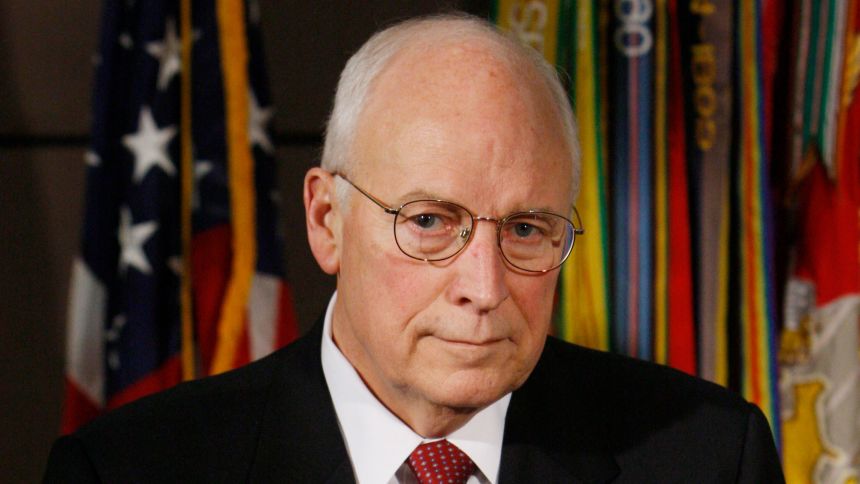
U.S. — The nation is mourning the death of former Vice President Dick Cheney, who has tragically passed away without getting to see World War III.
The renowned politician, avid hunter of both animals and men, and 43rd most popular Vice President, passed away peacefully at 84, surrounded by family.
“He dedicated his life to achieving his dream of devastating global conflict, and it’s a shame he passed before any of his work came to fruition,” said close friend John Bolton while adding his signature to the latest batch of bombs coming off the assembly line. “We can only do our best to carry on his legacy until this wretched sphere is baptized in the holy fires of thermonuclear war.”
“It’s what Dick would want.”
Cheney was known for vastly increasing the surveillance state, his aggressive foreign policy of invading Iraq and Afghanistan, and also for shooting a dude in the face. “We have lost a titan,” said Bolton.
At publishing time, reports from the celestial realm reported Cheney had opted to go to Hell after hearing it had oil.
“His beloved wife of 61 years, Lynne, his daughters, Liz and Mary, and other family members were with him as he passed,” the family said, adding that he died due to complications of pneumonia and cardiac and vascular disease.
“Dick Cheney was a great and good man who taught his children and grandchildren to love our country, and to live lives of courage, honor, love, kindness, and fly fishing,” the family added.
“We are grateful beyond measure for all Dick Cheney did for our country. And we are blessed beyond measure to have loved and been loved by this noble giant of a man.”
The 46th vice president, who served alongside Republican President George W. Bush for two terms between 2001 and 2009, was for decades a towering and polarizing Washington power player. In his final years, however, Cheney, still a hardline conservative, nevertheless became largely ostracized from his party over his intense criticism of President Donald Trump whom he branded a “coward”and the greatest-ever threat to the republic.
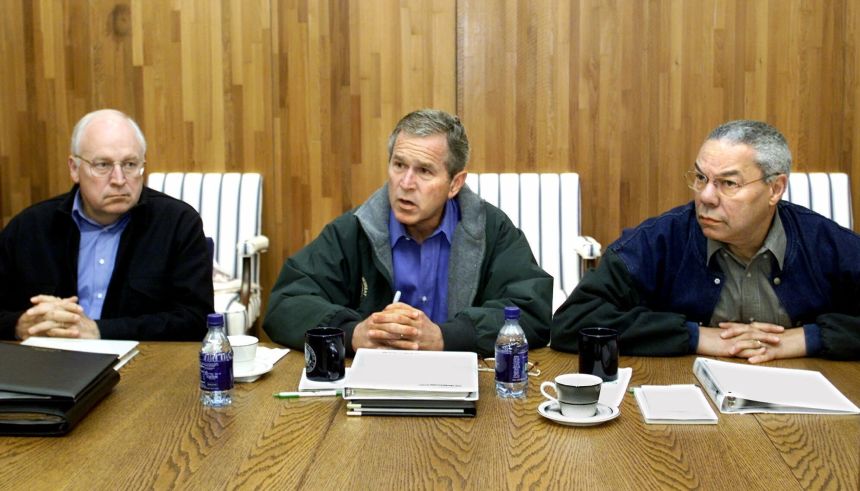
Cheney sits next to President George W. Bush as he meets with his cabinet and advisers, including Secretary of State Colin Powell, on September 15, 2001, at Camp David in Maryland. J. Scott Applewhite/AP
In an ironic coda to a storied political career, he cast his final vote in a presidential election in 2024 for a liberal Democrat, and fellow member of the vice president’s club, Kamala Harris, in a reflection of how the populist GOP had turned against his traditional conservatism.
Cheney was plagued by cardiovascular disease for most of his adult life, surviving a series of heart attacks, to lead a full, vigorous life and lived many years in retirement after a heart transplant in 2012 that he hailed in a 2014 interview as “the gift of life itself.”
Cheney, a sardonic former Wyoming representative, White House chief of staff and defense secretary, was enjoying a lucrative career in the corporate world when he was charged by George W. Bush with vetting potential vice-presidential nominees. The quest ended with Cheney himself taking the oath of office as a worldly number two to a callow new president who arrived in the Oval Office after a disputed election.
While caricatures of Cheney as the real president do not accurately capture the true dynamics of Bush’s inner circle, he relished the enormous influence that he wielded from behind the scenes.
Cheney was in the White House, with the president out of town on the crisp, clear morning of September 11, 2001. In the split second of horror when a second hijacked plane hit the World Trade Center in New York, he said he became a changed man, determined to avenge the al Qaeda-orchestrated attacks and to enforce US power throughout the Middle East with a neo-conservative doctrine of regime change and pre-emptive war.
“At that moment, you knew this was a deliberate act. This was a terrorist act,” he recalled of that day in an interview with CNN’s John King in 2002.
Cheney reflected in later years on how the attacks left him with overwhelming sense of responsibility to ensure such an assault on the homeland never happened again. Perceptions however that he was the sole driving force behind the war on terror and US ventures into Iraq and Afghanistan are misleading.
Contemporary and historic accounts of the administration show that Bush was his own self-styled “The Decider.”
A changed man
From a bunker deep below the White House, Cheney went into crisis mode, directing the response of a grief-stricken nation suddenly at war. He gave the extraordinary order to authorize the shooting down of any more hijacked airliners in the event they were headed to the White House or the US Capitol building. For many, his frequent departures to “undisclosed” locations outside Washington to preserve the presidential chain of succession reinforced his image as an omnipotent figure waging covert war from the shadows. His hawkishness and alarmist view of a nation facing grave threats was not an outlier at the time – especially during a traumatic period that included anthrax mailings and sniper shootings around Washington, DC, that exacerbated a sense of public fear even though they were unrelated to 9/11.
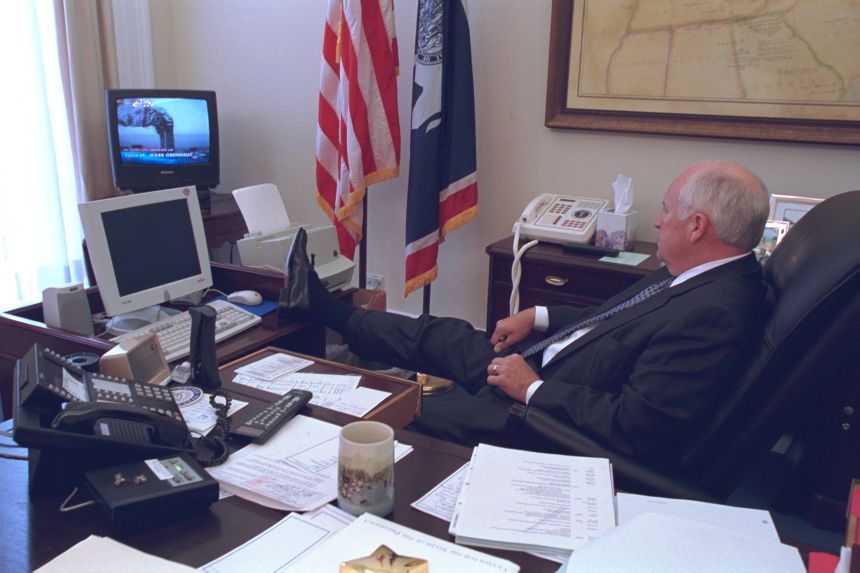
Cheney watches news coverage of the terror attacks on September 11, 2001. US National Archives
The September 11 attacks unleashed the US war in Afghanistan to overthrow the Taliban, which was harboring al Qaeda, though the terror group’s leader Osama bin Laden escaped. Soon, Cheney was agitating for widening the US assault to Iraq and its leader, Saddam Hussein, whose forces he had helped to eject from Kuwait in the first Gulf War as President George H.W. Bush’s Pentagon chief.
The vice president’s aggressive warnings about Iraq’s supposed weapons of mass destruction programs, alleged links to al Qaeda and intent to furnish terrorists with deadly weapons to attack the United States played a huge role in laying the groundwork for the US invasion of Iraq in 2003. Congressional reports and other post-war inquiries later showed that Cheney and other administration officials exaggerated, misrepresented or did not properly portray faulty intelligence about weapons of mass destruction programs that Iraq turned out not to possess. One of Cheney’s most infamous claims, that the chief 9/11 hijacker Mohamed Atta, met Iraqi intelligence officials in Prague, was never substantiated, including by the independent commission into the September 11 attacks.
But Cheney insisted in 2005 that he and other top officials were acting on “the best available intelligence,” at the time. While admitting that the flaws in the intelligence were plain in hindsight, he insisted that any claim that the data was “distorted, hyped, or fabricated” was “utterly false.”
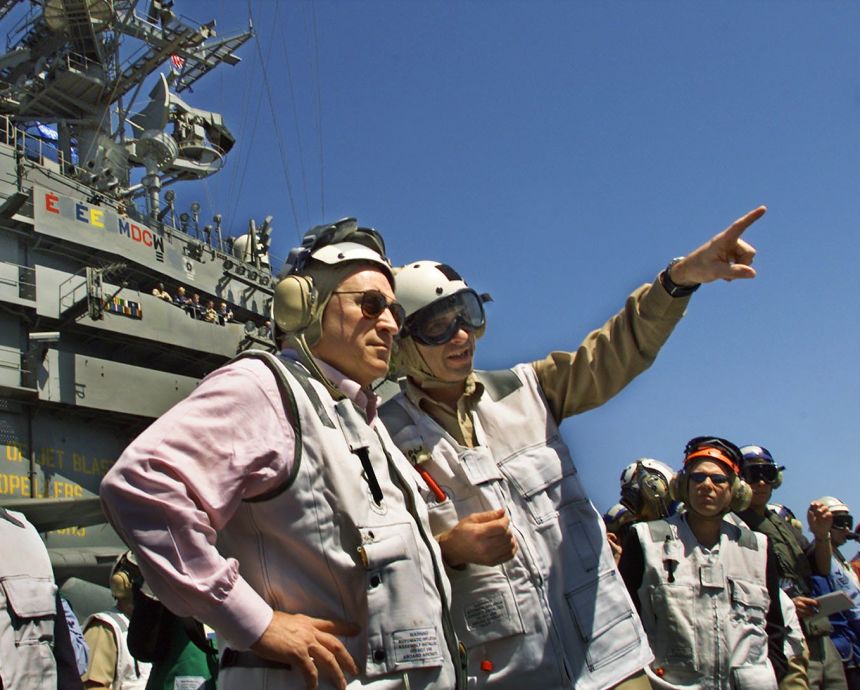
Cheney watches F-18 attack planes headed for Afghanistan catapult from the USS John C. Stennis in the Arabian Sea on March 15, 2002. J. Scott Applewhite/AP
The conflicts in Iraq and Afghanistan also led the US down a dark legal and moral path including “enhanced interrogations” of terror suspects that critics blasted as torture. But Cheney – who was at the center of every facet of the global war on terrorism – insisted methods like waterboarding were perfectly acceptable.Cheney was also an outspoken advocate for holding terror suspects without trial at Guantanamo Bay, Cuba – a practice that critics at home and abroad branded an affront to core American values.
No regrets
Cheney became a symbol of the excesses of the anti-terror campaigns and the fatally false premises and poor planning that turned the initially successful invasion of Iraq into a bloody quagmire. He left office reviled by Democrats and with an approval rating of 31%, according to the Pew Research Center.
To the end of his life, Cheney expressed no regrets, certain he had merely done what was necessary to respond to an unprecedented attack on the US mainland that killed nearly 2,800 people and led to nearly two decades of foreign wars that divided the nation and transformed its politics.
“I would do it again in a minute,” Cheney said, when confronted by a Senate Intelligence Committee report in 2014 that concluded enhanced interrogation methods as brutal and ineffective and responsible for damaging US standing in the eyes of the world.
Of the Iraq war, he told CNN in 2015: “It was the right thing to do then. I believed it then and I believe it now.”
‘He’s a coward’
Cheney’s aggressive anti-terror policies fit into a personal doctrine that justified extraordinary presidential powers with limited congressional oversight. That was in line with his belief that the authority of the executive branch had been mistakenly eroded in the aftermath of the Vietnam War and the Watergate scandal that led to the resignation of his first presidential boss, President Richard Nixon.
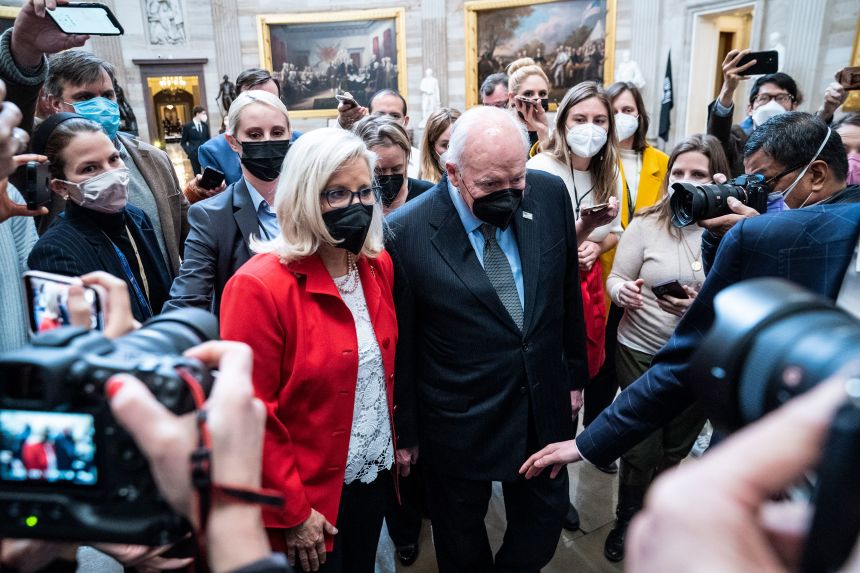
Cheney walks with his daughter Rep. Liz Cheney through the Capitol on January 6, 2022, the one year anniversary of the Capitol insurrection. Jabin Botsford/The Washington Post via Getty Images
Yet in his final years, Cheney emerged as a fierce critic of a man who had an even more expansive view of the powers of the presidency than he did – Trump. Cheney had supported Trump in 2016 despite his criticism of Bush-Cheney foreign policies and his transformation of the party of Reagan into a populist, nationalist GOP. But the ending of the president’s first term, when his refusal to accept his 2020 election defeat led to the January 6 insurrection, caused Cheney to speak out, in a rare, public manner.
The former vice president’s daughter, then-Wyoming Rep. Liz Cheney, meanwhile, sacrificed a promising career in the GOP to oppose Trump after his attempt to overturn the 2020 presidential election and the US Capitol insurrection on January 6, 2021. In an ad for his daughter’s unsuccessful campaign to fight off a pro-Trump candidate’s primary challenge in 2022, Dick Cheney – who was, by then, rarely seen in public – looked directly into the camera from under a wide brimmed cowboy hat and delivered an extraordinary direct message.
null
“In our nation’s 246-year history, there has never been an individual who is a greater threat to our republic than Donald Trump,” Cheney said.
“He is a coward. A real man wouldn’t lie to his supporters. He lost his election, and he lost big. I know it. He knows it, and deep down, I think most Republicans know.”
Early days out West
Richard Bruce Cheney was born January 30, 1941, in Lincoln, Nebraska. While living in the small mountain town of Casper, Wyoming, he met his high school sweetheart and future wife Lynne Vincent. Cheney was accepted to Yale University on a scholarship, but he struggled to fit in and maintain his grades. By his own admission, he was kicked out.
He returned West to work on power lines and was twice arrested for driving under the influence. In a turning point for Cheney, he was given an ultimatum from Lynne, who had “made it clear she wasn’t interested in marrying a lineman for the county,” he told The New Yorker. “I buckled down and applied myself. Decided it was time to make something of myself,” he told the magazine.
Cheney went back to school and earned a bachelor’s and master’s in political science from University of Wyoming. The couple was married in 1964.
Cheney is survived by Lynne, his daughters Liz and Mary Cheney and seven grandchildren.
A veteran Washington power broker
Cheney began honing his inside power game – at which he became a master – as an aide to Nixon.
He was later picked by Donald Rumsfeld as his deputy White House chief of staff under President Gerald Ford and then succeeded his mentor and close friend in the job in 1975 when Rumsfeld departed to become defense secretary. Cheney was instrumental in reviving their partnership in 2001 when he recalled Rumsfeld from the political wilderness to return to the Pentagon. The pair formed an extraordinary backroom alliance in the Bush administration throughout the war on terror and the Iraq war – much to the frustration of more moderate members of the administration including then-Secretary of State Colin Powell and National Security Adviser Condoleezza Rice – who took over from Powell in the second term.
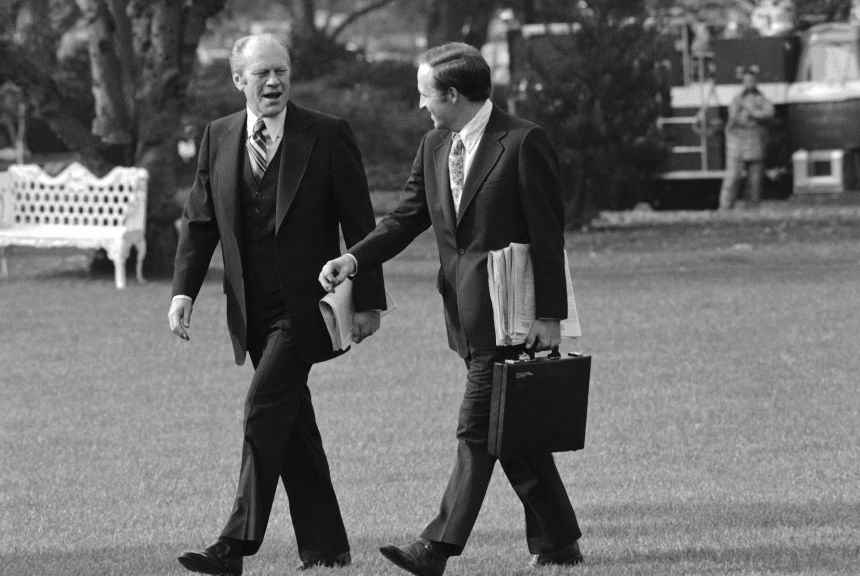
White House Chief of Staff Cheney chats with President Gerald Ford outside the White House as they walk to a helicopter in Washington, DC, on November 7, 1975. Bob Daugherty/AP
While Democratic President Jimmy Carter was in the White House, Cheney decided to run for Congress and was elected to Wyoming’s sole US House seat in 1978. Cheney served six terms, rising to become House minority whip, and racked up a very conservative voting record.
In 1989, President George H. W. Bush, who had served with Cheney in the Ford administration, tapped him to serve as his defense secretary, calling him a “trusted friend, adviser.” He was confirmed by the Senate in a 92-0 vote.
As Pentagon chief, Cheney showed considerable skill in directing the US invasion of Panama in 1989 and Operation Desert Storm in 1991 to push Iraq’s troops out of Kuwait. Following his stint as defense secretary, Cheney briefly explored a run for president in the 1996 election cycle but decided against it.
During Democrat Bill Clinton’s presidency, Cheney joined Dallas-based Halliburton Co. serving as its chief executive officer.
It wouldn’t be until the younger Bush decided to run for office that Cheney was chosen to lead the Republican candidate’s search for a running mate and, after initially turning down the job, ended up being added to the GOP ticket.
“During the process, I came to the conclusion that the selector was the best person to be selected,” Bush said in the 2020 CNN film “President in Waiting.”
Cheney brought a wealth of knowledge and experience to areas where critics complained Bush was weak. As a former Texas governor, Bush had no elected experience in Washington and little military and foreign policy background compared with Cheney.
Early in Bush’s presidency, Cheney led a task force to develop the administration’s energy policy and sought to keep its records secret in a fight that lasted Bush’s first term and went all the way to the US Supreme Court.
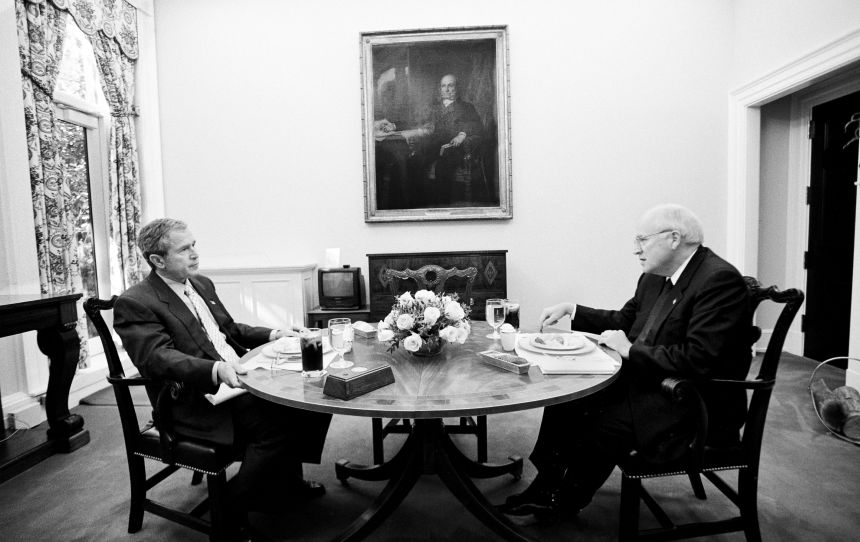
Bush and Cheney have their weekly lunch in a small dining room at the White House in October 2001. Brooks Kraft/Sygma via Getty Images
He was, however, at odds with Bush over the issue of same-sex marriage, saying that it should be left to the states to decide. In a 2004 town hall, he noted his daughter Mary’s sexual orientation reportedly for the first time publicly, according to The Washington Post. “With respect to the question of relationships, my general view is that freedom means freedom for everyone. People … ought to be free to enter into any kind of relationship they want to,” he said, the Post reported.
His relationship with Bush was complicated in later years, including by Bush’s refusal to pardon Cheney’s chief of staff Scooter Libby, who had been convicted of perjury and obstruction of justice in 2007 after a probe into who leaked the identity of a CIA operative. Libby was eventually pardoned by Trump in 2018.
In one of the most notorious moments in his personal life, which added to his grizzled legend in 2006, Cheney accidentally shot a hunting partner in the face with birdshot, causing relatively minor wounds.
Health issues
Cheney’s health issues began in 1978, when he had his first heart attack at age 37 while running for Congress. Three more followed in 1984, 1988 and November 2000, just a few days into the Florida presidential ballot recount that resulted in a Bush-Cheney win.
Cheney at the time said that he’d be the “the first to step down” if he learned he’d be unable to do the job and had a resignation letter in case he was deemed incapacitated. Cheney completed both terms under Bush, attending Barack Obama’s inauguration in January 2009 in a wheelchair.
A year after a fifth heart attack in 2010, Cheney received a heart pump that kept the organ running until his transplant in 2012.
Life after the White House
After leaving office, Cheney returned to private life, penning two memoirs — one about his personal and political career and the other about his struggles with heart disease as well as a book with his daughter, Liz. He became one of the most strident GOP critics of President Barack Obama, who had based his election campaign on promises to end the wars and other changes from what he called failed policies of the Bush-Cheney administration.
Years later, Cheney was decrying his own party — especially its leadership’s response to the attack on the Capitol — when he returned to the US Capitol with then-Rep. Liz Cheneyon the one-year anniversary of January 6, 2021.
“I am deeply disappointed at the failure of many members of my party to recognize the grave nature of the January 6 attacks and the ongoing threat to our nation,” he said in a statement.
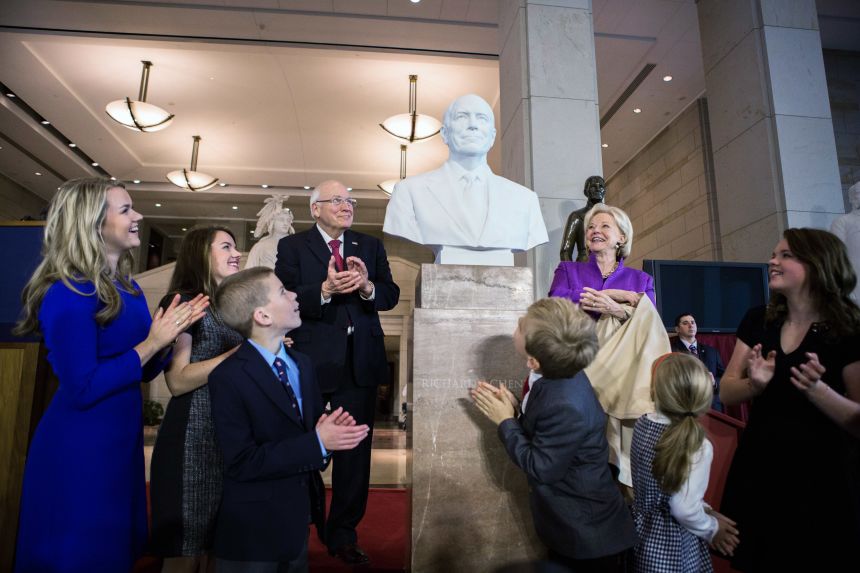
Cheney, alongside his wife and family, look at the bust of the former vice president after it was unveiled at Emancipation Hall inside the Capitol on December 3, 2015. Keith Lane/Getty Images
In a remarkable moment, Democrats lined up to greet the former Republican vice president and shake his hand. Former Democratic House Speaker Nancy Pelosi hugged Cheney. The former vice president slammed Republican leaders in Congress, saying they do not resemble the leaders he remembered from his time in the body.
It was a scene that would have been unthinkable two decades earlier and an illustration of how the extraordinary changes in American politics wrought by Trump had made former bitter political foes find common cause in the fight for democracy.
“It’s not leadership that resembles any of the folks I knew when I was here for 10 years,” Cheney said at the Capitol in 2022.
Cheney continued his criticism of Trump in the following years and went as far as to endorse then-Vice President Kamala Harris, a Democrat and Trump’s opponent in the 2024 presidential campaign. He said he would vote for Harris because of the “duty to put country above partisanship to defend our Constitution.” Cheney emphasized his disdain for Trump at the time and warned that he “can never be trusted with power again,” though Trump would go on to win the presidency a couple of months later.
CNN’s Jamie Gangel and Shania Shelton contributed to this report.
In 2025, there is no part of the world that is safe for Christians. Leftist prosecutors in Europe, Australia, Canada, and the United States criminalize fundamental tenets of the Christian faith as discriminatory forms of “hate speech.” Chinese communists replace images of Jesus Christ with portraits of Xi Jinping. Hindus beat and murder Christians in India. Islamic nations sentence Christian converts to death. Nigerian Muslims attack Christian churches during prayer services and torture and murder so many Christian worshipers as to constitute genocide. The assassin who murdered Christian martyr Charlie Kirk allegedly did so because he believes that Charlie’s Christian teachings were “hateful.”
It is a dangerous time to be a Christian. Michael Snyder wrote an illuminating article a couple weeks ago entitled “Most of the Population of the World Lives in a Nation Where Christians Are Being Persecuted.” In a sober analysis, he takes the reader on a tour of Christian persecution, torture, and mass slaughter around the planet.
Children in China are prohibited from attending Christian church services, and the Chinese Communist Party rewrites Bible verses to support official pronouncements from the State. Sharing the gospel online is a crime, and Christian pastors are regularly arrested and “disappeared.” In India, Hindu terrorists set Christian churches and Bibles on fire and beat up and murder Christian parishioners. Muslims in Indonesia hunt down Christians as if they were animals. Muslims in Nigeria have massacred or abducted a hundred thousand Christians over the last six years and have destroyed some 20,000 Christian churches and schools. Islamic governments in Pakistan, Afghanistan, and Iran discriminate against Christians, punish them ruthlessly for their beliefs, and execute anyone brave enough to convert to Christianity. In North Korea, Christianity is outlawed, and practicing Christians who are discovered are summarily executed or condemned to death in labor-intensive concentration camps.
The corporate news media do not report on the systematic persecution and killing of Christians around the world. On Friday, President Trump attempted to do journalists’ jobs for them by addressing the ongoing genocide of Christians in Nigeria. On Truth Social, the president wrote, “Christianity is facing an existential threat in Nigeria. Thousands of Christians are being killed. Radical Islamists are responsible for this mass slaughter. … The United States cannot stand by while such atrocities are happening in Nigeria, and numerous other Countries. We stand ready, willing, and able to save our Great Christian population around the World!” Nigerian Christians desperately hope that President Trump will find a way to save their brothers and sisters.
Muslims’ slaughter of Christians in Nigeria is so horrific that even left-leaning commentator Bill Maher describes it as a genocide much worse than anything that is happening in Gaza. “They are literally attempting to wipe out the Christian population of an entire country,” Maher told his studio audience a few weeks ago. “Where are the kids protesting this?”
The “kids” are nowhere to be found. Their college professors brainwashed them to see “systemic racism” everywhere it is not but to view Christians as “fascists,” “nationalists,” and even “Nazis.” Leftist billionaires and taxpayer-funded NGOs organize riots to “protest” Israel, “climate change,” duly elected conservative politicians, and “white supremacy.” Those same billionaires and NGOs are completely silent as Christians are massacred because, for many leftists, Christians are the “enemy.”
Western universities and institutions have discriminated against Christians for so many years that leftist lawmakers and leftist voters now openly endorse anti-Christian bigotry
A new California law mandating that foster parents “affirm a child’s self-identified sexual orientation or gender identity” effectively bans Christian couples from helping children in need. The state of California argues that Christians who object to the “trans” ideology are a “danger” to kids. In other words, only Californians who embrace chemical castration, bodily mutilation, the enabling of mental illness, hormone poisoning, and made-up pronouns are considered sufficiently stable to look after children. As Kevin Snider of the Pacific Justice Institute warns, “there is now a very small step for the state to deem any parent as unfit to raise [his] own children if the family holds a view that contradicts the state’s ideology on gender and sexual orientation. This could result in a visit by Child Protective Services with tragic consequences for the home.” California is coming for Christians’ children.
In Finland, government prosecutors continue to harass Christians for quoting the Bible. In 2019, Päivi Räsänen — a medical doctor, longtime member of Parliament, Finland’s former Interior minister, and the wife of a pastor — used a Bible verse to criticize Finland’s state church for sponsoring an LGBT “pride” parade. After the prominent Finnish Christian publicly stated that males and females are biologically different, police investigators interrogated her for some thirteen hours, forced her to justify her Christian worldview, and demanded that she publicly apologize and recant her Christian beliefs. Because she would not do so and instead defended the authority of God’s Word, she was criminally charged for illegal “hate speech.” Prosecutors have repeatedly asked Finnish courts to “wipe the internet” of Räsänen’s media appearances and writings, in which she has used her medical education and Christian faith to distinguish men from women and to promote the Bible’s moral teachings.
Although two lower courts have acquitted her, prosecutors have appealed and now argue before Finland’s Supreme Court that quoting the Bible should be considered a criminal offense under the country’s war crimes laws. One of Räsänen’s attorneys, Lorcán Price, argues that the outcome of the case will reverberate across Europe because it addresses directly whether a Christian can publicly express the tenets of Christianity. “Can you speak the truth as you see it freely, even if it might offend somebody, or will you be prosecuted for hate speech?”
However Finland’s Supreme Court decides, governments across Europe continue to persecute Christians and criminalize Christianity. In addressing the implications of Räsänen’s ordeal in Finland, The Federalist’s Joy Pullmann noted recently that citizens in the United Kingdom are regularly arrested for praying silently near abortion facilities, citizens of the Netherlands are arrested for publicly expressing a pro-life worldview, and the mayor of Brussels mobilized riot police last year to shut down a conference whose scheduled speakers recognize the scientific reality of two distinct biological sexes. Free speech, freedom of religion, and freedom of association are under sustained attack in Europe. Censorship and discrimination against Christians are pervasive.
If there is a silver lining to this global campaign of persecution against Christians, it is this: Lukewarm Christians and even non-Christians have begun to recognize that they cannot hide and hope for the best during the worldwide war against Christians. The battle between good and evil does not spare the cowardly, the weak-willed, or the naïve. Those who champion the toleration of sin or advocate for the acceptance of incompatible beliefs lay down a red carpet of moral relativism that invites evil to triumph.
One Christian pastor in Ohio, Michael Clary, wrote an essay in which he describes how Charlie Kirk’s assassination roused him from hypnotic conditioning to be “inoffensive” and made him realize that only bold defenses of the Christian faith can confront and defeat evil. Weak Christians not only invite sin into the world, but also invite greater persecution against Christians. What Charlie Kirk proved through his short time on Earth is that Christi,an courage and strength must be renewed. Or, as writer Michael Austin eloquently observes, “Christian leaders must pave the way in confronting the works of darkness with the gospel of light, without compromise or cowardice.”
Christ’s followers are suffering around the world. They are hunted, beaten, raped, burned, hanged, and slaughtered. The governments of formerly Christian countries insist on making Christ’s teachings a crime. Chinese, European, and American officials wish to censor the Bible. Christians must find faith and courage to face these evils now. Because much worse is sure to come.
Patriots, the storm has broken. For nine years, the Deep State cabal led by Barack Obama has slithered in the shadows, peddling their Russia hoax like a venomous serpent to poison the well of American democracy. But now, Director of National Intelligence Tulsi Gabbard has hurled the thunderbolt of truth, declassifying ironclad documents that lay bare the full scope of their betrayal.
This isn’t some dusty footnote in history. It’s a full frontal assault on the Republic, a treasonous conspiracy engineered to rip the presidency from Donald J. Trump’s grip and hand it back to the Clinton machine. The evidence screams: Obama, Brennan, Clapper, Comey, and Rice didn’t just meddle; they waged war on the voters who roared for Trump in 2016.
Flash back to that fateful December 9, 2016, in the bowels of the Obama White House. Fresh off Trump’s landslide — 306 electoral votes to Hillary’s whimpering 232 — the outgoing regime couldn’t stomach the people’s verdict. So they convened a war council: CIA spook John Brennan, DNI James Clapper, FBI boss James Comey, national security adviser Susan Rice, and a parade of other swamp creatures. Obama himself issued the kill order: Forge a new Intelligence Community Assessment (ICA) that flips the script. Pre-election intel? Crystal-clear — Russia lacked the chops or intent to hack votes or tilt the scales for Trump. But post-election? They twisted it into a fairy tale of Putin puppeteering the election to crown his American asset. The ICA, dropped like a dirty bomb on January 6, 2017, just days before Trump’s inauguration, declared with “high confidence” that Moscow had meddled to boost Trump. Lies, all of it — manufactured from the bogus Steele dossier, a Clinton-funded fever dream peddled by foreign hacks.
Gabbard’s declassification, starting with the July 18 bombshell and escalating through the HPSCI oversight report on July 23, rips the veil off this farce. These aren’t cherry-picked scraps – they’re over 100 pages of emails, memos, and whistleblower testimony proving the fix was in. Pre-ICA assessments from August and September 2016 flat-out stated foreign adversaries couldn’t “covertly overturn the vote outcome.” Clapper’s own talking points in December admitted no cyberattacks altered the election infrastructure. But Obama demanded a rewrite, and his henchmen delivered. They buried dissenting voices from the FBI and NSA, who pegged their confidence in Russian leaks at “low.” They laundered junk from the Steele dossier – unverified trash that even the ICA’s footnotes dismissed as “credible but uncorroborated” – to paint Trump as Putin’s pawn. This wasn’t intelligence; it was intel porn for the media lapdogs waiting to lap it up.
The fallout? A blitzkrieg on Trump’s America First agenda. That poisoned ICA ignited Crossfire Hurricane, the Mueller witch hunt, two sham impeachments, endless leaks, FBI raids on Mar-a-Lago, and a relentless barrage of smears that turned patriots into “insurrectionists.” It subverted every executive order, paralyzed appointments, and cost billions in taxpayer dollars chasing ghosts. Obama and his crew didn’t just undermine a president; they declared war on 63 million voters, shredding the sacred transfer of power to cling to their globalist throne.
The Constitution’s Article III doesn’t mince words: levying war against the United States or aiding its enemies. This cabal aided the enemy of democracy itself — its own unquenchable thirst for control.
Gabbard didn’t stop at exposure; she charged into the fray with criminal referrals straight to the DOJ, naming Obama, Brennan, Clapper, Comey, Rice, and their enablers like Andrew McCabe and Loretta Lynch. “No matter how powerful, every person involved must be investigated and prosecuted to the fullest extent of the law,” she thundered on July 18. By July 21, A.G. Pam Bondi had confirmed receipt, and whispers from FBI sources confirm probes into Brennan and Comey for perjury before Congress. A dedicated strike force is mobilizing, subpoena power locked and loaded. Justice isn’t whispering anymore.
The swamp’s predictable counterpunch? Whining from Democrats like Jim Himes, who branded it “baseless” rehashing, and fact-check mills like FactCheck.org and the AP sputtering that the docs “don’t disprove Russian interference.” Bull. Russia’s meddling was real but aimed at chaos, not crowning Trump. Early assessments proved it. The ICA’s fraud was in the targeted twist to delegitimize the vote, suppressing exculpatory intel to fuel the coup.
Obama himself dodged with a mealy-mouthed statement on July 22, claiming that it “doesn’t undercut” the hoax. Translation: We’re busted, but change the subject. Even Brennan, in a New Yorker snivel, admitted that Obama hushed pre-election intel to “ensure a fair vote” — code for letting the hoax ripen post-loss.
On X, the firestorm rages. Verified voices like Newsmax blast Gabbard’s interview: “It’s not difficult to determine Obama engaged in treasonous conspiracy.” Rasmussen polls echo the fury — voters smell blood. Trump himself torched Obama on Truth Social: “He’s guilty… This was treason, every word you can think of.” From @NEWSMAX to @TaraBull, the feed erupts with calls for handcuffs. “The dam is breaking,” thundered @JimFergusonUK. Even whistleblowers risk all, as Gabbard revealed on July 25, exposing how Clapper’s team doctored drafts to bury the truth.
This is our Rubicon, warriors. The Obama coup wasn’t a glitch; it was the Deep State’s blueprint for every subversion since: 2020’s steal, January 6’s frame-up, and the endless lawfare against Trump. But Gabbard’s blitz has cracked the fortress. Prosecutions will cascade like an avalanche, starting with Comey and Brennan for their perjury parade. Obama? Immunity be damned — history will judge him the architect of America’s darkest hour. Trump, unbreakable, stands taller: “It’s time to go after people.”
The Republic fights back. Demand the trials. Flood the streets with this truth. The cabal’s empire crumbles under the weight of its own forgery. Justice isn’t coming — it’s here. Lock them up, and let freedom thunder eternal.
…the fake news isn’t reporting on Operation Arctic Frost. It’s not that they’re trying to cover it up. . . but that they actually think it was totally normal and legitimate.” — Hans Mahncke.
Surely you’ve noticed in recent years just how gruesome the Halloween townscape has become with our competitive yard displays of giant skeletons, shrieking ghouls, corpses seeming to emerge from the crabgrass, and miscellaneous body parts strewn about the property. The symbolism seems pretty overt: America yearns to become a death cult.
The world has seen this before and it generally doesn’t end well. Something in their equivalent of the zeitgeist drove the Aztecs to sharply ramp-up the scale of their human sacrifices in the years just before Hernán Cortés came to their capital city, Tenochtitlán. Bernal Diaz, a foot-soldier in Cortés’s legion, later wrote:
“I remember that they had in a plaza, where there were some shrines, so many places of dead skulls, which could be counted, according to the concert as they were set, that when they appeared they would be more than one hundred thousand; and I say again about one hundred thousand. And in another part of the square were as many rows of bones without meat, bones of the dead, that could not be counted; and they had in many beams many heads hanging from one part to another. And keeping those bones and skulls were three priests, who, as we understood, were in charge of them. . . . “
Cortés had arrived in Mexico in April of 1519 with an expeditionary force of about 500 soldiers and by August of 1521, it was all over. He defeated the empire of a million Aztecs and commenced the systematic demolition of their monuments, including the horrifying great rack-of-skulls (tzompantli) where they displayed their thousands of trophies.
Something — more precisely, some cabal of somebodies — is attempting to systematically demolish the social scaffold of our country now. It can’t just be the Soros network of NGOs. The best we can do to identify the central animating agent is the Deep State or Blob, a malignancy within our own organs of national management. It’s shaping up as a kind of American Armageddon, a battle between the forces of darkness and light, death and life. The battle has been going on for at least ten years, since Mr. Trump invaded the body politic — rather like when Cortés entered Mexico and set off a chain of events that ended the cruel and despotic culture embedded there. We’re acting out something along those lines now.
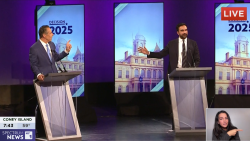
The death cult is vividly on display in our time and place. Minneapolis is poised to elect the skeletal-looking Somali Omar Fateh as its next mayor. The once-emblematic city of Garrison’s Keillor’s “above average,” relentlessly “nice” prairie folk was wrecked in 2020 in tribute to BLM’s patron saint, George Floyd, and has never recovered, written off as a national sacrifice zone for the sake of diversity, equity, and inclusion. Omar Fateh styles himself as a “Democratic Socialist.” This is the next new thing.
Likewise, New York City is about to elevate the Ugandan Marxist Jihadi (and self-styled Democratic Socialist) Zohran Mamdani into the top job at city hall. As usual with this brand of insurrectionists — that is, persons bent on destroying our society — the label is yet another language game meant to scramble your brain.
You have probably not failed to notice the incessant recital of the phrase “our democracy” by Democratic Party field marshals starting with “Joe Biden” in the final months of his, uh, late performance. “Our democracy” has nothing to do, really, with citizen participation in governance. The phrase is a cover for their desperate power-seeking — for instance, the “nomination” of Kamala Harris with zero democratic voting procedure — in the service of preserving a vast empire of rackets that siphon taxpayer dollars into multitudinous NGOs and countless government programs that provide jobs and free stuff to an ever-growing class of parasitic dependents in the party’s thrall.
So, the next ploy upcoming will be the sequel to the “No Kings” demos of recent months: “The Fall of the Trump Fascist Regime” mass protest event planned for Washington, DC, on November 5, following election day. The stated idea is to surround the White House with millions of shrieking “Resistance” warriors to exorcise President Trump. The unstated idea is to provoke the president to invoke the Insurrection Act and thus, supposedly, demonstrate that he is a tyrant to their satisfaction.
More likely, if things get out of hand and violence erupts, the Resistance warriors and their Antifa shock troops — sure to be on-hand — will only prove that they are the actual insurrectionists. In which case, this time, expect arrests and indictments of the folks behind the extravaganza, with the prospect of pretty harsh penalties. (Are you listening, Norm Eisen, Mary McCord, and friends?)
Meanwhile, the emerging scandal around the “Arctic Frost” scheme executed under “Joe Biden’s” DOJ to harass and persecute his admin’s political adversaries, takes shape as “worse than Watergate,” in the words of Senate Judiciary Committee chair Charles Grassley. Fresh evidence about this nefarious activity only reinforces the developing seditious conspiracy case that will be prosecuted out of the Southern District of Florida encompassing the entirety of treasonous acts from RussiaGate forward amounting to a long-running coup that never did manage to succeed, no matter how they keep at it.
You know the names of most of the major players involved, and ever more members of the supporting cast, lodged in the Deep State, are being revealed daily. Think of them when you see the ghouls and skeletons on display in America’s yards this Halloween eve.
Let’s say you paid top dollar to go to a fancy, five-star restaurant, and the waiter served you warmed-over McDonald’s. Would you ever go back?
Maybe, if you didn’t know any better.
I started thinking about that after I recently changed my residency from Virginia to California (for reasons I won’t go into) and noticed that my state income taxes had gone up by more than 33%.
Over the course of the year, I will pay California $2,115 more than I’d been paying in Virginia, which is hardly a low-tax state (Virginia has the 14th highest income tax burden in the country). Not only are income taxes higher, California’s sales tax is 66% higher, and the gasoline tax is almost double Virginia’s. Those are just the ones I know about.
So, I decided to look into what exactly I’m getting for the five-star cost of California’s government for basic services governments are expected to provide.
It’s infuriating. California is ripping off its taxpayers big time. Consider:
Crime: Despite having roughly the same number of police officers per capita, California has a “crime index” that is 47% higher than Virginia’s, and California has the sixth-highest rate of violent crime of all 50 states. Virginia has the 14th lowest.
Education: If you’re a teacher, California is a great place to live. They are the highest paid in the nation and have the fourth-lowest student-to-teacher ratio. But if you’re a parent? Your children are getting screwed. Eighth-grade reading, math, science, and writing scores are significantly below the national average, while Virginia’s are significantly higher. Virginia ranks 7 in average SAT scores, and California comes in 23rd.
Infrastructure: Despite having the nation’s highest gasoline taxes, California ranks in the bottom three when it comes to road conditions, with more than 25% of its roads in serious need of repair. In Virginia, just 9% of its roads are in poor shape.
Opportunity: How much economic opportunity are California’s sky-high taxes buying? None. The state ranks dead last in U.S. News and World Report’s “opportunity” ranking. And it ranks 47th in the Rich States, Poor States ranking of economic outlook.
It has the highest unemployment rate in the country at 5.5%, the most people on welfare, and the most homeless people.
It has the most progressive income tax yet is the fifth-worst state when it comes to income inequality. (Virginia comes in 29th on tax progressivity and 22nd on income inequality.)
It is the least affordable state for housing. Virginia is 35th.
Fiscal responsibility. Incredibly, despite the fact that California is one of the highest-tax states in the nation, it ranks No. 42 in U.S. News and World Report’s ranking for fiscal stability.
And it’s getting worse as out-of-control costs and the flight of hundreds of thousands out of the state have left yawning budget gaps. A new Reason Foundation study finds that California is almost half a trillion dollars in debt, which is more than twice New York’s. (Virginia is $35 billion in debt.)
And then there is the criminal amount of waste and fraud.
Gov. Gavin Newsom spent $37 billion to fight homelessness only to see the number of homeless climb from 151,000 in 2019 to about 187,000 today—prompting a federal criminal investigation.
The state’s Medicaid spending nearly doubled in six years, and almost one-half of that was due to free health care given to illegal immigrants.
The state lost $20 billion in COVID-19-related federal unemployment money—the most of any state.
In 2014, California voters overwhelmingly approved a $7.5 billion water bond proposal, nearly $3 billion of which was set aside to build new reservoirs. More than a decade later, not a single new reservoir has been built.
In 2018, former Gov. Jerry Brown signed a $1 billion bill that was supposed to improve land management to “prevent catastrophic wildfires and protect Californians.” In 2019, Newsom’s wildfire “strike force” said, “Over the next five years, the state will commit over $1 billion for critical fuel-reduction projects to support prescribed fire crews, forest thinning, and other forest health projects.”
Apparently, that money was completely wasted, as anyone looking at the burned-out Palisades and Altadena neighborhoods can attest.
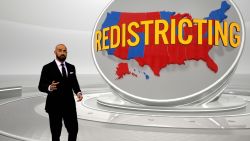
And just this year, the state decided to dump $282 million it doesn’t have for a special election to gerrymander its congressional districts—a completely pointless exercise that will disenfranchise California voters and have no impact on the control of Congress. And then it spent another $2 million to correct a typo in its original voter guide.
So, the question I have for every Californian is: “What is wrong with you? Why do you put up with this? Why are you content to let California be a one-party state?”
Most of your leaders should be in jail, not winning reelection.
It’s true that over the past four years, more than a million more people moved out of the state than moved in. But what about those who can’t or don’t want to leave?
Why do you keep electing the same class of criminals to steal your money?
I think part of the problem is that Californians don’t know how badly they’re getting screwed, because, while everyone knows which restaurants are worth the price, it’s not easy for average citizens to make direct comparisons between life in one state and another.
I can leave the state just as easily as I came. But most can’t pick up and move. Nor should they have to. California is a beautiful state with enormous potential. Its citizens just need to refuse to pay Wolfgang Puck prices for Hamburglar-quality service.
When Democrats today say they want to “save democracy,” conservatives often counter that the United States is not a democracy but a republic. Both sides are right in their own way—but they’re talking about two very different visions of government.
When Democrats use the phrase “save democracy,” they mean it quite literally: rule by the majority. In that system, whoever gets the most votes wins, and the will of the majority is considered the highest form of legitimacy. This especially applies to the presidency, where Democrats argue that whoever wins the most votes nationwide should occupy the Oval Office. To them, anything else—like the Electoral College—is unfair, outdated, or anti-democratic.
But the Founding Fathers rejected that very idea. They had seen what pure democracy produced in other nations, including in England’s parliamentary system, where a temporary majority could seize control and rule without restraint. They saw that the passions of the moment could sweep away the rights of the few, and that policy would swing wildly with every shift in public mood.
The Founders admired some parts of the British system—its respect for law, its experience with limited monarchy—but they also saw its instability. In Parliament, the majority is the government, and once it has power, there are few checks to stop it. The rights of citizens exist only as long as the majority allows them. To the Founders, that was too fragile a foundation for liberty.
They built something different: a republic. A system where the people still govern, but through layers of representation, separation of powers, and constitutional limits. It was designed to slow things down, to force deliberation, and to prevent fleeting majorities from remaking the nation in a moment of passion.
The Electoral College, the Senate, and the division of powers between states and the federal government all serve this purpose. They make sure that every region and every class of citizens has a voice, not just the biggest population centers. Without those safeguards, states like California and New York would decide every election, and the smaller states might as well not exist.
So when Democrats say they want to save “democracy,” they mean majority rule. When conservatives insist on preserving the “republic,” they mean constitutional balance—the system that protects everyone, not just the loudest or largest group at any given time.
The Founders didn’t reject democracy because they disliked freedom. They rejected it because they understood human nature: that passion and power need restraint, and that liberty endures only when even the minority has rights that the majority cannot touch.





















 THE ARTFUL DILETTANTE