Trump’s Executive Order Has Election Officials Terrified

Don’t believe the hype about the Supreme Court ending Trump’s effort to clean up mail-in ballots. He’s got every bureaucrat nervous and careful—and you can help.

If you read media headlines about the Supreme Court’s September 14, 2026, ruling on the Post Office’s handling of mail-in ballots, it’s easy to think the Supreme Court completely stopped Trump’s effort to secure our national elections.

Pundits, activists, and state officials claimed total victory. They pointed to federal district court injunctions issued by Judges Indira Talwani and Carl Nichols, arguing that because the Supreme Court didn’t lift those stays, Executive Order 14399 is permanently dismantled. They want you to believe federal oversight was turned back, leaving local election practices completely untouched for the midterm cycle.

Don’t buy it.

To understand why this mainstream narrative is wrong, let’s look beyond the media hype to legal history and statutory text.

On March 31, 2026, the administration issued EO 14399 to enforce citizenship verification and administrative integrity in federal elections. The U.S. Postal Service finalized regulations requiring uniform envelope designs, standardized Intelligent Mail barcodes, and mandatory state voter-list uploads to a centralized Federal Ballot Mail Portal. The order instructed USPS to hold or return ballot envelopes that lacked proper tracking or failed verification.

Using the Postal Service to stop mailing ballots to dead addresses, vacant lots, and unverified locations was a brilliant idea that eliminates potential fraud before it starts.

A coalition of Democrat attorneys general and election officials sued, arguing that Article I, Section 4 of the Constitution gives states—not federal agencies—authority over election rules.

The press immediately touted this as a shattering defeat for election integrity. But focusing strictly on whether a postal worker scans a barcode misses the true power of Executive Order 14399. Key provisions remain untouched.

The biggest impact from EO 14399 wasn’t at a post office but on the personal risk calculation of every local official and poll worker handling our ballots.

For decades, a major vulnerability in election administration was the lack of direct personal accountability. Loose local practices, informal rule-shaving, and gray-area procedures were routinely accepted. If a local worker accepted noncompliant ballots, ignored statutory deadlines, or skipped signature-verification protocols, the worst they faced was a polite warning or a routine post-election review.

That dynamic is over.

Buried beneath headlines about postal stays is the core enforcement framework established in Sections 1 and 3 of the order, which explicitly instructs the Department of Justice to prioritize direct criminal investigations and prosecutions of state and local officials who issue federal ballots to ineligible individuals or violate election laws.

What does this mean? Suppose an election administrator mails absentee ballots to deceased voters or to addresses known to be vacant or invalid. In the past, officials hid behind “poor list maintenance” or “administrative backlog.” Now, if the DOJ proves an official knowingly violated election rules, that official faces severe federal criminal statutes:

  • 18 U.S.C. 241 (Conspiracy Against Rights): A federal felony statute making it a crime for two or more people to conspire to injure, threaten, or intimidate any person in the free exercise of a constitutional right—including diluting valid votes with bad ballots.
  • 18 U.S.C. 1341 (Mail Fraud): A federal statute carrying heavy prison time for using the U.S. Mail system to execute any scheme to defraud.
  • 52 U.S.C. 20511 (Criminal Penalties for Voter Fraud): Explicit federal penalties for anyone—including election officials—who knowingly procures, submits, or tabulates materially false or fraudulent ballots.

When a local bureaucrat realizes that turning a blind eye to procedural violations no longer results in a slap on the wrist but instead brings personal legal fees, a federal investigation, and potential prison time, the incentive structure flips. The bureaucrat’s approach changes from “what can we get away with?” to “we’d better follow every statute strictly by the book.” This creates a self-policing mechanism at the lowest levels of administration, where decisions are made.

Federal court stays can temporarily pause specific operational mandates imposed on postal workers, but no district judge can grant local election workers or election boards immunity for breaking federal criminal law.

The emergency Supreme Court stay is a temporary procedural hold for the current election cycle. It continues the status quo while full appeals proceed through the federal judicial system. SCOTUS hasn’t issued a final ruling on the constitutional merits of the Postal Service regulations.

Most importantly, this stay applies narrowly to Postal Service operational rules—such as portal uploads and barcode-scanning requirements. The broader executive enforcement framework, including federal criminal oversight under Title 18, remains fully active and operational.

Take back your votes! If you spot election rules being broken, notice local irregularities, or witness staff ignoring statutory mandates, you can take direct action:

  • Document Everything Clearly: Record exact dates, times, precinct locations, and names of officials involved. Keep precise written notes and preserve any physical evidence.
  • Notify Local and State Authorities: Report procedural violations directly to your county board of elections or your state election division. For verified guidance on finding local contacts, refer to the National Association of State Election Directors.
  • Report Potential Crimes to Federal Law Enforcement: When statutory violations occur—such as deliberate mailing of ballots to known fake addresses—report them directly to federal authorities:
    • Federal Bureau of Investigation (FBI): Call 1-800-CALL-FBI (1-800-225-5324) or submit details online via FBI Tips.
    • DOJ Civil Rights Division: Report direct voting rights violations or intimidation to the U.S. Department of Justice Voting Section at 1-800-253-3931.
    • U.S. Attorney’s Office: Contact the designated Election Day Coordinator at your local district’s U.S. Attorney’s Office.

It’s easy to get discouraged reading headlines claiming court after court is striking down election integrity measures. But when you look past media framing and examine the actual mechanics of law and human behavior, the truth is clear.

The postal barcode rule was a strong operational concept, but it was always secondary. The real heart of Executive Order 14399 was re-establishing the rule of law and personal accountability for the people running elections.

That accountability framework hasn’t been struck down. It’s active, potent, and changing the behavior of election officials right now. When the people handling your ballot know they’re personally accountable to federal law, game-playing stops—and every lawful, legitimate vote gets the protection it deserves.

Election integrity isn’t dead; it’s alive and well. Your vote will count, and election officials are on notice to follow the law or else. Share this article with your friends and bring five of them with you to the ballot box on November 3.
Javier Milei shreds ‘useless’ UN to its face in fiery speech to ‘fatally arrogant parasites’

Argentina’s libertarian President Javier Milei struck again, this time in a fiery speech to the United Nations General Assembly in New York, calling the body “useless” and made up of “fatally arrogant parasites.”

Milei began by commending the U.N.’s founding mission of resolving conflict peacefully and promoting universal freedom and dignity as “noble words.” However, he went on to say that “today, regrettably, it is time to acknowledge that, in practice, that sacred covenant has been broken.”

“That’s to say, it has become a useless organization whose only purpose is to sustain a caste of fatally arrogant parasites masquerading as well-intentioned bureaucrats,” he charged.

To make his case, he pointed to the U.N.’s role in restrictions during the COVID-19 pandemic, which he called a type of “genocide,” and the “gender agenda, environmental extremism and unchecked immigration.”

Milei said, “During the pandemic, bodies under the auspices of this house put themselves before scientific evidence and the sovereignty of nations and promoted forced lockdown policies throughout the world.

“Where some allege a public health policy error, we see a global experiment in social control disguised as science. And when a state wearing public health blinkers deprives its population of the right to work, to receive an education and to bid farewell to their dead, this results in millions of avoidable deaths; there is a word for it, genocide.”

He charged that “every time [the U.N.] failed, rather than reviewing the model or apologizing, they doubled down.”

“Those who were supposed to guarantee collective security and human rights failed in their task. They allowed chaos, violence and international terrorism to flourish,” he said.

“The alleged defenders of human rights have sheltered bloodthirsty dictatorships and regimes that stone women in the streets; they have systematically voted against Israel.

Peter Pineto, Fox News

Mao Zedong Was A Monster

The 50th anniversary of the death of Mao Zedong has just passed. (He died on September 9, 1976.). I did not see large amounts of commentary about Mao on the occasion of the anniversary, but everything that I did see was either neutral or positive, with the majority being praise. And as I looked around for any commentary I could find from around the date of the anniversary, most of what I found is again praise.

How could that be? This man was a monster. Certainly, the death toll for which Mao was responsible was a large multiple of anything ever attributed to Hitler, and also a multiple (although a smaller one) of the carnage committed by Stalin. Does any self-respecting person give effusive praise of either of those two? And if not to them, then why to Mao? And it’s not just the death toll. Mao’s frankly ignorant and stupid extreme Marxist economic “theories,” if you want to call them that, caused decades of abject poverty, needless suffering and misery and often starvation for hundreds of millions of Chinese. And then there was the ruthless suppression of dissent (or even the slightest disagreement), which obstructed all efforts to introduce any sanity to counter the economic destruction. I can’t even think of a coherent defense for what Mao did to China and its people.

So let’s see what we can find in the press on the occasion of the anniversary of this man’s death.

The South China Morning Post had a piece on September 9 with the headline “Young Chinese turn to Mao Zedong for life advice, 50 years after his death.” (SCMP, based in Hong Kong, is owned by the Alibaba Group, and has no official relationship with the Chinese Communist Party. However, their independence in today’s Hong Kong is highly dubious.). Excerpts:

When you are denied a pay rise, when you feel anxious about your children’s education, or when you are alienated by colleagues, Chairman Mao can help. At least, that is what China’s online influencers and their hundreds of thousands of followers believe. Wednesday marks the 50th anniversary of the death of Mao Zedong, founding father of the People’s Republic of China.

SCMP notes that there was no official celebration in China of the anniversary of Mao’s death, but that Mao’s popularity is on the rise, with the clear encouragement of the state:

[I]t is hard to ignore the quiet comeback of Mao’s popularity in the country. In recent years, younger generations of Chinese have rediscovered Mao as their life coach. They organise online book clubs devoted to his works, spread the gospel through artificial intelligence-narrated videos, and affectionately refer to him as jiaoyuan, or “teacher”, a title Mao himself once said he preferred. . . . [M]uch of this youthful sentiment aligns with China’s official narrative about Mao as a symbol of national independence.

Here from the SCMP is a picture of two young men taking selfies with a large portrait of Mao:

And from the (Hong Kong) Standard on the same date, we have “’Long live Chairman Mao’: Supporters pay respects to founder of Communist China.” (Like the SCMP, the Standard is a theoretically-independent Hong Kong based outlet that somehow does not deviate from the CCP line.). Excerpt:

Fifty years after his death, diehard fans of the Chinese Communist leader Mao Zedong lined up Wednesday in his hometown to pay homage, holding portraits, flags and huge floral tributes. Chairman Mao’s . . . life and legacy [were] being commemorated fervently this week by those who still revere him as a visionary leader. . . . The night before, around 1,000 ardent admirers — some in the short, tunic-style suits famously worn by Mao — held an emotional ceremony at the statue. . . . “Long live Chairman Mao!” the group roared repeatedly, some pumping their fists in the air and singing revolutionary songs.

Here in the U.S., the press mostly stayed silent on Mao — even as the lesser murderer Hitler is mentioned in the news almost every day. But there is one influencer with a large following who is closely allied with the Democratic Socialists of America and with their current Congressional candidates, and who makes a point of frequently praising Chinese Socialism and by extension Mao. That’s Hasan Piker. Piker has recently made several favorable remarks about Mao (not explicitly tied to the anniversary of his death). The Washington Examiner had a summary on September 18, with the headline “Hasan Piker defends praise of Mao despite millions of deaths under his rule.” Excerpt:

The popular left-wing streamer previously said he would “never criticize” Mao and called him “one of the great leaders of this world,” comments Piker told the outlet were partly made in jest after a brief encounter with police while visiting Tiananmen Square in Beijing. But Piker stood by his broader assessment of Mao’s reign when asked whether he considered the communist revolutionary a great leader. “When I say Mao is a great leader, I mean he’s a great man of history,” Piker said. Piker conceded that there was an “excess” of deaths under Mao, which he attributed to being “born out of mismanagement and famine.”

“Mismanagement and famine.” A few mistakes were made! No Hasan, the famines (multiple over the course of decades), not to mention millions of murders by execution, were not mistakes, but fully intentional.

As I have previously mentioned, I am currently reading Frank Dikötter’s trilogy about Mao’s takeover and rule in China. There are hundreds of excerpts to choose from, but I’ll provide a few.

From The Tragedy of Liberation, pages 58-59, describing what happened in Shanghai and other major cities after the Communist takeover in 1949:

{C]adres vented their hatred in consultation meetings with representatives of trade and industry that degenerated into “struggle sessions” where people were mocked, humiliated and beaten. Soon nobody dared say a word. . . . Within a matter of months, bustling Shanghai was a dying city. Tianjin slipped into slow decay. Guangzhou almost went bankrupt. Factories were idle, trade ceased. Many firms, small and big alike, were driven into the red.

In 1951-52, there was a campaign of terror against the “bourgeoisie.” From page 171:

In the orgy of false accusations and arbitrary denunciations, few escaped with their reputations intact. By February [1952], no more than 10,000 of a total 50,000 “capitalists” in Beijing were considered honest. Similar figures came from other parts of the country. To punish all would wreck the economy. Mao had a solution to this conundrum. He came up with a quota, ordering that a few should be killed to set the tone, while exemplary punishment should focus on 5 per cent of the most “reactionary” suspects. Across most cities, by a rough rule of thumb, about 1 per cent of the accused were shot, a further 1 per cent sent to labour camps for life, and 2 to 5 per cent imprisoned for terms of ten years or more.

The longer things continued, the more the category of “enemies of the Party” expanded. From page 189:

[T]eachers, doctors, engineers and scientists suspected of possessing “counter-revolutionary” links with foreign powers were persecuted. Luo Ruiqing, who now pitched in as head of security, brought the inquisition to bear upon 85,000 teachers in middle schools. One in ten was purged as a deviant element who sabotaged socialism, plotted against the party or encouraged student unrest. In primary schools the number was double. In total, across the country, over a million people were forced to confront accusations of plotting against the state in 1955. . . .

And all this is before we even get to the Great Leap Forward (1958-62) or the Cultural Revolution (1966-76), where Mao and his henchmen cranked up the terror and caused intentional mass famines and racked up really big numbers of starvations and murders in the tens of millions.

The current rulers of China are the successors of Mao, and go around spouting his doctrines as if there is something admirable about them. They seem to have moved on from a mass-murder state to a mass-surveillance state, and at least so far that seems to be working to keep the population suppressed. We’ll see how long that can continue.

Anyway, I didn’t want to let this anniversary of Mao’s death pass without expressing my total revulsion at this man, his successors, and anybody who expresses admiration for them.

Francis Menton, Manhattan Contrarian

EXCLUSIVE: Talarico’s Pastor Says Jesus Didn’t Die For Sins, Slanders Virgin Mary

A lesbian minister at James Talarico’s longtime church doubts Jesus ever existed, rejects the virgin birth, and believes Christ “didn’t die to save our sins,” according to undercover footage obtained by The Daily Wire.

Rev. Babs Miller, minister to the parish at St. Andrew’s Presbyterian Church in Austin, flatly rejected core tenets of the Christian faith, even as fellow congregant James Talarico, the Democratic Senate nominee, routinely invokes his fringe view of the Gospel to appeal to voters in the Bible Belt’s largest state.

Speaking to an undercover journalist, Miller was caught saying she believes the virgin birth was made up while describing her approach to religion as similar to a 12-step program: “Take what you want and leave the rest.”

“Mary and the Virgin Birth comes out of the pagan belief that the gods came down and impregnated people,” Miller told the undercover journalist. “We have no way of knowing if Jesus really existed any more than we have of knowing that the original Buddha ever existed. And whether or not Jesus existed doesn’t really matter to me.”

But among mainstream historians, there is near-universal agreement that Jesus of Nazareth existed and was a historical figure, regardless of whether those scholars are Christian, Jewish, agnostic, atheist, or otherwise. Within decades of His lifetime, Jewish and Roman historians mentioned Jesus, providing independent evidence for aspects of the New Testament’s account of His life and crucifixion, according to history.com.

“It could have all been made up, for all I know,” Miller said in the footage. “The God in the Old Testament is not a loving God; it’s a vengeful, killing-people kind of God. This is a lot of mythology.”

Historians almost universally agree that Jesus was a real person who walked the earth around 2,000 years ago. Eric Meyers, an archaeologist and emeritus professor of Judaic studies at Duke University, said: “I don’t know any mainstream scholar who doubts the historicity of Jesus.”

“The details have been debated for centuries, but no one who is serious doubts that he’s a historical figure,” Meyers told National Geographic.

Miller’s church bio says she has been part of the St. Andrew’s community since the mid-1990s and was ordained there in 2014 as an “out” lesbian chaplain. She retired shortly before the COVID pandemic but returned in 2022.

Biblical teachings, archaeological evidence, and scholarly accounts aren’t enough for the leftist minister, who cloaks herself in the faith while also dismissing the central New Testament teaching that Jesus died on the cross to save humanity from sin, telling the undercover journalist: “He didn’t die to save our sins.”

“Jesus was political. Jesus was put on that cross not to save us. Jesus was put on that cross because Rome hated him and they thought he was a threat to their domination of that area. So they killed him. He didn’t die to save our sins,” she argued, framing Jesus as a social justice martyr rather than the biblical teaching of Him being the “Savior of the world.”

“That makes a whole lot more sense to me than to say that some God would kill his son for us. That doesn’t make sense. How does that make up for all the things I can do? No, it doesn’t.”

Talarico has been part of the Austin religious community since he was a toddler. The congregation’s longtime pastor, Rev. Jim Rigby, baptized Talarico, who has called Rigby “one of the biggest influences on me as a Christian, as a human being.” In a Christmas Day Facebook post from 2015, Rigby suggested that Jesus’ resurrection could actually be understood as “a poem about the whole life process.”

“Apparently, because I don’t believe in a literal resurrection, I’m not really Christian. This unfortunately also means I won’t be going to heaven with many of you,” he said.

St. Andrew’s is part of the Presbyterian Church (USA), a denomination known for its liberal positions on gender and sexuality. There, the Texas Democrat has delivered controversial sermons, declaring that “God is not a Christian” and that “our trans community needs abortion care too.”

Miller’s comments come as scrutiny grows over the theological views of Talarico’s home church and their potential impact on his campaign in a state where evangelicals, who polls show are most opposed to Talarico, make up the largest religious group. Last week, The Daily Wire revealed Miller saying Talarico’s shift toward the political center was merely for show, predicting the Democrat — who is racing to moderate his positions on transgender issues and walk back his declaration that “God is non-binary” — would return to his previous rhetoric once elected.

“He’s getting some advice that I don’t think he should be following,” Miller said in the viral clip. “I can guarantee you that once he gets elected, he’ll change his tune back to where he was.”

The Daily Wire reached out to Talarico’s campaign and St. Andrew’s Presbyterian Church for comment but did not receive a response by publication time.

Jacob Wheeler, Daily Wire

Mitch McConnell falls down stairs outside of Senate chamber

Former Republican Senate leader Mitch McConnell on Wednesday slipped on the stairs outside of the upper chamber, after confirming Scott Turner to lead the Department of Housing and Urban Development.

McConnell, who led the Republican conference in the upper chamber from 2007 to 2025, appeared to fall as he was headed to a GOP lunch meeting in the Mansfield Room. Some senators told The Hill that he also fell during the lunch.

The latest incident comes after the 82-year-old Kentucky senator fell in December, following a lunch meeting held by Senate Majority Whip John Barrasso.

McConnell has not publicly commented on the incident so far. But he was escorted to his old Capitol Building office by his aides and security after the meeting, and was later spotted being pushed through the Capitol in a wheelchair, per The Hill.

Misty Severi, Just the News

DNC Chair Secretly Addressed Chinese Communist Party Conference

At the conference, a CCP official urged America to drop the “enemy narrative” about China.

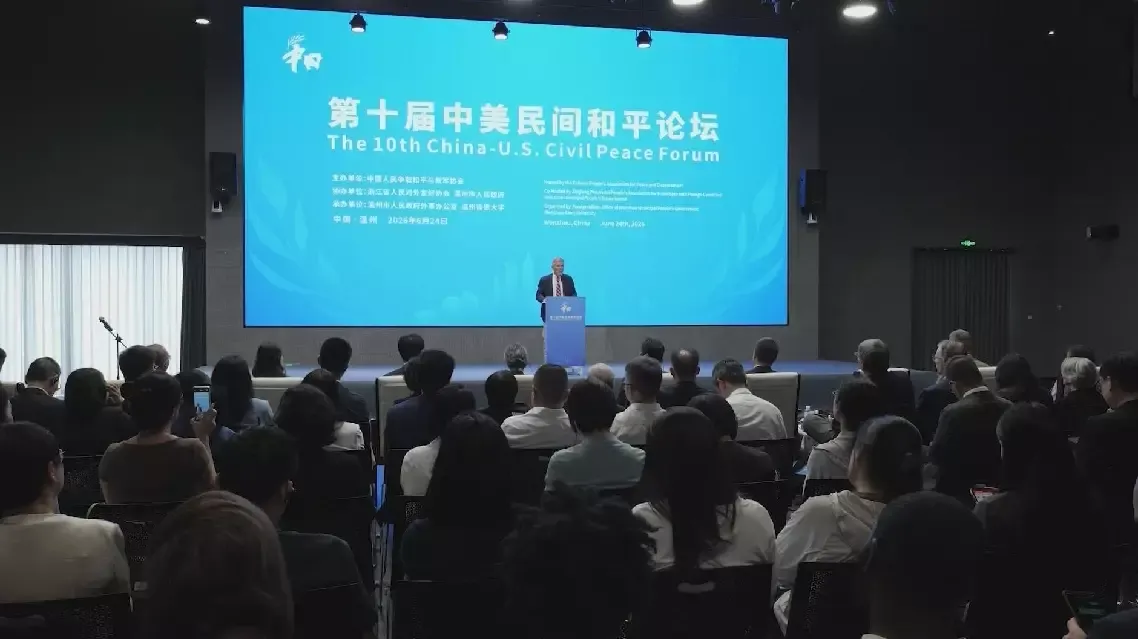
DNC Chairman Emeritus Howard Dean delivered the American welcome address at a China dialogue involving the China Institutes of Contemporary International Relations, a think tank identified in congressional commission testimony as “run by Chinese intelligence.”

The Chinese People’s Association for Peace and Disarmament, which co-organized the event⁠, has an equally explicit allegiance. Its charter⁠ says it:

“upholds the comprehensive leadership of the Chinese Communist Party.”According to the American organizer’s account⁠, Dean delivered his welcome virtually on June 23, 2026. The meeting took place in Wenzhou, China. Lu Kang, a vice minister of the CCP’s International Department, delivered the keynote.

Dean, a former Vermont governor and presidential candidate, was named DNC chairman emeritus in 2009⁠.

The think tank at the dialogue, known as CICIR, was specifically named by China intelligence specialist Peter Mattis in 2016 testimony to the U.S.-China Economic and Security Review Commission⁠. He described it among:

“think tanks run by Chinese intelligence.”

The peace association, known as CPAPD, says it jointly organized the event with the American Arsenault Family Foundation.

The association’s commitment to CCP leadership is written into its governing rules. Its charter requires it to establish a Communist Party organization, conduct Party activities, and provide the conditions necessary for those activities.

And the Party official speaking at Dean’s event had a message for the Americans.

According to the CCP International Department’s readout⁠, Lu urged participants to:

“move beyond the ‘enemy narrative’”

He also called on them to:

“foster a correct strategic perception”

The CCP then portrayed American participants as ready to translate the strategic-stability framework announced after the Trump-Xi summit into:

“practical and feasible policy measures”

The following day brought another forum organized by the same Chinese association. The American delegation’s opening speakers included⁠ Center for American Progress senior fellow David Rank and foundation leader Marcel Arsenault, who spoke by video.

Lu again made public perceptions a priority. He blamed “cognitive biases and groundless suspicions” for obstructing relations and urged exchanges that would:

“guide the peoples of both countries to objectively view each other’s development achievements”

Natalie Winters

Nathan Hale Gave His Life for America. 250 Years Later, We Should Remember Why

At noon on September 22, a small ceremony will take place at the foot of a bronze statue in Manhattan’s City Hall Park. A color guard will stand at attention, a wreath will be laid and most New Yorkers walking by probably will not notice.

They should.

The statue is of Nathan Hale, one of America’s first spies. Two hundred and fifty years ago, the British hanged him. He was 21 years old.

Hale hardly seemed destined for spy work. He was a Yale graduate, class of 1773, and a schoolteacher from Coventry, Connecticut – tall, fair and, by contemporary accounts, somewhat guileless.

After the battles of Lexington and Concord in April 1775, Hale joined a Connecticut regiment. In the summer of 1776, he served with Knowlton’s Rangers, an elite reconnaissance unit organized under George Washington after the American defeat on Long Island.

Washington desperately needed intelligence about British troop strength and positions in New York. He asked for a volunteer to go behind enemy lines.

Hale was the only one to step forward. Friends tried to dissuade him, but he insisted on going. In mid-September 1776, disguised as a schoolmaster, he crossed Long Island Sound and entered British-held territory. He gathered information about troop deployments and fortifications, but within days his mission unraveled.

According to one account, British Maj. Robert Rogers, commander of the Queen’s Rangers, became suspicious of Hale, pretended to share his Patriot sympathies and induced him to reveal himself. Hale was arrested and brought before British Gen. William Howe.

There was no trial; A spy caught behind enemy lines and out of uniform faced execution.

The following morning, September 22, Hale was taken to the British artillery park, believed to have been near what is now Third Avenue and East 66th Street. He asked for a Bible and a clergyman. Both requests were denied.

British officer Frederick Mackenzie later recorded that Hale “behaved with great composure and resolution,” saying that he believed it was the duty of every good officer to obey the orders of his commander-in-chief and urging those around him to be prepared to meet death whenever it came.

The British orderly book was more clinical: “A spy from the enemy (by his own full confession) apprehended last night, was this day executed at 11 o’clock in front of the Artillery Park.” Far better known are the words generations of Americans have associated with Hale: “I only regret that I have but one life to lose for my country.”

Whether that was his final utterance is uncertain. The sentiment closely resembles a passage from Joseph Addison’s “Cato,” a play Hale and many of his generation knew well, and the famous formulation was recorded later rather than at the scene.

Whatever his precise words, Hale went to the gallows with remarkable calm and courage. Accounts say his body was left hanging as a warning before being buried in an unmarked grave whose location remains unknown.

When he went to the gallows, American independence was barely two months old. Washington’s army had been driven from Long Island, New York had fallen to the British and there was no guarantee that the new nation would survive. Hale gave his life not for a victorious country, but for the possibility of one.

Hale did not command an army or draft a founding document. His intelligence mission failed. But the Revolution depended on more than the famous men whose portraits now hang in museums and government buildings.

It depended on thousands of Americans – soldiers, farmers, sailors, tradesmen and, in Hale’s case, a young schoolteacher – who were willing to risk everything to secure the independence their leaders had declared.

As America marks 250 years of independence, it is worth remembering that the words of the Declaration meant little unless Americans were willing to fight and die for them.

More than a century after Hale’s death, the Sons of the Revolution gave New York the statue that now stands in City Hall Park. Its location is fitting. The young Connecticut schoolteacher faces City Hall in a town that was once under British military occupation, a reminder that the freedom New Yorkers take for granted came at a heavy price.

Nathan Hale had only one life. At 21, with his country’s future hanging in the balance, he was willing to give it. Two hundred and fifty years later, America should honor and remember that.

Michael Freund is a Visiting Fellow at The Heritage Foundation and a columnist for The Daily Signal.

The Roots of Liberty

People write in and ask me: “How can it be liberating to identify your contradictions? It’s painful!”

In all honesty, this is the same as asking: “Why is it better to face reality? I’d rather live outside of reality, because reality can be unpleasant.”

This makes no sense at all. Not if reality is what it is, independent of what you think, assume, want, wish or desire. The way I look at it, reality is going to be what it is no matter what your mind says. Rather than fighting or ignoring the truth, it’s better to face the truth … and then work within that context. That’s what I mean by “liberating.” If you’re constantly fighting reality, then you’re unable to focus on what’s actually possible and feasible. Instead, you’re trying to do the impossible, wasting precious time and energy that could be spent on pursuing the possible instead.

Notice how psychological coping implies a particular metaphysical view of existence. You either accept the philosophical premise that reality is what it is, or you don’t. My psychological recommendations would be very different if I held a different philosophical view. If my philosophical view was that reality can be whatever your consciousness constructs it to be, then I wouldn’t be advising you the way that I am.

None of this is to discourage innovation or creativity, either. But even innovation or creativity has to be rational. I call this “working within the system.” The “system” here refers to any facts you cannot change, at least not at this point in time. You have to separate what you can change from what you cannot, and focus only on what you can change — assuming that interests you, and that it’s connected to some particular goal or purpose you have.

Wishful thinking is a means of escaping reality. This leads to emotional problems commonly known as depression or anxiety. Depression or anxiety are false beliefs, based on faulty premises — one of which is almost always the false belief that wishing can make it so. Trying to control what you cannot control will lead to a sense of futility or “learned helplessness” in some people — the definition of depression. In other people, it will lead to a sense of danger or foreboding — the definition of anxiety. People take pills and pursue therapy for these things, but that will only be a band aid at best until or unless the underlying view is identified and corrected: One’s underlying philosophical view.

Psychology is thought to be theory-neutral, or philosophy-neutral. This isn’t possible. By definition, a therapist is helping a person based upon a certain point-of-view. One therapist will say, “Whatever you feel is right.” Another therapist will say, “I know what’s right — just listen to me.” Still another will say, “Let’s examine the facts. The facts prove that this is the right course of action, the one that will bring you what you want. Do you see any other facts to contradict this?” This last is the method of reason and logic. It’s this method from which so many are trying to escape. A good therapist challenges you, but in a supportive way. “Let’s figure out what the truth is, together.”

When you try to escape from logic and thinking, you’re trying to escape your nature as a rational creature. To say man is a “rational creature” is not to imply that he will inevitably do rational things. It implies that man must reason and think if he’s going to survive, flourish, and be happy. Attempts to escape your nature are attempts to escape your humanity. Most will claim that the essence of humanity are your emotions. But what are emotions? Emotions are the product of thought. And thoughts can be wonderful or downright rotten, logical or completely off base. Hatred, hostility and bitterness are emotions. Do these emotions imply mental health? I don’t think so. It’s the content of your emotions that’s relevant, and the content of your emotions are the thoughts and ideas implied by them. To understand your emotions, you must understand what you think.

Embrace reality, and all the good or bad that goes with it. It’s the only liberation and freedom there is.

Michael J. Hurd, Daily Dose of Reason

Making Your Own Decisions … Imagine That!

I’ve written before about how aging parents can sometimes become manipulative; appearing to be more “helpless” than they actually are. Interestingly, reader responses were 100% in agreement, but many questioned how to tactfully approach the issue.

Well, sometimes it’s all in how you say it. For example, “Why are you sitting there all day? You can get around! Take a walk and do something for yourself!” As opposed to, “You say you want to be more social. Why not spend a little time at the Cheer Center and meet some new people? It might be fun.” The first one sounds kind of insulting. The second one? Not quite so bad.

When you bluntly tell somebody what to do, you’re implying that they don’t have a mind of their own. This not only applies to adults, but also to kids — especially teenagers. Lecturing or ordering a teenager around isn’t going to work. You have to invoke facts and explain the consequences if he doesn’t do what you ask. If those consequences are important enough to him, you’ll usually get his cooperation.

Interestingly, research from the Department of Psychology at the University of Memphis suggests that lecturing to students in large classroom settings is not the most effective method of instruction. Findings indicate that whenever students are actively engaged in their learning, i.e., experiencing the consequences first-hand, they learn better and faster. This makes sense, because people don’t learn unless they are applying their minds to the facts.

Lecturing has its place for a motivated audience, but it’s not the way to approach personal or business relationships. Of course there are exceptions: When you hire an expert to fix your car, build your house, or perform surgery, you want someone who’s in charge and knows what he/she is doing. But even then, it’s valuable to have things explained to you. In fact, one of the biggest complaints that I hear about some doctors is that they don’t take the time to explain what they’re doing. Even an expert should have a method of reasoning that a non-expert can understand. No matter how accomplished they may be, no one is above showing respect and consideration.

There will always be those who have a need to tell others what to do. These authoritarian personalities have an inflated sense of their own importance and the role they play in the lives of others. Sadly, more than a few of these types end up in positions of power, but many more show up in the personal lives of everyday individuals. The authoritarian is more than just a “control freak.” Control freaks are driven by an anxiety to get things done “right” – for better or worse. The authoritarian, however, believes that people are incompetent, and that he or she must take over for them. When a compulsive authoritarian and a depressed, dependent person find one other, the resulting combination can be sicker than either of the two alone.

None of us knows everything, but we’re all able to think. Needing to be told what to do stems from a mistrust in your ability to think things out. When you’re confident in that ability, you recognize your capacity to investigate and form responsible conclusions on your own. You can then make your own decisions based on your best judgment. All the talk of self-esteem really boils down to this: A belief in your ability to figure out what’s going on around you and to take responsibility for making judgments about it.

Healthy people look around the world and form conclusions carefully and objectively. As a result, they have no desire to tell others what to do. They know that it just doesn’t work.

Michael J. Hurd, Life’s a Beach