An Election Between Love and Hate

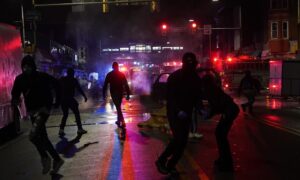
Why are President Trump’s rallies packed while Biden’s rallies are deserted? Where were all the Democrats who joined in the Black Lives Matter riots, who packed the streets of D.C. for the Women’s March, who are wailing in front of the Supreme Court and burning down Portland?

The Democrats aren’t campaigning for Joe Biden, but against Donald J. Trump.

The Biden-Harris ticket is a placeholder, two candidates picked by Wall Street and Hollywood, by corporate donors looking for the best angle, bringing together a friend of segregationists and the woman who accused him of racism, and then negotiated with the party’s socialist wing to split the difference between the prospective administration’s crony capitalism and socialism.

Nobody’s going to a rally for that.

The 2020 election can be boiled down to love against hate. It pits MAGA against the 1619 Project, those who love this country against those who want to destroy it. At Republican rallies, American flags are waved, at Democrat riots flags, churches, and shops are burned. The active part of the Democrat base won’t show up to a Biden rally because they won’t be allowed to destroy things, and because they’re not animated by the positive, but by the negative.

The Left’s radical change agenda isn’t born out of idealism, but cynicism. To get to the point where it can gather in mobs, topple statues, and tear down the United States, its followers have to believe that this country is fundamentally evil. Critical race theory is so popular because, like the more conventional Marxism before it, it resonates with what the mobs already believe.

Inside all the theories, articles, and plans to remake society is a great emptiness. The members of the mob are moved more by what they oppose than what they support. They can articulate hatred of the police, but not a serious proposal to replace them, they rage against America, but when they erect their CHAZ and CHOP replacements, they boil down into anarchy and violence.

All the plans to build a better world are only sanctimonious pretexts for destroying this one.

Biden isn’t really on the ticket. The destruction of America is the only candidate that the Democrats can put up anymore. When that candidate viscerally embodies the destruction, as only Biden’s boss ever truly did, then the rallies take off and the crowds faint at his word. But when, like Biden, the candidate is a Potemkin village putting up a facade of normalcy for the destroyers, then the crowds stay home, tweet furiously, or knock over a convenience store.

What enrages the radical mob isn’t oppression or injustice. That’s just what they call normalcy, stability, or any attempt to preserve the United States, a neighborhood, or a corner store.

They’re not voting for Biden. Or for anything. They’re not capable of being for things, only against them. The only thing their principles ever amount to is self-righteous outrage.

This election will test if their hate is stronger than the love Americans have for their nation.

Do Americans want to preserve their nation or destroy it in a furious tantrum while insisting that with their superior moral sensibilities they can build something better out of the rubble. The 1619 Project, critical race theory, the cancellation of everyone from Christopher Columbus to George Washington to Abraham Lincoln is an expression of profound disgust and contempt for America.

Make America Great Again is an expression of love for what America was and can be again.

MAGA rallies are filled with bright colors, while the mobs rampaging through American cities wear black. The clashing iconographies of red, white, and blue flags, and black power fists, starkly convey the choice between light and darkness, life and death, and love and hate.

Can hate drive more people to the polls than love? Is the lust to destroy more powerful than the drive to create? That’s the true question on the ballot.

This election isn’t just about the candidates. It’s about us.

The Democrats, like the rest of their leftist brethren, are at their most impassioned when they are running against something they truly hate. Each notable burst of political derangement aimed at a Republican, whether it was Nixon, Reagan, Bush, or Trump, led to an outpouring of ideological ferment, tactical innovation, explosive violence, and artistic creativity. When they lack an object for their hatred, then they recede into political mediocrity and impotent fuming.

The Left is at its best when it is also at its worst. It derives its sense of purpose and meaning not from within, but from hating its enemies. When it has purged all its enemies, its regimes decline into a state of mediocre misery until the great utopian system rots and falls. When there is nothing to fight against, no wars to make or lives to take, it is swallowed up by its emptiness.

Republicans are at their best when they sense an opportunity for national rebirth. Their high points, and there have been few, come when they sense that a sleeping giant is awakening. And then the scattered members of the silent majority who lack the organization and ideological consolidation of their enemies, rise with the tide, ready to rebuild the nation’s greatness.

Republicans and Democrats both need Trump for very different reasons. The Left needs him because it needs someone to hate. Its raptures of hatred inspire it to new extremes. The rage that animates it at the presence of someone like President Trump makes it feel truly alive.

The Left needs to destroy President Trump, but it also needs him to give it a sense of meaning.

And it is in the nature of the Left to destroy those things which give it meaning. Its drive to destroy Trump, like its drive to destroy America, is a manic obsession. After four years, it has the opportunity to truly live out its death wish because it is not only out to destroy America. Deep down, the Left also wants to destroy itself. Its ideologies have always been suicide notes. The sum total of them, from anti-capitalism to environmentalism to critical race theory to degenderization, is a compelling argument for why nothing should be allowed to exist.

Or, as David Benatar, the anti-natalist philosopher and author of Better Never to Have Been: The Harm of Coming into Existence, wrote, “Although it is obviously too late to prevent our own existence, it is not too late to prevent the existence of future possible people.”

That is what is at stake in this election. To call this hate understates the case. The other side of utopia is despair. If the world can’t be perfected, and it can’t, it must be destroyed. And since no amount of perfection can overcome the rage and unhappiness behind the feigned idealism, all the utopian deconstruction of what is eventually ends in barren lands and mass graves.

That is the dark heart that MAGA is running against. It asks Americans not to hope, but to build.

As the days of the calendar take us toward Election Day, a nation must decide between love and hate. Democrats will strive to win an election on the empty dregs of hate. They are running on nothing but antipathy, to President Trump and to America. Republicans must remember that they are not only running against something, but that they are running for their country.

America has had its dark hours, but it rose, grew, and thrived because our drive to build was stronger than our drive to destroy. That is why we came out of every war, no matter how devastating, stronger than ever as long as we believed in the future. When the time came that we no longer believed, even the lightest wars became hopeless affairs we couldn’t recover from.

The Democrats are still caught in that hopeless hate. They have nothing to love. The past is evil. History is a morass of crimes. The nation was stolen through genocide and built on slavery. Every historical hero is soon exposed as a monster. And the future holds more of the same.

The oceans are rising. Global warming will soon turn the parts of the world that aren’t underwater into desert. Mankind and all life on the planet is on the verge of extinction. And human greed is to blame. Wouldn’t it be better if the human race does indeed disappear?

Republicans have a nation and a storied history to love. The heroes of the nation are at their backs. And the future is one of promise or plenty, not misery and extinction. All they have to do is claim it. Hate is strong, but love, when it taps into the wellsprings of nationhood, family, and faith, is far stronger. Rage is powerful, but hollow. It is no match for the great love of a nation.

Daniel Greenfield

The Welfare State Neutralizes Opponents by Making Them Dependent on Government

From time immemorial—from Etienne de la Boitie to David Hume to Ludwig von Mises—political analysts have noted that because the number of those in the ruling elite amounts to only a small fraction of the number in the ruled masses, every regime lives or dies in accordance with “public opinion.” Unless the mass of the people, no matter how objectively abused and plundered they may appear to be, believe that the existing rulers are legitimate, the masses will not tolerate the regime’s continuation in power. Nor need they tolerate it, because they greatly outnumber the rulers, and hence whenever they become subjectively fed up, they have the power—which is to say, the overwhelming advantage of superior numbers—to oust the regime. Even if the regime possesses a great advantage of coercive power, its employment avails the rulers nothing if they must kill or imprison 90 percent of the population, because such massive violence would reduce them to the status of parasites without hosts.

This consideration long seemed to make sense as a critical element of political analysis, and even today one often encounters it. Something akin to it seems to motivate the current Occupy Wall Street movement and its spin-offs in other venues when they represent themselves as members of the (exploited) 99 percent, in opposition to the (exploiting) 1 percent.

Certain long-established trends in the welfare state, however, have progressively weakened the force of this analysis. The main element of these trends is the tremendous growth in the number of people (and in their proportion in the population) who are directly dependent on government benefits to a substantial degree. Researchers at the Heritage Foundation have been tracking this development for several years and have pushed their analysis back for several decades. An index of dependency based on this research increases from 19 in fiscal year 1962 to 272 in fiscal year 2009.

The Heritage index uses information on almost three dozen important federal programs on which Americans depend for cash income and other support—including housing assistance, Medicaid, Medicare, Social Security, unemployment insurance benefits, educational benefits, and farm-income supports—but it is scarcely a comprehensive measure, inasmuch as the total number of federal programs with dependents is gigantic at present. Of course, each such program has government employees and contractors who run it and hence depend on it to earn much, if not all, of their income. Government civilian and military retirees add millions more to the ranks.

The Heritage researchers found that in 1962, 21.7 million persons depended on the programs they included in their index for benefits. By 2009, the corresponding number of dependents had grown to 64.3 million. Adding dependents not included in the Heritage study might easily increase the number to more than 100 million, or to more than a third of the entire population. Thus, the parasites verge ever closer to outnumbering their hosts.

It would be a mistake, of course, to lump all of these dependents into the ruling (exploiting) class. The elderly recipients of old-age pensions, the recipients of unemployment insurance benefits, and the beneficiaries of temporary assistance for needy families are, as a rule, as far from the ruling class as one can get. However, to the extent that those who depend on government programs for substantial parts of their income enter the calculus of ruling and being ruled, they are likely to become, in effect, cyphers. They have approximately zero influence on the real rulers, yet they exert virtually no weight in opposition to those rulers, either. Fear of losing their government benefits effectively neutralizes them in regard to opposing the regime on whose seeming beneficence they rely for significant elements of their real income. Of course, for whatever voting may be worth, they vote directly or indirectly in overwhelming proportion for the continuation and budgetary enlargement of the government programs on which they depend. Hence, they help to produce seeming legitimacy for those at the top of the ruling hierarchy—a token of their appreciation for the crumbs their political masters drop on them.

As the ranks of those dependent on the welfare state continue to grow, the need for the rulers to pay attention to the ruled population diminishes. The masters know full well that the sheep will not bolt the enclosure in which the shepherds are making it possible for them to survive. Every person who becomes dependent on the state simultaneously becomes one less person who might act in some way to oppose the existing regime. Thus have modern governments gone greatly beyond the bread and circuses with which the Roman Caesars purchased the common people’s allegiance. In these circumstances, it is hardly surprising that the only changes that occur in the makeup of the ruling elite resemble a shuffling of the occupants in the first-class cabins of a luxury liner. Never mind that this liner is the economic and moral equivalent of the Titanic and that its ultimate fate is no more propitious than was that of the “unsinkable” ship that went to the bottom a century ago.

ROBERT HIGGS is Retired Senior Fellow in Political Economy, Founding Editor and former Editor at Large of The Independent Review.

Three Strategies for Dismantling Digital Totalitarianism in America

If Americans want to protect the free flow and exchange of ideas and dismantle digital totalitarianism in our country, we must act now.

In our divided nation, there is a rare consensus from both the left and the right: some of our technology companies have become too powerful. They know too much about us, and we know too little of their inner workings.

They know where we are, where we are going, what we are doing, and some can even listen to what we are talking about. They control what information to distribute, how fast, and to whom. They dictate that we see, read, and think in the ways they deem suitable.

The more we use their services, the more control they have over us, and the less likely we are to escape their manipulation. In other words: big tech companies are imposing digital totalitarianism on us, and we must take action to dismantle this tyranny and set ourselves free.

1. Breaking Up Big Tech First, the U.S. government should break up tech companies that have near-monopoly power. For example, Google controls more than 90 percent of the U.S. search market. About 85 percent of smartphones worldwide run on Google’s Android operating system. Google also collects one in every three dollars spent on digital advertising.

Google maintains that it achieves such domination due to the superiority of its products. An antitrust lawsuit filed by the Department of Justice last week, however, alleges that Google engages in anti-competitive practices to achieve and maintain its near-monopoly, such as paying billions of dollars to “distributors like mobile-phone makers, wireless carriers and web browsers to make Google their default search engine.” These exclusionary contracts have made it next to impossible for smaller competitors to gain any meaningful market share.

Moreover, Google uses its market dominance to serve as the world’s biggest censor. According to professor and researcher Robert Epstein, Google maintains at least 10 blacklists it uses to block websites, individuals, and even words. Robert wrote, “When Google’s employees or algorithms decide to block our access to information about a news item, political candidate or business, opinions and votes can shift, reputations can be ruined and businesses can crash and burn.”

Perhaps because the majority of people at Google lean left, it appears that conservatives are more likely to be censored than liberals by Google. Dennis Prager, whose educational Prager University videos get 1 billion views a year through YouTube, complains that YouTube, a subsidiary of Google, “has at various times placed about 100 of our videos on its restricted list.”

Some of the restricted Prager University videos include “Why Don’t Feminists Fight for Muslim Women?” by Somali-American activist Ayaan Hirsi Ali and “Are the Police Racist?” by the Manhattan Institute’s Heather Mac Donald. Prager believes the only reason these videos are restricted because they represent conservative viewpoints.

Prager University sued Google for violating its First Amendment rights, but a judge in California ruled in Google’s favor, stating “private companies like YouTube and its parent company Google are not bound by the First Amendment.” If an influential organization like the Prager University can’t hold Google accountable for its censorship, what recourse do ordinary consumers have?

Using another browser likely would not alleviate this issue either. According to Epstein, major browsers such as Safari and Firefox “check Google’s quarantine list before they send you to a website. Chrome, Android, Firefox, and Safari currently carry about 92 percent of all browser traffic in the United States — 74 percent worldwide — and these numbers are increasing.” This means that a site blocked by Google will have no means to survive because it is likely blocked by other major browsers, too.

Since there is practically no escape from Google’s control in the current setting, breaking it up is the only way to foster competition, empower consumer choices, and preserve the free exchange of ideas necessary to sustain a constitutional republic. CNBC’s Jim Creamer said breaking up Google will bring more value to the company’s shareholders because the sum of parts is worth more than the company’s current valuation as a whole. Breaking up Google seems to be a win-win for all.

2. Re-evaluate Section 230 Immunity The second action we should take is for the U.S. Congress to make big tech firms earn their Section 230 immunity. In the early days of the internet, U.S. Congress enacted the Communications Decency Act as part of the Telecommunications Act of 1996, to protect children from access to sexually explicit materials on the internet.

Section 230 of CDA states, “No provider or user of an interactive computer service shall be treated as the publisher or speaker of any information provided by another information content provider.” This language provides internet companies the protection they need: they can moderate indecent content on their platform without being classified as publishers because publishers are liable for the content they publish and can be sued for libel.

There is no doubt that the shield of Section 230 has fostered the incredible growth of Google, Facebook, Twitter, and other such companies. Today, they are the most powerful media companies in the world. Yet they continue to argue they shouldn’t be treated like publishers because they do not hire journalists to report and write about the news. This argument doesn’t hold water.

Companies like Facebook and Twitter do not need to hire journalists because millions — even billions — of global users write and report news, create content, and share information on these sites for free. While these internet companies do not have to pay for their content, they do hire armies of editors or what they call content moderators to review content, decide which content will be blocked, which will be allowed to distribute, and how fast and how wide the distribution will be.

The influence of these companies isn’t limited to the cyber world, either. What’s trending on these platforms and the ideological tone set by a small group of influencers on these platforms have an outsized impact on what’s reported in legacy media.

According to Pew Research, only one in five Americans use Twitter and only 10 percent of Twitter users are responsible for 80 percent of the tweets. In her resignation letter, former New York Times opinion page editor Bari Weiss wrote, “Twitter has become its [NYT] ultimate editor,” so much so that “stories are chosen and told in a way to satisfy the narrowest of audiences…history itself is one more ephemeral thing molded to fit the needs of a predetermined narrative.”

These internet companies may compete against each other for market share and number of users, but they often work together to censor ideas they do not agree with while reinforcing the same ideology across their platforms. For instance, when Twitter prevented The New York Post and its readers from sharing the Post’s story of Hunter Biden’s emails, Facebook intentionally “slowed” the distribution of the same story; left-leaning media took the cue and didn’t cover the story either. The combined effect is that countless American voters were deprived of the opportunity of reading the Post’s story and making an independent judgment about either the credibility of the story or the presidential candidate involved.

Missouri Sen. Josh Hawley concludes: “With Section 230, tech companies get a sweetheart deal that no other industry enjoys: complete exemption from traditional publisher liability in exchange for providing a forum free of political censorship… But big tech has failed to hold up its end of the bargain.”

To solve this problem, Hawley introduced an Ending Internet Censorship bill, which will let small to medium-sized internet firms continue to enjoy immunity. But large internet firms will have to earn Section 230 immunity by proving their algorithms and content removal practices are “politically neutral” to auditors at the Federal Trade Commission every two years. This bill provides the most practical and least harmful way to address political censorship by big tech, without repealing Section 230. The bill has generated bipartisan support. It’s time for Congress to move forward with it.

3. Insist On Openness From Tech Companies Last but not least, we should demand transparency from these companies. If Twitter and companies alike say they must block a post for violating their standards, they should at least be transparent about what standards they adhere to. Andy Kessler of The Wall Street Journal wrote, “Each banning action, like removing doctors’ Covid advice from YouTube, must come with a specific explanation, else leave the post up.”

An especially chilling example is the way Merriam-Webster rushed to change its entry on “sexual preference,” labeling it “offensive” right after Sen. Mazie Hirono, D-Hawaii, accused Judge Amy Coney Barrett of being “anti-LGBTQ” for saying it during her Supreme Court confirmation hearings. Before this exchange, people from both the left and the right used this term widely because no one deemed it “offensive.”

Merriam-Webster didn’t explain why they made the change and didn’t timestamp when they made it. Six months or a year from now, most people will forget about this incident. When current and future generations search for the definition of “sexual preference,” they will assume that the word has always been “offensive” because Merriam-Webster says so. The power and speed Merriam-Webster possesses to change minds should send chills down the spine of any freedom-loving person.

In his brilliant book “1984,” George Orwell warned us that this is how totalitarianism imposes mind control on people: by falsifying records and rewriting history. “If all records told the same tale — then the lie passed into history and became truth” and “whoever controls the past controls the present and whoever controls the present controls the future.”

In the Merriam-Webster case, one way to add some transparency in the future is to require the site to always include time and date when a change is made, and an explanation of why the change is made, next to the word so future readers will have a clear understanding.

Time is running out. If Americans want to protect the free flow and exchange of ideas and dismantle digital totalitarianism in our country, we must act now.

Helen Raleigh, The Federalist

The Landslide Victory We’ll be Glad to Have

An election prediction: Something has broken over the nation in the past couple weeks. And that’s a good thing.

Official White House Photo/Andrea Hanks

President Donald J. Trump and First Lady Melania Trump greet trick-or-treaters during the 2020 White House Halloween event Sunday, Oct. 25, 2020, at the South Portico of the White House.

Seems only yesterday, there were widespread fears we were headed for election night and post-election chaos. That it’d be the 2000 post-election pandemonium times 50. That tension was at such a fever pitch, we could pretty much guarantee violence in the streets.

In a bitterly contested, confused election, the social media giants would suppress any information favoring Trump as “disinformation,” and boost any news that demonstrated a Biden win. America wouldn’t know who was elected for weeks, maybe months. Maybe the House of Representatives was going to have to settle the issue. Certainly, battles from many states would land on the Supreme Court’s doorstep.

It would take the military to get Trump out of the White House. “Civil war” was on many lips.

Either that, or Joe Biden was going to coast to victory. As promised, his Antifa-BLM army would behave (for a few months). Those who opposed the socialist/totalitarian plans laid out by the radicals and former Clinton Labor Secretary Robert Reich would just have to suck it up, and prepare for the re-education camps and religious persecution.

Right now, Nate Silver’s 538 puts Biden’s chances at about 86%. Most polls still show Biden winning. GOP pollster Frank Luntz says if Trump wins, the polling industry is finished.

What do I know? I know that no matter what happens, God is in control. What do I sense? Things are going to be much better than we imagined. And by “we,” I mean all loyal Americans, Democrat or Republican.

With one week to go until Election Day, I now believe Donald Trump will be re-elected with such a resounding victory, there will be no serious disputing. Only the radicals and nutjobs will take to the street, and even those who have disdain for Trump will accept defeat.

And our attention will turn to having a warm holiday with those we love.

The Little Signs

Oh, I could point to little signs. Like Trump building a lead in Florida. Or even The New York Times reporting that Trump is polling about 10 points better in Philadelphia than he did in 2016, which would all but guarantee him a win in Pennsylvania. Or his stunning rise among Blacks and Latinos.

I could point to more Trump supporters showing up at Biden rallies than Biden supporters, or wild Trump car rallies in places where having a GOP sticker on your car used to guarantee your car getting keyed. I could point to the enthusiasm gap, which is massive.

Or Kamala Harris blowing her big audition, voters understanding she is the real candidate in this election, and going, “No, thank you!” Or the common sense observation that few people will stand in line for hours just to vote against Trump.

America is a Chuck Berry riff, not Russian literature.

I could point to the fact that Donald Trump is actually out there working to earn votes while Biden is, well, barely trying.

Or that Biden thinks he’s running for Senate and running against George Bush … or George Lopez … or George Jetson. George someone.

I could point to that, but no, I am talking about a sense. A feeling in my bones that a spirit of division and rancor is being broken. That something’s changed in recent weeks. Almost overnight.

I started feeling it when Trump beat COVID, and was bounding out with renewed energy and hope, expressing thanks to “The Boss” … aka God … for help. He took to dancing at the end of his rallies. The spirit of death and defeat and worry from COVID seems to have weakened.

The spirit of rebellion, while still existing in the form of the media, social media giants, and Democratic leaders, seems to have dissipated. I mean, even after the death of RGB, and the nomination and confirmation of Amy Coney Barrett, doesn’t it seem the anger merchants are just going through the motions?

America is a Sunny Country

I sense America is tired of fighting. Tired of lockdowns. Tired of being enslaved to a virus. Really tired of manipulation. Tired of hypocrisy. Tired of re-fighting 2016 every day.

And tired of not being able to sing at church. We want to sing or watch a choir sing … or watch our kids get married with a large circle of friends and family on hand.

The call to hope is being heard. The positivity of things like Trump boat and car parades, is more infectious than COVID. Who doesn’t want to step out of the Biden circles and party?Please Support The Stream: Equipping Christians to Think Clearly About the Political, Economic and Moral Issues of Our Day.

It’s like, “The heck with your ‘Dark Winter,’ talk. Yeah, there may still be pain in the night, but joy comes in the morning.”

America is a sunrise nation. Not a sunset nation. We’re sunny country, not a solemn country. We know the “sun will come out tomorrow.” We “keep on the sunny side of life.” Things seem stormy? No problem. We’ve got “sunshine on a cloudy day.”

America is a Chuck Berry riff, not Russian literature.

Hope Built Into Our DNA

The American breed has hope built into our DNA. Nobody comes here without heart and hope and chutzbah to take on the unknown. Take on adversity. Those huddled masses yearning to breathe free may have been tired, they may have been poor. But they were rich with courage and optimism, and they’ve passed it down to us.

That is why I think in one week, America will choose to step up rather than hunker down. Choose to join the parade, rather sit and sulk. Choose dancing to “YMCA” to bowing before COVID-19.

I believe Donald Trump will win with a broad coalition, including Blacks and Latinos in record numbers for a Republican. He will win the popular vote by millions. In the electoral college, he will win even where he’s not expected to.

And here’s the strangest part of my prediction. To their shock, some Democrats will feel less bad about it than they expected. They know Biden is not up for the job. That the corruption stories are likely true, and Kamala is a train wreck. They couldn’t bring themselves to vote for Trump. But there’s relief, after all the chaos of 2020, not to have to deal with the certain uncertainty of a Biden presidency.

And, it is no small thing that with a 2020 win, the 2016 election will finally be over.

Friends, I have a hope something new will rise.

A Beautiful Christmas

I believe we are in for a surprise after the election. In fact, we may see something beautiful. A joyful, deeper Christmas season.

After 2020, the glitz and tinsel of Christmas will pale next to the profound feeling for home and hearth, faith and family. Do you care what you get Mom, or are you just grateful you get to be with her?

Starting with two days before the election, we will discover the United States had a phenomenal, historic 30% or more growth during the third quarter, marking an amazing rebound from the COVID shutdown. The return to prosperity, there for the taking. We took the hit, Jack … or should I say “Xi,” … and we’ve bounced back.

Within weeks of the election we will have a bipartisan COVID relief package. Its hold-up was purely political. Perhaps Pelosi will even be in the room with Trump when he signs it,not that I expect them to smooch under any White House mistletoe.

We will suddenly see the COVID scare stories diminish dramatically. The 24/7 hysteria was purely political. More schools and blue state businesses will open.

We will see more of the gracious side of President Trump. More of that guy in our featured image. He already seems to be smiling more.

If the Saudis and Israelis Can Come to Terms…

We will see more peace on earth! An official with Israel’s Mossad said the other day Saudi Arabia and Israel will make peace shortly after the election. A Saudi-Israeli peace agreement will be monumental achievement, a glorious day for the nations of the earth.

And an opportunity to help heal the divided nation.

Can you imagine a signing ceremony in Washington before Christmas? I encourage President Trump to invite former President Jimmy Carter as his special guest to take part, honoring him for his role in the historic Egypt-Israel Camp David Accords. Share the spotlight with him. Re-enact the historic photo of Carter with Anwar Sadat and Menachim Begin, hands clasped. I could see Trump, as a reconciliatory gesture, also inviting former President Bill Clinton, who brokered the Israel-Jordan peace agreement.

What’s more, I see more people over the holidays reaching out to friends they’d defriended on Facebook, or family members reuniting who’d broken relations over politics.

If the Saudis and Israelis can do it …

First the Demo, Then the Rebuild

It may sound strange to think of Donald Trump as someone who could bring people together, but consider this: His previous job involved him taking over rundown, beaten up properties. Tearing them down to their foundations and frame, then building up something new and beautiful and exquisite in its place.

Tearing buildings to their foundations and basics is messy, dirty, noisy business. That was Trump’s first term.

Building up something beautiful and harmonious, and full and new and bright? That’s Trump’s second term.

Al Perrotta is the Managing Editor of The Stream and co-author, with @JZmirak, of The Politically Incorrect Guide to Immigration. You can follow him at @StreamingAl. And if you aren’t already, please follow The Stream at @Streamdotorg.

Don’t Believe the Polls, Trump Will Win, and Win Big

We predict that President Trump is going to win the 2020 presidential election — and win big.

While the majority of the polls suggest that Democratic presidential nominee Joe Biden is leading, or at best that it’s close, those polls suffer from at least three problems.

First, the tone of the questions. There is significant evidence from behavioral psychology that suggests that the way a question is framed predetermines the range of potential answers. In fact, Gallup has found that respondents can answer very differently to questions with the same topic even in the same survey based on the language that’s used. And the use of metaphors can even dwarf the importance of preexisting differences between Republicans and Democrats.

One of the reasons respondents do that is because of a tendency to give socially desirable answers, which was the case especially during the 2016 election. Most people don’t like confrontation, so the easiest, albeit not necessarily the best, solution is to avoid it. Right now, saying that you’re voting for Trump/Pence is often not the socially desirable answer. In fact, a recent poll by the Cato Institute suggests that nearly two-thirds of Americans say that the political climate is sufficiently harsh that they don’t want to give their genuine opinion about politics.

Second, the sample of respondents. Who responds depends on many factors, including the medium (e.g., landline versus cellphone), the location, the sample size and demographic factors. Moreover, the pool of respondents is not necessarily the same as the pool of likely voters. Even though election polls all contain a margin of error, that margin of error is unreliable if the underlying sample does not reflect the population. Researchers have also identified self-screening as the major contributing factor to the polling failures during the 2016 election cycle.

For example, distrust of pollsters also leads to lower response rates for Trump supporters. Rasmussen finds that 17 percent of likely U.S. voters who “strongly approve” of the job Trump is doing say they are less likely to let others know how they intend to vote in the upcoming election. By comparison, only 8 percent of those who “strongly disapprove” of the president’s performance say the same.

While proper sampling methodology matters more than the size, having a representative sample with enough people still helps considerably. Robert Cahaly of the Trafalgar Group notes how their work to create minimum samples sizes of 1,000 voters, added to their work to doggedly pursue the “quiet Trump voter,” led to Trafalgar being one of the most successful battleground polling firms in the country in 2016. Cahaly explains that “we don’t do a state with less than a thousand. You see these polls, 400, 500, 600 people for a state. I don’t buy that. Your margin of error is far too high.”

Third, the content of the current news cycle. What’s going on in a particular moment in time can influence voter attitudes, particularly in swing states. For example, the recent revelation of Hunter Biden’s hidden emails on his laptop, coupled with the link to his father, has come at an opportune time for the president. Moreover, if the economic recovery continues, the good news may continue putting wind in Trump’s sails.

Admittedly, no poll is perfect. That’s why RealClearPolitics takes a step forward by “averaging out” these errors across polls. But “averaging out” only works when errors are made in both directions. Here, many polls make errors primarily in one direction, so the average will still reflect some of the biases that exist.

Gallup conducted a recent survey finding that 56 percent of respondents report that they are better off than they were four years ago, which is striking given that we are in the midst of a pandemic with a recovering labor market and deepening political polarization.null

We delved a little deeper into the data from Gallup, coupled with voter registration data, for eight swing states. We find that states with a higher proportion of people who report that they are thriving have a lower polling average for Biden and a higher one for Trump. What’s even more telling is that there’s a big gap between the percentage of people who say they’re thriving and the percentage who say they’re voting for Biden. For example, that gap is 5.3 percentage points in Pennsylvania.

Moreover, if we look at voter registration in Pennsylvania, we see a similar pattern. There were 803,427 more registered Democrats than Republicans as of May, but that gap has narrowed to 700,853 as of October. In fact, Republicans have netted seven times as many registered Republican voters than Democrats since 2016. Similar trends are taking place in North Carolina and Florida.

We don’t pretend to have all the answers, but we do have some of the right questions. How are people actually feeling? Surveys are great when respondents know what they’re answering and when the sample is representative, but surveys can be misleading otherwise.

Jonathan Jakubowski is author of the newly-released book, “Bellwether Blues: A Conservative Awakening of the Millennial Soul.” He is also director of a startup business focused on sustainable packaging and is the executive chairman of the Wood County (Ohio) Republican Party. Follow him on Twitter at @jonjakubowski. Christos A. Makridis is a research professor with Arizona State University’s W.P. Carey School of Business, a senior adviser at Gallup and a nonresident fellow at Baylor University. Follow him at @camakridis.

The Great Ideological Lie of Diversity

If you are a Canadian faculty member, there is a reasonable chance that you recently received an email or letter from Statistics Canada. The Survey of Postsecondary Faculty and Researchers was designed to assess what has come to be known as “diversity” among the groups targeted, in consequence of a commitment made by the three Canadian research granting councils, under guidance from the federal Liberal government, to increase “diversity” among those receiving funding. It has long been the case that research funding was dependent, as much as possible, on two factors, both intensely meritocratic: the research record of the applicant and the quality of the proposed research. That appears about to change.

The fact of this occurrence motivated me to try my hand at writing a critique of the concept of diversity, which is a very slippery term. What it truly means is “let’s aim for fewer white men in positions of authority,” which would be a fine idea if race and sex were reasonable criteria by which to judge applicants, and if it wasn’t motivated by a broad set of “progressive” beliefs, which include the idea that we live in an oppressive patriarchy and that men who work now should be required to step back so that a litany of hypothetical, indefinable and prejudicial historical wrongs might be righted (this even though those who do the righting weren’t those who committed the prejudicial crimes, so to speak, and those who benefit not those who were the victims). There was even a recent article in Nature, a magazine that was once, with Science, one of the two unquestionably most influential scientific journals, suggesting that male scientist should voluntarily delay their career advancement so that their underprivileged colleagues (underprivileged despite their status as university professors) could catch up and justice properly served.

“Diversity” is a word that, on the face of it, masquerades as something positive—because it is positive, in some of its manifestations. It’s obviously not helpful to set up an organization where everyone thinks alike, or solely in the approved manner. It is necessary, for example, for healthy organizations to ally the conservative tendency to preserve with the more liberal tendency to transform. But that begs the question: where is diversity to be found? Among the ideologues who were pushing the “progressive” doctrine that it’s part of, most frequently including “inclusivity, equity and intersectionality,” it is to be found in a set of immutable characteristics that typify different groups, including race, sex, gender (because that is distinguished by those same ideologues from sex) and sexual proclivity, above all.

There are real problems with this agenda, however. The first is that it’s dangerous, in exactly the manner it is hypothetically designed to fight. The argument made by those who are truly prejudiced has always been that the differences between groups are so large that discrimination, isolation, segregation and even open conflict–including war and genocide–are necessary, for the safety of whatever group they are part of and are hypothetically protecting. Why is it any less risky for the argument to be made in the reverse manner? The claim that group-based differences are so important that they must take substantive priority during hiring and promotion merely risks validating the opposite claim.

There’s a second problem, too—and it’s particularly interesting, because it has been made by the same ideologically-oriented groups on the left that are pushing the diversity agenda: considering race, say and gender when making diversity decisions is not sufficient. Diversity that focuses on females is insufficient, because black, Asian or Hispanic women, for example, face more egregious prejudice than white women. This brings us to the last word of the progressive set—“intersectionality.” For the ideologues of intersectionality, true diversity cannot be limited to the features we have already considered—race and the like—because many people are alienated or, in the jargon, “marginalized,” from the broader culture by more than one oppressed minority feature. In consequence, the “intersection” between the groups must be considered for any real justice to make its appearance as a consequence of policy.

This is an extremely problematic theory, practically speaking (and this is the second problem, in addition to the danger just outlined), in that there appear to be no limits, practically or philosophically, to the number of group memberships that have to be taken into account for true diversity to establish itself (and I mean this non-ironically). It doesn’t take much thought—just a little arithmetic—to determine the nature of the problem: There are just too many potential intersectional categories. Let’s break it down.

There’s race and sex, for starters—and plenty of attention is paid to both—and, following that, gender, which seems to come in something approximating second place in terms of import. But how many races, sexes and genders is it required to consider? Assume, for the sake of argument (and this is what the modern science suggests) that there are five major human subpopulations: African, European/Middle Eastern, East Asian, inhabitants of Oceania, and denizens of the New World. Let’s assume two sexes and three genders—although many of those concerned with diversity, etc., would insist that there are a much larger number of the latter.  So that’s 5X2X3 =30.

Then we might as well add to that disabilities, which are extraordinarily common (particularly when you consider that many people who are not actively ill in some major manner, physical or mental, are faced with the exceptional stress that comes with caring for a family member who is).I don’t know how to calculate the appropriate number here, although but according to the U.S. National Center for Education Statistics, 20% of undergraduates[1] reported a disability in 2015-2016. These include “those who reported that they had one or more of the following conditions: blindness or visual impairment that cannot be corrected by wearing glasses; hearing impairment (e.g., deaf or hard of hearing); orthopedic or mobility impairment; speech or language impairment; learning, mental, emotional, or psychiatric condition (e.g., serious learning disability, depression, ADD, or ADHD); or other health impairment or problem.”[2] So, if we assume that two divisions (presence/ absence) are necessary to cover each disability (counting each listed in the last phrase separately), we’re now require nine additional multiples of 2 (two for blindness, two for hearing impairment, etc.) for our equation:

So that’s 30 X 2 X 2 X 2 X 2 X 2 X 2 X 2 X 2=15360.

I can’t see why class/economic origin shouldn’t be taken into account as well. According to the U.S. Census Bureau estimates, 12% of Americans live below the poverty line. So, we need at least an additional two categories to account for economic disparity, and that’s a very coarse grained measure. And that brings us to 30720 categories of “diverse” individuals (15360X2). If we are truly serious about diversity, and are willing to attribute it to group identity, and are going to apply its dictates to hiring, placement and promotion for every position, then we have a minimum of ~thirty thousand different categories to consider—and there are many other categories of exclusion that are arguably of equal import (such that it is difficult to determine why it was that race, sex and gender occupy so much attention).

There’s height, strength and attractiveness, which all arguably provide an unequal starting place in the race for success. There’s intelligence, native language and education. There’s age, marital status and—of critical importance—presence or absence of dependent children. That’s nine more categories. Assuming we once again use two divisions for each additional category (short/tall, strong/weak, etc.), the total of “diverse” individuals now exceeds fifteen million.

30720 X 2 X 2 X 2 X 2 X 2 X 2 X 2 X 2=15728640

We’d only need to add one more binary category (obese/non-obese (?)) to exceed the entire 18 million person workforce of Canada. And why not? Who’s to say, given that elimination of discrimination is hypothetically the goal, that one more important than another? I say this in all seriousness: Isn’t that just another form of discrimination?

And there are great problems even with the categories that seem, on the surface, relatively simple—let’s say, race. The geneticists, as I mention, consider five (and even those don’t overlap perfectly with the categories that are used politically: Hispanic, for example—a favorite unique to the US—is  more of a linguistic category, although those described that are often of mixed European and New World origin). But why is it reasonable to stop at five? Let’s take the case of “black,” for example. First, we could note that blacks who immigrate to the US do better, in general, than blacks who are born American. This is true for education[3] (black immigrants are more likely than Americans, in general, to have a college degree) as well as income ($43,800, somewhat lower than immigrants to the US in general ($48,000, a figure inflated by the outsized economic attainments of Asians: $70,600) but substantially higher than U.S. born blacks ($33,500). (Americans overall average $52,000).

Do we therefore differentiate blacks on the basis of their place of birth, and add another category to the diversity pool? And we could also make a very strong scientific case for even further differentiation. Are we truly to be satisfied with the claim that all blacks are the same, even independently of birthplace?  For example, there is much more genetic diversity among Africans—the putative home of humanity—than among all other non-African populations.[4] [5]This is in large part because the apparently small number of migrations out of Africa to the rest of the world produced a variability bottleneck: a relatively small number of people moved, and so a relatively small amount of genetic diversity existed. By what logic, therefore, is it reasonably to cluster all these people together, call them “black,” and assume that organizational diversity justice has been served, say, by their increased rates of hiring, promotion and placement?

And let’s return to the beginning. As far as I am concerned, unless you accept it as a dogmatic given (and this would be if you were an advocate of the “equity” doctrine, which means that all outcomes for all groups in all professions must be identical, and which therefor runs into the same arithmetical problem that diversity encounters, as described previously) university hiring and granting practices are remarkably meritocratic. In the university departments I have worked within (McGill, Harvard and the University of Toronto) it was obvious to everyone that within the limits of human error, which are of course manifold, people were promoted when they deserved it and obtained research grant money for the same reasons. In both cases, the more productive people had a pronounced edge, which is exactly how it should be if scientific research is important enough to garner investment, be it from private or public funding sources. The three granting agencies are as meritocratic as our somewhat (and inevitably) flawed measures of research productivity can make them, and the universities themselves bend over backwards and tie themselves in knots (both clichés are necessary) to right past wrongs—to the point where, according to the well-respected social scientists Wendy Williams and Stephen Ceci in their demonstrated a 2:1 hiring advantage for female candidates for open science, technology, engineering and mathematical positions.

In consequence, I would like to suggest that the proper way to determine who gets what slice of which pie in a given organization is the manner in which employers are legally bound to hire: first, they must conduct an analysis of the job to determine and list its requirements; then, with certain exceptions they are required to hire, place or promote the person who is most qualified to undertake that job, regardless of attributes that are not relevant to the task. These include, in my opinion, the differences in race, sex, gender, and their combinations (as well as the other intrinsic differences we discussed) that are pushed so assiduously, self-righteously and thoughtlessly by the progressives who think they can replace comparatively well-functioning meritocracies, aimed at the solution of serious problems by the most qualified people with candidates chosen on the basis of attributes that would clearly be viewed as prejudicial if they were used as grounds for rejection, failure to promote, and firing.

A final observation. The fact of the endless multiplication of categories of victimization, let’s say—or at least difference—was actually solved long ago by the Western emphasis on the individual. We essentially assumed that each person was characterized by so many differences than every other person (the ultimate in “intersectionality”) that it was better to concentrate solely on meritocratic selection, where the only difference that was to be considered was the suitability of the person for the specific and well-designed tasks that constituted a given job. That works—not perfectly, but less imperfectly than anything else that has been contemplated or worse, implemented. We toy with it at our peril.

Jordan B. Peterson

Biden is Running a Protection Racket

October 28, 2020

By Sidney Powell

Joe Biden’s big pitch is his promise to restore calm.  It’s a con.  It’s Antifa and Black Lives Matter — both on his side — that are stirring everything up.  He’s trying to run a protection racket: vote Democrat, or the chaos continues.

Biden talks of calm, but it is not Trump-supporters storming restaurants and other public places across the country to demand obeisance to their agenda.  Instead, from Washington to Kentucky to Florida, it is the “Black Lives Matter” movement — which Biden has made a centerpiece of his campaign — that has smashed up restaurants, threatened their owners, and demanded that diners raise the black power fist.  As one headline put it, “aggressive mob of white BLM protesters threaten and film white diners at DC restaurants and DEMAND they raise their fist and show solidarity with them…or else.” 

Biden speaks of tolerance, but it isn’t MAGA people marching into our schools, newsrooms, and even corporate boardrooms to demand absolute allegiance; it’s Biden-supporting leftists.  As President Trump warned in his Independence Day address at Mt. Rushmore, if you do not “perform its rituals, recite its mantras, and follow its commandments, then you will be censored, banished, blacklisted, persecuted, and punished.” 

Biden professes not to treat the other party as the enemy, but he demonizes his opponents whenever he opens his mouth.  Just this week, he called Trump-supporters “chumps.”  And his supporters call themselves “the resistance” — a term ordinarily used to describe armed insurgency against an occupying military power.

Biden speaks of mutual respect, but he demonstrates contempt, animosity, and rage at Trump-supporters.  Let’s face it: no one in America is afraid of going out in public while wearing a Biden hat. 

Biden accuses the president of sowing chaos, but small businesses across the country haven’t boarded up their windows in advance of MAGA rallies.

Biden decries deepening divisions but defends government-wide indoctrination sessions that preach tribalism and racism rather than unity and colorblindness.  In the first debate, with the assistance of moderator Chris Wallace, Biden dismissed the spread of “Critical Race Theory” as “racial sensitivity training.”

Critical Race Theory is an explicitly Marxist academic concept that casts all white people as oppressors.  It maintains that white Americans must stop valuing “white” things like “individualism” and “objectivity” and give up their “comfort,” “relationships with some other white people,” and even their “physical safety” to atone for their “complicity in the system of white supremacy.” 

A recent Wall Street Journal column called it “a deeply ideological agenda that includes reducing people to a racial essence, segregating them, and judging them by their group identity rather than individual character, behavior and merit.”  Joe Biden just calls that “sensitivity.”

There’s nothing new about the bad faith behind the Democratic appeal to “civility.”  What it really means is: no dissent from its views.  Just submit.

It started even before President Trump’s inauguration.  When Vice President–Elect Mike Pence and his wife went to see Hamilton on Broadway two weeks after his election victory, the cast berated him from the stage, haranguing the New York City audience to boo him.  A Democrat restaurateur in Virginia kicked White House press secretary Sarah Sanders out.  Crowds yelled “shame” at Homeland Security Secretary Kirstjen Nielsen as she tried to eat dinner at a Mexican restaurant in Washington.

Democrat elected officials cheered the thuggishness on from the very beginning.  Rep. Maxine Waters, in a typical display of civility, said that if you see Trump Cabinet members “in a restaurant, in a department store, at a gasoline station, you get out and you create a crowd … [a]nd you tell them they’re not welcome anymore, anywhere.”

If Joe Biden is really all about a return to civility, why is his national campaign co-chair Cedric Richmond, a top-ranking Democrat who defended Waters’s shocking call for public harassment, disturbance of the peace, bullying, and shaming?

The truth is, Biden has gone all in on division and hatred from the moment he launched his campaign with complete lies about the president’s remarks on the violence in Charlottesville in 2017 — remarks that included the words “I’m not talking about the neo-Nazis and the white nationalists, because they should be condemned totally.”

As it turns out, the president’s prediction at that juncture — that if you pulled down Robert E. Lee’s statues, they would come for Washington and Jefferson next — proved entirely correct.  The violence that day in Charlottesville would eventually pale in comparison to the violence accompanying leftists’ attempts to take over our cities and pull down our monuments — while Biden and Democrat mayors and public officials joined in marches or watched their cities burn.

The fraudulent Biden campaign has no policies, no proposals, no plans to do anything but divide America to facilitate the return of Biden and the Democrats to power to enrich their friends and themselves at the expense of “we the people.”  Unified patriots are their greatest fear.

Don’t be fooled by Biden’s sanctimonious rhetoric.  He is not the Fire Department.  He is the arsonist lobbing Molotov cocktails. 

Sidney Powell, a former federal prosecutor and veteran of 500 federal appeals, is the author of LICENSED TO LIE: Exposing Corruption in the Department of Justice.  She is a senior fellow at the London Center for Policy Research.

Image: Gage Skidmore via Flickr, CC BY-SA 2.0.https://939968f25c91f3b935716b04b8de8208.safeframe.googlesyndication.com/safeframe/1-0-37/html/container.html

Joe Biden’s big pitch is his promise to restore calm.  It’s a con.  It’s Antifa and Black Lives Matter — both on his side — that are stirring everything up.  He’s trying to run a protection racket: vote Democrat, or the chaos continues.

Biden talks of calm, but it is not Trump-supporters storming restaurants and other public places across the country to demand obeisance to their agenda.  Instead, from Washington to Kentucky to Florida, it is the “Black Lives Matter” movement — which Biden has made a centerpiece of his campaign — that has smashed up restaurants, threatened their owners, and demanded that diners raise the black power fist.  As one headline put it, “aggressive mob of white BLM protesters threaten and film white diners at DC restaurants and DEMAND they raise their fist and show solidarity with them…or else.” 

Biden speaks of tolerance, but it isn’t MAGA people marching into our schools, newsrooms, and even corporate boardrooms to demand absolute allegiance; it’s Biden-supporting leftists.  As President Trump warned in his Independence Day address at Mt. Rushmore, if you do not “perform its rituals, recite its mantras, and follow its commandments, then you will be censored, banished, blacklisted, persecuted, and punished.” 

Biden professes not to treat the other party as the enemy, but he demonizes his opponents whenever he opens his mouth.  Just this week, he called Trump-supporters “chumps.”  And his supporters call themselves “the resistance” — a term ordinarily used to describe armed insurgency against an occupying military power.

Biden speaks of mutual respect, but he demonstrates contempt, animosity, and rage at Trump-supporters.  Let’s face it: no one in America is afraid of going out in public while wearing a Biden hat. https://lockerdome.com/lad/9371484590420070?pubid=ld-8832-1542&pubo=https%3A%2F%2Fwww.americanthinker.com&rid=www.americanthinker.com&width=692

Biden accuses the president of sowing chaos, but small businesses across the country haven’t boarded up their windows in advance of MAGA rallies.

Biden decries deepening divisions but defends government-wide indoctrination sessions that preach tribalism and racism rather than unity and colorblindness.  In the first debate, with the assistance of moderator Chris Wallace, Biden dismissed the spread of “Critical Race Theory” as “racial sensitivity training.”

Critical Race Theory is an explicitly Marxist academic concept that casts all white people as oppressors.  It maintains that white Americans must stop valuing “white” things like “individualism” and “objectivity” and give up their “comfort,” “relationships with some other white people,” and even their “physical safety” to atone for their “complicity in the system of white supremacy.” 

A recent Wall Street Journal column called it “a deeply ideological agenda that includes reducing people to a racial essence, segregating them, and judging them by their group identity rather than individual character, behavior and merit.”  Joe Biden just calls that “sensitivity.”

There’s nothing new about the bad faith behind the Democratic appeal to “civility.”  What it really means is: no dissent from its views.  Just submit.

It started even before President Trump’s inauguration.  When Vice President–Elect Mike Pence and his wife went to see Hamilton on Broadway two weeks after his election victory, the cast berated him from the stage, haranguing the New York City audience to boo him.  A Democrat restaurateur in Virginia kicked White House press secretary Sarah Sanders out.  Crowds yelled “shame” at Homeland Security Secretary Kirstjen Nielsen as she tried to eat dinner at a Mexican restaurant in Washington.

Democrat elected officials cheered the thuggishness on from the very beginning.  Rep. Maxine Waters, in a typical display of civility, said that if you see Trump Cabinet members “in a restaurant, in a department store, at a gasoline station, you get out and you create a crowd … [a]nd you tell them they’re not welcome anymore, anywhere.”

If Joe Biden is really all about a return to civility, why is his national campaign co-chair Cedric Richmond, a top-ranking Democrat who defended Waters’s shocking call for public harassment, disturbance of the peace, bullying, and shaming?

The truth is, Biden has gone all in on division and hatred from the moment he launched his campaign with complete lies about the president’s remarks on the violence in Charlottesville in 2017 — remarks that included the words “I’m not talking about the neo-Nazis and the white nationalists, because they should be condemned totally.”

As it turns out, the president’s prediction at that juncture — that if you pulled down Robert E. Lee’s statues, they would come for Washington and Jefferson next — proved entirely correct.  The violence that day in Charlottesville would eventually pale in comparison to the violence accompanying leftists’ attempts to take over our cities and pull down our monuments — while Biden and Democrat mayors and public officials joined in marches or watched their cities burn.

The fraudulent Biden campaign has no policies, no proposals, no plans to do anything but divide America to facilitate the return of Biden and the Democrats to power to enrich their friends and themselves at the expense of “we the people.”  Unified patriots are their greatest fear.

Don’t be fooled by Biden’s sanctimonious rhetoric.  He is not the Fire Department.  He is the arsonist lobbing Molotov cocktails. 

Sidney Powell, a former federal prosecutor and veteran of 500 federal appeals, is the author of LICENSED TO LIE: Exposing Corruption in the Department of Justice.  She is a senior fellow at the London Center for Policy Research.

The Dreadful Inescapability of Conscience

We hold ourselves personally responsible for the decisions that we have made, or failed to have made, and the actions we have undertaken, or failed to have undertaken, as if we had a choice in the matter—and no matter how sophisticated the rationalizations we might generate to account for our failures, we find it very difficult for our consciences to be quelled by explanations that remove from us our sense of moral culpability and responsibility. 

In the light of day, we might be narcissistically certain of the correctness of our actions or inactions. In the dark of the night, however, when sleep will not come, or suddenly vanishes, we find ourselves confronted by doubt and uncertainty and shame and guilt and fear and apprehension, and we torture ourselves: did we do the right thing? And it is very difficult to account for this self-accusation, as it does not seem so much something we choose (as if we would choose to experience involuntary guilt and shame and doubt) as something that is an inevitable consequence of a poor decision—particularly if we knew when we made the decision that we were taking the easy way out. 

Jordan B. Peterson

Three Reasons the Left Keeps Winning

Share

Even if Trump somehow manages to win in November, the Left (i.e., “progressives” and social democrats) can rest easy knowing that the Left’s influence over the country’s institutions and ideological views have only increased in recent years.

Naturally, the Left has portrayed itself as somehow victimized, declaring itself to be “the resistance” and making numerous predictions of doom in which the opponents of the Left would gain untrammeled control over the population. In this view, the nation is always just a few days away from enduring a mixture of social darwinism and theocracy as imposed by libertarians and conservatives, respectively.

After four years with the Trump administration in power, of course, the nation isn’t even heading in this direction. Government control over healthcare isn’t going away. Most states have only expanded Medicaid. Gun control laws have become more stringent, not less. Government spending has risen to unprecedented levels and almost no political candidate at the federal level would seriously argue in favor of any substantial cuts. Anti-Christian rhetoric has become more fashionable than ever, so that now any Christian who actually practices his or her religion—i.e., Amy Coney Barrett—is portrayed in the media as a religious zealot.  Even minor deviations from the demanded orthodoxy—such as actor Chris Pratt’s lack of enthusiasm for Joe Biden—earns hate campaigns from the guardians of acceptable public opinion.

These trends have only accelerated in recent years. The Left has consolidated and increased its control over academia, the media, social media firms, Hollywood, the recording industry, and corporate America. In other words, outside some legislative and legal institutions—and a shrinking handful of religious institutions—the Left’s control of the nation’s educational, cultural, artistic, and media institutions is very safe indeed.

If the electoral success enjoyed by Donald Trump and his supporters has offered any meaningful opposition to this, it lies only in the fact that the Trump party has in some ways slowed these trends. But by no measure has the trend leftward been stopped or reversed.

But why has the Left been so successful in this?

The reasons for this are many, but there are three reasons that stand out: the Left recognizes the importance of education in forming Americans’ ideology. The Left takes a long-term view. The Left accepts partial victories, and then proceeds from there.

One: The Left Understands the Importance of Ideas and Ideologies

The Left long ago mastered the art of intellectual activism. What is intellectual activism? Legal scholar David Yamada offers a helpful definition: “intellectual activism involves conducting and publishing original research and analysis and then applying that work to the tasks of reforming and improving the law, legal systems, and the legal profession.”

Yamada is referring to intellectual activism within the field of law. But, of course, it can be applied to any number of fields. Within economics, intellectual activists conduct research, provide analysis, and then apply that work to reforming political and economic institutions. Historian often do similar work within their own fields.

In recent decades, the Left’s dominance of intellectual activism has grown to the point of dominating most fields. Leftwing (i.e., anti-capitalist) historians, sociologists, anthropologists, legal scholars, and economists routinely publish studies illustrating their views. But the activism doesn’t stop there. Journalists, pundits, and artists then cite these studies, rehash them, popularize them, and repackage them for public consumption.

These views are then passed on to the next generation of scholars, imbibed by school-teachers-in-training, and parroted by elected officials. These views filter down to the voting public, the TV viewer at home, and school children in the classroom.

Certainly, there are other intellectual activists offering differing views. There are still courageous scholars who attempt to do the work of fighting the Left’s dominance through research that dissents from the usual zeitgeist.

If these intrepid scholars did not exist, the Left’s success would be even more complete. Dissenting views would be even more marginalized, and even more in the minority. As Lew Rockwell noted:

A new BBC poll [reported November 2009] finds that only 11 percent of people questioned around the world — and 29,000 people were asked their opinions — think that free-market capitalism is a good thing. The rest believe in more government regulation.

As to those who would despair at this poll, consider that it might have been much worse were it not for the efforts of a relative handful of intellectuals who have fought against socialist theory for more than a century. It might have been 99% in support of socialist tyranny. So there is no sense in saying that these intellectual efforts are wasted.

And yet, there are many on the Right who want to completely abandon the field to the Left. For those of us involved in the work of intellectual activism, we’ve heard something like this many times: “We don’t have time to read books or spread ideas! We need to win elections now! All this stuff about spreading ideas and changing ideology will never work!”

Of course, what these people might as well be saying is “stop using the methods that the Left has employed so successfully for decades! Sure, after 12 years of public schooling, four years of university education, and a lifetime of watching TV news and Hollywood movies, most people are fully steeped in the Left’s ideology. But I have a newfangled plan that will magically undo all those years of ideological conditioning just in time for the next election!”

Needless to say, this isn’t exactly a recipe for success.

The Left wins because leftists understand that if the goal is to “win elections now!” one must first lay the groundwork that makes the public open to one’s ideological agenda. Sometimes this work takes decades. Without doing this necessary and time-consuming work before hand, however, long-term failure is assured.

This is why leftists have spent so much time writing books, teaching classes, getting graduate degrees, becoming journalists, and editing newspapers. They know that ideas matter, and that the long term goals of any ideological movement depend on spreading ideas through scholarship, media, and art.

In other words, the Left has long understood that ”politics is downstream from culture.” If we want to change political institutions, we must first change cultural, educational, and intellectual institutions first. Once the public’s ideas have been changed, then political change will follow.

Two: The Left Takes a Long-term View

It seems if there’s anything conservative and libertarians like to do, it’s to declare defeat at the earliest opportunity.

We see it in the language employed by conservatives and libertarians all the time. Every time the state seizes some new socialism-inspired powers, conservatives and libertarians frequently response by saying “oh, we’ll never get those freedoms back. The government will never give up those powers!” To quote Yoda when Luke Skywalker declared he’d never get his spaceship out of the swamp: “So certain are you.”

After all, “never” is a very long time. Consider the following two statements:

  • “The Soviet Union will never give up its rule over Russia and all the other republics of the USSR.”
  • “The Roman Empire will never allow Christians to worship legally and in peace.”

Both statements, of course, were wrong when uttered in that time and place. It’s true, the timeframe for breaking Soviet rule was 70 years. It took the Christians three centuries to obtain an edict of toleration from the emperor. But it’s a good thing the freedom fighters in the old USSR and the Roman Empire didn’t have modern-day conservatives and libertarians around to assure them that their attempts at gaining more freedom were futile and impractical.

Yes, I get it. In many cases, these people who insist good things will never happen recognize things are different in the long term. But if that is the belief, why not be clear about it?

Leftists, in contrast, are often quick to emphasize their belief that it will have the long-term victory with phrases like these: “It’s just a matter of time until we win! We’re on the right side of history! When we take over we’ll machine-gun everyone we don’t like!”

Meanwhile, many conservatives and libertarians spend their time debating whether or not they should give up and retreat to a mountain compound right now, or maybe wait until after the next election.

Successful ideological groups, of course, are in it for the long haul. Any modern day political or ideological activist who gives up after ten or twenty or thirty years simply was never serious to begin with.

Three: The Left Pursues Partial Victories

And how exactly do the leftists execute their long-term strategy? They accept partial victories.

Here’s something we never hear from the left: “Well, we got the legislation we wanted. It’s time to declare victory and rest on our laurels.”

Here’s the reality: the Left pushed and pushed for Obamacare. And then, when it was passed, not more than five minutes passed before the Left began advocating for Medicare for All.

Imagine also if the Left managed to win a federal mandate for a 15-dollars-per-hour minimum wage. Does anyone seriously believe the demands would stop there? We’d never stop hearing about the need for a 17-dollars-per-hour wage. And then one at 20 dollars.

In other words, leftists are willing to take partial victories, one step at a time. What we don’t hear leftists say is “if I call for a a 15-dollars-per-hour wage, that implies I don’t think a 20-dollars-per-hour wage is needed. Therefore I will oppose any wage mandate below 20 dollars-per hour!”

Yet, a sizable and vocal contingent of conservatives a libertarians use this line all the time: “Why, if I support a ban on late-term abortion, that implies I think abortion is fine!” Or, “if I support a cut to the income tax, that implies I think income taxes are fine!”

Here’s a real world example: in 2015, Colorado pro-gun-rights activists had almost everything they needed to increase gun magazine limits to 30 rounds, almost totally undoing a 2013 Democrat-passed bill reducing gun magazine limits to 15 rounds. Clearly, this would have been a significant victory for gun freedom. But then Rocky Mountain Gun Owners stepped in to prevent the passage of the bill by threatening elected officials with primaries if the officials voted for the change. “If you let them limit mags to 30 rounds, that implies we accept limits of any kind,” the “pro-gun” activists huffed. So, they killed the bill. To this day, the magazine limit is 15 rounds instead of 30. Gee thanks, Rocky Mountain Gun Owners!

This short-sighted and half-witted strategy can be contrasted with the strategy of the abolitionists — the strategy recommended by Murray Rothbard.

Rothbard understood that it is important to always “hold aloft” the ultimate goal, which is the evisceration of state power. But as with the abolitionists, it is important to also accept even partial victories, so long as these partial victories move us closer to the goal.

The Left understands this. A great many libertarians and conservatives, on the other hand, have apparently not yet figured this out.

Ryan McMaken

LRC Blog

LRC Podcasts

nullhttps://3d47e3410c7ee27d0a8e059f274270b3.safeframe.googlesyndication.com/safeframe/1-0-37/html/container.htmlhttps://c.sharethis.mgr.consensu.org/portal-v2.html

creativecommons.org

Alex Newman: False History Taught in Schools Incites Children to Hate American

The Epoch Times

A classroom at the MESA Charter High School in Bushwick, Brooklyn, N.Y., on Oct. 28, 2014. With the New Year upon us, a host of changes in education is set to mark the lives of the city’s students, parents, and educators alike. (Petr Svab/Epoch Times)

A classroom at the MESA Charter High School in Bushwick, Brooklyn, N.Y., on Oct. 28, 2014. With the New Year upon us, a host of changes in education is set to mark the lives of the city’s students, parents, and educators alike. e America

Epoch Times Photo
Chinese Red Guards, high school and university students, waving copies of Chairman Mao Zedong's "Little Red Book," parade in Beijing's streets at the beginning of the Cultural Revolution on June 1966. During China's Cultural Revolution (1966-1976), under the command of Mao, Red Guards rampaged through much of the country, humiliating, torturing, and killing perceived class enemies, and pillaging cultural symbols that were deemed as not representative of the communist revolution. (Jean Vincent/AFP/Getty Images)

The history taught in public schools is “a complete and total reversal of reality” and the root cause of the civil unrest sparked by the death of George Floyd in police custody in Minneapolis that has spread across the nation, said Alex Newman, an author, and award-winning international journalist.

President Donald Trump said during the Independence Day celebration at Mount Rushmore on July 3, “Against every law of society and nature, our children are taught in school to hate their own country and to believe that the men and women who built it were not heroes, but that were villains.”

“The violent mayhem we have seen in the streets of cities that are run by liberal Democrats, in every case, is the predictable result of years of extreme indoctrination and bias in education, journalism, and other cultural institutions,” Trump said.

“He hit the nail right smack on the head. That’s what I’ve been arguing for years,” said Newman, co-author of the book “Crimes of the Educators: How Utopians are Using Government Schools to Destroy America’s Children.”

“Now, when i say [what’s been taught is] a complete and total reversal of reality, that’s what i mean,” he told The Epoch Times‘ “Crossroads” program. “It’s not hyperbole, that’s not exaggeration.”

He said what defines American people as Americans are principles enshrined in the country’s founding document, the Declaration of Independence, “that all men are created equal, and that everyone is endowed by their Creator with unalienable rights,” Newman said.https://www.youtube.com/embed/DkLTQQw9aWA?wmode=transparent&wmode=opaque

Interview with Alex Newman starts at 14:47.

However, the history taught in schools has been replaced by a historical narrative that reverses those principles, claiming that the country’s founding principles were “slavery, oppression, racism, white supremacy,” and similar things, Newman said.

An example of U.S. history reversal is a New York Times series, called the 1619 Project, created by New York Times reporter Nikole Sheri Hannah-Jones, whose opening line of an essay that won her a Pulitzer was, “Our democracy’s founding ideals were false when they were written.”

According to the 1619 Project, America was founded in 1619 when a group of 20 Africans, who were considered to be the first enslaved Africans in British America, arrived in the colony of Virginia.

The project is “essentially fake history, as historians from across the political spectrum—and even The New York Times’ own fact-checker—publicly confirmed,” Newman wrote for the Epoch Times.

Despite this criticism, the series, which posits that America was not founded on the basis of liberty in 1776, but on the basis of slavery in 1619, has become school curriculum that is taught across America, Newman said.

According to Hannah-Jones, the notion is that racism and evil are embedded in the very DNA of America, Newman said. Since DNA cannot be changed or removed, “and so what she’s really saying—as the mullahs say in Iran—’Death to America.’ You’ve got to kill America to get rid of this horrible DNA,” Newman said.

“This could not be more wrong,” because America’s founding fathers wanted to abolish slavery as it was incompatible with the country’s founding principles based on Christian values, Newman said, adding that Thomas Jefferson fought a war against slave catchers in North Africa, and James Madison, the father of the Constitution, “loathed slavery” and expressed this view on many occasions.

Almost every civilization or culture has practiced some form of slavery at a certain point in its history, Newman said.

Rewriting American History

Mt. Rushmore, in Keystone, S.D. The presidents were selected on the basis of what each symbolized. George Washington (L) represents the struggle for independence; Thomas Jefferson (2nd L), the idea of government by the people; Theodore Roosevelt (2nd R), for the 20th-century role of the United States in world affairs; and Abraham Lincoln (R) for his ideas on equality and the permanent union of the states. (Karen Bleier/AFP/Getty Images)

The consequence of teaching wrong and reversed American history to children is that “our children hate America” and “they’re burning down our cities,” Newman said.

One of the most popular history books in the United States is Howard Zinn’s “A People’s History of the United States” which is a key text in schools and has sold more than 3 million copies, Newman said.

Dr. Mary Grabar, a resident fellow at the Alexander Hamilton Institute for the Study of Western Civilization, exposed Zinn’s distortions of American history in her book, “Debunking Howard Zinn: Exposing the Fake History that Turned a Generation against America.”

Zinn portrayed Christopher Columbus as a “genocidal monster” in his book, according to Newman, who added that Grabar already knew that Zinn’s book was biased when starting her project. However, Grabar wrote in her book that “even I was surprised by how blatantly and deliberately Zinn lied.”

Reading Columbus’s own diaries shows very clearly how Columbus was mischaracterized by Zinn. Columbus wanted to bring the Bible and Christianity to people, Newman said, and was inspired by his religious belief to embark on his journey.

“The truth, I believe is much more powerful than lies” and this is our big advantage, he said.

“Anybody can go look at the primary source documents, and investigate these things for themselves, and see what really happened.”

Chinese Communist Party Applauds 1619 Project

Chinese Red Guards, high school and university students, waving copies of Chairman Mao Zedong’s “Little Red Book,” parade in Beijing’s streets at the beginning of the Cultural Revolution in June 1966. (Jean Vincent/AFP/Getty Images)

“The Chinese Communist Party (CCP) has been openly celebrating the 1619 Project,” Newman said, because through propaganda, brainwashing, lies, indoctrination, misinformation and disinformation, and psychological warfare, Americans can be convinced to hate their own country and dismantle it from the inside. Then America’s economic or military power will no longer pose a threat to the CCP.

Americans will just “burn their own country up and that’s what we’re seeing right now,” he said. “It’s incredibly dangerous.”

The CCP, which understood this principle, launched the Cultural Revolution, one of the key elements of which was wiping out China’s true history, Newman said.

“China was this incredible civilization with thousands of years of the amazing, incredible history that contributed so much to humanity,” Newman explained, so the communists “were burning books, and they were pulling down statues and setting libraries on fire and murdering people who knew real history so that they could start from a blank slate.”

Everything prior to the communist revolution was branded “evil, backward, uncivilized, barbarous, and so on,” he said. “Everything post-Communist Revolution was wonderful and glorious, and all the rest of it.”

“That is exactly the same thing they’re trying to do in America and it’s the same thing they’ve done around the world.”

Joshua Philipp contributed to this report.

National Guard Mobilized in Philadelphia After Night of Riots, Protests

US NEWSNational Guard Mobilized in Philadelphia After Night of Riots, Protests3

Programming Alert: Devin Nunes: The Man Behind the Explosive Memo

AMERICAN THOUGHT LEADERSProgramming Alert: Devin Nunes: The Man Behind the Explosive Memo10

Mike Davis: Packing the Court Is ‘A Radical Assault on Judicial Independence’

FEATUREDMike Davis: Packing the Court Is ‘A Radical Assault on Judicial Independence’19

NXIVM Leader Keith Raniere Sentenced to 120 Years in Prison

US NEWSNXIVM Leader Keith Raniere Sentenced to 120 Years in Prison5

Democrat Lawmakers Move to Protect Local Newspapers From Tech Giants

TECH NEWSDemocrat Lawmakers Move to Protect Local Newspapers From Tech Giants4

Xinjiang COVID-19 Outbreak Likely Worse Than Official Total, Critics Say

Go to forum

258 CommentsHide Comments –Policies and RegulationsPost to MyForumhttps://comment.youmaker.com/web/iframe.html?host=https%3A%2F%2Fcomment.youmaker.com&site_id=remark&components=embed%2Ccounter&url=theepochtimes.com%2Falex-newman-false-history-taught-in-schools-incites-kids-to-hate-america_3553516.html&provider=youmaker&token=eyJhbGciOiJSUzI1NiIsInR5cCI6IkpXVCJ9.eyJleHAiOjE2MDY0MzE5NzUsIlRva2VuVHlwZSI6ImxldmVsMSIsIk5hbWUiOiJ1c2VyXzk2NTdkODA2ZWE0NTgwZGE0MTQwZGVjMDhlYzcwMzEyNDZjYzZlZDYifQ.dL0G-FbVKQy7lMFNDGBlcVTSVC_S6Btezy51xXc1q3x_NJgtDLEc-VAjH_pm8Zd2W6vFG_3IEZRuUttLwH58g9Djf9BMTxVh_4NTY4_fDlkF05WVs2KVuB9A129XpOzFaYvIx2wK8ADwaaf5bHZIrvVRS6W2PkAEx80k47Ydufo&max_shown_comments=10

The Epoch Times

Copyright © 2000 – 2020