The Artful Dilettante is a native of Pittsburgh, PA, and a graduate of Penn State University. He is a lover of liberty and a lifelong and passionate student of the same. He is voracious reader of books on the Enlightenment and the American colonial and revolutionary periods. He is a student of libertarian and Objectivist philosophies. He collects revolutionary war and period currency, books, and newspapers. He is married and the father of one teenage son. He is kind, witty, generous to a fault, and unjustifiably proud of himself. He is the life of the party and an unparalleled raconteur.
GLP-1 medications for weight loss and diabetes appear to slow the body’s aging processes, a sign that the blockbuster drugs could ultimately help people live longer.
The idea that these medications may extend lifespan isn’t exactly far-fetched; it’s more of an extension of what they’ve already been shown to do. Studies have found that along with helping people shed fat and control blood sugar, GLP-1 drugs improve the health of many different parts of the body, lowering the risk of heart, kidney and liver disease, for example, and reducing sleep apnea and inflammation, which contribute to loss of health and function as people age.
“Aging is the biggest risk factor for many diseases, and if we can target aging itself, we might be able to treat all kinds of diseases that are associated with aging,” said Dr. Danica Chen, a professor at the University of California at Berkeley who studies calorie restriction and aging.
Now, scientists have turned their attention to biological markers of aging to better understand exactly how GLP-1 drugs may affect the aging process.
The new research conducted in mice and people is early, and scientists say they don’t know whether the benefits apply only to people who are overweight or have diabetes when they start taking them medications, or if they could also slow aging in people who are normal weight and otherwise healthy.
For that reason, experts say it’s too early for people to use this medication solely in the hopes of living longer.
“There are people who are biohacking and taking these agents who are not either diabetic or obese, and the question there is what happens in lean younger non-diabetic individuals, especially over the long term,” said Dr. James Kirkland, who directs the Center for Advanced Gerotherapeutics at Cedars-Sinai Medical Center in Los Angeles. “My concern is that people could overread some of this stuff.”
Kirkland says the metrics used in the new studies – which are based on measurements of epigenetics, the way genes are turned on and off in the body and the measures of proteins our bodies make over time — are still in development, and although they’re useful for studies in larger groups of people, they’re not very informative for individuals, though many companies have begun marketing these types of tests to curious consumers.
“They can vary tremendously from day to day within a person,” Kirkland said.
Measuring biological clocks
Still, these early findings are generating excitement.
“We’re seeing a reduction in age,” somewhere around three to six years, said Dr. Kevin Duffin, vice president of aging research at Eli Lilly. Lilly makes tirzepatide, which is sold as Zepbound for weight loss and Mounjaro for diabetes management.
“It’s not the panacea. It’s not like we’re going to reduce age by 30 years or something, but it’s a significant reduction,” Duffin told a packed audience at the recent Aging Research and Drug Discovery conference in Boston.
Duffin presented new data from Lilly’s Surmount V clinical trial, which randomly assigned more than 700 adults who were overweight but did not have diabetes to use either tirzepatide or semaglutide for 72 weeks. The aging study looked at a group of 71 participants from the study who were on tirzepatide and over the age of 50.
By measuring how certain genes in their blood were turned off and on during the course of the study, the researchers were able to look at changes to so-called epigenetic clocks, which reveal the biological age of their organs and tissues, as opposed to their calendar age.
Over the course of the study, Duffin explained, they would have expected a person to age 1.38 years in chronological time. But in the small group of study participants who were using tirzepatide, biological clocks advanced more slowly. Across different types of epigenetic clocks, the researchers saw an average change of between 1.1 years and 0.7 years in biological aging. Some biological clocks actually went backward, suggesting that some organs and tissues were acting younger than when people started the study.
Duffin acknowledged that the study has limitations. There was no placebo group who were not using any weight loss meds to compare against the people on tirzepatide, for example, and the follow-up was relatively brief.
From what the researchers could see, the anti-aging effects seemed to get stronger over time, however, so they hope to follow people for longer in the next trial.
“Be very interesting to see what happens at four or five years after treatment with a GLP-1,” Duffin said.
It’s also not yet clear whether the slowing of the biological aging is due to weight loss or if there could be some effect of the GLP-1 drugs independently. There’s a lot of good evidence, for example, that eating a calorie-restricted diet — cutting calories by about 25% — has anti-aging effects and extends the lifespan of many types of animals.
Studies have shown that weight loss surgery, which helps people drop significant amounts of weight, slows biological aging, too. But it’s very hard to achieve weight loss or cut calories that much through willpower alone, making the role of medications and surgery critical.
In one of the first questions after his talk, an audience member asked Duffin whether he had repeated the experiment in someone who was not overweight, to see if the effect was a result of weight loss or something else the drug was doing.
“We get this question all the time,” Duffin said. “The bottom line is, these drugs work through [blood sugar] reduction and through weight loss, and the effects we’re seeing are mostly due to that.”
Benefits beyond weight loss
The drug semaglutide, which is sold as Wegovy and Ozempic, shows many of the same anti-aging benefits, according to new research from drugmaker Novo Nordisk.
By measuring changes to proteins in the body over time in people using semaglutide, the company’s scientists found that it reduced the heart’s biological age by two to four years compared with a placebo, and it reduced the age of organs such as the lung, kidney, brain and pancreas by one to four years. The study was published as a preprint, ahead of peer review.
The researchers said the effects were not completely explained by weight loss, blood sugar control or inflammation.
Study author Dr. Alejandro Aguayo-Orozco, senior global director of cardiometabolic research and development at Novo Nordisk, said the benefits of GLP-1 medications had thus far been measured one disease at a time – but what if the effects were bigger than that?
“If we’re touching so many diseases, are we actually also touching something that is systemic across these diseases? Is it aging? Is it health span?” he asked at the recent Aging Research and Drug Discovery meeting.
Recent research in mice tried to answer some of these questions more directly. Mice typically live about two years, so it’s easier to follow them throughout their lifespan than it is to do the same for humans.
Scientists at the University of California at Berkeley took 20-month-old mice – roughly the age equivalent of 60-year-old humans – and gave them injections of semaglutide or a placebo for the rest of their lives.
They were roughly the same body weight at the start of the study. But the mice on semaglutide ate less and lost weight, and they lived longer than the mice that got placebo injections. The semaglutide-treated mice had an average lifespan of 834 days, about the same as 80 human years, while the mice injected with placebos lived 742 total days, or roughly 75 human years.
To test whether it was the weight loss or the drug specifically that was responsible for the benefit, researchers next reduced the amount of calories fed to another group of mice by 25% — about the same amount of reduction seen in mice on semaglutide.
Like the GLP-1-treated mice, the calorie-restricted mice lived longer, but there were some differences between the two groups, said Chen at UC Berkeley, who helped lead the research, which was published in the journal Nature.
For many tissue functions the group looked at, especially related to muscle function and mobility, the semaglutide-treated mice and calorie-restricted mice performed about the same.
But mice on semaglutide showed some advantages. They functioned better at thinking and atfinding their way out of a maze, and they were better able to manage their blood sugar than mice on calorie restriction alone.
“So that just means that it’s more than just a calorie restriction and has additional benefits,” Chen said.
Vice President JD Vance took a shot at Texas Democrat Senate candidate James Talarico during a rally in Tyler, Texas.
As he prepared to speak, a man in the audience shouted, “I love you!”
Vance replied, “I love you too, sir. In a totally platonic way, to be clear. I love you too. I’m the Vice President, not James Talarico.”
Vance has taken several shots at the candidate since he won the Democrat primary race earlier this year. During another event, Vance said Talarico “will not shut up about how there are sex genders. He will not shut up about how, quote, ‘God is nonbinary.’”
I don’t know what the hell that even means, my friends. He won’t shut up about how having traditional Christian values makes you a bigot. And I got to say, a guy that age who is so obsessed and focused on transgender children, I don’t know about you, but I never want to see that guy’s web browser history.
Talarico has made LGBTQ issues a centerpiece of his political career and has made many statements on these matters that have come back to haunt him in his current campaign.
While discussing a 2021 bill that would prevent biological males from competing in women’s and girls’ sports. “God is both masculine and feminine and everything in between. God is nonbinary,” Talarico declared on the Texas House floor.
During a 2021 committee hearing, he said, “Modern science obviously recognizes that there are many more than two biological sexes. In fact, there are six.”
The candidate has tried distancing himself from some of his past comments. During an interview, he admitted that he “missed the mark on some of my past statements” and affirmed that “There are not six sexes. There are two.”
Jewish Democrats at U.S. Senate candidate Abdul El-Sayed’s alma mater are signing on to a “Nonnegotiable” petition to pressure the former Wayne County health official on his anti-Israel views.
“Shoutout to the students at the University of Michigan who’ve been out on campus collecting signatures for Nonnegotiable!” the group posted to Instagram on Saturday.
“On a campus where Jewish students have faced harassment, threats, and pressure to hid who they are, these students are meeting the moment,” the post read. “These are young Jewish Democrats who were excited to cast their first votes for U.S. Senate this November. Instead, they’re facing an election where, as of now, there’s no candidate they can vote for. So they’re demanding better from our party’s leaders.”
The UM students join a campaign that already includes rabbis, cantors, and synagogue lay leaders that represent about 40,000 Jewish Michiganders, with prominent leaders including UM Regent Mark Bernstein, state Rep. Noah Arbit, D-West Bloomfield, former state Rep. Ellen Cogen Lipton, D-Huntington Woods, and scores of other local current and former officials.
The group are lobbying for El-Sayed, and any other politician that wants its support, to agree to five “nonnegotiables”: Jewish safety, including for Zionist Jews; the right to define their own Jewish identity; Jewish sovereignty in Israel; welcoming full Jewish participation in civic life; and an affirmative vision for a better future in the Middle East.
“These are not high bars. They are commitments President Obama himself made, in word and deed,” the group wrote in a statement ahead of a planned El-Sayed campaign rally with the 44th POTUS on Oct. 24. “We urge him to ask Dr. El-Sayed to make them too, and to welcome Zionist Jews into the coalition that carried President Obama to victory in Michigan – twice.”
The nonnegotiable movement gains steam as El-Sayed has steadfastly refused to support Israel if elected to become the nation’s first Muslim senator.
During a debate with Republican former Congressman Mike Rogers last week, El-Sayed repeatedly refused to answer a question from moderator Rick Albin on whether Israel or Iran poses a bigger threat to America.
“I’m just going to say that that’s a ridiculous hypothetical,” El-Sayed said. “Our ostensible ally in Israel has lobbied us to go to war with Iran. We have watched as Iran has responded by bombing all kinds of countries in the Middle East and then choking off the world’s energy supply.”
“I don’t want to be pushed into a war by Israel, and I don’t want to be in a war with Iran,” he said, going on to argue both countries “have proven dangerous in their own way.”
“One, at risk of attacking us,” he said. “One, getting us into wars we have no business fighting.”
El-Sayed also made it clear he’s a no vote for any funding for Israel’s offensive or defensive weapons.
“I don’t want our tax dollars buying weapons for other countries,” he said. “I don’t know what’s so hard to understand about that. That’s a no.”
Rogers noted at the debate El-Sayed failed to acknowledge “the pain, the terrorism, the rape, the murders” on the third anniversary of Hamas’ October 7 attack on Israel. Rogers, a former U.S. Army lieutenant and FBI agent, told Michiganders he “staunchly” supports “the right to exist for the Jewish state, and the right to defend itself in a very difficult neighborhood.”
Throughout his campaign, El-Sayed has drawn heated criticism for his anti-Israel rhetoric, as well as his alliance with Hamas-supporting streamer Hasan Piker, whom he campaigned alongside on Michigan college campuses in April.
El-Sayed repeatedly targeted the American Israel Public Affairs Committee backing his primary opponent, proud Zionist Congresswoman Haley Stevens, D-Birmingham, refused to comment on Ayatollah Ali Khamenei’s death in February, worked to justify a Hezbollah-inspired terrorist attack on West Bloomfield’s Temple Israel in March, and could not answer whether Israel has a right to exist as a Jewish state when a launched a Jews for Abdul coalition in May.
The nonnegotiable movement isn’t the only Jewish coalition concerned about El-Sayed’s anti-Israel politics.
Even leaders with Jews for Abdul have called out “issues that Abdul has been less than effective in communicating,” as co-founder Steve Gold put it.
“I think there’s three issues … he could do a better job on,” Gold said in a mid-August organizing meeting.
“One is the Israel’s right to exist question, which I think needs to be answered yes, full stop, and then go on to explaining the nuances and the whatever,” Gold said.
“The second thing is his insistence on using the word genocide, with good reason,” he said. “It’s something that makes some Jews to stop as though he is denigrating the significance and importance of the Holocaust, which of course, he is not.”
“And the third is his, uh, statement that all aid to Israel, including things like Iron Dome, should be cut off,” Gold said, noting he’s “just talking about problems … (not) about whether they’re right or wrong or anything.”
“People stop listening when they say Israel doesn’t have a right to defend itself,” he said. “I think those are three things that turn off a lot of Jews.”
Could the destruction of Gaza after October 7 have been avoided? The answer is yes—had Hamas so wished.
First, if the Hamas leadership had simply complied with Israeli demands to (a) return the 251 hostages and (b) surrender the architects and perpetrators of the massacre of some 1,200 Israelis, the Israelis would not have had to fight Hamas in the streets and tunnels of Gaza.
Note how critics of Israel consistently fail to offer any viable alternative to the Israeli ground effort to destroy the Hamas mass murderers.
Nor do Israel’s enemies ever bother to explain why Hamas did not return its hostages and give up the perpetrators of October 7. Why did nobody expect the International Criminal Court or the UN to have the slightest effect when they ineffectually interceded to demand the return of the hostages and issued arrest warrants for the “war criminals” of Hamas?
The answer, of course, is that there was no more likelihood of them getting Hamas to cooperate than there was of the defunct League of Nations convincing Hitler to stop the killing of Jews or the UN persuading Pol Pot to stop murdering Cambodians. And it is likely that many anti-Israeli UN members silently approved of the murders.
Moreover, there is no evidence that most Gazans objected to the terrorism. Indeed, large numbers joined in when possible. More than 2,000 civilians tagged along in hopes of killing, raping, torturing, and looting with impunity. And when corpses and hostages appeared in the trucks of the returning Hamas murderers, the killers had to protect their prizes from their own even more bloodthirsty people back home, who sought to beat and spit on already dead and wounded Jews. Imagine: the killers had to protect their hostages from an even more bloodthirsty “civilian” mob.
Second, Hamas didn’t just refuse to stand down and hand over the hostages and culpable terrorists to the Israelis. Far from seeking peace, Hamas and Hezbollah spent the 20 days between the slaughter of October 7 and the Israeli ground forces’ entry into Gaza launching thousands of missiles, rockets, and drones at civilians in Israel (barrages that would exceed, within a year, 25,000 launches).
Third, the death toll in Gaza would have been far lower had the killers of October 7 helped their own civilians keep clear of combat zones. Far fewer Gazans would have died had Hamas not deliberately situated its tunnel exits and entrances beneath private homes, hospitals, mosques, and schools.
The IDF gave warnings to civilians and even texted thousands of Gazans with instructions to evacuate northern Gaza and keep clear of the Hamas terrorists who were using their own citizens as human shields. And why did Hamas do this, if not in the correct belief that the Israelis would avoid those human shields in a way that Hamas itself would never have avoided Israeli human shields had the situation been reversed?
Worse, Hamas had even less respect for its own citizens than did the supposedly genocidal Israeli enemy. It used noncombatants, hospitals, and mosques as shields because it was certain that Israel would show them more deference by not bombing them than Hamas itself showed by putting them in harm’s way.
What would have happened had Hamas (after jubilantly returning home with hostages, trophy corpses, and loot) immediately insisted that Gazan citizens descend into its 310 miles of subterranean sanctuaries to use them as air-raid shelters—while Hamas fighters battled the enemy above ground?
Could anyone imagine British soldiers during the Blitz sneaking into subway tunnels and hiding, Hamas-style, while British civilians fought above and braved the bombing?
Most fundamentally of all, if Hamas and the people of Gaza had opted out of the “ring of fire”—the Iranian-sponsored plan to use Arab proxies to destroy the Jewish state by both aerial assault and ground invasion—there would be no Gaza moonscape today.
But that scenario, too, was impossible, because Hamas was a prime architect of the multinational, multi-cabal effort to launch a surprise attack.
Hamas’s ultimate plan was always for its invasion force of 4,000 terrorists and 2,000 civilians to kill thousands of Jews and drive much farther into Israel than the 17 miles the killers eventually reached. Hamas expected that Hezbollah would at the same time unleash its huge arsenal of missiles and drones along Israel’s northern border, while the Houthis launched swarms of drones and missiles at key Israeli civilian infrastructure.
Iran was the bank and brain behind the complex invasion of Israel. Had Iran simply cut off funding to these three Arab entities, they would not have had the wherewithal to conduct such a costly operation. Meanwhile, the Iranian maestros of death would (at least for a while) safely sit back 1,000 miles away, under their supposedly state-of-the-art Russian and Chinese air defenses, pulling the strings, always denying any culpability.
Hamas, however, like Iran’s other fully funded proxies, Hezbollah and the Houthis, was foolish enough to be left openly holding the bag.
Before October 7, 2023
But to truly understand how the destruction of Gaza could have been avoided, it’s necessary to go back long before the recent Iranian death scheme.
The last Jewish settlement was forcibly removed from Gaza—by the Israeli authorities themselves—on September 12, 2005, some eighteen years before the October 2023 massacre.
Hamas won a legislative majority on January 25, 2006—its first and last election. After that, Hamas quickly silenced the population, killed off any lingering opposition, and never held another vote.
Instead, Hamas thugs set up an Iranian-style theocratic autocracy, with the express aim of destroying Israel and killing its Jewish population.
Much of the valuable Israeli infrastructure left behind for Gazans and paid for by Western philanthropists was quickly destroyed by civilian mobs. But even afterward, a great deal of Gaza’s fuel, power, and water was supplied by the Israelis. About the only way to stop that subsidy was to murder 1,200 Israelis during a time of peace.
Gaza’s Mediterranean beaches should have been more valuable than the distant Gulf coasts. So it is surreal to see vapid Western youth chant, “From the river to the sea, Palestine will be free”—given that an autonomous Gaza, without a single Jew inside its borders, was already in possession of an invaluable coastal corridor of some 24 miles on the Mediterranean Sea!
Over the next eighteen years, all Hamas had to do was to hold regular elections, cease efforts to kill Israeli Jews, invite Gulf investors to develop a tourist mecca, and use some of the $40 billion in aggregate UN, European, U.S., and Gulf state aid—not to build a pathological 310-mile military labyrinth from which to launch attacks on Israel, but to provide state-of-the-art housing, roads, bridges, infrastructure, and health care for its own people.
But that was impossible. Hamas was neither a political party nor a government. It was and remains a murderous cohort dedicated to directing all international aid and resources to its one unhinged goal—the complete destruction of Israel and the murder of every Jew within its reach.
October 13, 2026
After October 7, 2023
Could the destruction of Gaza after October 7 have been avoided? The answer is yes—had Hamas so wished.
First, if the Hamas leadership had simply complied with Israeli demands to (a) return the 251 hostages and (b) surrender the architects and perpetrators of the massacre of some 1,200 Israelis, the Israelis would not have had to fight Hamas in the streets and tunnels of Gaza.
Note how critics of Israel consistently fail to offer any viable alternative to the Israeli ground effort to destroy the Hamas mass murderers.
Nor do Israel’s enemies ever bother to explain why Hamas did not return its hostages and give up the perpetrators of October 7. Why did nobody expect the International Criminal Court or the UN to have the slightest effect when they ineffectually interceded to demand the return of the hostages and issued arrest warrants for the “war criminals” of Hamas?
The answer, of course, is that there was no more likelihood of them getting Hamas to cooperate than there was of the defunct League of Nations convincing Hitler to stop the killing of Jews or the UN persuading Pol Pot to stop murdering Cambodians. And it is likely that many anti-Israeli UN members silently approved of the murders.
Moreover, there is no evidence that most Gazans objected to the terrorism. Indeed, large numbers joined in when possible. More than 2,000 civilians tagged along in hopes of killing, raping, torturing, and looting with impunity. And when corpses and hostages appeared in the trucks of the returning Hamas murderers, the killers had to protect their prizes from their own even more bloodthirsty people back home, who sought to beat and spit on already dead and wounded Jews. Imagine: the killers had to protect their hostages from an even more bloodthirsty “civilian” mob.
Second, Hamas didn’t just refuse to stand down and hand over the hostages and culpable terrorists to the Israelis. Far from seeking peace, Hamas and Hezbollah spent the 20 days between the slaughter of October 7 and the Israeli ground forces’ entry into Gaza launching thousands of missiles, rockets, and drones at civilians in Israel (barrages that would exceed, within a year, 25,000 launches).
Third, the death toll in Gaza would have been far lower had the killers of October 7 helped their own civilians keep clear of combat zones. Far fewer Gazans would have died had Hamas not deliberately situated its tunnel exits and entrances beneath private homes, hospitals, mosques, and schools.
The IDF gave warnings to civilians and even texted thousands of Gazans with instructions to evacuate northern Gaza and keep clear of the Hamas terrorists who were using their own citizens as human shields. And why did Hamas do this, if not in the correct belief that the Israelis would avoid those human shields in a way that Hamas itself would never have avoided Israeli human shields had the situation been reversed?
Worse, Hamas had even less respect for its own citizens than did the supposedly genocidal Israeli enemy. It used noncombatants, hospitals, and mosques as shields because it was certain that Israel would show them more deference by not bombing them than Hamas itself showed by putting them in harm’s way.
What would have happened had Hamas (after jubilantly returning home with hostages, trophy corpses, and loot) immediately insisted that Gazan citizens descend into its 310 miles of subterranean sanctuaries to use them as air-raid shelters—while Hamas fighters battled the enemy above ground?
Could anyone imagine British soldiers during the Blitz sneaking into subway tunnels and hiding, Hamas-style, while British civilians fought above and braved the bombing?
Most fundamentally of all, if Hamas and the people of Gaza had opted out of the “ring of fire”—the Iranian-sponsored plan to use Arab proxies to destroy the Jewish state by both aerial assault and ground invasion—there would be no Gaza moonscape today.
But that scenario, too, was impossible, because Hamas was a prime architect of the multinational, multi-cabal effort to launch a surprise attack.
Before October 7, 2023
But to truly understand how the destruction of Gaza could have been avoided, it’s necessary to go back long before the recent Iranian death scheme.
The last Jewish settlement was forcibly removed from Gaza—by the Israeli authorities themselves—on September 12, 2005, some eighteen years before the October 2023 massacre.
Hamas won a legislative majority on January 25, 2006—its first and last election. After that, Hamas quickly silenced the population, killed off any lingering opposition, and never held another vote.
Instead, Hamas thugs set up an Iranian-style theocratic autocracy, with the express aim of destroying Israel and killing its Jewish population.
Much of the valuable Israeli infrastructure left behind for Gazans and paid for by Western philanthropists was quickly destroyed by civilian mobs. But even afterward, a great deal of Gaza’s fuel, power, and water was supplied by the Israelis. About the only way to stop that subsidy was to murder 1,200 Israelis during a time of peace.
Gaza’s Mediterranean beaches should have been more valuable than the distant Gulf coasts. So it is surreal to see vapid Western youth chant, “From the river to the sea, Palestine will be free”—given that an autonomous Gaza, without a single Jew inside its borders, was already in possession of an invaluable coastal corridor of some 24 miles on the Mediterranean Sea!
Over the next eighteen years, all Hamas had to do was to hold regular elections, cease efforts to kill Israeli Jews, invite Gulf investors to develop a tourist mecca, and use some of the $40 billion in aggregate UN, European, U.S., and Gulf state aid—not to build a pathological 310-mile military labyrinth from which to launch attacks on Israel, but to provide state-of-the-art housing, roads, bridges, infrastructure, and health care for its own people.
But that was impossible. Hamas was neither a political party nor a government. It was and remains a murderous cohort dedicated to directing all international aid and resources to its one unhinged goal—the complete destruction of Israel and the murder of every Jew within its reach.
All the World’s Lies
Granted that Israel’s actions in Gaza were unavoidable, were they perhaps worthy of opprobrium on other grounds?
Let us consider the ex post facto appeal of Israel’s critics to “proportionality.”
Can anyone cite an example from history in which “proportionality” stopped an aggressor?
Did America limit Japanese casualties to the number of Americans killed at Pearl Harbor? And had we done so, would that restraint have stopped the Japanese killing machine that would eventually slaughter some 20 million Chinese and Asian civilians, as well as Allied soldiers?
After 1939, did the Allies decide to limit their killing of Germans to roughly the number of Allied citizens that Hitler’s forces had killed? And had they done so, would that have stopped the Nazi reign of destruction that was finally responsible for over 30 million civilian and military deaths?
In sum, disproportionality is a fact of war. Usually, the more disproportionate the use of force, the more likely one is to bring about a quick end to the war.
And this brutal, eternal truth of disproportionality especially applies to aggressors who start hostilities and are deemed unlikely to desist until they have suffered disproportionate losses. It serves as a warning to cease their aggression and so avoid even greater lethal asymmetries in the future.
Let us also consider whether Hamas’s actions were a justifiable response to Israeli provocation—variously defined as genocide, apartheid, or occupation.
First, the now-debased charge of “genocide.”
In 2005, when the Israelis left Gaza, there were roughly 1.4 million Gazans. When Hamas attacked Israel in 2023, that population had soared in less than two decades to 2.2 million.
A genocidal regime does not remove all its soldiers and civilians from a neighboring belligerent—and then see the population grow by nearly 60 percent in only eighteen years.
Nor does a genocidal regime, supposedly bent on wiping out Arabs, allow the Arab population inside its own borders to grow to nearly fourteen times its original size—from 158,000 and 18 percent of the population in 1948 to 2.17 million and 21 percent of the population in 2026.
Nor does a genocidal regime, on the eve of a murderous attack by Hamas, issue some 18,000 work permits to Gazan civilians to work side by side with its own citizens inside Israel—at an average wage equivalent to some $10–$12 an hour, four to six times higher than wages inside Gaza.
Before October 7, could Jews visit Gaza and work there in safety in the manner of Gazans inside Israel?
Nearly one million Jews have been ethnically cleansed since 1948 from their ancestral homes all over the Muslim Middle East to ensure that those societies would be Judenrein, in the spirit of Hitler’s National Socialism. Do campus rioters ever ask whether Arab citizens are safer inside Israel than Jews would be today in any Arab country, or for that matter in most European nations?
Nor is it only Jews expelled long ago who fail to attract sympathy. Did Columbia erupt in protests against Azerbaijan when, just a month before the invasion of Gaza, it ethnically cleansed more than 100,000 Armenian Christians—the entire native population—from the Nagorno-Karabakh enclave?
Next, the now-debased word “apartheid.”
An apartheid state would not allow its supposedly victimized minority to enjoy full voting rights, the ability to form political parties, and the freedom to hold office. Unlike blacks in apartheid South Africa, Arabs can become full Israeli citizens, enjoying complete legal equality. And Israeli Arabs enjoy higher incomes, better education, and longer life expectancies than any of their Arab counterparts elsewhere, save only for the wealthiest Gulf oil sheikdoms.
It is also striking that a supposedly Jewish-supremacist Israeli apartheid state is one of a tiny handful of nations in the Middle East where it is both legal and safe for a citizen to convert from the majority religion to a minority faith.
Finally, the nearly meaningless term “occupation.”
Here, note that Israel would still have its UN-approved 1947 borders had its Arab neighbors not tried to destroy it in 1948, 1967, and 1973—and lost all those wars.
How many nations that win wars return the land they conquered? Does Ukraine today intend to return to Poland the majority of western Ukraine, stolen from Poland by Stalin in 1939? Are Ukrainians then “occupiers” or “settler-colonialists”?
Is Germany still demanding that the Poles and Russians give up Danzig and East Prussia—lost after World War II, when Germany’s aggression was defeated? Have the Poles, according to the logic of Hamas, been occupiers since the 1940s?
Note also that, despite all these precedents, Israel in 1982 returned all 23,000 square miles of Sinai to Egypt after the latter’s failed attempt to use it as a launching pad to destroy Israel in 1967. Why did Israel return 6 percent of Egypt’s land area? The answer is simple: the Egyptian government had finally ceased trying to destroy Israel and stopped allowing terrorists to do so from its territory.
Even when we turn to more recent conflicts, Israel’s “occupations” seem to be the only ones of concern. Whenever we hear talk about “occupation,” the speakers rarely refer to Turkey, which occupies 37 percent of Cyprus through a puppet proxy.
Nor did Mayor Mamdani threaten to arrest the Chinese delegation to the UN upon its arrival in New York, despite the fact that the Chinese still “occupy” Tibet—and, even more relevantly, Muslim Xinjiang—as “settler-colonialists.” (Nor, for that matter, has China’s mass incarceration, de facto enslavement, and genocidal forced sterilization of Uyghur Muslims attracted much, if any, condemnation from other Muslim nations.)
The world knows the reasons for all these double standards, even if it keeps silent.
As far as the Middle East is concerned, most of its 640 million Muslims despise tiny Israel because even without oil wealth it has still achieved a level of prosperity, security, and freedom unthinkable elsewhere in the region. And the more their racially and religiously driven envy incited Middle Easterners to try to destroy Israel, the stronger it emerged and the weaker its enemies became.
As far as the rest of the anti-Israeli world is concerned, it shares the pathologies of the Muslim Middle East, with Jews as a whole taking the place of Israelis. The more that Jews preserve their culture and religion—and the more that they thrive intellectually, economically, and politically—the more jealousy and hatred fuel the venom.
In 2026, these two pernicious forces have united in the new Democratic Party: the antisemitic socialism of the Western Left has now merged with the anti-Israeli Islamism of the growing Muslim and Arab population within the West.
And the result is that the once-somnolent, age-old bane of hating and killing Jews has reemerged, replete with the same old lies and violence—and with the same old silence from cowardly and terrified onlookers.
About Victor Davis Hanson
Victor Davis Hanson is a distinguished fellow of the Center for American Greatness and the Martin and Illie Anderson Senior Fellow at Stanford University’s Hoover Institution. He is an American military historian, columnist, a former classics professor, and scholar of ancient warfare. He has been a visiting professor at Hillsdale College since 2004, and is the 2023 Giles O’Malley Distinguished Visiting Professor at the School of Public Policy, Pepperdine University. Hanson was awarded the National Humanities Medal in 2007 by President George W. Bush, and the Bradley Prize in 2008. Hanson is also a farmer (growing almonds on a family farm in Selma, California) and a critic of social trends related to farming and agrarianism. He is the author of the just released New York Times best seller, The End of Everything: How Wars Descend into Annihilation, published by Basic Books on May 7, 2024, as well as the recent The Second World Wars: How the First Global Conflict Was Fought and Won, The Case for Trump, and The Dying Citizen.
Abdul el Sayed, the Democratic Senate candidate in Michigan, expresses irritation when he is asked about his association with Hasan Piker, the streamer/provocateur who said America deserved 9/11. “I’m not here to disavow people’s views,” el Sayed said during the Michigan Democratic primary campaign. “I’m here to have a conversation about how to get money out of politics, put money back in pockets, and pass Medicare for All.”
Give el Sayed credit for staying on message; those are the three main themes of his campaign. On his website, el Sayed groups several positions under each one. Under “Money Out of Politics,” for example, he lists his support for terrible ideas such as abolishing Immigration and Customs Enforcement and setting up a structure to bring waves of immigrants more quickly to the United States. He also vows to end the war in Iran; to “reform” the Supreme Court; to pass restrictive new campaign finance laws; to abolish the filibuster, and more.
Under the theme “Money in Your Pocket,” el Sayed put forward his views on artificial intelligence, farming, trade, education, housing, data centers, and more. Much of it is standard Democratic boilerplate.
The last item, “Medicare for All,” gets a category by itself. If there is one policy proposal that el Sayed seems to base his entire campaign on, it is Medicare for All. “I will fight to expand Medicare to cover all necessary healthcare, including vision, dental, and hearing, and extend it to every single American from cradle to grave without premiums, copays, or deductibles,” el Sayed says. “Medicare should be automatic, for everyone, and accepted everywhere.”
On Meet the Press Sunday, el Sayed made the promise again. “Medicare for All is guaranteed health insurance from cradle to the moment you pass away,” he said. “It comes without premiums or copays or deductibles. And it guarantees you care where you need it.
No premiums! No copays! No deductibles! El Sayed’s Democratic audiences apparently love to hear that sort of thing. But anyone, even those not naturally skeptical, has to wonder how el Sayed would create this wonderful system.
In the years since Medicare for All became a progressive cause, there have been several estimates for how much it would cost. The Wall Street Journal editorial page cites one study done in 2018, when Sen. Bernie Sanders (I-VT) introduced a Medicare for All bill, which put the price at $32.6 trillion over the program’s first decade. Other estimates have found similar numbers, while others have said the price might go to $36 trillion or higher.
El Sayed has never offered a detailed proposal on how he would pay for the new system. In an interview with NewsNation last month, he was asked whether Medicare for All would involve raising taxes on Michigan families making around $100,000 a year. “The hope is no,” el Sayed answered, which was not a terribly confidence-inspiring response. He went on to claim that in the big picture, the new system would reduce what Americans pay for healthcare.
But even though he has been short on details, el Sayed has had one all-purpose answer to the question of how he would pay for his high-priced proposals. He says it slowly and clearly, apparently so everyone will know he really means it: “Tax. Billionaire. Wealth.”
“It’s that simple,” el Sayed said at his recent debate with Republican opponent Mike Rogers. “We could return $4.6 trillion simply by taxing billionaires.” It was striking that el Sayed used the word “return,” indicating that the money was the government’s in the first place, and then billionaires took it, and then, led by el Sayed, would be “returned” to its rightful place in the federal coffers.
In any event, el Sayed cannot solve the massive math problem that his proposal raises. Start with this fact: the total combined net worth of every billionaire in America adds up to somewhere around $8 trillion to $9 trillion. That is everything they own — money, property, investments, etc. And then look at those estimates of the cost of Medicare for All — around $32 trillion over its first decade.
Do the math. What that means is that the government could confiscate every penny that every billionaire in America has, and it would not be enough to pay for more than a few years of Medicare for All. And then, there would be no more billionaires with wealth to confiscate.
Of course, no Democrat has had what it takes to propose confiscating billionaires’ wealth. Instead, they just propose to tax the heck out of it. El Sayed is a fan of Sanders’s and Rep. Ro Khanna’s (D-CA) Make Billionaires Pay Their Fair Share bill, which would impose a 5% annual wealth tax on billionaires. Not on their annual income, but on their entire net worth. By some estimates, that would bring the federal government about $4.6 trillion over 10 years, which appears to be where el Sayed got his figure for money that would be “returned” to the government.
It’s crazy. The wealth tax raises huge problems of how it would be calculated and how it would be collected. It raises the even bigger problem of serving as a powerful inducement for billionaires to leave the United States. And in the long run, it raises the problem of reducing the number of billionaires who are able to pay the billionaire tax. On top of that, it is probably unconstitutional.
What would happen if Medicare for All were enacted as el Sayed hopes, is that the government would have to raise taxes on Americans who are not billionaires. After all, that’s where the real money is. Remember that the net worth of all U.S. billionaires put together is $8 trillion to $9 trillion. The collective net worth of everybody else, all American non-billionaires, is somewhere around $180 trillion. Does anybody believe that a Sen. el Sayed would not start looking at them to pay for his dreams?
“To the French police officers I say: you are the last bulwark. If you give way, it will be great disorder. It will be the victory of the barbarians. Be proud of your uniform.”
So said Philippe de Villiers, member of the European Parliament and founder of the Puy du Fou theme park in Vendée, which is centred around the history of France.
How much truth in so few words.
Thousands of police officers place their bodies between the horde that sets fire to everything it finds, prevents residents from going down into the streets in safety, and forces thousands of schools to close.
761 police officers and gendarmes injured by stones, firecrackers, and Molotov cocktails.
While England is no longer safe enough to host American warplanes even on its military bases, there is only a police officer standing between civilization and chaos.
In Bordeaux, the barbarians blocked the entrance to the Capucins police station and set it on fire to stop the officers from coming out.
At this moment there is nothing more important in Europe than what is happening in France.
Clémence Guetté, vice-president of the French Parliament and leader of the insurrectionary left, announces: “We will sweep away the old world.”
If the police give way, who will defend this poor old world that they are so eager to sweep away?
The politicians who caused this disaster? For a week, Emmanuel Macron has said nothing.
According to an Elabe poll, 55 percent of the French say they approve of the riots.
Michel Houellebecq had already foreseen this defeat by exhaustion in “Submission”:
“For some months the attitude of the center-left media had changed: violence in the suburbs and interethnic clashes were no longer mentioned at all; the problem was simply ignored; they had even stopped denouncing the ‘Cassandras,’ who for their part had ended up falling silent. People in general seemed to have grown tired of hearing the subject discussed; and, in the circles I frequented, the fatigue seemed to have set in earlier than elsewhere; ‘what must happen will happen’ – that was how the common feeling could be summed up.”
If the police were to give way, only the army would remain, and I am sure few want to see the army take control of Europe’s streets.
Five years ago, French generals wrote a letter to Macron that caused a sensation: “Act, or there will be an explosion, and then we will have to intervene.”
Officially the DGSE, the General Directorate for Internal Security, has mapped 150 French districts “in the possession” of the Islamists.
These “lost territories” are not distant provinces. They are schoolyards where French has become a guest, stations where the name of the Republic can still be read but is no longer spoken, internal borders drawn by the habit of surrender.
“If one of ours falls, we will drop everything, we will let everything burn,” they now warn from the police union.
A warning of unprecedented gravity.
If the Islamic inhabitants of the suburbs had not taken control of the riots, it would have remained an ordinary high-school mobilization. That is the real novelty of these images: the barbarians have conquered the school.
From Paris to Viry-Châtillon, the police officers burned by the barbarians are beyond counting.
Fires follow one another at police stations in Cannes, in Cavaillon, in Le Havre, in Nîmes, in Roubaix…
In Marseille, two off-duty police officers dragged out of their car and almost lynched.
The police in Limoges are attacked with Molotov cocktails after being lured into a “sensitive” area of the city. A four-hour battle.
The situation is described by the former head of the French secret services, Pierre Brochand (the Direction générale de la Sécurité extérieure):
“1,500 portions of territory, in a ‘leopard-skin’ pattern, escape the full control of the public authorities, and the social pressure exerted there is contrary to our ways of living and thinking. In these enclave counter-societies, a low-intensity guerrilla war is spreading against what remains of the national state and, more generally, of French influence (firefighters, doctors, teachers, referees). A pessimist would even note the return, in a lesser form, of the colonial insurrections: police stations as forts, checkpoints, mutual ‘raids and withdrawals,’ cellar-sanctuaries, day/night contrast, the struggle for the ‘conquest of hearts.’ All that is missing – and it is no small thing – is the structure of the Algerian FLN.”
The other countries will follow if they do not correct course.
Meanwhile, across Europe, on October 7, people were shouting “long live October 7″ in the streets.
The great Georges Bernanos wrote that civilizations die of their own weariness before they fall under the blows of their enemies:
“The causes of decadence are almost everywhere the same in history: excessive individualism and hedonism, the softening of morals, social egoism, contempt for heroic values, the intellectualization of the elites, the decline of popular education, the diversion or abandonment of spirituality and the sacred. Other causes are frequent: alteration of the ethnic substrate, degeneration of natural aristocracies, loss of historical memory, oblivion of founding values. Decadence arrives when the concern to maintain the people-community in history weakens, when the communal bonds of solidarity and lineage grow feeble. To sum up, one can say that decadence sees apparently contrary symptoms come together: the excessive intellectualization of the elites, ever more detached from reality, and the primitivization of the people. Panem et circenses… Europe today is in a situation of this kind”.
Passengers have told of waking to screams as bed bugs crawled on their legs and up the windows of a Qantas flight.
They said they raised the alarm with air stewards on the Sydney to Perth leg of flight QF5 on Friday, before the plane continued on to Rome.
“[They were] crawling over our belongings, our clothing, our Qantas blankets, and they were even crawling along the window,” passenger Hailey Bagnall told 9News.
The return flight to Perth at the weekend ended up being cancelled so the Boeing 787 Dreamliner could undergo a deep clean.
“On the way to getting our bags, the bugs just kept coming,” Bagnall said.
“They were in my husband’s shoes, crawling up our legs, crawling on our jumpers.”
Passenger Hailey Bagnall said bed bugs were crawling over her belongings on the Qantas flight. 9News
Travellers complained of being bitten on the almost 17-hour non-stop service to Italy.
“I was woken by screaming, a baby saying ‘buggies’ – some children were sick,” one passenger, who didn’t want their name published, said.
Some passengers were delayed by up to two days due to the cancelled return leg. Qantas said affected passengers were given hotels and rebooked on flights.
“We sincerely apologise to customers for the cancellation of Saturday’s Rome to Perth service, which allowed our engineers and maintenance teams to carry out a deep clean of the aircraft after an issue identified on a small number of economy seats,” the airline said in a statement shared with nine.com.au.
Bed Bugs Bedbugs are tiny creatures which can appear in hotels and even on planes. AP
Qantas said its aircraft were cleaned regularly and disinfected every 50 days as a precaution.
Bed bugs are about six millimetres long and feed on blood. They are attracted by heat and carbon dioxide, such as that provided by sleeping humans, and their bites can cause red spots, which can become itchy.
University of Western Australia Associate Professor Theo Evans said they could travel up to about 10 metres.
“They’re looking for something to eat, and if they find somebody they can bite onto quickly, they won’t go any further,” the biological scientist and insect expert said.
An adult bed bug can live two months without feeding.
Bed bug expert Stephen Doggett previously told 9News the insects could be found on planes.
“It’s in the frequent flier seats – it’s always a problem, often business class, and crew quarters,” the director of medical entomology at Westmead Hospital for NSW Health Pathology said.
Bed bugs can also be particularly common in airport hotels, because of the high turnover.
Bedbugs can sometimes be found on planes. Qantas
Infestations can be exceedingly difficult to remove if they mait into passengers’ bags and eventually into their homes.
It’s not the first time bed bugs have been found on a flight. In 2017, the insects crawled on a British Airways plane from Vancouver to London, and again in 2024 on a Turkish Airways flight from Johannesburg to Istanbul.
Hillary Clinton, of former fame — former secretary of the U.S. State Department, former presidential contender, former Democrat Party presidential primary contender, former first lady — jumped back into the political headline world with a sideswipe at President Trump made during a Barack Obama-Michelle Obama event. The event took place months ago, but she was proud of her wittiness and had to share it with the world.
Proud of her pettiness. Proud of her tastelessness.“I was at the opening [months ago] of the Obama library,” she said this past weekend, during a Nebraska Democrat Party event, The Hill reported. “Bill and I were up there with the former presidents and first ladies and sitting behind, you know, Barack and Michelle and their daughters. So when Michelle gave that very touching and clever speech about all the things that her husband had done that the other guy hasn’t, and when she got to, and then, you know, the Nobel Peace Prize, I just burst into laughter.”
The joke, of course, is that Trump hasn’t yet been awarded the Peace Prize.
But there’s more.
“I thought it was so perfect,” Clinton went on. “And so, Barack turns around and he kind of, you know, grins at me, and so I lean forward and I said, ‘I really hope that Donald Trump is watching this, and I really hope he heard that line. And, you know, I think he’s got to feel like he is, you know, in the 10th circle of hell or something because of this litany of everything you’ve done,’ and Barack goes, ‘Yeah, me too. I hope so.’”
So funny. Hilarious. And then Obama put the mound of his palm over his mouth and blew fart sounds and Clinton responded by putting her hand under her armpit and making similar sounds, and they laughed and they laughed and they laughed.
But what’s really hilarious is that montage of video clips making the social media rounds where all the Democrats say, with utter sincerity and tones dripping with sarcasm: Donald. Trump. Will, Never. Be. President.
And it’s funny ‘cause, you know, he is. Twice now. Three times if you figure in the cheating. Remember when Newsweek magazine had that cover of Hillary Clinton ready to go just ahead of the 2016 election — “Madam President” — but oops, she lost the presidency; oops, she lost to Trump; and so the retailers had to quickly scoop the issues away and toss them in the trash?
That’s funny, too.
But back to the montage.
“I continue to believe Trump will not be president,” Obama said in February 2016. “And the reason is because I have a lot of faith in the American people. And I think they recognize that being president is a serious job.”
Clinton, in March 2016, said this of Trump: “We will not let a person like that ever become president of the United States.”
Rep. Nancy Pelosi in May 2016: “I guarantee it” — Trump won’t be president, she said. “Take it to the bank” — Trump won’t be president, she said.
Obama, in April 2016: “Mr. Trump is not succeeding me.”
Clinton, in April 2023: “Even if [Trump] gets the Republican nomination, he cannot, in my view, be reelected president because I think more people are on to him and his behavior than they were before. … In a general election against President Biden, I do not think he can win.”
It’s so funny.
Rep. Nancy Pelosi in May 2016: “I guarantee it” — Trump won’t be president, she said. “Take it to the bank” — Trump won’t be president, she said.
Obama, in April 2016: “Mr. Trump is not succeeding me.”
But achievers such as Trump don’t need awards to substantiate their achievements.
• Cheryl Chumley can be reached at cchumley@washingtontimes.com or on Twitter, @ckchumley. Listen to her podcast “Bold and Blunt” by clicking HERE. And never miss her column; subscribe to her newsletter and podcast by clicking HERE. Her latest book, “God-Given Or Bust: Defeating Marxism and Saving America With Biblical Truths,” is available by clicking HERE.
That’s what House Democrat Minority Leader Hakeem Jeffries said after the Biden Justice Department indicted Donald Trump nearly a year after an unprecedented raid on his Mar-a-Lago estate. But now that one of their own has found herself the subject of a federal search, Jeffries and his party are singing a different tune.
The search at issue happened early Monday morning at the Washington, D.C., residence of Rep. Ilham Omar, D-Minn. According to sources who spoke with Fox News, federal Homeland Security Investigations agents executed the judicially authorized search as part of a “criminal fraud investigation into the Somali-born congresswoman’s immigration paperwork, which was filled out by her late father when she was a child.”
Omar has faced notable allegations of corruption through the years, some of which rest on “extensive evidence suggesting that the Muslim representative legally married her flamboyant brother before a Christian minister,” as Federalist Senior Contributor Ben Weingarten reported.
Omar predictably cast Monday’s search on her estate as “an attempt to target political enemies and weaponize federal law enforcement” — a talking point quickly adopted by Jeffries and fellow Democrats. But such rhetoric is a significant departure from Democrats’ gleeful response to the Biden FBI’s 2022 raid on Mar-a-Lago, which came as part of Jack Smith‘s illegal classified documents lawfare against Trump.
Presidential wannabe and Rep. Ro Khanna, D-Calif., released a video message on Monday decrying the search of Omar’s home as a “targeting” of Trump’s “political opponents.” He also seemingly suggested that the move was based on the fact that Omar is Muslim.
That response is a complete 180-degree turn from the one Khanna gave following the FBI’s Mar-a-Lago infiltration. Appearing on MSNBC, the California congressman defended the Biden administration’s actions as “non-political” and claimed that the FBI had “some probable evidence about possible wrongdoing” since it got a judge to sign off on the search warrant.
Rep. Pramila Jayapal, D-Wash., characterized the search of Omar’s residence as “a disgusting abuse of power” and “a dangerous sign of an authoritarian president who will stop at nothing to distract you from his deep unpopularity with the American people.” When it came to the raid on Mar-a-Lago, however, Jayapal applauded the Biden administration and said that Trump “should be in jail.”
Former Rep. Jamaal Bowman, D-N.Y., similarly came rushing to Omar’s defense by claiming that the search of her home is designed to satisfy Trump’s base, whom he called “blood-thirsty” and “racist.” Yet, when pressed by CNN after the Mar-a-Lago raid about whether Congress should investigate Trump over the classified documents issue, the ex-Squad member defended the raid and fervently agreed by saying, “Oh, absolutely. Trump should be investigated for many things.”
Omar’s Islamist sister-from-a-different-mister and fellow Rep. Rashida Tlaib, D-Mich., also threw her “Trump is grossly abusing his power” hot-take out on social media. The America-hating congresswoman notably defended the Biden DOJ’s raid on Trump’s home with Democrats’ played out “No one is above the law” schtick.
Rep. Don Beyer, D-Va., is another Democrat now criticizing the feds’ Omar search after previously trotting out the Trump is “not above the law” talking point to run interference for the FBI’s Mar-a-Lago raid.
More than any other moment since the launch of Sputnik in 1957, the future of the human race’s effort to explore and settle the solar system is right now shining bright and hopeful, with everything converging enthusiastically in a manner that — if nothing is done to forcibly stop it — will make that colonization inevitable.
To understand that convergence, it necessary to understand how radically different this situation is. Unlike every space effort since Sputnik, space exploration is no longer controlled by governments. No longer do innovators and space geeks need to go to lawmakers, their hands out begging for money. Space exploration is now in the hands of private capital, which is quite generously committing a lot of money to fund a lot of space projects — not because these investors want to explore the stars — but because they see a lot of profits to be made.
This fact — that governments no longer control the situation — is what is driving this renaissance. It is also the one fact that might kill it, but I am getting ahead of myself. I must first describe this renaissance, in all its glory.
Rockets
The mass sent to orbit in 2023. Click for original image. The numbers for 2024, 2025, and 2026 have been comparable.
Above all, we must begin with rockets, because without them nothing in space can happen.
First on the list is of course SpaceX’s Falcon family of rockets, which revolutionized the rocket industry by being the first ever capable of reuse. That capability forced a major lowering in launch costs while making frequent and reliable launches of new payloads possible. For the past three years this rocket has dominated the global launch industry, launching more than the world combined and placing in orbit something like 90% of the total mass. Its development was funded from Elon Musk’s own pocket as well as from NASA.
The company is now building its much larger Starship/Superheavy rocket, intended to be the most powerful rocket ever built but also designed to be reusable with the ability to launch again and again, within hours. Unlike Falcon, its development has almost entirely been funded by private and public investment capital as well as the ample revenue SpaceX is getting from Starlink and its computer divisions. In fact, at this moment the contribution from NASA is relatively minor, only a very small percentage of the total cost.
SpaceX’s reliance on private capital however is not unique. Jeff Bezos’s Blue Origin has built its New Glenn rocket entirely from private capital (most coming from Bezos’s own pocket). Peter Beck’s Rocket Lab has developed both its Electron rocket (flying now for almost a decade) and its Neutron rocket (about to make its first flight) also from private capital. New Glenn and Neutron are both reusable, and will thus help accelerate the drop in launch costs.
Nor are these the only new rockets funded mostly on private investment. There are at this moment at least seventeen different privately funded rockets that are either operational or about to complete their first flights, aimed at garnering whatever commercial and government business they can get. For a more complete outline of this coming wave of rockets, see this September 10, 2026 essay.
But why is so much capital going into developing these rockets? What are they launching? Who are their customers?
Satellite constellations of all kinds
Visualization of just SpaceX’s 2nd generation Starlink constellation. Click for source.
When it comes to the future in space,, the hot topic recently has been coming launch of several gigantic constellations of data center satellites to serve the computer world of AI and smartphones. SpaceX plans a constellation, dubbed Starmind, of one million satellites. Blue Origin has its own, called TeraWave, comprising more than five thousand satellites. The startup Starcloud wants to build its own 88,000 data center satellite constellation. And Google is developing its own, dubbed Suncatcher, though the numbers and schedule remain unstated at this point.
That’s only a few examples of proposed data center constellations. All have investment capital, and all are on the verge of their first launches. The rocket industry will be hard pressed to meet this demand.
But data center constellations are only the newest entrant in the satellite business. Voice communications remains the first big player, with the industry shifting from geosynchronous satellites providing linkage between ground stations to large smallsat constellations in low orbit providing direct phone-to-cell connectivity. Both SpaceX and AST SpaceMobile already have satellites in orbit providing this service, with SpaceX planning a bigger constellation of 15,000 satellites in the future.
Starlink meanwhile established the viability of satellites for internet access, with Amazon’s Leo and several Chinese constellations now coming on line to compete.
Nor is this all. Commercial imaging satellite constellations, in both radar and optical, have become ubiquitous in recent years, replacing the expensive less capable government constellations. GPS-type constellations, launched by the U.S. the European Union, India, and China, are still needed and are being expanded, with private satellite companies beginning to offer their systems as alternatives. Weather satellite constellations, previously launched only by governments, are now being developed by private companies because they can build them faster and cheaper.
And of course, there are demands for new communications, surveillance, and reconnaissance satellites by the War Department. Most are simply variations of the above constellations, though designed to be more secure for military purposes. Some, such as Trump’s proposed Golden Dome, have unique goals, such as acting as a shield against missile attacks. All however presently have large budgets and are moving at this moment aggressively to get built.
In the next decade this demand should require thousands of launches per year, a demand that should further increase the number of reusable rockets available which in turn will further lower the cost to get into orbit.
Space Stations
Menu
To read this post please scroll down.
Thank you!
The July fund-raising campaign is now over. Though the donations and subscriptions were poor for most of the month, the response in the last helped make up the difference. Thank you all for coming through in the end. It was beyond gratifying to find out that there are supporters to my work out there.
I will keep this thank you notice up for the next week, just so that everyone who donated or subscribed can see it. And if you haven’t donated this year as yet, please consider supporting me in some small manner. My website has no advertising and no sponsors (other than my readers), and it is free for all to read and comment without charge or registration. Your support is the only thing that keeps me going. You can either give a one-time contribution or a regular subscription. There are five ways of doing so:
1. Zelle: This is the only internet method that charges no fees. All you have to do is use the Zelle link at your internet bank and give my name and email address (zimmerman at nasw dot org). What you donate is what I get.
2. Patreon: Go to my website there and pick one of five monthly subscription amounts, or by making a one-time donation. Takes about a 10% cut.
3. A Paypal Donation or subscription, which takes about a 15% cut:
4. Donate by check. I get whatever you donate. Make the check payable to Robert Zimmerman and mail it to Behind The Black c/o Robert Zimmerman P.O.Box 1262 Cortaro, AZ 85652
You can also support me by buying one of my books, as noted in the boxes interspersed throughout the webpage or shown in the menu above.
The new century will see a renaissance of space exploration as exciting and as challenging as the space race of the 1960’s. And this rebirth will happen under the banner of freedom and private property, the very principles for which the United States fought the Cold War. [predicted in 1998 in Genesis: the Story of Apollo 8, p. 263].
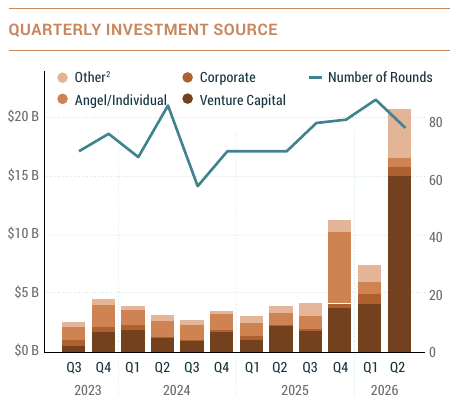
Investment in space since 2023, from the Space Capital report in July 2026.
More than any other moment since the launch of Sputnik in 1957, the future of the human race’s effort to explore and settle the solar system is right now shining bright and hopeful, with everything converging enthusiastically in a manner that — if nothing is done to forcibly stop it — will make that colonization inevitable.
To understand that convergence, it necessary to understand how radically different this situation is. Unlike every space effort since Sputnik, space exploration is no longer controlled by governments. No longer do innovators and space geeks need to go to lawmakers, their hands out begging for money. Space exploration is now in the hands of private capital, which is quite generously committing a lot of money to fund a lot of space projects — not because these investors want to explore the stars — but because they see a lot of profits to be made.
This fact — that governments no longer control the situation — is what is driving this renaissance. It is also the one fact that might kill it, but I am getting ahead of myself. I must first describe this renaissance, in all its glory.
Rockets
The mass sent to orbit in 2023. Click for original image. The numbers for 2024, 2025, and 2026 have been comparable.
Above all, we must begin with rockets, because without them nothing in space can happen.
First on the list is of course SpaceX’s Falcon family of rockets, which revolutionized the rocket industry by being the first ever capable of reuse. That capability forced a major lowering in launch costs while making frequent and reliable launches of new payloads possible. For the past three years this rocket has dominated the global launch industry, launching more than the world combined and placing in orbit something like 90% of the total mass. Its development was funded from Elon Musk’s own pocket as well as from NASA.
The company is now building its much larger Starship/Superheavy rocket, intended to be the most powerful rocket ever built but also designed to be reusable with the ability to launch again and again, within hours. Unlike Falcon, its development has almost entirely been funded by private and public investment capital as well as the ample revenue SpaceX is getting from Starlink and its computer divisions. In fact, at this moment the contribution from NASA is relatively minor, only a very small percentage of the total cost.
SpaceX’s reliance on private capital however is not unique. Jeff Bezos’s Blue Origin has built its New Glenn rocket entirely from private capital (most coming from Bezos’s own pocket). Peter Beck’s Rocket Lab has developed both its Electron rocket (flying now for almost a decade) and its Neutron rocket (about to make its first flight) also from private capital. New Glenn and Neutron are both reusable, and will thus help accelerate the drop in launch costs.
Nor are these the only new rockets funded mostly on private investment. There are at this moment at least seventeen different privately funded rockets that are either operational or about to complete their first flights, aimed at garnering whatever commercial and government business they can get. For a more complete outline of this coming wave of rockets, see this September 10, 2026 essay.
But why is so much capital going into developing these rockets? What are they launching? Who are their customers?
Satellite constellations of all kinds
Visualization of just SpaceX’s 2nd generation Starlink constellation. Click for source.
When it comes to the future in space,, the hot topic recently has been coming launch of several gigantic constellations of data center satellites to serve the computer world of AI and smartphones. SpaceX plans a constellation, dubbed Starmind, of one million satellites. Blue Origin has its own, called TeraWave, comprising more than five thousand satellites. The startup Starcloud wants to build its own 88,000 data center satellite constellation. And Google is developing its own, dubbed Suncatcher, though the numbers and schedule remain unstated at this point.
That’s only a few examples of proposed data center constellations. All have investment capital, and all are on the verge of their first launches. The rocket industry will be hard pressed to meet this demand.
But data center constellations are only the newest entrant in the satellite business. Voice communications remains the first big player, with the industry shifting from geosynchronous satellites providing linkage between ground stations to large smallsat constellations in low orbit providing direct phone-to-cell connectivity. Both SpaceX and AST SpaceMobile already have satellites in orbit providing this service, with SpaceX planning a bigger constellation of 15,000 satellites in the future.
Starlink meanwhile established the viability of satellites for internet access, with Amazon’s Leo and several Chinese constellations now coming on line to compete.
Nor is this all. Commercial imaging satellite constellations, in both radar and optical, have become ubiquitous in recent years, replacing the expensive less capable government constellations. GPS-type constellations, launched by the U.S. the European Union, India, and China, are still needed and are being expanded, with private satellite companies beginning to offer their systems as alternatives. Weather satellite constellations, previously launched only by governments, are now being developed by private companies because they can build them faster and cheaper.
And of course, there are demands for new communications, surveillance, and reconnaissance satellites by the War Department. Most are simply variations of the above constellations, though designed to be more secure for military purposes. Some, such as Trump’s proposed Golden Dome, have unique goals, such as acting as a shield against missile attacks. All however presently have large budgets and are moving at this moment aggressively to get built.
In the next decade this demand should require thousands of launches per year, a demand that should further increase the number of reusable rockets available which in turn will further lower the cost to get into orbit.
Space Stations
In the United States at this moment there are five commercial space stations under development, as shown to the right. All have all got extensive funding. Two, Vast’s Haven-2 and Max Space’s Thunderbird, are at this point funded entirely by their wealthy owners. Two, Starlab and Axiom, have raised about $1.5 billion in private capital, while also obtaining development contacts from NASA worth a little less than $300 million. The last, Orbital Reef, has also won a development contract from NASA, worth $130 million, but has done very little with it.
All five exist because their owners recognize that there is a lot of potential for making money in space, inside a space station. First, the U.S. and its international partners on ISS are not the only governments that want the prestige of flying astronauts in space. Numerous other countries want to do it also, and in fact in the past three years France, Czechia, Lithuania, Colombia, Uzbekistan, Japan, India, Poland, Hungary, and the Maldives have all signed passenger contracts with Axiom, Vast, and Starlab, with Axiom having already completed four such flights for profit to ISS.
Second, NASA is committed to buying space and passenger service for its own astronauts to one or more of these stations. It issued its request for space station proposals last week, with major contract awards to be issued in April 2027. The agency’s goal is to sustain its own manned program in low Earth orbit by encouraging competition between privately owned and operated space stations.
Third, the pure research done on ISS has demonstrated that valuable products can be produced in weightlessness that cannot be made on Earth, and many companies in a variety of fields, from pharmaceuticals to medical implants to material sciences, want access to an orbital facility to make these products for later sale. The new stations are not only eager to sign them up, Vast, Starlab, and Axiom have already begun to do so (see here, here, and here).
Serving the space stations
All these stations are going to need a range of ferrying services. For manned transportation only SpaceX at present provides this service with its fleet of five manned Dragon capsules. For cargo, both SpaceX’s unmanned Dragons and Northrop Grumman’s unmanned Cygnus capsules are available. The problem for manned transportation is that SpaceX is considering retiring both Dragon and the Falcon 9 rocket that launches it. While I personally doubt this will happen until other alternatives exist, its possibility remains a threat to the operation of these private stations.
Many of those alternatives are either on the verge of becoming operational or will do so in the near future. All have issues, but all are real. Boeing’s Starliner has flown with problems several times. If it can prove out its systems finally and become reliable, it becomes an immediate alternative.
The French startup The Exploration Company is building its Nyx cargo capsule. It has raised $680 million in private capital and has won a contract worth almost a billion dollars from the European Space Agency (ESA) to fly three Nyx missions. The company fully intends to eventually upgrade Nyx to a manned version, in the same manner as SpaceX did with Dragon, but that development is likely several years away.
Northrop Grumman has several times proposed upgrading its Cygnus capsule as a manned alternative. Little development on this option however has occurred because — as an old established space company — Northrop refuses to commit any of its own funds to such work. It wants a contract first. This however could change once one or more space stations begin operations.
Sierra Space’s Dream Chaser reusable cargo mini-shuttle is also an option. It was originally conceived as a manned ferry, but NASA wasn’t confident in its design to go with that concept. In retrospect this decision was a wise one, as an undisclosed technical issue has delayed the first launch of the first Dream Chaser, Tenacity, for more than two years. This undisclosed issue finally had NASA cancel its ISS cargo deal with Sierra Space. Nonetheless, this design concept is a viable one, and if Sierra can fix things it remains a future option for supplying the commercial stations.
And then there are the unknown manned and cargo spacecraft that don’t yet exist. Based on the investment capital going into the private stations, their need for ferrying service is going to become critical in the next decade. It therefore seems certain to me that one or more companies are going to step forward with new ideas, and make it happen. In fact, one of those companies might very well be found in the next area of space development.
Recoverable capsules
Varda’s first capsule on the ground in Utah in 2024, after completing an eight-month mission producing the drug ritonavir, which is used to treat HIV/AIDS.
While the space stations aim to provide large and extended capacity for product manufacture in orbit, the new recoverable capsule industry offers this same capability now, on a smaller scale and for much lower cost. The company Varda was the first, having already flown and recovered six capsules, with SpaceX following with its own test flight of its Starfall capsule.
A half dozen more startups in the U.S. and Europe have now raised capital to compete. In the U.S. Varda and SpaceX have been joined by Reditus, Inversion Space, and Sierra Space, all of whom have raised money or won contracts for putting short-term small recoverable capsules in orbit. In Europe, The Exploration Company in France, Atmos in Germany, PLD in Spain, Genesis in Croatia, and Space Cargo in Luxembourg have also raised capital for the same.
All of capsules these companies are building are relatively small, too small for humans to fly on. All however are developing the precise technology required for ferrying cargo and humans up and down from the commercial stations. We should fully expect that as the profits from their products begin to roll in, one or more of these capsule companies will commit the funds for developing larger capsule designs capable of carrying humans.
Miscellaneous other orbital industries
These miscellaneous industries include a half dozen orbital tug companies, a handful of robotic servicing companies, and a number of companies developing technologies of removing space junk. There are also proposals to provide refueling depots and fueling tankers for refueling satellites periodically.
All have raised capital, and all are either in development, have demonstrated their technology in orbit, or have actually started flying operational missions.
NASA’s Artemis program
While most would think I should list this government program first, because it is the most public part of America’s space
NASA’s Artemis program
While most would think I should list this government program first, because it is the most public part of America’s space effort, I place it last because in truth it is the least likely to succeed, and it acts mostly as an emotional linchpin for fueling all the other investment, innovation, and other industries now being developed above.
However, the way NASA is presently structuring its program is especially beneficial. The agency is no longer attempting to build anything. Instead it is asking the private sector — many of which are the many companies I list above — to do it. It is also not demanding ownership, as it has in the past. Instead, it is buying what it needs from these companies, and letting them develop the product in a manner that will allow them to sell it to others for further profits. As I wrote in the 2017 policy paper, Capitalism in Space,
Ownership … allows the companies to sell their products widely and make profits from it, regardless of whether NASA buys it.
In other words, NASA’s Moon program is now designed more than anything to fuel the growth of this private space sector. This is something it has failed to do very effectively since Apollo.
The threat that can kill it all
“Proclaim liberty throughout all the land unto all the inhabitants thereof.” Photo credit: William Zhang
Though it is certain that some of these projects and companies will fail, the number and wide variety of their customers and products provides depth and redundancy. Profits are going to be made by building things in space, in one case or another, thus guaranteeing a continuous and never-ending driving force upward. If some fail, others will not. The demand is now simply too high and varied.
Left to its own purposes, freedom and capitalism is now poised to conquer the stars.
What threatens all this new space development however is also its very fundamental nature: it is privately owned, independent, fueled by profit, and not controlled by the government. Governments — and the power-hungry people who are naturally attracted to these political positions — don’t like it when they don’t control things. In fact, the reason this renaissance in space has only occurred now is because, since the 1960s, the governments in both the U.S. and Europe have worked hard to keep control over the space industry. Only in the late 2000s did this finally begin to change, but it has taken almost two decades to wrest power from the government and give it back to the private sector.
All of that could change in a moment, if the wrong people gain power. All of the grand private projects listed above hinge entirely on the choices we make in a few short weeks on election day. For you see, elections always matter, and in this election we are really being presented a choice between this bright future of private enterprise in space and a dark future comparable to that of the failed Soviet Union.
Sadly, the concepts of communism and top-down rule by government have become strongly entrenched within the American Democratic Party. Too many politicians in that party now advocate socialism as their guiding principle of governance. They wax poetic about the socialist utopia they wish to create, where everything is controlled from above by wise government officials who only have our real needs in mind. At the same time, these same Democrats, like Bernie Sanders and Abdul El-Sayed (the Democrat candidate running for the Senate in Michigan), like to use the word “billionaires” as a curse word, advocating the use of government to squelch such people, on the misguided or downright evil idea that because someone has become rich building a business they have somehow robbed others of wealth.
The Democrats to private enterprise: “Great business you got there! Really be a shame if something happened to it!”
To achieve these goals however they must shut down freedom and private enterprise, because you can’t run things from on top if you allow free competition and innovation to exist outside your central control.
Nor is this just my opinion, it is based on recent history. During the Biden administration this is exactly what the Democrats did to Elon Musk and SpaceX after he announced his support for Republicans in 2022, slow-walking and even blocking the launch licenses SpaceX needed to test Starship/Superheavy, while conducting an aggressive lawfare campaign of investigations against him and his companies by numerous government agencies.
We should therefore have no doubt what the Democrats will do if they regain control of Congress, and eventually the presidency. They have made it clear they resent the success of others outside their control, and they have every intention of clamping down on that freedom, hard.
And while one might not like Donald Trump or the Republican Party, he and that party at this moment are the only political party that is working to encourage private enterprise, freedom, and using the government as a servant of the people. In fact, this renaissance in space is occurring right now precisely because of the policies the Trump administration has initiated since his second term began. As is stated expressly in a Trump executive order issued in December 2025, the goal is to grow ” a vibrant commercial space economy through the power of American free enterprise.” This was reinforced by Trump’s revised national space policy announced in August 2026, and confirmed by repeated orders to reduce red tape impacting both the launch and satellite industries.
This is the choice we face on election day, between the Democrats who want to squelch private enterprise and the Republicans who want to encourage it. I might sound partisan in saying this, but I am only summarizing the positions and actions of the two political parties. Nor will this choice impact only space exploration and this new space sector. It will impact American life across all sectors. Think once again of the Soviet Union and Venezuela, both of which chose the communist model and both of which went bankrupt.
As surely as the sun has risen this morning, and as surely as it will set this evening, the human race is going to the stars. Though we might do it for the adventure or profit or the search for knowledge, we will eventually settle down on those barren hills that Frank Borman called “not a very inviting place to live and work.” And when we do, we had better consider the social order that we establish. The Cold War might be over, but it was only a small episode in the never-ending struggle between freedom and tyranny, a battle that began when the first bully found he could use a club to make others do what he wanted.
We now face another episode in that never-ending struggle. I pray Americans will choose wisely.