The Artful Dilettante is a native of Pittsburgh, PA, and a graduate of Penn State University. He is a lover of liberty and a lifelong and passionate student of the same. He is voracious reader of books on the Enlightenment and the American colonial and revolutionary periods. He is a student of libertarian and Objectivist philosophies. He collects revolutionary war and period currency, books, and newspapers. He is married and the father of one teenage son. He is kind, witty, generous to a fault, and unjustifiably proud of himself. He is the life of the party and an unparalleled raconteur.
Socialism is not optional. The government monopolies it creates and the impoverishment that results are mandatory. Unless you are a politically connected elite, you must and will participate in it all. The ignorant, brainwashed fools who claim there’s a difference between Communism and socialism ignore a crucial point: Once the misery of socialism sets in, the censorship and political prison camps are inevitable–to shut you up.
It’s hard to fathom that America, of all places, comes closer to Communism every day. But if you take a minute and listen to the magnitude of the utterly faulty thinking everywhere today, you have to marvel that it hasn’t gone even further. Once the total end of freedom comes in America (if it does), the final collapse will come quickly. Most of us will wonder how it could have happened so fast.
It seems that everyone is talking about data centers these days; they’ve taken over the Internet with memes and conspiracy theories. As a computer professor, I decided to apply an academic research regimen to the situation and cut through the exaggeration and emotion that often accompany these current polarizing issues.
Two important points to begin with: AI’s water and power usage. As I have demonstrated in my previous article, data centers use about 0.02% of the water supply in the US according to recent sources, and most future data centers are already planned to use advanced cooling technology that requires very little water. While it is true that data centers require a lot of electricity, their impact on power systems and customers has been greatly exaggerated. Bloomberg’s often-cited piece on the subject mentions that at the highest instance, one area of the country experienced a 267% increase in wholesale costs. This data describing one area in one instance has been used incorrectly to state that it is the expected or average raise (rather than the high end), and it doesn’t even account for the fact that this is wholesale power costs, which does not translate directly into consumer costs. (Often the tech companies will offset these increases.) What this data does tell us is that there are places where we simply should not build data centers. This is one problem that should be avoided. The other problem is companies acting unethically.
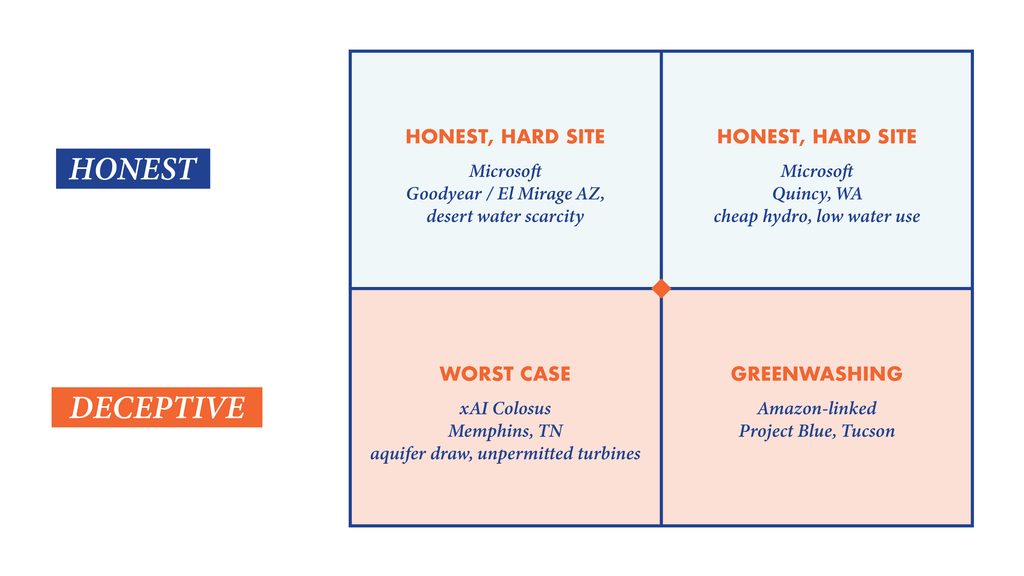
One of the most egregious examples of unethical data center implementation is xAI’s Colossus near Memphis, Tennessee. The company promised years ago that it would not rely on local water supply for cooling. Not only does it continue to use local water daily, but the proposed solution has been delayed. In addition, xAI ran as many as 35 unpermitted methane gas turbines at Colossus 1 beginning in June 2024, generating up to 421 MW without any preconstruction or operating air permits under the Clean Air Act. If there was ever an example of how not to build a data center, it is this one.
Another prime example is Project Blue in Tucson, Arizona. Beale, the project developer, actively deceived the city and used the local water supply to clean dust from the data center. And they used a lot of it. This caused Tucson to shut down its water supply. Not only that, but city staff and Amazon had signed an agreement to keep knowledge about the center secret from its residents for three years. It’s no wonder that many communities are suspicious of tech companies coming into their neighborhoods and deceiving them about their plans and the benefits they will bring.
There are cases where companies are unethical in their approach to data centers, and there are cases in which the location is just not suitable. Sometimes, both points of failure occur. Colossus 1 is an example of both, where the deception was extreme and its use of water is actively causing problems with the local aquifer.
An example of poor location choice but good ethics is Microsoft’s West US 3 in the Phoenix area. Microsoft separately agreed to invest $40 million directly into the water utility. Microsoft is testing a new zero-water cooling strategy, and it published its water use and other relevant information in its Environmental Sustainability Report. However, it built these data centers in the middle of an extremely arid, low-water area. There are reasons for doing this, but, generally speaking, drawing water from a nearby desert city’s supply is not ideal. It’s not entirely bad news, in that it has spurred Microsoft to invest in new cooling strategies that do not draw on the local water supply. This problem should not affect future data centers as much because of the new cooling technologies that require little to no water from the local supply.
You probably haven’t heard of too many examples of successful data center developments, and that’s partly because “something worked; everything is just fine” is not a common news story. However, CNN recently reported on exactly that: Quincy, Washington, is home to over 30 data centers and has experienced an incredible boom as a result.
The data centers now cover an estimated 57% of Quincy’s property tax revenue, funding a wave of public infrastructure projects: a $15 million aquatic center, a 143,000-square-foot indoor sports complex, a $120 million high school, a new hospital, library, police and fire stations, paved sidewalks, sewage systems, and a wastewater treatment plant.
Residential electricity rates in the county rose 3.5% last year, while large industrial users, such as the data centers themselves, absorbed a 9.1% increase. The data centers there are paying for their own added infrastructure and generation costs rather than spreading those costs to households.
Another advantage of this site is that it has abundant cheap hydroelectric power. As for water, Microsoft partnered with the city to build a $30 million water reuse facility. The only real caveat here is that the data centers generated so much revenue and development that housing prices have risen across the area.
It seems that everyone is talking about data centers these days; they’ve taken over the Internet with memes and conspiracy theories. As a computer professor, I decided to apply an academic research regimen to the situation and cut through the exaggeration and emotion that often accompany these current polarizing issues.
Two important points to begin with: AI’s water and power usage. As I have demonstrated in my previous article, data centers use about 0.02% of the water supply in the US according to recent sources, and most future data centers are already planned to use advanced cooling technology that requires very little water. While it is true that data centers require a lot of electricity, their impact on power systems and customers has been greatly exaggerated. Bloomberg’s often-cited piece on the subject mentions that at the highest instance, one area of the country experienced a 267% increase in wholesale costs. This data describing one area in one instance has been used incorrectly to state that it is the expected or average raise (rather than the high end), and it doesn’t even account for the fact that this is wholesale power costs, which does not translate directly into consumer costs. (Often the tech companies will offset these increases.) What this data does tell us is that there are places where we simply should not build data centers. This is one problem that should be avoided. The other problem is companies acting unethically.
One of the most egregious examples of unethical data center implementation is xAI’s Colossus near Memphis, Tennessee. The company promised years ago that it would not rely on local water supply for cooling. Not only does it continue to use local water daily, but the proposed solution has been delayed. In addition, xAI ran as many as 35 unpermitted methane gas turbines at Colossus 1 beginning in June 2024, generating up to 421 MW without any preconstruction or operating air permits under the Clean Air Act. If there was ever an example of how not to build a data center, it is this one.
Another prime example is Project Blue in Tucson, Arizona. Beale, the project developer, actively deceived the city and used the local water supply to clean dust from the data center. And they used a lot of it. This caused Tucson to shut down its water supply. Not only that, but city staff and Amazon had signed an agreement to keep knowledge about the center secret from its residents for three years. It’s no wonder that many communities are suspicious of tech companies coming into their neighborhoods and deceiving them about their plans and the benefits they will bring.
There are cases where companies are unethical in their approach to data centers, and there are cases in which the location is just not suitable. Sometimes, both points of failure occur. Colossus 1 is an example of both, where the deception was extreme and its use of water is actively causing problems with the local aquifer.
An example of poor location choice but good ethics is Microsoft’s West US 3 in the Phoenix area. Microsoft separately agreed to invest $40 million directly into the water utility. Microsoft is testing a new zero-water cooling strategy, and it published its water use and other relevant information in its Environmental Sustainability Report. However, it built these data centers in the middle of an extremely arid, low-water area. There are reasons for doing this, but, generally speaking, drawing water from a nearby desert city’s supply is not ideal. It’s not entirely bad news, in that it has spurred Microsoft to invest in new cooling strategies that do not draw on the local water supply. This problem should not affect future data centers as much because of the new cooling technologies that require little to no water from the local supply.
You probably haven’t heard of too many examples of successful data center developments, and that’s partly because “something worked; everything is just fine” is not a common news story. However, CNN recently reported on exactly that: Quincy, Washington, is home to over 30 data centers and has experienced an incredible boom as a result.
The data centers now cover an estimated 57% of Quincy’s property tax revenue, funding a wave of public infrastructure projects: a $15 million aquatic center, a 143,000-square-foot indoor sports complex, a $120 million high school, a new hospital, library, police and fire stations, paved sidewalks, sewage systems, and a wastewater treatment plant.
Residential electricity rates in the county rose 3.5% last year, while large industrial users, such as the data centers themselves, absorbed a 9.1% increase. The data centers there are paying for their own added infrastructure and generation costs rather than spreading those costs to households.
Another advantage of this site is that it has abundant cheap hydroelectric power. As for water, Microsoft partnered with the city to build a $30 million water reuse facility. The only real caveat here is that the data centers generated so much revenue and development that housing prices have risen across the area.Data Center Location and Ethics Matrix
As you can see, there are definitely ways to build, and examples of ethical and beneficial data centers. The benefits to a local community are substantial. Not only do local tax revenues increase, but data centers come with the benefit of being a generally low-traffic, relatively quiet development. Revenues can increase without needing to build many new roads, or bring large amounts of noisy traffic.
This goes along with the fact that we simply need more data storage. Yes, AI is driving much of the current surge, but we have continually created more data and need a place to store it. We take pictures with our cell phones, leave voice notes, and write emails. With self-publishing, so many people now are writing books. So many songs are written and digital videos made. All of that goes into data centers. All of your apps: data centers. All of the Internet: data centers. Nearly all human knowledge is now stored in these data centers; they are the modern archives of human creativity, education, and achievement.
Efficiency gains in AI are real and dramatic. OpenAI’s Sam Altman has pointed out that ChatGPT models have become roughly 1,000 times more efficient at a given level of intelligence in less than two years. But this doesn’t mean data center demand will eventually shrink; it means the opposite. Every time a computing resource has gotten this much cheaper, historically we haven’t used less of it; we’ve found a thousand more uses for it. Drops in data-storage prices didn’t lead to people using less data; now no one deletes anything. Altman’s prediction that we will use AI and data in the same way that we use utilities such as water and the Internet will likely come true, and in some ways, it already has.
This is not only happening in the United States. China, Europe, the Middle East, and Southeast Asia are all rushing to build data centers, and they are encountering very similar issues. This is a global phenomenon, and, the way things are going, data centers will be as much a part of modern infrastructure as airports, phone lines, and railroads, which people once opposed. Farmers once believed sparks from railroad tracks would burn their land, and doctors at the time warned the human body couldn’t survive driving at speeds over 20 miles per hour. We see the same patterns of resistance to new technology repeated throughout history.
The truth is, data centers themselves aren’t the problem. Poor location choices and unethical business practices cause the failures we’ve seen. If we’re wise about where we build and who we trust, we can avoid the pitfalls and reap the rewards.
Stephen WeeseStephen Weese is a computer professor and consultant in CS, IT, and AI. He also works in media and is the CEO of Marvelous Spiral Studios.
Soon it will a long, hot Labor Day weekend, and police in many cities are bracing for multiple teen takeovers.
These takeovers, usually of crowded downtown areas, are organized on social media and escalate rapidly into large-scale brawls involving the use of fists, knives, and guns. Bystanders and police are hurt, and businesses are damaged and have their hours curtailed.
Footage from a large teen takeover from the Wisconsin State Fair in Milwaukee has aired on national media, with commentators noting that “these kinds of takeovers have become all too common.” What was not said is that “these kinds of takeovers” are largely, though not entirely, black teen takeovers. Although white teens are certainly guilty of committing crimes, teen takeovers are mostly relegated to blacks. The question is, why?
Certainly, the Wisconsin State Fair takeover involved mostly blacks, including women punching, kicking, and brawling, and striking a police officer. As Fox News states, “malls, beaches, and restaurants become battlefields.” In New Jersey, Georgia, Wisconsin, Detroit, and other states, “massive crowds of juveniles overwhelm public spaces.” One of the most violent of these occurred at a Washington, D.C. Chipotle Grill restaurant, where a group of teens entered the location and began fighting and throwing chairs. What the report failed to indicate is that all of the teens shown in the video of the event appeared to be black. Outside the Chipotle, hundreds of teens reportedly brawled in the streets. None of the commentators noted that the vast majority of these teens were black, despite the fact that footage of the event showed it to be so.
Similar teen takeovers have occurred at a shopping mall in Glendale, Wisconsin; in downtown Detroit; and in Chicago, and at many other locations. Body cam footage from the Glendale takeover showed police battling black teens and teens striking police officers. Additional video showed dozens of black teens brawling, but this was only a small number of those participating in a takeover said to have been organized on social media. It’s important to note that though most of those involved in the so-called Bayshore Mall takeover appear to have been black, the overall black population of Glendale, Wisconsin, is 16 percent. Whites constitute 65 percent of Glendale’s population, but by and large they are not out there rampaging and causing harm. What has been causing a disproportionate number of black youths to participate in these violent takeovers?
In another recent takeover, hundreds of teens reportedly flocked to the Chicago Loop and began fighting and looting. These footage shows that most of the participants were black. In Charlotte, North Carolina, over 40 teen takeovers have occurred so far this summer, with most of those on the videos I have seen being black. In Charlotte, blacks constitute 33 percent of the population; whites and Asians constitute over 40 percent.
Chicago’s 57th St. Beach takeover involved an estimate 400 to 500 teens, again largely black, as one can see in video of the event. Chicago’s population is 28 percent black. Why are so many of the teen takeovers black events?
The fact that these takeovers involve mostly black teens is rarely if ever mentioned in media accounts. That fact by itself — the fact that the media refuse to identify black participants by race despite identifying some of those at the Tybee Island, South Carolina, mêlée as white female teens — may well be one reason blacks feel free to flock to these events: society refuses to face the facts and hold them accountable because they are black. Likewise, the chance of being arrested and punished is almost nil.
It would be better, for the public at large and for participants in the takeovers themselves, to identify the problem exactly as it is: not a problem with “teen” takeovers, but with “black teen” takeovers, and to move from there toward solutions. Solutions will never be found if the truth is suppressed and endless excuses are made for exactly those responsible. There is a problem with a certain segment of blacks youths in America today, and that problem needs to addressed head-on.
Conservatives care about the well-being of all persons, and especially about the well-being of our youth. In every teen takeover, young people are injured and sometimes killed. Above all, conservatives value human life, and the lives of our young, white and black, are put at risk every time a takeover occurs. Only a forceful response can save these precious lives.
At its core, there is a problem with the way our society makes excuses for the behavior of black youths. Too often the story is that offenders have grown up in difficult circumstances. So did millions of whites, but most of them do not go about breaking curfews and engaging in violence. There’s also the suggestion that since black Americans have historically suffered from slavery and Jim Crow, the failings of present-day blacks — including lawlessness — should be overlooked, almost as a sort of non-monetary reparations. But black American teens have never experienced discrimination; if anything, they receive preference in schooling and hiring and can look forward to future promotions ahead of whites.
The problem is not past discrimination. It is the way black teens, especially males, are being brought up today and the failure of parents and society to correct them when necessary. At its foundation, that failure is the result of society’s refusal to hold blacks to the same standards as whites. Until that happens, black teen takeovers, violence, and other lawlessness will continue.
A Houston dad got a shocking surprise when a DoorDash driver delivered food to him and his daughter while as naked as a jaybird.
Kiante Matlock said he was inside his home playing video games with his daughter Monday when he got a phone notification alerting him the order had arrived.
But when he checked his Ring camera, he realized to his horror that the driver who dropped off the food was stark naked.
The incredible footage showed the driver, who had shoulder-length dreadlocks, placing their order on the front porch and then casually walking back to his car like nothing was out of the ordinary.
Matlock, who said he uses the delivery service fairly regularly, said he couldn’t believe what he was seeing was real.
He discarded the food and reached out to DoorDash, which was equally appalled at the situation and refunded his money.
“What this consumer experienced was abhorrent, and we’ve reached out directly to offer our support. This man’s behavior was vulgar and completely unacceptable, and as soon as we were made aware, our team permanently removed their access to our platform,” the company said in a statement to Fox 26 Houston.
“We do not tolerate sexual harassment or misconduct of any kind, and we stand ready to assist law enforcement with any investigation.”
See the picture? That’s Darline Graham. She’s the faux conservative President Trump picked to be South Carolina’s next U.S. Senator. [photo courtesy of Corey Allen]
Wow. America really is going down. It’s not just New York and California anymore.
The left is going way, way, way left. And the right is going left.
It seems to be happening so fast. So decisively and unequivocally. Coast to coast. North and South.
America is ill. Politics and elections are not the cause; they are a reflection of just how unwell the whole culture is.
I only have two comments about Darline Graham winning the nomination for her brother’s seat in South Carolina.
1) Assuming Graham wins in November, how long before she buckles and becomes the Amy Coney Barrett of the U.S. Senate?
2) Will she necessarily even win in the general election? Watch her debate performance against Ralph Norman. She was utterly horrible. Kind of like Joe Biden on a good day. If she loses, South Carolina will be sending a woke Communist pediatrician (Annie Andrews) to the Senate, a woman who claims that you’re not a “real doctor” unless you support hormonal and genital alteration of minors. But frankly: How much different will the Democrat’s voting record be from the Republican’s? Is the Republican even a Republican? You have to vote her into office to find out.
Just watch. A year from now, President Trump will complain about what a disappointment Darline Graham is, and a disgrace to her brother’s legacy. But the Senate will be stuck with her, long after Trump leaves office.
The left and the right are both going left. It’s a frightening prospect. But it seems to be what most want, or are at least willing to let happen without a fight. If even South Carolina no longer has any pro-liberty voices, and DeSantis is leaving the scene in Florida soon, what chance does liberty have for lasting out even another generation?
If you have children or grandchildren, tremble for them. They will experience the greatest material and psychological downturn in all of human history.
I think it’s time to stop expecting anything out of our political system. The cancer that is Big Government has metastasized. Democrats are delusional Communists. Republicans are (with very rare exception) poseurs who claim to love liberty, but in practice mostly vote with the Communists, and clamor for acceptance in those circles.
Government is not a creator of social and philosophical trends; it’s a reflection of them. The left controls the agenda. Their agenda is insane, wrong, hypocritical, intolerant and evil. The Republicans (with rare exception) appease that evil and cash in on the money and approval from a sycophantic media wherever they can. It’s futile to take sides.
If you’re older (like I am), then the best thing to do is be grateful you got to experience the peak of civilization, and live out your life with the remaining embers of freedom we’re still fortunate to enjoy. If you’re younger, and you want the same great life for yourself, then you’re my hero — but you must face the fact that you’re up against almost unimaginable circumstances. Reason, freedom, liberty, private property, intelligence, character, achievement, success and ability are all vilified and mocked as never before. It’s such a deranged cultural climate that gets you the prospect of a President AOC. The sickness creates the rulers; the rulers do not create the sickness.
Fight for what’s right, what’s true and for what ought and might to be — and accept what comes if you cannot change it. Create a world, if you can, where the right kinds of candidates have a chance. Create a world in which politics and governance matter hardly at all — other than to preserve the individual’s right to freedom.
If you’re younger, and you think that government, bureaucrats, censorship, regulations, subsidies and general idiocy can deliver you into a Utopia of riches and spiritual meaningfulness like humans have never seen … Well, good luck with that.
Here’s a headline that you might not be surprised to see today: “Have The Democrats Been Lost To Socialism?” Only it wasn’t written today. Issues & Insights crafted that headline way back in 2016, when it was already clear the Democrats had moved sharply leftward. Today’s extremist Dems are no different; they’re just more obvious about it.
“Polls show a shocking number of Democrats, in particular young ones, find socialist ideas not merely acceptable but preferable to capitalism,” I&I wrote then. “It’s hard to imagine a more stunning indictment of our schools.”
That still stands up pretty well today, we’d say.
It was prompted by the release of a then-shocking February 2016 poll of 1,000 likely Democratic voters by the American Action Forum in which 47% of Democrats described “socialism” and “communism” as either “very favorable” or “favorable.” And 60% said they’d be OK if America went socialist.
The numbers went up for young Democrats (those under 45), who favored socialism over capitalism by 46% to 19%, a landslide for leftism.
“How could average Americans of a supposedly mainstream political party throw their lot in with a creed that’s responsible for more human misery and poverty in the world than any other?” we asked. “It boggles the mind. Socialism, and its evil twin, communism, murdered well over 100 million people during the last century, a scale of slaughter unmatched in human history.”
That was Feb. 22, 2016. Those under-45s who answered that poll then are today no longer youthful idealists; they’re the Democratic Party’s heart and soul, its establishment, as an even-more extreme group today emerges each year from our nation’s far-left universities to take their place.
So what has changed? Nothing really, except today Democrats show a brazenness and shamelessness about their extremism. Today, socialism is edgy. It’s cool. It’s violent. It’s destructive. It’s online. And if allowed to take over, it will ultimately and inevitably metastasize into the moral cancer of communism, the worst political system in history.
This is no false alarm. The Democrats are already objectively socialist.
How do we know?
Last November, we asked those taking our own I&I/TIPP Poll the following: “Socialism is commonly defined as ‘a social and economic system that calls for public rather than private ownership or control of property and natural resources.’ Generally speaking, do you agree or disagree with the principles of socialism?”
Among Democrats, “55% agreed with the principles of socialism, while only 27% didn’t,” we found.
Of course, many of today’s Democratic leaders have emerged from colleges and universities where they’ve been taught that extreme leftism is the inevitable wave of the future (a page right out of Marx), and that capitalism is unfair, hateful and even anti-human. Rarely do they hear the historically proven creative genius of capitalism extolled.
Meanwhile, the old backbone of the centrist Democrats — blue-collar workers, who were socially conservative, but economically liberal — have been abandoning the Dems for more populist political choices. That includes President Donald Trump’s MAGA movement.
Today’s Democratic Socialists think they’re the avatars of a new America — one that can come about only by destroying the America of today. They call it “socialism,” because that polls well, but the truth of what they’re aiming for is something different: communism.
“Our enemies are not just individual bosses, but the entire global system of capital; not just this or that cop, judge, or president, but the entire anti-democratic structure of our society,” the socialist wing of the Democratic Party wrote in its “Workers Deserve More” manifesto. “We are workers fighting to transform society: to win the battle for democracy, draft a new constitution, and create a democratic socialist republic.”
What does that mean? Democratic Socialists would tear up the U.S. Constitution, which guarantees rights for all. They would destroy free-market capitalism, the very engine of our nation’s great economy, by seizing the means of production; they would shut down prisons and let violent criminals roam free; they would eliminate private property; they would open our borders; and they would get rid of the U.S. Supreme Court and replace it with leftist tribunals.
Sure, elected Democratic leaders publicly wring their hands over losing votes from the dwindling number of moderates in their party. But then they cozy up to extreme-leftist online heroes such as Hasan Piker, and coddle Michigan Democratic senatorial nominee Abdul El-Sayed. Both have used their bad-boy socialist credentials to build millions of online followers. Dems also empower and pamper hard-left socialists like New York Rep. Alexandria Ocasio-Cortez and Michigan Rep. Rashida Tlaib and members of the hard-left “Squad.”
As we said before, there’s no “nice” socialism. Socialism is based on theft, robbing citizens of their rights to life, liberty, and property. And make no mistake, the Democratic Socialists of America, now ascendant in the Democratic Party, have made clear their ultimate goal is communism.
As Deroy Murdock, writing for the Daily Signal, points out, the “socialists” of the Democratic Party these days sound an awful lot like communists.
“Our goal is communism,” David Jenkins, a member of DSA’s National Political Committee, said in 2023. DSA member Cea Weaver is New York City’s tenant tsarina. She posted via X in December 2017: “Elect more communists.” The next year, she demanded: “Seize private property.”
For the record, neither socialism nor communism has ever succeeded in any country, anywhere at any time. Communism as a creed has failed everywhere it’s been tried, bringing only grinding misery, state slavery, mass death, and horrible poverty. Quite a record.
Socialism is communism with training wheels. We doubt Americans want that. But is it what Democrats want?
A taxpayer-funded study of children and young adults taking puberty blockers and hormone treatments found no improvement in youth mental health.
The Oversight Project, a watchdog group, obtained the final report of “The Impact of Early Medical Treatment in Transgender Youth” and shared it with the Daily Signal.
The National Institutes of Health first allocated a nine-year grant of up to $10 million for the study through the Children’s Hospital of Los Angeles. The study was led by Dr. Johanna Olson-Kennedy, who specializes in “gender-affirming care.”
The study included people as young as 8 years old. The sample receiving puberty blockers included participants up to age 16, while the sample receiving hormone treatments included participants up to age 20.
“Over 2 years of medical intervention that started with blockers, mental health remained relatively stable and was on par with the population at large,” the final report says. “These youth showed no worsening of their mental or emotional health and suicidality decreased from baseline to 24 months. Mean scores on mental health measures remain stable in a clinically non-significant range over two years.”
The longstanding argument for advocates of “transing” minors has been that not doing so could cause depression or suicide among youth.
The report’s release has been long awaited. The New York Times first reported in late 2024 that the study of almost 100 children would not be published because Olson-Kennedy feared the findings would be “weaponized.”
The report said that “at baseline, about half of these youths had clinically concerning scores for depression and anxiety. About two-thirds reported having thoughts of suicide, and about one-quarter reported having attempted suicide.”
Though it added that two years showed “increased scores for life satisfaction,” and decreased levels of depression and anxiety.
“The argument has been that this improves mental health,” Dr. Kurt Miceli, the chief medical officer at Do No Harm, which opposes gender changes for children, said. “ … The narrative by advocates has been that this is lifesaving treatment.”
He noted that a separate 2023 New England Journal of Medicine article referenced two minors observed in a study who committed suicide.
The recently released study noted that “Denominator for retention (expected visits) does not include participants who withdrew consent, passed away, or have not reached the end of their extended follow-up window.” But it does not say how the youths “passed away,” Miceli noted.
“Two suicides were reported in a previous study, but downplayed,” Miceli said. “It’s important for science and important to patients to know.”
Oversight Project Director of State Litigation Neal Cornett said the report confirms what most already know, which is that “treating troubled youth with puberty blockers and hormone treatments does nothing to improve their mental health.” freestar
“As a country, we should err on the side of caution before embarking on this type of medical intervention with minors,” Cornett told the Daily Signal.
Notably, it was an observational study, so the procedures involving participants as young as 8 years old were not conducted as a result of NIH funding.
The study also found potential affects on youth bone density, reproductive health, and height. Further, the researchers noted they sought “additional youth of color” to precipitate in the study.
The Oversight Project contends the release of the documents is a good first step, but the public should know more about the “Transgender Industrial Complex” and the medical impacts it’s having on children and adolescents.
Just one day after calling President Donald Trump a “fat pig,” Jelly Roll doubled down on his remarks.
The famous singer stepped in as guest host of Tuesday’s episode of “Jimmy Kimmel Live” and refused to back down amid backlash over comments he made Monday on the very same stage.
“Now, let’s be honest for a second. Any U.S. president should be able to handle a few jokes, right?” he told the audience, Tuesday.
Determined not to walk back his stance, Jelly Roll continued.
“They should also be able to handle gas prices, healthcare, and the occasional international conflict, but beggars can’t be choosers.”
Trump supporters were angered when the country music star took aim at Trump’s weight and appearance, Monday.
Making reference to his 300-pound weight loss, Jelly Roll said, “That means I’ve lost an entire Donald Trump.”
“And let’s be honest, based on his approval ratings, it seems like most of the country wants to do the same thing,” he said.
Then he unleashed on the president by adding, “From one fat pig to another, take it from me that physical fitness is very important. Trust me, you’ll be happy to see your penis again.”
Trump supporters immediately lashed out at the artist, but when he took the stage again Wednesday night, he dug his heels in and continued mocking the president.
He acknowledged the backlash, and noted that many people were upset “that I didn’t treat the president with reverence and dignity,” but he didn’t walk the comments back.
Asserting his position, Jelly Roll said, “But I want to remind y’all that I go by the name Jelly Roll. I don’t even treat myself with reverence and dignity.”
“Most people were just surprised that I had any opinions at all,” he quipped.
Jelly Roll leaned into the remarks people were making about him online after he attacked the president.
“They see a guy that looks like me and assume the only opinion I have is whether I prefer my meth crystal or classic,” he said. (RELATED: Tom Selleck Sparks Internet Firestorm With Donald Trump Comments)
He directed a comment to those who “are mad at me for goofing on Trump — they should have voted for Kamala Harris so he could make jokes about her instead.”
Social media continues to erupt with Trump supporters slamming Jelly Roll for being a “traitor,” but he doesn’t seem to be bothered by it at all.
Leena Nasir – Entertainment Reporter, Daily Caller
It’s a dirty trick. The people who spent fifty years overturning old assumptions now accuse anyone who objects of being a radical. The accusation is repeated so often that it has almost become accepted without examination. But conservatism, properly understood, isn’t a radical philosophy. It’s almost the opposite. It’s an argument for restraint, continuity, ordered liberty, and respect for institutions that have survived because, more often than not, they contain wisdom we didn’t invent. There’s nothing radical about believing parents should have the principal role in raising their children.
There’s nothing radical about believing men and women are different, that borders ought to be enforced, that criminals ought to be prosecuted, that the government should live within some reasonable relationship to its means, or that citizens should be free to speak, worship, work, own property, and raise families without constant interference from Washington. Those weren’t fringe ideas when most of us were growing up. They were ordinary American assumptions.
What changed wasn’t conservatism. What changed was the country around it, and especially the institutions which shape our politics, culture, education, entertainment, and public life.
For years, the political Left has pushed one boundary after another. Each new demand was presented as modest. We were told that nobody wanted to go any farther. Then, once the new position was established, the next demand arrived, and anyone who still defended yesterday’s consensus was treated as though he had wandered in from some dark corner of history.
We’ve watched it happen on marriage, sex, and gender. Barack Obama opposed same-sex marriage when he first ran for president. Hillary Clinton did too. That wasn’t considered radical or hateful at the time. But the argument didn’t stop with civil marriage. It moved into disputes over whether religious believers, bakers, photographers, adoption agencies, schools, and other institutions could be required to participate in conduct that violated their convictions.
Then came gender ideology. Americans were first asked to accept that sex and gender were separate concepts. Then we were told that men could become women. Then males began competing in women’s sports. Bathrooms, locker rooms, school policies, pronouns, and children’s education were pulled into the debate. People who said biological sex is real suddenly found themselves treated as if they were making some shocking new political claim. In truth, they were saying what nearly everyone in America had said without controversy a generation earlier.
Who radicalized whom?
The same thing happened with immigration. There was once broad agreement in both parties that a sovereign nation had a right to control its border, enforce its laws, deport people who entered illegally, and expect newcomers to assimilate into the country they chose to join. Democratic presidents said those things. Democratic senators voted for enforcement measures. None of it was considered extreme.
Over time, however, ordinary immigration enforcement came to be described as cruel. Deportation became morally suspect. Sanctuary cities grew to be fashionable. Illegal entry was often discussed as though it were merely an administrative inconvenience, while Americans who objected to millions of unlawful crossings were accused of fear, prejudice, or worse. Eventually, a demand for a secure border became the radical position.
Race followed much the same course. The great moral victory of the civil-rights movement was the rejection of the idea that Americans should be judged by the color of their skin. The aspiration was equal citizenship, equal protection, and a country in which race mattered less, not more. Yet over time, large parts of the Left moved away from that ideal and back toward racial categories, racial preferences, racial quotas, racial guilt, and the constant sorting of Americans into oppressors and victims according to ancestry and skin color. Then, we were told that colorblindness itself was suspect, that institutions should treat people differently in the name of correcting past wrongs, and that children should be taught to understand themselves through racial identity. Conservatives who still believe the law should treat every citizen as an individual, without favor or penalty because of race, are now sometimes described as the extremists. That’s an extraordinary reversal of the principle Americans were once taught to admire.
Crime followed the same path. Americans once understood that one of government’s first duties was to preserve order. Police were supposed to arrest criminals.
Prosecutors were supposed to prosecute them. Judges were supposed to impose sentences authorized by law. Then came campaigns to defund police departments, eliminate cash bail, decline prosecution of entire categories of offenses, reduce penalties, and treat enforcement itself as part of the problem.
People saw what followed in city after city. It’s becoming a nightmare. Stores locked ordinary merchandise behind plastic. Businesses closed. Families changed where they walked, shopped, and spent time. When voters finally demanded more police, more prosecution, and more accountability for repeat offenders, they were told they had moved to the extreme right. They hadn’t. They had simply grown tired of an experiment they never asked for.
Education has traveled the same road. Parents once assumed that sending a child to public school didn’t mean surrendering authority over that child’s moral upbringing. Then parents began discovering controversies over race, sexuality, gender identity, pronouns, school libraries, parental notification, and what teachers were able to discuss with young children. When mothers and fathers began showing up at school-board meetings and demanding answers, much of the political establishment acted as though the parents were the problem.
But the parents hadn’t suddenly changed. The institutions had.
The same is true of free speech. Older liberals once regarded free expression as almost sacred. They defended offensive speech because they understood that the First Amendment means very little if it protects only popular opinions. Somewhere along the way, that tradition weakened. Universities began shouting down speakers. Employees lost jobs over political opinions. Social media companies became more aggressive in policing disputed claims and political debate. Activists began describing speech itself as a kind of harm.
Conservatives responded by defending the old rule: let people speak. Let bad arguments be answered by better ones. Don’t give government, corporations, universities, or ideological mobs the power to decide what every American may say. Somehow, defending that older liberal principle became another mark of supposed right-wing radicalism.
Government has changed too. The national debt climbed into the tens of trillions. Trillion-dollar deficits became routine. Federal agencies accumulated extraordinary authority over subjects that previous generations would have considered local, private, or beyond Washington’s proper reach. Emergency powers expanded. Regulations multiplied. Unelected officials came to exercise tremendous influence over the daily lives of people who would never know their names.
Conservatives continued to make the same argument they had made for decades: government should spend less, borrow less, regulate less, and remain within the constitutional boundaries placed upon it. That position didn’t become more radical. Washington simply moved farther away from it.
Technology has made the problem even more obvious. Cameras can record license plates almost everywhere a person travels. Phones can reveal where we’ve been. Corporations accumulate vast amounts of information about our habits, purchases, interests, and movements.
Government possesses surveillance capabilities that earlier Americans could hardly have imagined. Yet when someone says a free people ought to be suspicious of all this, he is often dismissed as paranoid or anti-technology.
That suspicion isn’t new. It’s deeply American. The Founders were suspicious of concentrated power because they understood human nature. They didn’t believe good intentions were enough. Neither should we.
The pattern has become familiar. A longstanding social norm exists. Progressives challenge it and insist that the proposed change is limited. Conservatives resist and are told they’re overreacting. The change is adopted. Then the next demand arrives. The ground moves again.
Eventually conservatives stop retreating, organize serious resistance, and announce that there are some things they simply won’t surrender.
At that point, the resistance itself is called radical. That’s how political language gets turned upside down. It’s true that today’s conservative movement is angrier than it was twenty years ago. It’s more skeptical of universities, corporations, federal agencies, the national press, and even the Republican establishment. But that skepticism didn’t materialize out of thin air. People watched institutions they once trusted become increasingly hostile to their values. They watched political leaders promise one thing at election time and do another once safely back in office. They watched every compromise become the starting point for the next demand.
Eventually people noticed that compromise always seemed to move in the same direction. So they stopped moving.
That’s the part our critics refuse to understand. There is a difference between radicalism and reaction. If someone keeps moving the fence toward your house, defending your yard will eventually look aggressive to them. But you’re still standing in the same yard.
That is where a great many conservatives find themselves today. We aren’t asking America to commence upon some unprecedented social experiment. In most cases, we’re asking for things Americans took for granted within living memory: secure borders, equal treatment under the law, parental authority, recognition of biological reality, fiscal restraint, public safety, free speech, religious liberty, constitutional government, and a culture confident enough to defend its own inheritance.
For years, we were told to tolerate the changes. Then we were told to accept them. Then to celebrate them. Eventually we were told that refusing to participate in them was itself evidence of extremism.
Thankfully, some Americans have finally answered no. That doesn’t make them radicals. It may simply mean they have remembered where the line used to be, and decided they have retreated far enough.