Unknown's avatar

About theartfuldilettante

The Artful Dilettante is a native of Pittsburgh, PA, and a graduate of Penn State University. He is a lover of liberty and a lifelong and passionate student of the same. He is voracious reader of books on the Enlightenment and the American colonial and revolutionary periods. He is a student of libertarian and Objectivist philosophies. He collects revolutionary war and period currency, books, and newspapers. He is married and the father of one teenage son. He is kind, witty, generous to a fault, and unjustifiably proud of himself. He is the life of the party and an unparalleled raconteur.

Lindsey Graham says Trump will seize the Strait of Hormuz ‘by force’ if Iran deal collapses

South Carolina Republican Sen. Lindsey Graham said Sunday that President Trump will take military control of the Strait of Hormuz if the U.S.-Iran framework agreement falls apart, escalating the administration’s rhetoric on the same morning Vice President JD Vance landed in Switzerland for talks with Iranian negotiators.

“If this deal fails, Trump is going to take the strait over by force,” Graham said on CBS’s Face the Nation. “The United States will control the strait. We will charge a fee for those who go through.”

The comments came hours after Trump floated the same idea on Truth Social, saying that if the framework collapses, the U.S. itself would impose tolls on shipping through the strait. There would be no tolls during the 60-day negotiating window, Trump said, and none after — unless the deal fell through, in which case the U.S. would charge for “services rendered as the Guardian Angel to the countries of the Middle East.”

Iran showed no signs of backing down Sunday. The Revolutionary Guard navy still had not issued permission for any vessels to transit the strait, a military source told Iran’s Fars news agency, a day after Tehran’s initial closure announcement. Foreign Ministry spokesperson Esmail Baghaei warned Saturday that “the memorandum of understanding as a whole will be jeopardized” if Israel’s strikes in Lebanon continue.

Graham also issued a direct warning to Tehran over Hezbollah, the Iran-backed militant group whose recent strikes inside Lebanon have rattled the week-old ceasefire.

“To the Iranians, if you are listening, when you use Hezbollah to attack Israel, the new policy will be, we will attack Iran,” Graham said.

National security adviser Mike Waltz, appearing on the same network, said Iran’s stockpile of highly enriched uranium — long a sticking point — has been “shipped to Russia,” a disclosure that, if confirmed by the administration, would represent one of the most concrete steps yet taken under the framework signed last week.

“We’re going to keep their nuclear program destroyed and have it permanently destroyed, as opposed to the past where it was ongoing and we were basically bribing them to not continue,” Waltz said. “It’s a totally different negotiation dynamic.”

Iranian President Masoud Pezeshkian, in a Sunday address to a banking conference in Tehran, said Iran would “never back down” from its right to enrich uranium, complicating the technical talks getting underway in Switzerland.

The Strait of Hormuz is a narrow waterway between Iran and Oman that connects the Persian Gulf to the Arabian Sea, serving as the only sea route for oil tankers leaving the Gulf. Roughly 20% of the world’s oil and liquefied natural gas passes through it each day, making any disruption to traffic an immediate shock to global energy markets.

The U.S. and Iran signed a framework agreement on June 17 at the Palace of Versailles, ending nearly four months of war. The deal lifted the U.S. naval blockade and reopened the waterway but began fraying within days as Israel and the Iran-backed militant group Hezbollah exchanged fire across the Lebanese border — prompting Iran to announce Saturday that it was re-closing the strait.

Vance arrived in Switzerland on Sunday morning, joining special envoy Steve Witkoff and Jared Kushner at a mountainside resort near Lake Lucerne. Mediators from Pakistan and Qatar were also at the table. Speaking before the session, Vance struck an optimistic tone: “The question before us now is how much more can we accomplish together? Can we turn over a new leaf?”

Poll: 92% of Israelis believe Iran emerged as winner after war and deal with US

Israelis overwhelmingly view the war with Iran and the subsequent deal between Tehran and the United States in a negative light, with 92.1 percent of Israelis believing the Islamic Republic to have won, according to a survey published Sunday.

The poll of 3,644 respondents, conducted between June 17 and 20 by the Hebrew University of Jerusalem in collaboration with the Agam Institute, paints a stark picture of public sentiment following the US-Iran deal.

The survey found that even among voters who support the right-wing bloc led by Prime Minister Benjamin Netanyahu, 93.1% believed Iran had won.

Furthermore, 82.9% of respondents believe the six-week campaign against Iran weakened Israel’s long-term security, and 86% have a negative attitude toward the outcome of the fighting and the deal forged by the US and Iran without input from Jerusalem.

The poll also found 87.8% of Israelis believe that the country failed to achieve the objectives it launched the offensive to achieve, or fulfilled only some of them. Israel and the US has said they aimed to eradicate Iran’s nuclear program and missile threat, and bring down the regime.

The findings pointed to a broader crisis of confidence in Israel’s leadership, with nearly three-quarters of those surveyed, 72.5 percent, saying they did not believe Prime Minister Benjamin Netanyahu’s assertion that Israel achieved significant gains and removed an existential threat, and 56.4% rating his management of the war as “failed” or “poor.”

Just 26.5% considered the premier’s management of the offensive “good” or “excellent,” and 17.1% considered it “fair.”

The poll also pointed to the political price paid by Netanyahu, with support for his premiership plummeting from 40.5% in early March to 29.4% in June.

Also apparent in the survey was the depth of the anger over US President Donald Trump’s handling of the war and its aftermath, including the deal with Iran, which is deeply unpopular in Israel.

Among survey respondents, 69.1% rated his management of the war as “failed” or “poor,” compared to just 10.8% who considered it “good” or “excellent.”

At the same time, however, the poll found ongoing support for military action against Hezbollah in Lebanon.

Asked whether Israel should renew major military action against Hezbollah, including strikes in Beirut, even at the risk of a clash with Trump, who has voiced displeasure over the fighting in Lebanon, 48.2% of respondents said it should, compared to 20.9% who disagreed with this option and 30.9% who said they were unsure.

Finally, respondents were asked whether Israel’s wars against Hamas and Hezbollah had fulfilled the goal of “total victory” espoused by Netanyahu and his government for the past 31 months since the October 7, 2023, Hamas attack sparked the war in Gaza and beyond.

Just 12.2% of respondents said they believe Israel achieved most of the goals encompassed in the claim of “total victory,” which the survey described as “among other things, toppling Hamas rule in Gaza, freeing the hostages, and later removing the Hezbollah threat in Lebanon.”

Another 61.3% said Israel did not achieve these goals “at all,” while 26.5% assessed that Israel had achieved “some” of its goals.

The poll was conducted between June 17 and 20. The survey questioned 3,644 Israelis aged 17 and over in a weighted sample to reflect the population. The maximum sampling error is 2.2% at a 99% confidence level, the pollsters said.

Times of Israell

Benjamin Franklin’s Presence at the Creation

By Dan McLaughlin

June 21, 2026 6:30 AM

On June 21, 1776, Thomas Jefferson presented Benjamin Franklin and John Adams with his first complete draft of the Declaration of Independence. Franklin’s role at that critical hour — which marked his return to the deliberations in Philadelphia after arduous months away on a journey that nearly killed him — reflected the great prestige that he brought to the cause of independence. In 1776, at 70 years old, Franklin was the most famous man in America, and the most prominent and respected American in the world. And by now, he was a rebel against his king.

A man of status and reputation elevates such an endeavor. That was true in the Civil War of Robert E. Lee, who lent a dignity to perceptions of the Confederate cause that it would otherwise have lacked, given the contrast between Lee’s gravitas, family name, and long service in the national army and the quality or pedigree of many of the other Confederate leaders. For Franklin, long esteemed in England, France, and the German states and with a son in the king’s service as a royal governor, the decision of a man so wise to put so much at risk was a public symbol of the seriousness of the patriot cause.

In understanding Franklin’s career in and after the American Revolution, it is useful to recall how much of his life was already behind him as a subject of the British kings before the Revolution came. In 1754, when 22-year-old George Washington touched off the conflict that became the Seven Years’ War (known here as the French and Indian War), Franklin was already 48 years old, a substantial age in an era when even the wealthy and prominent often died in their thirties or forties. He was already retired from his primary career as a newspaperman, and already well-known enough in Europe for his scientific experiments that King Louis XV of France ordered a test of Franklin’s investigations into lightning.

Self-Made in America

Born in Boston in 1706 — the year before the United Kingdom was formed under Queen Anne by the Act of Union between England and Scotland — Franklin was 32 years older than King George III, and was 21 when the king’s grandfather George II ascended the throne. In 1706, Louis XIV still ruled France, and Peter the Great still ruled Russia. The Glorious Revolution, which supplanted King James II and established the principle that the king ruled with the consent of Parliament, concluded 17 years before Franklin’s birth. Franklin was 13 when Robinson Crusoe (arguably the first English-language novel) was published, and 21 when Isaac Newton died. He came of age in the golden age of pirates and wrote an early poem about the death of Blackbeard.

Franklin’s father Josiah came to Boston from England in 1683 seeking safe haven for religious dissent. Benjamin was the 15th of Josiah’s children and the eighth of ten children of Josiah and his second wife. He was never given a full grade-school education (although he was precocious, later writing that “I do not remember when I could not read”), but by the end of his life, he would be arguably the most respected intellectual on earth.

Franklin was apprenticed to his older brother as a printer, which made him legally an indentured servant for nine years. Franklin never liked servitude, and that experience may have gnawed at him later in life when he turned against slavery, freed his own slaves, and began to campaign against the institution in Pennsylvania (which banned it in 1780 while Franklin was in France) and nationally (his last public act was an anti-slavery petition to the new federal government in 1790 as head of the Pennsylvania Abolition Society).

The heavy hand of government helped free Franklin. In 1723, his brother’s publication got in hot water with Cotton Mather and the Massachusetts authorities in part for denouncing Mather’s promotion of inoculation for smallpox — and to prove that the paper was under new, independent management, it was handed over to Ben (then 17 and already experienced at writing under pseudonyms), and his indenture was torn up. While a second, private indenture was redrawn, it would be hard to enforce, and taking no chances, Ben slipped out of town, bribing a sea captain, and made his way to Philadelphia to become his own man.

While most of our images of Franklin come from his old age, he was a tall, broad-shouldered man of great strength in his youth, a strong swimmer accustomed to lifting and carrying heavy sets of type. He would need strength of character as well. Like George Washington, another largely self-educated man who had to make his way in the world young, Franklin wrote himself up a series of rules, setting goals and virtues to which he aspired. By 1730, the 24-year-old Franklin was sole proprietor of the Pennsylvania Gazette, which he built into the colony’s most popular newspaper. Two years later, he launched his highly popular annual Poor Richard’s Almanack; one of his readers was John Peter Zenger, the New York free-press pioneer. His newspaper published sermons by the Great Awakening preacher George Whitefield, although the skeptical Franklin gravitated to the Quakers.

Franklin was a polymath, never truly satisfied to confine his energies to just one field. In the 1740s and 1750s, he was especially active, particularly after retiring from the newspaper business in 1748. He started the American Philosophical Society, one of the earliest inter-colonial organizations, to promote scientific discussion. He was the founder and innovator of Philadelphia’s firefighting companies, the first president of the University of Pennsylvania, and a postmaster responsible for inter-colonial mail. He invented a stove that revolutionized home heating, as well as bifocal glasses, a urinary catheter, a new musical instrument, and more than a dozen other devices. He made news across the scientific world for his experiments connecting lightning and electricity, and he pioneered theories about ocean currents and even the size of molecules that were decades ahead of his time. His theories of population growth later influenced Malthus, except that Franklin drew from them optimistic rather than gloomy conclusions.

Affairs of State

Politics was never Franklin’s chief concern, but neither was he a man to be confined. He fought the Penn family’s control of the colony. He entered the Pennsylvania Assembly, was briefly a colonel of militia, and in 1754, presented an early plan for a defensive union of the colonies as war with France loomed. Independence was on nobody’s mind yet, but even within the structure of British rule, Franklin was already thinking big.

really think big, he needed to be in the capital: London. Franklin first visited the city in 1724, and between 1759 and 1774, he spent most of his time there as an agent for Pennsylvania and other American colonies. He appeared before the House of Commons to make the case against the Stamp Act, even as his wife was defending the family home from anti-Stamp Act rioters with the family firearm. He corresponded with Hume, Kant, and Burke and wrote a pioneering autobiography, crafting his self-made image as a son of the imperial frontier. Much like Washington and John Adams, Franklin in these years suffered a thousand cuts both to his personal standing and to the interests of the colonies, and he radicalized only gradually and in stages to the conclusion that American rights would never gain equal respect.
https://6de3a2ced07116514291ea4219c24df6.safeframe.googlesyndication.com/safeframe/1-0-45/html/container.html?n=0

The climactic breaking point came in January 1774. In the immediate aftermath of the Boston Tea Party the prior month — which, like the Stamp Act riots, shocked Franklin in its disorder — it came out that Franklin had been involved in leaking controversial letters written by the governor of Massachusetts to the British government. Worse, he had stayed silent while a duel was fought over accusations that someone else was the leaker. Franklin was hauled before a Privy Council inquiry that was basically just one-sided abuse, with accusations leveled against him that were so slanderous the London papers wouldn’t print them. He came away convinced that no fair hearing could be had in London. After a last-ditch scheme to help the Whigs take power and reverse the British course — a doomed effort, given the remaining power of the king in the system — Franklin went home. His wife had died while he was in England, and his best friend in London noted tears in Franklin’s eyes as they talked of revolution on his last day in the city. Franklin was reluctant and mournful — but decided.

The Wise Man of the Revolution

Given the scope and variety of Franklin’s talents, it is unsurprising that his contributions to the nation’s founding were equally varied. Returning to America in May 1775, a few weeks after Lexington and Concord, he was immediately selected to serve in the Second Continental Congress. He would be the oldest man there. The average age of the signers of the Declaration the following year was 44. Only 13 of the 56 signers were over 50. While the Continental Congress and later the Constitutional Convention (at which he also served as a delegate) were full of men too strong-willed to be led, everyone looked to Franklin’s wit and wisdom, which as often as not was deployed to defuse tensions and avoid dissension.
https://6de3a2ced07116514291ea4219c24df6.safeframe.googlesyndication.com/safeframe/1-0-45/html/container.html?n=0

That spirit was necessary in 1775–76. John Dickinson, his fellow Pennsylvania delegate, was insistent that the rebellion should aim for a better deal with Britain rather than independence, and he was a personal adversary of Franklin who even refused to put a lightning rod on his house. Franklin went along, for the sake of a unified front, with Dickinson’s “Olive Branch Petition” in mid-1775, the last effort to reach a negotiated end. Its conspicuous failure left no realistic alternative to independence.
https://6de3a2ced07116514291ea4219c24df6.safeframe.googlesyndication.com/safeframe/1-0-45/html/container.html?n=0

In July 1775, Franklin proposed an “Articles of Confederation and Perpetual Union” that took some of the general outlines of his 1754 defensive league of colonies loyal to the Crown and revised it into a federal governing structure — the starting point of our first federal constitution, the Articles of Confederation, which was adopted two years later. He also organized the new national postal service before there was even a national government. In the summer of 1776, shortly after signing the Declaration, he went to work helping draft a constitution for Pennsylvania. There as in his other constitution-writing roles, Franklin insisted on popular self-government.

He also played an indirect role in the most explosive publication of the Revolution: Thomas Paine’s pamphlet Common Sense, which relative to the population of the day is rivaled only by Uncle Tom’s Cabin as the most widely read tract published in American history. It was Franklin who had spotted the penniless Paine’s talents, arranged for his passage from England to America in 1774, and secured him a job with a printer.
https://6de3a2ced07116514291ea4219c24df6.safeframe.googlesyndication.com/safeframe/1-0-45/html/container.html?n=0

Franklin had to endure his share of hardships for the cause. He fell out bitterly and permanently with his son William, who as royal governor of New Jersey remained loyal to the king. In March 1776, after the initial invasion of Quebec had already gone disastrously wrong, Franklin was dispatched to head a congressional fact-finding expedition that made it to Montreal, where he personally handed £53 of his own money to Benedict Arnold but could offer little more, and recommended that the invasion and efforts to induce Quebec to join the rebellion both be abandoned. He was so exhausted and ill from the travel that he was barely able to leave his bed for a month upon his return in May. But a visit from Washington and news that there was a draft declaration to review roused him back to action.

Even in drafting the Declaration, Franklin’s role was less about perfecting the language than about sustaining Jefferson’s morale in enduring edits to his prose. It was Jefferson who recorded in his memoirs Franklin’s anecdote about a man who proposed a sign for his hat-making shop that read “‘John Thompson, Hatter, makes and sells hats for ready money,’ with a figure of a hat subjoined,” and through a series of suggested edits wound up with nothing left on the sign but his name and a picture of a hat. Every writer who has been edited by a committee can share the pain; its effect on Jefferson can be deduced from how he retold it years later.
https://6de3a2ced07116514291ea4219c24df6.safeframe.googlesyndication.com/safeframe/1-0-45/html/container.html?n=0

Franklin was also a master of intrigue. Already skilled in the art of intelligence gathering (as was illustrated by the purloined letters that got him hauled before the Privy Council), Franklin founded Congress’s Committee on Secret Correspondence, putting him in charge of establishing an American intelligence network. (Less auspiciously, he employed a secretary in Paris who was actually a British double agent). Franklin also put his technological know-how to use, promoting the first experimental submarine, the Turtle (it was used once in October 1776, but sank). David Bushnell, the submarine’s inventor, consulted Franklin on how to provide lighting by phosphorus inside the one-man sub, given that candles would consume the oxygen supply.

France and Back to Philadelphia

Franklin’s flurry of activity in 1775–76 was set aside when he was summoned again for a new task: traveling to France in October 1776, where he remained for a decade. Franklin mustered French support for the American war effort, signed the treaty of alliance with France in 1778, ran an expanded network of spies abroad, negotiated a trade treaty with Sweden, and ultimately represented the United States (along with John Adams and John Jay) in negotiating the Treaty of Paris that resolved the war, formally recognized American independence, and let us walk away with extensive Western possessions beyond the original 13 colonies. Franklin, being Franklin, also found time in Paris to meet Voltaire and witness the first hot-air balloon flight in 1783.

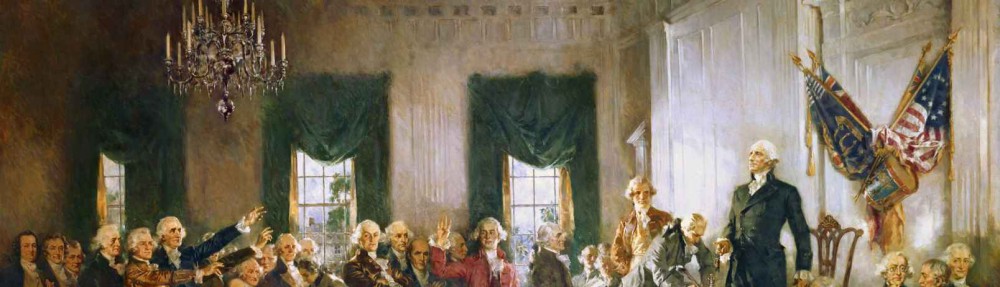
Franklin was 81 and in failing health when he attended the Constitutional Convention in 1787. Some of the moving forces at the convention, such as Alexander Hamilton and James Madison, were still young and establishing their reputations, but once again it was the presence of Washington and Franklin at the convention that lent it prestige and public confidence. It was Franklin who quipped at the close of the final session that he had watched the sun carved on Washington’s chair and wondered whether the sun was rising or setting, “but now at length I have the happiness to know that it is a rising and not a setting sun.” It was Franklin, as Maryland delegate James McHenry recorded, who was immediately accosted outside the hall by a woman who asked what type of government Franklin and his fellow delegates had given them, prompting a reply that is one of his most storied: “a republic, madam, if you can keep it.”

Inside the hall, Franklin’s closing remarks reflect his insistence on putting unity and compromise above anyone standing on their own principles — and that included his late-in-life abolitionist convictions, upon which the new Constitution made delicate compromises:

Every possible objection has been combated. With so many different and contending interests it is impossible that any one can obtain every object of their wishes. We have met to make mutual sacrifices for the general good, and we have at last come fully to understand each other, and settle the terms. Delay is as unnecessary as the adoption is important.

I confess [the Constitution] does not fully accord with my sentiments. But I have lived long enough to have often experienced that we ought not to rely too much on our own judgments. I have often found I was mistaken in my most favorite ideas. I have upon the present occasion given up, upon mature reflection, many points which at the beginning, I thought myself immovably and decidedly in favor of . . . These objections shall never escape me without doors; as, upon the whole, I esteem the constitution to be the best possible, that could have been formed under present circumstances; and that it ought to go abroad with one united signature, and receive every support and countenance from us. I trust none will refuse to sign it.

Anyone standing on their objections, Franklin added with characteristic humor, would “put me in mind of the French girl who was always quarrelling and finding fault with every one around her, and told her sister that she thought it very extraordinary, but that really she had never found a person who was always in the right but herself.”
https://6de3a2ced07116514291ea4219c24df6.safeframe.googlesyndication.com/safeframe/1-0-45/html/container.html?n=0

We were fortunate to have men of genius such as Franklin at the Founding of the country. And we were fortunate to have men of his virtues, too. Any serious book on the American founding will not omit the flaws, foibles, and sins of Franklin and his contemporaries. Yet, in an inversion of the line that Shakespeare gives to Marc Antony, it is their virtues that have endured. Over and over, Franklin put his own good name and accumulated respect and goodwill on the line in service of his country — and not the other way around. He set his considerable ego aside to make compromises, secure a united front, and make room for dissenting views to be reconciled. It is not only Franklin’s inventiveness and vision that contributed so much to the making of America, but also his wisdom, humility, unselfishness, and congeniality.

What the Iran MOU Is Really All About

It’s not Israel. It’s not even Iran. Look closer to home.

At this point, everyone is familiar with the 14 points of the Memorandum of Understanding between President Trump and remnants of Iran’s power structure. The document appears to use careful, ambiguous diplomatic language, but it actually serves as a raw political instrument.  To decipher its true meaning, one must strip away the mannerly phrasing and read it in the plain political lexicon — the language of power, elections, and survival.

Article 1 states that midterm elections in America will take place in November 2026.

Article 2 specifies that they will occur on November 3, 2026.

Article 3 notes that these elections are nearly four months away.

Article 4 calculates the remaining time as approximately 20 weeks.

Articles 5 through 14 continue in the same vein: They emphasize the narrowing window and the need for visible results before voters go to the polls.  They manifest the importance of avoiding distractions that could shift media focus.  Finally, they raised the requirement that any international agreements produce measurable domestic benefits in time for Election Day.

The document never says these things directly.  Instead, it speaks of “regional de-escalation,” “energy market stabilization,” and “confidence-building measures.” Translated into the realpolitik domain, however, every clause points to one overriding objective: securing a conservative majority in Congress on November 3, 2026.

Basically, these articles make the metric explicit.  To win those elections, the average price of gasoline across the United States must remain below $4 per gallon — roughly less than $1 per liter.  That single number has become the administration’s key performance indicator for the next four months.

This translation reveals the central truth the Memorandum aimed to obscure: The primary threat to American national security at this moment is not Iran.  On the contrary, it is the possibility that the Democrat party regains control of Congress.


Basically, these articles make the metric explicit.  To win those elections, the average price of gasoline across the United States must remain below $4 per gallon — roughly less than $1 per liter.  That single number has become the administration’s key performance indicator for the next four months.

This translation reveals the central truth the Memorandum aimed to obscure: The primary threat to American national security at this moment is not Iran.  On the contrary, it is the possibility that the Democrat party regains control of 

Losing the Republicans’ congressional majorities in 20 weeks will weaken, or even turn off, the legislative and oversight tools Trump’s administration has used to pursue the “America First” agenda.  Investigations and impeachments will multiply, and funding for border security and military modernization will face constant resistance.  Most likely, Democrats will pull foreign policy back toward the multilateral frameworks they favored in previous administrations.  Trump’s signature on the Memorandum with Iran is therefore not primarily about Iran at all.  It is about locking in enough momentum and public support so that even a narrowed majority — or the threat of one — cannot easily reverse the structural changes already underway.

The principal perceptible and immediate lever for achieving that momentum is energy prices.  American voters feel gasoline costs at the pump every week.  When prices rise sharply, approval ratings for the party in power tend to decline, regardless of other economic indicators.  Historical patterns (recall 2008, 2012, and particularly 2021–2022) demonstrate how quickly pocketbook pain translates into midterm losses.  The $4-per-gallon threshold has emerged as a coarse psychological and political demarcating line.  Above it, the narrative of economic competence weakens; below it, the administration can credibly claim that its policies are delivering tangible relief.

The day after they signed the Memorandum, the national average gasoline price fell to $3.99.  Oil markets responded with further downward pressure.  This was not a coincidence.  The agreement signaled that the risk of sudden supply disruptions from the Persian Gulf had decreased, at least for the critical pre-election window.  At the same time, the administration accelerated domestic permitting and leasing on federal lands.  The combination created the political dividend Trump required: noticeable, pocketbook-level proof that his approach to the Middle East produces lower costs for American families.

If the oil-price game is relatively easy for attentive pundits to follow, the information arena is more opaque.  Public disagreements between President Trump and Prime Minister Netanyahu have generated headlines suggesting a serious rift.  Those who recall last year’s public friction between Trump — the most powerful man on the planet — and Elon Musk — the richest man on the planet — will identify the pattern.  At the time, many interpreted the exchanges as genuine estrangement.  In reality, they served a tactical purpose: allowing each side to speak to different audiences while preserving the underlying alliance.  The same dynamic is now unmistakable between Washington and Jerusalem.

The current posture is a classic “good cop, bad cop” arrangement.  Trump projects reasonableness and restraint to international audiences and to American voters who prefer stability during an election season.  Netanyahu continues to cling to a hard line, conducting operations against Hezb’allah infrastructure in Lebanon and signaling that Israel will not be constrained by external timetables.  Both leaders comprehend that calm on the international stage between present and November benefits their respective domestic positions.  China must not create a crisis over Taiwan.  Gulf Arab states, recently unified by Trump’s pressure on Iran, must avoid provocative moves.  Iran itself must absorb the recent setbacks without launching major retaliation that could spike oil prices or monopolize American news cycles.  Quiet serves everyone’s electoral calendar.

This arrangement has forced a hard realization in parts of the Israeli political establishment: A superpower’s domestic political needs will always take precedence over the preferences of even its closest allies.  The observation is harsh, yet it reflects the structural reality of great-power politics.  No American president can afford to let foreign crises dictate the domestic narrative in the months before a midterm election, especially one that will determine whether his agenda survives the remainder of his term.

The 250th anniversary of American independence on July 4, 2026 adds another layer of calculation.  National milestones of this scale are carefully stage-managed.  The administration does not want global headlines on that date postulating that the United States is “trampling the independence” of another country.  By empowering Israel to handle immediate threats in Lebanon during the spring and summer, the United States creates space for its citizens to celebrate the anniversary without the overlay of fresh Middle East escalation.  Israeli operations that degrade Hezb’allah’s capabilities reduce the chance of a major attack that could force American involvement or dominate the news.  In that narrow but important sense, Israeli soldiers are helping ensure that American families can mark the semi-quincentennial in peace.  Such contributions are rarely acknowledged publicly, but they are remembered in the corridors of power.  Moreover, ordinary Americans will never forget that.

The Memorandum, stripped of diplomatic language, is therefore a timetable and a scorecard.  It establishes a 20-week timeline and defines success in terms that voters can effortlessly grasp: reduced gas prices, the absence of foreign crises, and a political climate stable enough to render the administration’s core reforms difficult to reverse.

Whether one views the Memorandum as cynical or merely realistic depends on how much weight one assigns to the domestic political survival of elected leaders in democratic systems.  In either case, the document makes explicit what experienced spectators have long understood: in the final analysis, the most consequential battles for both America and Israel are still being fought inside the American political system.

Gary Gindler is a conservative columnist and author of two Amazon bestsellers, Left Imperialism (2024) and Left Anti-Semitism (2026).

Image via PixabayPixabay License.

Related Topics: Iran War2026 Elections

icon
icon
icon
icon
icon
icon
icon
icon

View & Add Comments12

SUPPORT AMERICAN THINKER

Now more than ever, the ability to speak our minds is crucial to the republic we cherish. If what you see on American Thinker resonates with you, please consider supporting our work with a donation of as much or as little as you can give. Every dollar contributed helps us pay our staff and keep our ideas heard and our voices strong. Thank you.https://givebutter.com/embed/c/WhA2EO?goalBar=false&gba_gb.element.id=gkx27p

Powered by Givebutter

Advertisement

After 60, Leg Strength Comes From One Simple Daily MoveApexLabs

Surgeons: This Simple Trick Will End Knee Pain & Arthritis Quickly (Try It)Health Weekly

Sponsored

Advertisement

null

Around the web

Advertisement

Surgeons: This Simple Trick Will End Knee Pain & Arthritis Quickly (Try It)Health Weekly

Getting Rid of Moles and Skin Tags Has Never Been This Simple Before!BHSkin Dermatology

Swollen Prostate? Do This Every Morning and Feel The Change in Just Days!Health Weekly

Cardiologists: How to Quickly Lose a Hanging Belly (Its Genius!)Purehealthcircle

Goodbye AC and Expensive Bills: This New AC Cooler Cools The Room in Secondsamestory

The Real Reason Your Sciatica Won’t Go Away (And How to Fix It)SmoothSpine

Bo Derek, Turned 68, Grab Tissues Before You See Herfolkaly

Honey: The Greatest Enemy of Memory Loss (See How to Use It)Health Weekly

Neurologists Beg Seniors With Neuropathy: Stop Doing This NowHealth Weekly

D.C. Approves 50-Cent Generic Viagra Program – Apply OnlineDartford Kent Review

Enlarged Prostate Has Nothing to Do With Age: Just Stop Doing This One ThingHealth Weekly

This New Air Cooler is All The Ragepeoasis

Revcontent
icon

Trending

Advertisement

After 60, Leg Strength Comes From One Simple Daily MoveApexLabs

Surgeons: This Simple Trick Will End Knee Pain & Arthritis Quickly (Try It)Health Weekly

Cardiologists: 2 Veggies Will Kill Your Belly Fat Like Crazy (Try It)Health Weekly

Neurologists Beg Seniors With Neuropathy: Stop Doing This NowHealth Weekly

Revcontent
icon

Most ReadLast 24hrsLast 48hrsLast 7 Days

Artículo

1

Peace For Our Time: A Lost War In Iran

Artículo

2

We’re learning more about Hillary Clinton; it’s not pretty

Artículo

3

The Four Jokers of the Apocalypse: Carney, Starmer, Macron, and Merz

Artículo

4

China discovers electric vehicles aren’t the future

Artículo

5

The US-Iran MOU is worse than we thought

Top ContributorsLast 7 DaysLast 30 Days

Eric Utter

M.B. Mathews

Selwyn Duke

Bill Ponton

Vince Coyner

SponsoredX

After 60, Leg Strength Comes From One Simple Daily Move

Surgeons: This Simple Trick Will End Knee Pain & Arthritis Quickly (Try It)

Valerie Bertinelli’s Son Wolfgang Van Halen’s Transformation Will Drop Your Jaws

Goodbye AC and Expensive Bills: This New AC Cooler Cools The Room in Seconds

Kamala Harris brutally mocked for saying ‘hope is a verb’ in latest confusing ‘word salad’

Julia Bonavita, Fox News

Former Vice President Kamala Harris offered podcast host Don Lemon her own definition of the word “hope” on Friday, resulting in a clip that has since gone viral on social media as a “word salad” response.

“I really, truly believe this,” Harris said. “We each have light inside of us. And we need to know that that is what inspires our hope as much as anything external to ourselves.”

The former vice president and 2026 presidential candidate continued her long-winded response, imploring Americans not to lose sight of their vision of the future when faced with political or personal loss.

“And when we feel that and and and not allow an election or an individual to dampen that light, and instead light, let that light kind of carry us in particular through moments of darkness, that that we not only act on that hope, but we inspire that hope in each other,” Harris added.

“And, in particular, at this moment, it is so important that we not only have hope, but that we understand that that should be a verb.”

Harris’ seemingly meandering answer quickly gained traction on social media, with critics blasting the former vice president.

“Good word salad answer that can be summed up in two words: stay positive,” one user wrote on X.

“When the teacher told you to write a 300-word essay but you could only think of 100 words,” another poster said.

Others pointed out that the word is already defined as both a verb and a noun.

Good word salad answer that can be summed up in two words: stay positive,” one user wrote on X.

“When the teacher told you to write a 300-word essay but you could only think of 100 words,” another poster said.

Others pointed out that the word is already defined as both a verb and a noun.

It’s a noun: ‘I have hope that she never runs for any government office again,’” a user posted to X. “And it is a verb: ‘I hope she never runs for any government office again.’”

Lemon asked Harris whether she is planning to run for the country’s highest office again in 2028.

“I have not decided, to be honest with you,” Harris replied, notably not ruling out a potential run.

I’ve been spending a lot of time traveling the country [and] listening to folks,” she continued. “I think that people want a leader who is willing to take risks, as opposed to just doing what is popular.

“I think people want to know that they are being seen and heard, and that their leaders — whether they’re at the local, state, federal level or in the White House — are looking first at the people. You know, not looking at themselves in the mirror.”

Trump’s ready to reopen mental institutions and liberals are furious…

How did we get to a place in this country where we’ve decided that the humane approach to severe mental illness is to just leave people alone and let them fend for themselves?

If someone is living on a sidewalk, talking to invisible people, wandering through traffic, or spiraling deeper into psychosis, government intervention is now treated like the “evil” thing to do. Activists, disability-rights groups, and this massive network of NGOs have spent decades arguing mental institutions should be used only in the rarest circumstances.

And the results of that disastrous agenda speak for themselves.

Cities all over America are drowning in homelessness, tent cities, violence, addiction, untreated mental illness, and public chaos. All while billions of taxpayer dollars flood into programs that “manage” the crisis rather than solve it.

It’s one big giant grift.

But help is on the way.

It appears the Trump administration is ready to challenge one of the legal foundations behind this scam system.

In a new memorandum, the DOJ claims that federal disability laws have been stretched way beyond what Congress intended, and this is creating restrictions that make it harder for states to step in and help when people are suffering with severe mental illness.

If that argument holds, it could be one of the biggest shifts in mental health policy in decades.

Devon Kurtz:

Today, DOJ broke with 35 years of bad law.

Regarding the integration mandates of section 504 and Title II of the ADA, “the regulations are unlawful.”

This is a shot across the bow for Olmstead and P&A groups that have weaponized it against state programs for the mentally ill.

So, activist groups and regulators are using disability laws to block states from giving needy people treatment so they can keep their grift going.

This is a battle to allow states to implement safety and treatment. It’s also a battle to end this vicious, heartless scam.

Joe Lonsdale:

For decades, the fed govt has been more focused on a psychotic person’s “right” to die on the street than a state’s right to intervene and help them get care. Now, the Trump DOJ is signaling that it will end DC’s incursion on psychiatric care, and let states decide what best helps their people. This is a disaster for the corrupt NGO-grift complex that feeds off permanent misery; it’s great for people in need of help, and those who want safe cities.

Meanwhile, the left is terrified that the mental illness situation could be solved. Left-wing publications like Mother Jones are sounding the alarm bells.

Mother Jones:

On Thursday, the Department of Justice quietly released a memo pertaining to the landmark 1999 disability civil rights case Olmstead v. L.C., which curtailed states’ power to institutionalize people diagnosed with mental illnesses, and related federal civil rights laws. That precedent, the Trump administration memo argues—in conjunction with federal civil rights and disability rights statutes—increases homelessness, a claim that likely signals a push to expand institutionalization in restrictive psychiatric facilities.

The administration’s claims, according to University of Michigan law professor Sam Bagenstos, are not rooted in fact.

“It’s just absurd,” says Bagenstos, general counsel for the Department of Health and Human Services and the Office of Management and Budget during the Biden administration, calling the Olmstead decision “one of the most effective tools in combating homelessness” by encouraging states to augment mental health and housing services outside institutions.

More concerning is the fact that the White House instructed the Justice Department to produce the document, which Bagenstos says “suggests we might potentially be seeing an executive order” directing DOJ and the Department of Health and Human Services to roll back rules meant to avoid institutionalization. The memo, however, does not change laws itself.

“This administration is trying to take away one of the most fundamental rights that people with disabilities have fought for,” said George Washington University law professor Alison Barkoff.

In December, for instance, the Department of Justice reached an agreement with South Carolina to expand supportive services for people with psychiatric disabilities to reduce rates of institutionalization.

Mother Jones is acting like the real crisis is Trump trying to fix the system, not the fact that the system is clearly broken and human beings are suffering.

Americans can see what’s happening on the streets. They see people in obvious mental distress living on sidewalks, wandering through traffic, screaming in public, and cycling through the same failed NGO programs over and over again.

And that’s why the left is protecting it. They don’t want to lose their government money and their “mail-in” ballot scam.

Roy Rogue:

My jaw literally dropped listening to this

Homeless woman in Los Angeles says NGOs come to them and register them to vote 5 TIMES PER YEAR and pay them $25

Multiple people all confirm they register the homeless 4-5x A YEAR EACH and pay them

This is why Democrats made ballot harvesting by 3rd party networks in California legal

They are registering the homeless to vote 5x each, providing the fake name and address information, and then ballot harvesting hundreds of thousands of ballots

America can’t move forward and be great again while homeless and mentally ill people are being held hostage by left-wing NGOs that have no interest in solving the problem. It’s in their financial and political interest to keep the mentally ill in a state of perpetual crisis.

Let’s hope President Trump can pull off another win and reopen the mental institutions.


Staff, Revolver News

Atlas of Iran’s Missile Cities – How the Islamic Republic built a hidden missile network across Iran – and how two wars exposed its limits

Here lies the man who wanted to destroy Israel.”

The words are carved into the tombstone of Hassan Tehrani Moghaddam, the man the Islamic Republic later called the father of its missile industry.

Almost in parallel with its nuclear program, the Islamic Republic spent nearly four decades advancing its missile program toward the goal Tehrani Moghaddam had written into his will: the destruction of Israel. It has not achieved that goal.

Iranian officials have long insisted that the program is solely defensive. But the tombstone of the man credited with building it tells a different story.

Tehrani Moghaddam was also a close friend of Imad Mughniyeh, the senior Hezbollah commander who was one of the most wanted militant figures in the world before his 2008 assassination in Damascus. In 1986, in the middle of the Iran-Iraq War, Tehrani Moghaddam traveled to Lebanon to help establish Hezbollah’s missile capability.

Over roughly 40 years, almost every part of the Islamic Republic’s system was, in one way or another, placed at the service of this program.

With the backing of Akbar Hashemi Rafsanjani, Iran’s president from 1989 to 1997 and one of the Islamic Republic’s most powerful postwar figures, the IRGC’s “Self-Sufficiency Jihad Organization” was established outside the Guards’ formal structure, giving the missile program greater autonomy.

Ali Larijani – a former parliament speaker and veteran nuclear negotiator who returned as secretary of the Supreme National Security Council in 2025 and was killed in an Israeli airstrike during the recent war – was the organization’s first managing director. He was the same politician later described, after his death, as a “philosopher-politician.”

The missiles the Islamic Republic has today owe much to early models purchased from Ukrainian arms dealers, North Korea and China during Mohammad Khatami’s presidency (1997 to 2005).

Under Khatami, Iran unveiled the Shahab-3, the first Iranian missile with enough range to reach Israel. While Khatami spoke of a “dialogue among civilizations,” Mohammad Bagher Ghalibaf, then commander of the IRGC Air Force, was digging tunnels and building underground missile depots in the Zagros Mountains – facilities that were later given the grandiose title of “missile cities.”

While Hassan Rouhani, Iran’s president from 2013 to 2021, and his foreign minister, Mohammad Javad Zarif, sold the nuclear agreement with world powers as a “win-win” diplomatic breakthrough, another project was advancing out of view. Amir Ali Hajizadeh, the IRGC Aerospace Force commander later killed in an Israeli strike, was expanding the underground depots Ghalibaf had dug across Iran and building new missile production and assembly complexes in the deserts around Shahroud, northeast of Tehran, and in the valleys of Khojir, one of the Islamic Republic’s key missile-production zones east of the capital.

During the same period, Iran expanded its southern missile cluster, designed to threaten shipping in the Strait of Hormuz and the Persian Gulf states.

This is the story of the Islamic Republic’s missile program inside Iran.

Missile Bases

The Islamic Republic has roughly 30 missile bases across Iran – the underground tunnels, depots and launch complexes that officials and state media call “missile cities.”

A chain of facilities in north-central Iran, stretching from Shahroud in Semnan province to Khojir east of Tehran and Bidganeh west of the capital, forms a key research-and-development corridor. The Isfahan complex, in central Iran, plays a major role in production and assembly.

Other clusters, including those around Tabriz in the northwest, Kermanshah in western Iran, Shiraz in the southwest, Khorramabad in the Zagros Mountains and the southern strip near the Persian Gulf, have been used to store missiles.

Missile depots have also been built in tunnels in Yazd, Kerman and other scattered bases across the country.

In the southern strip, especially during Rouhani’s presidency from 2013 to 2021, similar bases were built with vertical launch shafts, allowing missiles to be fired directly from hardened underground positions.

Although Islamic Republic officials like to portray the missile program as secret and unknowable, virtually all of these bases have been examined in scattered media and open-source intelligence reports over the past two years. Two organizations – Israel’s Institute for National Security Studies, or INSS, and the Alma Research and Education Center, an Israeli security research group focused on threats from Iran and its regional network – have been among the leading institutions mapping and analyzing these sites.

According to Morteza Azimi, a member of the OSINT Iran group, the underground tunnels are only one part of Iran’s missile bases. Satellite imagery shows that the bases include multiple facilities designed to support missile operations: buried concrete bunkers for launchers, elevated communications systems on mountaintops, and equipment for fueling and calibrating missiles.

The Islamic Republic’s missile capability is not just a collection of missiles. It is an operational network of launchers, command centers, communications sites, missile-guidance facilities and intelligence systems that help identify targets, coordinate launches and guide missiles beyond Iran’s borders.

This chain is designed to help missiles penetrate air-defense systems through various tactics, including submunition-dispensing warheads and midcourse maneuvers. Missile bases support different parts of that system.

Reports of air-defense radars being used in support of missile attacks show that Iran’s missile operations can rely on assets beyond the missile force itself, drawing on the wider military network for detection, tracking and targeting.

Key North-Central Chain

The facilities at Shahroud and Garmsar, and the Khojir and Parchin areas east and southeast of Tehran, form the key north-central chain of the Islamic Republic’s missile research-and-development program, from engines to fuel.

In an area of roughly 40 square kilometers southeast of Tehran lies the Shahid Bakeri Industrial Group facility, better known as Khojir. The area is one of the oldest and most important centers of the Islamic Republic’s missile program. Nearby, on the edge of Tehran, the IRGC Aerospace Force’s Hakimiyeh production complex is located.

Military expert Farzin Nadimi told Iran International that Hakimiyeh is significant because it brings together several missile-related industrial groups in one area, including the Mahallati, Kazemi, Jahanara, Mofatteh, Rezvan, Namjoo and Chamran groups.

Nadimi said most of the area’s metal structures and metallurgy industries are concentrated there. For example, at the Shahid Jahanara Industrial Group, fuel tanks are produced for liquid-fuel missiles such as the long-range ballistic missile Khorramshahr.

About 11 kilometers from Khojir, south of the Mamloo Dam, lies the Shahid Hemmat facility, better known as Parchin. The name Parchin is more familiar internationally because of its long association with the Islamic Republic’s nuclear file and suspected weapons-related work. The recently exposed Taleghan 2 site is located inside the same complex.

A major fire was first reported at Parchin in 2007. In 2020, the site was hit by a powerful explosion that The New York Times reported may have been deliberate.

In 2022, Israel carried out its first drone attack on the site. During the 12-day war in June 2025, this area became one of Israel’s main targets and was bombed repeatedly.

Deh Torkaman

The Deh Torkaman facility lies inside the Khojir area southeast of Tehran, near Hajarabad and Deh Torkaman, from which it takes its name.

Satellite imagery shows that, as of 2012, there were no significant facilities in this area. Construction and development began in 2013 and continued until the site reached its current form by 2021.

The Washington Post reported, citing satellite imagery taken in March, that at least 88 buildings in the Khojir complex, including the Deh Torkaman section, were targeted during the US-Israeli offensive.

Development Timeline of the Deh Torkaman Facilities in the Khojir Area.

Iran International

We’re learning more about Hillary Clinton; it’s not pretty

If you thought Hillary Clinton was awful, you had no idea.

Buzz Patterson was the Air Force pilot who, as a Major, carried the nuclear football for Bill Clinton. He has since written several best-selling books about his experiences in the Clinton White House. He has also written about those experiences on X.  The Daily Mail provides some insight: 

[Patterson] said he primarily lived in the White House and was ‘always in close proximity to both Bill and Hill’, which made him quickly learn that the mood of the day ‘depended solely on the presence or absence of Hillary.’ [skip]

He said in his X post that the day-to-day work for Clinton varied dramatically based on Hillary’s whims, as he scathingly described her as ‘evil, vindictive, profane’ and ‘a b****.’ 

‘Among the military who served in the White House and the professional White House staff, the Clinton administration was infamously known for its lack of professionalism and courtesy, though few ever spoke about it,’ he wrote. 

‘But when it came to rudeness, it was Hillary Clinton who was the most feared person in the administration. She set the tone.’ 

With DNI Tulsi Gabbard resigning to care for her cancer-stricken husband, we’re learning more about Hillary Clinton and the Russia hoax, as Fox News reports:

“As of September 2016, the Russian Foreign Intelligence Service had DNC information that President Obama and Party leaders found the state of Secretary Clinton’s health to be ‘extraordinarily alarming,’ and felt it could have ‘serious negative impact’ on her election prospects,” the report states. “Her health information was being kept in ‘strictest secrecy’ and even close advisors were not being fully informed.” 

The Russian Foreign Intelligence Service also allegedly had DNC communications that showed that “Clinton was suffering from ‘intensified psycho-emotional problems, including uncontrolled fits of anger, aggression, and cheerfulness.'” 

“Clinton was placed on a daily regimen of ‘heavy tranquilizers’ and while afraid of losing, she remained ‘obsessed with a thirst for power,’” the report states.

Clinton’s reported fondness for alcohol in combination with tranquilizers would certainly have contributed to the emotional instability and health problems Americans witnessed during Hillary’s campaign against Trump and her behavior thereafter.

The Russians also allegedly had information that Clinton “suffered from ‘Type 2 diabetes, Ischemic heart disease, deep vein thrombosis, and chronic obstructive pulmonary disease.’”

Here’s the real Russian revelation:

The Russians also allegedly possessed a “campaign email discussing a plan approved by Secretary Clinton to link Putin and Russian hackers to candidate Trump in order to ‘distract the American public’ from the Clinton email server scandal.” 

What we’ve always suspected now seems confirmed:

“Then CIA Director Brennan and the intelligence community mischaracterized intelligence and relied on dubious, substandard sources to create a contrived false narrative that Putin developed a, quote unquote, ‘clear preference’ for Trump,” Gabbard said. “Brennan and the IC misled lawmakers by referencing the debunked Steele dossier to assess, quote unquote, ‘Russia’s plans and intentions,’ falsely suggesting that this dossier had intelligence value when he knew that it was discredited, the intelligence community excluded significant intelligence and ignored or selectively quoted reliable intelligence that contradicted the intelligence community assessments.” 

“Key findings on Putin’s alleged support for Trump, including this intelligence reporting, would have exposed the ICA’s claim as implausible, if not ridiculous,” she said. 

This was only the beginning of the Obama/Clinton attempt to rig the election for Clinton, and their continuing coup after Trump was elected. The article goes into substantial detail, confirming the elements of that plot.

Since her failed White House bid, Hillary has become ever more angry and bitter, and seldom wastes an opportunity to attack Trump, as she did when he staged a patriotic extravaganza on the White House lawn, featuring a military jet flyover, patriotic music provided by the Marine Band, and a UFC fight. She’s certainly no more fond of “Deplorable” Americans who can never be forgiven for failing to elect her, or for Trump’s remodeling of the White House. Buzz Patterson, once again delivering faithful service to America, provided a dose of blunt reality:

T.W. Shannon to Newsmax: Obama Should Answer Unpaid Contractor Claims

Oklahoma Republican lieutenant governor nominee T.W. Shannon criticized the opening of the Obama Presidential Center in Chicago, arguing that the project highlights concerns about voter identification, community impact, and reports of unpaid contractors.

Shannon made the remarks during a Friday appearance on Newsmax’s “Wake Up America” while discussing the opening of the Obama Presidential Center on Chicago’s South Side.

The center officially opened this week in Jackson Park after years of planning, legal challenges, and construction. Supporters have praised the project as a major investment in the South Side, while critics have raised concerns about rising housing costs, displacement, and the project’s effect on surrounding neighborhoods.

Asked about the center’s opening ceremony, Shannon said one aspect of the event reinforced a point Republicans have made for years regarding voter ID laws.

“First of all, I was really happy to see that they proved one point that Republicans have been saying for a very long time. Black people do have IDs,” Shannon said.

“So, you know, they require ID for everybody to get in. And it’s on the South Side of Chicago. It’s tickets are sold out through November. So Black people are going to see this, and they’re going to have to present an ID. So we now can end the charade that Black people can’t get IDs.”

Shannon said he also was disappointed by what he viewed as a lack of gratitude expressed during the ceremony.

“I did watch the ceremony because I love Stevie Wonder. I knew he was performing,” Shannon said.

“But I was sad for him, you know, this country has been extraordinarily good to Michelle and Barack Obama. And I’ve yet to hear a thank you.

“I hear a lot of complaints. I hear a lot of bemoaning about what hasn’t been done and what wasn’t done and what was done 400 years ago. But I haven’t heard a thank you to a country that’s been extraordinarily good, to a family that became, you know, the first family of the United States of America.”

Shannon reserved his strongest criticism for reports that some contractors involved in the project remain unpaid for work they performed.

“The saddest part is you do have contractors. A lot of them are minority and Black-owned businesses that have not been paid,” Shannon said. “Obama should do better than that. He knows better.”

Contractor payment disputes have shadowed the center’s opening. Several subcontractors have publicly alleged they are owed money for work performed on the project, though project officials have disputed claims that the Obama Foundation itself bears responsibility for those payments.

The center’s opening also has renewed debate over its impact on surrounding communities. While supporters argue the project will bring jobs, tourism, and economic development to Chicago’s South Side, some neighborhood activists have voiced concerns about gentrification and rising housing costs in nearby communities.

Shannon said those concerns, combined with the contractor disputes, detracted from what otherwise could have been a celebratory moment for the former president’s legacy project.

Newsmax

Did Trump Snooker Iran?

Trump may have given Iran everything it wanted on paper—but the real question is whether Tehran fell for a deal that gives America the leverage to walk away.

To evaluate the Iran Memorandum of Understanding on its merits, beyond the hype, let’s start by separating what we know from what we don’t.

Iran’s military has been destroyed. It has no air force, no navy, and no air defenses.

We have obliterated Iran’s uranium enrichment plants, its uranium mills, and its uranium hexafluoride conversion facility, as well as the secret bomb-making workshops in Parchin that Iran would never allow the IAEA to inspect.

We have destroyed most of Iran’s ability to manufacture drones and ballistic missiles.

We have shattered the Iranian economy.

We have pitted the regime against itself, as seen in recent demonstrations organized by hard-liners against the MoU.

We have also demonstrated that America has a new “special relationship”—with Israel, not Britain. We have gone to war with the IDF, flying thousands of joint air missions without a single mishap, something we could arguably not do today with our NATO allies.

These are facts, and they are major accomplishments of a military campaign that no previous American president has been willing to attempt.

But we did not defeat the Iranian regime. That, too, is a fact—one the regime reminds the U.S. of every day.

Not only do they appear to be undeterred, but they enjoy taunting us, threatening to “bloody” our noses, and deliver a “harsh blow” should we not keep up our commitments under the MoU.

But just what are the U.S. commitments?

The 14-point MoU reads like a wish list crafted in Tehran. And I suspect that is exactly what it is. (More on that below).

Over the past several weeks, I have watched with disbelief as pro-regime media in Tehran released this or that version of the accord, including what appeared to be U.S. commitments to establish a $300 billion reconstruction fund and to withdraw all U.S. military forces from the region.

Astonishingly, those measures do indeed figure in the 14-point MoU. Paragraph 6 says that the United States “undertakes with regional partners to develop a definitive, mutually agreed plan with at least USD 300 billion for the reconstruction and economic development of the Islamic Republic of Iran.”

Paragraph 4 states that the United States “undertakes to remove its forces from the proximity of the Islamic Republic of Iran within 30 days after the final deal.”

These are just two of the extraordinary concessions made by Trump’s negotiating team to the Iranian regime. Other concessions include immediately releasing frozen Iranian assets, and the future removal of sanctions.

But will all of those U.S. concessions actually occur? Listening to President Trump at his G7 press conference on Thursday suggests perhaps not.

He said that if the Iranians didn’t hold up their end of the agreement—opening the Strait of Hormuz and surrendering their nuclear material—then the U.S. would return to bombing, maybe for two weeks, maybe for two years.

He also said the U.S. wasn’t putting up one cent for the reconstruction fund. Any U.S. “contribution” would come from Iranian money the U.S. has frozen and now has pledged to release.

It all raises the question whether Trump didn’t somehow snooker the Iranians.

That’s right.

From the man who said the Iranians had never won a war but never lost a negotiation, did Team Trump actually get the better of the Iranians in this deal?

He gave them all they could possibly want. But it’s not a deal. It’s an MoU.

It contains only three active pieces: an end to immediate hostilities, opening the Strait, and an undefined release of frozen Iranian assets. Everything else is to be negotiated at a later date, in principle, by August 15.

Those follow-on negotiations were supposed to have started in Geneva on Friday, June 19—the day after Trump signed the MoU publicly at the G7 conference in Evian.

But nobody came.

Ever since Jimmy Carter, U.S. presidents have bet a piece of their presidency on the quixotic notion that somehow they could offer the Iranians something so enticing they would change their behavior.

But I have long argued that this Iranian regime can never change the behavior we object to. It can never abandon its nuclear ambitions; it can never give up its terror proxies; it can never abandon the charter of the Islamic Revolutionary Guards Corps, which is to spread the Islamic revolution around the globe, because these are core values of the regime.

Give up on those core values, and the regime disintegrates.

JD Vance has made clear that the goodies contained in the MoU are all “performance-based.” In other words, if the Iranians don’t deliver on their commitments—whether it’s the ceasefire itself, freedom of navigation in the Strait, or the surrender of their nuclear program—then they will not receive the benefits set forth in the MoU.

And that’s what leads me to suspect that the president may actually have snookered the Iranians.

When they see a U.S. president offering them $150 billion in sanctions relief, as Obama did, they take it to the bank. It’s not up to further negotiation; it’s a fait accompli.

But with President Trump, those bets are off. They can point to all the goodies they believe they are entitled to in the 14-point MoU, but until Trump declares that they have fulfilled their commitments, they won’t be getting them. Not a one.

So what does the MoU achieve? It settles the oil markets, it fuels the stock market, and arguably it enhances the chances of the Republicans to win the midterm elections. If it collapses on November 5 because the Iranians didn’t carry out their part of it, so be it. America will be back to war without the restraint of another election..

American Greatness