A former AOC (Alexandria Ocasio-Cortez (D-NY)) aide is a Communist. She doesn’t defensively admit she’s a Communist; she proudly brags about it.
AOC does not disassociate herself from her former aide. Why should she? AOC’s policies, like those of the entire Democratic Party, are now TOTALLY COMMUNIST.
Justine Medina, AOC’s pal and fellow Communist writes, “Communism is about equality, democracy, peace, the advancement of workers, the oppressed, and humanity in general. It is the true path; there will be unkind[ness] to those who block progress, but Communism is good and should not scare you.” She is now the senior official in the New York State Communist Party.
Wow. When a terrorizing, air-headed morally vacant thug tells you not to be scared, you should be scared. The only reason to be scared? Most are not paying attention and think it can’t happen here, and will never happen here. But it’s happening, and you don’t need AOC to ensure it. Joe Biden — the pitiful, half-dead puppet — will do just fine. With virtually no opposition worthy of the name, America is going down, and most people hope and pray that somehow a (rigged) election will fix everything.
Communism uses force and brutality to serve its ends. This has has been the case, whether in Venezuela, Cuba, Nicaragua, Soviet Russia, Maoist China or anywhere else. Communism HAS to use force and brutality, by definition. Why? Because some people have to be sacrificed to others. “From each according to his ability; to each according to his need.” That’s the Marxist credo of Communism. It’s an ideology of “share the wealth” — through brute force. Remember Stalin and Mao? They slaughtered millions to attain their ends. None of their ends were achieved, but the slaughters could not be reversed.
No worries, say Medina and — by extension — AOC and the modern Democratic Communist Party in America. Communism is nothing to fear — so long as you agree with it, and so long as you do what you’re told.
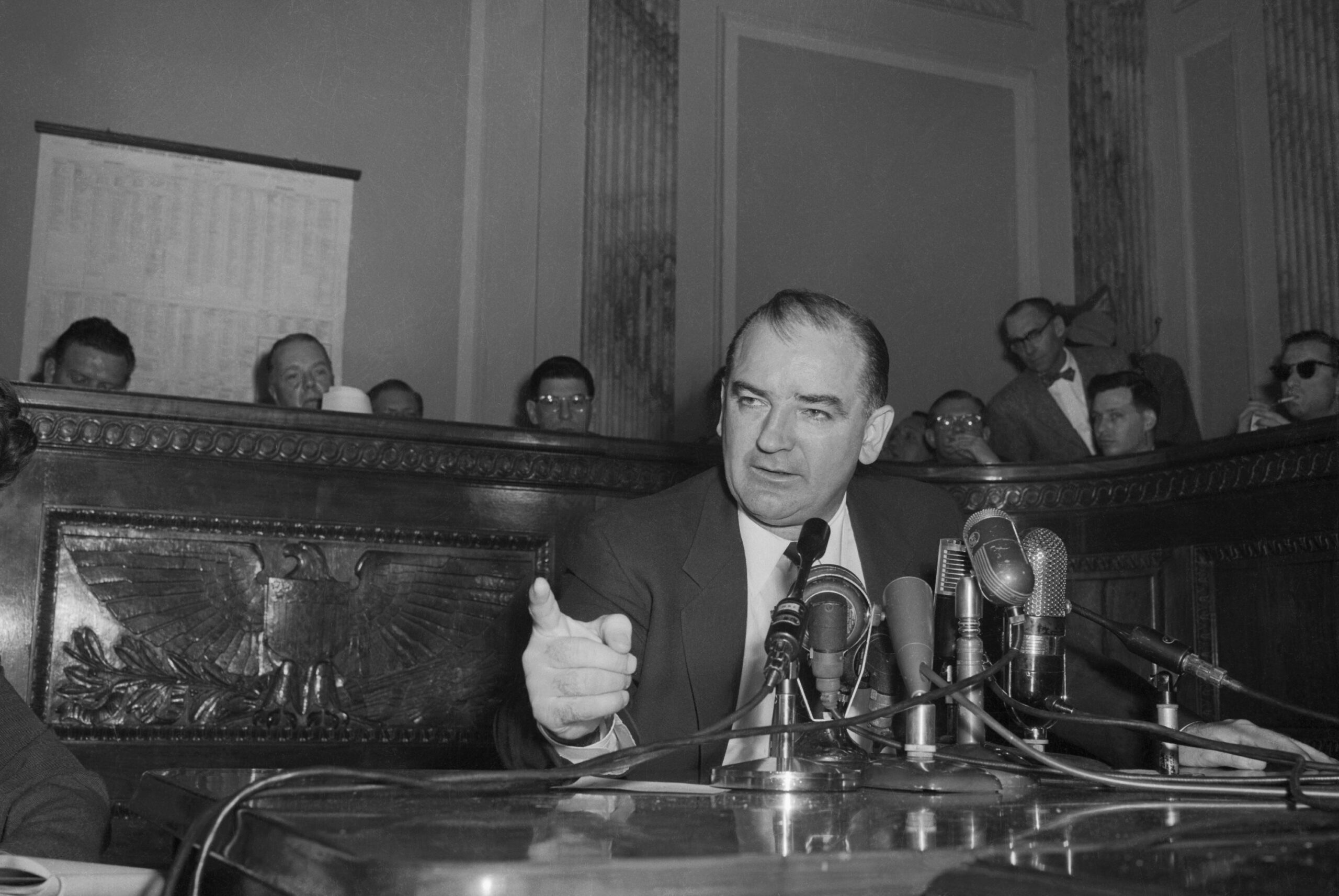
Joseph McCarthy was right. Communism did eventually take over America. But not by stealth. Out in the open, and with barely a whimper from what passes as opposition.
So in a way, McCarthy was wrong. He underestimated just how weak, ignorant, cowardly and stupid most Americans would become.
The proper evaluation of the United States in relation to slavery is this: ending slavery by fighting and winning the Civil War was a tremendous moral achievement and should be celebrated.
Slavery is an evil institution. It is a total violation of individual rights.
America did not create slavery
However, a routinely hidden secret in pubic discourse is the fact that America did not create slavery. Slavery has been part of world history for millennia. The first recorded report of slavery occurred about 9,000 years ago. Slavery existed in various forms in the Arab world, Africa, Assyria, Babylonia, China, Egypt, Greece, India, Italy, and Russia.
The prevailing explicit or implicit political view in the premodern world was that “might makes right.” It was considered only natural that the more militarily powerful tribes or cities had the right to enslave the less powerful. This was true even in ancient Greece; the city-states often fought each other.
If there were ever to be an alternative viewpoint, it had to be discovered as a product of philosophy. As noted earlier, a critical turning point in world political history was the 1690 publication of John Locke’s momentous Second Treatise on Civil Government. Locke argued that rather than citizens existing to serve the government, the government should exist to protect individual rights. Specifically, citizens should be protected from the initiation of force by the government (as well as by criminals). He argued that when the government usurped the rights of its citizens and could not be reformed, it was proper to overthrow it. Locke was the core philosopher of the American Revolution (Thompson, 2019).
Slavery before Locke was not based on the evasion of a valid, known moral principle but on moral ignorance. Even the Bible took slavery for granted. Locke’s theory made it clear that dictatorships, including those that espoused slavery, were immoral.
But there is more. Slavery was not brought to the U.S. by the vote of its own citizens. Until 1783, America was a British colony, and it was the British who brought slaves here for economic reasons: the British needed labor to grow sugar cane, tobacco, and cotton. To morally condemn the American colonies, which were under British rule, for a condition created by the colony’s rulers, is a gross injustice. The attacks on America put forth in The 1619 Project are a thinly veiled attempt to cause today’s Americans to feel unearned guilt for the unchosen actions of their colonial ancestors.
Slavery is based on statism, not capitalism
Another fallacy is that slavery was based on capitalism. This is a flagrantly dishonest claim, an obvious left-wing smear. Capitalism involves voluntary trade (see Assertion 21). Under capitalism the employer can offer a job and the job seeker has the right to accept or refuse it. Employees who dislike their job can quit anytime they want. Employees have to be paid; the employer does not have the right to make them work at gunpoint. The fact that slave owners bought and sold slaves does not make slave owners capitalists; they were flagrant criminals.
The first step needed in promoting a new theory of government based on Locke’s principle of individual rights was to free America from British rule. Battling slavery would have been pointless given that the White colonists were more numerous than their Black slaves (27 million White colonists v. 4.5 million Black slaves) and were not free themselves.
The two heroic American figures in freeing America were Thomas Jefferson and George Washington. Jefferson, with the help of others, wrote the Declaration of Independence (1776), which was based on Locke’s theory. The Declaration led to America becoming an independent nation, thanks to General Washington, without whom we would surely have lost the Revolutionary War. The regrettable fact that both men owned slaves, a leftover of British rule, does not undo their positive achievements. These achievements, in the end, doomed slavery.
It soon became obvious that the Declaration of Independence and slavery were incompatible. The Constitution, though correct in advocating rights, involved a temporary but tragic compromise with the South based on the probably justified fear that a divided nation would not survive. The British could have come back to protect their investments. There was a war in 1812. But it was inevitable that an abolitionist movement would arise.
Another great American hero was Frederick Douglas an escaped slave who spent decades talking and writing against slavery. It became more and more obvious that the Declaration of Independence and slavery could not long exist in the same country (or in the same mind) without evasion. The South saw the potential threat to its economy, which was based on slavery and the White Southerners’ feelings of racial superiority. As a result, the South resisted emancipation to the death. The inevitable result was the Civil War.
There were two more heroes here. The first was General Ulysses Grant,without whom the Union would certainly not have won the Civil War (the South was counting on a stalemate). The second was President Lincoln, who supported Grant and emancipated the slaves, and who would surely not have been re-elected without key Union victories.
The US ended slavery
The proper evaluation of the United States in relation to slavery is this: ending slavery by fighting and winning the Civil War was a tremendous moral achievement and should be celebrated.
Most revolutions in history have simply replaced one dictator or tribe with another. The American Revolution was based on a moral theory founded on reason and rights. Hundreds of thousands of men fought and died in the Civil War in the name of morality. The right side won. Shockingly, in today’s hostile, anti-intellectual climate, Jefferson, Washington, Lincoln, and Grant, all of whom deserve the utmost admiration, have been roundly condemned. In many cases, their statues have been torn down or threatened.
The Civil War, of course, was only the beginning. The next issue was how to put the Declaration and the Constitution into action because those immortal documents did not end prejudice or violence against Black Americans.
Frederick Douglas, the great abolitionist, was disappointed in the aftermath of the war. Backs still did not have equal rights. President Grant used Union troops for some time during reconstruction in order to protect Black Americans, but Grant lost his power, and the protection did not last. Racial violence thrived. One cause was that the White South never fully accepted defeat and greatly resented both the loss of slaves and the feeling of superiority that slavery gave them. State and local politics in the South backed forced segregation, vote prevention, corrupt courts, police brutality, murder, and more. A second cause of continued racial violence was that Southern politicians still had enormous power in Congress. Many bills could not be passed without their cooperation. Of course, racism also existed in the North but was less institutionalized.
And yet, the best people kept pushing back. Making Blacks equal before the law has been a critical ongoing project for over 150 years. We would all, of course, wish that progress had been made faster but changing 9000 years of history is not that easy. Many people stood in the way of progress. We can condemn those people who stood in the way while admiring those who moved us forward.
Most revolutions in history have simply replaced one dictator or tribe with another. The American Revolution was based on a moral theory founded on reason and rights. Hundreds of thousands of men fought and died in the Civil War in the name of morality. The right side won. Shockingly, in today’s hostile, anti-intellectual climate, Jefferson, Washington, Lincoln, and Grant, all of whom deserve the utmost admiration, have been roundly condemned. In many cases, their statues have been torn down or threatened.
The Civil War, of course, was only the beginning. The next issue was how to put the Declaration and the Constitution into action because those immortal documents did not end prejudice or violence against Black Americans.
Frederick Douglas, the great abolitionist, was disappointed in the aftermath of the war. Backs still did not have equal rights. President Grant used Union troops for some time during reconstruction in order to protect Black Americans, but Grant lost his power, and the protection did not last. Racial violence thrived. One cause was that the White South never fully accepted defeat and greatly resented both the loss of slaves and the feeling of superiority that slavery gave them. State and local politics in the South backed forced segregation, vote prevention, corrupt courts, police brutality, murder, and more. A second cause of continued racial violence was that Southern politicians still had enormous power in Congress. Many bills could not be passed without their cooperation. Of course, racism also existed in the North but was less institutionalized.
And yet, the best people kept pushing back. Making Blacks equal before the law has been a critical ongoing project for over 150 years. We would all, of course, wish that progress had been made faster but changing 9000 years of history is not that easy. Many people stood in the way of progress. We can condemn those people who stood in the way while admiring those who moved us forward.
Edwin A. Locke is Dean’s Professor of Leadership and Motivation Emeritus at the R.H. Smith School of Business, University of Maryland. He is a Fellow of the Association for Psychological Science (APS), the American Psychological Association, the Society for Industrial & Organizational Behavior, and the Academy of Management. He is the recipient of the Distinguished Scientific Contribution Award (Society for I/O Psychology), the Lifetime Achievement Award from the Academy of Management (OB Division), the J. M. Cattell Award (APS) and the Distinguished Scientific Contribution Award from the Academy of Management. He, with Gary Latham, has spent over 50 years developing Goal Setting Theory, ranked No. 1 in importance among 73 management theories. He has published over 320 chapters, articles, reviews and notes, and has authored or edited 13 books including (w. Kenner) The Selfish Path to Romance, (w. Latham) New Directions in Goal Setting and Task Performance, and The Prime Movers: Traits of the Great Wealth Creators. He is internationally known for his research on motivation, job satisfaction, leadership, and other topics. His website is: EdwinLocke.com
A man, an ex-Marine with no criminal history, restrains a known mentally insane, violent man on a New York City subway. In the process, he saves himself and others on the train from probable physical harm. At first, the idea of prosecuting him is too much even for New York DA Alvin Bragg, the Soros-appointed lawyer whose explicit intention is to destroy American cities and the American republic, starting with made-up charges against former President Donald Trump. However, after Black Lives Matter and other domestic terrorists weigh in, openly threatening to shoot up New York City if the ex-Marine, named Daniel Penny, is not immediately arrested and prosecuted for murder (or at least manslaughter), then Bragg gives in and proceeds to arrest Penny.
“[Daniel Penny] did the right thing,” Guardian Angel’s founder Curtis Sliwa said on Newsmax. “You give the Marine the benefit of the doubt who served America, not Neely, who already was listed as one of the 50 most dangerous people living in the subways.
“We spend millions to catalog who are the most dangerous and we don’t remove them and put them in shelters or psychiatric facilities.”
You do NOT want to live in or near New York City. The police are politicized, and they will protect citizens only according to political standards — not normal, reasonable police standards in a free society. And if you try to defend yourself in lieu of police, if you’re not in a politically protected class (or worse still, if you’re in a politically hated class, such as white, male and heterosexual) — well, you’ll be toast.
Stay the hell away from blue states and cities. Let these ignorant mounds of barbarism collapse of their own irrationality.
In the present-day world, a procapitalist foreign policy is indistinguishable from a pro-American foreign policy. The United States is the world’s leading capitalist country. It is so on the basis of its fundamental laws–its Constitution and Bill of Rights. And, not surprisingly, it is hated for it. It is regarded by much of the rest of the world in the same way that within the United States the minority constituted by businessmen and capitalists–the “rich”–are regarded by much of the rest of the American citizenry. If the United States is to stand up for itself, it must learn to stand up for capitalism.
The most essential point which needs to be recognized is that to the extent that the United States is a capitalist country, its government is morally legitimate, because to that extent its government acts to defend individual rights, and the powers it exercises consist of nothing more than those of the individual’s delegated right of self-defense. By the same token, governments which do not recognize the existence of individual rights, governments whose very existence is based on the premise of the forcible sacrifice of the individual to the collective, have no moral legitimacy. This means, above all, that the surviving Communist regimes, such as those of mainland China, North Korea, and Cuba, and many, if not most of the governments of the so-called third-world countries have no moral legitimacy.
The overthrow of these governments is earnestly to be desired on behalf not only of their own citizens, who are enslaved, but also on behalf of the people of the entire world, who are forcibly deprived of the benefits they could otherwise derive if these countries were free–benefits in the form of the free development of the talents of the citizens of those countries and the free development of their natural resources. A major principle here is that the violation of the rights of the individual anywhere is an attack on the well-being of people everywhere.
A foreign policy based on these principles would deal with such governments as bandits and outlaws, temporarily holding power by means of force and fear. This does not mean that it would be the obligation of the U.S. government to go to war with such countries if it were not itself attacked or directly threatened by them. But it certainly does mean, as a minimum, that the U.S. government should do nothing to promote the existence of such governments. It should certainly not aid them in any way, nor provide them with any kind of forum in which to defend their crimes, nor denounce those who prevent them from expanding their power or who prevent similar regimes from coming to power in the first place.
As examples from the recent past, the U.S. government should certainly not have provided Soviet Russia or Communist Poland with free food or loan guarantees. Instead, it should have allowed them to suffer the famines that socialism causes, while at the same time explaining to the world how socialism was the cause of the famines and thus how millions were forced into starvation because of the power-lust of the Communist rulers and their insistence on the preservation of the socialist system. It should have led world opinion in demanding that the Communist rulers step down and the socialist system they had imposed be abolished, so that the citizens of the Communist countries could become free to produce and live. Had the United States followed this policy, the collapse of communism would have occurred decades earlier.
Today, the United States should withdraw all official recognition from the remaining Communist-bloc countries and from totalitarian third-world countries, such as Iran, Iraq, and Libya, and expel their diplomats and alleged trade missions. It should end all so-called cultural exchanges with such regimes. If necessary, it should withdraw from the United Nations and expel that organization from U.S. territory. The only purpose served by the presence of these individuals and institutions is spying, terrorism, and subversion. If the governments of these countries wish to continue to be recognized, the prime condition must be their formal disavowal of socialism and the adoption of a genuine plan for the protection of individual rights and the establishment of capitalism in their countries.
It should be recalled that the very fact of the United States adopting a policy of laissez faire and respect for private property rights at home would itself go a long way toward undermining the power of today’s leading terrorist governments, namely, those of the Middle East. At the same time, it would cut the ground from under the resurgence of religious fanaticism in the region, which, like the arms build-up by governments in the region, is financed by money derived from an artificially high price of oil. These results would follow because a leading consequence of the adoption of a policy of laissez faire and respect for private property rights by the United States would be a great increase in the supply of domestically produced oil and other sources of energy, which latter, as substitutes for oil, would cause a reduction in the demand for oil. In the face both of a substantial increase in the supply and reduction in the demand for oil, there would be a sharp decline in its price. Thus, the revenues that finance the terrorists and fanatics would sharply decline.
* * *
A major obstacle to the pursuit of a proper foreign policy by the U.S. government is the incredible corruption of thought which exists not only within the United States but, to a much greater degree, in the rest of the world. This corruption was blatantly evident in the fact that throughout the so-called cold war, the state of world opinion was such that the expulsion of Communist diplomats from the United States would have been regarded as an act of aggression on our part. A call for the Communist leaders to step down and end the enslavement of their citizens would have been regarded as a transgression against their allegedly God-given right to enslave–or, as it is customarily put, “an interference in the internal affairs of sovereign nations.”
The ability of the United States to pursue a proper foreign policy and the ability of foreign countries themselves to move toward the achievement of a capitalist society depends on the spread of procapitalist ideas abroad. To say the same thing in different words, both our immediate national security and our long-run goal of the establishment of a fully capitalist society throughout the world, with worldwide free trade, freedom of investment, and freedom of migration, require that we be interested in the spread of proreason philosophy and procapitalist economic theory in foreign countries as well as in the United States.
A major task in the years ahead must be to bring about the translation of all of our main books into all of the world’s major languages. Human Action,Socialism,Atlas Shrugged, and about fifty or more other titles, should be made available in Russian, Polish, and Chinese, as well as in Japanese, Korean, Arabic, and all the other leading languages. Efforts should be made to promote the circulation of these books everywhere. I do not agree for a moment with the notion that only people brought up in the United States or Canada can readily appreciate our literature. Our philosophy recognizes only one reality and one human nature. No matter what intellectual and psychological obstacles a particular culture may create in the thinking of people, there is always some significant number who are open to new ideas. Our commitment to our philosophy and our national and economic self-interest require that we try to reach these people. As an example of the importance of doing so, just imagine the effect on our national self-interest of a totalitarian regime’s someday having to deal with people who have come to realize that each individual possesses reason and has an inalienable right to life, and that their reason and their lives are being sacrificed because of nothing more than the rulers’ willful refusal to abandon an irrational dogma. Imagine the effect of the regime’s being infiltrated by such people.
It should go without saying that all such intellectual efforts must be undertaken privately, not as an activity of the U.S. government.
As a further point in connection with what we should be working toward in the area of foreign policy, I would like to make a suggestion for another special campaign. This would be a campaign urging newspapers, magazines, and television stations which choose to maintain officially accredited reporters in Communist or other totalitarian countries to provide a warning label on all their reports from those countries which are obtained with government sanction. The label would identify the totalitarian nature of the country and state that no reason exists for regarding the report as anything but propaganda serving the interests of the government that originated it or sanctioned it.
Freedom of Immigration
We need to make a beginning toward the establishment of freedom of immigration. A logical place to begin would be in calling for free immigration from our immediate neighbors, Canada and Mexico. There is not the slightest reason for excluding Canadians. They are virtually indistinguishable from Americans, and had one or two battles gone the other way early in our history, would in fact be Americans. By the same token, had the Confederacy won the Civil War, then, with the prevalence of today’s ideas, present-day New Yorkers would probably not be able to migrate to Texas, nor Texans to California. Such restrictions, based on mere accidents of history, simply have no logical foundation.
It should not be necessary to add that the free immigration of Canadians, Mexicans, or any other nationality should not be at the expense of the immigration allowed under existing law to the members of any other nationality. As in the case of tax reduction, no one should be made any worse off than he now is, because of an attempt to improve conditions for anyone else.
The reason we must seek to abolish restrictions on Mexican immigration at the earliest possible moment is because the attempt to restrict it is in danger of making us adopt some of the most obnoxious features of the former South African regime–namely, a virtual pass law, in which people of Latin origin will have to carry identity papers to show on demand to immigration police, who, if they do not find the appropriate “papers,” will have the authority to destroy the lives of said individuals by uprooting them from their jobs and homes and deporting them. Already virtually Gestapo-like conditions exist in Southern California in connection with a notorious immigration checkpoint, where fleeing Mexicans of all ages and both sexes have often run into oncoming automobile traffic rather than be arrested by officers of the Immigration and Naturalization Service. This ignominy, I must note, has now been compounded by the recent passage of Proposition 187 in the state of California, which, if upheld in the courts, will actually impose the requirement of having an official identity card that must be shown on demand to the authorities.
Furthermore, the principle of private property rights implies that the Mexicans, and everyone else, have a perfect right to come here–to work for anyone who is willing to hire them and to live wherever anyone is willing to sell or rent to them. The violation of the rights the Mexicans or any other category of immigrant is a violation of the private property rights of employers and landlords–it is telling them that other people have the right to dictate whom they may or may not employ or to whom they may or may not sell or rent their property. It is a blatant manifestation of collectivism to believe that somehow the people of the United States as a whole have the right to tell the individual, private owners of property how they may use their property–that they must use it not as they, the private owners wish to use it, but as the nation collectively, or at least a majority of those voting, wish it to be used.
As I explained in Chapter 9, in a capitalist society free immigration does not deprive those already present of the opportunity of working and it does not reduce their standard of living. On the contrary, in the long run free immigration into a capitalist society from a semifeudal one, such as Mexico’s, must operate to raise the general standard of living in the capitalist society, because it means that more human beings will now live under freedom and have the opportunity to develop their talents. There are Mexicans and the children of Mexicans who have the potential for making the same kind of economic contribution to the general standard of living as have immigrants from other countries before them.
The only legitimate argument against unrestricted Mexican immigration (or unrestricted immigration of any other ethnic group) is based on the existence of our welfare state. To the extent that Mexicans come here and go on welfare and medicaid, or use public hospitals and public schools, and place an increased burden on government-subsidized public transportation facilities and so forth, then, it is true, there is a genuine loss imposed on the people already here. The solution, however, is not to violate the right of the Mexicans to immigrate, but to start dismantling our welfare state.
Without immediately abolishing the totality of the welfare state, which would be politically impossible, we could simply change its terms and make all noncitizens ineligible for its programs. This, of course, is essentially what a portion of California’s Proposition 187 seeks to do. However, that proposition also seeks to expel the immigrants and to deter further immigration through fear. Totally unlike Proposition 187, the mere exclusion of the immigrants from the welfare state would not impose any actual burden or disability on them. It would not be they who had to carry identity papers and prove why they should not be deported. There would be no question of that. On the contrary, it would only be the American citizens who sought the alleged benefits of the welfare state who would have to show papers and prove their citizenship.
While excluding the immigrants from the welfare state, we should simultaneously remove all government-imposed barriers to their being supplied privately with what they need. This would entail the removal of government licensing requirements in connection with meeting the medical, educational, transportation, and sanitation needs of the immigrants. As far as possible, this should be accompanied by privatization of such things as existing government-owned hospitals, schools, bus lines, and garbage-collection operations. An important result of privatization would be that the presence of the larger numbers of people resulting from immigration would be viewed as a source of more business, not more problems, as it is under the ineptitude of government ownership. In addition, in order to reduce the injustice that would exist in making immigrants pay taxes for the support of the welfare state for the native population, the immigrants should receive as nontaxable wages what would otherwise be their own and their employer’s social security and medicare contributions made in connection with their employment. The ironic effect of all these liberalizing measures would be to give the immigrants more freedom than today’s American citizens, and in that sense to make them truer Americans than today’s American citizens. If, at the same time, the immigrants could be reached with procapitalist ideas, this might well serve as the foundation for their being developed into a major group opposed to the welfare state for anyone.
In the present circumstances, it is especially important to make every effort to exclude immigrants from the public education system. At one time, it is true, public elementary education succeeded in educating pupils of all different nationalities in the three R’s. And even though its own existence represented a contradiction of the principle of individual rights, it instilled in pupils a basic respect and admiration for the United States. Today, public education teaches very little to anyone. It turns out masses of illiterates and students who have not the slightest idea of what the United States stands for. One of the last things we should want is today’s public education system teaching masses of immigrants in their own language. One of the major subjects that would be taught would undoubtedly be revolutionary Marxist nationalism. Under such conditions, as far fetched as it may sound, large-scale Mexican immigration into the Southwest could well result, one or two generations later, in a widespread demand for the return of the Southwest to Mexico. Thus, an important part of any campaign for free immigration for Mexicans should be an attack on public education and its Marxist domination. It is vital that the immigrants be assimilated as English speakers who support capitalism.
It would be enormously valuable if it could be explained to the immigrants that only the philosophy of individualism and respect for private property rights made possible their immigration. It would be legitimate to require of all immigrants an oath swearing to uphold the system of private property rights and to educate their children in the English language.
It would be a very short step from freedom of immigration for Mexicans to freedom of immigration for everyone.
Friendly Relations with Japan and Western Europe
Because of their exceptional economic strength and thus their potential someday to constitute a serious military threat to the United States, a cardinal principal of American foreign policy must be the maintenance of friendly relations with Japan and the countries of Western Europe. To assure this, what is necessary on our part is a policy of free trade, freedom of investment, and freedom of immigration–in short, a policy of full capitalism with respect to these countries. If we were to follow this policy, we would eliminate any possible economic basis of aggression against us on the part of these countries. And for all of the reasons shown in this book, from an economic point of view we could only gain from such a policy–probably very substantially. As I have shown, we would gain even if we alone were to follow a policy of free trade while the others clung to various protectionist measures. In that case our position would be analogous to the situation of a territory in which inbound transportation costs were lower than outbound transportation costs.
If we followed such a policy toward these countries, we could reasonably ask them to undertake a larger share of the defense of the free world, in accordance with the increase in wealth and income they have experienced. We would not have to worry that in doing so, we were encouraging potential enemies to arm, as we should presently be concerned.
Of course, the policy of full capitalism with respect to foreign relations should be applied to all countries. However, for the reasons stated, it is especially important in these two cases.
Copyright 1996 George Reisman. All rights reserved. The encyclopedic Capitalism: A Treatise on Economics is a required reference for every Capitalist’s library. Reisman’s treatise is now available in two volumes: Volume I (focuses on microeconomic issues) and Volume II (focuses on macroeconomic issues).
Dictatorships use their connections to the free world to get unearned respect, steal technology and money, and spread propaganda. The best solution would be to achieve the highest degree of separation possible between the free world and the unfree world.
We need to take seriously the lesson of the last 25 years. It is because the peace process negated the principle of moral judgment, that it enabled the Palestinian movement to subjugate, indoctrinate, and impoverish its people while continuing to attack Israel.
Imagine if the government gave you $200 million because of your race. Because, they tell you, of wrongdoing against your great-great-great-great grandparents (who may or may not have been actual victims of the injustice). How would you feel about getting this huge sum of money for that reason? Would you feel you deserve it, and that it’s fair? What about people of different races who don’t get the money? Their taxes go up, the price of goods goes up because of the significant inflation created by unprecedented government benefits. Your cost of living goes up too, but you can now afford it. Would you feel sorry for people of other races who don’t get the money, and who must struggle now to ensure your status as a millionaire? Will all this help or hurt your self-esteem and emotional state? What about their self-esteem and emotional state? Do you care? Do you think they will now treat and view you the same, now that you are a millionaire because of your DNA, and they are not, because of their DNA?
No dystopian novelist could ever have dreamed up this scenario. Yet this is exactly where California is headed. Other blue states will follow. The permanently blue federal government, thanks to election fraud, will attempt to force something like it down our throats, even in red or purple states. When they’re talking slave reparations, they’re talking BIG BIG BUCKS. And ensuring social strife like the world has never seen.
Biden way behind in every poll? IT DOES NOT MATTER. We still have mail-in voting. We still have DemComs in control of Philadelphia, Atlanta, greater Phoenix, Wisconsin, and Michigan. We still have all the means of ballot fraud perpetrated in 2020 that will be used again, plus new methods, no doubt.
And, most importantly: The fraudsters know they can so whatever the hell they want because nobody–absolutely nobody–in media or government has held them accountable, or will ever hold them accountable. Stop dreaming we can hope for an honest election, and start planning on how to liberate us from 21st century tyranny! [One suggestion: ConventionofStates.com]
It has NOTHING to do with “transgenders.” These poor lost, often suicidal souls are merely board pieces in a power game played by totalitarians.
The actual purpose of the insanity of our era? To destroy our cognition. If we become unable even to acknowledge the existence of something as self-evident as the difference between a boy and a girl — well then, they’ve got us.
But they know full well they cannot actually destroy our cognition. We can only do that to ourselves. Human cognition, over the centuries, gave us the space ship, the jet airplane, and the microchip. Human cognition also gave us the gulag, the concentration camps and the Middle Ages.
They’re appealing to the worst within us; not the best. As we saw with Galileo, the Salem witch trials and (most recently) with COVID hysteria, appealing to the worst within us often works.
The goal is not to get us to believe there’s no such thing as male or female. That’s absurd. The goal is to get us to PRETEND that we believe it. Pretending is all they want. Pretending proves we’re afraid of them. Once they see we’re afraid — well, the rest will be easy.
I understand the sentiments of people excited about DeSantis, Trump 2.0 or even RFK, Jr., but — in all honesty — it’s too late for elections. We will need a Convention of states, or secession, or else we just continue to roll over for the Communist fascist freaks. Those are the choices. Republicans will NOT carry Georgia, Wisconsin, Michigan, Pennsylvania or Arizona in the general election, no matter how many votes they get. This ensures a narrow and undoubtedly false Dem victory. These nasty totalitarians will absolutely not give up power, and if they think Biden’s going to lose, we will see something (in 2024) that makes 2020 look like a day at the beach. I promise.
I am not being negative. I am basing this on 100 percent experience of the last 3-4 years, and am trying to prepare you for what’s coming.
As Jim Crupi wrote in reply, on Facebook:
I agree, and the fact that the Supreme Court will not even consider looking at the fraud data being provided in many of these states, and the fact that these same states are not following their own Constitution regarding election laws/processes shows we are doomed, and after next week, the flood of non-citizens coming here to overwhelm us with chaos and destruction…we have already lost. Without a Convention of States and Term Limits, the frauds that are running both parties will continue this path simply because none of it affects them, their finances or their lifestyle.
We often post articles from “fringe” economists and doomsayers because financial tidings certainly seem to have been heading in the wrong direction ever since the pandemic started, made far worse by insane policies from the Biden-Harris regime. But not everyone has embraced the notion that the American economy is tanking, and we respect the optimism.
In fact, there are actually very good reasons to believe things are not going to fall apart completely, that we can recover quickly and turn things around. If we can survive the bad policies long enough for common sense to return to DC, the American fighting spirit and a wholesale rejection of “woke” fiscal maneuvers can help us rebound nicely in the coming years.
Recently, The Liberty Daily has taken on two precious metals sponsors. We did this because it benefits us when our readers purchase from them, but we hand-selected these two specifically because they act to benefit America. It’s shocking to learn how many companies in the industry donate to Democrats, work with the Chinese Communist Party, or both. Genesis Precious Metals and Our Gold Guy are America First companies.
It doesn’t just make sense to move wealth or retirement to precious metals if the crap is about to hit the fan. It makes sense from a long-term perspective as well. Precious metals have retained some degree of value since the dawn of humanity. If this nation and the world as a whole are going to have an economic recovery, gold and silver will play very important roles in it. That’s why central banks and entire nations are buying up as much as they can.
If things keep heading south, precious metals offer security. If things recovery, precious metals have an opportunity to appreciate considerably.
According to APMEX:
If you are concerned about the volatility of the stock market, you’re not alone. The extreme highs and lows of the stock market often lead investors towards safe-haven assets, like bullion. Historically, the Precious Metals market has an inverse relationship with the stock market, meaning that when stocks are up, bullion is down and vice versa.
This inverse correlation holds firm even when the stock market has crashed. Though Gold and Silver don’t automatically rise with every fall in the stock market, history points to bullion as a hedge during stock market declines. Bullion allows you to be prepared for such catastrophes, providing you with a hedge against economic uncertainty.
But what if there’s a massive recovery? Does that mean gold and silver will tank since APMEX claims precious metals have an inverse relationship with the stock market? Not likely. As we learned during the Trump years, a rising stock market did NOT hurt precious metals prices. Gold jumped around 30% from the day Donald Trump was elected until the pandemic hit, then rose another 30% during the pandemic.
When things were good, prices moved up. When they were bad, prices still moved up.
Nobody knows if precious metals prices will continue to rise, but you’d be hard-pressed to find an economist today who’s anticipating prices will fall dramatically in the short- or long-term. The same cannot be said about the U.S. Dollar, cryptocurrency, or the stock market. Depending on who you ask, a major drop can occur sooner, later, or anywhere in between.
Gold and silver are the hedge millions of Americans are seeking in these turbulent economic times. As for those who believe we will recover, gold and silver are still the common sense play. Reach out to Genesis Precious Metals or Our Gold Guy and learn how they can help