Where’s Our 1776 Moment ?

America desperately needs a 1776 moment. And soon. Today’s villains are so much more depraved and insane than anything the colonists faced back in 1776. I don’t know what it will take for Americans to realize they no longer live in even a slightly free, remotely rational society. Denial is still rampant, and I know denial is part of the human mechanism for coping. Yet we are on an entirely unsustainable path. What will the tipping point be? Or will there be one? My guess is that it will happen when they come for the guns, and propose the seizure of retirement accounts or homes for the good of the collective. Or maybe when the currency loses all value.

Don’t you dare say you weren’t warned.

Michael J. Hurd, Daily Dose of Wisdom

Democrats Want Vaccine Passports to Attend Concerts, but no Voter ID

While Democrats aim to eliminate voter ID laws under the 800-page election bill H.R. 1, also known as the “For the People Act,” they contrarily flirt with the idea of mandating citizens show proof of COVID-19 vaccine or testing results.

According to H.R. 1, states are to be prohibited from requiring voter identification, including things like witness signatures, and notary stamps. This would ultimately overturn laws in 36 states, as noted by the National Conference of State Legislatures.

Republican attorneys general, led by Indiana’s Todd Rokita, wrote in a letter to Congress in early March that the bill would erode faith in our elections and systems of governance.

“As introduced, the Act betrays several Constitutional deficiencies and alarming mandates that, if passed, would federalize state elections and impose burdensome costs and regulations on state and local officials. Under both the Elections Clause of Article I of the Constitution and the Electors Clause of Article II, States have principal—and with presidential elections, exclusive— responsibility to safeguard the manner of holding elections,” the letter stated.

Why would mandating proof of vaccination be acceptable if laws that reasonably mandate people demonstrate they are an American citizen by ID are not?

In an executive order in January, President Joe Biden urged government agencies “to assess the feasibility” of having COVID-19 vaccination certificates, and documents available for digital purposes. Subsequently, 30 airlines and travel organizations penned a letter to Jeff Zients, the COVID-19 Recovery Team Coordinator, telling Zients to take action on vaccine passports for international travel.

On March 9, White House Press Secretary Jen Psaki fielded a question on “vaccine passports,” noting that “we recognize that as many Americans get vaccinated, questions will come up, and they’re already starting to come up, as to how people will be able to demonstrate they are vaccinated. I think it’s important to remember only about 10 percent of the American population is vaccinated at this point. We’ve obviously made progress, but we have more work to do.”

New York Gov. Andrew Cuomo announced a “Pilot Program” recently that forces New Yorkers to display an “excelsior pass” in order to gain entry to Madison Square Garden and Barclays Center. IBM has partnered with the state to deliver the program.

“The Excelsior Pass will play a critical role in getting information to venues and sites in a secure and streamlined way, allowing us to fast-track the reopening of these businesses and getting us one step closer to reaching a new normal,” Cuomo’s press release read.

In February, the International Air Transport Association announced a new travel app that will provide the U.S. government and others with the vaccination status and COVID-19 test results for passengers.

“Similar to a mobile airline boarding pass, individuals will be able to either print out their pass or store it on their smartphones using the Excelsior Pass’s ‘Wallet App,” Cuomo added. “Each pass will have a secure QR code, which venues will scan using a companion app to confirm someone’s COVID health status.”

The New York Times, who has been ardently in favor of H.R. 1, contemplated the idea of vaccine passports.

“There are clear upsides: grandparents reuniting with out-of-town grandchildren; sports, concerts and other events partly but safely returning; resumption of international travel and some tourism; businesses reopened without putting workers at undue risk,” the Times writes.

As noted by CNN also in December, “Vaccination cards will be used as the ‘simplest’ way to keep track of Covid-19 shots, said Dr. Kelly Moore, associate director of the Immunization Action Coalition, which is supporting frontline workers who will administer Covid-19 vaccinations,” writes John Bohnfield and Amir Vera.

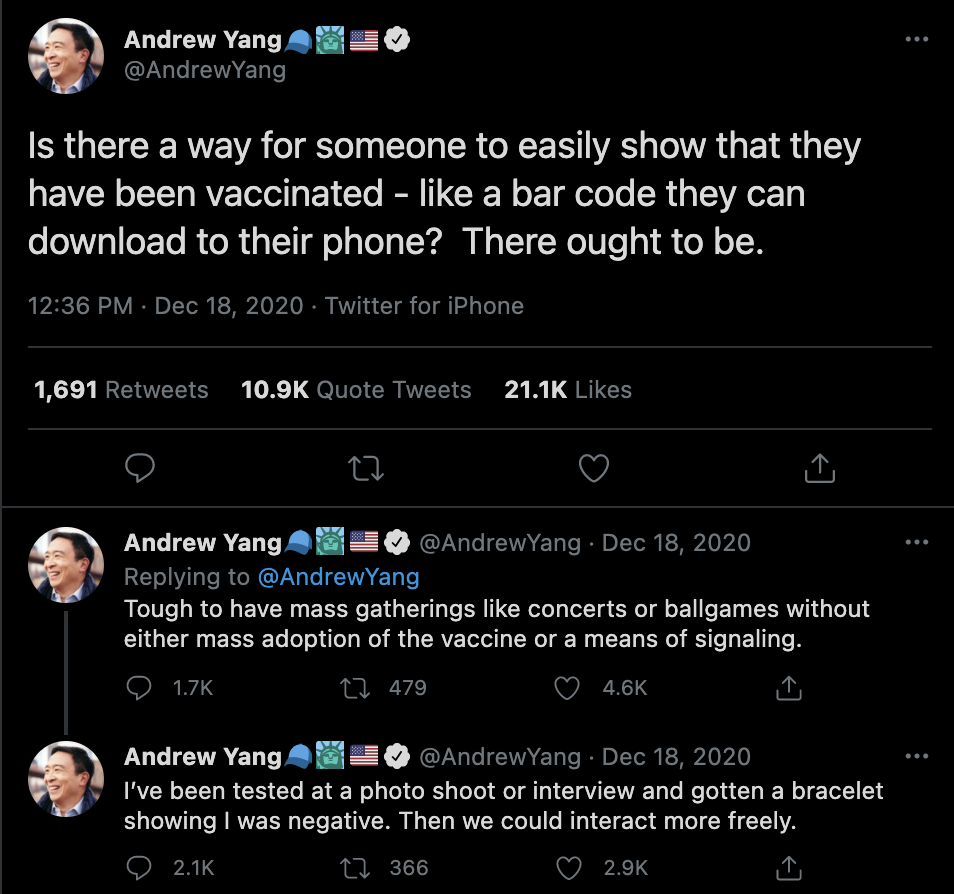
Former 2020 presidential candidate Andrew Yang favored the idea, noting that “mass gatherings” ought to be vetted with “a bar code.”

Texas Sen. Ted Cruz called HR. 1 a “universal voter fraud law” on Fox News last week.

“You know, it’s an amazing thing, we came out of this last election where we saw multiple instances of serious allegations of voter fraud, and the Democrats and the media took on the talking points that voter fraud doesn’t exist [and] that anyone who says it exists is somehow engaged in a conspiracy theory,” Cruz said. “Now with HR.1, the Democrats are seeking to lock in their advantage. They want mail-in balloting everywhere. They want no photo ID.”

H.R. 1 will head to the Senate at a date to be determined.

Gabe Kaminsky is an intern at The Federalist and a student at the University of Pittsburgh. His work has appeared in The Daily Wire, Townhall.com, Fox News, The Washington Times, The American Conservative, RealClearPolitics, The Washington Examiner, and other outlets. He is a participant in the Academy program at The Heritage Foundation. Follow him on Twitter @Gabe__Kaminsky

Jordan Peterson: The Archetypal Man

If you think tough men are dangerous, wait until you see what weak men are capable of.” – Jordan Petersen

Fascist. Toxic. Is he left or is he right? To postmodernists, he’s a formidable foe. To ideologues, he’s a mystery. To atheists, he’s a problem. Canadian professor and political commentator Jordan Peterson might be the most significant mind of our day, yet even with high tech mass exposure, most coverage gets him wrong.

At the University of Toronto, Professor Peterson’s rise to fame came with his “here I stand” moment that challenged the change in Canadian law for the mandatory use of gender pronouns. His controversial opinions sparked a flame that attracted considerable attention to his sizable library of lectures on the Internet, everything from Piaget to Pinocchio.

Petersen promotes the hero archetype, or manliness, defined by ancient stories.

He derives his project from a deep concern with the direction of Western history, informed by a vast knowledge of philosophy and religion. Where his arguments do take a hard stand is when calling out ideas that contradict nature or dismiss human need. Ideas made destructive by the toxic forces of postmodernism and Marxism.

YouTube gave him a platform from which to reach a generation of males desperate to speak truth back to the growing anti-male, anti-West, anti-family bias. For many, Peterson was a welcomed father figure, who filled a sizable hole left by the culture’s move toward the radical left. His book, “12 Rules for Life” restored their pride with a simple tenet, “Clean your room.”

Peterson passes through America’s divided mind because he operates in multiple worlds at once, organized by what he refers to as “the logos” — truth spoken into creation. The same word is used for Christ in the Gospel of John. Maps of Meaning reflect a triumvirate mind with an uncommon sophistication absent in political thought.

Peterson also travels a path between philosophical nihilism and religious fundamentalism, his penetrating mind a lens focused through Carl Jung’s prism of archetypal story. The story allows for non-partisan, universal, life lesson appeal to all human audiences.

Confusion is caused when the listeners require ideological purity and cordon off spheres in the divided brain: no overlap between conservative and liberal views, or critical thought (academic) and faith, or progress and the fixed natural order. For narrow thinkers his independent mind wreaks havoc.

With the aid of postmodernism, Peterson, the well-trained professor, detects modern cultural ills rampant in the academy today. Not for its challenge or even its suspicion, but for the fact that in the name of deconstructed ideology it joins with Marxism to do just that. Peterson argues the system won’t stand.

Where postmodernism has a helpful role in added perspective, but without the fortitude of positive philosophy, it becomes another political tool to rewrite history, distort gender relations, and break down traditional life, traveled by generations of lived Judeo-Christian souls.

Peterson identifies Marx as a source of the threat, perhaps as equal to the influence of Nietzsche on the Nazis.

In certain hands, Marx becomes political division replacing individual virtue or redemption with suspicion and political power, intending to destroy the role of the male.

Nietzsche warned that the end of Christianity would leave open a door to the very nihilism of which Peterson warns his audience. Postmodernism would tear down the sacred system, and Marxism would serve as the new religion. Peterson warns while we know when the right goes too far, we do not know when the left has reached extremes.

Peterson is a transformational figure, able to separate the contingent from the constant in history. In other words, when reflecting on the West’s philosophical and religious roots or great literature, he knows how not to throw the baby out with the bathwater.

He seeks a way to transform the power of logos into a new perspective, able to withstand the radical left. Not escapist religion, as Marx promotes, but the redemption of our present world, one life at a time. Peterson cautions, before you can change the world, you must change yourself. Take responsibility, speak the truth, train your mind, and in doing so you will save the world!

In other words, strive to be the archetypal male.
Ayn Rand on Ambition

“Ambition” means the systematic pursuit of achievement and of constant improvement in respect to one’s goal. Like the word “selfishness,” and for the same reasons, the word “ambition” has been perverted to mean only the pursuit of dubious or evil goals, such as the pursuit of power; this left no concept to designate the pursuit of actual values. But “ambition” as such is a neutral concept: the evaluation of a given ambition as moral or immoral depends on the nature of the goal. A great scientist or a great artist is the most passionately ambitious of men. A demagogue seeking political power is ambitious. So is a social climber seeking “prestige.” So is a modest laborer who works conscientiously to acquire a home of his own. The common denominator is the drive to improve the conditions of one’s existence, however broadly or narrowly conceived. (“Improvement” is a moral term and depends on one’s standard of values. An ambition guided by an irrational standard does not, in fact, lead to improvement, but to self-destruction.)

Politically, the goal of today’s dominant trend is statism. Philosophically, the goal is the obliteration of reason; psychologically, it is the erosion of ambition.

The political goal presupposes the two others. The human characteristic required by statism is docility, which is the product of hopelessness and intellectual stagnation. Thinking men cannot be ruled; ambitious men do not stagnate.

It Is Time to Remove the Debt Barrier to Economic Growth

Out of habit, American economists worry about federal debt. But federal debt can be redeemed by the Federal Reserve printing the money with which to retire the bonds. The debt problem rests with individuals, companies, and state and local governments. They have no printing press.

We have explained that the indebtedness of the population means there is little discretionary income with which to drive the economy. The offshoring of middle class jobs lowered incomes, and after paying debt service—mortgage interest, car payments, credit card interest, student loan debt—Americans’ pockets are empty.

This situation has been worsened by Covid lockdowns. In the US the federal government has sent out a few Covid payments to help keep people’s heads above water as they face expenses without income. The financial press refers to these Covid checks as “fiscal stimulus,” but there is no stimulus. The Covid checks do not come close to replacing the missing wages, salaries and business profits from lockdowns.

Corporations have indebted themselves and impaired their capitalization by borrowing money with which to repurchase their stock. This has built up their debt in the face of stagnant or declining consumer discretionary income.

We propose to deal with the debt crisis by forgiving debts as was done in ancient times. Our basic premise is that debts that cannot be paid won’t be. Widespread foreclosures and evictions would further worsen the distribution of income and wealth and further contrain the ability of the economy to grow. Writing debt down to levels that can be serviced would clear the decks tor a real recovery. Income that would be siphoned off in debt service would instead be available to purchase new goods and services.

A few economists muttered that we were overlooking the “moral hazzard” of absolving people of their debts. But leaving the economy stagnated in debt is also a moral hazzard.

Policymakers did not endorse our proposal, but, in effect, policymakers adopted our policy. However, instead of forgiving the debt itself, they forgave payment of the debt service. Individuals and businesses who cannot pay their landlords or lenders cannot be evicted or foreclosed until June. This doesn’t hurt the lenders or banks, because the loans are not in default, and their balance sheet is not impaired. The banks add the unpaid payments to their assets, and their balance sheets remain sound.

When June arrives, the prohibition against eviction and foreclosure will have to be extended as the accrued debt service cannot be paid. Extending the moratorium on foreclosures and evictions will just build up arrears. Is the implication a perpetual moratorium?

The question is: If policymakers are willing to forgive debt service, why not just forgive the debt. The latter is neater and clears the decks for an economic renewal.

The US economy has been financialized. Debt has been built up without a corresponding gain in productive capital investment in order to carry the mounting debt.

In financialized capitalism, the main purpose of bank loans is to refinance existing investments, not to expand productive capacity with which to service the debt. It is not possible to grow out of debt in a financialized economy, because too much income is used for debt service. The way to deal with this problem is to write down debts.

Michael Hudson and Paul Craig Roberts, UNZ Review
NOTE: The views expressed in this article are those of the authors, and do not necessarily represent those of the Artful Dilettante. It is, however, good food for thought. A/D

This is What the Fall of Civilization Looks Like

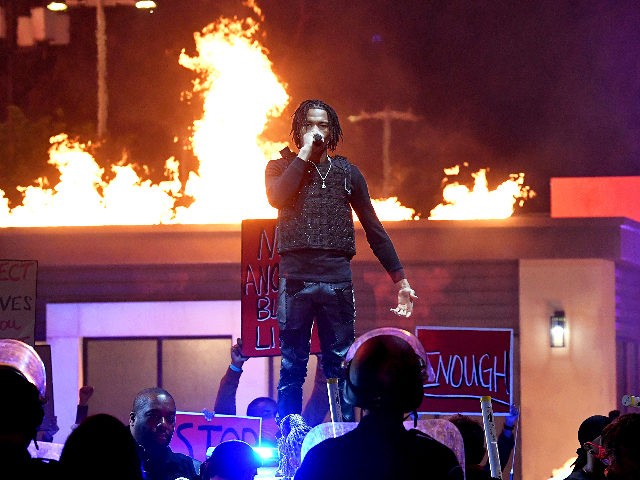
Rapper Lil Baby turned the Grammys stage on Sunday night into a riot scene that mirrored the deadly and violent protests that gripped the nation in response to the death of George Floyd. Lil Baby’s performance of his song “The Bigger Picture” included a speech from Black Lives Matter activist Tamika D. Mallory, who looked into the camera and demanded President Joe Biden to bring “justice, equity, policy, and everything else that freedom encompasses.” [Breitbart News]

All that “freedom encompasses”? What do anarchist-Communists know or care about freedom?

Freedom requires self-responsibility. And rationality, objectivity. It does not mean equality of outcome, as “equity” implies. It simply means equal under the law. Martin Luther King had the right idea; not rappers given an opportunity to spout BS because wealthy celebrities wish to be SEEN applauding it.

The Grammys used to mean something. They meant MUSIC. Music and politics don’t mix. You shouldn’t know, or have to care about, the political views of the people whose music you enjoy.

But the political views of the people whose music you enjoy are no longer limited to national health insurance, higher taxes and more regulations. These people whose music you try to enjoy, and whose achievements you would otherwise be glad to admire, now support things like defunding the police; letting small businesses be shut down by government and torn apart by looters; destroying our military; handing over all competitive advantages in a now unfree market to totalitarian dictators in China; upholding election fraud in support of one party being in control; and confiscating guns.

“Justice”, to such people, means getting to stomp, scream and get whatever they want. Not because they’re right. But because morally shallow, psychologically fragile and intellectually challenged musicians and celebrities want to be SEEN endorsing these things.

This is what the fall of civilization looks like. Enjoy.

Michael J. Hurd, Daily Dose of Reason

Ayn Rand on The Virtue of Productiveness

The virtue of Productiveness is the recognition of the fact that productive work is the process by which man’s mind sustains his life, the process that sets man free of the necessity to adjust himself to his background, as all animals do, and gives him the power to adjust his background to himself. Productive work is the road of man’s unlimited achievement and calls upon the highest attributes of his character: his creative ability, his ambitiousness, his self-assertiveness, his refusal to bear uncontested disasters, his dedication to the goal of reshaping the earth in the image of his values. “Productive work” does not mean the unfocused performance of the motions of some job. It means the consciously chosen pursuit of a productive career, in any line of rational endeavor, great or modest, on any level of ability. It is not the degree of a man’s ability nor the scale of his work that is ethically relevant here, but the fullest and most purposeful use of his mind.

Productiveness is your acceptance of morality, your recognition of the fact that you choose to live—that productive work is the process by which man’s consciousness controls his existence, a constant process of acquiring knowledge and shaping matter to fit one’s purpose, of translating an idea into physical form, of remaking the earth in the image of one’s values—that all work is creative work if done by a thinking mind, and no work is creative if done by a blank who repeats in uncritical stupor a routine he has learned from others—that your work is yours to choose, and the choice is as wide as your mind, that nothing more is possible to you and nothing less is human—that to cheat your way into a job bigger than your mind can handle is to become a fear-corroded ape on borrowed motions and borrowed time, and to settle down into a job that requires less than your mind’s full capacity is to cut your motor and sentence yourself to another kind of motion: decay—that your work is the process of achieving your values, and to lose your ambition for values is to lose your ambition to live—that your body is a machine, but your mind is its driver, and you must drive as far as your mind will take you, with achievement as the goal of your road—that the man who has no purpose is a machine that coasts downhill at the mercy of any boulder to crash in the first chance ditch, that the man who stifles his mind is a stalled machine slowly going to rust, that the man who lets a leader prescribe his course is a wreck being towed to the scrap heap, and the man who makes another man his goal is a hitchhiker no driver should ever pick up—that your work is the purpose of your life, and you must speed past any killer who assumes the right to stop you, that any value you might find outside your work, any other loyalty or love, can be only travelers you choose to share your journey and must be travelers going on their own power in the same direction.

Productive work is the central purpose of a rational man’s life, the central value that integrates and determines the hierarchy of all his other values. Reason is the source, the precondition of his productive work—pride is the result.

Where Are All the Girls in Boys’ Sports ?

It’s probably a question I’m not allowed to ask, but I honestly don’t care. And the fact that it will upset a bunch of pearl-clutching leftists and gender fascists just makes me want to ask it more, and louder. But with all the talk from the left about transgender rights and how boys who believe they are girls should be allowed to compete in any sport they so choose, why aren’t there any stories of the opposite happening? Where are the girls in boys’ sports?

It’s pretty easy to find stories about boys competing in girls’ sports, particularly track and field events, largely because they tend to win…by a lot. Records are being broken, record books rewritten, and scholarships awarded to boys who “identify” as girls, but has there been one case of a girl identifying as a boy, not only competing in boys’ sports, but dominating?

I can’t find one.

We’re told by Democrats that there is no difference between the sexes, and people should be allowed to compete in sports in the gender with which they identify. If that’s true, if they aren’t simply spouting off talking points cooked up by activist organizations to deflect from the reality of the situation, shouldn’t there be girls in boys’ sports?

If leftists are telling something backed up by science, as they claim it is, then the only option is that every single “trans-boy” in America is disinterested in sports. Every sport, always.

If there are no physical advantages for biological boys identifying as something else, then biological women identifying as boys should easily slide into male sports. Even if they don’t dominate the way boys do in girls’ track, they should at least be on the team and win every once in a while, right?

If there are no differences, shouldn’t trans-boys have been awarded some scholarships by now? Wouldn’t that have led to the boys who didn’t win those scholarships and their parents being upset the way the girls who’ve lost scholarships to boys are? Wouldn’t a Democrat lawmaker somewhere in the country be highlighting cases like this the way parents are highlighting the track situation in Connecticut?

Seems to me like the would be.

That makes the fact that they aren’t all the more curious, doesn’t it?

Of course, how someone “identifies” is irrelevant, in the grand scheme of things. I don’t care how someone chooses to live. I care that Democrats are using the power of government to force others to participate in someone else’s view of the world that is the opposite of reality. Reality is not dependent upon your belief in it, or your willingness to accept it. It just is.

Boys are, by and large, physically stronger than girls. We’re just built that way. If you have an issue with that, take it up with God.

That doesn’t mean there aren’t some women who aren’t stronger than some men, because there are. But we aren’t dealing with hypotheticals or exceptions to the rules. We’re dealing with reality. There is no woman on Earth who can lift as much weight as a man. The world record for deadlifting, for example, is currently 1,104.52 pounds by a guy named Hafthor Bjornsson. The women’s world record is 683 pounds by a woman named Becca Swanson.

Men have been lifting over 1,000 pounds since 2006. Women aren’t close.

The women’s world record for the 100-meter dash is 10.49 seconds, set in 1988 by Florence Griffith-Joyner. The men’s world record is 9.58 seconds by Usain Bolt set in 2009. The men’s record was 10.4 seconds back in 1932. Griffith-Joyner’s world record time would not have qualified for the Olympic finals for the men at the Rio Olympics, where the slowest racers qualified for the finals with a time of 10.01 seconds.

People can lament the fact that there are biological differences between men and women all they want, but that lament won’t change the fact that they exist. Because if they didn’t, there would be girls not only trying out for, but doing well in boys’ sports, and they simply are not.

That leads to another question we aren’t allowed to ask, that will have to be saved for another time, but is worth posing here: if gender is a “social construct,” how does anyone know what it feels like to be another person, let alone the opposite gender? The short answer is they don’t. Which then opens you up to a world of possibilities about what is really going on in this wing of the culture war that will have the left freaking out. Good times ahead.

Derek Hunter, townhall.com

More Evidence the United States Fought WW II Against the British

Yesterday (March 8, 2021) I reported that my conclusion from David Irving’s two volume Churchill’s War (a third volume is expected) is that Washington fought World War II against the British. Confirmation of this is provided by Michael Hudson’s book, Super Imperialism: The Economic Strategy of American Empire, whose expanded 50th-anniversary edition is to be published this May.

In the fifth chapter, “Lendlease, the British Loan and Fracturing of the British Empire, 1941-45,” Hudson shows that British desperation for financial means with which to conduct war was taken advantage of by Washington in order to destroy the British Empire.

“Treasury Secretary Henry Morgenthau Jr. and his staff negotiated with Britain the terms on which America would provide support. Their aim was to help Britain against Germany, but not help it recover its position as world banker, for it was seen not only as a friendly belligerent in need of arms credit but as a potential rival. The U.S. negotiators were single-minded and unyielding.” The aim was “American financial hegemony.” One of the steps taken was to strip Britain of her overseas investment holdings of its large companies. Britain had to nationalize the private companies and put them up for sale abroad.

“To U.S. officials, what was being decided were the terms for just how the dollar would end up replacing sterling as the world’s leading currency. When Britain’s negotiator Frederick Phillips reached Washington in December 1940, he found that Morgenthau “insisted that the British should turn their pockets ‘inside out’ and give him full details of their assets in the United States and Latin America, and what they were willing to take for them.” Morgenthau “started putting pressure on the British to sell off their big American companies – Shell Oil, Lever Brothers and Brown & Williamson Tobacco,” and on January 28, 1941, promised the Senate Foreign Relations Committee: “If Lord and Lady Astor own real estate in New York their assets will be on the auction block with the rest.” The assets that Roosevelt’s officials had been unable to get the British government to requisition from its citizens and sell off to U.S. buyers to settle its World War I debts now would be sold to pay for arming itself and fighting World War II.

The Americans even wanted the British to turn over the gold deposited in London for safekeeping by Britain’s defeated allies and to send a cruiser to seize South Africa’s gold for Washington.

The British economist John Maynard Keynes complained that the Roosevelt administration was focused on stripping Britain “of our liquid assets to the greatest extent possible” as the price of LendLease. The British were plundered by the Americans. For example, Britain’s Courtauld’s Viscose Corporation was sold “to an American banking group for $54 million, about half its real value.”

Congress delayed the British rescue until “a financially exhausted Britain was left with only $12 million in uncommitted reserves. On July 28, 1941, Keynes was handed a draft of Article VII of the Lend-Lease Agreements, calling for a strict commitment to non-discriminatory foreign trade and the end of British Imperial Preference.”

In other words, the price to the British of LendLease was “the dismantling of Commonwealth economic arrangements” and the end of the British Empire. Churchill warned “that the United States was capitalizing on British adversity to seize control of the British Empire.” Keynes insisted that the British could not sign what he said were “lunatic proposals,” but the British acquiesced. The price of Churchill’s war was the British Empire and the rise of US world hegemony.

Paul Craig Roberts, UNZ Review

So Money DOES Grow on Trees After All

“Money doesn’t grow on trees.” Parents used to teach this to their kids — because it’s true, and because they believed it.

There’s no longer a basis for believing it. At least, not if you believe politicians.

Starting last year, and now with more intensity since President Trump and Republicans lost control of the government, government spends trillions upon trillions of dollars. Even the most robust economy could never create the money they’re spending. It’s just debt — and inflation of the currency, via “printing” more money.

They do it as justification for the wreckage they caused via lockdowns and riots — and then take credit for cleaning up.

Even five years ago, it would have been unthinkable for the government to shut down most human activity. The first protest you’d hear is, “What about the economy?”

Today, that’s no longer a problem. The government shuts down most human activity and then pays everyone what they no longer get. Unemployment benefits now pay more than many jobs, particularly entry level jobs, or jobs in the not-so-high-paying food service industries. To the government, that’s just fine. They can provide a guaranteed national income (without calling it that) which makes jobs increasingly irrelevant.

I routinely hear people talking about it now. Particularly younger people, or people with low income. There’s little or no rational anxiety about holding or keeping a job. The question isn’t, “Where will I find work?” Or: “How do I keep my job? Or rise up the ladder?” The question has become: “When is the next stimulus check coming? And how much will it be?” Democrats are firmly, and likely permanently (thanks to election fraud), in charge of the government. They have openly reassured their needy subjects: More checks will be coming. Forever.

It appears that money DOES now grow on trees. Most of our parents were wrong. Since it’s so easy for the government simply to “print” or create (electronically) more and more money, then why not just pay everyone a billion dollars a month, instead of a mere $1400 or $2000 or whatever the next stimulus check will be? On the same premise, it shouldn’t be a problem. And if it IS a problem, morally and economically speaking, then why are we doing it at all?

It’s the greatest con job in all of human history. The government has created a crisis to ensure destruction of the economy. Then the same government that destroyed the economy comes in as the rescuer to provide “emergency” bailouts for an emergency that’s already into year two, with no signs of ending.

Of course, economists do have a few things to say about unlimited government spending. Deficits and a spiraling national debt do matter. And something called inflation — to say nothing of hyperinflation, which totally devalues the currency — might eventually come home to affect everyone except for the one percent elites who rule over our Communist paradise. Everything we know about economics, human nature, and the repeated failures of socialism tell us that disaster will arrive. Including — and especially — toward the ignorant fools who now celebrate their government “freebies”.

Not that we’ll be permitted to talk about it, when it happens.

Michael J. Hurd, Daily Dose of Reason