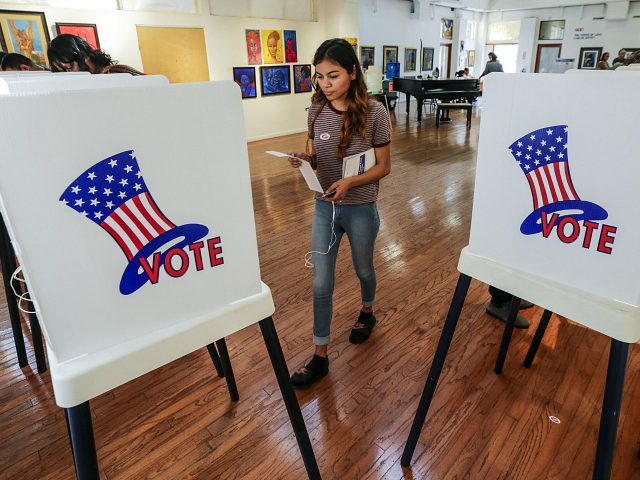
During an appearance on Sunday’s broadcast of Fox News Channel’s “Tucker Carlson Tonight,” Sen. Josh Hawley (R-MO) weighed in on Big Tech’s interference in the 2020 presidential election campaign.
The Missouri Republican told host Tucker Carlson how Big Tech was handling the flow of information was reminiscent of the “robber barons” of the 1900s.
“Well, for one, it is because they control the information,” he said. “I mean, think about this, you now have the perfect censors in Big Tech. Not only do they get to decide what we can and cannot say to each other on social media, they actually control the news that we read. So you know, it’s like the robber barons from a century ago, Tucker. If they don’t like a news story, if they don’t want something written badly about them, they just kill the story. We saw that with The New York Post. And I think that one of the reasons reporters aren’t saying very much about tech investing in Joe Biden is because they know they’ll get punished by tech. They know that their stories won’t get distributed — all the more reason for Congress to take action. We’ve got to attack this monopoly. We’ve got to break it up.
Roosevelt understood a century ago that you have to confront the trust because it’s about democracy,” Hawley added. “Look, it’s either the people, everyday normal Americans, either they run the country, or the corporations and the monopolies run the country. And that’s the choice we have today. Is Big Tech going to run this country, or is it going to be the voters of America? And we see Big Tech has been brazen about this in the last few weeks. They want to run the country. They want to buy the presidency. They want to control the news. They want to control what we say. They want to run this country, and we cannot let them.”
Lockdowns are back. Great Britain has imposed a totalitarian shutdown for at least a month. “Blue” states in the U.S. like New Jersey are already threatening to reimpose lockdowns. The events of 2020 tell us that 21st Century tyrants keep their word on their threats. Sure, the presidential election in the U.S. has something to do with it all. But tyranny is here to stay, so long as we keep permitting it, and no presidential election will change that. Note that Britain’s prime minister is the Conservative party leader who won in a landslide. It doesn’t matter. Putting a time limit on the lockdown, which will almost certainly be extended, is probably his idea of being “moderate” on the subject.
Lockdowns are like Communism, in that they extend total government control over every last detail of human activity in daily life. If lockdowns were necessary, and effective, then the lockdowns of last spring and early summer should have killed the virus. Or at least kept it from coming back in full force. Of course, that didn’t happen. Now we’re told the virus is stronger than ever, and more dangerous than ever. No, death rates are NOT going up. But we’re still supposed to believe it’s mortally dangerous. Yet if that’s true, then how effective have lockdowns been? And what reason is there to believe the next lockdown will be any better?
Under Communist regimes, the more the government intervenes and controls economic activity, the poorer people become. Eventually people starve, because a strangled economy cannot deliver the goods. It’s the rational miracle of CAPITALISM, private property and profits that deliver us the Amazon goods — not the Department of Health & Human Services in D.C. The government’s answer, when its policies of command and control fail? Does the government change its way? Or relinquish power? Of course not. Instead, the government says we need MORE control, and more time for the controls to take effect. And things get worse. In Soviet Russia, this went on for 75 years until the system finally imploded. In Venezuela and Cuba, it’s still going on. THOSE are the economic models of lockdowns. Lockdowns are Communism and Marxism — just for a different reason. The virus scares people into accepting a Marxist system they never otherwise would have accepted. It’s fear, not a virus, that will bring us down, on our current course.
The virus is not life-threatening for the vast majority of people who get it. But even if it were, it wouldn’t make sense to shut down all human activity for the entire population. Yet that’s where we’re going. Politicians are stopping the motor of the world. If Joe Biden and the Democrats win on Tuesday, massive lockdowns will be nationwide and international — for a long, long time to come. Masks and locked up restaurants and health clubs will be the least of it. “Look at the bright side,” they’ll say. “At least now there won’t be any climate change.” How can you have climate change if virtually all human activity stops? Of course, we’ll all be dead, too. Not from a virus. But from the massive and destructive consequences of shutting down a world economy upon which billions depend for survival.
Life was pretty great before all this started. COVID hysteria was an international act of suicide. When you hear of a seemingly happy person’s suicide, that’s how it is with America and the rest of the civilized world. Future generations will say, “America was doing so well. The world had come so far. Why did they kill themselves?”
We are, indeed, at a crossroads in America. Next Tuesday, we’ll learn the choice of direction. Will voters stick with President Trump, who, in saner times, would be a slam-dunk for reelection — or do they embrace Joe Biden and his grim vision of a dark winter? We have to believe that most Americans haven’t cast off common sense, along with their used masks and empty hand sanitizer bottles. But for voters on the fence — as inexplicable as that is — let’s evaluate what the Democratic Party is showing us about itself.
Biden’s claim in the last debate that the U.S. is moving toward a dark winter, thanks to COVID, was revealing. It exposed more than Biden’s cynicism in trying to manipulate people’s fear of the virus, it exposed an irony.
The dark winter tag speaks to the Democratic Party’s condition, not America’s. Democrats are ominous. Their worldview is antithetical to the American experience, and it’s rotted. Worse is that they’re destructive. We see it in their language and actions. 2020 is showcasing the Democrats accelerating descent into a mean-spirited, grudge-filled aggression toward traditional America — the America of the Revolution and the founding. They despise that immense swath of red, white, and blue between the Northeast and West Coast. And anywhere patriots live.
Perhaps 2020 is providential, in that the Good Lord chose an election year to lay bare the Democrats’ grim plots? Maybe this is a chance for the broader electorate to get a strong read on the party that’s dumped Happy Days are Here Again for its rendition of Eve of Destruction?
The Democratic Party is a cancer making systemic attacks on the nation. The attacks are political, cultural, and moral. The left, which is ascendent in the party, has over many years, infiltrated major institutions: education, the media, arts and entertainment, corporate executive suites, government bureaucracies. The fight to restore traditional America won’t end after the president’s hoped for reelection. With Trump, though, our chances of winning the fight increase dramatically. https://lockerdome.com/lad/9371484590420070?pubid=ld-8832-1542&pubo=https%3A%2F%2Fwww.americanthinker.com&rid=www.americanthinker.com&width=692
Let’s focus on two big, foreboding developments that are transpiring this year. They’re pincers in the Democrats ambition to impose tyranny — a tyranny that leftists and globalists plan to fully unfold should the corrupted and compromised Joe Biden win.
COVID and the Shutdowns
In March, the COVID crisis struck, but for Democrats, it had little to do with public health. It was an opportunity to impose and exercise raw political power. 15-day state closures to assess and formulate approaches to grappling with the infection turned into open-ended blue state shutdowns. New York, California, New Jersey, Pennsylvania, Illinois, Oregon, Wisconsin, Washington State — blue states all – are still closed to varying degrees. Businesses have been erased and millions are unemployed. The rights to worship, to assemble (except for protests and riots), and to function as free citizens, have been curtailed.
Democrats are previewing their preferred model of governance — and it should chill patriots. Theirs isn’t bigger government as an expediency to deal with a temporary crisis. How Andrew Cuomo, Tom Wolf, Gretchen Whitmer, Gavin Newsom, et al, are governing sets precedents. Democrats are demonstrating top-down, strongman government as their choice. It has the stink of Xi Jinping and the PRC.
Conventional wisdom claims that the lockdowns may ease when the elections end. After all, shuttering blue state economies was meant to hurt Trump. Collateral damage to Democrat leaders’ own constituents? A necessary price to defeat the president.
But will the shutdowns end? Why, when they’re so useful to undermining rights and allowing governments’ grips to tighten? Biden has declared for more shutdowns until the virus is beaten. Of course, viruses are never beaten. Biden’s handlers are trying to be clever.
Biden in the White House means a national shutdown. The U.S. economy has taken a multitrillion-dollar hit this year. More blows in 2021 would send the nation careening into a depression that would surpass the 1930s.
But a depression would accomplish much for power-hungry Democrats and globalists. The Great Reset initiative, advanced by the World Economic Forum, is poorly disguised fascism. “Manmade climate change” failed to trigger a “reset.” The COVID crisis is the globalists’ new lodestar.
Race and Mob Violence
In late May came George Floyd’s death in Minneapolis. There, cringing leftist mayor Jacob Frey was joined by the leftist city council in withdrawing police protection, thereby handing over their city to mobs, though gaslighting that peaceful protests are a right. Mobs acted as mobs act: with violence — ransacking, smashing, and burning Minneapolis. Leftist BLM and Antifa provocateurs did their parts, inciting rioters to even more mayhem.
Minnesota governor Tim Waltz, in Nero fashion, decided to stand down as Minneapolis burned — though he had the cheekiness to seek federal aid to recoup millions of dollars in clean-up costs, smartly denied by the Trump administration.
Not to be outdone, Seattle and Portland followed Minneapolis’ lead. It was all rinse and reap as mobs ran loose. Seattle mayor Jenny Durkan’s impotence and endless rationalizations for her city being destroyed were surpassed finally by her embrace of something called the “Capitol Hill Autonomous Zone (CHAZ).” It was a haven for lawlessness in a broader jurisdiction of lawlessness. Washington State’s chief eunuch, Jay Inslee, jabbered about protests and rights from the comfort and safety of the governor’s mansion in Olympia.
South of Seattle, Portland ignited. Mobs took the streets. Mayor Ted Wheeler wasn’t to be out-soyboyed by Jacob Frey. Whereas Frey, like a conquered potentate, groveled before a BLM mob in Minneapolis to show contrition, Wheeler went into the streets seeking dialogue with the barbarians, only to suffer a tear gassing before retreating. Oregon’s progressive governor Kate Brown jabbered about protests and rights from the comfort and safety of the governor’s mansion in Salem.
Do you see the pattern? Blue states and blue cities alone have sunk into dystopia. We can attribute some of this to Democrats’ gutlessness and moral desolation, but there’s more here.
One way of interpreting what’s occurring in blue cities is that anarchy creates vacuums, and power — goes the saying — abhors vacuums. So, it’s a twofer. Democrats have exploited COVID to push tyranny and have opened the doors to chaos to create the conditions for yet more tyranny. Their Brave New World is comprised of zombie apocalypses as a precondition for Orwell’s Big Brother.
George Floyd’s killing sparked yet other opportunities to spew venom and lambast decent Americans as racists. Only blacks (except defiant Larry Elders) and “woke” affluent progressive whites are exempt from the vitriol and coming recriminations — if the haters prevail.
Robert Reich has floated the idea of a “Truth and Reconciliation Commission” should Biden win. That would be a redo of Soviet show trials and Mao’s shaming of Chinese during his Cultural Revolution.
In race matters, America itself doesn’t get a pass. No, America was racist from its inception, that being 1619, not 1776. The founders were nothing more than well-heeled white overlords. Say Democrats and leftists, Americans must pay for the sins of racism. Critical Race Theory is indoctrination through shaming and bare-knuckled intimidation. It was being introduced in federal agencies and the military before the president took steps to halt it.
A Biden presidency dooms this nation to tyranny — or, more likely, protracted conflict. How could patriots ever meekly surrender their God-given rights and the noble — and ennobling — ideals of our Revolution and founding? Ronald Reagan made the case powerfully: patriots will not surrender. Donald Trump is the only man standing between us and tyranny and conflict.
J. Robert Smith can be found on Twitter @JRobertSmith1 and Parler @JRobertSmith. He also blogs at Flyover.
The United States is a screwed-up country. It this regard, the US has few rivals.
The legal voting age in the US is 18 years of age, which is also the age of female sexual consent and military enlistment. So at 18 years of age youth can affect the governance of the country, get legally laid, kill and die in combat, but are considered too irresponsible to imbibe alcohol and purchase a pistol from a licensed dealer until three years later at age 21.
An 18 year old can be sent off to war armed to the teeth, but cannot legally purchase a pistol in a gun store. He or she can influence how we are governed but cannot purchase a drink at a bar or restaurant.
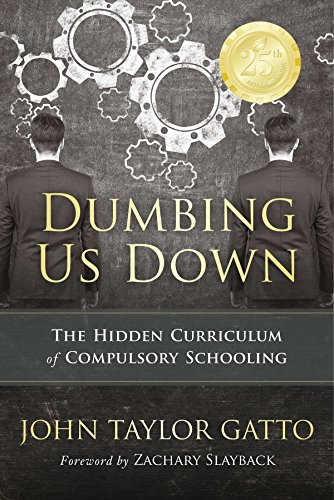
What does an 18-year old know about politics, life, anything? Except in very rare circumstances, nothing at all.Dumbing Us Down -25th …John Taylor GattoBest Price: $4.94Buy New $7.69(as of 09:20 EST – Details)
The anti-American, anti-Western civilization (dead white men), anti-white indoctrination (systemic racism) that is the main function of an American university education is filtering down into the high schools and elementary schools. The United States is perhaps the first country to use education to destroy its own future. Most certainly, the US is the first country to make multicultural existence impossible. The Identity Politics of the liberal-progressive-left splits the country into hostile Identity Groups, some of whom have successfully cultivated victim status, which they use to oppress those without it, primarily heterosexual white males.
The anti-American, anti-white liberal-progressive-left has succeeded in brainwashing large swaths of American youth. In America the best students for the country are no longer the A students. The best students are the C students who are turned off by the indoctrination and just want to get on with their lives.
It is the A students who are receptive to the demonization of their country and themselves. These students have been targeted by the Democrats for massive voter registration. They have been refocused on overthrowing the “orange-haired racist/misogynist” in the White House.
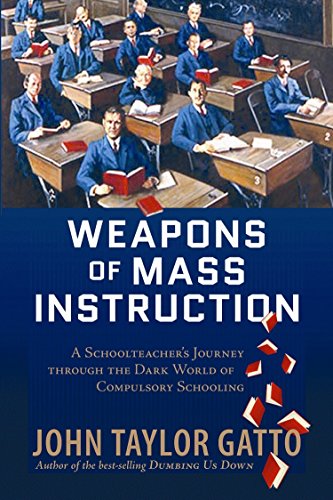
Weapons of Mass Instru…Gatto, John TaylorBest Price: $4.94Buy New $2.99(as of 03:50 EST – Details)It is unfortunate that the future of the United States depends on brainwashed, ignorant youth full of self-assertion and confidence that they know best.
But it does. Therefore, the United States is doomed.
The Russians and Chinese are likely the future rulers, if they can free their minds from the propaganda that the United States is the Hegemonic and Indispensable Nation empowered to rule by the End of History.
Fortunately for the rest of us, both Russia and China have gone through despotic eras that, apparently, the ruling elites themselves are tired of and want no more of.
Liberation often comes, not from those who speak its langauage, but from those who have suffered its absence.
Graduates of American schools need a decade to recover from the indoctrination. I propose that the legal voting age in the US be legislated at 30 years of age. Perhaps it would be best if the voting age was 40 years of age or even 50. By then at least some people have learned lessons from life. At 18 no lessons have been learned.
To allow people judged too irresponsible to order a drink or to purchase a pistol to influence, even determine, the governance of a country is mindless.
Since I’m a crystal ball mother trucker, my fans have asked my prediction how this will all play out. Trump will win on election night by electoral landslide. But…
@RealWayneRoot
2) Between mail in ballots, no Voter ID. dead voters, illegal alien voters, criminal ballot harvesting, late deadline, massive cheating by dirty Democrats, scores of lawsuits by slimy lawyers…no winner official for 30 to 45 days…
@RealWayneRoot
3) Then Supremes led by courageous Amy Coney Barrett officially declare Trump winner. In meantime, massive rioting, looting, burning, murder in big cities across USA. Worst unrest in US history. @realDonaldTrump will order National Guard to cities to restore peace.
@RealWayneRoot
4) But happy ending! @realDonaldTrump will be sworn in on Jan 20, 2021 in DC w/ @RealWayneRoot proudly watching in audience. Ushering in 4 years of unbridled capitalism, low taxes & record prosperity. God bless America. The end.
At first glance, a lot of the social problems and resource waste emerging from government intervention seem pretty easy to fix: the government should just stop doing whatever it is doing that is creating the problems and the waste. The stubborn persistence of institutions and organizations that keep societies poor is a vexing problem for social scientists. In Political Capitalism, the economist Randall Holcombe takes on this problem by analyzing “political capitalism” as a distinct economic system with its own logic and features rather than as some kind of midpoint between capitalism and socialism.
As he points out, people do not generally demand “big government” in general. Rather, they demand intervention to solve specific problems when people believe using government is either cheaper or more than just relying on the market. The reader might be reminded of Milton Friedman’s observation that every businessperson believes in unregulated, free competition in every industry but their own–which, of course, must be protected and subsidized as a matter of “national security” or something like that.
If you surf the web a bit you might come across a picture of a protest sign with a slogan like “The system didn’t fail; it was designed this way.” Holcombe argues that it is a mistake to think Political Capitalism–he gets the term from the historian Gabriel Kolko, who in turn got it from Max Weber–was designed by sinister interests in a smoke-filled room. His goal is to understand “the system and its pathologies,” and, importantly, to show that “(p)olitical capitalism was not designed by the elite, it evolved as a result of human action but not of human design” (p. 269).
He makes an obvious point that a lot of economists are too quick to forget: “Economic policy is not made by economists, it is made by politicians” (p. 141). We are not, as too many scholars seem to think, disinterested technocrats whispering wisdom into the ears of benevolent and omnipotent autocrats. We should dispense with this presumption if we are going to make serious and meaningful progress toward actually understanding the world we inhabit, to say nothing of improving it.
The pathologies of political capitalism emerge too frequently and regularly to be a coincidence, but they emerge too haphazardly to be a conspiracy. Holcombe works to build a theory of political capitalism on a multidisciplinary foundation. He mixes the theory of economic and political elites as it has been developed by political scientists and sociologists with Good Old Fashioned, Methodologically Individualistic Public Choice Theory to help us understand what Ayn Rand called “the aristocracy of pull” in Atlas Shrugged.
One of the striking facts about the zeitgeist, Holcombe points out, is the many areas of agreement between the left and the right with respect to the characteristics of political capitalism. Using a series of quotes from David Stockman (on the right) and the Nobel Laureate Joseph Stiglitz on the left, he shows that both believe the political system is captured and dominated by political and economic elites who, to the best of their ability, run “the system” for themselves. If virtually everyone agrees that “the system” is controlled by elites for their benefit and at the expense of everyone else, why is it this way and why don’t we replace it with something better?
Holcombe builds a theory of political capitalism that might remind readers of the framework Douglass North, Barry Weingast, and John Wallis develop in their 2009 book Violence and Social Orders. North, Wallis, and Weingast distinguish between natural states, which “use the political system to regulate economic competition and create economic rents; the rents order social relations, control violence, and establish social cooperation,” and open access societies, where “entry and competition order social relations.”
Political Capitalism is a complement to North, Wallis, and Weingast because it helps us better understand the stability of elite coalitions and their ability to create rents by restricting entry. Readers might also be reminded of Gregory Clark’s 2015 book The Son Also Rises: Surnames and the History of Social Mobility. Clark shows how even very different societies exhibit similar social mobility patterns. To Clark, “social competence” is the secret sauce that helps people move into (or out of) elite circles. While Holcombe does not discuss “social competence” explicitly, his analysis complements Clark’s by marrying public choice theory to elite theory and explaining the bargains (sometimes implicit, sometimes explicit) that explain the stability of the political and economic elite.
Holcombe’s theory of the elite has three steps (p. 67): “Individuals sometimes act as members of groups rather than as individuals,” “Individuals sort into groups in which they have common interests,” and “Groups use any power at their disposal to provide institutional advantages to their group over others.” That one can be a beneficiary of these steps helps us understand why competition to get into the elite groups–by attending an elite college or university, for example–is so fierce.
Here is where Clark’s “social competence” is especially relevant. Holcombe explains that there are a lot of unwritten rules in the rent-seeking society that is political capitalism. Lobbyists understand, for example, that if they are invited to a reception hosted by a legislator, they had better show up. What’s more, they had better show up with a check. The opportunities to buy and sell influence–”pull”–are practically infinite, and they are often opaque. Holcombe offers the example of the Clinton Foundation, analyzed in a 2015 book by Peter Schweizer. Here is Holcombe (p. 268):
“In his 2013 book Extortion, [Schweizer] gives examples of the payments legislators extort from business interests in exchange for favorable legislation. In his 2015 book Clinton Cash, he describes how foreign governments and businesses made contributions to the Clinton Foundation when Hillary Clinton was Secretary of State from 2009 to 2013, rapidly followed by State Department policies and decisions that benefitted (sic) those donors. Did foreign governments and businesses receive favorable treatment from the State Department in exchange for their contributions to the Clinton Foundation? Schweizer presents evidence that they did, but Clinton says they did not.”
Holcombe offers this example to illustrate “the ambiguities inherent in regulation.” The system–which no one designed–encourages and reinforces activities that blur the lines between respectable rent-seeking and contemptible corruption.
Consider, for example, the problem of transitional gains and transitional losses. Institutional changes are capitalized into the value of assets that then receive no more than normal market returns. Holcombe points to taxi medallions in New York City, where the transitional gains–the present value of the rents accruing to taxi privileges–accrued to those who got the medallions first. Unsurprisingly, people who hold the medallions fight hard to avoid the transitional losses (reflected in falling values for taxi medallions) that come with the erosion or elimination of privileges.
This helps us understand the persistence of institutions that are unambiguously evil (like chattel slavery) and those that are merely inefficient (like the mortgage interest deduction). As an economist, I think we should get rid of the mortgage interest deduction. As someone who, as of this writing, is preparing to sign a thirty-year mortgage, I balk just a bit at the idea because eliminating that deduction would reduce the value of our home. Even if it were “offset” by a reduction in tax rates, it’s not clear that we would be better off. My narrow material interest makes it hard to say, “Let’s get rid of this special privilege that clearly benefits me.” It’s easier to push legislators and regulators to gore other people’s oxen and leave ours alone.
Herein lies the logic of Political Capitalism. As Holcombe explains, “The elite implement institutional changes, after all, and if changes could not assure benefits to those who have the power to change them institutional improvement is unlikely to occur” (p. 222). We cannot, in short, expect the elite to go to the barricades in the pursuit of policies that will make them poorer. Hence, resource-wasting, gains-from-trade-reducing policies persist in all their inefficient glory.
What, then, is to be done? In various places, Friedrich Hayek and Milton Friedman emphasize the importance of public opinion. Deirdre McCloskey argues that the Great Enrichment emerged in response to changes in how people think and talk about trucking and bartering. Holcombe seems to concur: “As the ideology of democracy has replaced the ideology of liberty, the force of government has encroached upon the voluntary exchange of markets” (p. 197).
If public opinion continues this drift, political capitalism will become harder and harder to uproot. Political capitalism grows as a hardy weed in the soil of ideas that might choke out the delicate flower of liberty; however, changing the intellectual soil and moving it in the direction of support for an open access society has the potential to fight back at least some of this encroachment.
People who teach principles of economics courses know the frustration. We spend a lot of time talking about how free markets work and how different government interventions like price controls and tariffs make things worse for the people their advocates claim to be trying to help.
We gloss over some of the important and real complications of transition between institutions if we limit ourselves to just saying, “The government should stop doing that.” Political Capitalism helps us understand why they don’t and, importantly, helps us plot a way forward by marrying elite theory to public choice.
The reader of Political Capitalism will be pulled away from blackboard models of perfect worlds we can imagine, but they will come away with a better understanding of the world we actually inhabit.
We are witnessing in every Western country a rapid transformation of what were formerly free countries into police states. Governments violate their constitutions, issue edicts in place of legislation, treat citizens arbitrarily, and pursue agendas on the basis of justifications that are contrary to the facts. The digital revolution has given governments powers far beyond those of Big Brother in George Orwell’s dystopian novel, 1984.
I can remember when the year 1984 seemed to be the far distant future, and I can remember the free country in which I was born and grew up. That country is no more.
The youth of today have never experienced a free country and do not know what has been lost. Indeed, they are absorbed in the digital revolution that they think is freedom.
The “War on Terror” launched by 9/11 and the war on Covid launched in order to learn techniques of mass population control have together terminated free societies. Today privacy is a non-existent right, as are free speech, free inquiry, open pubic debate, and the right to operate a business.
In place of debate, people who disagree with official explanations enforced by the presstitutes and social media are “cancelled.” Your every email, phone call, purchase and web search is captured and used to build a profile of you for marketing purposes and for future arrest should you prove troublesome for the regime.
Whistleblowers are prosecuted despite legislation defending them from prosecution. Thought control and behavior control are imposed by firing people and destroying their careers for using unapproved words and taking unapproved positions.
The collapse of liberty has been rapid in the 21st century. But it has been creeping upon us for some time. Few Americans alive today remember when a wife could not testify against her husband or a husband against his wife. Such testimony was considered a violation of marriage that had formed one out of two. It was self-incrimination, which is prohibited by the US Constitution in those days when the Constitution was respected and had authority.
Few who are alive remember that the marriage contract was in part a sexual contract and there was no such thing as “wife rape.”
There was no such thing as Child Protective Services with the power to intervene in the family, seize children from parents, and have parents prosecuted on charges of child neglect or abuse whether real or fabricated.
You could yell at and spank your child without being arrested. You didn’t live in fear that bruises from sports activity or falling off a bike would be noticed by a school teacher, doctor, or neighbor and result in an intrusion into the family by Child Protective Services determined to prosecute parents in order to justify the budget.
Kids of my generation were free to be wherever they chose to be without adult supervision on week-ends, holidays from school, and summers as long as they were home by dinner time. Our bikes made us mobile, and we could be anywhere in range of a bike and a pair of legs, and our parents weren’t arrested for child neglect. It was mass third world immigration, integration of formerly stable homogeneous neighborhoods, and the rise of the pedophile sex trade that made children no longer safe. Multicultural society failed to protect children and began persecuting parents instead.
A person could start a car without, if it had a manual transmission, having to push the clutch petal to the floor. A person could drive away without having to put on a seat belt or endure endless beeping. Soon, if not already, you must be strapped in or the car will not move. The range of free judgment has been greatly narrowed. Even the appliances we use bully us.
I could go on at great length, but it is too depressing.
If Donald Trump wins the election and is permitted to be inaugurated, perhaps he will make it a part of “making America great again” to get the intrusive government out of our lives. I was born a free person, and I would like to die a free person.
DONALD TRUMP is on course to win four more years in the White House with a one point lead in the popular win, the final Democracy Institute poll for the Sunday Express has found.
The survey of voters by the US President’s favourite pollsters gives him 48 percent ahead of his rival Joe Biden on 47 percent.
In the last days of the campaign the Democrat former vice president who has been dogged by corruption allegations surrounding his son Hunter which have, according to the poll, cut through with the electorate.
The last Democracy Institute/Sunday Express poll gave the US President a two point lead and landed just after he went into hospital with coronavirus.
Significantly, the President has, according to the latest findings, maintained a four point lead of 49 percent to 45 percent in the key swing states including Florida, Iowa, Michigan, Minnesota, Pennsylvania and Wisconsin.
It means he is on course to easily win the electoral college by 326 to 212 votes against his Democrat rival in a result which would shock the world even more than his astonishing defeat of Hilary Clinton in 2016.
The Democracy Institute/Sunday Express poll has throughout the campaign been one of the few to predict a Trump victory since March.
This is because unlike other polls it only looks at people identifying as likely voters instead of just registered to vote and it has tried to identify the shy Trump vote.
According to this latest poll almost eight in ten (79 percent) of Trump supporters would not admit it to friends and family compared to 21 percent of Biden supporters.
With the race hotting up in the final days allegations that Mr Biden and his family are corrupt surrounding claims about his son Hunter’s business dealings with China and the Ukraine using family connections appear to have had cut through.
There was controversy when social media platforms including Twitter apparently attempted to filter out the stories surrounding Hunter Biden published by the New York Post.
But the row has, according to the poll, only helped to put the issue in the public consciousness more.
Asked who they thought was telling the truth about the Biden family allegations 57 percent chose businessman and former Biden associate Tony Bobulinski who has levelled accusations against the former vice President.
Meanwhile, 52 percent agreed that Mr Biden is “a corrupt politician” with 21 percent saying they are less likely to vote for him and 75 percent saying it makes no difference.
Asked if the allegations made him a national security risk, 54 percent agreed that it did.
The US President’s job approval rating it now at 52 percent which, according to the Democracy Institute director Patrick Basham, is now at “normal levels” to expect to be reelected.
And even after the Black Lives Matter protests, almost four in ten black voters approve of his presidency and 21 percent are prepared to vote for him.
Mr Trump’s two strongest issues among voters are still ranked the most important – the economy and law and order – both at 29 percent.
In comparison coronavirus, where the President’s approval rating is not as high, is fourth on 20 percent as the most important issue.
According to the findings 61 percent think Mr Trump will be better for the economy but only 45 percent approve of his handling of coronavirus while 49 percent disapprove.
Meanwhile, Mr Biden still comes a distant third when asked about who has had the most positive impact on the criminal justice system with 14 percent behind both Mr Trump and the celebrity Kim Kardashian both on 43 percent.
The US President’s job approval rating it now at 52 percent which, according to the Democracy Institute director Patrick Basham, is now at “normal levels” to expect to be reelected.
And even after the Black Lives Matter protests, almost four in ten black voters approve of his presidency and 21 percent are prepared to vote for him.
Mr Trump’s two strongest issues among voters are still ranked the most important – the economy and law and order – both at 29 percent.
In comparison coronavirus, where the President’s approval rating is not as high, is fourth on 20 percent as the most important issue.
According to the findings 61 percent think Mr Trump will be better for the economy but only 45 percent approve of his handling of coronavirus while 49 percent disapprove.
Meanwhile, Mr Biden still comes a distant third when asked about who has had the most positive impact on the criminal justice system with 14 percent behind both Mr Trump and the celebrity Kim Kardashian both on 43 percent.
Mr Basham said: “Our final Democracy Institute poll shows President Donald Trump, the Republican standard bearer, holding a razor thin one-point national lead over his Democratic rival, former Vice President Joe Biden. This is a statistical tie that falls firmly within the poll’s margin of error.
“The election will not be decided by the popular vote, of course; instead, it will be decided within the battleground states located primarily in the nation’s Midwest and Sunbelt regions.
“The Republican’s vote is a very efficient one, as it was in 2016. This is the president’s Trump card.
“Trump’s voters are more evenly dispersed across the country than are Biden’s.
“Biden’s comparatively inefficient vote is likely to mirror Hillary Clinton’s from four years ago. Biden will do incredibly well in the heavily populated states of California, Illinois, New Jersey, and New York. In these states, and in others reliably painted a deep Democratic blue, he will rack up enormous margins of victory over Trump, providing him with the potential to score a national popular vote victory, yet probably depriving him of sufficient votes in Iowa, Pennsylvania, Michigan, Ohio, Wisconsin, Arizona, North Carolina, and Florida to turn Trump into a one-term president.”
Notable pollsters are cautioning Americans to refrain from getting too comfortable with polling predictions as Election Day approaches, suggesting polls may not account for “shy” or “hidden” Trump voters– those who are largely responsible for President Trump’s upset victory four years ago. In this election, the magnitude of such voters could be even greater.
Politicospoke to two pollsters who “weren’t blindsided” by the Trump phenomenon in 2016: Arie Kapteyn and Robert Cahaly.
Cahaly is the chief pollster with the Trafalgar Group, which RealClearPolitics’ co-founder and president, Tom Bevan, called “one of the most accurate polling operations in America” because of its predictions in the last two political cycles. In 2016, Cahaly showed Trump winning both Pennsylvania and Michigan. His polls also showed Florida Gov. Ron DeSantis (R) leading his Democrat challenger, Andrew Gillum, in 2018’s gubernatorial race.
“Kapteyn, a Dutch economist who leads the USC’s Dornsife Center for Economic and Social Research, oversaw the USC/Los Angeles Times poll that gave Trump a 3-point lead heading into election day—which, Kapteyn notes, was wrong: Clinton won the popular vote by 2 points,” Politicoreported, adding that both men suspect that surveys could be, once again, “undercounting” the support for President Trump. They attribute this phenomenon to “shy” Trump voters, or people “reluctant to share their opinions for fear of being judged.” These voters are more commonly known among GOP circles as the “silent majority.”
Kapteyn and his team at USC have attempted to identify this mysterious demographic by asking respondents whom they believe their friends and neighbors will vote for, in addition to whom they are supporting personally.
While Biden leads by double-digits nationally for the routine question of who the respondent supports, his lead shrinks to five or six points in what Kapteyn described as the “‘social-circle’ question.”
“One explanation for that may indeed be ‘social desirability.’ In general—and certainly on the phone—people may still be a little hesitant to say to [sic] that they’re Trump voters,” he explained.
While Cahaly said he is “not even debating” if Joe Biden will secure the popular vote, he believes Trump is “likely” to enjoy another victory in the Electoral College due to the “hidden Trump votes out there.”
“We live in a country where people will lie to their accountant, they’ll lie to their doctor, they’ll lie to their priest,” Cahaly explained. “And we’re supposed to believe they shed all of that when they get on the telephone with a stranger?”
He told Politico he focuses on battleground state polls rather than national surveys and stated that “people are going to be shocked.”null
“A lot of people are going to vote this year who have been dormant or low-propensity voters. I think it’s going to be at an all-time high,” he predicted.
“The models of who’s going to turn out this year are very flawed. What type of person comes out for Trump? They’re not a normal election participant. They’re a low-propensity voter. We included them in all of our surveys in fall 2016, and we are including them now,” he continued.
Many of the Trafalgar Group surveys released in the last week show Trump and Biden statistically tied in key battleground states. While a Trafalgar Group survey released this week showed Biden up by less than half of a percentage point in Wisconsin, an ABC/Washington Post survey also released this week showed Biden up by 17 percent.
Cahaly believes the magnitude of the “shy” Trump voter could be even greater this year due to the heightened tensions across the board, particularly against Trump supporters.
“In 2016, the worst being said about Trump voters is that they were ‘deplorable.’ 2020 is a whole different ballgame,” Cahaly said. “It is worse this time—significantly worse.”null
“This year had more things where you can get punished for expressing an opinion outside the mainstream than almost any year I can think of in modern history,” he continued, adding that he is finding that people are “very hesitant [to share their preference for Trump], because now it’s not just being called ‘deplorable.’”
“It’s people getting beat up for wearing the wrong hat, people getting harassed for having a sticker on their car. People just do not want to say anything,” he explained:
We talk to lots of people in our surveys. And I hear things like, “Yeah, I’m for Trump, my neighbors are for Trump, but there’s one neighbor who just hates Trump. And when he walks his dog, he kind of wrinkles his nose by those houses, and I don’t want him to do it at my house, so I don’t put a Trump sign. I like the guy, and I don’t want him mad at me.” I hear stuff like that all the time. People are playing their cards close to their chest because there’s a stigma to being for Trump. What happens when the stigma rolls away from people who hide their vote, and they start admitting where they are? This is what I think is going to happen on Election Day.
When asked what he would say to voters who believe the election is locked up for Biden, Cahaly emphasized his belief in “hidden” Trump voters.
“I don’t think it’s done. Some of these national polls are not even taking into consideration the fact that Republicans have closed the gap with voter registrations,” he said, adding that they are not “taking into account the number of low-propensity voters who are voting and who will vote on Election Day.”
“I don’t think they’re measuring people’s genuine opinions. And I think [pollsters] are just not going to see it coming,” he said.
“I will be really surprised, given our own numbers, if there isn’t a very sizable gap between Biden and Trump in the popular vote—in favor of Biden,” Kapteyn said. “But in the states? I don’t know.”
All eyes are on key swing states, such as Pennsylvania, Wisconsin, Michigan, Florida, North Carolina, Arizona, and even Minnesota as Election Day swiftly approaches. Over the weeks, Breitbart News has spoken to dozens of Trump supporters across those states, Florida and Wisconsin, particularly, who also expressed the belief that the silent majority will show up in a greater volume than in 2016.
“We have everything, and I said, well, after hearing that they were going to pack the court, I finally said I’m putting my Trump flag up,” Bryce, a Wisconsin resident, recently told Breitbart News.
“Wouldn’t you know? Dozens in my neighborhood went up. The lesbian couple across the street — they’re very nice people; we love them — I didn’t think they’d ever put one up. They’ve got a Trump flag. There’s a lot of support that is sleeper support,” he continued.
“It’s like you gotta just ‘shh’ — just be cool,” he said. “Show up to the polls and vote, you know.”
“It’s like it’s a secret but when you meet somebody else in the secret society that supports Trump — because you can’t do it publicly or people will rip you. You know,” Bryce added when asked if there is a bigger and stronger silent majority from 2016.
President Trump is expected to hold three rallies in Pennsylvania on Saturday, one of the states he unexpectedly won four years ago, followed by stops in Michigan, Iowa, North Carolina, Georgia, and Florida on Sunday.