Democrats Tried to Rig the Ballot – The Media Blamed Trump.

For the past week, Americans have been treated to another familiar media spectacle. Donald Trump was supposedly threatening democracy. His Justice Department was interfering with an election. Republicans were preparing to reject the will of the voters before a single ballot had been counted.

The controversy centers on Alaska’s U.S. Senate race, where Democratic operatives recruited a second candidate named same as the first, Dan Sullivan, to confuse voters into selecting him instead of the Republican incumbent. Trump’s Justice Department sued to delay certification if the incumbent narrowly loses, triggering headlines accusing the administration of attempting to overturn an election before the votes were even cast.

The headlines were breathless, the accusations predictable, and the villain was, as always, Donald Trump.
Then, on October 28, the New York Times published an investigation that turned the narrative upside down.

Democratic operatives associated with the Senate candidate Mary Peltola had spent months recruiting spoiler candidates, specifically looking for citizens with the name Dan Sullivan. then, in fact, they found such a man named Dan Sullivan, to run against Republican incumbent Senator Dan Sullivan.

The apparent strategy was breathtakingly cynical: Find someone with the Republican senator’s name, put him on the ballot, and hope enough voters accidentally select the wrong man to influence the election.

The New York Times investigation puts Mary Peltola’s personal knowledge squarely under scrutiny. Her former campaign manager reportedly acknowledged that Peltola knew about the effort to recruit spoiler candidates, while documented communications link senior campaign aides and national Democratic officials to the operation. These are not allegations that can be brushed aside with another campaign denial. If Peltola knew that operatives were deliberately recruiting candidates to confuse voters, the public deserves to know whether she approved, encouraged, or helped conceal the scheme. Constitutional qualifications for Senate office may limit the grounds for disqualification, but they provide no immunity from investigation or prosecution for violations of election law. The next step should be a thorough examination of the communications, financing, and decisions behind this operation, including Peltola’s own role.

And these are the people who lecture America about protecting democracy.

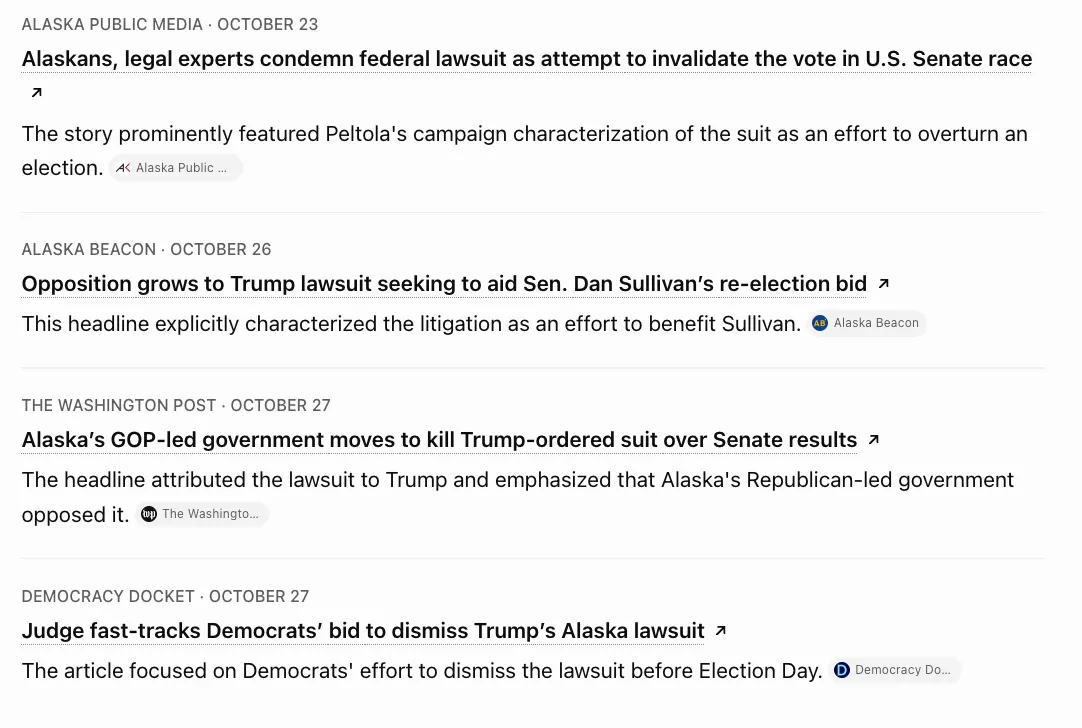
Consider how the mainstream press framed the controversy just days earlier. ABC News declared, “Trump told DOJ to sue to block Alaska Senate results if Republican narrowly loses.” The Washington Post announced, “DOJ seeks to block Alaska Senate result if Republican incumbent narrowly loses.” Reuters characterized the lawsuit as an attempt to block the possible election of a Democrat. Roll Call reduced the entire controversy to “DOJ sues to prevent Sullivan loss in Alaska.”

Notice the framing. Trump was the aggressor. His Justice Department was the threat. The underlying allegations of deliberate voter deception were relegated to secondary details, if they received attention at all.

Readers were encouraged to believe this was another attempt by Trump to overturn an election because he disliked the likely outcome. There was just one inconvenient problem.

The election-integrity concerns were not invented by Trump. And the alleged manipulation began long before his Justice Department intervened.

According to the October 28 New York Times investigation by Kellen Browning, the effort began in summer 2025, when a staffer associated with Peltola’s political operation was reportedly instructed to identify people throughout Alaska named Dan Sullivan.

The investigation, based on interviews, text messages, and other documentation, described involvement by Peltola campaign aides and individuals connected to the Democratic Senatorial Campaign Committee. The operation reportedly extended beyond recruiting a namesake candidate to finding other potential spoilers who might siphon votes from the Republican incumbent.

This was not simply an independent candidate who happened to share a common name. The reporting describes a coordinated effort to exploit that coincidence for political advantage.

And the alleged scheme required no ballot stuffing, hacked machines, or falsified vote totals. It required an ordinary voter to enter a polling place, recognize the name Dan Sullivan, and mistakenly select the wrong candidate.

The ballot would be counted accurately. The voter, however, would have supported someone he never intended to elect.

Alaska election officials had already raised concerns about the second Sullivan’s candidacy. His actual middle initial is J., yet he initially sought to appear on the ballot as “Dan S. Sullivan,” matching the Republican incumbent’s name and middle initial. His campaign presentation raised additional concerns about deliberately misleading voters. The Alaska Supreme Court ultimately allowed him to remain on the ballot, but that ruling did not resolve who recruited him, who financed his campaign, or whether the apparent attempt to confuse voters was part of a coordinated political operation.

The Justice Department subsequently filed suit seeking to delay certification under certain circumstances if the Republican incumbent narrowly loses. Whether federal law authorizes that remedy remains for the courts to decide.

But the Times investigation gives the underlying allegations a significance the early headlines largely obscured.

For years, Democratic politicians and their media allies have proclaimed themselves the guardians of election integrity. They have condemned voter suppression, warned about electoral interference, and insisted that democracy depends on public confidence in the voting process.

Yet in Alaska, political operatives associated with a major Democratic Senate campaign and the candidate herself pursued a corrupt scheme that sought to trick voters into making mistakes when voting.

The reported involvement of individuals connected to the Democratic Senatorial Campaign Committee makes this more than a local political stunt. It raises questions about the national party apparatus, campaign financing, and the extent of coordination behind the effort.

The New York Times has already identified some of the people behind this operation. Peltola’s former campaign manager, Elisa Rios, said Peltola was “definitely aware” of the scheme, although not personally directing it. Senior campaign aides exchanged messages with Democratic Senatorial Campaign Committee officials, including campaign director Andrew Piatt, about strategies to siphon conservative votes. Democratic operative Jerid Kurtz reportedly traveled through Alaska under an assumed name to recruit potential spoiler candidates.

The question is no longer simply whether Democratic operatives participated. The documented communications establish their involvement in planning ballot strategies. What remains unresolved is who authorized the namesake recruitment, who financed it, and whether senior officials approved the operation.

These questions demand answers, not another carefully crafted press statement.

Dr. Robert W. Malone, Malone News

Feds ‘surge’ law enforcement to Alaska after ‘troubling new revelations’ in ‘Decoy Dan’ Senate scheme

Victor Nava

Published Oct. 30, 2026, 7:14 p.m. ET86

The Trump administration is surging federal law enforcement resources to Alaska amid the “troubling new revelations” of an apparent Democratic scheme to siphon votes away from incumbent Sen. Dan Sullivan (R-Alaska) in the midterm election.

The criminal investigation into “Decoy Dan” Sullivan’s alleged sham Senate campaign in the Last Frontier has been ongoing for the last “several months,” but additional assets are being deployed as a direct result of a bombshell New York Times report on the alleged involvement of Democratic Senate hopeful Mary Peltola’s campaign, as well as the Democratic Senatorial Campaign Committee (DSCC), in the plot, Alaska’s top federal prosecutor revealed Friday.

“This new information has resulted in a significant surge of law enforcement assets to Alaska,” Michael Heyman, the US Attorney for District of Alaska, told reporters at a press conference in Anchorage.

“As we speak, law enforcement around the country are taking investigative steps with respect to the criminal investigation,” he added, noting that he could not discuss the specifics of what those steps were due to the ongoing probe.

Heyman said several attorneys from his office have been assigned to the matter as well and that authorities are taking the allegations in the New York Times report “extremely seriously.”

“We are acting on it intensely and swiftly,” he said.  

Earlier this week, Fox News reported that the DOJ had issued at least 30 subpoenas within 24 hours of the new revelations

“Every Alaskan deserves a fair election and they’re going to get one,” Heyman vowed, warning that “anyone who tries to illegally deceive voters and interfere with the election will answer for it.”

Peltola’s former campaign manager, Elisa Rios, and several other sources told the New York Times that campaign aides were instructed to search for people named “Dan Sullivan” that could jump into the Senate race as part of an effort to confuse voters intending to cast a ballot for Sen. Sullivan. 

Peltola, a former congresswoman, was not directly involved in the recruitment effort but was “definitely aware” of it, Rios said. 

In her first public remarks about the scandal, Peltola told Alaskans that she “knew nothing about any other candidate on the ballot except for me and the incumbent.”

“I am not interested in tricking voters,” she said during a campaign event Thursday. 

President Trump called on Peltola to drop out of the race and be criminally prosecuted in the wake of the report. 

At the press conference, Heyman said the criminal investigation is operating in parallel to a civil investigation into the scheme.

New York Post

An Excuse or a Reason — What’s the Difference?

I have a friend who, when confronted with something he did wrong, often ends his explanation with, “Well, it’s not an excuse, but it IS a reason.” Though it always gets a chuckle, the expression doesn’t really resolve anything.

A reason tells you what caused something. An excuse is an attempt to “explain” why a person had no other choice but to act as he or she did. For example, “I treated you badly because I was drunk.” Being drunk explains the rudeness, but it doesn’t excuse the choice to get drunk in the first place. Or: “I’m nasty to my kids because my parents were nasty to me.” That explains where the nastiness was learned, but it doesn’t excuse the choice to refuse to behave differently. People who try to combine excuses and reasons are using phony “common sense” to explain away the fact that they actually DID have a choice. Sometimes we really don’t have a choice, but most of the time we do.

A person who actually knows the difference between a reason and a choice might say, for example, “I missed our therapy appointment. There’s no excuse, and I’m sorry. I’ll pay you for it.” Or: “I stood you up for our dinner date. There’s no excuse, and I’m sorry I ruined your evening. Please let me make it up to you.” Those who acknowledge their errors without resorting to excuses are comfortable with their own imperfections and continue to strive for higher standards. When they say, “I won’t do it again,” they really mean it.

Sadly, that healthy attitude is often not verbalized after somebody wrongs another person. But that probably doesn’t mean they’re not sorry. In fact, decent and conscientious people don’t like to see themselves as rude and thoughtless. But unfortunately, the natural tendency is to go on the defensive; fabricating excuses to avoid seeing themselves as inconsiderate: “I didn’t mean it! I’ve really been stressed — that’s why I forgot our meeting.” That may be a nice excuse for them, but it’s a pretty lame reason from the offended party’s point of view.

Most transgressions are forgivable, as long as the offending party shows the right attitude. The right attitude isn’t a skill or a technique; it’s something that’s sincere. And it will not be laced with excuses.

Another word for excuse is “rationalization.” My favorite definition of rationalization is “rigging the conclusion.” We play a trick on ourselves by leaving out relevant facts and circumstances, suggesting cause-and-effect when there is none. Notice how the same situation can look completely different, depending on whether you rationalize or think in plain English: “I was tired from a late night — and I backed into my neighbor’s car by accident.” Both statements are facts, but the rationalization implies a connection between the two that doesn’t make sense.

Here’s the same thing in plain English: “I wasn’t paying attention, and I carelessly backed into my neighbor’s car.” Bingo! The cause-and-effect relationship is clear and honest.

Is it unforgiving to set the personal responsibility bar so high? No, it is not. It’s a lot healthier to confront reality head-on than to insult yourself (and others) by sugarcoating or rationalizing. And nobody’s going to buy it but you. Being personally responsible for your actions serves your interest because it enables clear and healthy thinking.

The great majority of excuses and rationalizations stem from faulty premises. An example of a faulty premise is the notion that a mistake is a disaster. I maintain that if everyone’s still alive, no mistake is truly a disaster. Acknowledge mistakes by affirming the truth and moving on. Personal accountability isn’t an unpleasant obligation. It’s how we grow to live a happy, responsible life.

Michael J. Hurd, Life’s a Beach

Vote Like Your Life and Liberty Depend on it

Elon Musk warned that if Democrats get a trifecta — a “clean sweep” — by winning control of the House, Senate, and the presidency in 2028, they will make Washington, DC, and Puerto Rico states, expand the Supreme Court, and open borders.

In a post on X, Musk explained that by making the nation’s capital and Puerto Rico states, packing the court, and opening the borders and legalizing illegal migrants, it “would result in America becoming a permanent one-party state.” Musk added that it would also result in “the end of democracy in any meaningful sense of the word.”

“My biggest concern is that if there is a clean sweep by Democrats of the House, Senate and Presidency in 2028, they will: 1. Make DC and Puerto Rico states to gain a strong majority in the Senate,” Musk wrote.

He added that his second concern is that Democrats would “open the borders and legalize everyone living in” the United States “illegally to cement a permanent majority.”

As his third concern, Musk listed they would “[i]ncrease the size of the Supreme Court to gain an immediate majority.” [Newsmax 10-30-26]

It will be a totalitarian dictatorship without an open seizure of power. They will say it’s “democracy” and therefore ok. If you question it, you will be called an enemy of “democracy,” and the federal government agencies will all be poised and weaponized. America — all of it — will be one gigantic California, or Seattle, or Chicago, or Massachusetts, with no possibility of losing power. There will be no going back.

A totalitarian government benefits nobody, except for the rulers. You might smugly conclude, “Well, I am a Democrat. I have nothing to fear. Let them censor, imprison or even kill the MAGA people. Who needs them?” This will come back to bite you, I promise. Affordability–which you won’t have under a socialist econony–will be the least of your concerns.

*******

“To me gun control is how steady you hold your weapon.” — Senator Darline Graham, running for U.S. Senate in South Carolina against a far left, woke socialist.

I hope she means it. Her opponent is a Communist and an advocate for Islam, gender alteration of children, government seizure of private property, censorship and gun confiscation. Democrats in all 50 states are radicalized. A vote for any Democrat anywhere is an act of suicide-homicide — unless you cheer the end of America and plan to go live in Cuba, Venezuela or Iran after America is destroyed from within. I can hardly believe we have reached such a low point that we have to beg and plead our fellow Americans not to kill us all by voting in explicit totalitarians. I cannot fathom the ignorance, intellectual laziness and general depravity that brought us here. I am grateful that I (being in my 60s) knew better times, because today’s children and very young adults possibly never will.

Michael J. Hurd, Daily Dose of Reason

Democrats Could Take Congress Tuesday. Here’s What It Could Mean for Your Investments

President Donald Trump could soon face a dramatically different Congress, and investors are already evaluating what that might mean for the stock and bond markets.

With Democrats seeking control of the House and Senate in Tuesday’s midterm elections, the possibility of divided government is raising questions about corporate regulation, government spending, and the future of some of Wall Street’s most important industries. Banking, artificial intelligence, healthcare, and cryptocurrency companies could face increased scrutiny, while changes in fiscal policy could influence interest rates and investment returns.Start Investing

A Political Shift That Could Reshape Wall Street

The November 3 elections will determine whether Republicans retain control of Congress or Democrats gain enough seats to challenge the Trump administration’s legislative agenda.

Republicans currently control both chambers, but their House majority is narrow. Democrats need a net gain of three House seats and four Senate seats to secure majorities, making control of Congress a central issue for investors heading into Election Day.

The financial implications could extend far beyond the political battles in Washington. A Democratic victory in either chamber would complicate Republican efforts to advance legislation, potentially slowing tax initiatives, financial deregulation, and policies benefiting certain industries.

However, a change in congressional leadership would not automatically reverse the Trump administration’s existing policies. The president would retain executive authority over many regulatory and trade decisions, and major legislation would still face significant obstacles.

For investors, that distinction is important. The biggest consequences of the election could come from changes in congressional oversight, regulatory expectations, and corporate spending rather than sweeping new laws.

Why Wall Street Could Face More Scrutiny

One of the most immediate consequences of a Democratic takeover would be a shift in congressional committee leadership.

Democrats would gain greater authority to investigate federal agencies and private companies, request documents, hold hearings, and summon executives to testify. Industries that have benefited from the administration’s policies could find themselves under closer examination.

Financial institutions, cryptocurrency businesses, and technology companies would be particularly exposed. Democratic lawmakers have already questioned the administration’s efforts to loosen financial regulations and its relationships with digital asset businesses.

These investigations could affect corporate valuations even without new legislation. High-profile hearings may expose business practices, increase compliance expenses, or create uncertainty about future regulation, prompting investors to reassess company risks.

The potential impact would vary substantially across industries, with some facing greater challenges and others potentially benefiting from policy changes.

Six Industries That Could Feel the Biggest Impact

1. Banking: Regulatory Relief Could Slow

Major U.S. banks have benefited from the Trump administration’s efforts to ease certain financial regulations, including capital requirements, supervisory practices, and consumer protection enforcement.

A Democratic Congress could challenge those efforts through congressional investigations and increased oversight of financial regulators. Companies such as JPMorgan Chase, Bank of America, and Citigroup could face greater scrutiny of their lending practices, consumer fees, and relationships with federal agencies.

Prominent Democratic lawmakers, including Sen. Elizabeth Warren and Rep. Maxine Waters, have supported stronger financial oversight and questioned aspects of the administration’s deregulatory agenda.

However, financial regulators would retain considerable authority over their own rulemaking. Congressional pressure could slow additional regulatory relief without necessarily reversing changes already implemented.

For bank investors, the outcome could affect expectations for future regulatory costs. Nevertheless, interest rates, loan growth, credit quality, and the strength of the broader economy would remain central drivers of profitability.

2. Artificial Intelligence: The Industry Could Face New Restrictions

Artificial intelligence has become one of the most important drivers of stock market growth, fueling enormous investments in semiconductors, computing infrastructure, and data centers.Read Economics

Companies such as Nvidia, Microsoft, Alphabet, and Amazon have significant exposure to the continued expansion of AI technology. However, growing concerns about electricity prices, data center construction, and the financial consequences of rapid infrastructure development are attracting greater political attention.

A Democratic Congress could intensify investigations into AI companies and support legislation addressing the industry’s impact on consumers and local communities.

One major concern involves electricity demand. Data centers consume substantial amounts of power, and lawmakers from both parties have expressed interest in ensuring that their construction does not impose excessive costs on residential electricity customers.

Additional requirements could increase expenses for companies developing large computing facilities or delay projects in regions facing power constraints.

For investors, the issue reaches beyond technology stocks. Utilities, natural gas producers, power equipment manufacturers, and infrastructure companies could also be affected as policymakers decide how to accommodate growing electricity demand.

The long-term opportunity in artificial intelligence remains substantial, but the cost of supporting that growth could become increasingly important to company valuations.

3. Healthcare: Drugmakers and Insurers Could Face Pressure

Healthcare could become one of the most politically sensitive industries following the election, particularly as Americans continue dealing with rising insurance premiums, prescription drug costs, and medical expenses.Buy Maps

Democratic lawmakers have proposed measures intended to limit prescription drug prices, increase oversight of health insurers, and address the denial of medical claims. Companies such as UnitedHealth Group, CVS Health, Humana, and major pharmaceutical manufacturers could face greater attention.

More ambitious proposals, including Medicare for All, would face significant political obstacles under a Republican president. However, congressional hearings and narrower policy initiatives could still influence how investors value healthcare companies.

For insurers, the financial implications would depend on potential changes to reimbursement rates, benefit requirements, and government-sponsored healthcare programs. Pharmaceutical manufacturers could face additional pressure over drug pricing, particularly for expensive treatments used by Medicare beneficiaries.

There could also be benefits for parts of the healthcare industry. Divided government could reduce the likelihood of certain cuts to federal healthcare programs, potentially supporting companies dependent on government reimbursement.

For retirees and investors holding healthcare stocks, the important question is how proposed policies would affect company earnings and the cost of healthcare coverage.

4. Cryptocurrency: Regulatory Momentum Could Stall

Cryptocurrency businesses have spent considerable time pursuing legislation that would establish clearer rules for digital assets and potentially reduce regulatory uncertainty.

A Democratic takeover could complicate those efforts, particularly amid disagreements over consumer protections, oversight responsibilities, and relationships between cryptocurrency companies and political officials.

Companies such as Coinbase could face uncertainty about the future regulatory environment, while executives may be called to testify before congressional committees.

The industry has supported legislation that would clarify whether particular digital assets fall under securities or commodities regulation. Delays could extend the period of uncertainty for exchanges, investors, and businesses developing blockchain-based financial services.

Still, Democrats hold differing views on cryptocurrency regulation, and some support establishing comprehensive rules that could encourage institutional participation.

For investors, regulatory developments could influence cryptocurrency company valuations, although prices of Bitcoin and other digital assets would remain closely tied to market liquidity, institutional demand, and investor sentiment.Read Economics

5. Energy: Oil, Natural Gas, and Power Projects Could Face Changes

Energy policy could become another major source of disagreement between Congress and the White House.

Republicans have generally supported expanding domestic oil and natural gas production, accelerating infrastructure approvals, and reducing environmental restrictions. Democrats could seek stronger environmental oversight and greater scrutiny of federal energy policy.

One important issue involves legislation intended to make it easier to build pipelines, transmission systems, and other major energy infrastructure projects.

Companies such as Williams Companies and Energy Transfer could benefit from faster permitting processes, which can reduce development costs and shorten construction timelines. However, political disagreements over environmental protections could delay legislation.

The situation is complicated by growing electricity demand from artificial intelligence. Both traditional and renewable energy projects could benefit from efforts to expand power generation and transmission capacity.

This creates areas where lawmakers from both parties may find common ground, even if they disagree over fossil fuel development and environmental regulations.

Investors should pay particular attention to companies supplying electricity, natural gas, and critical infrastructure for data centers. Their long-term opportunities may be influenced as much by electricity demand and construction economics as by political decisions.Start Investing

6. Trade and Tariffs: Trump Could Remain Aggressive

A Democratic Congress would have limited ability to directly control some of President Trump’s trade policies, leaving tariffs as an important source of potential market volatility.

The administration could continue pursuing trade restrictions through available executive authorities, although those powers remain subject to statutory requirements and judicial review.

Additional tariffs involving China and other trading partners could affect companies dependent on international supply chains, including manufacturers, automobile producers, retailers, and technology businesses.

Higher import costs can reduce corporate profit margins, raise consumer prices, and complicate Federal Reserve decisions if inflation becomes more persistent.

Trade negotiations involving Canada and Mexico could also become more difficult if political expectations shift ahead of the 2028 presidential election.

For investors, the consequences would depend heavily on each company’s exposure to international manufacturing and imported materials.

Businesses with significant domestic production may be less directly exposed to certain tariffs, while multinational corporations with complex supply chains could face greater costs and uncertainty.

Global Market News

Schumer accused of yearlong plot to plant ‘decoy’ candidate in critical Senate race (Alaska)

The Senate’s No. 2 Republican believes that Senate Minority Leader Chuck Schumer, D-N.Y., had a hand in the alleged scheme unfolding in the Alaska Senate race.

Operatives for Rep. Mary Peltola’s Senate campaign, along with top aides in Senate Democrats’ campaign apparatus, the Democratic Senatorial Campaign Committee (DSCC), are alleged to have been involved in creating one of the stranger races this election cycle: finding and recruiting another candidate named Dan Sullivan to run against the incumbent Sen. Dan S. Sullivan, R-Alaska, according to reporting from The New York Times.

National Democrats have maintained they had no hand in the move, but Senate Majority Whip John Barrasso, R-Wyo., told Fox News Digital in an interview that he believes the campaign received help from the very top.

“I mean, this is criminal behavior to steal the Alaska Senate race, it’s now been fully exposed,” Barrasso said. “And there is proof that the Peltola campaign knew about it, and that Schumer schemed and colluded with them for over a year to try to search for and then coax a decoy of Dan Sullivan onto the ballot with a purpose only to deceive the voters.”

Schumer’s office and Peltola’s campaign did not respond to requests for comment from Fox News Digital.

The peculiar situation in Alaska has been ongoing for months and has sparked legal battles at the state and national levels, as well as condemnation from Republicans across the country, including Sen. Lisa Murkowski, R-Alaska.

Murkowski argued on X that “ballot-stacking should have no place in our electoral process.”

“Alaskans deserve the honest truth from Mary and her campaign — what has been revealed is a pattern of lies and coverups and a culture of deception that belongs nowhere in our elections or among our elected officials,” she said.

Alex Miller, Fox News

California’s Bullet Train Boondoggle

In 2008, California voters approved funding for a high-speed rail line between San Francisco and Los Angeles. A group of contractors donated tens of thousands of dollars to support the ballot measure. A state program manager projected that the initiative would create more than 100,000 construction jobs.

Eighteen years and more than $15 billion later, not a single mile of high-speed track has been laid. The state hasn’t even laid track on the rump Merced-Bakersfield line that it wants to open in the 2030s. In a recently resurfaced video from his time as lieutenant governor, Gavin Newsom said the full project was unlikely to “materialize in our lifetime.”

The bullet train, like almost every effort to build things in California, was killed by environmental regulations. The state’s high-speed-rail website contains more than 130,000 pages of environmental-review-related materials. Stacked together, they stand 40 feet tall and weigh 1,300 pounds. All this has cost taxpayers more than $677 million and served as a meal ticket for consulting firms that backed the 2008 ballot measure.

California law typically requires an entity to perform an environmental review when its building project requires a state permit. In practice, that applies to many major efforts in California. These reports create delays, new expenses, and burdensome requirements, some of which have nothing to do with meaningful environmental protection.

We wanted to find out how much environmental paperwork the bullet-train project has generated. To do that, we had multiple AI systems scan the reams of reports linked on the California High Speed Rail Authority’s website, and asked them to catalog the files, establish each one’s page-count, and sum those numbers.

Both systems tallied more than 130,000 pages. To verify the results, we reviewed one of the AI systems’ spreadsheets, which included each document’s web link, title, and page count. Remarkably, across more than 27,000 pages of cross-referenced files, the AI system didn’t make a single page-count error. A California High Speed Rail Authority spokesperson told us that the authority “does not maintain a running page count of all environmental documents,” but did not deny the 130,000-page figure.

Some of the bullet-train reports include ridiculous measures. One proposed that biologists count bumblebees, one by one. Another outlined when a contractor was allowed to break down woodrat stick huts. Still others contemplated using dogs to sniff for lizard scat or spending $119.4 million on an overhead tube partly to limit the train’s “acoustic impacts on waterfowl and shorebirds.”

Such measures have prompted a flurry of expensive change orders. Contractors have requested $480,000 “to dig small burrows for mammals by hand”; $352,490 for lizard surveys and reports; and $290,000 to implement the state’s environmental-requirements-tracking software. In one case, California’s high-speed rail agency revised its draft environmental report after the state proposed a regional mountain lion as a candidate for protected status.

Environmental reviews are one reason that costs continue to spiral. Another is poor oversight. A November 2018 state audit, for example, found that a contractor received a $3 million amendment from the rail authority. The authority, however, could not demonstrate that it had independently verified the contractor’s claims. Instead, it had lifted part of its report “directly from the contractor’s amendment request.”In June 2018, the authority unanimously approved amendments worth more than $142 million.

Who benefits from all this? Politicians and contractors. The scheme is straightforward: the contractors back the bullet-train boondoggle and shuffle money to politicians, and California directs millions of dollars to the firms to perform endless environmental reviews. It’s a massive gravy train.

Three contractors, HNTB, AECOM Tech, and Parsons Brinckerhoff (later acquired by WSP), were among the biggest donors to a committee supporting the 2008 bullet train ballot measure. They donated $63,000, $75,000, and $76,500, respectively.

The firms have also sent wads of cash to California Democrats and their pet causes. Newsom’s gubernatorial campaigns received $5,000 from AECOM’s PAC, $18,500 from WSP, and $26,000 from HNTB’s PAC. Governors Jerry Brown and Newsom solicited payments worth $55,000 and $75,000, respectively, from AECOM for charitable purposes. HNTB’s PAC donated to California rail advocate Scott Wiener’s campaign.

Their efforts seem to have paid off. AECOM, WSP, HNTB, and Parsons Brinckerhoff were paid $38 million, $61 million, $86 million, and $101 million, respectively,to perform high-speed-rail-related environmental reviews, according to data obtained by the Daily Caller News Foundation. One former HNTB employee, Ian Choudri, has become the bullet-train project’s chief executive.

California voters were promised a high-speed rail system delivering riders from San Francisco to Los Angeles in under three hours. Nearly two decades later, they face the prospect of a train transfer and an hours-long bus ride between Bakersfield and Los Angeles.

The main beneficiaries of this program are not California residents but consulting firms that bankrolled the ballot measure. For them, the point of California’s bullet train is not to move people, but to move money, for as long as possible—with taxpayers footing the bill.

Christopher F. Rufo is a senior fellow at the Manhattan Institute, a contributing editor of City Journal, and the author of America’s Cultural Revolution. Kenneth Schrupp is an investigative reporter at City Journal.

A Fine, Deliberately Engineered Mess

“Can’t we just be Mexico or Paraguay and have peace and quiet while things mostly go to hell?” — Matt Taibbi

A pro-Peltola political action committee (49th State PAC) paid $87,000 to an Ohio consulting company run by one Jerid Kurtz (operating under the name “Zane”) to compile a list of all the Dan Sullivans in Alaska and recruit one to run for Dan S. Sullivan’s Senate seat. They succeeded, finding Dan J., age 69, a retired US Forest Service employee and schoolteacher, in Petersburg, AK, who had never run for anything before. In late May 2026, he filed as a Senate candidate without a party label, then received about 2.5% in the top-four primary, and advanced to the general election ballot.

The Alt Dan Sullivan was assisted with all the filing paperwork by one Amber Lee, an Anchorage-based political consultant. A super PAC, Right for Alaska (meaning good for, not right wing, and based in Hudson, Wisconsin, by the way), has spent $1.15 million on Alt Dan, with $990,000 of that funneled in from the Sixteen Thirty Fund, a Washington DC-based Lefty-left pass-through operation — a 501(c)(4), not required to disclose its dark money donors — that has handled hundreds of millions of dollars in recent years. The org is associated with Arabella Advisors, which is funded by George Soros’s Open Society grants.

Former campaign manager Rios had told The Times that, “Ms. Peltola was not directly involved in the Two Dan Sullivans project, but she was ‘definitely aware.’” Two days ago, just before publication of The Times report, Rios attempted to retract her story, declaring to the newspaper, “As discussed on our call earlier today, I am confirming that I have retracted all statements made regarding the 2026 Alaska Senate Race in connection with any article you may or may not be writing. I am not willing to be a source for any story in any capacity.” Nice try. Explain that to a grand jury.

The DOJ opened criminal and civil investigations in the Two Dan Sullivans matter last summer but bumped up its activities with the publication of The Times report. A grand jury was convened in August. On the criminal side, prosecutors have now issued thirty to forty grand jury subpoenas targeting Democratic officials, the Peltola campaign, and others linked to the Alt Dan recruitment effort. No one has been charged yet. At issue is whether this was a conspiracy to mislead voters or interfere with a fair election. Potential charges could include 18 U.S.C. §§ 241 and 242, conspiracy against rights / deprivation of rights under color of law and wire fraud.

On the civil side, a DOJ lawsuit filed October 23, seeks to block certification of the vote if Senator Dan S. Sullivan happens to lose the election in a way that could be attributed to voter confusion.

Yesterday, Governor Mike Dunleavy directed the Alaska Bureau of Investigation to determine whether the prank violated Alaska law and whether criminal charges or civil action are warranted. The governor said the state’s actions were based on “Alaskans’ right to vote for the candidate they actually intend to support” and described deliberately confusing voters as “striking at election integrity.” The Alaska Supreme Court previously ruled that Daniel J. Sullivan (Alt Dan) met the constitutional requirements to appear on the ballot and that officials could not exclude him based on alleged motives. How that happened remains a mystery.

From a public sentiment point of view, the Two Dan Sullivans case underscores how desperately filthy Democratic Party tactics are in the service of preserving their longstanding racketeering operations. As a practical matter, the outcome could affect which of the two parties gets control of the US Senate. A vote for Democratic Party candidates is a vote to wreck our country. Think hard on that when you go to the polls.

James Howard Kunstler

281 arrested in Florida child predator, human trafficking sting; 17 worked at theme parks

POLK COUNTY, Fla. (CBS12) — A weeklong undercover operation called “Polk Around & Find Out II” led to 281 arrests in Polk County, including 17 people who worked at theme parks, Florida Attorney General James Uthmeier’s office said Friday. The operation targeted child predators and human trafficking and resulted in 488 new charges, including 198 felonies.

The Polk County Sheriff’s Office ran two stings at the same time: one targeting adults seeking sex with children and another focused on human trafficking. Sheriff Grady Judd called it the largest undercover operation his office has conducted.

At the news conference, Judd said investigators found 31 people who traveled to meet a child for sex, while attorney general’s office counted 32 arrests in the traveler sting. The release said the separate trafficking sting led to 249 arrests, including 117 alleged sex buyers and 122 people arrested for prostitution

Two other suspects were charged with human trafficking in connection with the child predator investigation, the sheriff’s office said. Detectives accused Derrick Opitz, 27, of offering a child’s guardian $500, and Odlanier Marrero Rodriguez, 22, of offering marijuana in exchange for sex with a child.

Uthmeier’s office said those arrested had 798 prior charges, including 358 felonies. Nine were on probation, and nine had been arrested in earlier sheriff’s office stings. Authorities said 24 suspects brought firearms to the operation, while 32 people were charged with drug possession.

Of the 17 theme park employees arrested, 13 worked for Disney and four for Universal, Judd said. He said Disney told investigators it had fired the employees.

Among the 31 child predator arrests, the sheriff’s office highlighted Rashion Crayton, 31, of Bartow, whom it identified as a youth football coach. Detectives said Crayton exchanged explicit messages with an undercover detective posing as a 14-year-old girl and arrived at the meeting location with lubricant and sex toys. He faces charges including traveling to meet a minor and attempted lewd or lascivious battery, the department said.

The sheriff’s office said several suspects told detectives they worked at theme parks. Adam Snyder, 24, of Champions Gate, said he worked in Toy Story Land at Disney World; investigators found part of his uniform and his Disney ID in his vehicle, according to the release. Snyder was among the 31 people accused of traveling to meet a child for sex.

Uthmeier said his office would pursue the cases and seek significant penalties. “We need our judges to take this seriously,” he said, arguing that repeat offenders can pose a risk if they are released early or receive light sentences. He said prosecutors would review defendants’ records and pursue additional charges when warranted.

The operation also included services for people who may have been trafficked. Judd said partner organizations identified 11 possible victims. One More Child’s senior director of anti-trafficking operations, Saine Dressler, said the group spoke with 93 people, supported them through initial court appearances and continued outreach through jail visits. Eighteen had agreed to receive services so far, she said.

Stacy Ham, a survivor who works with One More Child, said identifying possible exploitation is only one part of the response. People also need long-term support, including housing and accessible services, she said. “Behind every number is a person, a story and someone that deserves to be seen, valued and heard,” Ham said.

The operation involved local, state and federal agencies. David Gritte, an acting deputy field office director with Immigration and Customs Enforcement, said officers interviewed more than 65 foreign-born people encountered during the operation and placed more than 30 immigration detainers. The attorney general said 32 people arrested were in the country illegally and 16 had been turned over to ICE.

CBS News12 Orlando

Trying to Ignore France’s Muslim Problem, WaPo Stumbles Onto Truth About Socialism

Stephen Kruiser

There is something in the watercooler at The Washington Post. Well, more specifically, in whatever water WaPo’s editorial board is drinking. For the most part, the Post remains a hotbed of Trump Derangement Syndrome-induced hysteria. Typically, the wildfire of irresponsible propaganda “journalism” is lit by editorial directives. For example, The New York Times editorial board is comprised of pathological liars, and that creates the standards-free environment that permeates the organization.

WaPo’s editorial board has been getting some things right lately, which is one of the most interesting things I’ve seen in 20+ years of writing about media bias. The way it gets there can often be convoluted, which is what I’m discussing in this column. More often than not, there will be mere kernels of correctness in an editorial that mostly misses the mark. Here is an example from its most recent editorial, which is about various property tax initiatives that are on the ballot next week:

Ad hoc rate cuts require capable elected officials who closely monitor tax collections and don’t have grand designs for greater government spending. Such officials are not always in power. So, voters may want a more solid assurance that their tax burden won’t rise too fast.

Old-school WaPo boards spent more than half a century celebrating “grand designs for greater government spending.” The new group sees not having any as something that “capable elected officials” do. This board is risking not being invited to the Democrats’ annual “Free Healthcare and Abortions Also Plus J6” ball next year.

Another editorial this week was titled, “Europe is running out of other people’s money,” which made me do a double-take. I don’t think WaPo channeling Margaret Thatcher has ever been on anybody’s bingo card. After determining that I wasn’t concussed, I dove right in to see what the catch was. We’ll take a look at the intro to the piece, then get into that:

France’s political crisis is colliding with a mathematical one. The government has made expensive commitments that its economy isn’t growing fast enough to keep. Hundreds of thousands of people took to the streets again this weekend to fight for larger slices of a pie that is not getting bigger.

The grievances differ from country to country, but the protests unfolding across Italy, Portugal, Spain and Belgium share an economic backdrop: weak growth, rising living costs and governments struggling to satisfy public demands.

The article is a fairly decent examination that begins its conclusion with the stunning line, “A continent that fancies itself a regulatory superpower should not be surprised when it impedes wealth creation and winds up with less wealth to redistribute.” Again, this is The Washington Post editorial board. The board members sound like they’re ready to revive the Tea Party movement. 

The leftist bent of the WaPo board shows up not in what was written, but what wasn’t. There is no mention of the not insignificant rise in Muslim migrant populations in the countries that are struggling. Once more, with feeling: Mark Steyn told everybody that something like this would happen 20 years ago in America Alone. In it, he wrote of large influxes of Muslim migrants who immediately got on the dole in European countries that didn’t have a lot of barriers to entry for those desiring full participation in the welfare state. 

One of the biggest problems in France since the riots broke out is that no one on the left is being honest about the root of the unrest. As I told my good friend, co-host, and partner in thought crime Stephen Green on a recent episode of “Five O’Clock Somewhere,” it is impossible to formulate a coherent response to a crisis when the people in charge refuse to correctly identify what the crisis is. 

Ignoring the Muslim component in France‘s current situation takes effort. As Catherine wrote earlier in the month, there was evidence that only Jewish-owned businesses were being targeted by some rioters, while businesses owned by Muslims in the same area were safe. Even coincidence doesn’t think that’s a coincidence. Catherine’s post goes on to note that Palestinian flags were well represented among the rioters. 

The WaPo editorial does point out the harsh financial realities of hyper-regulatory states that keep promising freebies to their citizens. That’s a partial win, given the history of the organization. However, ignoring the huge common denominator that accelerated the rush to the edge of the fiscal cliff for all of these countries is irresponsible. 

Things will only get worse if leftists in government, media, and voting booths keep deluding themselves about the Islamic agenda. Don’t look for that to stop anytime soon. As the WaPo board showed here, the only terror that lefties fear is being called Islamophobic.

PJ Media