The political expression of altruism is collectivism orstatism, which holds that man’s life and work belong to the state—to society, to the group, the gang, the race, the nation—and that the state may dispose of him in any way it pleases for the sake of whatever it deems to be its own tribal, collective good.
A statist system—whether of a communist, fascist, Nazi, socialist or “welfare” type—is based on the . . . government’s unlimited power, which means: on the rule of brute force. The differences among statist systems are only a matter of time and degree; the principle is the same. Under statism, the government is not a policeman, but a legalized criminal that holds the power to use physical force in any manner and for any purpose it pleases against legally disarmed, defenseless victims.
Nothing can ever justify so monstrously evil a theory. Nothing can justify the horror, the brutality, the plunder, the destruction, the starvation, the slave-labor camps, the torture chambers, the wholesale slaughter of statist dictatorships.
Government control of a country’s economy—any kind or degree of such control, by any group, for any purpose whatsoever—rests on the basic principle ofstatism, the principle that man’s life belongs to the state.
A statist is a man who believes that some men have the right to force, coerce, enslave, rob, and murder others. To be put into practice, this belief has to be implemented by the political doctrine that the government—the state—has the right toinitiatethe use of physical force against its citizens. How often force is to be used, against whom, to what extent, for what purpose and for whose benefit, are irrelevant questions. The basic principle and the ultimate results of all statist doctrines are the same: dictatorship and destruction. The rest is only a matter of time.
he ideological root of statism (or collectivism) is thetribal premiseof primordial savages who, unable to conceive of individual rights, believed that the tribe is a supreme, omnipotent ruler, that it owns the lives of its members and may sacrifice them whenever it pleases to whatever it deems to be its own “good.” Unable to conceive of any social principles, save the rule of brute force, they believed that the tribe’s wishes are limited only by its physical power and that other tribes are its natural prey, to be conquered, looted, enslaved, or annihilated. The history of all primitive peoples is a succession of tribal wars and intertribal slaughter. That this savage ideology now rules nations armed with nuclear weapons, should give pause to anyone concerned with mankind’s survival.
Statism is a system of institutionalized violence and perpetual civil war. It leaves men no choice but to fight to seize political power—to rob or be robbed, to kill or be killed. When brute force is the only criterion of social conduct, and unresisting surrender to destruction is the only alternative, even the lowest of men, even an animal—even a cornered rat—will fight. There can be no peace within an enslaved nation.
Capitalism is a social system based on the recognition of individual rights, including property rights, in which all property is privately owned.
The recognition of individual rights entails the banishment of physical force from human relationships: basically, rights can be violated only by means of force. In a capitalist society, no man or group mayinitiatethe use of physical force against others. The only function of the government, in such a society, is the task of protecting man’s rights, i.e., the task of protecting him from physical force; the government acts as the agent of man’s right of self-defense, and may use force only in retaliation and only against those who initiate its use; thus the government is the means of placing the retaliatory use of force underobjective control.
Capitalism demands the best of every man—his rationality—and rewards him accordingly. It leaves every man free to choose the work he likes, to specialize in it, to trade his product for the products of others, and to go as far on the road of achievement as his ability and ambition will carry him. His success depends on theobjectivevalue of his work and on the rationality of those who recognize that value. When men are free to trade, with reason and reality as their only arbiter, when no man may use physical force to extort the consent of another, it is the best product and the best judgment that win in every field of human endeavor, and raise the standard of living—and of thought—ever higher for all those who take part in mankind’s productive activity.
The flood of misinformation, misrepresentation, distortion, and outright falsehood about capitalism is such that the young people of today have no idea (and virtually no way of discovering any idea) of its actual nature. While archeologists are rummaging through the ruins of millennia for scraps of pottery and bits of bones, from which to reconstruct some information about prehistorical existence—the events of less than a century ago are hidden under a mound more impenetrable than the geological debris of winds, floods, and earthquakes: a mound of silence.
Moral cowardice is fear of upholding the goodbecauseit is good, and fear of opposing the evilbecauseit is evil.
Moral cowardice is the necessary consequence of discarding morality as inconsequential. It is the common symptom of all intellectual appeasers. The image of the brute is the symbol of an appeaser’s belief in the supremacy of evil, which means—not in conscious terms, but in terms of his quaking, cringing, blinding panic—that when his mind judges a thing to be evil, his emotions proclaim its power, and the more evil, the more powerful.
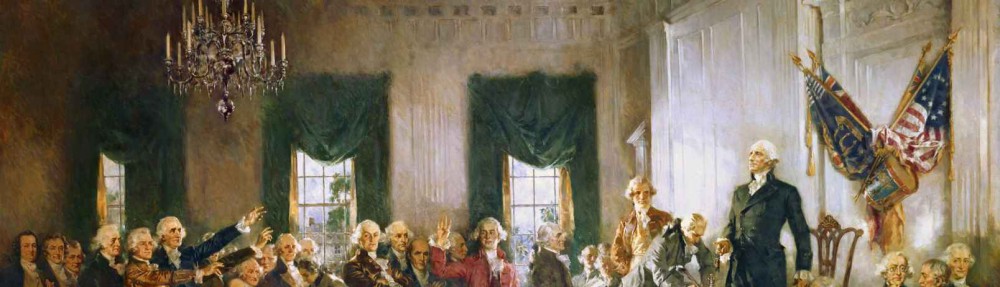
The basic premise of the Founding Fathers was man’s right to his own life, to his own liberty, to the pursuit of his own happiness—which means: man’s right to exist for his own sake, neither sacrificing himself to others nor sacrificing others to himself; and that the political implementation of this right is a society where men deal with one another astraders, by voluntary exchange to mutual benefit.
The Founding Fathers were neither passive, death-worshipping mystics nor mindless, power-seeking looters; as a political group, they were a phenomenon unprecedented in history: they werethinkerswho were also men of action. They had rejected the soul-body dichotomy, with its two corollaries: the impotence of man’s mind and the damnation of this earth; they had rejected the doctrine of suffering as man’s metaphysical fate, they proclaimed man’s right to the pursuit of happiness and were determined to establish on earth the conditions required for man’s proper existence, by the “unaided” power of their intellect.
In the modern world, under the influence of the pervasive new climate, a succession of thinkers developed a new conception of the nature of government. The most important of these men and the one with the greatest influence on America was John Locke. The political philosophy Locke bequeathed to the Founding Fathers is what gave rise to the new nation’s distinctive institutions. That political philosophy is the social implementation of the Aristotelian spirit.
Throughout history the state had been regarded, implicitly or explicitly, as the ruler of the individual—as a sovereign authority (with or without supernatural mandate), an authority logically antecedent to the citizen and to which he must submit. The Founding Fathers challenged this primordial notion. They started with the premise of theprimacy and sovereignty of the individual. The individual, they held, logically precedes the group or the institution of government. Whether or not any social organization exists, each man possesses certainindividual rights. And “among these are Life, Liberty and the pursuit of Happiness”—or, in the words of a New Hampshire state document, “among which are the enjoying and defending life and liberty; acquiring, possessing, and protecting property; and in a word, of seeking and obtaining happiness.”
The genius of the Founding Fathers was their ability not only to grasp the revolutionary ideas of the period, but to devise a means of implementing those ideas in practice, a means of translating them from the realm of philosophic abstraction into that of sociopolitical reality. By defining in detail the division of powers within the government and the ruling procedures, including the brilliant mechanism of checks and balances, they established a system whose operation and integrity were independent, so far as possible, of the moral character of any of its temporary officials—a system impervious, so far as possible, to subversion by an aspiring dictator or by the public mood of the moment.
The heroism of the Founding Fathers was that they recognized an unprecedented opportunity, the chance to create a country of individual liberty for the first time in history—and that they staked everything on their judgment: the new nation and their own “lives, fortunes, and sacred honor.”
“I have sworn upon the altar of God, eternal hostility against every form of tyranny over the mind of man.”
Jefferson—and the other Founding Fathers—meant it. They did not confine their efforts to the battle against theocracy and monarchy; they fought, on the same grounds, invoking the same principle of individual rights—againstdemocracy, i.e., the system of unlimited majority rule. They recognized that the cause of freedom is not advanced by the multiplication of despots, and they did not propose to substitute the tyranny of a mob for that of a handful of autocrats . . . .
When the framers of the American republic spoke of “the people,” they did not mean a collectivist organism one part of which was authorized to consume the rest. They meant a sum of individuals, each of whom—whether strong or weak, rich or poor—retains his inviolate guarantee of individual rights.
The political philosophy of America’s Founding Fathers is so thoroughly buried under decades of statist misrepresentations on one side and empty lip-service on the other, that it has to bere-discovered, not ritualistically repeated. It has to be rescued from the shameful barnacles of platitudes now hiding it. It has to be expanded—because it was only a magnificent beginning, not a completed job, it was only apoliticalphilosophy without a full philosophical andmoralfoundation, which the “conservatives” cannot provide.
Men have been taught that the ego is the synonym of evil, and selflessness the ideal of virtue. But the creator is the egoist in the absolute sense, and the selfless man is the one who does not think, feel, judge or act. These are functions of the self.
Here the basic reversal is most deadly. The issue has been perverted and man has been left no alternative—and no freedom. As poles of good and evil, he was offered two conceptions: egoism and altruism. Egoism was held to mean the sacrifice of others to self. Altruism—the sacrifice of self to others. This tied man irrevocably to other men and left him nothing but a choice of pain: his own pain borne for the sake of others or pain inflicted upon others for the sake of self. When it was added that man must find joy in self-immolation, the trap was closed. Man was forced to accept masochism as his ideal—under the threat that sadism was his only alternative. This was the greatest fraud ever perpetrated on mankind.
This was the device by which dependence and suffering were perpetuated as fundamentals of life.
The choice is not self-sacrifice or domination. The choice is independence or dependence. The code of the creator or the code of the second-hander. This is the basic issue. It rests upon the alternative of life or death. The code of the creator is built on the needs of the reasoning mind which allows man to survive. The code of the second-hander is built on the needs of a mind incapable of survival. All that which proceeds from man’s independent ego is good. All that which proceeds from man’s dependence upon men is evil.
The egoist in the absolute sense is not the man who sacrifices others. He is the man who stands above the need of using others in any manner. He does not function through them. He is not concerned with them in any primary matter. Not in his aim, not in his motive, not in his thinking, not in his desires, not in the source of his energy. He does not exist for any other man—and he asks no other man to exist for him. This is the only form of brotherhood and mutual respect possible between men.
Racism is the lowest, most crudely primitive form of collectivism. It is the notion of ascribing moral, social or political significance to a man’s genetic lineage—the notion that a man’s intellectual and characterological traits are produced and transmitted by his internal body chemistry. Which means, in practice, that a man is to be judged, not by his own character and actions, but by the characters and actions of a collective of ancestors.
Racism claims that the content of a man’s mind (not his cognitive apparatus, but itscontent) is inherited; that a man’s convictions, values and character are determined before he is born, by physical factors beyond his control. This is the caveman’s version of the doctrine of innate ideas—or of inherited knowledge—which has been thoroughly refuted by philosophy and science. Racism is a doctrine of, by and for brutes. It is a barnyard or stock-farm version of collectivism, appropriate to a mentality that differentiates between various breeds of animals, but not between animals and men.
Like every form of determinism, racism invalidates the specific attribute which distinguishes man from all other living species: his rational faculty. Racism negates two aspects of man’s life: reason and choice, or mind and morality, replacing them with chemical predestination.
What better way to begin a review of what is an excellent book than to say that the book’s authoralways knew. It’s as simple as that. Jeffrey Tucker knew in March of 2020 that tragic times were ahead.
I remember it vividly. In February of 2020 witless headline writers were trying in vain to tie a falling stock market to a coronavirus that investors had been pricing for many weeks. They revealed their misunderstanding of big market lurches. They’re a consequence of surprise. In February the surprise wasn’t a virus that had been in the news since early January; rather it was the presidential primary success of a since forgotten socialist by the name of Bernie Sanders. Of course, by month’s end Sanders was falling as quickly as he had risen. Stocks soared as a risk-factor to future growth was vanquished. Sanders, as I argue in my upcoming bookWhen Politicians Panicked, was the original “coronavirus.”
So what did the great Tucker know? He knew when the virus had become a problem for the U.S., and by extension the world. Crucial here is that Tucker was far too wise to presume that a virus could fell a nation populated by individuals long on common sense. To Tucker, the second “coronavirus,” or the “second wave” to paraphrase the alarmists of the moment, was thepolitical reactionto a virus that had been traveling around the world for months. The politicians easily gulled by the experts would take over. In the 20th century this was called central planning. Tucker correctly referred to it as central planning in the 21st century.
Tucker wrote with horror in March about Austin Mayor Steve Adler’s shocking decision to cancel South by Southwest, thus robbing Austin’s businesses of a “Black Friday” in the spring. Tucker knew that Austin was just the beginning whereby the expert standard would replace the freedom standard, only for this most essential thinker to sound the alarm. The always prolific Tucker started writing feverishly. He hasn’t stopped, and we’re very lucky for that.
Indeed, it’s pretty scary to contemplate how weak the editorial response to lockdowns and other virus hysteria would be without Jeffrey Tucker. It’s not just that he writes so much. He’s also provided a forum at the American Institute for Economic Research (where he’s editorial director) for an impressive team of economic thinkers to make a case for freedom, and against forced economic desperation as a way to combat what causes illness in some, and in the rarest of circumstances, death.
Tucker’s tireless work proved crucial for it providing people around the world with information that put them in the position to comfortably and confidently push back against acceptance of unemployment, starvation, and death as punishment for the spread of a virus that over half infected don’t even know they’re infected with. Without Tucker, the response to tyranny would be much less informed, and quite a bit less confident. We also wouldn’t have theGreat Barrington Declaration, which Tucker organized, and that millions around the world have signed. When histories are written about the tragedy foisted on the world by inept politicians, Tucker’s name will loom large as someone who led the shell-shocked back.
Thankfully for those who want a better understanding of just how appallingly the global political class has comported itself, Tucker has recently releasedLiberty or Lockdown. It’s an essential and very excellent read that will deeply inform its lucky buyers.
Tucker doesn’t pull punches. Instead, his book grabs the reader from the very first sentence: “For most Americans, the Covid-19 lockdown was our first experience in a full denial of freedom.” So true, and so well put. As he goes on to write in sentence two, “Businesses forced closed. Schools, padlocked. Churches, same. Theaters, dead.” From his first two sentences Tucker might agree that a potential silver lining to what is a global tragedy is that what happened, and what’s happening will hopefully wake the world up to how quickly politicians can foist sickening damage on the people whose freedoms they swore to protect. About what’s hoped for, time will tell. It’s not unreasonable to suggest that much of the world is still in shock. With good reason.
Indeed, it’s no reach to say what’s taken place over the last nine months is easily the worst human rights tragedy of the still young 21st century. The numbers back this up. As theNew York Timesreported last summer, 285 million of the world’s inhabitants are rushing toward starvation. Hundreds of millions more are being reacquainted with the poverty they had worked so diligently to escape. Poverty is easily history’s greatest killer, at which point we have to contemplate the “unseen” deaths related to so much focus on the coronavirus; as in how many will be brought to an early grave by tuberculosis, malaria, diarrhea, and other killers thanks to global health officials paying less attention to some of the worst health challenges in the world after poverty and starvation. What about cancer, heart and other killers like it not caught during an ongoing separation from reason? What about suicides in response to economic devastion, along with simple loneliness? The unseen with the virus promises to be endless, and possibly gruesome.
In Tucker’s words, we’ve been “subjected to a sadistic social experiment in the name of virus mitigation.” So true. And Tucker was merely talking about the U.S. Except that he knows the only closed economy is the world economy. When Americans take a decadent break from reality, or more realistically have their ability to live in reasonable fashion taken from them, the world suffers in ways Americans can’t begin to understand. Sadism foisted on suddenly unemployed and bankrupted Americans amounts to murder around the world. See above.
Basically the U.S. failed the world. When we panic, the world convulses. When our leaders lose any contact with reason and resort to lockdowns in their stupor, they provide cover to despots around the world not remotely constrained by anything resembling the Constitution, and who are only too glad to relieve their people of freedom. At this point it’s probably wise for readers to sit back and contemplate a counterfactual; as in imagine if President Trump had kept his wits only to go on national television (meaning global television) to tell those watching that it would be tragically mindless to fight a virus with economic contraction, and while each U.S. state is an autonomous one, that he as president would hopscotch around the country on Air Force One with a focus on embarrassing governors and mayors so foolish as to fight disease with poverty-inducing lockdowns. Trump’s actions wouldn’t have just saved countless Americans from destitution, they probably would have forced politicians and dictators around the world to rethink what they were about to do.
Furthermore, Trump acting asRepublican votersexpect Republican politicians to act would have revealed simple common sense. Tucker reminds us why this is so true. Lost in all the hysteria about a virus that traveled around China (and rather reasonably, the world) for months with no discernible death count amid what George Gilder has described as “dithering” (Gilder writes the foreword to Tucker’s book) by Chinese officials, is that there are few ways to fight a virus. Tucker already knew them care of his wise mother, but to be sure he purchased “Molecular and Cell Biology for Dummiesjust to check if I was crazy.” The book confirmed what Tucker already knew; “that there are only two ways to defeat a virus: natural immunity and vaccines.” Translated, viruses eventually die out because enough people get them only for those infected to develop immunity to them. As Tucker makes plain, as has the essential Holman Jenkins at theWall Street Journal, no vaccines were ever developed for viruses that spread in 1918, 1957, and 1968. They’re still with us, but society has grown naturally immune bystaying togetheras opposed to pursuing the life-and-nature wrecking path of living apart.
Notable here for those a bit slow on the uptake is thatMolecular and Cell Biology for Dummiesper Tucker “completely left out the option that almost the entire world embraced in March: destroy businesses, force everyone to hide in their homes, and make sure that no one gets close to anyone else.” As this column has asserted too many times to count,historians will marvel. Politicians can’t disappoint simply because the half-awake know that force always comes up well short against freedom when it comes to quality of outcome. Politicians only know force. Still, in 2020 they actually disappointed. Economic destruction despite the tautology that growth is the greatest foe of sickness and death, combined with a rejection of the pursuit of population immunity (not separating people from one another) that has historically brought viruses to their proverbial knees.
Tucker has a way with words, and the latter very much reveals itself inLiberty or Lockdown. As the world contracted amid broad takings of personal and economic freedom, politicians piled on. It wasn’t just a shutdown of global travel, it was also limits on travel within countries, including the U.S. About this, Tucker reminds us that just as globalization has improved the living standards of every living human, so has it elongated our healthful lives. When we “bump” into each other, we don’t just share ideas; rather we help new avenues of immunity to travel the world. In 2020, politicians tried to arrest this happy development. In vain. As Tucker puts it, a virus “cares nothing about borders, executive orders, and titles.” Naturally tyrannical politicians in countries like Australia and New Zealand tried the approach of forced isolation from the world and reality, but in Tucker’s words, all they did was at best “delay the inevitable.” And, assuming forced isolation proved successful, the near-term win would logically be pyrrhic. Think about it. To isolate is to “make the whole population of your tribe fatally vulnerable to the next bug that comes along.” Immunity and longer life are achieved through exposure. Always.
Of course, common sense means nothing to politicians, and those who enable them. We’re talking about a class of people that believes cheap rent can be decreed, that healthcare cost curves can be “bent downward,” and that expensive credit can be made “easy” via central banks.
And so they proceeded to try and fight the virus with “borders, executive orders, and titles.” It mocked them. Arguably to our betterment. As Tucker explains it, “A virus is a thing to battle one immune system at a time, and our bodies have evolved to be suited to do just that.” Historically this was what families that couldn’t afford to be ridiculous did: when one family member got sick, others were required to not separate from the ill. “Family immunity” is arguably what revealed itself before the better known “population immunity” or “herd immunity.” It turns out there was even such a thing as troop immunity. In Tucker’s words, “George Washington’s troops scraped off the scabs of the smallpox dead to inoculate themselves.” It’s all a long way of saying that while politicians panicked around the world in March of 2020, a virus that doesn’t abide the nail-biting schedules of the elected had been spreading in a globalized world for months before March. Who knows, but some speculate that politicians and experts who are expert at fighting the last war perhaps got to the coronavirus long after its global spread had brought on a fair amount of immunity. Thank goodness always late politicians were late yet again. Imagine how desperate the world would be if the lockdowns had begun in October of 2019 instead of March of 2020.
The shame yet again is that politicians eventually did discover the virus, only to lose their minds in the cruelest of ways. Their hysteria will exist as a forever reminder that emotion in front of the camera combined with force doesn’t correlate with positive outcomes. Tucker knows this intuitively simply because he knows intuitively that central planning logically fails precisely because it suffocates the immense knowledge that is a consequence of a decentralized, free society. Translated yet again for those a bit slow on the uptake, Tucker didn’t need the central-planning tragedies of the 20th century to open his eyes to the certain failure of centralized force. In short the author, whoalways knew,was certain well ahead of time that troubled times were on the way as politicians panicked in the only way they know how: the taking of freedom.
The above rates mention, or realistically repeat, simply because Tucker is clear about there having been no relationship between lockdowns, transmission of the virus, and death. Or, in Tucker’s words, whether a country locked down or not had “as much predictive power over deaths per million as whether it rains today is related to the color of my socks.” The numbers support this truth. New York locked down early in the U.S., while Florida locked down late and opened early. Yet the death count in New York well exceeds that in Florida. France locked down stringently, but Japan didn’t. Yet deaths in Japan related to the virus were very, very small. Even in crowded Tokyo. Correlation? Who knows? Think back to AIDS. So much that was assumed in the 1980s didn’t age well. The wager here is that the same will reveal itself about the coronavirus.
Which is why Tucker is for freedom first and foremost. Just as free people produce abundance that has always enabled a much more than fair right against death and disease, so does freedom produce abundant health advances precisely because decentralized experimenting and decision-making always trumps one-size-fits-all.Free people produce information. Some in response to a virus will never leave their house. Others will leave while covered by gloves, masks, and other presumed barriers to what’s spreading. Others will continue to go about as they used to while abiding minor precautions, while still others will throw caution fully to the wind; hitting every crowded restaurant and bar they can find, football stadiums too, plus they’ll kiss every person willing to kiss them back. We need them all when fighting an unknown. Through their varied actions we can learn how to live with a virus rather than it telling us how to live.
Same with businesses. The biggest and best known, potentially fearful in the early days of a killer virus (despite clear information from its epicenter – China – that it wasn’t) spreading to its customers, would have likely shut down in total. Small, lesser known businesses, perhaps facing a more a challenging credit environment, might have remained open in total. Some would have limited customers served as a way to bring in customers, some customers of businesses would have altered times of patronage to limit human contact somewhat, and still others would have yet again thrown caution to the wind. You once again need them all. Freedom doesn’t just produce information about virus spread, it also produces crucial information for businesses about how to re-open in a world changed (or maybe not changed at all) by a virus scare. These questions were never adequately answered about how virus spreads and how businesses should respond to spread precisely because politicians indirectly banned information.
And then there’s the question ofWhy?Politicians can’t act without at least some buy-in from the citizenry? Did Americans buy in, and do they, or did the lockdowns happen so fast that Americans never had a chance to protest? Tucker concludes that we “must reject the wickedness and compulsion of this current moment in American life. It needs to counter the brutalism of the lockdowns.” There’s total agreement here, but do Americans agree? One hopes, but there’s an admitted fear that Americans have somehow changed; that they’re more accepting of having their freedoms taken, particularly if a virus appears threatening. Time will tell. So will elections tell. The next few should be interesting.
For now, it’s useful to conclude about this excellent book that it’s filled to the brim with information about the meek nature of the virus, how ineffective the lockdowns were, how typically feckless government officials were. It’s all well and good, but the much more compelling arguments made by the brilliant Jeffrey Tucker were about freedom itself. That’s ultimately the only answer. It has to be. Much as the numbers about the virus work in our favor, we risk winning the argument while losing the battle. That’s the case because as Tucker acknowledges, this won’t be the last virus to reveal itself. Numerical and lethality arguments are fascinating, but they set the stage for future lockdowns of the “this time is different” variety.
Which is why the author whoalways knewis most right and most compelling when he calls for the countering of “the brutalism of the lockdowns.” That’s the only answer. No more lockdowns.Never again. Any other argument fails.
All thinking is a process of identification and integration. Man perceives a blob of color; by integrating the evidence of his sight and his touch, he learns to identify it as a solid object; he learns to identify the object as a table; he learns that the table is made of wood; he learns that the wood consists of cells, that the cells consist of molecules, that the molecules consist of atoms. All through this process, the work of his mind consists of answers to a single question:Whatis it? His means to establish the truth of his answers is logic, and logic rests on the axiom that existence exists. Logic is the art ofnon-contradictory identification. A contradiction cannot exist. An atom is itself, and so is the universe; neither can contradict its own identity; nor can a part contradict the whole. No concept man forms is valid unless he integrates it without contradiction into the total sum of his knowledge. To arrive at a contradiction is to confess an error in one’s thinking; to maintain a contradiction is to abdicate one’s mind and to evict oneself from the realm of reality.
“Man cannot survive except through his mind. He comes on earth unarmed. His brain is his only weapon. Animals obtain food by force. man had no claws, no fangs, no horns, no great strength of muscle. He must plant his food or hunt it. To plant, he needs a process of thought. To hunt, he needs weapons,and to make weapons – a process of thought. From this simplest necessity to the highest religious abstraction, from the wheel to the skyscraper, everything we are and we have comes from a single attribute of man -the function of his reasoning mind.”

 THE ARTFUL DILETTANTE