A New Era of Objectivism

The Atlas Society stands for an open, benevolent, intellectually tolerant approach to Objectivism in which philosophical disagreements are dealt with through civil discussion and intellectual exchange. We adopted this approach partly in contrast to an approach that has led to many unnecessary conflicts and schisms among adherents of Ayn Rand’s philosophy over the years, as discussed in David Kelley’s book, Truth and Toleration in Objectivism (1990, 2019).

The Ayn Rand Institute recently published a long article addressing this history of schisms—the first official comment on the issue from that wing of the Objectivist movement in many years. The article rehearses selective details of some disagreements among Objectivists in an attempt to vindicate the many bridges ARI has burned over the decades. Yet along the way, it ends up embracing the key ideas The Atlas Society has been advocating all along.

First, ARI acknowledges that it is not the definitive representative or arbiter of the philosophy of Objectivism.

ARI does not regard itself as the leader of an organized Objectivist movement:

ARI…does not pretend to be a spokesman for Ayn Rand or Objectivism…. ARI seeks a “movement” only in the sense that Rand describes above: independent individuals and organizations working on the task of spreading ideas—specifically, on increasing awareness and understanding of Objectivism—who cooperate when they find it mutually beneficial to do so and who otherwise go their separate ways.

Moreover, they concede that after Ayn Rand’s death, “She was no longer there to police the use or misuse of her name or philosophy, to declare who is an authorized representative and who is not. And no one could reasonably regard any existing individual or organization as a spokesman for a person now deceased.”

As to whether this is how ARI has actually conducted itself over the years, those who have been in the movement can consult their own memories of the various past disagreements and decide for themselves. Rather than revive these debates, we choose simply to accept this implicit acknowledgement that the questions of what the philosophy of Objectivism means, what principles are essential to it, and what new ideas are consistent with it are to be evaluated by every individual Objectivist based on his own judgment. No person or organization has a central role or special authority. To which we can only say: “Amen.”

Second, ARI acknowledges that ideological disagreement within a movement, even sometimes deep and bitter disagreement, is normal and natural.

It is entirely normal for a movement that is engaged in bringing important new knowledge to the world to have leaders who disagree, often vehemently, about the meaning and application of that knowledge.

If disagreement is normal, it should be treated as such and addressed through the ordinary norms of intellectual debate, not through division into warring camps along with warnings against sanctioning each other’s sanctioners. We are glad to see that such demands have now been conspicuously dropped and ARI has nominally adopted the more benevolent approach of “going our separate ways” as and when we disagree.

That leads us to the final point of interest in this article, which is its repeated use of the phrase “other Objectivists,” including “other Objectivist intellectuals or organizations,” to describe the counter-parties of the various breaks and schisms. It is an implicit recognition that despite our disagreements, we are all advocates of the same philosophy and that there is a multiplicity of Objectivist voices.

Objectivism is and should be a movement of “independent individuals and organizations…who cooperate when they find it mutually beneficial to do.” We agree and are glad to see the Ayn Rand Institute endorsing the same idea. There is still a great deal that needs to be done to make this happen, rationally and benevolently, in practice. But we are happy to see it acknowledged in theory.

The Atlas Society has been putting these principles into practice for many years, and to the extent others choose to follow that lead, we can all move forward into a new and more productive era in the Objectivist movement.

The Atlas Institute

“I Wanted to Watch them Die Right in Front of my Fu***ng Face”–Frank James

“Person of interest” Frank James. Image provided by the New York City Police Department.

Yesterday, someone opened fire on the occupants of a New York City subway. The shooter injured ten people (none fatally) and another 13 people were injured in the rush to get out of harm’s way.

The prime suspect is Frank R. James because the key to a U-Haul Mr. James rented was found at the scene of the crime, along with a Glock, ammunition, gasoline, a hatchet, and smoke grenades.

Police at a nearby street after a shooting took place at a subway station in Brooklyn, New York, the United States, on April 12, 2022. (Credit Image: © Wang Ying / Xinhua via ZUMA Press)

Keechant Sewell, NYC’s black Police Commissioner, noted that Mr. James has “made some concerning posts” without going into much detail. The “concerning posts” show that Mr. James is a black radical unopposed to violence. In a YouTube video (since removed) uploaded a day before the shooting, he said:

I’ve been through a lot of shit, where I can say I wanted to kill people. I wanted to watch them die right in front of my fucking face immediately. But I thought about the fact, ‘Hey, I don’t want to go to no fucking prison. Fuck that! I’m not going to no fucking prison. I’m just not.’

In another video (also since removed), he seemed to imply that the Russo-Ukrainian War was a kind of test run for whites hoping to exterminate blacks:

They’re white, you’re not. They’re doing that to each other? What do they think they’re going to do to you? It’s just a matter of time before these white motherf—ers say, ‘Hey listen, enough is enough, these n—–s gotta go.’ What’re you going to do? You gonna fight. And guess what? You gonna die.

Other posts criticized NYC Mayor Eric Adams in broad terms, and Ketanji Brown Jackson for marrying a white man.

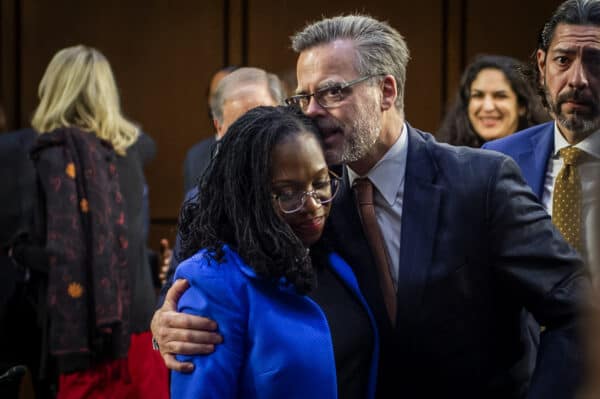
March 23, 2022: Ketanji Brown Jackson is embraced by her husband Patrick Jackson following the third and final day of her Senate nomination hearings. (Credit Image: © Rod Lamkey / CNP via ZUMA Press Wire)

Information about the race of the ten people shot is unavailable. However, if Mr. James really did the deed, he was almost certainly copying Colin Ferguson. Mr. Ferguson, a black Jamaican, opened fire on passengers of a NYC subway in 1993. His motive was vengeance against the white man, and all of his victims were white or Asian. It will be interesting to see how the media spins this story as more information becomes available.

Chris Roberts

America is in its Second Civil War

Republicans are usually worthless, except for DeSantis. Now the governor of Texas has found his inner DeSantis. He is holding the Biden regime accountable for the impeachable offense of refusing to enforce America’s borders under existing law. He has shipped illegal immigrants to the Imperial City.

We know the tactic had an effect. How? The leftists occupying the capital of the former American republic are really, really mad.

Texas’ action isn’t just symbolic. It’s an exercise of state power over federal power in defense of the American Constitution, and — more fundamentally — the U.S. Bill of Rights. Enforcing the border is an individual rights issue. The Biden regime is letting anyone and everyone into the country, creating a state of lawlessness and anarchy so that it may hook millions of people on government programs, ensuring a DemCom majority forever. And the tactic may well work. But states like Texas have other options. They can do what their present governor did — ship illegal aliens to annoy the corrupt elite in the Imperial City.

And, worst case, Texas can secede once it becomes clear — as it will, on our present course — that the unaccountable leftist regime in D.C. is an enemy of individual rights, the U.S. Constitution and — therefore — an enemy of Texas too.

Other states and localities will have to follow suit, at some point. Not just with immigration, but with vax mandates, permanent mask mandates, deliberate inflation and decisive destruction of the American economy. Otherwise, the occupying forces in D.C. are going to swallow all of us up. Like it or not, we’re already in a civil war. The only choice is how soon you accept it.

Michael J. Hurd, Daily Dose of Reason

Biden is Making Fools out of Progressive Democrats

Like a lepidopteran Charlie Brown drawn to Lucy van Pelt’s flaming football, congressional progressives keep falling for corporate Democrats’ pathetically predictable, and transparently self-serving, pleas for unity. Support our priorities, the centrists keep urging, and we’ll get around to your stuff later.

How much later?

We’ll tell you later.

“Progressives have grown increasingly accustomed to disappointment with the Biden administration,” the Daily Beast reports with the breaking-news tone of “sun rises in east,” “and now a proposed increase in Department of Defense and law enforcement spending are causing them to air their grievances anew with just months left before the 2022 election.” Insanely — remember, we just left Afghanistan, so war spending should drop precipitously — President Joe Biden’s latest budget proposes a record high of $813 billion in military spending, an increase of $30 billion from last year. He just sent $13 billion to Ukraine. Plus, he wants $32 billion for cops.

Refund the police.

Whether working inside a system diametrically opposed to your values has ever been effective is historically debatable. Since Bill Clinton ditched the New Deal coalition of the working class, labor and Black voters in favor of Wall Street banks and other large corporate donors, it certainly has never worked for progressives inside the Democratic Party.

Impotent and hopeless, members of the AOC-led House Squad and left-leaning senators only have one option left to make a strong political statement: leave the Democratic Party and either join the Greens or form a new progressive party. But that would risk ridicule and marginalization by liberal media outlets like The New York Times and MSNBC, not to mention grassroots organizing, which requires hard work like talking to voters and getting rained upon.

So the squeaky mice of the inside-the-Beltway progressive left are reduced to issuing sad little whines in response to once again getting the shaft.

“If budgets are value statements, today’s White House proposal for Pentagon spending shows that we have a lot of work to do,” Congressional Progressive Caucus Chair Pramila Jayapal (D-Washington), Reps. Barbara Lee (D-California) and Mark Pocan (D-Wisconsin) wrote in a statement in response to Biden’s GOP-inspired budget.

“It’s a mistake,” Rep. Alexandria Ocasio-Cortez (D-New York) said.

“You know, you want to say ‘fund the police,’ cool. But you also talk about police accountability,” added Rep. Jamaal Bowman (D-New York).

These quotes appeared in an article headlined “Left Seethes at Biden’s Big Defense Budget.”

I know seething. Seething is a friend of mine.

“Work to do” is not seething. “Mistake” is not seething. “Police accountability” is not seething.

“I think this year’s number was too much,” said Sen. Elizabeth Warren (D-Massachusetts). Yes — by about 1,000%.

Biden’s Build Back Better infrastructure package, which incorporated some progressive priorities, died because the White House and its corporate Democratic allies in Congress didn’t go to the mat for it; in particular, they weren’t willing to punish DINO Sens. Joe Manchin and Kyrsten Sinema by threatening to strip the traitors of their committee assignments.

Increasing the national minimum wage to $15 an hour, a progressive priority for the last decade, is dead under Biden.

There’s been no movement on another key platform plank of Bernie Sanders’ presidential bids: student loan forgiveness.

About 112 million Americans struggle to afford health care, and we’ve lost nearly 1 million Americans to the COVID-19 pandemic, yet Biden, satisfied with his former running mate’s wobbly Affordable Care Act, hasn’t spent a penny of political capital, or cash capital, on Medicare For All.

Besides lessons in humility and patience, what exactly do congressional progressives gain by working inside the Democratic Party? Mainstream legitimacy. But to paraphrase Lyndon B. Johnson, what the hell else is working inside the Democratic Party for if it never pays off?

While the self-identified progressive congressional Democrats spin their wheels, their constituents get a defense budget that Donald Trump would be proud of, higher taxes to pay for more police and soaring prices chomping away at a $7.25 national minimum wage last increased in 2009. (Adjusted for inflation, that’s $5.48 today.)

At this point, progressive voters can only draw one logical conclusion about the decision of AOC, the Squad and other supposedly left-wing congressmen and senators to remain inside the Democratic Party: Their sole purpose is to legitimize and prop up an institution that’s working against them, their ideas and their supporters.

Ted Rall (Twitter: @tedrall), the political cartoonist, columnist and graphic novelist, is the author of a new graphic novel about a journalist gone bad, “The Stringer.”

It’s Free !

One of the most misused words in the English language is “free,” as in “it’s free.” Whether it’s the free samples of stuff at Costco, or the free pens and refrigerator magnets they give away at your local bank or car dealership, or the free hip replacement your mother-in-law just received, we use the term freely, so to speak, without ever considering it’s true meaning.  When we say “it’s free,” what we really mean is that someone else is paying for it—voluntarily or involuntarily.  And this is a very important distinction. Because one is morally defensible, while the other is not.  One involves a clear violation of private property rights, enshrined in the Seventh Commandment, while the other does not.  The Seventh Commandment states, “Thou Shalt Not Steal Thy Neighbor’s Goods.” This is the clearest affirmation of private property rights ever handed down.  By The Man Himself.  And it’s etched in stone.  You can’t take someone else’s things, period. And just because you take something from someone and turn around and give it to someone you believe is deserving doesn’t justify it either. The Seventh Commandment is everything the Good Lord ever had to say about “social justice,”–about what is mine and what is thine.

The free samples of some new pineapple/anchovy salsa being handed out by the nice ladies in latex gloves at Costco are not really free.  They are either being paid for by Costco, or the company that makes those dreadful concoctions.  So while Costco is erroneously saying, “Try these free samples,” what they really should be saying is, “Try one of these dreadful concoctions that we or the producer are paying for.”  The same with the pens and refrigerator magnets at your local bank or car dealership. And the customers are likewise incorrect when they proudly tell their spouses, “The pens were free, Honey.”

So, while the merchants and customers are misusing the word free in these examples, if only because it’s convenient, the actions in both cases are not immoral.  Neither action involves breaking the Seventh Commandment nor anyone’s private property rights. Both the salsa and the pens and refrigerator magnets are owned by the parties giving them away. The owners can dispose of them as they wish.  But, in any event, they are not free. Someone had to pay for them.

In the case of your mother-in-law’s hip replacement, however, it is neither free nor morally acquired. The new hip wasn’t free; it was clearly paid for by somebody else, in this case the taxpayer.  And it was not morally acquired, since it involved a breach of the Seventh Commandment and private property rights.  The money to pay for her new hip came out of her neighbor’s pocket, the very party the Seventh Commandment (and the United States Constitution) was designed to protect. The money to pay for the hip was taken from her neighbor by a third party, an intermediary we customarily call the government. Third Party intervention, however, does not legitimize the violation of the Seventh Commandment nor the very private property rights protected by the Seventh Commandment.  If a highwayman robs you at gun-point and tells you they are going to give all your money to the needy, it doesn’t make it right.  It’s still a violation of that pesky Seventh Commandment.

Both the hip replacement and the act of that thoughtful highwayman involve a breach of the Seventh Commandment and the private property rights protected by the Seventh Commandment.  In either case, the ends do not justify the means.  Nor is the hip replacement free.  But if you ask your mother-in-law how much she had to pay for the hip replacement, she would in all likelihood and without a second thought say, “It was free.” What she really should have said was, “My neighbor paid for it, and they didn’t even ask him for permission.”

So the next time you’re about to casually say, “It’s free,” think again.  Because, rightly or wrongly, it really means somebody else is paying for it.

The Artful Dilettante—Conscience of the Second American Revolution

ESG is Even Worse than You Think

The ideas behind the Environmental, Social, and Governance (ESG) movement have been around for quite some time. However, until recently, they have remained mostly out of the public eye. 

So, what is the purpose of the ESG movement? Initial ESG efforts were aimed at fossil fuels (coal, oil, and natural gas), in a push to decarbonize our economy and transition to “clean” energy.

Yet, what if there is more to the transition? What if it goes beyond energy? After all, the “E” in ESG deals with more than just “Environmental.” Issues such as land use and production agriculture must be evaluated for climate risk. What if the transition envisioned by ESG backers includes food production and consumption, mining, and timber? And that is just the “E” in ESG.

It is important to understand that the transition envisioned by ESG backers goes far beyond the source of energy, and it truthfully has little, if anything, to do with the environment. The transition being engineered by ESG backers seeks to remake our society in the vision of our utopian betters.

Most large global corporations, central banks, and Wall Street investment firms are aligned in their support of ESG and NetZero 2050. The Biden administration, through numerous executive orders, has directed all federal agencies to develop ESG goals, policies, and regulations. This unholy alliance controls nearly every sector of our economy. And if you thought the “E” in ESG is bad, wait until they get to the “S.”

Even a casual observer of the news over the past several years has seen the things that form the foundation of our society under attack. The family, parental rights, public education, the Constitution, the free market, free speech, freedom of assembly, man, woman, everything. 

Which brings us to Disney. If you do not believe that the goal of ESG is to fundamentally change our society, our individual rights and freedoms, how do you explain Disney’s latest actions? For instance, Disney recently eliminated the greeting “Ladies and Gentlemen, Boys and Girls” at the Magic Kingdom to promote inclusivity. Diversity and inclusivity are very important in the “S” of ESG. Now, who can argue against diversity and inclusivity? Well, the tricky thing about ESG is that the transition also applies to the meaning and intent of words.

Disney’s “transition” started much earlier and goes much deeper, as shown in recent videos and statements. I grew up watching Walt Disney on Sunday nights. Yes, I am that old. And I have to wonder how things got to this point with such an iconic brand. When did the magic leave the kingdom? And why?

In a recent article in the Washington Examiner, Vivek Ramaswamy, author of the bestseller Woke, Inc. pointed to the role that Disney’s three largest shareholders may have played in picking the fight over Florida’s Parental Rights in Education bill. Who are the three largest shareholders in Disney? BlackRock, Vanguard, and State Street—do these names sound familiar? Together, these three firms own 15.3 percent of Disney stock. In a publicly traded company that is a lot.

Need proof. Much was made of the news that Elon Musk acquired a 9.2 percent stake in Twitter to become the company’s single largest shareholder. Mr. Musk was even offered a seat on the Board at Twitter. Yes, shareholders owning 15 percent of your stock have your attention.

You may question Mr. Ramaswamy’s assertion, but it is consistent with the ESG movement. As BlackRock CEO Larry Fink said, “Behaviors are going to have to change and this is one thing we are asking companies, you have to force behaviors and at BlackRock we are forcing behaviors.”

If BlackRock and the other ESG movers and shakers are into forcing behaviors, do you think they simply sat by and watched Disney’s halting efforts over the past year before going all in against the Florida legislation? Or is it more likely that there was a phone call or two? As any CEO of a publicly traded company can attest, you take that call. Disney’s actions show that if these large financial institutions were not pushing those decisions, they certainly weren’t opposed. 

Now, you may wonder why BlackRock and other Wall Street firms would weigh in on social issues, parents’ rights, and public education. It will not come as a surprise if you go to their websites and read about their policies and initiatives, in their own words. It is all there, and it is time to take this very seriously.

For more proof, a recent column in Politico’s newsletter, The Long Game, discussed SOC Investment group’s latest shareholder activism efforts to require companies to undergo a civil rights audit focusing on social justice and related issues. They are having some success with companies like BlackRock, Citigroup, and Apple agreeing to conduct the audits. There’s that BlackRock again. 

On their face, it can be hard to understand the intent and outcome of these shareholder resolution efforts. On one hand, this could improve accountability for money that public corporations have given to popular causes. On the other hand, the audit results can be used to push ideology through publicly traded companies. Given everything we are seeing, which is more likely? 

One thing we do know is that as the ESG movement gains momentum large corporations will be the tool to “force behaviors” and complete the transition of our society. Shareholders in these public companies must be involved and educated. I should add that Blackrock, Vanguard, and State Street are not the actual shareholders of Disney stock. The true owners are the participants in state pension plans, 401(k)s, and individual investors who employ these money management firms to buy, hold, and vote shares with their money.

 Large corporations are being pushed by financial institutions to adopt ESG policies that you may not agree with or that run counter to your values and beliefs, and they are largely using your money to do it.

 Several states are taking steps to exercise the voting rights under state pension plans and other state funds. These policymakers and state financial officers should be supported in this effort as they face tremendous pushback. They are accused of “meddling in the free market,” but the idea of a free market has gone the way of Disney’s innocence.

How bad is the ESG movement? Judge a tree by its fruit. 

Bette Grande (bgrande@heartland.org) is a government relations manager at The Heartland Institute.