It used to be called “State of the Union.” Now it’s a “congressional address”. Very Soviet-like.
His stupid address to the nation doesn’t matter. It’s all totalitarian Communism. There’s no news there. It’s all predictable. It will have to be undermined and fought outside the traditional channels like free elections and free speech BECAUSE WE NO LONGER HAVE THOSE. The healthy thing is to stop dignifying this rigged regime as a legitimate successor to real presidencies. That America is over. The republic has been dying a long time. Face the truth before the stormtroopers of the cabal propping up this demented miscreant literally or figuratively come knocking on your door. Facing the truth, that our republic is dead, does not automatically lead to a solution; but it’s an entirely necessary condition for finding one. Remember: the reality and rationality of individual rights and the Bill of Rights once honored by the American government, more or less, will long outlive these outlaws disguised as “leaders”.
“I don’t remember a time in my lifetime people more divided than they are right now.” — Frank Luntz, long-time pollster
I agree. Why would anyone who cherishes his or her liberty want anything to do with people who don’t care if the Bill of Rights is obliterated — just so their guys are in charge? When I encounter people who support the Communists taking over our country, I am disgusted by them. I think, “YOU stole my freedom.” And that’s personal.
The past, we’re so often told, is a dystopia — a cauldron of backwardness and bigotryApril 28, 2021 | 11:19 pm
Are citizens of liberal societies permitted to question liberalism? In theory, the answer is yes, given liberalism’s commitment to ‘free thought’ and ‘the marketplace of ideas’. Such tolerance is rarely in evidence in practice, however — a reality illustrated in hilarious fashion by a writer for a Washington magazine who recently decried ‘cancel culture’ even as he insisted that: ‘It’s absolutely necessary to de-platform public intellectuals who object to liberal democracy.’
To the liberal mind, to question liberalism risks opening portals to the past, a place populated by tyrannical kings, Catholic inquisitors, Spanish conquistadores, religious warriors, zealous apparatchiks, ‘collectivists’, fascists and sundry other ghastlies. Over the past few years, as voters registered discontent with the global liberal consensus, an entire cottage industry of books, essays and charities has sprung up to warn against revivifying the past.
The past, we’re so often told, is a dystopia — a cauldron of backwardness and bigotry. One that must be repressed at all costs.
Liberals disagree over where exactly lies the line dividing the enlightened time and the dark time. ‘Classical’ liberals tend to mark 1789, whereas ‘progressive’ liberals — noting that much of reality since that watershed year has failed to conform to their own liberal ideal — are uncomfortable with anything not from the present or the future. Hence they now issue fatwas against even the avatars of liberalism’s own recent past (Cher, Dr Seuss, J.K. Rowling, etc).
The current tendency to see the past as a foreign land of endless horrors brings with it periodic bursts of purges and violent iconoclasm — most recently, the statue-toppling of last year. In the realm of ideas, we see the inability of even Christian liberals to tolerate any serious consideration of non-liberal political, economic and cultural arrangements. We see the growing discord in the Anglican Church over once-standard ideas about marriage and gender.
Church and state have long been separated. The ideal is that a new liberal order ushers in a new, rational, tolerant and secular regime: cleaving apart day-to-day politics from religion and metaphysics. So instead of enshrining any one orthodoxy, a liberal neutral ground would be created, one that could be contested by rival accounts of the good life. The religious would be able to live happily beside the unbelievers, with all minorities protected. In this way, the advent of liberalism would — once and for all — put an end to the persecutions of the past.
But has that really come to pass? Given man’s inclination to worship, to build altars in the public square, our societies will always enshrine some orthodoxy or other (and, therefore, empower some clerisy or other). The only questions are: which orthodoxy? Which clerics? If the past couple of years have made anything clear, it is that there is to be no neutrality. The West must choose.
Do we enshrine the orthodoxy of the latest theories on race, sex and gender? Do we empower the woke clerisy, the army of blue-check Twitterati and HR managers who can destroy careers and lives in a matter of minutes over the smallest of ideological infractions, and whose judgments are subject to no reasoned appeal and no code of canon law? Do we live under their new blasphemy laws, ostensibly designed to prohibit ‘hate speech’?
Or do we choose the more forgiving, perhaps old-fashioned orthodoxy that sustained western culture for the better part of two millennia? The Judeo-Christian values and institutions that venerated natural reason, that by their discipline tamed the big and small would-be tyrants of Europe, reminding them that there exists a higher power than theirs? You don’t need to be religious to think that, on balance, this world view has put us in pretty good stead so far — and is worth keeping now.
It’s tempting to imagine that there is no choice — or to defer the choice for ever. This excuse for doing so is precisely that the present is the best of all possible worlds, while any attempt to preserve the past means clinging to unremitting horrors. For the liberal, to evoke a bedrock pre-modern concept such as the common good — much less the highest good — is to summon those various demons that good progressive liberal values were supposed to have vanquished.
Anyone, left or right, calling today’s progressive order into question — or daring to propose alternatives — is first asked to apologize for these horrors, stretching from antiquity to whenever enlightened time began (which may be as recently as a couple of years ago). This is a type of intellectual blackmail, and the best defense against it is to go on the offense: no, it’s the actually existing present that increasingly resembles a dystopia, and the onus is on the liberal to give account and apology. The non-liberal’s rejoinder can be summed up with three simple words: look around you.
Look around you: has liberalism delivered on its own terms, on its promise of neutrality between world views? How’s the liberty of the church faring amid lockdowns and renewed threats to force American nuns to pay for abortifacients? Why are churches told they can no longer run adoption services if they refuse to follow the liberal view on sexuality? Why was a Catholic priest expelled from a Glasgow university campus because he held a prayer meeting protest on the day of a Pride march? This is not a sign of neutrality, but one world view crushing another.
Look around you: if a 200-plus-year-old newspaper like the New York Post (where I work) can be censored ahead of an election for posting a true story about Hunter Biden, how safe are you from the censors and cancelers? Does it make any meaningful difference that in liberal societies, the repression is meted out by large, privately owned corporations, rather than a centralized state? Do a Silicon Valley dweeb’s Birkenstock sandals taste any better than a junta commandant’s boots?
Look around you: when was the last time you felt like you lived in a pluralistic, tolerant society? Does the Free World feel free? Four centuries or so since it was launched, has the liberal project delivered on its promise to make men and women free, by toppling all the old authorities? Or has the downfall of authority left us more vulnerable to more insidious and subtle forms of coercion, by woke demagogues, employers and advertisers?
Look around you: does our marketplace of ideas resemble anything like that promised by the bewigged liberals of the late-18th and 19th centuries? Does truth prevail over its cacophony of nonsense? Set aside the teaching of Genesis, whatever happened to the basic teachings of biology and genetics about the immutability of sex? (Don’t ask Richard Dawkins, just cancelled by the American Humanist Association for daring to question gender ideology.)
Look around you: do today’s eye-watering wealth and power inequalities suggest that liberalism has done away with social hierarchies? Or has it rather empowered an especially selfish class of owners and managers, their rapaciousness made all the more galling by their woke and ‘meritocratic’ pretensions?
It won’t do for the ‘classical’ liberal to insist that these phenomena are gross distortions of some aboriginal version of his ideology. After a while, he begins to sound like the Trotskyist circa 1936 who, as evidence mounted of show trials, camps and NKVD torture, insisted that none of these crimes could be laid at the feet of ‘original’ Marxism.
At some point, the liberal has to admit that the powdered-wig version of his ideology contained in it the seeds of its woke, repressive variety: that enshrining individual autonomy and choice as the highest goods of human life would eventually create the conditions for a kind of private tyranny, precisely what the common-good tradition of classical and Christian thought had always warned about and sought to restrain.
The past, in a realistic frame, is a mix of light and dark. Remove the rosy glasses of liberalism, however, and it is the present that looks more dark than
How can America unite again to do great things if we are led by people who believe America suffers from a great sickness of the soul, an original sin that dates back to her birth as a nation?
Consider.
After his long night of prayer for “the right verdict” to be pronounced — Derek Chauvin was convicted on all three counts — Joe Biden stepped before the White House cameras to tell us what it all meant.
George Floyd’s death, said Biden, “was a murder in the full light of day, and it ripped the blinders off for the whole world to see the systemic racism… that is a stain on our nation’s soul — the knee on the neck of justice for Black Americans.”
Astonishing. Biden is saying that when Chauvin knelt on the neck of George Floyd for nine minutes as the life drained out of him, the world, for once, was getting a good, close look at the diseased soul of America.
What Chauvin was doing to Floyd, said the president of the United States, is a reflection of the kind of justice America delivers to Black Americans.
This is no aberration, Biden was saying. This is the routine reality.
Biden was introduced by Kamala Harris, who said much the same:
“America has a long history of systemic racism. Black Americans and Black men in particular have been treated throughout the course of our history as less than human.”
At Al Sharpton’s National Action Network, U.S. Ambassador to the U.N. Linda Thomas-Greenfield delivered what The Wall Street Journal called, “a recitation of America’s sins (that) could have come from China’s Global Times.”
Said Thomas-Greenfield:
“I have… seen for myself how the original sin of slavery weaved white supremacy into our founding documents and principles. … Racism is the problem of the racist. And it is the problem of the society that produces the racist.”
What our diplomat to the world is saying is that our Declaration of Independence, Constitution and Bill of Rights are interwoven with white supremacy and that America, to this day, continues to breed racists.
Speaker Nancy Pelosi, at a Congressional Black Caucus event after the verdict, turned her eyes heavenward in gratitude:
“Thank you, George Floyd, for sacrificing your life for justice….For being there to call out to your mom — how heartbreaking was that … And because of you … your name will always be synonymous with justice.”
Implication: Floyd died to redeem America of her original sin of racism.
All in all, quite a commentary on our leaders.
For, again, our president and vice president are saying that this people and country still suffer from a sickness of the soul that dates back to its formative days.
The 1960s radicals who vilified our country as “Amerika” were rightly called “anti-American.” Today, the difference between what they said about America and what our highest elected leaders are saying is hard to discern.
Our enemies have picked up on this. In Anchorage, after Secretary of State Antony Blinken called Beijing out for repression in Hong Kong and “genocide” in Xinjiang, China’s foreign minister was right back in his face.
You Americans should look to your own sins and clean up your house before lecturing the world on political morality, he said. Today, that Chinese foreign minister could cite Biden and Harris as his chief witnesses that America is a nation sick in its soul.
We hear our leaders’ attacks on America. Where is their defense?
What other nation has provided the same measures of personal and political freedoms and material blessings for 40 million Black people as has the United States?
If people of color are treated “as less than human” in America, as Harris says, why are so many people of color seeking desperately to get across our Southern border to build their future here?
What is the real truth about race in America that goes unmentioned in the mainstream media’s endless hunt for encounters between Black men and white cops?
The main perpetrators of violent crimes against Black Americans — are other Black Americans. Black men, ages 16 to 40, are 3% of the U.S. population but commit roughly a third of America’s violent crimes.
Defund police, restrict police, remove police and you will get more of what the police prevent — crimes, especially violent crimes, in your community.
When Biden and Harris spoke of “systemic racism” afflicting our society, they were not describing their enlightened selves. And it was Hillary Clinton who identified the people the leftist elites have in mind:
“You could put half of Trump’s supporters into what I call the basket of deplorables. … The racist, sexist, homophobic, xenophobic, Islamaphobic — you name it. … Some of those folks… are irredeemable, but thankfully they are not America.”
What Clinton, Biden and Harris are all saying is that, though the moral sickness of racism pervades our society, we are the vaccinated ones.
Patrick J. Buchanan is the author of “Nixon’s White House Wars: The Battles That Made and Broke a President and Divided America Forever
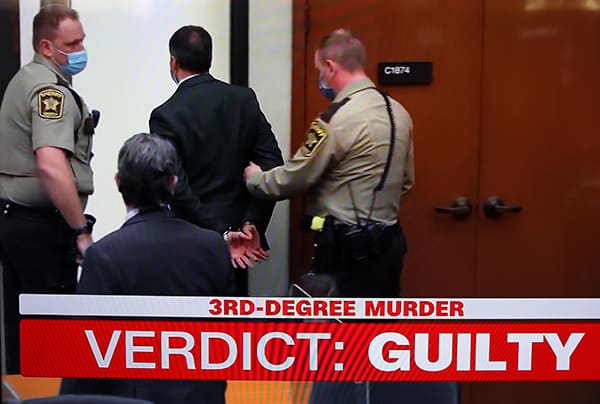
The jury has found Derek Chauvin guilty on all three counts. It took fewer than 24 hours to reach a unanimous decision. I have argued all along that an acquittal was impossible, no matter what the evidence showed. No jury, anywhere in the United States, could have found Mr. Chauvin innocent after nearly a year of riots.
I had some hope that the jury might acquit on one or two of the more serious charges, but the guilty verdict was announced first on the most serious of the three, so the other two verdicts were inevitable. Under Minnesota law, Mr. Chauvin will be sentenced under only the most serious charge. It carries a maximum sentence of 40 years, but according to state guidelines, a first offence is supposed to get 12-1/2 years. Judge Peter Cahill said he would pass sentence eight weeks from now.
As the verdicts were read, the camera closed in on Mr. Chauvin for the first time since the trial began. He was wearing a mask, but appeared to show no emotion. He was led from the courtroom in handcuffs and will remain in custody.
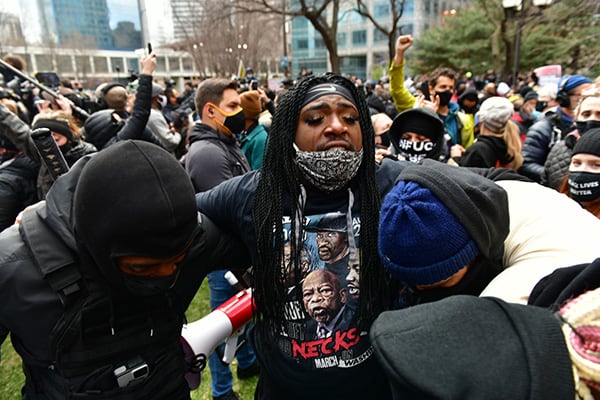
Crowds had gathered in various places in Minneapolis to wait for the verdict. They wept, rejoiced, and fell into each other’s arms.
There are solid grounds to appeal the verdict. From the start, Mr. Chauvin’s lawyer, Eric Nelson, argued that it would be impossible to get a fair trial in Minneapolis because of the rioting and massive publicity. The judged refused to move the trial. Mr. Nelson will probably argue that there was prosecutorial misconduct. In closing arguments, the prosecution said that the defense’s arguments were “nonsense,” that Mr. Nelson was “shading the truth,” “misrepresenting facts,” putting words in witnesses’ mouths, and “creating Halloween stories.” Judge Cahill ruled that he had sufficiently admonished the prosecution for this.
Mr. Nelson will certainly appeal and call for a mistrial on grounds that the jury should have be sequestered — shut off from any outside information about the case — right from the start. His call for sequestration was denied, and later events supported his argument that media coverage and other events would put great pressure on jurors to convict.
There were days of demonstrations and rioting after a white policewoman shot a black criminal to death just 10 miles away from the courthouse, in Brooklyn Center, Minnesota. This was how the country was going to react if blacks and leftist whites thought the jury let Mr. Chauvin off too lightly.
Over the weekend, black Congresswoman Maxine Waters had flown to Minneapolis and told a crowd of demonstrators:
We’ve got to not only stay in the street, but we’ve got to fight for justice. But I am very hopeful and I hope that we’re going to get a verdict that will say, ‘Guilty. Guilty, guilty’. . . . I don’t know whether it’s in the first degree, but as far as I’m concerned, it’s first-degree murder . . . . We’ve got to get more confrontational. We’ve got to make sure that they know that we mean business.
That sent hundreds of people marching through Minneapolis waving Black Lives Matter flags and carrying signs that read “Blue Lives Murder.” As Eric Nelson argued to the judge, this would intimidate any juror, and it happened before the panel was sequestered for deliberation. Judge Cahill refused to declare a mistrial on the spot, but agreed that the congresswoman may have given Mr. Nelson serious grounds for appeal:
I’m aware that Congresswoman Waters was talking . . . about the unacceptability of anything less than a murder conviction, and talk about being confrontational. . . . I wish elected officials would stop talking about this case, especially in a manner that is disrespectful to the rule of law and to the judicial branch and our function. I think if they want to give their opinions, they should do so . . . in a manner that is consistent with their oath to the Constitution . . . . Their failure to do so is abhorrent.
When Miss Waters was pressed on this point later by CNN, she replied with “dindu nothin’ ” aplomb: “The judge says my words don’t matter.” Congressional Republicans called for a vote of censure, but were defeated 216-210 by Democrats.
I suspect the defense appeals will fail, whatever their merits, just as the jury was sure to convict whatever the arguments. Appellate court justices watch TV, too. I predict Mr. Chauvin will spend at least 12 years in prison.
President Joe Biden waited until the jury was sequestered to echo Congresswoman Waters, saying he was “praying for the right” outcome, claiming that the evidence against Mr. Chauvin was “overwhelming.” He said he has become friends with George Floyd’s brother Philonise and the rest of the family, adding that he could “only imagine the pressure and anxiety they’re feeling.” Not a word, of course, about the pressure and anxiety Mr. Chauvin might be feeling.
Philonise reported that the President had called him for a nice chat after the case went to the jury, adding that they looked forward to guilty verdicts. “Hopefully it will be the way the world wants to see it,” he said.
With those words, Philonise put his finger on the problem: The whole world had decided Mr. Chauvin was guilty before the trial even began, and it was clear there would be mayhem if the jury didn’t agree. There were 3,000 National Guardsmen on patrol in Minneapolis, along with thousands of policemen, just in case the lynch mob didn’t get its way.
The jury had to find Derek Chauvin guilty beyond a reasonable doubt. You can read the judge’s instructions to the jury here. Did the prosecution really prove beyond a reasonable doubt that Mr. Chauvin “intentionally inflicted substantial bodily harm”? That he was “perpetrating an act eminently dangerous to others and evincing a depraved mind [emphasis added], without regard for human life”? That he “consciously [took] chances of causing death or great bodily harm”? Was this “[un]reasonable force in the line of duty in effecting a lawful arrest or preventing an escape from custody”? I wasn’t in the courtroom, so I can’t answer these questions, but it is well beyond a reasonable doubt that there was tremendous pressure to convict.
This is how “justice” works in the age of Black Lives Matter. The media whoop up an ambiguous encounter between a white cop and a black criminal to the point that the whole world thinks this is Emmett Till all over again. Half the country goes into paroxysm of rage and violence, while our rotten elites donate billions of dollars to black causes, obediently takes down monuments to white people, and vows to scour everything from math and music theory to our very souls for “white supremacy.”
How could anyone expect a jury to be fair to Derek Chauvin? And what does it say about a country when it has to mobilize thousands of men with rifles to keep the peace in case a duly empaneled jury does not deliver the verdict Philonise wants? The jurors listened to two weeks of testimony. The lynch mob — and the media — saw a few snatches of video, but they knew better. They always know better if knowing better puts the white man in the wrong. This is perversion of justice.
Some people will argue that it’s better for one unlucky cop to do hard time than for justice to be done, if justice means looting and arson. That means accepting perversion of justice. That means recognizing that justice is impossible once the lynch mob begins to howl. And whenever there’s a way to hurt the white man, it will howl.
“Let go the people who are not prepared to love you. This is the hardest thing you will have to do in your life and it will also be the most important thing. Stop having hard conversations with people who don’t want change.
Stop showing up for people who have no interest in your presence. I know your instinct is to do everything to earn the appreciation of those around you, but it’s a boost that steals your time, energy, mental and physical health.
When you begin to fight for a life with joy, interest and commitment, not everyone will be ready to follow you in this place. This doesn’t mean you need to change what you are, it means you should let go of the people who aren’t ready to accompany you.
If you are excluded, insulted, forgotten or ignored by the people you give your time to, you don’t do yourself a favor by continuing to offer your energy and your life. The truth is that you are not for everyone and not everyone is for you.
That’s what makes it so special when you meet people who reciprocate love. You will know how precious you are.
The more time you spend trying to make yourself loved by someone who is unable to, the more time you waste depriving yourself of the possibility of this connection to someone else.
There are billions of people on this planet and many of them will meet with you at your level of interest and commitment.
The more you stay involved with people who use you as a pillow, a background option or a therapist for emotional healing, the longer you stay away from the community you want.
Maybe if you stop showing up, you won’t be wanted. Maybe if you stop trying, the relationship will end. Maybe if you stop texting your phone will stay dark for weeks. That doesn’t mean you ruined the relationship, it means the only thing holding it back was the energy that only you gave to keep it. This is not love, it’s attachment. It’s wanting to give a chance to those who don’t deserve it. You deserve so much, there are people who should not be in your life.
The most valuable thing you have in your life is your time and energy, and both are limited. When you give your time and energy, it will define your existence.
When you realize this, you begin to understand why you are so anxious when you spend time with people, in activities, places or situations that don’t suit you and shouldn’t be around you, your energy is stolen.
You will begin to realize that the most important thing you can do for yourself and for everyone around you is to protect your energy more fiercely than anything else. Make your life a safe haven, in which only ′′compatible′′ people are allowed.
You are not responsible for saving anyone. You are not responsible for convincing them to improve. It’s not your work to exist for people and give your life to them! If you feel bad, if you feel compelled, you will be the root of all your problems, fearing that they will not return the favours you have granted. It’s your only obligation to realize that you are the love of your destiny and accept the love you deserve.
Decide that you deserve true friendship, commitment, true and complete love with healthy and prosperous people. Then wait and see how much everything begins to change. Don’t waste time with people who are not worth it. Change will give you the love, the esteem, happiness and the protection you deserve.”
“James Tooley has taken his argument about the transformative power of low-cost private education to a new and revelatory level in Really Good Schools. This is a bold and inspiring manifesto for a global revolution in education.” —Niall C. Ferguson, Milbank Family Senior Fellow, Hoover Institution, Stanford University Almost overnight a virus has brought into question America’s nearly 200-year-old government-run K-12 school system—and prompted an urgent search for alternatives. But where should we turn to find them?
A distinguished scholar of education and the world’s foremost expert on private, low-cost innovative education, Tooley takes readers to some of the world’s most impoverished communities located in some of the world’s most dangerous places—including such war-torn countries as Sierra Leone, Liberia, and South Sudan.
And there, in places where education “experts” fear to tread, Tooley finds thriving private schools that government, multinational NGOs, and even international charity officials deny exist.
Why?
Because the very existence of low-cost, high-quality private schools shatters the prevailing myth in the U.S., U.K., and western Europe that, absent government, affordable, high-quality schools for the poor could not exist. But they do. And they are ubiquitous and in high demand. Founded by unheralded, local educational entrepreneurs, these schools are proving that self-organized education is not just possible but flourishing—often enrolling far more students than “free” government schools do at prices within reach of even the most impoverished families.
In the course of his analysis Tooley asks the key questions:
What proportion of poor children is served?
How good are the private schools?
What are the business models for these schools?
And can they be replicated and improved?
The evidence is in. In poor urban and rural areas around the world, children in low-cost private schools outperform those in government schools. And the schools do so for a fraction of the per-pupil cost.
Thanks to the pandemic, parents in America and Europe are discovering that the education of their children is indeed possible—and likely far better—without government meddling with rigid seat-time mandates, outdated school calendars, absurd age-driven grade levels, and worse testing regimes. And having experienced the first fruits of educational freedom, parents will be increasingly open to the possibilities of ever-greater educational entrepreneurship and innovation.
Thankfully, they have Really Good Schools to show the way. “In the fascinating and provocative book, Really Good Schools, James Tooley applies his immense learning about low-cost, entirely-private schools around the world to develop a daring and truly thought-provoking proposal along those lines for the United States. . . . Check it out.” —Chester E. Finn Jr., Distinguished Senior Fellow and President Emeritus, Thomas B. Fordham Institute; former U.S. Assistant Secretary of Education
“His pathbreaking and superbly written book, Really Good Schools, provides the essential understanding of how low-cost, private schools extend access to high quality education for the poor. . . . This makes Really Good Schools utterly essential reading!” —Sir Anthony F. Seldon, former Vice Chancellor, Buckingham University; Co-Founder, Institute for Contemporary British History James Tooley is Vice Chancellor (President) of the University of Buckingham in England, where he also serves as Professor of Educational Entrepreneurship and Policy, and is a Senior Fellow at the Independent Institute. He was formerly Director of the E. G. West Centre and Professor of Education Policy at Newcastle University upon Tyre, and temporarily Global Head of Low Cost Schools for GEMS Education. He received his Ph.D. in education from the University of London, and he has previously taught and researched at the Universities of Oxford and Manchester, Simon Fraser University, and University of the Western Cape, South Africa.
Everything today is political. That’s one of the ugliest and hardest things about today. Culturally, we’re already a Communist society; because that’s what it’s like in a Communist society. The God is government and the religion is the state. Try escaping politics today. Try not wearing a mask in most parts of the country. Try not being “woke”. Try even being quiet, or non-political. People are scared to death to even hit “like” on a non-woke post. Why is nobody scared of conservatives, Republicans, Trump-lovers or libertarians? And yet everyone is scared to death of leftists. Because, as I said, it’s like we’re already a Communist society.
People who want to make everything political are after power. In some cases, it’s literal, physical power. More often, it’s psychological. The woke twenty-five-year-old still living in his childhood bedroom at his parents’ house will not attain power, neither in business nor government. His power is limited to the Internet, perhaps social media. But power is the motive. When you turn things that aren’t political, or need not be political, into political issues, your obvious goal is to intimidate people. When you intimidate or cause people to be in annoying if not life-threatening dilemmas, you attain a sense of power you would not otherwise achieve through productive means — and believe you are incapable of achieving. In this sense, the power mongers destroying our culture and freedom are life’s biggest losers. Whatever talent and capabilities they may possess, they squander those virtues and potentialities on politics. Because politics is where the power is. They don’t believe they are capable of being architects, engineers, artists, medical professionals, small business people or anything else productive. So they impose their irrationality and neuroses on the rest of us — finding most of us, at least up to now, more than willing to grudgingly comply.
I recently read an excellent book. It’s called “The Madness of Crowds” by Douglas Murray. Published in 2019, it’s perfectly timed for the unraveling of the Western World we are witnessing in 2020 and 2021. The author doesn’t explicitly name the precise cause of today’s demise: the death of reason. But throughout the book he asks reasonable questions and exposes error after error, and absurd contradiction after absurd contradiction, regarding the insanity of our times, both on and off social media. Unlike a lot of thinkers, he correctly points out that reason is not the goal of today’s “woke” tyrants. It never was. Marxists celebrate the inherent contradiction of the “dialactic”, going back to the time of Marx. They love contradictions in the same way they love destruction. They’re not trying to create a beautiful or utopian society. They sneer at Martin Luther King’s vision of “color blindness.” Racism finally died out in America. THIS is what drove them mad. They have to bring divisiveness and hatred back. It’s how they make a living and, far worse: it’s how they thrive.
Scores of millions of Americans sense that something terrible has been happening in our country recently. Democracy has been steadily slipping away for years, but never faster than in the catastrophic year of 2020. Meanwhile, the process continues at an ever-increasing rate under the administration of the cognitively declining man in the White House. Incompetent tyrants at the federal, state, and local level rule the American people. Who knew that anonymous local health officials could violate our property rights by shutting down small businesses and that governors could restrict our rights to freedom of association and of worship? Who knew that social media corporations could censor our First Amendment rights to freedom of speech?
Leading American corporations publicly embrace the radical agenda of the far left while holding in contempt much of the population whom they seem to regard as “white supremacists.” It would be hard to find a major American corporation with an international presence that does not think of itself in global rather than national terms. This should not be surprising. Globalism is the antithesis of nationalism — or should I say, patriotism.
CEOs of major corporations act like oligarchs who can do as they please as long as they have government on their side. So, they donate hundreds of millions of dollars either directly or indirectly to the party of government and tilt the electoral process toward their friends in high places. What’s more, many of those big corporations have gone woke in an effort to please their Democrat allies. In the aftermath of the recent intervention by much of corporate America into the controversy about Georgia’s election law, many conservatives are awakening to the magnitude of this problem. Scores of millions of Americans feel helpless in the face of this overwhelming threat posed to our liberty.
What most Americans don’t know — because we don’t teach history very well anymore — is that we faced a very similar dilemma before and that Americans charted a path to overcome the corporate oligarchy of another era. Our ancestors even gave us many of the tools we need to bend our modern oligarchs to the popular will. Ironically, given the behavior and ideas of their contemporary namesakes, they were known as “progressives.”
The corporate oligarchs of the past had names like Rockefeller, Morgan, and Carnegie. Along with scores of lesser tycoons, they ran “trusts” which used their monopolistic power to crush competitors and undermine the free market system of business enterprise. Money bought them enormous influence in the courts, statehouses, and even in Congress. Through their enterprise they created much of modern America, but they did it in such a manner as to rouse enormous hostility. Though it did not always seem so at the time, they did a great deal of good and gradually raised standards of living throughout much of the nation, and ultimately the world. The problem was that their unrestricted power and influence threatened to destroy both the free enterprise system and democracy itself.
response, agrarian “populists,” and urban “progressives,” the reformers of their time, organized, agitated, and enlisted the assistance of friendly members of the press in a crusade to use the power of government to subject private power to the public will. Over the course of many years, they successfully established two major tools to deal with the threat of monopoly created by big business. One was the use of the government power to regulate business activities. The other was the employment of government force to break up enterprises that became so big and powerful as to threaten the ability of the people to govern themselves. The latter was anti-trust action. During the course of the twentieth century, anti-trust action was used intermittently in a handful of high-profile court cases while ongoing regulation of big business on a day-to-day basis by government agencies became routine. It is time to revive the use of anti-trust action to deal with the oligarchs of our time.
Senator Josh Hawley (R-Mo.) has recently introduced a bill into Congress called the “Trust-Busting for the Twenty-First Century Act.” In promoting his legislation Hawley rightly said that “a small group of woke mega-corporations control… the information Americans can receive, and the speech Americans can engage in.” Although Americans of the early twentieth century had never heard of a “woke mega-corporation,” and monopolistic control of the flow of information in a free society was inconceivable, otherwise the language in that sentence could have been lifted almost verbatim from the political debates of one hundred-twenty years ago.
Two of the progressive reform leaders and presidents of the era were Theodore Roosevelt and Woodrow Wilson, one a Republican and the other a Democrat. Roosevelt earned a reputation as a “trust-buster,” because his administration conducted a number of high-profile anti-trust suits against the likes of John D. Rockefeller’s Standard Oil Trust, and the financial magnate J.P. Morgan’s Northern Securities Company, but his preferred course of action was to deal with “malefactors of great wealth” through regulation rather than by breaking them up. This eventually led, during the 1912 presidential campaign, to an ongoing debate between TR and Wilson, who feared that federal regulation of the type TR advocated, would eventually lead to partnership between the government and big business. This in turn Wilson thought would create such a powerful combination that the common man would have little chance to compete and succeed. Accordingly, he championed the more aggressive use of anti-trust action to break up powerful monopolies and re-establish free market conditions. In Wilson’s vision, the fragments that remained after the trusts were broken up would be compelled to compete against one another, thereby creating greater opportunity for entrepreneurs to challenge their dominance.
Ironically, while in office Wilson came around to TR’s position and used regulatory action more aggressively than TR ever did. Indeed, during the First World War he went so far as to use the power of the federal government to temporarily seize and run a wide variety of war industries. Although the government takeover was abandoned after the war, the idea of government-business partnership inspired the establishment of the second Roosevelt’s National Recovery Administration (NRA) during the Depression. In a final irony, it looks as though Wilson’s fears of business-government partnership have been realized in our time. But even he never imagined that a woke tyranny of the self–loathing would take root in American corporations and hijack the federal government.
Early twentieth-century progressives provided citizens with yet additional tools to fight despotism. Reformers in some states, California prominent among them, made provision in their state constitutions for the initiative and referendum and the recall of incompetent or tyrannical officials. This makes it possible for citizens to override the state legislatures when they are unresponsive to the public will. It also makes it possible to recall recalcitrant public officials such as Governor Gavin Newsom. The initiative process could be used to restrict the powers of local health officials to order destructive and unconstitutional lockdowns.
Unfortunately, there is little chance that Hawley’s legislation will be passed before a new conservative administration takes over in Washington and a friendly majority is in control of Congress. Nevertheless, American citizens can make use of some of these tools established by progressive reformers over a hundred years ago to make it more difficult for tyrants to trample on their liberties.
Saul Alinsky was a brilliant man. Evil, but brilliant. Unfortunately, whether we like it or not, everyone on the Left from the President on down is playing by his rules in the political arena. Not all liberals have read his book or know his name, but his tactics have become universal. Sadly for conservatives, when two evenly matched forces go head-to-head outside of a fairy tale, the side that tries to play nice usually ends up with its head in a box. So, don’t lie or become an evil person like Alinsky, but learn from what he wrote and give the Left a taste of its own medicine.
1) Power is not only what you have but what the enemy thinks you have.
2) Never go outside the experience of your people.
3) Wherever possible go outside the experience of the enemy.
4) Make the enemy live up to their own book of rules.
4A) Ridicule is man’s most potent weapon.
6) A good tactic is one that your people enjoy.
7) A tactic that drags on too long becomes a drag.
8) Keep the pressure on.
9) The threat is usually more terrifying than the thing itself.
10) The major premise for tactics is the development of operations that will maintain a constant pressure upon the opposition.
11) If you push a negative hard and deep enough it will break through into its counterside.
12) The price of a successful attack is a constructive alternative.
13) Pick the target, freeze it, personalize it, and polarize it.
NOTE: Alinsky was not brilliant. If you don’t know the difference between right and wrong, you’re not brilliant. A/D
Many Americans saw former policeman Derek Chauvin’s conviction on all counts last week as affirming the principle that no one is above the law. Many others were concerned that the jury was scared that anything less than a full conviction would result in riots, and even violence against themselves and their families.
Was the jury’s verdict influenced by politicians and media figures who were calling for the jury to deliver the “right” verdict? Attempts to intimidate juries are just as offensive to the rule of law as suggestions that George Floyd’s criminal record somehow meant his rights were not important.
The video of then-policeman Chauvin restraining Floyd led people across the political and ideological spectrums to consider police reform. Sadly, there have also been riots across the country orchestrated by left-wing activists and organizations seeking to exploit concern about police misconduct to advance their agendas.
It is ironic to see self-described Marxists, progressives, and other leftists protesting violence by government agents. After all, their ideology rests on the use of force to compel people to obey politicians and bureaucrats.
It is also ironic to see those who claim to want to protect and improve “black lives” support big government.
Black people, along with other Americans, have had their family structure weakened by welfare policies encouraging single parenthood. This results in children being raised without fathers as a regular presence in their lives, increasing the likelihood the children will grow up to become adults with emotional and other problems.
Those at the bottom of the economic ladder are restrained in improving their situation because of minimum wage laws, occupational licensing regulations, and other government interference in the marketplace. They are also victims of the Federal Reserve’s inflation tax.
Many progressives who claim to believe that “black lives matter” do not care that there is a relatively high abortion rate of black babies. These so-called pro-choice progressives are the heirs of the racists who founded the movement to legalize and normalize abortion.
The drug war is a major reason police have increasingly looked and acted like an occupying army. Police militarization threatens everyone’s liberty. Black people have been subjected to drug war arrests and imprisonment at relatively high rates.
Those interested in protecting and enhancing black people’s (and all people’s) lives should embrace liberty. Libertarians reject the use of force to achieve political, economic, or social goals, Therefore, in a libertarian society, police would only enforce laws prohibiting the initiation of force against persons or property.
A libertarian society would leave the provision of aid to the needy to local communities, private charities, and religious organizations. Unlike the federal welfare state, private charities can provide effective and compassionate aid without damaging family structure or making dependency a way of life. In a libertarian society, individuals could pursue economic opportunity free of the burdens of government regulations and taxes, as well as free of the Federal Reserve’s fiat currency.
Free markets, individual liberty, limited government, sound money, and peace are key to achieving prosperity and social cohesion. Those sincerely concerned about improving all human lives should turn away from the teaching of Karl Marx and John Maynard Keynes, who advocated expansive government power, and, instead, embrace the ideas of pro-liberty writers such as Ludwig von Mises and Murray Rothbard.