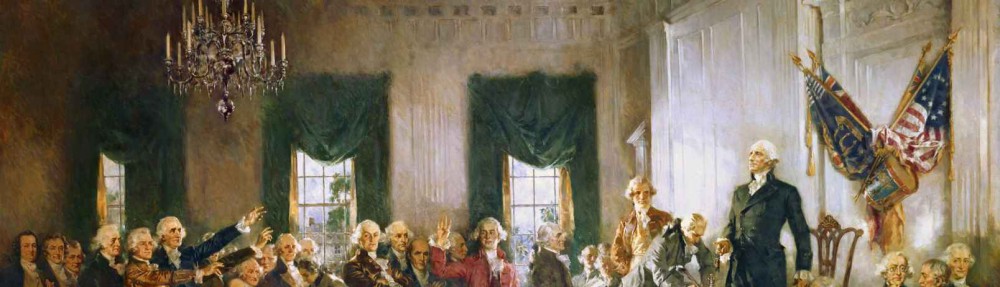
The Viking word hidden in the Declaration of American Independence

Sophie Hardach

From Roman freedom to Viking happiness, the iconic words in the Declaration of Independence reveal thousands of years of humans wrestling with how to live well together – and the power of language to put those ideas into action.

“We hold these truths to be self-evident, that all men are created equal, that they are endowed by their Creator with certain unalienable Rights, that among these are Life, Liberty and the pursuit of Happiness.” 

When Thomas Jefferson drafted these words in the Declaration of Independence, two things were on his mind. One: he needed to find “terms so plain and firm as to command their assent” by the colonies, as he later explained, and justify independence from Great Britain. Two: beyond the practical purpose, he wanted the text to be “an expression of the American mind, and to give to that expression the proper tone and spirit called for by the occasion”. 

250 years ago, Congress approved the Declaration on 4 July 1776. But the meaning of those seemingly simple terms – “created equal”, right to “Life, Liberty and the pursuit of Happiness” – continue to provoke debate.  

“These phrases seem always to be running automatically in the American background, rather like software,” says Michael Ditmore, professor of English at Pepperdine University in Malibu, US, and the author of Texting the Nation: Agencies and Actions in the Declaration of Independence. “Still, considered purely in their textual wording, we hardly agree on what they mean or obligate us to,” he adds. 

A ‘mongrel language’ 

Let’s start with the brief phrase “Life, Liberty and the pursuit of Happiness”.  

“This iconic line is actually a great demonstration of what a mongrel language English is,” says Tom Birkett, a professor of Old English and Old Norse at University College Cork in Ireland.  

Life” is rooted in Old English, a language brought to Britain by Germanic tribes from around AD400-500. “Liberty” and “pursuit” are Latin-rooted, then evolved into French and arrived in Britain with the Norman French conquest in AD1066.  

And then there is “happiness”: a word echoing with distant voices telling stories of trolls, battles and seafarers. 

“Happiness has an interesting etymology, as it comes from Old Norse happ, meaning ‘fortune’ or ‘good luck’,” says Birkett. “When ’happy‘ is first attested in Middle English it means ‘fortunate’, or ‘blessed by good luck’.”  

Old Norse, a Scandinavian language, was spoken by Viking raiders and Scandinavian settlers who brought the word to Britain from around AD800 onwards. Happ appears, for example, in the nickname of the Norse explorer Leif Erikson, who was also known as “Leif the Lucky”, Leif heppni Erikson. He was a member of an early voyage to North America in the 11th Century, and saved a group of shipwrecked sailors – which may have partly inspired his nickname. 

One way to interpret “happ” is as something fixed and fated, which can’t be controlled. It still echoes with that meaning in English words such as “hapless” – luckless, unfortunate – and “happen” – to occur by chance.  

But over time, the English meaning of “happy” and “happiness” gradually shifted from “favoured by fortune” to “glad, pleased, content“. In the 17th and 18th Centuries, the Enlightenment movement, with its ideals of human rights, fundamentally challenged the idea that one’s fortune was fixed or divinely steered: instead, human reason and action took on a central role. 

By the time the Declaration was drafted by Thomas Jefferson, with inspiration from the Virginia Declaration of Rights, “happiness” had acquired many layers of meaning. And in the Declaration, its pursuit was presented as a human right – one that was central to the new United States.  

“The document was both political and philosophical, asserting the ‘separate and equal station’ of the new United States among the nations of the Earth, while also laying out the philosophical underpinnings for that assertion,” says Carli Conklin, an associate professor of law and constitutional democracy at the University of Missouri, US, and the author of The Pursuit of Happiness in the Founding Era: An Intellectual History.  

“As both Thomas Jefferson and fellow drafter John Adams stated, the Declaration was not asserting anything new. It was not intended to do so,” says Conklin. “These ideas were commonplace in Enlightenment Era discussions about politics and law, with many of these ideas stretching back millennia.” What was new was “the opportunity to practically apply these principles in the formation and establishment of a brand new government in the new United States”, she says.  

The punchy phrasing hid a lot of ambiguity, however. 

That’s because on a practical level, the text had to be easy to agree to, says Ditmore: “It had to speak with a voice and sense common enough across 13 competing, edgy – and in-development – colony states to seal agreement for the publicity of independence.” As a result, its phrasing was seemingly clear, and easy to endorse, but actually, left a lot of room for conflicting interpretations, he says.  

Those interpretations have only widened since then. For example, how we think of happiness has changed over time, says Conklin. 

“Our general understanding of happiness today does not seem to be as rich or as expansive as the understanding of the concept in the founding era,” Conklin says. “To the founders, to be happy was to experience a state of well-being or human flourishing.”  

The founders distinguished between what they called “fleeting and temporal” happiness, and “true and substantial” happiness, she explains. To pursue true happiness was to live a life of virtue, she says: one of wisdom, justice, courage, moderation, industry and benevolence.  

“As John Adams wrote in a letter to his wife, Abigail, the founders believed ‘the virtues that make for a happy private life make for a happy public life’, as well,” says Conklin. 

While the idea of a right to the “pursuit of happiness” might seem far removed from the happ in Old Norse sagas, there is a subtle echo of voyages, quests and human persistence in both contexts – along with the idea of an uncertain outcome. 

“The Declaration does not include a right to attain happiness,” Conklin points out. “It contains only the right to pursue.”  

How exactly might one pursue happiness, then?  

One clue is in the other rights – to life and liberty, Conklin says: “The founders most frequently talked about liberty as a status – a status from which one could exercise their reason and free will toward action,” she explains. “The right to pursue happiness, then, was the right to determine and then to take that action – to exercise one’s reason and free will in active pursuit of one’s own well-being.” 

That meaning of liberty – as a state that allows you to actively shape your life – may sound very modern. But as with “happiness”, the ancient roots of “liberty” reveal how humans have wrestled with the idea of freedom, and what it means to be free, for a very long time.  

Freedom and heartbreak in Roman-era Britain  

“Liberty is a rather old word,” says Philippa Steele, a research professor in the Faculty of Classics at the University of Cambridge. It is built on an Indo-European root  “which surfaces in numerous languages across Europe and Asia with a meaning connected to ‘people’,” she explains. 

This ancient word appears in Greek as eleutheria, in Latin as libertas, and many related, but lesser-known languages. In all cases, it generally related to personal freedom, she says.  

One of its oldest appearances on British soil is on a 2,000-year-old tombstone from a Roman-era settlement. The stone was put up by a widower, Barates, for his late wife, Regina. The Latin inscription refers to Regina as a “liberta”, a “freedwoman”: liberta, or libertus for men, was the Roman term for freed, formerly enslaved people

Latin lived on in Britain for some time after the Romans left. But many of the Latin-rooted words used in English today, including “liberty“, were re-introduced later, with the 1066 Norman French invasion – French being a descendant of Latin.  

“Liberty”, also spelled “libertee” and “libertie“, appears in various English texts from around 1300AD onwards. It refers to freedom from serfdom, but also, the freedom to do certain things.  

This historical link between the word liberty, and freedom from enslavement, then meets a painful twist in the Declaration of Independence: an early passage condemning slavery, and describing enslavement as a crime against liberty, was deleted from the draft. And Jefferson, as well as other founders, enslaved people themselves. “They did not apply these rights to all people, in practice,” says Conklin.  

Steering the ship 

Other words in the Declaration also carry long histories of people trying to express complex ideas, for example, through metaphor. One of them is “government”, as in: “it is the Right of the People to alter or to abolish it, and to institute new Government”.   

“It comes from Latin via Old French,” says Steele, but the Latin verb gubernare is a borrowing from [the Greek word kybernao]”, meaning, to steer a ship. She adds that this Greek root also lives on “cybernetics“, and other words that feature “cyber”. And then there is the document’s title: “Declaration comes from a root related to light and brightness: claro quite literally means “illuminate”, and a declaratio is an act of making clear,” says Steele.  

While it drew on ancient words, the Declaration also marked a linguistic beginning: one of American English as a distinctive voice. That shift became more pronounced in the early decades of independence.  

“The Declaration of Independence contains spellings that now look British,” says Anne Curzan, a professor of English language and literature, linguistics and education at the University of Michigan, US. She points to the “–our” spelling in: “He has endeavoured to prevent the population of these States”. In American English, “endeavoured” became  “endeavored“. 

So what does the Declaration, this short text squishing together millennia of history, teach us today? 

The answer depends on what we think the Declaration is for, says Ditmore. Is it “a creedal, maybe a propositional, document, one that so foundationally outlines the boundaries of American character and identity that we can return to them for correction when we stray”?  

Or was it “a document that served a specific temporary, limited purpose admirably well, broadcasting independence far and wide, and its surface ought not be scratched further”? 

In other words: is it a historical artefact – or a kind of manual for a good American life and thriving nation? I’ll leave you to find your own answers to that – and join the long chain of human thought filling this document with life.  

Oh baby! New York Times is losing its mind because Republican women are … having children

Andrea Peyser

Published June 26, 2026, 5:56 p.m. ET

This isn’t pregnancy. It’s a political plot.

A full-blown, unhinged conspiracy orchestrated by the MAGA movement to take over the hearts, minds and uteruses of gestating people all over the nation, one bassinet, one burp, one stretch mark at a time.

The New York Times has cracked the code. It’s Pulitzer time, baby!

In an investigation masquerading as a style piece, the Paper of Record published an unglued commentary, researched with the self-seriousness of Watergate, revealing that a whopping three women connected to the White House are preggers.

At the same time!

That Press Secretary Karoline Leavitt, Katie Miller, the wife of White House deputy chief of staff for policy Stephen Miller and Second Lady Usha Vance should all be on the nest simultaneously isn’t just a happy mini baby boom. It is — according to the Times — a pernicious “Handmaid’s Tale”-style political plot promoting conservative child-making frenzy in an age of declining birthrates and the collapse of the Democratic Party in middle America.

It’s a cautionary fable, a warning that the dreaded GOP’s steady rate of reproduction amid a Democratic baby drought poses a dire threat to the nation.

According to the Gray Lady (now Gray Female-Identifying Newspaper) Republicans are planning to win support and ever-greater numbers of adherents by growing their own voters. One infant at a time.

It’s all laid out in the piece entitled “The Politics and Power of the Pregnancy Image.”

In it, Times chief fashion critic Vanessa Friedman writes: “That three such prominent women in the MAGA movement were pregnant at pretty much the same time was, indubitably, a coincidence.”

Or maybe not.

“But” — there’s always a “but” — “for an administration that has such an intuitive and strategic understanding of the power of aesthetics that an unspoken dress code in which men outfit themselves in the image of the president has developed, it has also become a telling one,” Friedman froths.

“Together, the women have created a notably consistent, and somewhat paradigm-shifting, picture of the White House’s family and fertility platform.”

Fertility platform? Silly me. I thought the three lovelies just got themselves knocked up.

The writer also found leftist joy in taking aim at the body-hugging coral dress that the wife of Vice President JD Vance allegedly used to showcase her burgeoning bump as she grows the couple’s fourth child, a boy, due next month. To The Times, it’s not just discount maternity-wear from Old Navy. The clothes represent Mrs. Vance’s sinister method of broadcasting cuddly daddy vibes emanating from her hub ahead of November’s

Friedman writes, I assume with a straight face, that Mrs. Vance’s job as second lady “is also to represent and humanize the vice president.”

“By spotlighting her pregnancy,” Friedman spews, “she is doing exactly that

She posted the receipt from her cowl-necked maternity get-up to X, writing “Now that we know the political significance of my $8.75 coral maternity dress from Old Navy, can’t wait to hear what the New York Times has to say about my elastic-waistband pants and compression socks!”

I can’t wait to read the Times’ take on the politics of onesies. And the paper’s answer to this burning question: Breastfeeding — natural nutrition, or infantile.

Gavin Newsom Fires Up ChatGPT To Find Out What His Political Positions Should Be This Week

SACRAMENTO, CA — Governor Gavin Newsom opened up his laptop and fired up ChatGPT this morning to find out what his political positions will be this week.

The day after proposing a billionaire tax while simultaneously working to defeat a billionaire tax, Newsom checked in with ChatGPT for further guidance on what to do next.

“Okay, Chat. What do I believe today?,” typed Newsom. “Let’s maybe talk law enforcement. Is it good or bad right now? I could go either way, to be honest. What’s the vibe out there on the streets about criminals? What’s the scuttlebutt?”

Newsom has bragged that while many politicians struggle to decide major policy positions, he has no such issue. “It’s so easy for me. I just ask ChatGPT, and do whatever it says. I guess it’s one of my many gifts,” said Newsom. “It’s frankly embarrassing hearing other leaders talk about how hard it is to decide things like whether they should commute someone’s life sentence. I just ask Chat — boom, done.”

At publishing time, Newsom had announced that he would proposing a universal health care bill and also breaking up health insurance conglomerates to promote competition.

Babylon Bee

How Was the American Mind Poisoned?

A new book blames “progressive” intolerance and malfeasance.

Mar 4, 2026 George Leef

In 1987, Allan Bloom warned about The Closing of the American Mind. In 2018, Jonathan Haidt and Greg Lukianoff warned about The Coddling of the American Mind. And now Lawrence Eppard, Jacob Mackey, and Lee Jussim warn about The Poisoning of the American Mind. This academic trio (Eppard is professor of sociology at Shippensburg University, Mackey professor of classics at Occidental College, and Jussim professor of psychology at Rutgers) have collected 50 mostly short essays to make the case that bad trends in education and the media are getting in the way of the ability of Americans to discern truth from falsehood.

The “guardrails” that used to restrain the publication of misleading or even blatantly false information have been largely demolished.Eppard’s opening essay, “The Golden Age of Information,” makes the point that, although people have access to more information than ever before, much of it is unreliable and even dishonest. He laments that the “guardrails” that used to restrain the publication of misleading or even blatantly false information have been largely demolished, such that it is now common for Americans to live in ideological “silos” where they receive only stories that have been curated to support a particular point of view. Many Democrats never hear anything critical of what their party does, and the same is true for Republicans. Worse yet, we have been led to believe that any dissent is not merely mistaken but immoral. Therefore, argumentation is pointless, and political victory by any means necessary over the forces of evil is essential.

It is now common for Americans to live in ideological “silos” where they receive only stories that have been curated to support a particular point of view.This situation is compounded by the fact that our universities have become very politicized. Eppard observes that “ideologically charged and empirically questionable research is being done in some academic fields around a variety of topics (perhaps most prominently about issues related to gender and race) at the same time that there is a growing tendency across academic fields to inject those findings into the public discourse.” Scholarly research used to be carefully scrutinized, and if it did not rise to a high level of proof it would not be published. But now, it’s sufficient for writers to rely on their “lived experiences” and feelings.

At the same time as many “scholars” are producing a flood of research purporting to find social and economic problems that call for the expansion of governmental control, it has become perilous for anyone to dispute them. Several of the book’s chapters discuss cases where professors were sanctioned or even terminated because they dared to question such findings. Our information ecosystem has been undermined by the way advocates can use power to silence dissent and limit the kinds of questions that may be investigated.

In his essay “The Constitution of Knowledge,” Jonathan Rauch maintains that the pillars of that constitution are eroding. For example, it was formerly accepted that any hypothesis could be advanced, but that is no longer true. Academics now face severe trouble if they argue in favor of positions that don’t fit the “progressive” worldview. He concludes, “If universities foster cultures of conformity rather than of criticism, if they traffic in politicized orthodoxies and secular religions, then the winner is not social justice but trolling. Which is all downside.”

This problem is especially acute in the social sciences. In his essay, Professor Carl Bankston notes that college leaders are complicit in the attack on knowledge by declaring that speech and research are unwelcome if they can be said to violate the “core values” of the institution. Thus have professors found themselves in hot water for, e.g., talking about the downsides of “affirmative action” or environmental policies.

However, the hard sciences are also suffering from constant attacks by those who insist that their longstanding rules are unfair and somehow prop up “white privilege.”

In a devastating essay entitled “In Defense of Merit in Science,” Professor Dorian Abbot (along with quite a few co-authors) explains the damage to science that has been done by the leftist obsession with “equity.” That is to say, what matters is not individual achievement but ensuring that we have enough “representation” in science by members of various minority groups.

Abbot writes the following:

Liberal epistemology prizes free and open inquiry, values vigorous discourse and debate, and determines the best scientific ideas by separating those that are true from those that are likely not. […] In contrast, identity-based ideologies seek to replace these core liberal principles, essential for scientific and technological advances, with principles derived from postmodernism and Critical Social Justice, which assert that modern science is “racist,” “patriarchal,” and “colonial,” and a tool of oppression rather than a tool to promote human flourishing and global common good.

Bowing to governmental pressure and ideological demands, merit is giving way. Increasingly, faculty are chosen because they have the right backgrounds, and research money is allocated to those who are investigating wasteful but politically correct projects. Researchers are now expected to practice “citation justice,” which means that they must cite a sufficient number of published papers by women and minorities. One of the latest fads is “research” into “decolonizing” various aspects of science, such as pharmacology, which entails teaching about drugs developed from folk remedies and emphasizing contributions by non-Europeans.

Perhaps the most poisonous aspect of all is the spreading idea that certain beliefs may never be questioned.Perhaps the most poisonous aspect of all is the spreading idea that certain beliefs may never be questioned.

Abbot observes, “Attempts to demonize, inflict reputational damage, or silence critics of social engineering practices by characterizing them as racists, white supremacists, or worse is particularly detrimental to the open intellectual environment in which scientific inquiry into difficult social problems thrives.”

In many academic precincts, intolerance has become a badge of honor.In his essay, Professor Jussim gives a good example. He is among the scholars who have criticized the research purporting to show that “microaggressions” against minority students and workers are both common and damaging. When confronted by skeptics, one of the leading proponents of microaggression theory, Professor Monnica Williams, replied that to argue with her position was itself a microaggression. Jussim and other writers also point out how weak concepts gain acceptance through “idea laundering.” That is the practice of getting ideological allies to approvingly cite a dubious paper so often that it becomes common knowledge.

Bad mental habits are being inculcated in the minds of students. The idea that “progressives” should not allow arguments against them to be heard (introduced in the 1960s by the radical professor Herbert Marcuse) is now widely accepted. Today, true-believing students declare that speakers they dislike will cause harm to “vulnerable” populations and seek to ban them. In many academic precincts, intolerance has become a badge of honor.

Strangely, the book itself helps to show another aspect of our poisoning, namely academic publishing. When the editors submitted the manuscript to George Mason University Press, it contained a chapter detailing long-accepted (but now “controversial”) biological differences between men and women. GMU Press said that the chapter would have to be eliminated before they’d publish. (You can read about that here.)

The Poisoning of the American Mind has, I would say, a rather narrow target. The many Americans who live in ideological silos will ignore the book, thinking that everything they do is justified by the moral imperative of beating back the assault on civilization that the other side represents. Our best hope is that some higher-education leaders will realize how deeply complicit they are in the undermining of Americans’ ability to use their minds and start looking for antidotes.

George Leef is director of external relations at the James G. Martin Center for Academic Renewal.

New Book Encapsulates Higher Ed’s Problems

The James G. Martin Center for Academic Renewal

Menu

Oliver Hung, Pexels

New Book Encapsulates Higher Ed’s Problems

A collection of expert essays says “it’s worse than you think.”

Jun 17, 2026 George Leef

Suppose you have a friend who knows little about American higher education but is eager to learn about it. You might want to recommend to him a book that introduces the subject with readily understood essays covering the range of problems we face.  A good choice would be Higher Education in America: It’s Worse Than You ThinkThe book consists of nineteen essays by people who have been on the front lines in the battle to rescue our colleges and universities from the menaces of mediocrity and politicization.

So, what has gone wrong with American higher education?

One theme that recurs throughout the book is that most of our colleges and universities have lost their sense of mission. As Hillsdale College president Larry Arnn writes in the foreword, they have converted the “sublime activity of education” into a “manufacturing operation.” Rather than working with young minds to help them learn how to discover truth, most colleges just want to process through as many graduates as possible. And worse, instead of enlightenment, students are often steeped in conflict, taught that certain groups are oppressors and others oppressed.

In his introduction, Christopher Rufo observes, “The great project of liberal education, designed to inculcate knowledge of the truth, appreciation of the beautiful, and the civic virtue necessary to advance both, has been replaced by bureaucracies, activism, anti-Western ideology and empty credentialism.” College degrees that used to betoken a wide range of knowledge and skills now signal nothing. Rufo argues that education and liberty are inextricable and we need to worry for our civilization because many students now graduate without the slightest appreciation for liberty.College degrees that used to betoken a wide range of knowledge and skills now signal nothing

Among the reasons why college has become such a poor value is the way the federal government makes it so easy to borrow to pay for it. In his chapter, Preston Cooper concludes, “For too long, colleges have taken advantage of an opaque and dysfunctional financial-aid system to strong-arm students into paying higher tuition than they would in a free and competitive market.” That’s what we need.

Can’t American students depend on colleges for a high quality education? Supposedly, our accreditation system ensures that they do, since colleges and universities (at least those that accept federal funds) have to obtain accreditation from an agency approved by the Department of Education. Unfortunately, obtaining the stamp of approval from an accrediting agency does not ensure that students receive a sound education. In their chapter, Jonathan Butcher and Madison Marino Doan disabuse readers of the notion that accreditors ensure that students receive a good education.  Accreditors, they observe, don’t actually investigate courses to see if they have serious academic standards, but instead focus on institutional inputs—and sometimes those inputs are the wrong types, such as “diversity” among faculty.  

That many American students receive a weak education in college is the theme of the chapter by Adam Kissel and Madison Marino Doan. They investigated the course offerings at many of our supposedly finest schools and found that it would be easy for students to avoid intellectually challenging ones and coast along taking courses that focus on pop culture and politics. And, generally, colleges have cashed in by luring in students with weak academic preparation by dumbing down the curriculum and offering lots of enjoyable amenities. Kissel and Doan conclude that it’s time to make college hard again and to stop subsidizing it with easy government loans.

One of the most frequently heard complaints about our colleges is that they allow faculty members to substitute political advocacy for objective teaching. In “The Leftist Monopoly Problem,” Andrew Gillen shows that this is a serious concern. Many academic fields are now completely dominated by professors who embrace a leftist worldview that is hostile to individualism, limited government and free enterprise. Such professors usually want to hire only ideological allies by screening out applicants who might voice differing views. Gillen makes it clear why this matters, writing, “When one side dominates, only truths that conform with that political ideology will be acknowledged. Inconvenient truths will be ignored, dismissed, or explained away.” Academic fields thus become hidebound and intolerant.Many academic fields are now completely dominated by professors who embrace a leftist worldview that is hostile to individualism, limited government and free enterprise.

What is the experience of college like for today’s students? In his chapter, Kyle Washut argues that it is far different from what it used to be. He writes, “For many students, going to college at a legacy institution involves faculty who do not teach, the students themselves spending little time on learning (and what time is spent studying is on classes of little rigor or in slanted “studies” departments) and immersion in terrible experiences of loneliness and anxiety, all while spending vast amounts of money and garnering large quantities of debt.” In short, we have lost sight of the purpose of education. He argues that one step in the right direction would be a law that would empower universities with large endowments to create smaller colleges under their umbrellas with a traditional academic focus.

At the heart of our drift away from the serious, useful college education of the past into the often feeble and politicized education of the present is poor leadership. Few college and university presidents have been willing to say “no” to the ruinous trends. In his chapter, George Harne drives that point home. He writes, “Unfortunately, leaders of colleges and universities frequently derive their leadership not from the natures and highest purposes of their institutions but from the worlds of leftwing politics, moralistic-therapeutic culture, the corporate book trade, or some combination of the three.” If we are going to restore academic standards and integrity, we will need to choose leaders who are deeply committed to the educational enterprise, not to promoting themselves or their personal views.

And there is also the faculty problem, which John Sailer discusses in depth. He writes, “Today, an increasing number of faculty have come to see their scholarship as a means for advancing a political agenda. These scholars—more accurately, scholar-activists—place primacy on the categories of race, sex, and ethnicity. They often invoke faculty-lounge neologisms, such as ‘racial capitalism’ and ‘decolonization.’” Over the last several decades, the pipeline into academic life has been altered so that it greatly favors candidates from “underrepresented” groups, so long as they favor leftist activism. Those who don’t fit are filtered out.

Our college leaders love to spend money but much of their spending is on projects and programs that are inimical to the nation’s long-run good. For that reason, Jay P. Greene argues, donors ought to stop ladling money carelessly into college coffers. He suggests that billionaires direct their educational giving toward the founding of new institutions that will once again provide higher education that is untainted by politics. As for wealthy Americans who don’t have the funds to start new universities, Greene suggests that instead of trying to establish good programs at existing schools, which are apt to be taken over by leftists eventually, they direct their money to help programs at those new schools, such as the University of Austin.Our college leaders love to spend money…on projects and programs that are inimical to the nation’s long-run good.

Kenneth Marcus, in “Antisemitism on College Campuses,” shows how virulent that has become, as student organizations, faculty committees and even administrative programs spout anti-Semitic rhetoric and commitment to intifada. This has come about, he argues, because “ideological movements have gained influence in the humanities and social sciences, replacing the older ideal of the university as a neutral forum with a model in which higher education serves as an instrument for social and political transformation. When that view takes hold, the safeguards against bias and partiality weaken.” They certainly have.

There is much more in this hard-hitting book, which I recommend to anyone who wants to know the truth about what has happened to higher education in America.

Trojan Horse Politicians

There’s a particular dangerous breed of dishonest Democrat politician who speaks in moderate terms to get elected, only to govern as a radical.

There’s a particular dangerous breed of dishonest Democrat politician who speaks in moderate terms to get elected, only to govern as a radical.

America is threatened not only by its openly radical elements, but by politicians who present themselves as reasonable moderates while advancing policies that steadily undermine the foundations of American capitalism and constitutional government.

I want America to survive as the exceptional country I grew up in. That requires us to confront an uncomfortable reality.

Every day, Americans are told that the greatest threats to our future come from foreign adversaries, economic competition, or political polarization. Those dangers are real enough. But the more immediate threat is internal: a growing and particularly vocal class of politicians who speak the language of moderation while advancing ideas that move the country further away from the foundational principles that made it prosperous, free, self-governing, and the envy of the world.

The loud radicals are easy to identify. They openly criticize capitalism. They openly advocate socialism, egalitarianism, and, if you listen to their words carefully, communism, vocalizing a belief that the end justifies the means. They openly call for sweeping transformations of American society. Whether one agrees with them or not, at least they are honest about what they espouse.

The greater danger comes from what I call the Trojan Horse Politicians.

These are the polished, camera-ready public officials who rarely describe themselves as radicals. They speak instead of “fairness,” “equity,” “compassion,” “democracy,” and “reimagining” institutions to reassure you that they’re not radical. Their rhetoric is designed to be reassuring, almost somnolent in intent. Their tone is reasonable. Their presentation is carefully crafted to appear moderate and pragmatic, even when a student of history knows differently.

Their policies, however, often point in a very different direction.

Again and again, proposals are introduced as modest reforms only to result in greater centralization of power, larger bureaucracies, heavier regulation, increased dependency on government programs, an ever-increasing share of GDP by government, and diminished space for private enterprise. Ideas that would likely face strong resistance if presented honestly are repackaged as common-sense adjustments, temporary measures, or acts of compassion.

The Inflation Reduction Act itself illustrates the phenomenon. Supporters presented it primarily as an anti-inflation measure. At the same time, critics argued that its true significance (as has been shown over time) lay in its industrial policy, climate initiatives, and the expansion of federal influence over key sectors of the economy.

The strategy is not new. Throughout history, major political transformations have rarely arrived announcing themselves as revolutions. They arrive incrementally, wrapped in language designed to reduce opposition and reassure the public that nothing fundamental is changing.

We can see this pattern throughout modern American politics.

Many of the most visible figures on the left openly advocate policies that would dramatically expand federal control over healthcare, energy, education, housing, and labor markets. Critics argue that such proposals would weaken or even replace the market-based system that generated America’s unprecedented prosperity with a more centralized, government-directed model with little accountability, as most government-run programs have proven to be.

But these openly ideological figures are not the Trojan Horse.

They are the visible edge of the movement.

The Trojan Horse is the politician who claims unwavering support for capitalism while supporting policies that steadily restrict it. It is the official who presents ever-expanding government authority as merely a technical adjustment. It is the public servant who insists that every new crisis requires another transfer of power from citizens and communities to distant institutions that thrive on additional power and the attendant requirement to grow the bureaucracy and silence opposing voices.

Their success depends on language. Voters naturally resist radical change when it is described honestly. They are far more willing to accept the same changes when they are framed in terms such as moderation, fairness, expertise, or necessity. Voters can be and are swayed by rhetoric, the creation of boogeymen, and the passion that these Trojan Horse politicians generate so well.

This is why clarity matters.

Americans deserve to know exactly what policies are being proposed, what assumptions underlie them, and what consequences they may have. Citizens cannot make informed choices when political language becomes a tool for concealment rather than explanation.

The danger is not disagreement. Disagreement is essential to a healthy republic.

The danger is political camouflage.

A free society depends upon honest debate between competing visions. It cannot function when controversial ideas are disguised behind soothing rhetoric that obscures their true implications. A free society also depends on thinking individuals who value their self-interest, but not at the expense of destroying the very society that made everything possible.

That is why this moment demands more than partisan loyalty. It demands courage. It demands individuals willing to place principle above comfort, career, and political convenience.

Recently, John Healey resigned as Britain’s Defense Secretary, warning that Britain’s defense posture “falls well short of what is required for defense and the country at this dangerous time.” Whether one agrees with his conclusions is beside the point. The willingness to publicly challenge prevailing policy and accept the consequences remains increasingly rare in modern politics.

America needs more of that spirit.

We need elected officials willing to speak plainly. We need public servants willing to challenge prevailing narratives when they believe the country is headed in the wrong direction. We need leaders who value truth over approval and conviction over advancement.

Most of all, we need citizens willing to recognize that the future of the American experiment will not be determined solely by the radicals who openly attack it. It may be determined by the far more respectable figures who claim to be preserving it while gradually transforming it into something else entirely.

History teaches that republics are rarely lost all at once.

More often, they are surrendered piece by piece, compromise by compromise, under assurances that there is nothing to worry about.

That is why the Trojan Horse remains such a powerful warning.

The danger is not always outside the gates.

Sometimes we build the horse ourselves and wheel it inside.

God Bless America!

Author, Businessman, Thinker, and Strategist. Read more about Allan, his background, and his ideas to create a better tomorrow at 1plus1equals2.com.

How Mayor Bass Can Save LA, and Why History Says She Won’t

Every big city in America where the population is declining, businesses are closing, public safety is failing, and national relevance is diminishing suffers from the same handful of leadership failures.

Every big city in America where the population is declining, businesses are closing, public safety is failing, and national relevance is diminishing suffers from the same handful of leadership failures. Cities don’t become helpless has-beens due to budget shortfalls, racial tension, natural disasters, or any of the other common excuses cities like Los Angeles use to explain or justify their decline. Along with New York, Chicago, Seattle, and other cities currently spiraling down the drain, LA is going from bad to worse because of four mistakes its leaders have perpetuated.

These failures are both predictable and preventable. But history tells us that as mayor, Karen Bass will have a hard time implementing the simple changes required.   

Here is why cities wither and die:

1. Failure to keep citizens safe — If people don’t feel safe on their own streets, nothing else matters. Productive, law-abiding, taxpaying residents deserve protection from criminals, vagrants, and other undesirables. It’s the responsibility of the police and the judicial system to establish and preserve a safe environment. Failing cities prioritize the rights of criminals over those of their victims. This turns the whole public safety system on its head. Lax policing standards, cashless bail, soft-on-crime prosecutors, and continued financial investment in policies that have failed to solve homelessness, addiction, and street crime all lead to trouble. Where the government turns a blind eye to criminal behavior, hard-working taxpayers who generate jobs and revenue leave for safer pastures, to be replaced by hordes of the unemployed who contribute nothing. Certainly, there are mentally and physically needy people in any city who must be helped. Letting them shoot up in a tent under the freeway is not helping them.

Angelenos could take a cue from the former mayor of Coronado, California, Richard Bailey. In his city, homeless people had two choices: get help or leave. “Although there are a myriad of reasons that people end up homeless,” he observed, “they eventually only fall into two camps — those that want help and those that do not.” City police “make it very clear that we don’t tolerate encampments along our sidewalk, and we don’t tolerate other code violations… An individual either chooses to get help or they end up leaving.” As a result, the homeless population of Coronado was zero.    

2. Failure to provide effective schools – Families with children are the backbone of any thriving community. Responsible parents — the ones who have steady jobs, volunteer in the community, support local businesses, pay taxes, and obey the law — will stop at nothing to send their children to the best schools they can. In Detroit, the decline of public schools in the 1970s sent more residents packing for the suburbs than the racial upheavals of the 1960s. The city had some of the highest per-student costs in the country, yet consistently ranked last among major cities in student performance. Other failing cities today have a similar story: Chicago schools are more than $9 billion in debt, even as enrollment declines, and produce some of the worst results in America.

Successful leaders face this and other problems not with studies and platitudes but with action. After years of weak performance and broken promises, the Texas Education Agency took control of Houston public schools. In the face of predictable whining, race-baiting, and calls for “due process,” the state, after reviewing 462 applications, installed Mike Miles as the new Houston superintendent. With degrees from West Point, UC Berkeley, Columbia, and a stellar track record, he had no time for excuses. “Schools do not struggle because of the students they serve or the communities they are in,” he said. “Students fail because the district fails to support them.” His results have been spectacular. Problem solved. This is one of the reasons why Houston is on track to replace Chicago as America’s third-largest city.

America’s third-largest city.

Advertisement

null

3. Failure to keep the cost of living manageable – Los Angeles, like Chicago, Seattle, New York, and other failing cities, is living hopelessly beyond its means. In order to fund vast social programs that attract homeless addicts from around the country, meet extreme and unrealistic environmental standards, and support a hopelessly bloated bureaucracy, the cost of living in LA is through the roof. Less expensive options, with fewer restrictions and less red tape, are available nationwide to prove that high prices are not inevitable.

Prospering states help their cities keep costs in check. The average price of a house in California is about twice that of Texas. Yet Texas has no state income tax, and a budget surplus. Florida has a population of about 23.5 million; New York has about 20 million. Florida’s state budget is half of New York’s. Yet Florida has no state income tax and a budget surplus. Although Florida and Texas face the same national and international challenges as California and New York, they produce very different results. Ambitious people and their capital go where they’re welcome, not where leaders treat them like piggy banks to be looted.  

4. Failure to keep corruption in check – There is corruption in every American city; it’s unavoidable in a fallen world. But it has to be held in check for governments to function and serve their constituents. While Detroit suffered over the years with mayors Charles Bowles (a fan of the Klan who became the first mayor in America to be recalled), Richard Reading (sentenced to prison for accepting underworld bribes), and Kwame Kilpatrick (convicted on 28 felony counts, including mail fraud and racketeering), Los Angeles makes news almost every day now with another corruption story. There is probably one in the headlines today.

Unchecked corruption robs cities of their resources, energy, and legitimacy. One of the reasons Chicago struggles is there has been no change in leadership to clean house: Democrats have controlled the city since 1930. Like Chicago, Los Angeles desperately needs a new team to sweep those nasty streets from top to bottom.     

All these urban failures are a result of poor leadership. The way to turn them into success is to vote out failing leaders and vote in new ones. This is harder than it sounds due to the Curley Effect. Named after James Michael Curley, the fiery Irish mayor of Boston in the early twentieth century, this is the tendency of mayors elected on the basis of identity politics to promote policies popular with their core constituents rather than policies good for the city. Thus, history tells us that as mayor, Karen Bass will continue to govern not to improve the lives of Angelenos, but to safeguard her voter base.  

During his twenty years as mayor of Detroit (1974-94), Coleman Young stayed in power because he knew who his voters were and what they wanted, and satisfied them no matter how the city suffered as a result. Taxes and expenses went up; policing and other services went down. Between 1970 and 1990, Detroit lost a third of its population, falling from 1.5 million residents to 1 million (today it’s about 650,000). Unemployment doubled. Households in poverty rose 60%. But the black population – Young’s most reliable constituents – increased from 43% to 75%, cementing his position in the seat of power.  

Zohran Mamdani, Brandon Johnson, Karen Bass, and others follow the Curley Effect playbook. Their base is defined by race and class identity politics. They play to these constituents’ demands for less policing, more welfare, environmental extremism, supporting the unions, and soaking the rich.

The results are there for all to see: Great for being re-elected. Terrible for the citizens and cities these leaders are supposed to lead.

John Perry is a ghostwriter and collaborator, as well as the author of more than a dozen books including Sgt. York: His Life, Legend, and Legacy (Fidelis, 2021). His latest book is The Detroiting of America: What Happened to the Motor City, Why Other Cities Followed, How Detroit is Coming Back (Fidelis, 2024).

Leftists Share a Common Desire to be Miserable

Leftists seem to share an insatiable desire to seek out the miserable in everything.

Over the years, I’ve had many different social media conversations with people who are leftists. Not political conversations (I avoid open social media discussion of politics with leftists), but rather many other topics. I have found a common pattern; they seem to have a remarkable lack of self-esteem, because they often seek only sympathy or praise, and they share an insatiable desire to be miserable. There is no desire to have a conversation or intellectual debate. Although there are many examples, I will limit myself to three (chronologically widely spaced) in this article.

I should preface this with some background; I am a successful engineer who has designed and produced many different complex mechanical products (I have eight patents), whose product longevity ends up being typically longer than prior art. I credit that achievement with an innate understanding of statistical probabilities and the ability to exercise creativity in the industries where I’ve applied it. I thrive on statistics not only in my professional life but also my private life, which sometimes maddens my wife when we play board games, and I spend too much time examining probabilities.

Story #1: When COVID hysteria was headlining social media, I followed much of the hype with great interest, hoping to learn as much as I could about this “novel” virus from available data. While New York City was publicly hailed as the COVID “hot spot,” I examined available data from CDC (as skewed as it was…) and could not confirm it. But my leftist friends were apoplectic about the lack of support and sympathy for all those poor New Yorkers who were dropping dead in the streets. In some of their social media posts, I pointed out how there was an abundant lack of actual data to support that conclusion.

Over the years, I’ve had many different social media conversations with people who are leftists. Not political conversations (I avoid open social media discussion of politics with leftists), but rather many other topics. I have found a common pattern; they seem to have a remarkable lack of self-esteem, because they often seek only sympathy or praise, and they share an insatiable desire to be miserable. There is no desire to have a conversation or intellectual debate. Although there are many examples, I will limit myself to three (chronologically widely spaced) in this article.

I should preface this with some background; I am a successful engineer who has designed and produced many different complex mechanical products (I have eight patents), whose product longevity ends up being typically longer than prior art. I credit that achievement with an innate understanding of statistical probabilities and the ability to exercise creativity in the industries where I’ve applied it. I thrive on statistics not only in my professional life but also my private life, which sometimes maddens my wife when we play board games, and I spend too much time examining probabilities.

Story #1: When COVID hysteria was headlining social media, I followed much of the hype with great interest, hoping to learn as much as I could about this “novel” virus from available data. While New York City was publicly hailed as the COVID “hot spot,” I examined available data from CDC (as skewed as it was…) and could not confirm it. But my leftist friends were apoplectic about the lack of support and sympathy for all those poor New Yorkers who were dropping dead in the streets. In some of their social media posts, I pointed out how there was an abundant lack of actual data to support that conclusion. Of course, I was criticized, ridiculed, and eventually blocked. Well, a little-known truth is that Trump did come to the rescue by sending USNS Comfort in March of 2020. It had 1,000 beds and nearly 1,300 personnel on board. Andrew Cuomo welcomed it while he braced for “a tidal wave of coronavirus patients.” In the one month it was there it treated — wait for it — 179 people.

Story #2: There was a leftist candidate running for a local (small town) office post-COVID. He bragged about how he was “deployed” on a COVID mission to a small town about 2,000 miles from here. He was not a doctor and indeed had no medical credentials whatsoever. Nobody knows why he was “deployed” or who sent him when the destination he went to was far from being a “hot spot.” Frankly, it reeks of a personal vacation disguised as a mission of compassion, like so many other leftists did during the lockdowns. Anyway, in his campaign, he bragged about his high level of fatigue from stuffing body bags in the intense heat from the staggering death toll and sitting with people who died alone in hospital rooms while he held their hand and their families had to wait outside. The outpouring of sympathy regarding his claims (without question) from his friends was quite disgusting, and I couldn’t take it, so I called him out. First, why he (a non-medical person) was “deployed” from one small town to another for three months for no apparent reason didn’t make any sense; second, the death toll he claimed was many orders of magnitude higher and disproportionate than statistical average nationwide and third, the notion that he (a non-medical person), was allowed to be with people dying of COVID while family was locked outside also made zero sense. I was chastised by everyone sympathetic to his self-proclaimed heroism… and blocked.

Story #3 A social media post recently showed up from a leftist friend where he grumbled about a package that took almost a month to arrive from Carrier A (a common ground-based shipping company). He went on to grumble about how the service from Carrier A was consistently poor. His sympathetic leftist friends predictably took it from there with their usual cries of sympathy and their own exaggerations about the poor service from Carrier A. Well, I have a business manufacturing products that I ship in volume all over the world. I do about $10,000 worth of business annually, exclusively with Carrier A, and have for about 20 years. In that time and many, many thousands of packages shipped mainly within the USA, but also to every continent on planet Earth, to residents and businesses, hospitals, hotels, apartments, and many other types of facilities, exactly zero packages have shown up damaged and only two were ever lost, with Carrier A confirming that they were stolen off the back of their truck in a parking lot so the claim was immediately honored. On the other hand, I used Carrier B (the other common ground-based carrier) for several years before switching to Carrier A because damaged, misshipped, and lost packages were common; typically, once per month. And they never once honored a claim; somehow, it was always my fault. Many incoming packages are still shipped today with Carrier B, and my experiences are similar… although a much smaller volume of incoming compared to outgoing, the incidents of damaged and lost packages remain statistically too significant to ignore. I shared my experiences with Carrier A with my friend, suggesting that although it’s not impossible for a package to be mishandled, statistically, Carrier A is, overall, a stellar performer compared to other carriers because I have the receipts (in volume) to prove it. Again, since I was not entirely sympathetic in agreement with my friend, a reply demonstrated a complete lack of understanding of statistics. “It’s not about volume. If we as individuals order a package to be delivered by {Carrier A}, we deserve the same level of service as you.” I have no answer to that. I have not been blocked yet, but I’m sure that’s coming.

What Would C.S. Lewis Have Thought of AI ?

What Would C. S. Lewis Have Thought of AI?

June 26, 2026By Benjamin M. Osborne

What Would C. S. Lewis Have Thought of AI?
Photo via Flickr

Facebook X Truth Social

What would C. S. Lewis have thought of artificial intelligence? I doubt he would have begun with the machine. Indeed, Lewis always began with man.

He would not have asked first whether AI can write a poem, draft a law, tutor a child, or write a sermon. He would have asked, “What sort of people want a machine to do these things for them?” He would have asked, “What have we already lost when we greet such a tool not with care, but with wonder?”

That is why reading The Abolition of Man in 2026 makes the work feel more like a book written for the age of the chatbot. Lewis warned that we “make men without chests and expect of them virtue and enterprise.” By the chest he meant the trained physical sources of love and judgment. The head thinks. The belly wants. The chest teaches a man to love what is good, hate what is evil, and submit both thought and appetite to truth.

AI has no chest. It has no loves. It does not know courage, shame, mercy, sin, or worship. It can regurgitate “writing” about these things, but it cannot live them. It can compose a prayer without praying and a sermon without fear of God. It can say “I understand,” but, in truth, there is no “I” and no understanding.

The machine is made. Man, on the other hand, is made in the image of God. Machines are tools. Men have souls. When we forget the difference, we do not raise up the machine. We lower the man.

Lewis saw this danger before AI, data centers, and servers. Modern man wants to conquer nature. But when man throws off moral law, “man’s conquest of Nature” soon becomes the rule of some men over other men. AI will not govern itself. Men will train it, tune it, censor it, sell it, and use it to govern other men. And man’s flawed idea of man will pass into how and what it trains AI to say and do.

That should trouble us. A tool trained by people who think speech is harm will teach others to fear plain speech. A tool trained by people who hate limits will teach others to hate limits. A tool trained by people who think man is only a bundle of wants will answer as if man were no more than that. No software is neutral when its makers are not.

George Orwell helped us see what is coming. In “Politics and the English Language,” Orwell wrote that bad public speech is not just clumsy. It is dishonest. It piles up long words, stale phrases, and soft names until the facts disappear. The words do not defend the act; they rename it, doing what the Prophet Isaiah condemned: calling evil good and good evil, so the honest argument never has to happen.

Orwell called this inflated style a kind of euphemism. It falls on the facts like snow. It blurs the outline. It covers the blood. The great enemy of clear language, he said, is insincerity. When a man’s real aim differs from his declared aim, he reaches for cloudy words. He does not say what he means because he does not want others to see what he means.

AI can make that habit effortless for those who want to practice it. It can turn a lie into a memo, a threat into a policy, a command into a recommendation, and a sin into a service. It can help the coward sound kind and the tyrant sound calm. It can give every evasion a pleasant voice.

We already live under this kind of speech. We are told to say “care” when we mean killing, “safety” when we mean censorship, “equity” when we mean favoritism, “misinformation” when we mean dissent, and “progress” when we mean decay. AI did not invent this perversion of language. It only gives it a faster tongue.

So the first Christian rule for AI is simple: Do not let the machine teach you to lie.

Use it, perhaps, as one uses a calculator or a plow. But do not kneel to it. Do not ask it to replace your mind, your memory, your judgment, or your conscience. Do not let it write what you have not dared to think. Do not let it soften what ought to be said plainly.

A sane people would teach children to read old books before they are encouraged to prompt new machines. It would teach them to write one honest sentence before asking software for 10 smooth ones. It would teach them that words are acts. They can bless, wound, hide, reveal, tempt, and tell the truth.

Lewis would not have feared AI as a rival soul. He would have feared the man who sees in it a mirror and likes what he sees. The machine has no chest. But does man still have his?

Postmaster General Will Block Mail-In Ballots for States That Won’t Hand Over Voter Rolls

The explosive expansion of mail-in voting — turbocharged during COVID and conveniently never rolled back in many blue states — punched a massive hole in American election security. Conservatives raised the alarm for years. They were dismissed as paranoid. The media shrugged. Meanwhile, ballots kept flying through the postal system with zero meaningful verification that the person on the envelope was, you know, an actual eligible voter.

But something just shifted. The federal government has stumbled onto a devastatingly simple enforcement mechanism, and the states with the dirtiest voter rolls are already lawyering up. Funny how that works.

From The Post Millennial:

The US Postal Service General said Wednesday that states refusing to comply with a presidential order requiring the submission of voter information could have their mail-in ballots halted.

During a Senate hearing testimony, Postmaster General David Steiner defended the administration’s position, saying the US Postal Service was not being politicized and that compliance with the proposed requirements would determine whether ballots are processed.

Read that again slowly. The Postmaster General — under oath, in front of the United States Senate — just told every non-compliant state in America that the mail stops if they won’t verify their voters. No hedging. No bureaucratic weasel words. Just a clean, direct ultimatum.

The masterstroke

President Trump’s executive order, “Ensuring Citizen Verification and Integrity in Federal Elections,” is almost disarmingly straightforward. It directs federal agencies to coordinate on verifying that mail-in ballots reach only eligible American citizens. The USPS — which, let’s remember, is a federal agency — would require states to submit their absentee voter lists before processing a single ballot. Steiner called it the “manifest.”

No manifest, no mail.

The policy also ties federal funding to state compliance, which adds a second pressure point. This isn’t some novel power grab cooked up by White House lawyers at midnight. It’s the federal government directing its own agency on how to conduct its own operations. The postal service answers to the American taxpayer — not to state officials who’d prefer to keep their voter rolls buried in a filing cabinet somewhere.

The opposition tips its hand

Right on schedule, several Democratic-led states and voting rights organizations filed lawsuits. They’re calling the policy “plainly unconstitutional.” A federal judge has allowed one challenge to move forward.

But here’s the question that keeps going unanswered: if your voter rolls are accurate and your elections are squeaky clean, why burn money on attorneys to avoid a basic verification check? The resistance itself tells you everything.

Senator Gary Peters tried to corner Steiner during the hearing, pressing him on whether USPS would still deliver ballots to states that refuse to hand over their absentee voter lists. Steiner didn’t blink. “Under our proposed regulation, no,” he replied. “We would tell the state that we need the manifest.”

That’s not politicization — it’s the bare minimum of competent governance. Strange how those two concepts get confused so often in Washington.

The road to November

With the 2026 midterms on the horizon, this policy draws a bright line. States that comply signal they have nothing to conceal. States that dig in and resist? They’re essentially advertising that their voter rolls can’t survive scrutiny. Good luck explaining that one to your constituents.

For decades, the conservative movement has championed voter ID, citizenship verification, and transparent election administration. These are common-sense positions that consistently poll well — even among independents. Trump’s executive order opens an entirely new front in that fight, leveraging federal infrastructure to accomplish what blue-state legislatures have stubbornly refused to do themselves.

The legal battles will drag on. Cable news panelists will shriek about voter suppression between commercial breaks. None of it changes the core argument: before the United States Postal Service delivers a ballot, it should confirm that ballot is going to a verified American citizen.

That’s not suppression. That’s a republic acting like it actually cares about its own survival. And for the first time in a long time, the federal government is backing that principle with real teeth.

Key Takeaways

  • Postmaster General Steiner confirmed USPS will withhold mail-in ballots from non-compliant states.
  • Trump’s executive order leverages federal postal authority to enforce voter verification.
  • States resisting basic voter-roll transparency are raising serious questions about their motives.
  • Federal funding conditions add a powerful second layer of accountability for compliance.

Sources: The Post Millennial