Passengers have told of waking to screams as bed bugs crawled on their legs and up the windows of a Qantas flight.
They said they raised the alarm with air stewards on the Sydney to Perth leg of flight QF5 on Friday, before the plane continued on to Rome.
“[They were] crawling over our belongings, our clothing, our Qantas blankets, and they were even crawling along the window,” passenger Hailey Bagnall told 9News.
The return flight to Perth at the weekend ended up being cancelled so the Boeing 787 Dreamliner could undergo a deep clean.
“On the way to getting our bags, the bugs just kept coming,” Bagnall said.
“They were in my husband’s shoes, crawling up our legs, crawling on our jumpers.”
Passenger Hailey Bagnall said bed bugs were crawling over her belongings on the Qantas flight. 9News
Travellers complained of being bitten on the almost 17-hour non-stop service to Italy.
“I was woken by screaming, a baby saying ‘buggies’ – some children were sick,” one passenger, who didn’t want their name published, said.
Some passengers were delayed by up to two days due to the cancelled return leg. Qantas said affected passengers were given hotels and rebooked on flights.
“We sincerely apologise to customers for the cancellation of Saturday’s Rome to Perth service, which allowed our engineers and maintenance teams to carry out a deep clean of the aircraft after an issue identified on a small number of economy seats,” the airline said in a statement shared with nine.com.au.
Bed Bugs Bedbugs are tiny creatures which can appear in hotels and even on planes. AP
Qantas said its aircraft were cleaned regularly and disinfected every 50 days as a precaution.
Bed bugs are about six millimetres long and feed on blood. They are attracted by heat and carbon dioxide, such as that provided by sleeping humans, and their bites can cause red spots, which can become itchy.
University of Western Australia Associate Professor Theo Evans said they could travel up to about 10 metres.
“They’re looking for something to eat, and if they find somebody they can bite onto quickly, they won’t go any further,” the biological scientist and insect expert said.
An adult bed bug can live two months without feeding.
Bed bug expert Stephen Doggett previously told 9News the insects could be found on planes.
“It’s in the frequent flier seats – it’s always a problem, often business class, and crew quarters,” the director of medical entomology at Westmead Hospital for NSW Health Pathology said.
Bed bugs can also be particularly common in airport hotels, because of the high turnover.
Bedbugs can sometimes be found on planes. Qantas
Infestations can be exceedingly difficult to remove if they mait into passengers’ bags and eventually into their homes.
It’s not the first time bed bugs have been found on a flight. In 2017, the insects crawled on a British Airways plane from Vancouver to London, and again in 2024 on a Turkish Airways flight from Johannesburg to Istanbul.
Hillary Clinton, of former fame — former secretary of the U.S. State Department, former presidential contender, former Democrat Party presidential primary contender, former first lady — jumped back into the political headline world with a sideswipe at President Trump made during a Barack Obama-Michelle Obama event. The event took place months ago, but she was proud of her wittiness and had to share it with the world.
Proud of her pettiness. Proud of her tastelessness.“I was at the opening [months ago] of the Obama library,” she said this past weekend, during a Nebraska Democrat Party event, The Hill reported. “Bill and I were up there with the former presidents and first ladies and sitting behind, you know, Barack and Michelle and their daughters. So when Michelle gave that very touching and clever speech about all the things that her husband had done that the other guy hasn’t, and when she got to, and then, you know, the Nobel Peace Prize, I just burst into laughter.”
The joke, of course, is that Trump hasn’t yet been awarded the Peace Prize.
But there’s more.
“I thought it was so perfect,” Clinton went on. “And so, Barack turns around and he kind of, you know, grins at me, and so I lean forward and I said, ‘I really hope that Donald Trump is watching this, and I really hope he heard that line. And, you know, I think he’s got to feel like he is, you know, in the 10th circle of hell or something because of this litany of everything you’ve done,’ and Barack goes, ‘Yeah, me too. I hope so.’”
So funny. Hilarious. And then Obama put the mound of his palm over his mouth and blew fart sounds and Clinton responded by putting her hand under her armpit and making similar sounds, and they laughed and they laughed and they laughed.
But what’s really hilarious is that montage of video clips making the social media rounds where all the Democrats say, with utter sincerity and tones dripping with sarcasm: Donald. Trump. Will, Never. Be. President.
And it’s funny ‘cause, you know, he is. Twice now. Three times if you figure in the cheating. Remember when Newsweek magazine had that cover of Hillary Clinton ready to go just ahead of the 2016 election — “Madam President” — but oops, she lost the presidency; oops, she lost to Trump; and so the retailers had to quickly scoop the issues away and toss them in the trash?
That’s funny, too.
But back to the montage.
“I continue to believe Trump will not be president,” Obama said in February 2016. “And the reason is because I have a lot of faith in the American people. And I think they recognize that being president is a serious job.”
Clinton, in March 2016, said this of Trump: “We will not let a person like that ever become president of the United States.”
Rep. Nancy Pelosi in May 2016: “I guarantee it” — Trump won’t be president, she said. “Take it to the bank” — Trump won’t be president, she said.
Obama, in April 2016: “Mr. Trump is not succeeding me.”
Clinton, in April 2023: “Even if [Trump] gets the Republican nomination, he cannot, in my view, be reelected president because I think more people are on to him and his behavior than they were before. … In a general election against President Biden, I do not think he can win.”
It’s so funny.
Rep. Nancy Pelosi in May 2016: “I guarantee it” — Trump won’t be president, she said. “Take it to the bank” — Trump won’t be president, she said.
Obama, in April 2016: “Mr. Trump is not succeeding me.”
Clinton, in April 2023: “Even if [Trump] gets the Republican nomination, he cannot, in my view, be reelected president because I think more people are on to him and his behavior than they were before. … In a general election against President Biden, I do not think he can win.”
It’s so funny.
Rep. Nancy Pelosi in May 2016: “I guarantee it” — Trump won’t be president, she said. “Take it to the bank” — Trump won’t be president, she said.
Obama, in April 2016: “Mr. Trump is not succeeding me.”
But achievers such as Trump don’t need awards to substantiate their achievements.
• Cheryl Chumley can be reached at cchumley@washingtontimes.com or on Twitter, @ckchumley. Listen to her podcast “Bold and Blunt” by clicking HERE. And never miss her column; subscribe to her newsletter and podcast by clicking HERE. Her latest book, “God-Given Or Bust: Defeating Marxism and Saving America With Biblical Truths,” is available by clicking HERE.
That’s what House Democrat Minority Leader Hakeem Jeffries said after the Biden Justice Department indicted Donald Trump nearly a year after an unprecedented raid on his Mar-a-Lago estate. But now that one of their own has found herself the subject of a federal search, Jeffries and his party are singing a different tune.
The search at issue happened early Monday morning at the Washington, D.C., residence of Rep. Ilham Omar, D-Minn. According to sources who spoke with Fox News, federal Homeland Security Investigations agents executed the judicially authorized search as part of a “criminal fraud investigation into the Somali-born congresswoman’s immigration paperwork, which was filled out by her late father when she was a child.”
Omar has faced notable allegations of corruption through the years, some of which rest on “extensive evidence suggesting that the Muslim representative legally married her flamboyant brother before a Christian minister,” as Federalist Senior Contributor Ben Weingarten reported.
Omar predictably cast Monday’s search on her estate as “an attempt to target political enemies and weaponize federal law enforcement” — a talking point quickly adopted by Jeffries and fellow Democrats. But such rhetoric is a significant departure from Democrats’ gleeful response to the Biden FBI’s 2022 raid on Mar-a-Lago, which came as part of Jack Smith‘s illegal classified documents lawfare against Trump.
Presidential wannabe and Rep. Ro Khanna, D-Calif., released a video message on Monday decrying the search of Omar’s home as a “targeting” of Trump’s “political opponents.” He also seemingly suggested that the move was based on the fact that Omar is Muslim.
That response is a complete 180-degree turn from the one Khanna gave following the FBI’s Mar-a-Lago infiltration. Appearing on MSNBC, the California congressman defended the Biden administration’s actions as “non-political” and claimed that the FBI had “some probable evidence about possible wrongdoing” since it got a judge to sign off on the search warrant.
Rep. Pramila Jayapal, D-Wash., characterized the search of Omar’s residence as “a disgusting abuse of power” and “a dangerous sign of an authoritarian president who will stop at nothing to distract you from his deep unpopularity with the American people.” When it came to the raid on Mar-a-Lago, however, Jayapal applauded the Biden administration and said that Trump “should be in jail.”
Former Rep. Jamaal Bowman, D-N.Y., similarly came rushing to Omar’s defense by claiming that the search of her home is designed to satisfy Trump’s base, whom he called “blood-thirsty” and “racist.” Yet, when pressed by CNN after the Mar-a-Lago raid about whether Congress should investigate Trump over the classified documents issue, the ex-Squad member defended the raid and fervently agreed by saying, “Oh, absolutely. Trump should be investigated for many things.”
Omar’s Islamist sister-from-a-different-mister and fellow Rep. Rashida Tlaib, D-Mich., also threw her “Trump is grossly abusing his power” hot-take out on social media. The America-hating congresswoman notably defended the Biden DOJ’s raid on Trump’s home with Democrats’ played out “No one is above the law” schtick.
Rep. Don Beyer, D-Va., is another Democrat now criticizing the feds’ Omar search after previously trotting out the Trump is “not above the law” talking point to run interference for the FBI’s Mar-a-Lago raid.
More than any other moment since the launch of Sputnik in 1957, the future of the human race’s effort to explore and settle the solar system is right now shining bright and hopeful, with everything converging enthusiastically in a manner that — if nothing is done to forcibly stop it — will make that colonization inevitable.
To understand that convergence, it necessary to understand how radically different this situation is. Unlike every space effort since Sputnik, space exploration is no longer controlled by governments. No longer do innovators and space geeks need to go to lawmakers, their hands out begging for money. Space exploration is now in the hands of private capital, which is quite generously committing a lot of money to fund a lot of space projects — not because these investors want to explore the stars — but because they see a lot of profits to be made.
This fact — that governments no longer control the situation — is what is driving this renaissance. It is also the one fact that might kill it, but I am getting ahead of myself. I must first describe this renaissance, in all its glory.
Rockets
The mass sent to orbit in 2023. Click for original image. The numbers for 2024, 2025, and 2026 have been comparable.
Above all, we must begin with rockets, because without them nothing in space can happen.
First on the list is of course SpaceX’s Falcon family of rockets, which revolutionized the rocket industry by being the first ever capable of reuse. That capability forced a major lowering in launch costs while making frequent and reliable launches of new payloads possible. For the past three years this rocket has dominated the global launch industry, launching more than the world combined and placing in orbit something like 90% of the total mass. Its development was funded from Elon Musk’s own pocket as well as from NASA.
The company is now building its much larger Starship/Superheavy rocket, intended to be the most powerful rocket ever built but also designed to be reusable with the ability to launch again and again, within hours. Unlike Falcon, its development has almost entirely been funded by private and public investment capital as well as the ample revenue SpaceX is getting from Starlink and its computer divisions. In fact, at this moment the contribution from NASA is relatively minor, only a very small percentage of the total cost.
SpaceX’s reliance on private capital however is not unique. Jeff Bezos’s Blue Origin has built its New Glenn rocket entirely from private capital (most coming from Bezos’s own pocket). Peter Beck’s Rocket Lab has developed both its Electron rocket (flying now for almost a decade) and its Neutron rocket (about to make its first flight) also from private capital. New Glenn and Neutron are both reusable, and will thus help accelerate the drop in launch costs.
Nor are these the only new rockets funded mostly on private investment. There are at this moment at least seventeen different privately funded rockets that are either operational or about to complete their first flights, aimed at garnering whatever commercial and government business they can get. For a more complete outline of this coming wave of rockets, see this September 10, 2026 essay.
But why is so much capital going into developing these rockets? What are they launching? Who are their customers?
Satellite constellations of all kinds
Visualization of just SpaceX’s 2nd generation Starlink constellation. Click for source.
When it comes to the future in space,, the hot topic recently has been coming launch of several gigantic constellations of data center satellites to serve the computer world of AI and smartphones. SpaceX plans a constellation, dubbed Starmind, of one million satellites. Blue Origin has its own, called TeraWave, comprising more than five thousand satellites. The startup Starcloud wants to build its own 88,000 data center satellite constellation. And Google is developing its own, dubbed Suncatcher, though the numbers and schedule remain unstated at this point.
That’s only a few examples of proposed data center constellations. All have investment capital, and all are on the verge of their first launches. The rocket industry will be hard pressed to meet this demand.
But data center constellations are only the newest entrant in the satellite business. Voice communications remains the first big player, with the industry shifting from geosynchronous satellites providing linkage between ground stations to large smallsat constellations in low orbit providing direct phone-to-cell connectivity. Both SpaceX and AST SpaceMobile already have satellites in orbit providing this service, with SpaceX planning a bigger constellation of 15,000 satellites in the future.
Starlink meanwhile established the viability of satellites for internet access, with Amazon’s Leo and several Chinese constellations now coming on line to compete.
Nor is this all. Commercial imaging satellite constellations, in both radar and optical, have become ubiquitous in recent years, replacing the expensive less capable government constellations. GPS-type constellations, launched by the U.S. the European Union, India, and China, are still needed and are being expanded, with private satellite companies beginning to offer their systems as alternatives. Weather satellite constellations, previously launched only by governments, are now being developed by private companies because they can build them faster and cheaper.
And of course, there are demands for new communications, surveillance, and reconnaissance satellites by the War Department. Most are simply variations of the above constellations, though designed to be more secure for military purposes. Some, such as Trump’s proposed Golden Dome, have unique goals, such as acting as a shield against missile attacks. All however presently have large budgets and are moving at this moment aggressively to get built.
In the next decade this demand should require thousands of launches per year, a demand that should further increase the number of reusable rockets available which in turn will further lower the cost to get into orbit.
Space Stations
Menu
To read this post please scroll down.
Thank you!
The July fund-raising campaign is now over. Though the donations and subscriptions were poor for most of the month, the response in the last helped make up the difference. Thank you all for coming through in the end. It was beyond gratifying to find out that there are supporters to my work out there.
I will keep this thank you notice up for the next week, just so that everyone who donated or subscribed can see it. And if you haven’t donated this year as yet, please consider supporting me in some small manner. My website has no advertising and no sponsors (other than my readers), and it is free for all to read and comment without charge or registration. Your support is the only thing that keeps me going. You can either give a one-time contribution or a regular subscription. There are five ways of doing so:
1. Zelle: This is the only internet method that charges no fees. All you have to do is use the Zelle link at your internet bank and give my name and email address (zimmerman at nasw dot org). What you donate is what I get.
2. Patreon: Go to my website there and pick one of five monthly subscription amounts, or by making a one-time donation. Takes about a 10% cut.
3. A Paypal Donation or subscription, which takes about a 15% cut:
4. Donate by check. I get whatever you donate. Make the check payable to Robert Zimmerman and mail it to Behind The Black c/o Robert Zimmerman P.O.Box 1262 Cortaro, AZ 85652
You can also support me by buying one of my books, as noted in the boxes interspersed throughout the webpage or shown in the menu above.
The new century will see a renaissance of space exploration as exciting and as challenging as the space race of the 1960’s. And this rebirth will happen under the banner of freedom and private property, the very principles for which the United States fought the Cold War. [predicted in 1998 in Genesis: the Story of Apollo 8, p. 263].
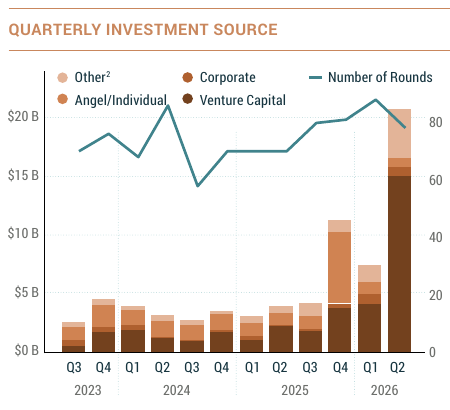
Investment in space since 2023, from the Space Capital report in July 2026.
More than any other moment since the launch of Sputnik in 1957, the future of the human race’s effort to explore and settle the solar system is right now shining bright and hopeful, with everything converging enthusiastically in a manner that — if nothing is done to forcibly stop it — will make that colonization inevitable.
To understand that convergence, it necessary to understand how radically different this situation is. Unlike every space effort since Sputnik, space exploration is no longer controlled by governments. No longer do innovators and space geeks need to go to lawmakers, their hands out begging for money. Space exploration is now in the hands of private capital, which is quite generously committing a lot of money to fund a lot of space projects — not because these investors want to explore the stars — but because they see a lot of profits to be made.
This fact — that governments no longer control the situation — is what is driving this renaissance. It is also the one fact that might kill it, but I am getting ahead of myself. I must first describe this renaissance, in all its glory.
Rockets
The mass sent to orbit in 2023. Click for original image. The numbers for 2024, 2025, and 2026 have been comparable.
Above all, we must begin with rockets, because without them nothing in space can happen.
First on the list is of course SpaceX’s Falcon family of rockets, which revolutionized the rocket industry by being the first ever capable of reuse. That capability forced a major lowering in launch costs while making frequent and reliable launches of new payloads possible. For the past three years this rocket has dominated the global launch industry, launching more than the world combined and placing in orbit something like 90% of the total mass. Its development was funded from Elon Musk’s own pocket as well as from NASA.
The company is now building its much larger Starship/Superheavy rocket, intended to be the most powerful rocket ever built but also designed to be reusable with the ability to launch again and again, within hours. Unlike Falcon, its development has almost entirely been funded by private and public investment capital as well as the ample revenue SpaceX is getting from Starlink and its computer divisions. In fact, at this moment the contribution from NASA is relatively minor, only a very small percentage of the total cost.
SpaceX’s reliance on private capital however is not unique. Jeff Bezos’s Blue Origin has built its New Glenn rocket entirely from private capital (most coming from Bezos’s own pocket). Peter Beck’s Rocket Lab has developed both its Electron rocket (flying now for almost a decade) and its Neutron rocket (about to make its first flight) also from private capital. New Glenn and Neutron are both reusable, and will thus help accelerate the drop in launch costs.
Nor are these the only new rockets funded mostly on private investment. There are at this moment at least seventeen different privately funded rockets that are either operational or about to complete their first flights, aimed at garnering whatever commercial and government business they can get. For a more complete outline of this coming wave of rockets, see this September 10, 2026 essay.
But why is so much capital going into developing these rockets? What are they launching? Who are their customers?
Satellite constellations of all kinds
Visualization of just SpaceX’s 2nd generation Starlink constellation. Click for source.
When it comes to the future in space,, the hot topic recently has been coming launch of several gigantic constellations of data center satellites to serve the computer world of AI and smartphones. SpaceX plans a constellation, dubbed Starmind, of one million satellites. Blue Origin has its own, called TeraWave, comprising more than five thousand satellites. The startup Starcloud wants to build its own 88,000 data center satellite constellation. And Google is developing its own, dubbed Suncatcher, though the numbers and schedule remain unstated at this point.
That’s only a few examples of proposed data center constellations. All have investment capital, and all are on the verge of their first launches. The rocket industry will be hard pressed to meet this demand.
But data center constellations are only the newest entrant in the satellite business. Voice communications remains the first big player, with the industry shifting from geosynchronous satellites providing linkage between ground stations to large smallsat constellations in low orbit providing direct phone-to-cell connectivity. Both SpaceX and AST SpaceMobile already have satellites in orbit providing this service, with SpaceX planning a bigger constellation of 15,000 satellites in the future.
Starlink meanwhile established the viability of satellites for internet access, with Amazon’s Leo and several Chinese constellations now coming on line to compete.
Nor is this all. Commercial imaging satellite constellations, in both radar and optical, have become ubiquitous in recent years, replacing the expensive less capable government constellations. GPS-type constellations, launched by the U.S. the European Union, India, and China, are still needed and are being expanded, with private satellite companies beginning to offer their systems as alternatives. Weather satellite constellations, previously launched only by governments, are now being developed by private companies because they can build them faster and cheaper.
And of course, there are demands for new communications, surveillance, and reconnaissance satellites by the War Department. Most are simply variations of the above constellations, though designed to be more secure for military purposes. Some, such as Trump’s proposed Golden Dome, have unique goals, such as acting as a shield against missile attacks. All however presently have large budgets and are moving at this moment aggressively to get built.
In the next decade this demand should require thousands of launches per year, a demand that should further increase the number of reusable rockets available which in turn will further lower the cost to get into orbit.
Space Stations
In the United States at this moment there are five commercial space stations under development, as shown to the right. All have all got extensive funding. Two, Vast’s Haven-2 and Max Space’s Thunderbird, are at this point funded entirely by their wealthy owners. Two, Starlab and Axiom, have raised about $1.5 billion in private capital, while also obtaining development contacts from NASA worth a little less than $300 million. The last, Orbital Reef, has also won a development contract from NASA, worth $130 million, but has done very little with it.
All five exist because their owners recognize that there is a lot of potential for making money in space, inside a space station. First, the U.S. and its international partners on ISS are not the only governments that want the prestige of flying astronauts in space. Numerous other countries want to do it also, and in fact in the past three years France, Czechia, Lithuania, Colombia, Uzbekistan, Japan, India, Poland, Hungary, and the Maldives have all signed passenger contracts with Axiom, Vast, and Starlab, with Axiom having already completed four such flights for profit to ISS.
Second, NASA is committed to buying space and passenger service for its own astronauts to one or more of these stations. It issued its request for space station proposals last week, with major contract awards to be issued in April 2027. The agency’s goal is to sustain its own manned program in low Earth orbit by encouraging competition between privately owned and operated space stations.
Third, the pure research done on ISS has demonstrated that valuable products can be produced in weightlessness that cannot be made on Earth, and many companies in a variety of fields, from pharmaceuticals to medical implants to material sciences, want access to an orbital facility to make these products for later sale. The new stations are not only eager to sign them up, Vast, Starlab, and Axiom have already begun to do so (see here, here, and here).
Serving the space stations
All these stations are going to need a range of ferrying services. For manned transportation only SpaceX at present provides this service with its fleet of five manned Dragon capsules. For cargo, both SpaceX’s unmanned Dragons and Northrop Grumman’s unmanned Cygnus capsules are available. The problem for manned transportation is that SpaceX is considering retiring both Dragon and the Falcon 9 rocket that launches it. While I personally doubt this will happen until other alternatives exist, its possibility remains a threat to the operation of these private stations.
Many of those alternatives are either on the verge of becoming operational or will do so in the near future. All have issues, but all are real. Boeing’s Starliner has flown with problems several times. If it can prove out its systems finally and become reliable, it becomes an immediate alternative.
The French startup The Exploration Company is building its Nyx cargo capsule. It has raised $680 million in private capital and has won a contract worth almost a billion dollars from the European Space Agency (ESA) to fly three Nyx missions. The company fully intends to eventually upgrade Nyx to a manned version, in the same manner as SpaceX did with Dragon, but that development is likely several years away.
Northrop Grumman has several times proposed upgrading its Cygnus capsule as a manned alternative. Little development on this option however has occurred because — as an old established space company — Northrop refuses to commit any of its own funds to such work. It wants a contract first. This however could change once one or more space stations begin operations.
Sierra Space’s Dream Chaser reusable cargo mini-shuttle is also an option. It was originally conceived as a manned ferry, but NASA wasn’t confident in its design to go with that concept. In retrospect this decision was a wise one, as an undisclosed technical issue has delayed the first launch of the first Dream Chaser, Tenacity, for more than two years. This undisclosed issue finally had NASA cancel its ISS cargo deal with Sierra Space. Nonetheless, this design concept is a viable one, and if Sierra can fix things it remains a future option for supplying the commercial stations.
And then there are the unknown manned and cargo spacecraft that don’t yet exist. Based on the investment capital going into the private stations, their need for ferrying service is going to become critical in the next decade. It therefore seems certain to me that one or more companies are going to step forward with new ideas, and make it happen. In fact, one of those companies might very well be found in the next area of space development.
Recoverable capsules
Varda’s first capsule on the ground in Utah in 2024, after completing an eight-month mission producing the drug ritonavir, which is used to treat HIV/AIDS.
While the space stations aim to provide large and extended capacity for product manufacture in orbit, the new recoverable capsule industry offers this same capability now, on a smaller scale and for much lower cost. The company Varda was the first, having already flown and recovered six capsules, with SpaceX following with its own test flight of its Starfall capsule.
A half dozen more startups in the U.S. and Europe have now raised capital to compete. In the U.S. Varda and SpaceX have been joined by Reditus, Inversion Space, and Sierra Space, all of whom have raised money or won contracts for putting short-term small recoverable capsules in orbit. In Europe, The Exploration Company in France, Atmos in Germany, PLD in Spain, Genesis in Croatia, and Space Cargo in Luxembourg have also raised capital for the same.
All of capsules these companies are building are relatively small, too small for humans to fly on. All however are developing the precise technology required for ferrying cargo and humans up and down from the commercial stations. We should fully expect that as the profits from their products begin to roll in, one or more of these capsule companies will commit the funds for developing larger capsule designs capable of carrying humans.
Miscellaneous other orbital industries
These miscellaneous industries include a half dozen orbital tug companies, a handful of robotic servicing companies, and a number of companies developing technologies of removing space junk. There are also proposals to provide refueling depots and fueling tankers for refueling satellites periodically.
All have raised capital, and all are either in development, have demonstrated their technology in orbit, or have actually started flying operational missions.
NASA’s Artemis program
While most would think I should list this government program first, because it is the most public part of America’s space
NASA’s Artemis program
While most would think I should list this government program first, because it is the most public part of America’s space effort, I place it last because in truth it is the least likely to succeed, and it acts mostly as an emotional linchpin for fueling all the other investment, innovation, and other industries now being developed above.
However, the way NASA is presently structuring its program is especially beneficial. The agency is no longer attempting to build anything. Instead it is asking the private sector — many of which are the many companies I list above — to do it. It is also not demanding ownership, as it has in the past. Instead, it is buying what it needs from these companies, and letting them develop the product in a manner that will allow them to sell it to others for further profits. As I wrote in the 2017 policy paper, Capitalism in Space,
Ownership … allows the companies to sell their products widely and make profits from it, regardless of whether NASA buys it.
In other words, NASA’s Moon program is now designed more than anything to fuel the growth of this private space sector. This is something it has failed to do very effectively since Apollo.
The threat that can kill it all
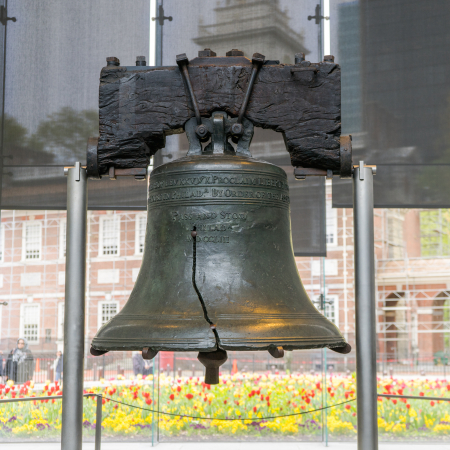
“Proclaim liberty throughout all the land unto all the inhabitants thereof.” Photo credit: William Zhang
Though it is certain that some of these projects and companies will fail, the number and wide variety of their customers and products provides depth and redundancy. Profits are going to be made by building things in space, in one case or another, thus guaranteeing a continuous and never-ending driving force upward. If some fail, others will not. The demand is now simply too high and varied.
Left to its own purposes, freedom and capitalism is now poised to conquer the stars.
What threatens all this new space development however is also its very fundamental nature: it is privately owned, independent, fueled by profit, and not controlled by the government. Governments — and the power-hungry people who are naturally attracted to these political positions — don’t like it when they don’t control things. In fact, the reason this renaissance in space has only occurred now is because, since the 1960s, the governments in both the U.S. and Europe have worked hard to keep control over the space industry. Only in the late 2000s did this finally begin to change, but it has taken almost two decades to wrest power from the government and give it back to the private sector.
All of that could change in a moment, if the wrong people gain power. All of the grand private projects listed above hinge entirely on the choices we make in a few short weeks on election day. For you see, elections always matter, and in this election we are really being presented a choice between this bright future of private enterprise in space and a dark future comparable to that of the failed Soviet Union.
Sadly, the concepts of communism and top-down rule by government have become strongly entrenched within the American Democratic Party. Too many politicians in that party now advocate socialism as their guiding principle of governance. They wax poetic about the socialist utopia they wish to create, where everything is controlled from above by wise government officials who only have our real needs in mind. At the same time, these same Democrats, like Bernie Sanders and Abdul El-Sayed (the Democrat candidate running for the Senate in Michigan), like to use the word “billionaires” as a curse word, advocating the use of government to squelch such people, on the misguided or downright evil idea that because someone has become rich building a business they have somehow robbed others of wealth.
The Democrats to private enterprise: “Great business you got there! Really be a shame if something happened to it!”
To achieve these goals however they must shut down freedom and private enterprise, because you can’t run things from on top if you allow free competition and innovation to exist outside your central control.
Nor is this just my opinion, it is based on recent history. During the Biden administration this is exactly what the Democrats did to Elon Musk and SpaceX after he announced his support for Republicans in 2022, slow-walking and even blocking the launch licenses SpaceX needed to test Starship/Superheavy, while conducting an aggressive lawfare campaign of investigations against him and his companies by numerous government agencies.
We should therefore have no doubt what the Democrats will do if they regain control of Congress, and eventually the presidency. They have made it clear they resent the success of others outside their control, and they have every intention of clamping down on that freedom, hard.
And while one might not like Donald Trump or the Republican Party, he and that party at this moment are the only political party that is working to encourage private enterprise, freedom, and using the government as a servant of the people. In fact, this renaissance in space is occurring right now precisely because of the policies the Trump administration has initiated since his second term began. As is stated expressly in a Trump executive order issued in December 2025, the goal is to grow ” a vibrant commercial space economy through the power of American free enterprise.” This was reinforced by Trump’s revised national space policy announced in August 2026, and confirmed by repeated orders to reduce red tape impacting both the launch and satellite industries.
This is the choice we face on election day, between the Democrats who want to squelch private enterprise and the Republicans who want to encourage it. I might sound partisan in saying this, but I am only summarizing the positions and actions of the two political parties. Nor will this choice impact only space exploration and this new space sector. It will impact American life across all sectors. Think once again of the Soviet Union and Venezuela, both of which chose the communist model and both of which went bankrupt.
As surely as the sun has risen this morning, and as surely as it will set this evening, the human race is going to the stars. Though we might do it for the adventure or profit or the search for knowledge, we will eventually settle down on those barren hills that Frank Borman called “not a very inviting place to live and work.” And when we do, we had better consider the social order that we establish. The Cold War might be over, but it was only a small episode in the never-ending struggle between freedom and tyranny, a battle that began when the first bully found he could use a club to make others do what he wanted.
We now face another episode in that never-ending struggle. I pray Americans will choose wisely.
The social justice warriors came for Columbus. The real target is America.
By: Dr.s Jill Glasspool Malone and Robert W. Malone
“In fourteen hundred ninety-two, Columbus sailed the ocean blue.”
In the 1960s, when I was a child in elementary school, California was enjoying its golden years. Agriculture was thriving, vast cattle ranches still dotted the arid landscape, and the aerospace industry was reaching extraordinary heights. Hollywood was the undisputed capital of American moviemaking, and the state’s population and economy were growing by leaps and bounds. Brand new, uncrowded freeways made it easy to get around. California represented the best and brightest of America, a place of opportunity, innovation, ambition, and seemingly limitless possibilities. People from around the world looked to California as a symbol of what America could accomplish. There was a palpable sense of optimism about the future, a belief that hard work, ingenuity, and determination could make almost anything possible.
I grew up in Goleta, on California’s Central Coast, where Spanish heritage was woven into the landscape, the architecture, the place names, and the history we learned in school. We studied the Spanish missions, the California vaqueros, the great ranchos, and the Chumash Indians who had inhabited the region long before Europeans arrived. We learned about the hardships and injustices experienced by the Chumash, but we also learned about the explorers, missionaries, ranchers, and settlers who shaped California. I remember reading Richard Henry Dana Jr.’s Two Years Before the Mast, with its vivid descriptions of life aboard a sailing ship and the California coast in the 1830s. These stories brought our local history to life. They gave us an appreciation for the people who came before us, the hardships they endured, and the extraordinary changes that had transformed California into the place we called home.
And, of course, we learned American history. We learned about Christopher Columbus and his three small ships, the Niña, the Pinta, and the Santa María, sailing across the vast Atlantic in 1492. We learned about Spain’s role in the voyages of discovery, the European settlement of the Americas, the thirteen colonies, the American Revolution, and the founding of the United States. These stories were taught with a sense of wonder and pride. We were encouraged to admire the courage of explorers, the determination of pioneers, and the extraordinary accomplishments of the men and women who helped build this nation. We learned that America was a land of opportunity, a country founded on the ideals of liberty and self-government, and a place where ordinary people could aspire to extraordinary things.
That education gave us something important. It gave us a connection to our history, a sense of belonging, and pride in the country we had inherited. It taught us that America was worth appreciating, worth defending, and worth improving. It gave us patriotism, not as a political slogan or an obligation imposed from above, but as something that grew naturally from learning about the people, events, sacrifices, and achievements that had made our country possible.
The Columbus I learned about in elementary school was a navigator who crossed an immense ocean in three small wooden ships, undertaking a voyage whose outcome was anything but certain. We memorized the familiar rhyme, learned the names of the ships, and imagined what it must have been like to sail westward into waters that few Europeans had ever crossed. We were also taught about the people who already inhabited the Americas, the Spanish missions, and the hardships and injustices of colonization. We were instructed to read “Ishi in two worlds,” the heartrending story of one of the last remaining Native Californians to grow up outside the surrounding Anglo-Spanish-American culture. Learning about those darker chapters did not prevent us from appreciating the extraordinary accomplishments that had shaped the world we inherited.
Today, the educational emphasis is quite different. The Pulitzer Center distributes classroom materials that explicitly seek to reframe American history around 1619 and the institution of slavery.
Launched by The New York Times in 2019, the 1619 Project seeks to reframe American history around the arrival of enslaved Africans in colonial Virginia rather than the founding of the United States in 1776. Its central premise is that slavery and its legacy are fundamental to understanding virtually every aspect of American society. What began as a magazine publication has grown into a substantial educational enterprise, supported by the Pulitzer Center, with more than 100 curricular resources, a national network of more than 400 educators across 30 states, professional-development conferences, and classroom materials extending from elementary school through law school. Its original educational guides reportedly received more than one million accesses during their first five years.
The American Federation of Teachers (AFT), led by Randi Weingarten, has actively promoted the project through its Share My Lesson platform and partnered with the Pulitzer Center to distribute teaching resources. This is no longer simply a controversial interpretation of American history. It is an organized effort to influence how American history is taught, supported by educational institutions, philanthropic funding, and a major national teachers’ union. The concern is not that children are learning about slavery, which is an essential part of American history, but that a contested interpretation placing racial oppression at the center of America’s origins is being promoted as a foundational framework for understanding the country and its institutions.
The Pulitzer Center identifies Meta, Open Society Foundations, Rockefeller Brothers Fund, and several other philanthropic organizations among supporters of its 1619 education initiative
California’s own Ethnic Studies Model Curriculum directs attention toward colonialism, systemic oppression, and social transformation. Educational organizations publish elementary-school lessons encouraging children to reconsider the celebration of Columbus. These are not imaginary controversies invented by political commentators. The materials are publicly available, and their authors openly describe the changes in historical interpretation they seek to promote.
There is an important difference between teaching children that Columbus and America’s founders were imperfect men, sometimes responsible for grave injustices, and teaching American history through an interpretive framework in which exploitation and oppression occupy the center of the national story. The first expands historical understanding. The second raises legitimate questions about how the nation’s achievements, founding ideals, and historical failures are weighed against one another. What children learn to admire, what they learn to condemn, and what they learn to regard as their national inheritance will influence how they understand the country in which they live.
And what are the results of this re-educational programming?
The generational divide is unmistakable. Gallup found that only 41 percent of Generation Z adults are extremely or very proud to be American, compared with 75 percent of Baby Boomers. YouGov polling also shows that younger Americans are far more likely to view Christopher Columbus unfavorably than their grandparents. These surveys reveal a profound shift in how younger generations regard their country and its historical figures. When schools change the way American history is taught, it is reasonable to ask whether they are also changing how children understand what it means to be American.
Children begin forming attitudes about race, identity, and belonging long before they are capable of critically evaluating complicated historical arguments. Developmental research shows that racial attitudes emerge in early childhood and are shaped by the messages children receive from adults, peers, and institutions. This places an enormous responsibility on schools. Teaching any child to judge classmates through inherited categories of racial guilt or victimhood will reinforce the very prejudices education should help overcome.
When Racial Justice Became an Industry
The death of George Floyd in May 2020 ignited a wave of anger that swept across the United States. The demonstrations, riots, destruction of property, and demands for institutional change did not emerge in an organizational vacuum. Long before Floyd’s death, major philanthropic foundations had been financing an extensive network of racial-justice organizations, activist training programs, and political advocacy groups. The Ford Foundation helped establish the Black-Led Movement Fund in 2016, while George Soros’s Open Society Foundations contributed to the network through the Borealis Philanthropy.
The money supported grassroots organizing, direct-action training, leadership development, and campaigns to transform public institutions. Following Floyd’s death, the funding expanded dramatically. In July 2020, Open Society announced $220 million in commitments to Black-led organizations and racial-justice initiatives. What began as public outrage over a death in police custody rapidly became a nationwide political and institutional movement backed by substantial financial resources.
The nationwide protests and riots following George Floyd’s death in 2020 came at an enormous human and economic cost. According to the Armed Conflict Location and Event Data Project (ACLED), at least 25 people were killed in demonstrations and incidents connected to the broader political unrest. The Major Cities Chiefs Association documented more than 2,000 police officers injured between May and July, while the total number of civilian injuries remains unknown.
Rioting, arson, vandalism, and looting spread across more than 140 American cities. According to the Insurance Information Institute, the destruction resulted in more than $2 billion in insured losses, making the unrest the costliest civil disorder event in American insurance history. The violence accompanying the movement left communities devastated, businesses destroyed, and a financial burden extending well beyond the insured losses.
The infrastructure for mobilizing protests, amplifying political messages, and pressing institutions for change had been built over years. Organized advocacy and spontaneous public anger reinforced one another. The result was a period in which race became an organizing principle for political debate, corporate policy, university administration, and educational “reform.”
The timing coincided with a troubling change in racial attitudes. In the American National Election Studies data, the average favorability rating that Black Americans ages 18–29 gave white Americans fell from approximately 64 in 2016 to 47 in 2020, before partially recovering to 56 in 2024. The pattern documents that the extraordinary emphasis and money spent on amplifying racial division during 2020 had the desired effect: it reinforced racial tension.
The relationship between the protest movement and education is especially relevant. The 1619 Project had launched in 2019, before Floyd’s death, and was already promoting an interpretation of American history centered on slavery being the foremost catalyst for the founding of America, with continuing consequences that last until now.
There is an intellectual connection worth examining as well. Marxist and neo-Marxist traditions have long emphasized the relationship between social institutions, power, economic inequality, and political change.
The educational philosophy known as critical pedagogy was heavily influenced by Paulo Freire, a Brazilian socialist educator whose work drew extensively on Marxist theories of oppression and class struggle. Freire believed schools should do more than teach facts and practical skills. Education should encourage students to question established institutions, identify perceived systems of oppression, and become agents of social and political change. His ideas have become influential in American universities and schools of education and helped shape approaches to teaching that emphasize social justice and political consciousness. Basically, these ideas have woven Marxist theories into educational curricula
The events of 2020 therefore deserve examination not only as a protest movement but as a turning point in institutional approaches to race and Marxist theory. The documented funding networks, rapid expansion of racial-justice programs, and contemporaneous deterioration in some measures of interracial attitudes are related. The resulting institutional changes have deepened the divisions they sought to address.
From Columbus to the Classroom The controversy over Christopher Columbus is no longer simply about a fifteenth-century explorer. It is part of a much larger struggle over how American history is interpreted and transmitted to the next generation. Consider how differently children can encounter the same historical figure. One lesson introduces Columbus through navigation, maritime exploration, the dangers of the Atlantic crossing, and the extraordinary consequences of 1492.
Another begins by asking students to reconsider whether Columbus deserves to be celebrated or even remembered, emphasizing conquest, enslavement, and the experiences of Indigenous peoples. Both subjects belong in a serious history curriculum, but the choice of emphasis matters, particularly for young children who are still developing their understanding of history, identity, and national belonging.
The movement to reshape historical education is neither imaginary nor confined to individual classrooms. The Pulitzer Center’s 1619 Project Education Network has offered grants to educators developing curricula centered on slavery, racial inequality, and their contemporary consequences. Its supporters have included George Soros’s Open Society Foundations, alongside Meta and other major philanthropic organizations. The initiative has also reached university schools of education, where future teachers are trained. Its published grant objectives go beyond historical instruction to include preparing students to participate in social change.
The more immediate concern is whether students are learning to understand the constitutional republic, including its remarkable achievements, or being encouraged to view its institutions primarily through the lens of historical oppression.
The American founders understood the dangers of concentrated political power and unchecked majority rule. They established a representative republic with divided powers, constitutional limitations, and protections for individual liberty. These institutions were imperfectly applied from the beginning, but they also provided mechanisms through which later generations fought to abolish slavery, expand citizenship, and secure civil rights. Students deserve to understand that history alongside the injustices that made those struggles necessary. The enduring question is whether contemporary historical education gives them the knowledge to evaluate and preserve their constitutional inheritance, or teaches them to regard that inheritance chiefly as a problem to be overcome.
From Education to Ideological Transformation The influence of critical theory and Marxist-inspired approaches to education extends well beyond elementary and secondary schools. American universities now offer degrees, certificates, and professional training in diversity, equity, and inclusion (DEI), social justice, and environmental, social, and governance (ESG) principles.
At Penn State, a Social Justice certificate examines how unequal power relationships shape society. Northwestern University teaches students to analyze intersectionality and develop approaches to social change. More explicitly, the University of Massachusetts Amherst offers graduate courses titled Liberatory Pedagogies for Social Transformation and Confronting Oppression in Education. These are not fringe pamphlets circulating among student radicals. They are formal academic programs, including programs designed to train future educators.
Author James Lindsay, in The Marxification of Education (2022), traces these developments to the influence of Marxist and neo-Marxist thinkers, particularly the above-mentioned Brazilian Marxist and educator Paulo Freire. Lindsay argues that critical pedagogy transforms education from the transmission of knowledge into a means of developing political consciousness and promoting institutional change. These types of university programs explicitly describe social transformation as an educational objective.
And that brings us back to Christopher Columbus. What our universities teach future educators, and what those educators pass on to our children, will determine how the next generation understands America’s history and its founding institutions. Children deserve to learn about the courage, determination, and extraordinary navigational achievement of a man who crossed the Atlantic in three small wooden ships more than five centuries ago, changing the course of human history. They deserve an education that inspires curiosity, ambition, and an appreciation for the achievements of those who came before them, not one that reduces every historical figure to a catalog of moral failures.
The Campaign to Remove Columbus from Public Life The attack on Columbus has not been confined to textbooks, academic conferences, or political rhetoric. It has been carried into America’s public squares. A 2021 Washington Post and MIT analysis documented at least 40 Columbus monuments removed since 2018, with most removals occurring during the racial unrest of 2020 and 2021. Statues were toppled, vandalized, removed by municipal governments, or placed in storage. In Baltimore, demonstrators pulled down a Columbus statue and threw it into the harbor. Elsewhere, cities removed monuments that had stood for generations, sometimes over the objections of Italian-American communities that regarded Columbus as a symbol of their own immigrant heritage. The campaign represents something larger than a disagreement over one historical figure. It raises the question of whether Americans should confront the complexities of their history through education and debate, or whether political activists and public officials should decide which parts of that history are permitted to remain visible
Trump Draws a Line on Columbus Day President Donald Trump has made the defense of Christopher Columbus and Columbus Day a direct challenge to the political left. In his October 11 Truth Social message, Trump condemned Democrats, socialists, and communists for tearing down Columbus statues, declaring that the “days of plunder are over.” His October 7 presidential proclamation went further, celebrating Columbus for his courage and contributions to the historical developments that eventually produced the United States.
Trump also highlighted the installation of a replica Columbus statue on the White House grounds, replacing a monument that rioters had destroyed in Baltimore on July 4, 2020. The symbolism is unmistakable. At a time when universities, activist organizations, and progressive politicians increasingly portray America’s historical inheritance as something to apologize for, the president is insisting that the nation’s history, heroes, and cultural foundations deserve to be honored rather than erased.
Columbus Day is an opportunity to celebrate the spirit of exploration and discovery, our nation’s historical inheritance, and the remarkable constitutional republic that eventually emerged in the New World. Christopher Columbus deserves to be remembered and celebrated.
WASHINGTON, D.C. — As public debate continued over the scheduled live-streaming of terrorist Nidal Hasan’s death by firing squad, President Donald Trump told liberals who are uncomfortable with public executions to just imagine that it’s a healthcare CEO.
Trump’s suggestion came on the heels of public outcry that live-streaming Hasan’s execution is barbaric. The trick, Trump said, is for the liberals to view the man who went on a murderous rampage at Fort Hood and killed 14 people with the same level of disdain as an executive of a healthcare corporation.
“If they picture him that way, they’ll cheer for it,” Trump told reporters in the Oval Office. “It’s very easy. They say, ‘Oh, we can’t be happy that a man is being shot to death.’ But if you tell them to think of him the same way they think of healthcare CEOs, they’ll be celebrating it, believe me. They hate the healthcare people, don’t they? So nasty toward them. They’re happy when they get shot, if you can believe it. But they’re very angry about a terrorist being executed. Very sad about it. Very backwards, the liberals.”
When asked if they could get on board with Hasan’s public execution if they imagine him being a healthcare CEO, one liberal voiced strong support. “Oh yeah, definitely,” said Dean Huff. “We’re absolutely, one hundred percent against the death penalty in all its forms. Unless it’s a healthcare CEO. If we can picture the person being executed as one of those, we’re cool with it. We might even host watch parties.”
At publishing time, liberals also admitted that they would be in favor of Hasan’s execution if they could picture him as an unborn baby.
Parents of teenagers sometimes tell me that they don’t feel appreciated by their kids. “Look at all I’ve done for them,” they say. “Why can’t they show gratitude?” As reasonable as this may seem, it contains a huge error. Gratitude is an emotion one feels when somebody does something you wanted them to do. For example, I needed the door held for me, and you held the door. I feel gratitude. I asked you to be truthful and you were truthful. I feel gratitude. You got me a discount on a new car. I feel gratitude. All of these are things I wanted, and you delivered.
As shocking as it may seem, the same does not apply to a child. Yes, you brought them into existence, you endured their infancy, fed them, clothed them, and worked hard to ensure their education. Though these are big things, you child asked for none of them. Put bluntly, your child did not ask to be born.
Nobody likes to help anybody who feels righteously entitled. Yet, your child is entitled to your care. And entitlement in this context is indeed valid. The parent chooses to give him life, and with that comes the responsibility of helping him into adulthood.
Some parents go to the opposite extreme. Instead of resenting their child for feeling entitled, they actually assume she’s entitled to everything – forever. You’d be surprised at how often I see parents of twenty- or thirty-somethings pouring money and resources into that adult. They rationalize: “It’s my child. And I love him or her.” But does that love make you their slave in perpetuity? Sometimes I’ll ask such parents if their son or daughter deserves that help. The question rarely occurs to them, and sometimes they even resent it.
Some help is deserved and some isn’t. And this doesn’t change just because you gave life to that person and cared for him when he was helpless. Many parents of grown children resent the help they feel they’re expected to give when they find these grown children mooching off of them. And in spite of that, they feel guilty! “How can I resent my own child?” Well, the “child” is no longer helpless. You can’t throw a two-year-old or a fifteen-year-old out on her own, but that doesn’t mean you can never throw a grownup out. Resentful parents can’t have it both ways. They can’t righteously announce, “I’ll never throw my (adult) child out, no matter how much he mooches or brings his problems upon himself,” and then feel resentful about it. Your grown child is just responding to the message you’re clearly sending: He or she is free to live off of you forever.
A parent has to be prepared to let a grown-up child go – even if it means throwing him out. Set a deadline, and stick to it. Anything less conveys the very unloving message that, “You can’t survive alone. I don’t have confidence in you, and I know you have to rely on me.”
Though childhood is a temporary state of helplessness, by adolescence a healthy young adult is capable of abstract thinking and a significant measure of responsibility and freedom. An adult child is no more helpless than you are. As fellow adults, you may be able and willing to help each other out; but short of an obvious accident or illness, nobody is helpless.
The challenge for parents is to keep things in perspective. When your kids are young, don’t resent them for the fact that while they might enjoy being alive, they didn’t ask to be born. They cannot help that they require your help to survive. But grown children are not helpless. They’re adults, and the responsibilities you once had don’t convey into their adulthood.
The posts follow a recognizable formula: “I’m not Jewish. I’m [nationality, religion or identity]. And I am a Zionist.”
The Jerusalem Post analyzed public X posts to identify where the trend began and who was amplifying it. The analysis uncovered 613 posts published between October 4 and October 11, with activity accelerating sharply on October 9.
The dataset contained three matching posts on October 4, followed by 13 on October 5, 10 on October 6, 22 on October 7, and 26 on October 8.
The number jumped to 131 on October 9, roughly five times the previous day’s total. Another 270 matching posts were published on October 10, followed by 138 on October 11 as of the time the data was collected.
In total, 539 of the 613 posts analyzed, or approximately 88%, were published from October 9 onward.
From scattered declarations to a viral formula
Declarations of support for Zionism by non-Jewish users predate the current trend. However, the earliest posts identified by the Post did not consistently follow the standardized format that has since become widespread.
Among the posts found on October 4 were broader declarations such as, “I’m not Jewish, but I am a Zionist.”
By October 5, users had begun incorporating their national identities. One early example read, “I’m not Jewish. I am Irish, and I am a Zionist.”
An October 6 post similarly stated, “I’m English, I’m not Jewish, but I am a Zionist.”
By October 7, the three-part structure appeared more frequently, with variations identifying the poster as American, Canadian or Iranian before declaring support for Zionism.
One example posted by Dutch writer Bart Schut on October 11 read, “I’m not Jewish. I’m a Dutch atheist. And I am a Zionist.”
The dataset included references to a wide range of national identities, including Iranian, American, Canadian, German, Finnish, Irish, Italian, New Zealander, English, Polish, Australian, British, Dutch, Czech, Japanese, Portuguese and Nigerian, among others.
Some users combined national and religious identities. References to Christians, Catholics, atheists, Muslims, Hindus and agnostics also appeared in the posts analyzed.
Hundreds of accounts join the trend.
The 613 posts collected by the Post came from 549 separate X accounts, indicating that the activity was not primarily driven by a small number of accounts repeatedly posting the same phrase.
Most accounts appeared only once in the dataset.
The available data does not establish that the posts were centrally coordinated or part of an organized campaign. Rather, it demonstrates the rapid replication and adaptation of a common linguistic template across hundreds of accounts.
The timing suggests that the phenomenon changed significantly around October 9, just two days after the third anniversary of the October 7 attacks.
After the Post captured 74 matching posts between October 4 and October 8, another 539 appeared from October 9 onward.
The trend had also begun drawing attention from users on X, with posts explicitly referring to the growing number of “I’m not Jewish, but I’m a Zionist” declarations.
On October 9, for example, user Oren Barsky wrote: “the ‘I’m not Jewish, but I’m a Zionist’ trend is one of the most moving things I’ve seen on this platform.”
By October 11, Barsky said the trend was “basically [his] whole feed.”
How the Post analyzed the trend
The Jerusalem Post collected public X search results using multiple variations of the phrases “I’m not Jewish” and “Zionist,” covering posts published between October 4 and October 11.
Duplicate post URLs were removed, leaving 613 posts from 549 unique accounts.
The dataset is not an exhaustive record of every post participating in the trend. Instead, the figures provide a snapshot of the trend visible through public X search results and demonstrate its growth during the period analyzed.
Amid widespread hostility toward Israel and Zionism, the emergence of a trend centered on expressions of solidarity with Israel and the Jewish people’s right to self-determination marks a notably positive shift in social media discourse.
A social media trend in which non-Jewish users publicly declare themselves non-Jewish Zionists has spread rapidly across X, with a Jerusalem Post analysis identifying more than 600 matching posts from nearly 550 accounts over just over a week.
The posts follow a recognizable formula: “I’m not Jewish. I’m [nationality, religion or identity]. And I am a Zionist.”
The Jerusalem Post analyzed public X posts to identify where the trend began and who was amplifying it. The analysis uncovered 613 posts published between October 4 and October 11, with activity accelerating sharply on October 9.
The dataset contained three matching posts on October 4, followed by 13 on October 5, 10 on October 6, 22 on October 7, and 26 on October 8.
The number jumped to 131 on October 9, roughly five times the previous day’s total. Another 270 matching posts were published on October 10, followed by 138 on October 11 as of the time the data was collected.
In total, 539 of the 613 posts analyzed, or approximately 88%, were published from October 9 onward.
From scattered declarations to a viral formula
Declarations of support for Zionism by non-Jewish users predate the current trend. However, the earliest posts identified by the Post did not consistently follow the standardized format that has since become widespread.
Among the posts found on October 4 were broader declarations such as, “I’m not Jewish, but I am a Zionist.”
By October 5, users had begun incorporating their national identities. One early example read, “I’m not Jewish. I am Irish, and I am a Zionist.”
An October 6 post similarly stated, “I’m English, I’m not Jewish, but I am a Zionist.”
By October 7, the three-part structure appeared more frequently, with variations identifying the poster as American, Canadian or Iranian before declaring support for Zionism.
One example posted by Dutch writer Bart Schut on October 11 read, “I’m not Jewish. I’m a Dutch atheist. And I am a Zionist.”
The dataset included references to a wide range of national identities, including Iranian, American, Canadian, German, Finnish, Irish, Italian, New Zealander, English, Polish, Australian, British, Dutch, Czech, Japanese, Portuguese and Nigerian, among others.
Some users combined national and religious identities. References to Christians, Catholics, atheists, Muslims, Hindus and agnostics also appeared in the posts analyzed.
Hundreds of accounts join the trend
The 613 posts collected by the Post came from 549 separate X accounts, indicating that the activity was not primarily driven by a small number of accounts repeatedly posting the same phrase.
Most accounts appeared only once in the dataset.
The available data does not establish that the posts were centrally coordinated or part of an organized campaign. Rather, it demonstrates the rapid replication and adaptation of a common linguistic template across hundreds of accounts.
The timing suggests that the phenomenon changed significantly around October 9, just two days after the third anniversary of the October 7 attacks.
After the Post captured 74 matching posts between October 4 and October 8, another 539 appeared from October 9 onward.
The trend had also begun drawing attention from users on X, with posts explicitly referring to the growing number of “I’m not Jewish, but I’m a Zionist” declarations.
On October 9, for example, user Oren Barsky wrote: “the ‘I’m not Jewish, but I’m a Zionist’ trend is one of the most moving things I’ve seen on this platform.”
By October 11, Barsky said the trend was “basically [his] whole feed.”
How the Post analyzed the trend
The Jerusalem Post collected public X search results using multiple variations of the phrases “I’m not Jewish” and “Zionist,” covering posts published between October 4 and October 11.
Duplicate post URLs were removed, leaving 613 posts from 549 unique accounts.
The dataset is not an exhaustive record of every post participating in the trend. Instead, the figures provide a snapshot of the trend visible through public X search results and demonstrate its growth during the period analyzed.
Amid widespread hostility toward Israel and Zionism, the emergence of a trend centered on expressions of solidarity with Israel and the Jewish people’s right to self-determination marks a notably positive shift in social media discourse.
I’m bringing Columbus Day back from the ashes,” President Donald Trump declared on Truth Social back in April of 2025. “Christopher is going to make a major comeback,” Trump continued. “I am hereby reinstating Columbus Day under the same rules, dates, and locations, as it has had for all of the many decades before!”
Columbus Day was established as a federal holiday in 1934, but in October 2021, then-President Joe Biden issued the first-ever presidential proclamation for Indigenous Peoples Day to exist alongside it. You may recall that failed presidential candidate Kamala Harris expressed her support for “efforts on the federal level to change the second Monday in October from Columbus Day to ‘Indigenous Peoples Day.’” She consistently recognized Indigenous Peoples Day (but not Columbus Day) in official statements since 2021. In a speech to the National Congress of American Indians that year, she said of the European explorers to the Americas,
Those explorers ushered in a wave of devastation for Tribal nations – perpetrating violence, stealing land and spreading disease. We must not shy away from this shameful past, and we must shed light on it and do everything we can to address the impact of the past on Native communities today.
The Left has worked assiduously for half a century or more to perpetuate this hateful, corrosive narrative that the history of European colonialism throughout the New World is nothing but one long, atrocity-punctuated narrative of genocide, exploitation, theft and oppression, launched by Christopher Columbus.
For a rejuvenating antidote to that narrative, I highly recommend Jeff Fynn-Paul’s 2023 book Not Stolen: The Truth About European Colonialism in the New World, a must-have for anyone who wants to be prepared to defend the truth about our civilization against the ideologically charged distortions and smears that predominate in our culture. It is a deeply researched book by a scholar who explicitly states that his intention in writing it was not to be a cheerleader for Western civilization or to whitewash atrocities that actually happened in the New World, but to simply present the balanced, objective truth about very contentious historical issues. (For a deeper dive into that book, check out my interview with Professor Fynn-Paul at The Right Take podcast here and my review of his book here.)
The book includes a chapter titled “Intrepid Explorer or Genocidal Maniac? The Complex Case of Christopher Columbus.” In it, Fynn-Paul begins by noting what a boogeyman the Left has made of Columbus. According to their narrative,
Columbus embodies the European penchant for killing and enslaving nonwhite peoples wherever they are found. Throw in the notion that he was also the founder of modern capitalism, the first imperialist, the first colonizer, the bringer of patriarchy to the New World, and the instigator of mass environmental destruction, and Columbus becomes a nearly perfect embodiment of everything hated by the Left today.
He goes on to summarize the truth, both good and bad, of Columbus’ character and accomplishments in the New World, to set the record straight and humanize the monster which the Left have constructed:
Columbus was no saint. He was a self-aggrandizing entrepreneur and a bad administrator who allowed anarchy to break out where some other men might have kept order. This ended up causing thousands of deaths to set the stage for more. At the same time, Columbus was an extremely brave, skilled navigator and a visionary who set the stage for modernity by uniting the two halves of planet earth.
Fynn-Paul adds,
Columbus’s accomplishments as a navigator and explorer are irrefutable and justly catapult him into the first rank of historical figures. For hundreds of years after Columbus, the mapmaking and geography he spurred acted as anchors for countless scientific advancements. It is no exaggeration to say that the European voyages of discovery remain foundational to all modern science and technology. Columbus was the first to bring New World peoples back into contact with the major civilizations of the Old World, and he is rightly remembered as a brash, colorful architect of modern globalism.
But Fynn-Paul notes that, just as multiculturalist Leftists demonize Columbus and other European explorers, they idealize the “indigenous peoples” in that condescending soft bigotry that characterizes the Left’s attitude toward the “people of color” they claim for their own. They believe that
if only indigenous institutions and mentalities had triumphed over European ones, rather than the other way around, the world today would be a veritable utopia, where all races and genders live in harmony with nature and one another. Because that, in their idealized view, is what New World society was like before Columbus arrived.
In this simplistic, utopian worldview, which requires the Left to omit the inconvenient truths and complexities that are always part of the human story, “the wellspring of Western civilization is the oppression of Natives… The resulting worldview is so rabidly anti-white, anti-male, and anti-European that it challenges the idea of human progress itself.”
And that is the real reason Christopher Columbus is a lightning rod for Left-wing hatred: he represents the principal pillars of Western civilization they want to deconstruct and destroy: Christianity, capitalism, masculinity, and “whiteness.”
As for the truth of Indigenous Peoples Day, my colleague Daniel Greenfield has written,
[R]emember that the notion of ‘indigenous’ is a Marxist myth used to browbeat civilized peoples into feeling like they have no right to exist because tribes of settlers and colonists who sacrificed children on pyramids and cut the noses off women are considered to be ‘indigenous’ because they did their settling and colonizing a thousand years earlier.
In his Columbus Day proclamation issued on October 7, Trump called the explorer “a legend whose vision, fortitude, and perseverance unleashed a dynamic of history that led to the creation of the greatest, freest, and most just Nation in history.” Trump added, with an unambiguous warning shot at the America-hating Left, “We are forever indebted to his courageous voyage, and we will never allow his legacy to be erased by radical extremists.”
The President concluded,
Today, as we celebrate the anniversary of Christopher Columbus’ arrival in the New World, we honor his unrivaled greatness. We embrace our duty to prove worthy of the inheritance he left us, to match his courage with our own, and to never abandon, forsake, or forget the beauty of our faith, the glories of our culture, and the stories of our heroes.
President Donald Trump suggested on Saturday that the Democratic Party was long overdue for a name change that better reflected what the party truly represented within the current political landscape.
Trump made it clear that the Democratic Party had already done a thorough job of reinventing itself, embracing the socialists and communists that threaten to devour the organization from within and gleefully taking the 20-side of every 80-20 issue — like men playing in women’s sports and legal requirements for voter identification — and he suggested that it was high time for the party to be rebranded as well.
“I think that the Democrats have become the Socialists of America and I think that they ought to get rid of the name Democrat because it’s no longer accurate,” he told reporters. “But you have a combination of socialists and communists, and I think frankly, the word democrat is a — or ‘dumocrat,’ as I call them — but I think it’s a very inaccurate name.”
“Democrat is a — they’re really socialists, they’ve become socialists,” Trump repeated, adding, “And they’re being dragged much further left than socialists.”
Trump’s comments come as a number of self-described Democratic socialists — including some who have aligned themselves with the radical Democratic Socialists of America — sit poised to win seats in the U.S. House of Representatives. And although most of them ran on watered-down platforms calling for the abolition of Immigration and Customs Enforcement (ICE), police, and prisons, the official DSA platform calls for the complete abolition of the United States Senate and the reinterpretation of both the presidency and the Supreme Court.
In addition, the DSA would have the United States dissolve all foreign military installations and defer to the notoriously anti-Israel International Criminal Court to handle accusations of war crimes.
The entire program, as previously reported by The Daily Wire, reads like part Marxist wishlist, part antisemitic fever dream: demanding open borders and mass amnesty; calling for a free Palestinian state with Jerusalem as its capital; and demanding the confiscation of large corporations and “aggressive wealth taxes.”
Some formerly within the party are sounding the alarm — former Sen. Joe Manchin (I-WV), Sen. John Fetterman (D-PA), Democratic strategist James Carville, and comedian Bill Maher — but many appear to be ignoring the “socialist” part in a desperate bid to get more “democrats” on Capitol Hill.